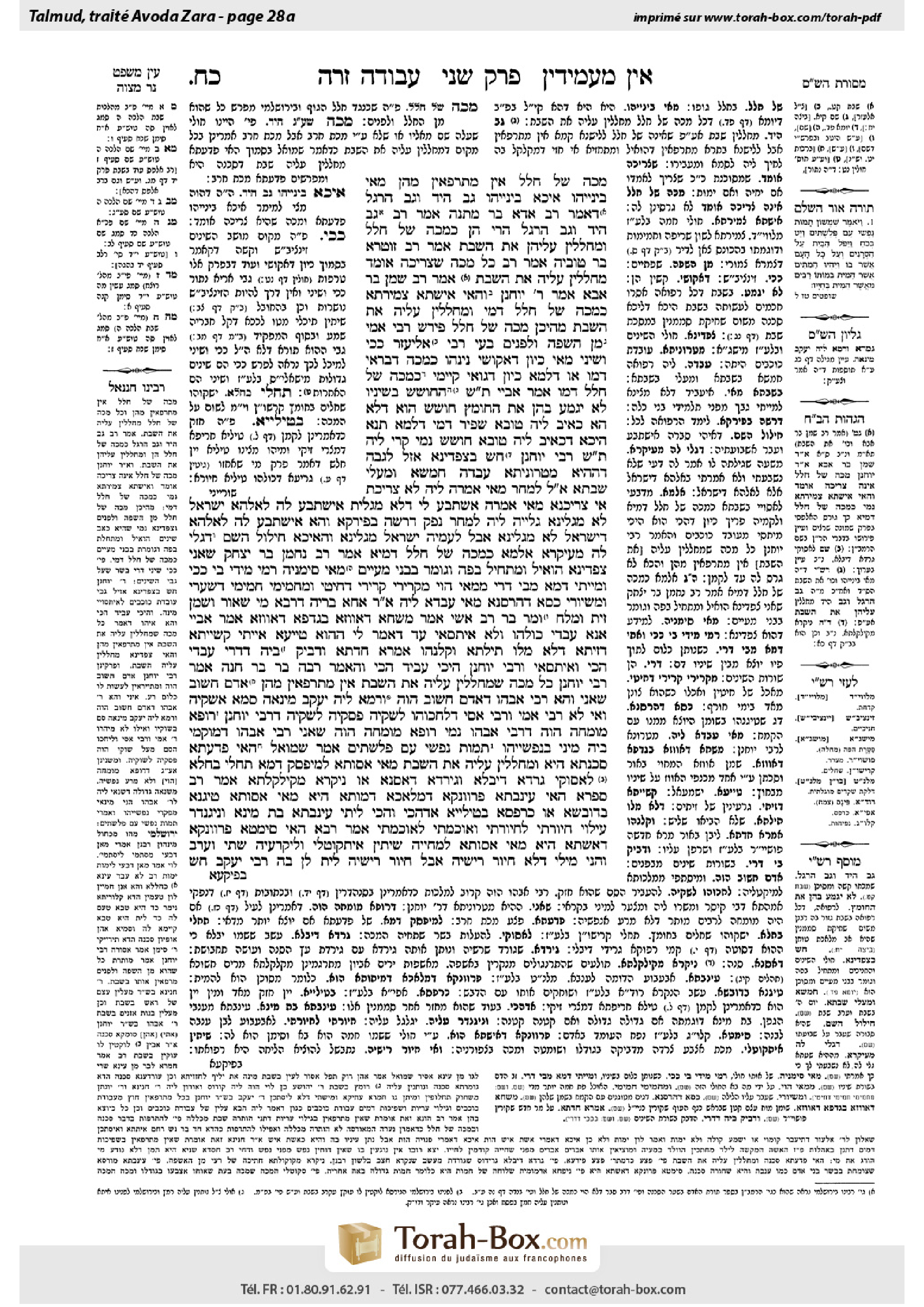
Avodah Zarah 28a: Talmud study for Daf Yomi
Study the Talmud for Daf Yomi with scanned pages, Hebrew text, English translations from Sefaria and AI-generated French translations.
Passage selection and English or AI-generated French translation are available where the scan has annotations. Daf Study is independent of Torah-Box and Sefaria.
Browse Avodah Zarah · עבודה זרה · All tractatesAvodah Zarah 28a text and translations
This page of Avodah Zarah includes the Aramaic text, an English translation and an AI-generated French translation, alongside the scan above.
עבודה זרה כ״ח א · Aramaic and Hebrew text
מַכָּה שֶׁל חָלָל — אֵין מִתְרַפְּאִין מֵהֶן. מַאי בֵּינַיְיהוּ? אִיכָּא בֵּינַיְיהוּ גַּב הַיָּד וְגַב הָרֶגֶל, דְּאָמַר רַב אַדָּא בַּר מַתְנָה אָמַר רַב: גַּב הַיָּד וְגַב הָרֶגֶל הֲרֵי הֵן כְּמַכָּה שֶׁל חָלָל, וּמְחַלְּלִין עֲלֵיהֶן אֶת הַשַּׁבָּת.
אָמַר רַב זוּטְרָא בַּר טוֹבִיָּה אָמַר רַב: כׇּל מַכָּה שֶׁצְּרִיכָה אוֹמֶד, מְחַלְּלִין עָלֶיהָ אֶת הַשַּׁבָּת. אָמַר רַב שֶׁמֶן בַּר אַבָּא אָמַר רַבִּי יוֹחָנָן: וְהַאי אִישָּׁתָא צְמִירְתָּא כְּמַכָּה שֶׁל חָלָל דָּמֵי, וּמְחַלְּלִין עָלֶיהָ אֶת הַשַּׁבָּת.
מֵהֵיכָן מַכָּה שֶׁל חָלָל? פֵּירֵשׁ רַבִּי אַמֵּי: מִן הַשָּׂפָה וְלִפְנִים. בָּעֵי רַבִּי אֱלִיעֶזֶר: כַּכֵּי וְשִׁינֵּי מַאי? כֵּיוָן דַּאֲקוּשֵׁי נִינְהוּ כְּמַכָּה דְּבָרָאֵי דָּמוּ, אוֹ דִלְמָא, כֵּיוָן דְּגַוָּאֵי קָיְימִי, כְּמַכָּה שֶׁל חָלָל דָּמוּ?
אָמַר אַבָּיֵי, תָּא שְׁמַע: הַחוֹשֵׁשׁ בְּשִׁינָּיו לֹא יְגַמֵּעַ בָּהֶן אֶת הַחוֹמֶץ. חוֹשֵׁשׁ הוּא דְּלָא, הָא כָּאֵיב לֵיהּ טוּבָא — שַׁפִּיר דָּמֵי. דִּלְמָא תַּנָּא הֵיכָא דְּכָאֵיב לֵיהּ טוּבָא ״חוֹשֵׁשׁ״ נָמֵי קָרֵי לֵיהּ.
תָּא שְׁמַע: רַבִּי יוֹחָנָן חָשׁ בְּצַפְדִּינָא, אֲזַל לְגַבַּהּ דְּהַהִיא מַטְרוֹנִיתָא, עֲבַדָה חַמְשָׁא וּמַעֲלֵי שַׁבְּתָא. אֲמַר לַהּ: לְמָחָר מַאי? אֲמַרָה לֵיהּ: לָא צְרִיכַתְּ. אִי צְרִיכְנָא מַאי? אֲמַרָה: אִשְׁתְּבַע לִי דְּלָא מְגַלֵּית. אִישְׁתְּבַע לַהּ: ״לֵאלָהָא יִשְׂרָאֵל לָא מְגַלֵּינָא״. גַּלִּיָיהּ לֵיהּ, לִמְחַר נְפַק דַּרְשַׁהּ בְּפִירְקָא.
וְהָא אִישְׁתְּבַע לַהּ! ״לֵאלָהָא דְיִשְׂרָאֵל לָא מְגַלֵּינָא״, אֲבָל לְעַמֵּיהּ יִשְׂרָאֵל מְגַלֵּינָא. וְהָאִיכָּא חִילּוּל הַשֵּׁם! דְּגַלִּי לַהּ מֵעִיקָּרָא.
אַלְמָא כְּמַכָּה שֶׁל חָלָל דָּמְיָא. אָמַר רַב נַחְמָן בַּר יִצְחָק: שָׁאנֵי צַפְדִּינָא, הוֹאִיל וּמַתְחִיל בְּפֶה וְגוֹמֵר בִּבְנֵי מֵעַיִים.
מַאי סִימָנֵיהּ? רָמֵי מִידֵּי בֵּי כַכֵּי, וּמַיְיתֵי דְּמָא מִבֵּי דָרֵי. מִמַּאי הָוֵי? מִקָּרִירֵי קָרִירֵי דְּחִיטֵּי, וּמֵחַמִּימֵי חַמִּימֵי דִּשְׂעָרֵי, וּמִשִּׁיּוּרֵי כָּסָא דְּהַרְסָנָא. מַאי עֲבַדָא לֵיהּ? אָמַר רַבִּי אַחָא בְּרֵיהּ דְּרָבָא: מֵי שְׂאוֹר וְשֶׁמֶן זַיִת וָמֶלַח, וּמָר בַּר רַב אָשֵׁי אָמַר: מִשְׁחָא דַּאֲוָוזָא בְּגַדְפָּא דַאֲוָוזָא.
אָמַר אַבָּיֵי: אֲנָא עֲבַדִי כּוּלְּהוּ וְלָא אִיתַּסַּאי, עַד דַּאֲמַר לִי הַהוּא טַיָּיעָא: אַיְיתִי קַשְׁיָיתָא דְּזֵיתָא דְּלָא מְלוֹ תִּילְתָּא, וּקְלִנְהוּ אַמָּרָא חַדְתָּא, וְדַבֵּיק (בֵּיהּ) [אַבֵּי] דְּדָרֵיךְ. עֲבַדִי הָכִי וְאִיתַּסַּאי.
וְרַבִּי יוֹחָנָן הֵיכִי עָבֵיד הָכִי? וְהָאָמַר רַבָּה בַּר בַּר חָנָה אָמַר רַבִּי יוֹחָנָן: כׇּל מַכָּה שֶׁמְּחַלְּלִין עָלֶיהָ אֶת הַשַּׁבָּת — אֵין מִתְרַפְּאִין מֵהֶן! אָדָם חָשׁוּב שָׁאנֵי.
וְהָא רַבִּי אֲבָהוּ, דְּאָדָם חָשׁוּב הֲוָה, וּרְמָא לֵיהּ יַעֲקֹב מִינָאָה סַמָּא אַשָּׁקֵיהּ, וְאִי לָא רַבִּי אַמֵּי וְרַבִּי אַסִּי דְּלַחֲכוּהּ לְשָׁקֵיהּ, פַּסְקֵיהּ לְשָׁקֵיהּ!
דְּרַבִּי יוֹחָנָן רוֹפֵא מוּמְחֶה הֲוָה, דְּרַבִּי אֲבָהוּ נָמֵי רוֹפֵא מוּמְחֶה הֲוָה, שָׁאנֵי רַבִּי אֲבָהוּ דְּמוֹקְמִי בֵּיהּ מִינֵי בְּנַפְשַׁיְיהוּ ״תָּמֹת נַפְשִׁי עִם פְּלִשְׁתִּים״.
אָמַר שְׁמוּאֵל: הַאי פְּדַעְתָּא סַכַּנְתָּא הִיא, וּמְחַלְּלִין עָלֶיהָ אֶת הַשַּׁבָּת. מַאי אָסוּתַאּ? לְמִיפְסַק דְּמָא — תַּחְלֵי בְּחַלָּא, לְאַסּוֹקֵי — גִּרְדָּא דְּיַבְלָא וְגִירְדָּא דַּאֲסַנָּא, אוֹ נִיקְרָא מִקִּילְקַלְתָּא.
אָמַר רַב סָפְרָא: הַאי עִינְבְּתָא פַּרְוַונְקָא דְּמַלְאֲכָא דְמוֹתָא הִיא. מַאי אָסוּתַאּ? טִיגְנָא בְּדוּבְשָׁא, אוֹ כַּרְפְּסָא בְּטִילְיָיא. אַדְּהָכִי וְהָכִי, לַיְתֵי עִינְבְּתָא בַּת מִינַאּ וְנִיגַּנְדַּר (עילוי) [עִילָּוַיהּ], חִיוָּרְתִּי לְחִיוָּרְתִּי וְאוּכַּמְתִּי לְאוּכַּמְתִּי.
אָמַר רָבָא: הַאי סִימְטָא פַּרְוַונְקָא דְּאִשָּׁתָא הִיא, מַאי אָסוּתֵאּ? לִמְחֲיֵיהּ שִׁיתִּין אִיתְקוּטְלֵי, וְלִיקְרְעֵיהּ שְׁתִי וָעֵרֶב, וְהָנֵי מִילֵּי דְּלָא חִיוָּר רֵישֵׁיהּ, אֲבָל חִיוָּר רֵישֵׁיהּ לֵית לַן בַּהּ.
רַבִּי יַעֲקֹב חָשׁ
Avodah Zarah 28a · English translation
internal injury, one may not be treated by them. The Gemara asks: What is the difference between the two versions of Rabbi Yoḥanan’s statement? There is a difference between them with regard to the case of one who was injured on the back of the hand or the back of the foot. As Rav Adda bar Mattana says that Rav says: Injuries to the back of the hand and the back, i.e., the top, of the foot are like an internal injury, and one may desecrate Shabbat for their treatment.
Rav Zutra bar Toviyya says that Rav says: With regard to any injury that requires a medical evaluation to determine whether or not it is fatal, one may desecrate Shabbat for its treatment. Rav Shemen bar Abba says that Rabbi Yoḥanan says: And a burning fever is similar to an internal injury, and therefore one may desecrate Shabbat for its treatment.
The Gemara inquires: From what point on the body is a wound considered an internal injury? Rabbi Ami explained: From the lips inward. Rabbi Eliezer raises a dilemma: With regard to afflictions located in the gums [kakhei] or teeth, what is the halakha? Do we say that since they are located in firm parts of the body, they are similar to external injuries, or perhaps we say that since they are situated within the mouth, they are similar to internal injuries?
Abaye said: Come and hear a proof from a mishna (Shabbat 111a): One who is concerned about pain in his teeth may not sip vinegar through them on Shabbat for medicinal purposes, as it is generally prohibited by rabbinic law to perform acts of healing on Shabbat. Abaye infers: It is only when he is merely concerned about pain in his teeth that he may not treat them, which indicates that if it hurts him greatly, it is permitted to seek treatment. The Gemara rejects this inference: Perhaps the tanna also characterizes a situation where it hurts one greatly as one of mere concern.
The Gemara suggests a different proof: Come and hear the following incident: Rabbi Yoḥanan suffered from the illness tzafdina, which affects the teeth and gums. He went to a certain gentile matron who was a well-known healer. She prepared a medicine for him on Thursday and Friday. Rabbi Yoḥanan said to her: What shall I do tomorrow, on Shabbat, when I cannot come to collect the medicine from you? She said to him: You will not need it. Rabbi Yoḥanan asked her: If I do need it, what shall I do? She said to him: Take an oath to me that you will not reveal the remedy, and I will tell you, so that you can prepare it yourself should you need it. Rabbi Yoḥanan took an oath to her: To the God of the Jews, I will not reveal it. She revealed the remedy to him. On the following day Rabbi Yoḥanan went out and taught it publicly, revealing the secret of the remedy.
The Gemara challenges: But Rabbi Yoḥanan took an oath to her that he would not reveal her secret. The Gemara explains that his vow meant: I will not reveal it to the God of the Jews, which indicates: But I will reveal it to His people, the Jews. The Gemara challenges: But even so, isn’t there a desecration of God’s name, as the matron now thinks that a great man of Rabbi Yoḥanan’s stature violated his vow? The Gemara answers that he revealed it to her at the outset. As soon as she disclosed the remedy to him, he informed her that his vow would not prevent him from publicizing it.
With regard to the issue at hand, the Gemara infers: Apparently, an affliction that affects the gums is similar to an internal injury, as it was permitted for Rabbi Yoḥanan to prepare the remedy on Shabbat. Rav Naḥman bar Yitzḥak said: Tzafdina is different, since it begins in the mouth, and ends in the intestines, i.e., the disease spreads until it infects one’s intestines, and therefore it is considered an internal affliction even while it is only in the mouth. Consequently, the incident involving Rabbi Yoḥanan affords no proof, and Rabbi Eliezer’s dilemma remains unresolved.
The Gemara inquires: What are the symptoms of tzafdina? If one places an item between his teeth, blood flows from the rows of teeth. From what does it result? It results from the consumption of very cold wheat foods, and from very hot barley foods, and from remains of fried fish [kasa deharsena]. With what remedy did the gentile matron treat Rabbi Yoḥanan? Rabbi Aḥa, son of Rava, said: It was water in which leaven was steeped, olive oil, and salt. And Mar bar Rav Ashi said: She smeared goose fat over his gums with a goose feather.
Abaye said: I prepared all of these medicines and was not cured from this ailment until a certain Arab told me the remedy for it: Take olive seeds that are less than one-third ripe, and burn them in a fire on top of a new hoe, and stick them along the row of gums. I did this and was cured.
§ It was stated above that Rabbi Yoḥanan sought the medical attention of a gentile. The Gemara asks: And how could Rabbi Yoḥanan do so? But doesn’t Rabba bar bar Ḥana say that Rabbi Yoḥanan says: With regard to any injury for which Shabbat is desecrated, one may not be treated by gentiles. Tzafdina is a disease for which Shabbat is desecrated, and yet Rabbi Yoḥanan was treated by a gentile. The Gemara answers: An important person such as Rabbi Yoḥanan is different, as gentiles would not dare to kill him.
The Gemara questions this: But Rabbi Abbahu was an important person, and yet Ya’akov the heretic placed upon his leg a salve that was actually a poison. And if it were not for Rabbi Ami and Rabbi Asi, who licked his leg to remove the poison, his leg would have had to be amputated. Apparently, Ya’akov the heretic attempted to kill Rabbi Abbahu despite the fact that Rabbi Abbahu was an important person.
The Gemara explains: The healer of Rabbi Yoḥanan was an expert physician who would not jeopardize her reputation by harming him. The Gemara rejects this explanation: But the healer of Rabbi Abbahu was also an expert physician. The Gemara answers: The case involving Rabbi Abbahu is different, as heretics establish within themselves the attitude of: “Let me die with the Philistines” (Judges 16:30), i.e., heretics are willing to risk their lives in order to hurt Jews, due to their religious disputes. By contrast, gentiles will not jeopardize their own reputation for this purpose, and therefore it was permitted for Rabbi Yoḥanan to be treated by the matron.
§ The Gemara lists a series of afflictions and their remedies. Shmuel said: This gash caused by a sword is considered a danger to one’s life, and one may desecrate Shabbat for its treatment. The Gemara asks: What is the remedy for this wound? To stop the blood flow one should consume cress soaked in vinegar. To cause flesh to emerge over the gash, one applies a salve made of yavla scrapings and thornbush scrapings, or a salve made from the worms of the trash.
Rav Safra said: These grapelike boils are the forerunners [parvanka] of the Angel of Death, i.e., they often precede one’s death. The Gemara asks: What is the remedy? The remedy is either a tigna plant soaked in honey or parsley soaked in wine. In the meantime, while the plants are soaking, one should bring a grape of the same size and rub it on the boil, a white grape for a white boil, and a black grape for a black boil.
Rava said: This abscess [simta] is the forerunner of fever. The Gemara asks: What is the remedy? One should snap [itkutlei] the boil sixty times with his fingers, i.e., click one’s fingers on the boil, and then he should tear it vertically and horizontally. The Gemara comments: And this statement applies only in a case where the head of the abscess has not whitened, but if its head has whitened, we have no problem with it, i.e., it is in the process of healing, and it does not pose any danger.
Rabbi Ya’akov suffered
Avodah Zarah 28a · Traduction française (IA)
Une blessure interne, on ne peut pas la traiter par eux. La Guemara pose la question : Quelle est la différence entre les deux versions de la déclaration de Rabbi Yoḥanan ? Il y a une différence entre elles concernant le cas d'une personne blessée sur la paume de la main ou sur la face du pied. Rav Adda bar Mattana dit que Rav dit : Les blessures sur la paume de la main et la face du pied, c'est-à-dire la partie supérieure du pied, sont comme une blessure interne, et on peut transgresser le Sabbat pour les soigner.
Rav Zutra bar Toviyya dit que Rav dit : Concernant toute blessure nécessitant une évaluation médicale pour déterminer si elle est fatale, on peut transgresser le Sabbat pour la soigner. Rav Shemen bar Abba dit que Rabbi Yoḥanan dit : Et la fièvre brûlante est semblable à une blessure interne, et par conséquent on peut transgresser le Sabbat pour la soigner.
La Guemara pose la question : À partir de quel point du corps une blessure est-elle considérée comme une blessure interne ? Rabbi Ami explique : À partir des lèvres vers l'intérieur. Rabbi Eliezer pose un dilemme : Concernant les affections situées dans les gencives [kakhei] ou les dents, quelle est la halakha ? Disons-nous qu'elles sont situées dans des parties solides du corps et donc semblables à des blessures externes, ou peut-être disons-nous qu'elles sont situées à l'intérieur de la bouche et donc semblables à des blessures internes ?
Abaye dit : Viens écouter une preuve tirée d'une mitsva (Shabbat 111a) : Celui qui souffre de douleur dans ses dents ne peut pas boire du vinaigre à travers ses dents le Sabbat à des fins médicales, car il est généralement interdit par la loi rabbinique d'agir en vue de la guérison le Sabbat. Abaye en déduit : C'est seulement lorsqu'il est simplement préoccupé par la douleur dans ses dents qu'il ne peut pas être traité, ce qui indique que si la douleur est forte, il est permis de chercher un traitement. La Guemara rejette cette déduction : Peut-être que le tanna caractérise également une situation où la douleur est forte comme une simple préoccupation.
La Guemara suggère une preuve différente : Viens écouter l'incident suivant : Rabbi Yoḥanan souffrait de la maladie tzafdina, qui affecte les dents et les gencives. Il est allé chez une certaine matrone païenne, connue comme guérisseuse. Elle a préparé un remède pour lui le jeudi et le vendredi. Rabbi Yoḥanan a dit à elle : Que dois-je faire demain, le Sabbat, quand je ne peux pas venir récupérer le remède ? Elle a dit à lui : Tu n'en auras pas besoin. Rabbi Yoḥanan a demandé : Si j'ai besoin, que dois-je faire ? Elle a dit : Prends un serment envers moi que tu ne révéleras pas le remède, et je te le dirai, afin que tu puisses le préparer toi-même si tu en as besoin. Rabbi Yoḥanan a pris un serment : À Dieu des Juifs, je ne révélerai pas. Elle a révélé le remède à lui. Le lendemain, Rabbi Yoḥanan est sorti et a enseigné publiquement, révélant le secret du remède.
La Guemara conteste : Mais Rabbi Yoḥanan a pris un serment envers elle qu'il ne révélerait pas son secret. La Guemara explique que son serment signifiait : Je ne le révélerai pas à Dieu des Juifs, ce qui indique : Mais je le révélerai à Son peuple, les Juifs. La Guemara conteste : Mais même ainsi, n'y a-t-il pas une profanation du nom de Dieu, car la matrone pense maintenant que le grand homme de stature de Rabbi Yoḥanan a violé son serment ? La Guemara répond qu'il l'avait révélé à elle dès le début. Dès qu'elle lui avait révélé le remède, il lui avait dit que son serment ne l'empêcherait pas de le divulguer publiquement.
Concernant l'affaire en question, la Guemara en déduit : Apparemment, une affliction affectant les gencives est semblable à une blessure interne, car il était permis à Rabbi Yoḥanan de préparer le remède le Sabbat. Rav Naḥman bar Yitzḥak dit : Tzafdina est différent, car elle commence dans la bouche et finit dans les intestins, c'est-à-dire la maladie se propage jusqu'à infecter les intestins, et par conséquent, c'est une affliction interne même lorsqu'elle est seulement dans la bouche. Ainsi, l'incident concernant Rabbi Yoḥanan ne fournit pas de preuve, et le dilemme de Rabbi Eliezer reste sans résolution.
La Guemara pose la question : Quels sont les symptômes de tzafdina ? Si on place un objet entre ses dents, du sang s'écoule des rangées de dents. De quoi cela provient-il ? Il provient de la consommation de céréales très froides et de céréales très chaudes, ainsi que des restes de poissons frits [kasa deharsena]. Avec quel remède la matrone païenne a-t-elle guéri Rabbi Yoḥanan ? Rabbi Aḥa, fils de Rava, dit : C'était de l'eau dans laquelle on avait trempé du levain, de l'huile d'olive et du sel. Et Mar bar Rav Ashi dit : Elle a appliqué de la graisse de canard sur ses gencives avec une plume de canard.
Abaye dit : J'ai préparé tous ces remèdes et n'ai pas été guéri de cette maladie jusqu'à ce qu'un certain Arabe me dise le remède : Prends des graines d'olivier moins d'un tiers mûres, et brûle-les dans un feu sur un nouvel araire, et enfonce-les le long de la rangée des gencives. J'ai fait cela et j'ai été guéri.
§ Il a été dit ci-dessus que Rabbi Yoḥanan a cherché l'attention médicale d'un païen. La Guemara pose la question : Et comment Rabbi Yoḥanan a-t-il pu le faire ? Mais n'est-ce pas Rabba bar bar Ḥana qui dit que Rabbi Yoḥanan dit : Concernant toute blessure pour laquelle le Sabbat est transgressé, on ne peut pas être traité par des païens. Tzafdina est une maladie pour laquelle le Sabbat est transgressé, et pourtant Rabbi Yoḥanan a été traité par un païen. La Guemara répond : Un homme important comme Rabbi Yoḥanan est différent, car les païens ne oseraient pas le tuer.
La Guemara questionne cela : Mais Rabbi Abbahu était un homme important, et pourtant Ya’akov l'hérétique a appliqué sur sa jambe un onguent qui était en réalité un poison. Et si ce n'était pas pour Rabbi Ami et Rabbi Asi, qui ont léché sa jambe pour enlever le poison, sa jambe aurait dû être amputée. Apparemment, Ya’akov l'hérétique a tenté de tuer Rabbi Abbahu malgré le fait que Rabbi Abbahu était un homme important.
La Guemara explique : Le médecin du rabbi Yochanan était un médecin compétent qui ne risquait pas sa réputation en le nuisant. La Guemara rejette cette explication : Mais le médecin du rabbi Abbahu était aussi un médecin compétent. La Guemara répond : Le cas du rabbi Abbahu est différent, car les hérétiques se sont eux-mêmes imposés l'attitude de : « Je mourrai avec les Philistins » (Juges 16:30), c'est-à-dire que les hérétiques sont prêts à risquer leur vie pour nuire aux Juifs, en raison de leurs conflits religieux. En revanche, les Gentils ne risquent pas leur propre réputation à cette fin, et donc il était permis à rabbi Yochanan d'être soigné par la matrone.
§ La Guemara énumère une série de maladies et de leurs remèdes. Shmuel dit : Cette plaie causée par une épée est considérée comme un danger pour la vie, et on peut transgresser le sabbat pour la soigner. La Guemara demande : Quel est le remède pour cette plaie ? Pour arrêter le saignement, on doit consommer de la cresson imbibé de vinaigre. Pour faire émerger la chair sur la plaie, on applique un onguent fait de dépouilles de yavla et de dépouilles de buis, ou un onguent fait des vers du déchet.
Rav Safra dit : Ces cloques comme des raisins sont les prédécesseurs [parvanka] de l'Ange de la Mort, c'est-à-dire qu'elles précèdent souvent la mort. La Guemara demande : Quel est le remède ? Le remède est soit une plante tigna imbibée de miel, soit des persil imbibé de vin. Pendant ce temps, pendant que les plantes sont imbibées, on doit apporter un raisin de la même taille et le frotter sur la cloque, un raisin blanc pour une cloque blanche, et un raisin noir pour une cloque noire.
Rava dit : Cette simta est le prédécesseur de la fièvre. La Guemara demande : Quel est le remède ? On doit écraser l'abcès soixante fois avec ses doigts, c'est-à-dire frapper des doigts sur l'abcès, puis il doit le déchirer verticalement et horizontalement. La Guemara commente : Et cette déclaration s'applique uniquement dans le cas où la tête de l'abcès n'a pas blanchi, mais si sa tête a blanchi, nous n'avons pas de problème avec cela, c'est-à-dire qu'il est en cours de guérison et ne présente aucun danger.
Le rabbi Ya'akov souffrait
Traduction française générée par IA à partir de l’édition anglaise de Sefaria. Vérifie toujours un passage avec le texte source.
Text from Sefaria: William Davidson Edition - Vocalized Aramaic (CC BY NC); William Davidson Edition - English (CC BY NC).