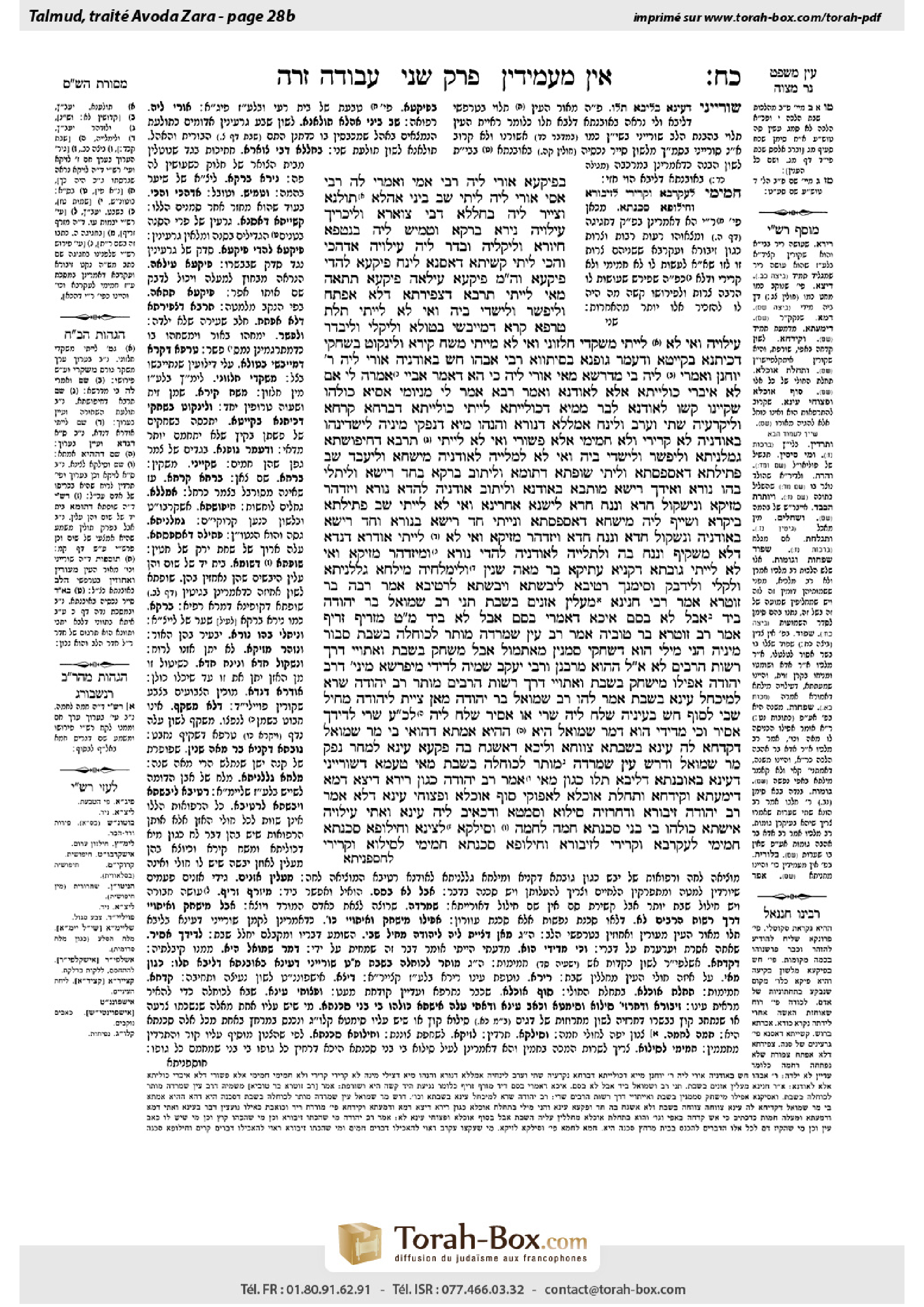
Avodah Zarah 28b: Talmud study for Daf Yomi
Study the Talmud for Daf Yomi with scanned pages, Hebrew text, English translations from Sefaria and AI-generated French translations.
Passage selection and English or AI-generated French translation are available where the scan has annotations. Daf Study is independent of Torah-Box and Sefaria.
Browse Avodah Zarah · עבודה זרה · All tractatesAvodah Zarah 28b text and translations
This page of Avodah Zarah includes the Aramaic text, an English translation and an AI-generated French translation, alongside the scan above.
עבודה זרה כ״ח ב · Aramaic and Hebrew text
בְּפִיקְעָא, אוֹרִי לֵיהּ רַבִּי אַמֵּי, וְאָמְרִי לַהּ רַבִּי אַסִּי אוֹרִי לֵיהּ: לַיְתֵי שַׁב בִּינֵי אַהֲלָא תּוֹלָנָא, וְצָיַיר לֵיהּ בַּחֲלָלָא דְבֵי צַוְּארָא, וְלִיכְרִיךְ עִילָּוֵיהּ נִירָא בַּרְקָא, וְטָמֵישׁ לֵיהּ בְּנִטְפָא חִיוָּרָא, וְלִיקְלְיֵהּ וּבָדַר לֵיהּ עִילָּוֵיהּ. אַדְּהָכִי וְהָכִי, לַיְתֵי קַשְׁיָתָא דַּאֲסַנָּא, לַינַּח פִּיקְעָא לַהֲדֵי פִּיקְעָא.
וְהָנֵי מִילֵּי פִּיקְעָא עִילָּאָה, פִּיקְעָא תַּתָּאָה מַאי? לַיְיתֵי תַּרְבָּא דִּצְפִירְתָּא דְּלָא אִפְּתַח, וְלִיפַשַּׁר וְלִישְׁדֵּי בֵּיהּ.
וְאִי לָא, לַיְיתֵי תְּלָת טַרְפֵא קָרָא דִּמְיַיבְּשִׁי בְּטוּלָּא, וְלִיקְלֵי וְלִיבַדַּר עִילָּוֵיהּ. וְאִי לָא, לַיְיתֵי מְשַׁקְּדֵי חֶלְזוֹנֵי. וְאִי לָא, מַיְיתֵי מְשַׁח קִירָא, וְלִינְקוֹט בְּשַׁחְקֵי דְכִיתָּנָא בְּקַיְיטָא, וְדַעֲמַר גּוּפְנָא בְּסִיתְוָוא.
רַבִּי אֲבָהוּ חַשׁ בְּאוּדְנֵיהּ, אוֹרִי לֵיהּ רַבִּי יוֹחָנָן, וְאָמְרִי לַיהּ בֵּי מִדְרְשָׁא. מַאי אוֹרִי לֵיהּ? כִּי הָא דְּאָמַר אַבָּיֵי: אֲמַרָה לִי אֵם — לָא אִיבְּרַי כּוּלְיְיתָא אֶלָּא לְאוּדְנָא. וְאָמַר רָבָא: אֲמַר לִי מִנְיוֹמֵי אָסְיָא — כּוּלְּהוּ (שַׁקְיָינוּ) [שַׁקְיָינֵי] קָשׁוּ לְאוּדְנָא, לְבַר מִמַּיָּא דְּכוּלְיְיתָא. לַיְיתֵי כּוּלְיְיתָא דְּבַרְחָא קַרְחָא, וְלִיקְרְעַיהּ שְׁתִי וָעֵרֶב, וְלַינַּח אַמִּלְּלָא דְּנוּרָא, וְהָנְהוּ מַיָּא דְּנָפְקִי מִינֵּיהּ לִישְׁדִּינְהוּ בְּאוּדְנֵיהּ — לָא קָרִירֵי וְלָא חַמִּימֵי, אֶלָּא פָּשׁוֹרֵי.
וְאִי לָא, לַיְיתֵי תַּרְבָּא דְּחִיפּוּשְׁתָּא גַּמְלָנִיתָא, וְלִיפַשַּׁר וְלִישְׁדֵּי בֵּיהּ. וְאִי לָא, לְמַלְּיֵיהּ לְאוּדְנֵיהּ מִישְׁחָא, וְלֶיעְבֵּד שַׁב פְּתִילָתָא דְּאַסְפַּסְתָּא, וְלַיְתֵי שׁוּפְתָּא דְּתוּמָא, וְלֹיתֵוב בַּרְקָא בְּחַד רֵישָׁא, וְלִיתְלֵי בְּהוּ נוּרָא, וְאִידַּךְ רֵישָׁא מוֹתֵבא בְּאוּדְנָא, וְלֹיתֵוב אוּדְנֵיהּ לְהָדָא נוּרָא, וְיִזְדְּהַר מִזִּיקָא, וְנִישְׁקוֹל חֲדָא וְנַנַּח חֲדָא.
לִישָּׁנָא אַחֲרִינָא: וְאִי לָא, לַיְיתֵי שַׁב פְּתִילָתָא בִּיקְרָא, וְשָׁיֵיף לֵיהּ מִישְׁחָא דְּאַסְפַּסְתָּא, וְנַיְיתֵי חַד רֵישָׁא בְּנוּרָא וְחַד רֵישָׁא בְּאוּדְנֵיהּ, וְנִשְׁקוֹל חֲדָא וְנַנַּח חֲדָא, וְיִזְדְּהַר מִזִּיקָא.
וְאִי לָא, לַיְיתֵי אוּדְרָא דְּנָדָא דְּלָא מְשַׁקֵּף וְנַנַּח בַּהּ, וְלִתְלְיַּיהּ לְאוּדְנֵיהּ לַהֲדֵי נוּרָא, וּמִזְדְּהַר מִזִּיקָא. וְאִי לָא, לַיְיתֵי גּוּבְתָּא דְּקַנְיָא עַתִּיקָא בַּר מְאָה שְׁנִין, וְלִימְלְחֵיהּ מִילְחָא גְּלָלְנִיתָא, וְלִקְלֵי וְלִידַבֵּק. וְסִימָנָךְ: רַטִּיבָא לְיַבִּשְׁתָּא וְיַבִּשְׁתָּא לְרַטִּיבָא.
אָמַר רַבָּה בַּר זוּטְרָא אָמַר רַבִּי חֲנִינָא: מַעֲלִין אׇזְנַיִם בְּשַׁבָּת. תָּנֵי רַב שְׁמוּאֵל בַּר יְהוּדָה: בַּיָּד אֲבָל לֹא בְּסַם. אִיכָּא דְּאָמְרִי: בְּסַם אֲבָל לֹא בַּיָּד. מַאי טַעְמָא? מִזְרָיף זָרֵיף.
אָמַר רַב זוּטְרָא בַּר טוֹבִיָּה אָמַר רַב: עַיִן שֶׁמָּרְדָה מוּתָּר לְכוֹחְלָהּ בְּשַׁבָּת. סְבוּר מִינֵּיהּ: הָנֵי מִילֵּי הוּא דִּשְׁחִקִי סַמָּנִין מֵאֶתְמוֹל, אֲבָל מִשְׁחָק בְּשַׁבָּת וְאֵתוֹיֵי דֶּרֶךְ רְשׁוּת הָרַבִּים — לָא. אֲמַר לֵיהּ הָהוּא מֵרַבָּנַן וְרַבִּי יַעֲקֹב שְׁמֵיהּ: לְדִידִי מִיפָּרְשָׁא מִינֵּיהּ דְּרַב יְהוּדָה, אֲפִילּוּ מִישְׁחָק בְּשַׁבָּת וְאֵתוֹיֵי דֶּרֶךְ רְשׁוּת הָרַבִּים — מוּתָּר.
רַב יְהוּדָה שְׁרָא לְמִיכְחַל עֵינָא בְּשַׁבָּת. אֲמַר לְהוּ רַב שְׁמוּאֵל בַּר יְהוּדָה: מַאן צָיֵית לִיהוּדָה מַחֵיל שַׁבֵּי? לְסוֹף חַשׁ בְּעֵינֵיהּ, שְׁלַח לֵיהּ: שְׁרֵי אוֹ אֲסִיר? שְׁלַח לֵיהּ: לְכוּלֵּי עָלְמָא שְׁרֵי, לְדִידָךְ אֲסִיר.
וְכִי מִדִּידִי הוּא? דְּמָר שְׁמוּאֵל הִיא! הָהִיא אַמְתָּא דַּהֲוַאי בֵּי מָר שְׁמוּאֵל, דִּקְדַחָא לַהּ עֵינָא בְּשַׁבְּתָא, צְוַוחָא, וְלֵיכָּא דְּאַשְׁגַּח בַּהּ. פְּקַעָא עֵינַאּ. לִמְחַר נְפַק מָר שְׁמוּאֵל וּדְרַשׁ: עַיִן שֶׁמָּרְדָה — מוּתָּר לְכוֹחְלָהּ בְּשַׁבָּת. מַאי טַעְמָא? דְּשׁוּרְיָינֵי דְּעֵינָא בְּאוֹבַנְתָּא דְּלִיבָּא תְּלוּ.
כְּגוֹן מַאי? אָמַר רַב יְהוּדָה: כְּגוֹן רִירָא, דִּיצָא, דְּמָא, דִּימְעֲתָא, וְקִידְחָא, וּתְחִלַּת אוּכְלָא, לְאַפּוֹקֵי סוֹף אוּכְלָא וּפַצּוֹחֵי עֵינָא — דְּלָא.
אָמַר רַב יְהוּדָה: זִיבּוּרָא, וּדְחַרְזֵיהּ סִילְוָא, וְסִמְטָא, וּדְכָאֵיב לֵיהּ עֵינָא, וְאָתֵי עִילָּוֵיהּ אִישָּׁתָא — כּוּלְּהוּ בֵּי בָנֵי סַכַּנְתָּא. חַמָּה לְחַמָּה, וְסִילְקָא לְצִינָּא, וְחִילּוּפָא סַכַּנְתָּא. חַמִּימֵי לְעַקְרַבָּא וְקָרִירֵי לְזִיבּוּרָא, וְחִילּוּפָא סַכַּנְתָּא. חַמִּימֵי לְסִילְוָא וְקָרִירֵי
Avodah Zarah 28b · English translation
from hemorrhoids. Rabbi Ami instructed him, and some say that Rabbi Asi instructed him that he should bring seven seeds of ice plant that are red like a worm and bind them in the collar of a shirt, and then he should wrap a strip of hair around it, and dip the bundle in white naphtha and he should burn it and spread the ashes upon the sores. In the meantime, he should bring the kernel of a bramble [asna] fruit and place its crevice against his own crevice, i.e., the anus.
The Gemara remarks: And this matter applies only to the upper crevice, which is located at the outer edge of the anus and can be treated with bramble fruit. What should one do if he is experiencing pain in the lower crevice, located deeper within the rectum? He should bring the fat of a goat that has not yet opened, i.e., given birth, and he should melt it and then he should apply it to the irritated area.
And if this is not possible, he should bring three pumpkin leaves that were dried in the shade and he should burn them, and then he should spread the ashes upon the irritated area. And if this is not possible, he should bring snail shells instead. And if this is also not possible, he should bring oil mixed with wax [kira] and he should smear it upon worn flax clothing in summer, or worn cotton clothing in winter, and place it upon the irritated area.
Rabbi Abbahu suffered from pain in his ear. Rabbi Yoḥanan instructed him, and some say that other Sages from the study hall instructed him, how to heal it. The Gemara asks: What did they instruct him? They told him to act in a fashion similar to that which Abaye said: My mother told me that the kidney was created only for the ear, i.e., it can be extremely beneficial to the ear. And Rava said: Minyumi the physician said to me: All liquids are harmful to the ear except for the fluid of the kidneys. Therefore, Rabbi Abbahu should bring the kidney of a bald goat [barḥa] and tear it vertically and horizontally and then place it upon dimming coals. And as for those fluids that issue from it, he should apply them to his ear while they are neither cold nor hot, but tepid.
The Gemara adds: And if this is not possible, he should bring the fat of a large beetle and melt it and apply it to the ear. And if not, he should fill his ear with oil and prepare seven wicks made of alfalfa [aspasta] and bring dried garlic ends, and tie the ends to the wicks with a strip of hair at one end, and set the wicks aflame. And he should place the other end of each wick in his ear one at a time, and place his ear opposite the flame. Parenthetically, the Gemara notes: And he should be cautious of drafts and avoid them, as they will harm his ear. The Gemara continues: And he should take one wick and remove one wick, i.e., replace each wick as it is consumed until all seven have been used.
The Gemara presents another version of this remedy: And if not, he should bring seven wicks of wax tapers and smear them with alfalfa oil, and place one end of each wick in the flame and one end in his ear, and take one wick and remove one wick. And again he should be cautious of drafts.
And if this is not possible, he should bring fiber that was dried but not combed and place it in his ear, and then bring his ear opposite the flame. And he should be cautious of drafts. And if not, he should bring the tube of an aged reed that is one hundred years old, i.e., that has been detached from the ground for a century, and salt it with rock salt and then burn it and stick it in his ear. The Gemara adds: And your mnemonic to remember these remedies is this: Moist cures are prescribed for dry afflictions, and dry cures are prescribed for moist afflictions.
§ The Gemara returns to the issue of medical treatment on Shabbat. Rabba bar Zutra says that Rabbi Ḥanina says: One may raise his ears to their appropriate position, i.e., set his dislocated jaw, on Shabbat. Rav Shmuel bar Yehuda teaches: This applies only if one raises it by hand, but not by means of medicine. There are those who say the opposite: One may raise his ears by means of medicine, but not by hand. What is the reason that one may not manually raise the ear? It is because doing so might injure [zareif ] the ear, which would constitute a violation of Torah law, whereas applying medicine is a violation of rabbinic law.
Rav Zutra bar Toviyya says that Rav says: With regard to an eye that rebelled, i.e., which is apt to pop out of its socket, it is permitted to apply blue eye shadow to it on Shabbat. The Sages initially concluded from this that this statement applies only where one had already ground the ingredients yesterday, i.e., on Shabbat eve, but if he planned to grind them on Shabbat, or to bring them through a public domain, it would not be permitted, as this would constitute a desecration of Shabbat by Torah law. To dispel this notion, one of the Sages, named Rabbi Ya’akov, said to them: This matter was explained to me by Rav Yehuda, who said that even if he plans to grind the ingredients on Shabbat and bring it through a public domain, it is permitted.
The Gemara relates that Rav Yehuda permitted someone to apply blue eye shadow to the eye on Shabbat. Rav Shmuel bar Yehuda said to the Sages: One who adheres to the ruling of Yehuda desecrates Shabbat. Ultimately, Rav Shmuel bar Yehuda himself suffered pain in his eye. He sent a message to Rav Yehuda, asking: Is it permitted or prohibited for me to treat my eye on Shabbat? Rav Yehuda sent back to him: For everyone else, it is permitted; for you, it is prohibited, as you treated my lenient ruling with disdain.
Rav Yehuda continues: But was it of my own accord that I issued this ruling? It is the ruling of Mar Shmuel, as demonstrated in the following incident: There was a certain maidservant who was in the house of Mar Shmuel whose eye became infected on Shabbat. She screamed in pain, but there was no one who attended to her. Eventually, her eye popped out of its socket. The next day, Mar Shmuel went out and taught: With regard to an eye that rebelled, it is permitted to apply blue eye shadow to it on Shabbat. What is the reason for this leniency, seeing as one may desecrate Shabbat only to treat life-threatening afflictions? The reason is that the tendons [shuraynei] of the eye are dependent upon the valves of the heart.
The Gemara asks: What ailment of the eye, for example, is considered life-threatening? Rav Yehuda said: For example, any of the following: Abnormal discharge; the sensation of pricking; blood flow from the eye; excessive tearing; and inflammation; and the onset of infection. This list serves to exclude the final stages of a waning infection that is mostly healed, and the opening of the eye, i.e., treatment administered to improve one’s eyesight, which are not life-threatening and therefore one is not permitted to treat them on Shabbat.
Rav Yehuda says: With regard to one who suffers from the sting of a hornet, or the prick of a thorn [silva], or an abscess, or one whose eye pains him, or one overcome by a fever, bathing in a bathhouse is a life-threatening danger for all of these. Additionally, eating radish [ḥamma] is good for a fever [ḥamma], and eating beets [silka] is good for chills [tzina], but the reverse, i.e., eating radish when one has chills or beets when one has a fever, poses a danger. Similarly, eating hot foods is good for the sting of a scorpion, and cold foods are good for a hornet sting, but the reverse poses a danger. Hot water is good for a thorn embedded in one’s skin, and cold water is good
Avodah Zarah 28b · Traduction française (IA)
De la maladie hémorroïdaire. Le maître Rabbi Ami lui a donné des instructions, et certains disent que c'est Rabbi Asi qui lui a donné des instructions, lui demandant de ramasser sept graines de plante de glace rouges comme un ver et de les attacher au col d'une chemise, puis de les envelopper avec un morceau de cheveux, et de les tremper dans du naphta blanc, puis de les brûler et de répandre les cendres sur les plaies. Pendant ce temps, il devrait ramasser le noyau d'un fruit de buis [asna] et placer sa crevasse contre sa propre crevasse, c'est-à-dire l'anus.
La Guemara remarque : Et cette affaire s'applique uniquement à la crevasse supérieure, qui est située à l'extérieur de l'anus et peut être traitée avec le fruit de buis. Que doit-on faire si l'on souffre de douleur dans la crevasse inférieure, située plus profondément dans le rectum ? Il devrait ramasser la graisse d'un bouc qui n'a pas encore donné naissance, c'est-à-dire qui n'a pas encore accouché, et la faire fondre, puis l'appliquer sur la zone irritée.
Et si cela n'est pas possible, il devrait ramasser trois feuilles de courge sèches en ombre et les brûler, puis répandre les cendres sur la zone irritée. Et si cela n'est pas possible, il devrait utiliser les coquilles de limaces à la place. Et si cela n'est pas possible non plus, il devrait utiliser de l'huile mélangée à du cire [kira] et l'appliquer sur des vêtements de lin usés en été, ou des vêtements de coton usés en hiver, et les placer sur la zone irritée.
Rabbi Abbahu souffrait de douleur à l'oreille. Rabbi Yoḥanan lui a donné des instructions, et certains disent que d'autres Sages du réfectoire lui ont donné des instructions, sur la manière de guérir. La Guemara demande : Qu'ont-ils lui dit ? Ils lui ont dit d'agir de la même manière que ce que disait Abaye : Ma mère m'a dit que le rein a été créé uniquement pour l'oreille, c'est-à-dire qu'il peut être extrêmement bénéfique pour l'oreille. Et Rava a dit : Minyumi, le médecin, m'a dit : Tous les liquides sont nuisibles pour l'oreille sauf le liquide des reins. Donc Rabbi Abbahu devrait ramasser le rein d'un bouc chauve [barḥa] et le déchirer verticalement et horizontalement, puis le placer sur des braises qui s'éteignent. Et quant aux liquides qui en émanent, il devrait les appliquer sur son oreille lorsqu'ils ne sont ni froids ni chauds, mais tièdes.
La Guemara ajoute : Et si cela n'est pas possible, il devrait ramasser la graisse d'un grand scarabée et la faire fondre, puis l'appliquer sur l'oreille. Et si cela n'est pas possible, il devrait remplir son oreille d'huile et préparer sept bougies faites d'aspasta et ramasser les extrémités sèches d'ail, et attacher les extrémités aux bougies avec un morceau de cheveux à l'une des extrémités, et allumer les bougies. Et il devrait placer l'autre extrémité de chaque bougie dans son oreille une à une, et placer son oreille face au feu. Par parenthèse, la Guemara note : Il devrait être prudent avec les courants d'air et les éviter, car ils nuiront à son oreille. La Guemara continue : Et il devrait prendre une bougie et enlever une bougie, c'est-à-dire remplacer chaque bougie une fois qu'elle est consumée jusqu'à ce que toutes les sept aient été utilisées.
La Guemara présente une autre version de ce remède : Et si cela n'est pas possible, il devrait ramasser sept bougies de cire et les recouvrir d'huile d'aspasta, et placer une extrémité de chaque bougie dans le feu et l'autre dans son oreille, et prendre une bougie et enlever une bougie. Et à nouveau, il devrait être prudent avec les courants d'air.
Et si cela n'est pas possible, il devrait ramasser un fil qui a été séché mais pas peigné et le placer dans son oreille, puis placer son oreille face au feu. Il devrait être prudent avec les courants d'air. Et si cela n'est pas possible, il devrait ramasser le tube d'un roseau âgé d'un siècle, c'est-à-dire qui a été détaché du sol depuis un siècle, le saler avec du sel de roche et le brûler, puis le placer dans son oreille. La Guemara ajoute : Et votre mnémonique pour se souvenir de ces remèdes est celui-ci : Les remèdes humides sont prescrits pour les affections sèches, et les remèdes secs sont prescrits pour les affections humides.
§ La Guemara reprend la question du traitement médical le sabbat. Rabba bar Zutra dit que Rabbi Ḥanina dit : On peut lever ses oreilles à leur position appropriée, c'est-à-dire rétablir une mâchoire déplacée, le sabbat. Rav Shmuel bar Yehuda enseigne : Cela s'applique uniquement si l'on le fait à la main, mais pas par le biais de médicaments. Certains disent le contraire : On peut lever ses oreilles par le biais de médicaments, mais pas à la main. Quelle est la raison pour laquelle on ne peut pas lever l'oreille manuellement ? C'est parce que cela pourrait endommager l'oreille, ce qui constituerait une violation de la loi divine, tandis que l'application de médicaments constituerait une violation de la loi rabbinique.
Rav Zutra bar Toviyya dit que Rav dit : En ce qui concerne un œil qui rebelle, c'est-à-dire qui a tendance à sortir de sa loge, il est permis d'appliquer un fard bleu sur l'œil le sabbat. Les Sages ont d'abord conclu à partir de cela que cette déclaration s'applique uniquement dans le cas où l'on avait déjà broyé les ingrédients la veille, c'est-à-dire le soir du sabbat, mais si l'on prévoyait de les broyer le sabbat, ou de les apporter d'un domaine public, cela ne serait pas permis, car cela constituerait une violation du sabbat par la loi divine. Pour éliminer cette idée, l'un des Sages, nommé Rabbi Ya’akov, a dit aux autres : Cette affaire m'a été expliquée par Rav Yehuda, qui a dit que même si l'on prévoyait de broyer les ingrédients le sabbat et de les apporter d'un domaine public, cela est permis.
La Guemara rapporte que Rav Yehuda a permis à quelqu'un d'appliquer un fard bleu sur l'œil le sabbat. Rav Shmuel bar Yehuda a dit aux Sages : Celui qui suit la décision de Yehuda viole le sabbat. Finalement, Rav Shmuel bar Yehuda lui-même souffrait de douleur dans l'œil. Il a envoyé un message à Rav Yehuda, lui demandant : Est-il permis ou interdit de traiter mon œil le sabbat ? Rav Yehuda a répondu à son message : Pour tout le monde d'autre, cela est permis ; pour vous, cela est interdit, car vous avez traité ma décision leniente avec mépris.
Rav Yehuda continue : Mais ce n'était pas de mon propre chef que j'ai rendu cette décision ? C'est la décision de Mar Shmuel, comme démontré dans l'incident suivant : Il y avait une servante qui était chez Mar Shmuel, dont l'œil s'était infecté le sabbat. Elle criait en raison de la douleur, mais personne ne s'occupait d'elle. Finalement, son œil est sorti de sa loge. Le lendemain, Mar Shmuel est sorti et a enseigné : En ce qui concerne un œil qui rebelle, il est permis d'appliquer un fard bleu sur l'œil le sabbat. Quelle est la raison de cette lenienc, vu que l'on peut seulement transgresser le sabbat pour traiter des affections menaçant la vie ? La raison est que les tendons [shuraynei] de l'œil dépendent des valves du cœur.
La Guemara demande : Quelle maladie de l'œil, par exemple, est considérée comme menaçant la vie ? Rav Yehuda dit : Par exemple, n'importe laquelle des suivantes : une sécrétion anormale ; la sensation de piquant ; le sang qui coule de l'œil ; une larmoiement excessif ; et l'inflammation ; et l'origine d'une infection. Cette liste sert à exclure les dernières étapes d'une infection qui s'atténue et qui est presque guérie, et l'ouverture de l'œil, c'est-à-dire le traitement administré pour améliorer la vue, qui ne sont pas menaçant la vie et par conséquent l'on n'est pas permis de les traiter le sabbat.
Rav Yehuda dit : En ce qui concerne celui qui souffre du piquant d'une guêpe, ou du piquant d'une épine [silva], ou d'un abcès, ou celui dont l'œil le fait souffrir, ou celui qui est pris par une fièvre, la baignade dans un bain est un danger menaçant la vie pour tous ces cas. De plus, manger un radis [ḥamma] est bon pour une fièvre [ḥamma], et manger des betteraves [silka] est bon pour les frissons [tzina], mais l'inverse, c'est-à-dire manger un radis quand on a des frissons ou des betteraves quand on a une fièvre, représente un danger. De même, manger des aliments chauds est bon pour le piquant d'un scorpion, et des aliments froids sont bons pour le piquant d'une guêpe, mais l'inverse représente un danger. L'eau chaude est bonne pour une épine plantée dans la peau, et l'eau froide est bonne pour le piquant d'une guêpe
Traduction française générée par IA à partir de l’édition anglaise de Sefaria. Vérifie toujours un passage avec le texte source.
Text from Sefaria: William Davidson Edition - Vocalized Aramaic (CC BY NC); William Davidson Edition - English (CC BY NC).