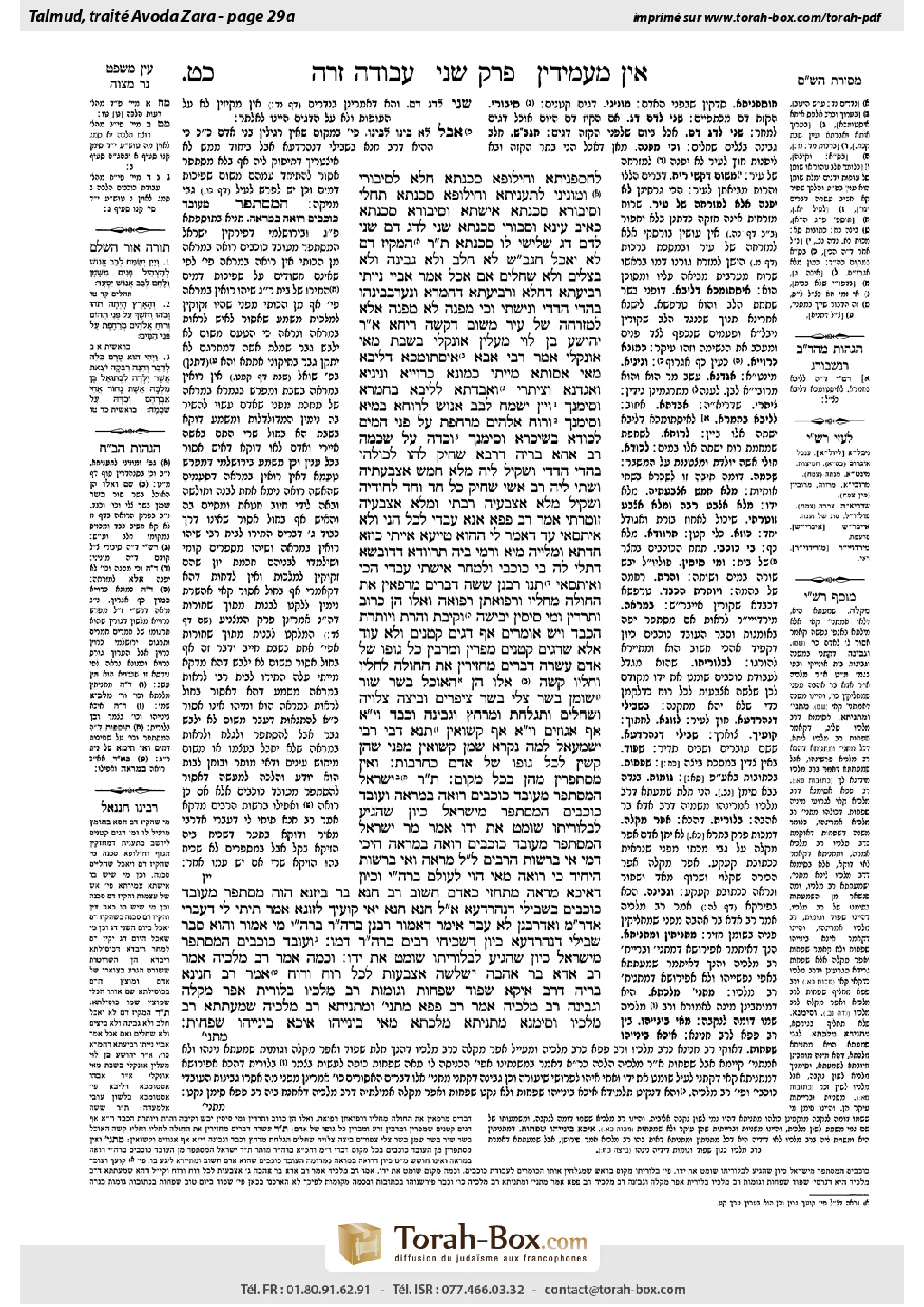
Avodah Zarah 29a: Talmud study for Daf Yomi
Study the Talmud for Daf Yomi with scanned pages, Hebrew text, English translations from Sefaria and AI-generated French translations.
Passage selection and English or AI-generated French translation are available where the scan has annotations. Daf Study is independent of Torah-Box and Sefaria.
Browse Avodah Zarah · עבודה זרה · All tractatesAvodah Zarah 29a text and translations
This page of Avodah Zarah includes the Aramaic text, an English translation and an AI-generated French translation, alongside the scan above.
עבודה זרה כ״ט א · Aramaic and Hebrew text
לְחַסְפָּנִיתָא, וְחִילּוּפָא סַכַּנְתָּא.
חַלָּא לְסִיבּוּרֵי, וּמוֹנִינֵי לְתַעֲנִיתָא, וְחִילּוּפָא סַכַּנְתָּא. תַּחְלֵי וְסִיבּוּרָא סַכַּנְתָּא, אִישָּׁתָא וְסִיבּוּרָא סַכַּנְתָּא, כְּאֵיב עֵינָא וְסִיבּוּרֵי סַכַּנְתָּא. שֵׁנִי לַדָּג דָּם, שֵׁנִי לַדָּם דָּג, שְׁלִישִׁי לוֹ סַכַּנְתָּא.
תָּנוּ רַבָּנַן: הַמַּקִּיז דָּם לֹא יֹאכַל חגב״ש — לֹא חָלָב, וְלֹא גְּבִינָה, וְלֹא בְּצָלִים, וְלֹא שַׁחֲלַיִם. אִם אָכַל, אָמַר אַבָּיֵי: נַיְיתֵי רְבִיעֲתָא דְּחַלָּא וּרְבִיעֲתָא דְּחַמְרָא, וּנְעַרְבְּבִינְהוּ בַּהֲדֵי הֲדָדֵי וְנִישְׁתֵּי. וְכִי מִפְּנֵה — לָא מִפְּנֵה אֶלָּא לְמִזְרָחָהּ שֶׁל עִיר, מִשּׁוּם דְּקָשֵׁה רֵיחָא.
אָמַר רַבִּי יְהוֹשֻׁעַ בֶּן לֵוִי: מַעֲלִין אוּנְקְלֵי בְּשַׁבָּת. מַאי אוּנְקְלֵי? אָמַר רַבִּי אַבָּא: אִיסְתּוּמְכָא דְּלִיבָּא. מַאי אָסוּתָא? מַיְיתֵי כַּמּוֹנָא כֵּרְוַיָּיא וְנִינְיָא וְאַגְדָּנָא וְצִיתְרִי וְאַבְדָּתָא.
לְלִיבָּא בְּחַמְרָא, וְסִימָנָךְ ״וְיַיִן יְשַׂמַּח לְבַב אֱנוֹשׁ״. לְרוּחָא בְּמַיָּא, וְסִימָנָךְ ״וְרוּחַ אֱלֹהִים מְרַחֶפֶת עַל פְּנֵי הַמָּיִם״. לְכוּדָא בְּשִׁיכְרָא, וְסִימָנָךְ ״וְכַדָּהּ עַל שִׁכְמָהּ״.
רַב אַחָא בְּרֵיהּ דְּרָבָא שָׁחֵיק לְהוּ לְכוּלְּהוּ בַּהֲדֵי הֲדָדֵי, וְשָׁקֵיל לֵיהּ מְלֵא חֲמֵשׁ אֶצְבְּעָתֵיהּ, וְשָׁתֵי לֵיהּ. רַב אָשֵׁי שָׁחֵיק כֹּל חַד וְחַד לְחוֹדֵיהּ, וְשָׁקֵיל מְלֵא אֶצְבְּעֵיהּ רַבָּתִי וּמְלֵא אֶצְבְּעֵיהּ זוּטַרְתִּי. אָמַר רַב פָּפָּא: אֲנָא עֲבַדִי לְכֹל הָנֵי וְלָא אִיתַּסַּאי, עַד דַּאֲמַר לִי הַהוּא טַיָּיעָא: אַיְיתִי כּוּזָא חַדְתָּא וּמַלְּיֵיהּ מַיָּא, וּרְמִי בֵּיהּ תַּרְוָודָא דְּדוּבְשָׁא דִּתְלֵי לֵהּ בֵּי כוֹכְבֵי, וְלִמְחַר אִישְׁתִּי. עֲבַדִי הָכִי וְאִיתַּסַּאי.
תָּנוּ רַבָּנַן: שִׁשָּׁה דְּבָרִים מְרַפְּאִין אֶת הַחוֹלֶה מֵחׇלְיוֹ וּרְפוּאָתָן רְפוּאָה, וְאֵלּוּ הֵן: כְּרוּב, וּתְרָדִין, וּמֵי סִיסִין (יְבֵישָׁה וְקֵיבַת) [יְבֵישִׁין וְקֵיבָה], וְהֶרֶת, וְיוֹתֶרֶת הַכָּבֵד. וְיֵשׁ אוֹמְרִים: אַף דָּגִים קְטַנִּים, וְלָא עוֹד, אֶלָּא שֶׁדָּגִים קְטַנִּים מַפְרִין וּמַרְבִּין כׇּל גּוּפוֹ שֶׁל אָדָם.
עֲשָׂרָה דְּבָרִים מַחְזִירִין אֶת הַחוֹלֶה לְחׇלְיוֹ, וְחׇלְיוֹ קָשֶׁה, אֵלּוּ הֵן: הָאוֹכֵל בְּשַׂר שׁוֹר, שׁוֹמֵן, בְּשַׂר צָלִי, בְּשַׂר צִיפֳּרִים, וּבֵיצָה צְלוּיָה, וְשַׁחֲלַיִם, וְתִגְלַחַת, וּמֶרְחָץ, וּגְבִינָה, וְכָבֵד. וְיֵשׁ אוֹמְרִים: אַף אֱגוֹזִים. וְיֵשׁ אוֹמְרִים: אַף קִשּׁוּאִין. תָּנָא דְּבֵי רַבִּי יִשְׁמָעֵאל: לָמָּה נִקְרָא שְׁמָן קִשּׁוּאִין? מִפְּנֵי שֶׁהֵן קָשִׁין לְכׇל גּוּפוֹ שֶׁל אָדָם כַּחֲרָבוֹת.
וְאֵין מִסְתַּפְּרִין מֵהֶן בְּכׇל מָקוֹם. תָּנוּ רַבָּנַן: יִשְׂרָאֵל הַמִּסְתַּפֵּר מִגּוֹי רוֹאֶה בַּמַּרְאָה, וְגוֹי הַמִּסְתַּפֵּר מִיִּשְׂרָאֵל, כֵּיוָן שֶׁהִגִּיעַ לִבְלוֹרִיתוֹ שׁוֹמֵט אֶת יָדוֹ.
אָמַר מָר: יִשְׂרָאֵל הַמִּסְתַּפֵּר מִגּוֹי רוֹאֶה בַּמַּרְאָה. הֵיכִי דָמֵי? אִי בִּרְשׁוּת הָרַבִּים, לְמָה לִי מַרְאָה? וְאִי בִּרְשׁוּת הַיָּחִיד, כִּי רוֹאֶה מַאי הָוֵי? לְעוֹלָם בִּרְשׁוּת הַיָּחִיד, וְכֵיוָן דְּאִיכָּא מַרְאָה — מִתְחֲזֵי כְּאָדָם חָשׁוּב.
רַב חָנָא בַּר בִּיזְנָא הֲוָה מִסְתַּפֵּר מִגּוֹי בִּשְׁבִילֵי דִנְהַרְדְּעָא, אֲמַר לֵיהּ: חָנָא, חָנָא, יָאֵי קוֹעָיךְ לְזוּגָא! אָמַר: תֵּיתֵי לִי דַּעֲבַרִי אַדְּרַבִּי מֵאִיר.
וְאַדְּרַבָּנַן לָא עֲבַר? אֵימַר דַּאֲמוּר רַבָּנַן בִּרְשׁוּת הָרַבִּים, בִּרְשׁוּת הַיָּחִיד מִי אֲמוּר? וְהוּא סָבַר: שְׁבִילֵי דִנְהַרְדְּעָא, כֵּיוָן דִּשְׁכִיחִי רַבִּים, כִּרְשׁוּת הָרַבִּים דָּמוּ.
וְגוֹי הַמִּסְתַּפֵּר מִיִּשְׂרָאֵל, כֵּיוָן שֶׁהִגִּיעַ לִבְלוֹרִיתוֹ שׁוֹמֵט אֶת יָדוֹ. וְכַמָּה? אָמַר רַב מַלְכִּיָּה אָמַר רַב אַדָּא בַּר אַהֲבָה: שָׁלֹש אֶצְבָּעוֹת לְכׇל רוּחַ וָרוּחַ.
אָמַר רַב חֲנִינָא בְּרֵיהּ דְּרַב אִיקָא: שַׁפּוּד, שְׁפָחוֹת, וְגוּמוֹת — רַב מַלְכִּיּוֹ; בְּלוֹרִית, אֵפֶר מִקְלֶה, וּגְבִינָה — רַב מַלְכִּיָּה.
אָמַר רַב פָּפָּא: מַתְנִיתִין וּמַתְנִיתָא — רַב מַלְכִּיָּה, שְׁמַעְתָּתָא — רַב מַלְכִּיּוֹ, וְסִימָנָךְ: מַתְנִיתָא מַלְכְּתָא. מַאי בֵּינַיְיהוּ? אִיכָּא בֵּינַיְיהוּ שְׁפָחוֹת.
Avodah Zarah 29a · English translation
for facial wounds, but the reverse presents a danger.
Vinegar is good for one to consume after bloodletting, and eating small fish is good for one who has completed a fast, but the reverse is a danger. Eating cress and then undergoing bloodletting poses a danger. With regard to one who suffers from a fever and undergoes bloodletting, this poses a danger to his life. Similarly, one who suffers from pain of the eye and undergoes bloodletting endangers to his life. On the second day after eating fish one may let blood, and on the second day after letting blood one may eat fish. With regard to eating fish on the third day after letting blood, or letting blood on the third day after eating fish, both of these actions pose a danger.
§ The Gemara presents a series of health-related statements. The Sages taught: One who lets blood may not eat the following foods, corresponding to the acronym ḥet, gimmel, beit, shin. That is, he may consume neither milk [ḥalav], nor cheese [gevina], nor onions [betzalim], nor cress [sheḥalim]. If he ate one of these, Abaye said: He should bring a quarter-log of vinegar and a quarter-log of wine and mix them together and drink the mixture. And when he defecates, he should defecate only toward the east of the city, because the odor of the excrement after that treatment is offensive. Since the wind does not usually blow from the east, it is less likely to spread the stench.
Rabbi Yehoshua ben Levi says: One may lift the unkali on Shabbat. The Gemara asks: What is the unkali? Rabbi Abba said: It is the edge of the ribs [istumkha] near the heart which sometimes bend inward, in which case they must be lifted and straightened into their proper position. The Gemara asks: What is the cure for one whose unkali has been bent? He should take cumin, caraway, mint [ninya], wormwood, satureja, and hyssop.
This remedy is beneficial for several ailments, and the Gemara presents each of these in turn: For curing the heart, the above combination should be taken with wine, and your mnemonic for this is the verse: “And wine that makes glad the heart of man” (Psalms 104:15). For curing an ailment that arises due to the wind [ruḥa], one drinks the mixture in water, and your mnemonic for this is the verse: “And the spirit [ruaḥ] of God hovered over the face of the waters” (Genesis 1:2). For childbirth [lekhuda], a woman in labor drinks the mixture with beer [shikhra], and your mnemonic for this is the verse: “With her pitcher [vekhadah] upon her shoulder [shikhmah]” (Genesis 24:15).
Rav Aḥa, son of Rava, ground all of these together and took a handful of the mixture and drank it. Rav Ashi ground each and every one of the herbs separately and he took all that he could hold between his large finger and his small finger and drank it. Rav Pappa said: I tried all these remedies and I was not healed until a certain Arab said to me: Bring a new jug and fill it with water and place in it a ladle [tarvada] of honey that is suspended among the stars, i.e., add the ladle at night, and drink it on the next day. Rav Pappa concludes: I did this and I was healed.
The Sages taught: Six items heal a sick person from his illness and their cure is a permanent cure, and these are: Cabbage, beets, water in which dried chamomile was soaked, and the stomach contents of an animal, and the womb of an animal, and the lobe of the liver. And some say: Small fish are also included in this list. And moreover, eating small fish causes a person’s entire body to flourish and to grow.
Ten items return a sick person to his illness, and his illness becomes even more severe than it originally was, and they are: One who eats ox meat, fat, roasted meat, bird meat, and a roasted egg, and cress; and the act of shaving, and bathing, and the consumption of cheese, and liver. And some say: Nuts are also included in this list. And some say: Cucumbers are also included in this list. The school of Rabbi Yishmael taught: Why are they called cucumbers [kishu’in]? Because they are as harmful [kashin] to a person’s entire body as swords.
§ The mishna teaches: And one may not have his hair cut by gentiles anywhere. The Sages taught in a baraita: A Jew who has his hair cut by a gentile should observe the gentile’s actions in a mirror while he cuts his hair. And in the case of a gentile who has his hair cut by a Jew, when the Jew reaches the gentile’s forelock he removes his hand and does not cut it, because it is associated with idol worship.
The Master said: A Jew who has his hair cut by a gentile should observe the gentile’s actions in a mirror. The Gemara asks: What are the circumstances of this case? If it is referring to a haircut performed in a public domain, why do I need a mirror? After all, the gentile will not harm a Jew in public. And if it occurs in a private domain, even if the Jews observes the gentile’s actions, what of it? How does the fact that the Jew is watching prevent the gentile barber from harming him? The Gemara explains: Actually, this is referring to a haircut in a private domain, but since there is a mirror in place, the Jew appears as an important person whom the gentile will hesitate to attack.
The Gemara relates a relevant incident: Rav Ḥana bar Bizna was having his hair cut by a gentile in one of the side streets of Neharde’a. The barber said to him: Ḥana, Ḥana; Your throat is appealing to the razor. Rav Ḥana bar Bizna said: I have this coming to me, as I violated the ruling of Rabbi Meir, who stated that one may not have his hair cut by a gentile in any location.
The Gemara asks: And didn’t Rav Ḥana bar Bizna violate the ruling of the Rabbis as well? Say that when the Rabbis stated that it is permitted to have one’s hair cut by a gentile, they were referring to a haircut performed in a public domain; but with regard to a haircut performed in a private domain, did they say that it is permitted? Since the side streets of Neharde’a cannot be considered a public domain, evidently Rav Ḥana bar Bizna violated the ruling of the Rabbis. The Gemara explains: And Rav Ḥana bar Bizna maintains: With regard to the side streets of Neharde’a, since many people are present there, they are similar to a public domain, and it would therefore be permitted to have one’s hair cut there according to the opinion of the Rabbis.
The baraita stated: And in the case of a gentile who has his hair cut by a Jew, when the Jew reaches the gentile’s forelock, he removes his hand and does not cut it, because it is associated with idol worship. The Gemara asks: And how much space should the Jew leave around the forelock? Rav Malkiyya says that Rav Adda bar Ahava says: Three fingerbreadths in each and every direction.
In addition to Rav Malkiyya, whose ruling was just cited, there was another amora known as Rav Malkiyyu. In order to avoid confusing the two, the Gemara records their respective rulings. Rav Ḥanina, son of Rav Ika, says: The statements concerning a skewer, maidservants, and follicles were issued by Rav Malkiyyu; the rulings concerning a forelock, burnt ashes, and cheese were stated by Rav Malkiyya.
Rav Pappa said a different opinion: Statements from the Mishna and baraita were issued by Rav Malkiyya, whereas rulings of halakha that are not related to a mishna or baraita were taught by Rav Malkiyyu. And the mnemonic to remember this is: The Mishna is a queen [malketa], i.e., the statements that are referring to a mishna were made by Rav Malkiyya, whose name is similar to the Aramaic term for queen. The Gemara asks: What is the difference between the opinions of Rav Ḥanina and Rav Pappa? The Gemara answers: There is a difference between them with regard to the halakha concerning maidservants. According to Rav Ḥanina, this halakha was stated by Rav Malkiyyu, whereas Rav Pappa holds that it was taught by Rav Malkiyya, as it is referring to a dispute in a mishna.
Avodah Zarah 29a · Traduction française (IA)
pour les plaies faciales, mais l'inverse est dangereux.
Le vinaigre est bon à consommer après une saignée, et manger des petits poissons est bon pour celui qui a terminé une jeûne, mais l'inverse est dangereux. Manger des cressons puis subir une saignée est dangereux. En ce qui concerne celui qui souffre d'une fièvre et subit une saignée, cela met sa vie en danger. De même, celui qui souffre de douleur oculaire et subit une saignée met sa vie en danger. Le deuxième jour après avoir mangé des poissons, on peut saigner, et le deuxième jour après avoir saigné, on peut manger des poissons. En ce qui concerne manger des poissons le troisième jour après avoir saigné, ou saigner le troisième jour après avoir mangé des poissons, ces deux actions sont dangereuses.
§ Le Guemara présente une série d'affirmations liées à la santé. Les Sages enseignèrent : celui qui saigne ne doit pas manger les aliments suivants, correspondant à l'acronyme ḥet, gimmel, beit, shin. C'est-à-dire qu'il ne doit ni consommer du lait [ḥalav], ni du fromage [gevina], ni des oignons [betzalim], ni des cressons [sheḥalim]. Si l'un d'eux a été mangé, Abaye dit : il devrait boire un quart de log de vinaigre et un quart de log de vin mélangés ensemble. Et lorsqu'il défèque, il devrait déféquer uniquement à l'est de la ville, car l'odeur des déjections après ce traitement est offensante. Puisque le vent ne souffle généralement pas de l'est, cela est moins susceptible de propager l'odeur.
Rabbi Yehoshua ben Levi dit : on peut soulever l'unkali le sabbat. Le Guemara demande : qu'est-ce que l'unkali ? Rabbi Abba dit : c'est la bordure des côtes [istumkha] près du cœur, qui parfois se courbent vers l'intérieur, dans ce cas, elles doivent être soulevées et redressées dans leur position normale. Le Guemara demande : quelle est la cure pour celui dont l'unkali est courbé ? Il devrait prendre du cumin, du fenouil, de la menthe [ninya], de la sauge, de l'hysope et de l'absinthe.
Ce remède est bénéfique pour plusieurs maladies, et le Guemara présente chacune de ces maladies à son tour : pour guérir le cœur, on prend la combinaison ci-dessus avec du vin, et votre mnémonique pour cela est la verset : « Et le vin qui réjouit le cœur de l'homme » (Psaumes 104:15). Pour guérir une maladie due au vent [ruḥa], on boit le mélange dans l'eau, et votre mnémonique pour cela est la verset : « Et l'esprit [ruaḥ] de Dieu planait sur la surface des eaux » (Genèse 1:2). Pour l'accouchement [lekhuda], une femme en travail boit le mélange avec de la bière [shikhra], et votre mnémonique pour cela est la verset : « Avec sa cruche [vekhadah] sur son épaule [shikhmah] » (Genèse 24:15).
Rav Aḥa, fils de Rava, a broyé tous ceux-ci ensemble et a pris une poignée du mélange et l'a bu. Rav Ashi a broyé chaque herbe séparément et a pris tout ce qu'il pouvait tenir entre son doigt majeur et son doigt annulaire et l'a bu. Rav Pappa dit : j'ai essayé tous ces remèdes et je n'ai pas été guéri jusqu'à ce qu'un certain Arabe me dise : apporte un nouveau tonneau et remplis-le d'eau et place-y une cuillère [tarvada] de miel qui est suspendue parmi les étoiles, c'est-à-dire ajoute la cuillère la nuit, et bois-le le lendemain. Rav Pappa conclut : j'ai fait cela et j'ai été guéri.
Les Sages enseignèrent : six choses guérissent une personne malade de sa maladie et leur guérison est une guérison permanente, et ce sont : le chou, les betteraves, l'eau dans lequel on a trempé des fleurs de camomille sèches, et les contenus du ventre d'un animal, et le utérus d'un animal, et la lobule du foie. Et certains disent : les petits poissons sont également inclus dans cette liste. Et de plus, manger des petits poissons cause à la personne que tout son corps prospère et grandit.
Dix choses ramènent une personne malade à sa maladie, et sa maladie devient même plus grave qu'elle ne l'était initialement, et ce sont : celui qui mange de la viande de bœuf, de la graisse, de la viande grillée, de la viande d'oiseau, et un œuf grillé, et des cressons ; et l'acte de se raser, de se baigner, et de consommer du fromage, et du foie. Et certains disent : les noix sont également inclus dans cette liste. Et certains disent : les concombres sont également inclus dans cette liste. La maison de Rabbi Yishmael enseigna : pourquoi sont-ils appelés concombres [kishu'in] ? Parce qu'ils sont aussi nuisibles [kashin] pour le corps entier d'une personne que des épées.
§ La mitsva enseigne : et on ne doit pas laisser un gentil couper ses cheveux nulle part. Les Sages enseignèrent dans une baraïta : un Juif dont les cheveux sont coupés par un gentil devrait observer les actions du gentil dans un miroir pendant qu'il coupe ses cheveux. Et dans le cas d'un gentil dont les cheveux sont coupés par un Juif, lorsque le Juif arrive à la mèche du gentil, il retire sa main et ne la coupe pas, car cela est associé à l'idolâtrie.
Le Maître dit : un Juif dont les cheveux sont coupés par un gentil devrait observer les actions du gentil dans un miroir. Le Guemara demande : quelles sont les circonstances de ce cas ? Si cela fait référence à un rasage effectué dans un domaine public, pourquoi ai-je besoin d'un miroir ? Après tout, le gentil ne nuira pas à un Juif en public. Et si cela se produit dans un domaine privé, même si le Juif observe les actions du gentil, qu'est-ce que cela change ? Comment le fait que le Juif regarde empêche le barbier gentil de le nuire ? Le Guemara explique : en réalité, cela fait référence à un rasage dans un domaine privé, mais puisque le miroir est présent, le Juif apparaît comme une personne importante que le gentil hésitera à attaquer.
Le Guemara rapporte un incident pertinent : Rav Ḥana bar Bizna était en train de faire couper ses cheveux par un gentil dans l'une des rues latérales de Neharde’a. Le barbier lui dit : Ḥana, Ḥana ; ton cou est attirant pour le ciseau. Rav Ḥana bar Bizna dit : j'ai cela à mon tour, car j'ai enfreint la décision de Rabbi Meir, qui a déclaré qu'on ne doit pas laisser un gentil couper ses cheveux nulle part.
La Guemara pose la question : Et n’a-t-il pas violé la décision des Sages, Rav Ḥana bar Bizna ? Réponse : Lorsque les Sages ont dit qu’il est permis de laisser un gentil couper ses cheveux, ils parlaient d’un rasage effectué dans un domaine public ; mais concernant un rasage effectué dans un domaine privé, ont-ils dit qu’il était permis ? Puisque les ruelles de Neharde’a ne peuvent pas être considérées comme un domaine public, il est évident que Rav Ḥana bar Bizna a violé la décision des Sages. La Guemara explique : Et Rav Ḥana bar Bizna affirme : Concernant les ruelles de Neharde’a, puisque beaucoup de personnes y sont présentes, elles sont semblables à un domaine public, et il serait donc permis de laisser couper ses cheveux là-bas selon l’opinion des Sages.
La baraïta dit : Et dans le cas d’un gentil dont un Juif coupe les cheveux, lorsque le Juif arrive à la mèche du gentil, il retire sa main et ne la coupe pas, car cela est associé à l’idolâtrie. La Guemara pose la question : Et quelle distance doit laisser le Juif autour de la mèche ? Rav Malkiyya dit que Rav Adda bar Ahava dit : Trois doigts dans chaque direction.
En plus de Rav Malkiyya, dont la décision vient d’être citée, il y avait un autre amora appelé Rav Malkiyyu. Afin d’éviter toute confusion entre les deux, la Guemara note leurs décisions respectives. Rav Ḥanina, fils de Rav Ika, dit : Les déclarations concernant un brochet, les servantes et les follicules ont été émises par Rav Malkiyyu ; les décisions concernant la mèche, les cendres brûlées et le fromage ont été émises par Rav Malkiyya.
Rav Pappa dit une opinion différente : Les déclarations tirées de la Michna et de la baraïta ont été émises par Rav Malkiyya, tandis que les décisions de halakha non liées à une Michna ou une baraïta ont été enseignées par Rav Malkiyyu. Et le moyen mnémotechnique pour se souvenir de cela est : La Michna est une reine [malketa], c’est-à-dire que les déclarations qui font référence à une Michna ont été faites par Rav Malkiyya, dont le nom est semblable au terme araméen pour reine. La Guemara pose la question : Quelle est la différence entre les opinions de Rav Ḥanina et de Rav Pappa ? La Guemara répond : Il y a une différence entre eux concernant la halakha concernant les servantes. Selon Rav Ḥanina, cette halakha a été émise par Rav Malkiyyu, tandis que Rav Pappa considère qu’elle a été enseignée par Rav Malkiyya, car elle fait référence à un débat dans une Michna.
Traduction française générée par IA à partir de l’édition anglaise de Sefaria. Vérifie toujours un passage avec le texte source.
Text from Sefaria: William Davidson Edition - Vocalized Aramaic (CC BY NC); William Davidson Edition - English (CC BY NC).