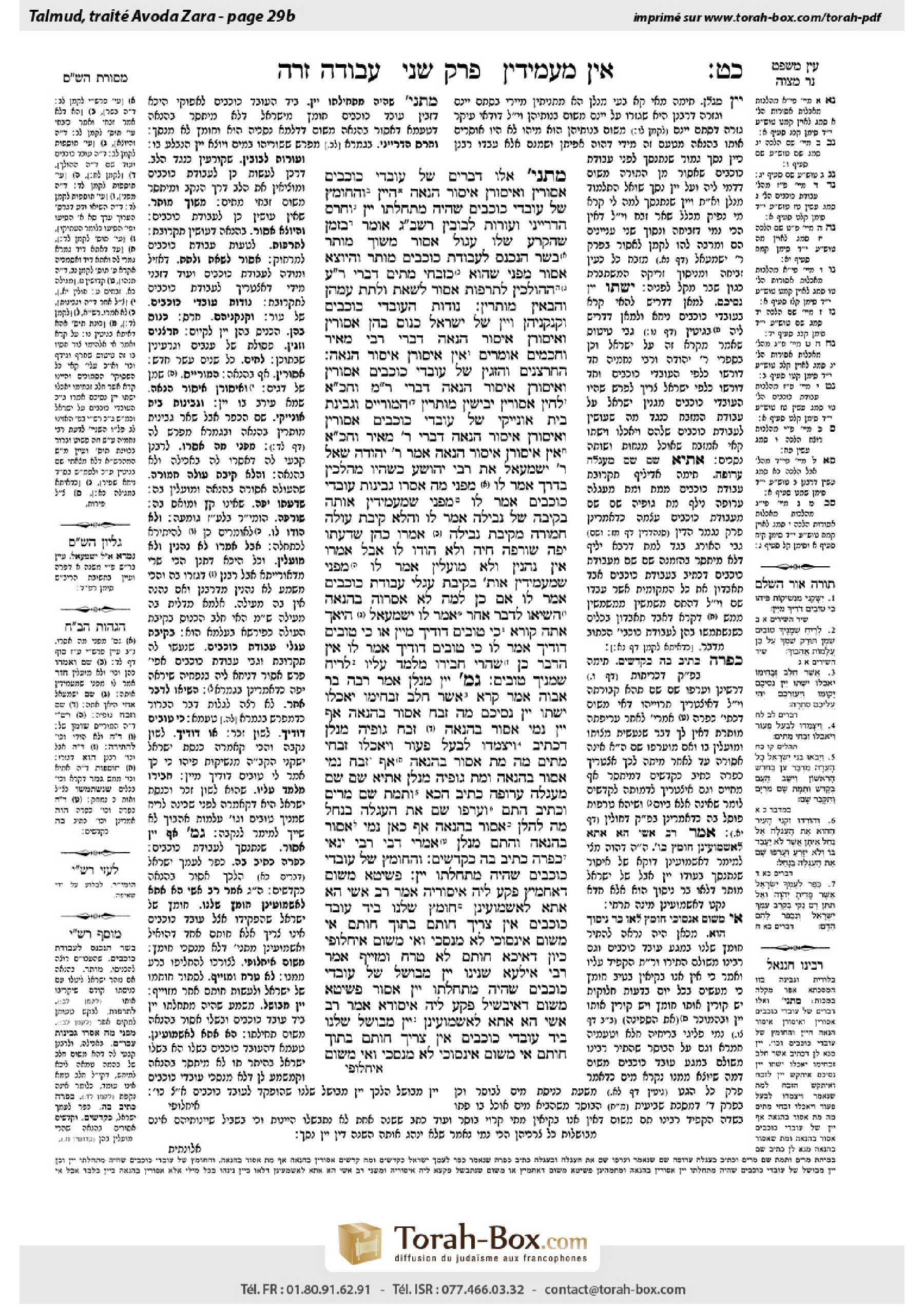
Avodah Zarah 29b: Talmud study for Daf Yomi
Study the Talmud for Daf Yomi with scanned pages, Hebrew text, English translations from Sefaria and AI-generated French translations.
Passage selection and English or AI-generated French translation are available where the scan has annotations. Daf Study is independent of Torah-Box and Sefaria.
Browse Avodah Zarah · עבודה זרה · All tractatesAvodah Zarah 29b text and translations
This page of Avodah Zarah includes the Aramaic text, an English translation and an AI-generated French translation, alongside the scan above.
עבודה זרה כ״ט ב · Aramaic and Hebrew text
מַתְנִי׳ אֵלּוּ דְּבָרִים שֶׁל גּוֹיִם אֲסוּרִין, וְאִיסּוּרָן אִיסּוּר הֲנָאָה: הַיַּיִן, וְהַחוֹמֶץ שֶׁל גּוֹיִם שֶׁהָיָה מִתְּחִלָּתוֹ יַיִן, וְחֶרֶס הַדְרְיָינִי, וְעוֹרוֹת לְבוּבִין. רַבָּן שִׁמְעוֹן בֶּן גַּמְלִיאֵל אוֹמֵר: בִּזְמַן שֶׁהַקֶּרַע שֶׁלּוֹ עָגוֹל — אָסוּר, מָשׁוּךְ — מוּתָּר.
בָּשָׂר הַנִּכְנָס לַעֲבוֹדָה זָרָה — מוּתָּר, וְהַיּוֹצֵא — אָסוּר, מִפְּנֵי שֶׁהוּא כְּזִבְחֵי מֵתִים, דִּבְרֵי רַבִּי עֲקִיבָא. הַהוֹלְכִין לַתַּרְפּוּת — אָסוּר לָשֵׂאת וְלָתֵת עִמָּהֶן, וְהַבָּאִין — מוּתָּרִין.
נוֹדוֹת הַגּוֹיִם וְקַנְקַנֵּיהֶן, וְיַיִן שֶׁל יִשְׂרָאֵל כָּנוּס בָּהֶן — אֲסוּרִין, וְאִיסּוּרָן אִיסּוּר הֲנָאָה, דִּבְרֵי רַבִּי מֵאִיר. וַחֲכָמִים אוֹמְרִים: אֵין אִיסּוּרָן אִיסּוּר הֲנָאָה. הַחַרְצַנִּים וְהַזַּגִּין שֶׁל גּוֹיִם — אֲסוּרִין, וְאִיסּוּרָן אִיסּוּר הֲנָאָה, דִּבְרֵי רַבִּי מֵאִיר. וַחֲכָמִים אוֹמְרִים: לַחִין — אֲסוּרִין, יְבֵישִׁין — מוּתָּרִין.
הַמּוּרְיָיס, וּגְבִינַת בֵּית אוּנְיָיקִי שֶׁל גּוֹיִם — אֲסוּרִין, וְאִיסּוּרָן אִיסּוּר הֲנָאָה, דִּבְרֵי רַבִּי מֵאִיר. וַחֲכָמִים אוֹמְרִים: אֵין אִיסּוּרָן אִיסּוּר הֲנָאָה.
אָמַר רַבִּי יְהוּדָה: שָׁאַל רַבִּי יִשְׁמָעֵאל אֶת רַבִּי יְהוֹשֻׁעַ כְּשֶׁהָיוּ מְהַלְּכִין בַּדֶּרֶךְ, אָמַר לוֹ: מִפְּנֵי מָה אָסְרוּ גְּבִינוֹת גּוֹיִם? אָמַר לוֹ: מִפְּנֵי שֶׁמַּעֲמִידִין אוֹתָהּ בְּקֵיבָה שֶׁל נְבֵילָה.
אָמַר לוֹ: וַהֲלֹא קֵיבַת עוֹלָה חֲמוּרָה מִקֵּיבַת נְבֵילָה, אָמְרוּ: כֹּהֵן שֶׁדַּעְתּוֹ יָפָה שׂוֹרְפָה חַיָּה, וְלֹא הוֹדוּ לוֹ, אֲבָל אָמְרוּ: אֵין נֶהֱנִין וְלֹא מוֹעֲלִין!
אָמַר לוֹ: מִפְּנֵי שֶׁמַּעֲמִידִין אוֹתָהּ בְּקֵיבַת עֶגְלֵי עֲבוֹדָה זָרָה. אָמַר לוֹ: אִם כֵּן, לָמָּה לֹא אֲסָרוּהָ בַּהֲנָאָה?
הִשִּׂיאוֹ לְדָבָר אַחֵר, אָמַר לוֹ: יִשְׁמָעֵאל, הֵיאַךְ אַתָּה קוֹרֵא ״כִּי טוֹבִים דֹּדֶיךָ מִיָּיִן״ אוֹ ״כִּי טוֹבִים דֹּדַיִךָ״?
אָמַר לוֹ: ״כִּי טוֹבִים דֹּדַיִךָ״. אָמַר לוֹ: אֵין הַדָּבָר כֵּן, שֶׁהֲרֵי חֲבֵירוֹ מְלַמֵּד עָלָיו: ״לְרֵיחַ שְׁמָנֶיךָ טוֹבִים״.
גְּמָ׳ יַיִן מְנָלַן? אָמַר רַבָּה בַּר אֲבוּהּ, אָמַר קְרָא: ״אֲשֶׁר חֵלֶב זְבָחֵימוֹ יֹאכֵלוּ יִשְׁתּוּ יֵין נְסִיכָם״, מָה זֶבַח אָסוּר בַּהֲנָאָה, אַף יַיִן נָמֵי אָסוּר בַּהֲנָאָה.
זֶבַח גּוּפֵיהּ מְנָלַן? דִּכְתִיב: ״וַיִּצָּמְדוּ לְבַעַל פְּעוֹר וַיֹּאכְלוּ זִבְחֵי מֵתִים״, מָה מֵת אָסוּר בַּהֲנָאָה, אַף זֶבַח נָמֵי אָסוּר בַּהֲנָאָה.
וּמֵת גּוּפֵיהּ מְנָלַן? אָתְיָא ״שָׁם״ ״שָׁם״ מֵעֶגְלָה עֲרוּפָה, כְּתִיב הָכָא: ״וַתָּמׇת שָׁם מִרְיָם״, וּכְתִיב הָתָם: ״וְעָרְפוּ שָׁם אֶת הָעֶגְלָה בַּנָּחַל״, מָה לְהַלָּן אָסוּר בַּהֲנָאָה, אַף כָּאן נָמֵי אָסוּר בַּהֲנָאָה.
וְהָתָם מְנָלַן? אָמְרִי דְּבֵי רַבִּי יַנַּאי: ״כַּפָּרָה״ כְּתִיב בָּהּ, כְּקָדָשִׁים.
וְהַחוֹמֶץ שֶׁל גּוֹיִם שֶׁהָיָה מִתְּחִלָּתוֹ יַיִן. פְּשִׁיטָא! מִשּׁוּם דְּאַחְמֵיץ פְּקַע לֵיהּ אִיסּוּרֵיהּ? אָמַר רַב אָשֵׁי: הָא אֲתָא לְאַשְׁמוֹעִינַן חוֹמֶץ שֶׁלָּנוּ בְּיַד גּוֹי אֵין צָרִיךְ חוֹתָם בְּתוֹךְ חוֹתָם. אִי מִשּׁוּם אִינַּסּוֹכֵי — לָא מְנַסְּכִי, וְאִי מִשּׁוּם אִיחַלּוֹפֵי — כֵּיוָן דְּאִיכָּא חוֹתָם לָא טָרַח וּמְזַיֵּיף.
אָמַר רַבִּי אִילְעָא, שָׁנִינוּ: יַיִן מְבוּשָּׁל שֶׁל גּוֹיִם שֶׁהָיָה מִתְּחִלָּתוֹ יַיִן — אָסוּר. פְּשִׁיטָא! מִשּׁוּם דְּאִיבַּשִּׁיל פְּקַע לֵיהּ אִיסּוּרֵיהּ? אָמַר רַב אָשֵׁי: הָא אֲתָא לְאַשְׁמוֹעִינַן, יַיִן מְבוּשָּׁל שֶׁלָּנוּ בְּיַד גּוֹיִם אֵין צָרִיךְ חוֹתָם בְּתוֹךְ חוֹתָם. אִי מִשּׁוּם אִינַּסּוֹכֵי — לָא מְנַסְּכִי, וְאִי מִשּׁוּם
Avodah Zarah 29b · English translation
MISHNA: This mishna discusses the halakhic status of various items that belong to gentiles. These are items that belong to gentiles and are prohibited to Jews, and their prohibition is that of an item from which deriving benefit is prohibited: Wine, and vinegar belonging to gentiles that was originally wine, and Hadrianic earthenware, and hides with a tear opposite the heart. Rabban Shimon ben Gamliel says: A hide is prohibited only when the tear around its heart is circular, but if it is elongated it is permitted, as gentiles will sacrifice a heart only when it has been removed by a circular laceration.
Meat that enters the house of idol worship is permitted, and meat that exits this house is prohibited, because it is considered as offerings to the dead, i.e., to idols; this is the statement of Rabbi Akiva. With regard to those going to a festival of idolatry [tarput], it is prohibited to engage in business with them. And with regard to those who are coming from it, it is permitted to engage in business with them.
Wineskins and jugs belonging to gentiles, which have a Jew’s wine contained in them, are prohibited to Jews, and their prohibition is that of an item from which deriving benefit is prohibited; this is the statement of Rabbi Meir. And the Rabbis say: Their prohibition is not that of an item from which deriving benefit is prohibited. Residual grape seeds and grape skins belonging to gentiles, which are left behind after the grapes are crushed for wine, are prohibited, and their prohibition is that of an item from which deriving benefit is prohibited; this is the statement of Rabbi Meir. And the Rabbis say: Moist grape residues are prohibited, but dry residues are permitted.
Fish stew [murayes] and cheese of Beit Unyaki belonging to gentiles are prohibited, and their prohibition is that of an item from which deriving benefit is prohibited. This is the statement of Rabbi Meir. And the Rabbis say: Their prohibition is not that of an item from which deriving benefit is prohibited.
Rabbi Yehuda said: Rabbi Yishmael asked Rabbi Yehoshua a series of questions while they were traveling along the road. Rabbi Yishmael said to him: For what reason did the Sages prohibit the cheeses of gentiles? Rabbi Yehoshua said to him: Because gentiles curdle cheese with the stomach contents of an unslaughtered animal carcass, and as the carcass of an unslaughtered animal is not kosher, cheese that is curdled with it is likewise prohibited.
In response, Rabbi Yishmael said to him: But aren’t the stomach contents of a burnt-offering subject to a more stringent prohibition than the stomach contents of an unslaughtered animal carcass? And yet they said: A priest who is open-minded [shedato yafa] with regard to what he eats may swallow [shorefah] the stomach contents of a burnt-offering while they are raw, and the other Sages did not agree with him. But the Sages said: One may not derive benefit from the stomach contents of a burnt-offering ab initio, and if one did derive benefit from them, he is not liable for misusing consecrated property. According to both opinions, deriving benefit from the stomach contents of a burnt-offering is not prohibited by Torah law. Since the halakha with regard to a burnt-offering is more stringent than that of an animal carcass, why would deriving benefit from the carcass be prohibited, while deriving benefit from the burnt-offering is permitted?
Rabbi Yehoshua said to Rabbi Yishmael: The cheese of gentiles is prohibited because they curdle it in the stomach contents of calves used for idol worship. Since it is prohibited to derive benefit from such calves, cheese curdled in their stomach contents is also prohibited. Rabbi Yishmael said to him: If that is so, why didn’t the Sages prohibit deriving any benefit from the cheese, instead of merely prohibiting its consumption?
Instead of answering Rabbi Yishmael, Rabbi Yehoshua diverted his attention to another matter and said to him: Yishmael, how do you read the following verse in the Song of Songs (1:2)? Do you read it as: For Your love [dodekha] is better than wine, or as: For your love [dodayikh] is better than wine? The first version, which is in the masculine form, would be a reference to God, whereas the second version, in the feminine, would be a reference to the Jewish people.
Rabbi Yishmael said to him that it should be read in the feminine: For your love [dodayikh] is better than wine. Rabbi Yehoshua said to him: The matter is not so, as another verse teaches with regard to it: “Your ointments [shemanekha] have a goodly fragrance... therefore do the maidens love you” (Song of Songs 1:3). This phrase, which appears in the next verse, must be describing a male, and therefore it can be deduced that the preceding verse is also in the masculine form.
GEMARA: From where do we derive that wine belonging to gentiles is prohibited? Rabba bar Avuh says that the verse states: “Who did eat the fat of their offerings, and drank the wine of their drink-offering” (Deuteronomy 32:38). This verse juxtaposes the fat of gentile sacrifices to their wine: Just as deriving benefit from their offering is prohibited, so too, deriving benefit from their wine is prohibited.
The Gemara asks: From where do we derive the prohibition with regard to an offering itself? It is derived from a verse, as it is written: “They joined themselves also unto Baal of Peor, and ate the offerings to the dead” (Psalms 106:28). This verse teaches that just as deriving benefit from a corpse is prohibited, so too, deriving benefit from an offering of idolatry is prohibited.
The Gemara asks: And from where do we derive the prohibition of a corpse itself? The Gemara answers: It is derived from a verbal analogy between the words “there” and “there” employed with regard to the heifer whose neck is broken to absolve a city from bearing responsibility for the death of a visitor. It is written here: “And Miriam died there” (Numbers 20:1), and it is written there: “And the elders of that city shall bring down the heifer unto a rough valley, which may neither be plowed nor sown, and shall break the heifer’s neck there in the valley” (Deuteronomy 21:4). Just as there, deriving benefit from the heifer is prohibited, so too here, deriving benefit from a corpse is prohibited.
And there, from where do we learn that deriving benefit from the heifer is prohibited? The Sages said in the school of Rabbi Yannai: A term of atonement is written with regard to the heifer whose neck is broken (Deuteronomy 21:8), just as it is written with regard to sacrificial animals. This teaches that deriving benefit from the heifer is prohibited, just as deriving benefit from sacrificial animals is prohibited.
§ The mishna teaches: And vinegar belonging to gentiles that was originally wine is prohibited. The Gemara asks: Isn’t this obvious? Just because the wine has soured, should its prohibition lapse? Rav Ashi said: This comes to teach us that our vinegar that is in a gentile’s possession does not require a seal within a seal for it to remain permitted for consumption. Rather, one seal is sufficient. Rav Ashi explains the reason for this leniency: If the concern is due to idolatrous libation, gentiles do not offer libations of vinegar. And if it is due to the concern that a gentile may secretly exchange his prohibited vinegar with the vinegar of a Jew, since there is one seal, the gentile will not exert himself and forge a different seal in order to facilitate the exchange.
Rabbi Ile’a says: We learned that cooked wine belonging to gentiles that was originally uncooked wine is prohibited. The Gemara again asks: Isn’t this obvious? Just because the wine was cooked, should its prohibition lapse? Rav Ashi said: This comes to teach us that our cooked wine that is in a gentile’s possession does not require a seal within a seal for it to remain permitted for consumption. Rather, one seal is sufficient. Rav Ashi elaborates: If the concern is due to idolatrous libation, gentiles do not offer libations of cooked wine. And if it is due to
Avodah Zarah 29b · Traduction française (IA)
MICHNA : Cette mitsva discute du statut halakhique de divers objets appartenant aux non-Juifs. Il s'agit d'objets appartenant aux non-Juifs et interdits aux Juifs, et leur interdiction est celle d'un objet dont l'usage est interdit : le vin, le vinaigre appartenant aux non-Juifs qui était initialement du vin, les céramiques de Hadrian, et les peaux de bête avec une déchirure opposée au cœur. Rabban Shimon ben Gamliel dit : Une peau est interdite uniquement lorsque la déchirure autour de son cœur est circulaire, mais si elle est allongée, elle est permise, car les non-Juifs sacrifient le cœur uniquement lorsqu'il a été retiré par une déchirure circulaire.
La viande qui entre dans la maison de l'idolâtrie est permise, et la viande qui en sort est interdite, car elle est considérée comme des offrandes aux morts, c'est-à-dire aux idoles ; c'est la déclaration de Rabbi Akiva. En ce qui concerne ceux qui vont à une fête d'idolâtrie [tarput], il est interdit d'entreprendre des affaires avec eux. Et en ce qui concerne ceux qui en reviennent, il est permis d'entreprendre des affaires avec eux.
Les outres et les tonneaux appartenant aux non-Juifs, qui contiennent du vin juif, sont interdits aux Juifs, et leur interdiction est celle d'un objet dont l'usage est interdit ; c'est la déclaration de Rabbi Meir. Et les Sages disent : Leur interdiction n'est pas celle d'un objet dont l'usage est interdit. Les graines de raisin et les peaux de raisin appartenant aux non-Juifs, qui restent après la fermentation du raisin en vin, sont interdites, et leur interdiction est celle d'un objet dont l'usage est interdit ; c'est la déclaration de Rabbi Meir. Et les Sages disent : Les résidus de raisin humides sont interdits, mais les résidus secs sont permis.
Les soupes de poissons [murayes] et le fromage de Beit Unyaki appartenant aux non-Juifs sont interdits, et leur interdiction est celle d'un objet dont l'usage est interdit. C'est la déclaration de Rabbi Meir. Et les Sages disent : Leur interdiction n'est pas celle d'un objet dont l'usage est interdit.
Rabbi Yehuda a dit : Rabbi Yishmael a posé une série de questions à Rabbi Yehoshua alors qu'ils voyageaient sur la route. Rabbi Yishmael a dit à lui : Pour quelle raison les Sages ont-ils interdit les fromages des non-Juifs ? Rabbi Yehoshua a répondu à lui : Parce que les non-Juifs coagulent le fromage avec les contenus du ventre d'un cadavre non sacrifié, et comme le cadavre non sacrifié n'est pas kasher, le fromage coagulé avec lui est également interdit.
En réponse, Rabbi Yishmael a dit à lui : Mais ne sont-ce pas les contenus du ventre d'un holocauste soumis à une interdiction plus stricte que les contenus du ventre d'un cadavre non sacrifié ? Et pourtant, ils ont dit : Un prêtre qui est ouvert d'esprit [shedato yafa] concernant ce qu'il mange peut avaler [shorefah] les contenus du ventre d'un holocauste lorsqu'ils sont crus, et les autres Sages n'ont pas été d'accord avec lui. Mais les Sages ont dit : On ne peut pas tirer profit des contenus du ventre d'un holocauste dès le début, et si l'on a tiré profit d'eux, on n'est pas tenu responsable de l'usage de la propriété sacrée. Selon les deux opinions, tirer profit des contenus du ventre d'un holocauste n'est pas interdit par la Loi. Puisque la halakha concernant un holocauste est plus stricte que celle d'un cadavre, pourquoi tirer profit du cadavre est-il interdit, tandis que tirer profit du holocauste est permis ?
Rabbi Yehoshua a dit à Rabbi Yishmael : Le fromage des non-Juifs est interdit car ils le coagulent avec les contenus du ventre de veaux utilisés pour l'idolâtrie. Puisque il est interdit de tirer profit de ces veaux, le fromage coagulé avec leurs contenus est également interdit. Rabbi Yishmael a dit à lui : Si c'est ainsi, pourquoi les Sages n'ont-ils pas interdit de tirer profit de tout le fromage, au lieu de simplement interdire sa consommation ?
Au lieu de répondre à Rabbi Yishmael, Rabbi Yehoshua a détourné son attention vers une autre question et a dit à lui : Yishmael, comment lis-tu la suivante verset du Cantique des Cantiques (1:2) ? Lis-tu cela comme : Pour ton amour [dodayikh] est meilleur que le vin, ou comme : Pour ton amour [dodekha] est meilleur que le vin ? La première version, qui est à la masculin, fait référence à Dieu, tandis que la seconde version, à la féminin, fait référence au peuple juif.
Rabbi Yishmael a dit à lui que cela devrait être lu à la féminin : Pour ton amour [dodayikh] est meilleur que le vin. Rabbi Yehoshua a dit à lui : La question n'est pas ainsi, car un autre verset enseigne à ce sujet : « Votre huile [shemanekha] a un parfum agréable... donc les jeunes filles t'aiment » (Cantique des Cantiques 1:3). Cette phrase, qui apparaît dans le verset suivant, doit décrire une femme, et donc on peut en déduire que le verset précédent est également à la féminin.
GUEMARA : D'où dérivons-nous que le vin appartenant aux non-Juifs est interdit ? Rabba bar Avuh dit que le verset dit : « Qui a mangé la graisse de leurs offrandes, et bu le vin de leurs offrandes de vin » (Deutéronome 32:38). Ce verset juxtapose la graisse des sacrifices des non-Juifs à leur vin : Tout comme tirer profit de leurs offrandes est interdit, ainsi également tirer profit de leur vin est interdit.
La Guemara pose la question : D'où dérivons-nous l'interdiction concernant l'offrande elle-même ? Elle est dérivée d'un verset, car il est écrit : « Ils se sont joints également à Baal de Peor, et ont mangé les offrandes aux morts » (Psaumes 106:28). Ce verset enseigne que tout comme tirer profit d'un cadavre est interdit, ainsi également tirer profit d'une offrande d'idolâtrie est interdit.
La Guemara pose la question : D'où dérive-t-on l'interdiction du corps lui-même ? La Guemara répond : On en déduit par analogie verbale entre les termes « là » et « là » utilisés concernant la bête dont le cou est brisé pour exempter une ville de la responsabilité de la mort d'un visiteur. Il est écrit ici : « Et Miriam mourut là » (Nombres 20:1), et il est écrit là : « Et les anciens de cette ville descendront la bête jusqu'à un vallon aride, qui ne peut être labouré ni semé, et briseront le cou de la bête là dans le vallon » (Deutéronome 21:4). Tout comme là, il est interdit d'en tirer un bénéfice, de même ici, il est interdit d'en tirer un bénéfice.
Et là, d'où apprend-on que tirer un bénéfice de la bête est interdit ? Les Sages ont dit dans l'école de Rabbi Yannai : Un terme d'expiation est écrit concernant la bête dont le cou est brisé (Deutéronome 21:8), tout comme il est écrit concernant les animaux sacrifiés. Cela enseigne que tirer un bénéfice de la bête est interdit, tout comme tirer un bénéfice des animaux sacrifiés est interdit.
§ La mitsva enseigne : Et le vinaigre des non-juifs qui était initialement du vin est interdit. La Guemara pose la question : N'est-ce pas évident ? Juste parce que le vin a ranci, l'interdiction ne devrait-elle pas disparaître ? Rav Ashi dit : Cela vient enseigner que notre vinaigre, qui est en possession d'un non-juif, n'a pas besoin d'un sceau dans un sceau pour rester permis à la consommation. Plutôt, un seul sceau suffit. Rav Ashi explique la raison de cette lenienc : Si l'inquiétude est due à la libation païenne, les non-juifs ne font pas de libations de vinaigre. Et si elle est due à l'inquiétude qu'un non-juif puisse secrètement échanger son vinaigre interdit avec le vinaigre d'un juif, puisque il y a un seul sceau, le non-juif ne se donnera pas la peine de forge un autre sceau afin de faciliter l'échange.
Rabbi Ile’a dit : Nous avons appris que le vin cuit des non-juifs, qui était initialement du vin non cuit, est interdit. La Guemara pose à nouveau la question : N'est-ce pas évident ? Juste parce que le vin était cuit, l'interdiction ne devrait-elle pas disparaître ? Rav Ashi dit : Cela vient enseigner que notre vin cuit, qui est en possession d'un non-juif, n'a pas besoin d'un sceau dans un sceau pour rester permis à la consommation. Plutôt, un seul sceau suffit. Rav Ashi développe : Si l'inquiétude est due à la libation païenne, les non-juifs ne font pas de libations de vin cuit. Et si elle est due à
Traduction française générée par IA à partir de l’édition anglaise de Sefaria. Vérifie toujours un passage avec le texte source.
Text from Sefaria: William Davidson Edition - Vocalized Aramaic (CC BY NC); William Davidson Edition - English (CC BY NC).