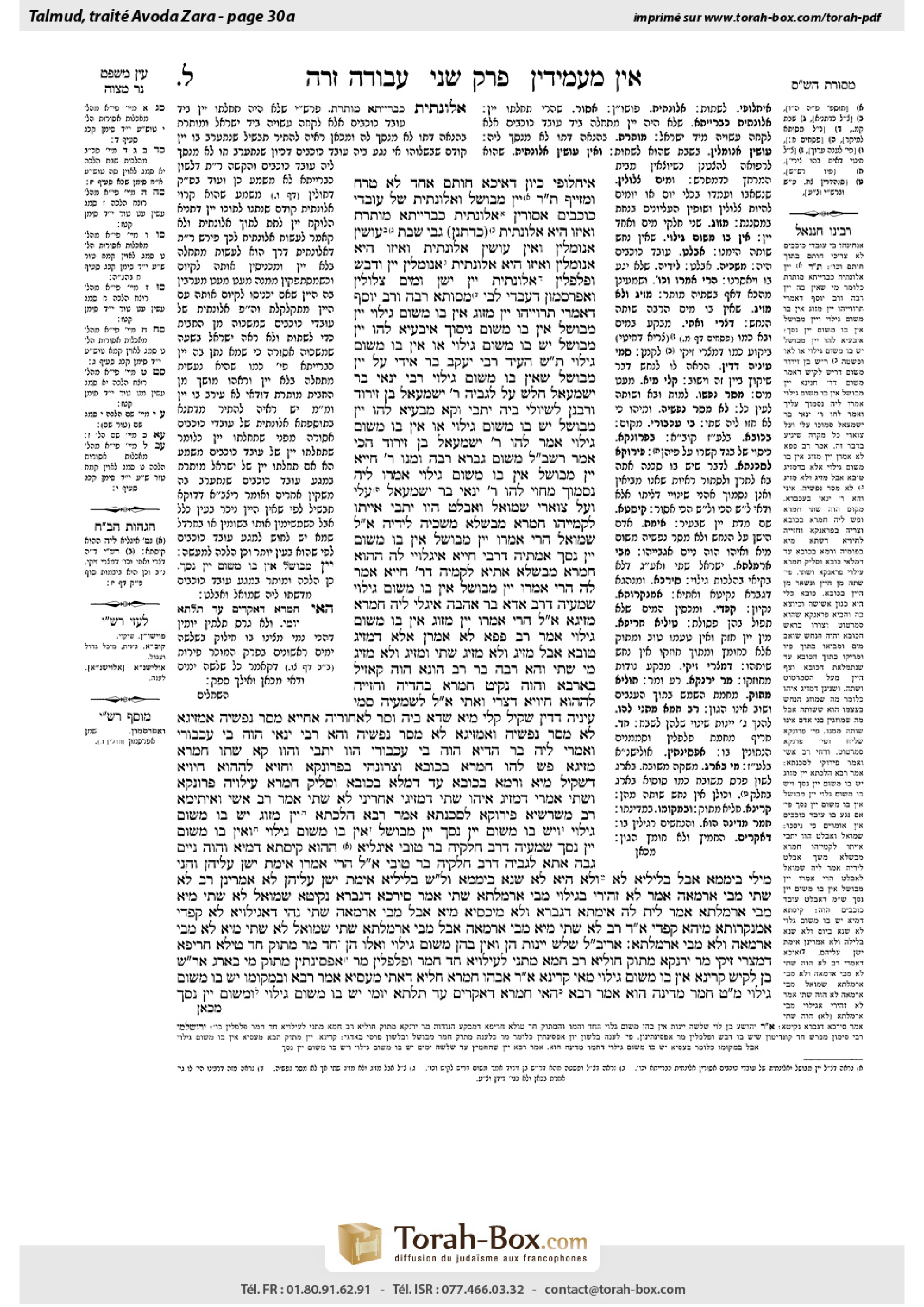
Avodah Zarah 30a: Talmud study for Daf Yomi
Study the Talmud for Daf Yomi with scanned pages, Hebrew text, English translations from Sefaria and AI-generated French translations.
Passage selection and English or AI-generated French translation are available where the scan has annotations. Daf Study is independent of Torah-Box and Sefaria.
Browse Avodah Zarah · עבודה זרה · All tractatesAvodah Zarah 30a text and translations
This page of Avodah Zarah includes the Aramaic text, an English translation and an AI-generated French translation, alongside the scan above.
עבודה זרה ל׳ א · Aramaic and Hebrew text
אִיחַלּוֹפֵי — כֵּיוָן דְּאִיכָּא חוֹתָם אֶחָד, לָא טָרַח וּמְזַיֵּיף.
תָּנוּ רַבָּנַן: יַיִן מְבוּשָּׁל וַאֲלוּנְתִּית שֶׁל גּוֹיִם — אֲסוּרִין, אֲלוּנְתִּית כִּבְרִיָּיתָהּ — מוּתֶּרֶת. וְאֵיזוֹ הִיא אֲלוּנְתִּית? כְּדִתְנַן גַּבֵּי שַׁבָּת: עוֹשִׂין אֵנוֹמֵלִין וְאֵין עוֹשִׂין אֲלוּנְתִּית. וְאֵיזוֹ הִיא אֵנוֹמֵלִין וְאֵיזוֹ הִיא אֲלוּנְתִּית? אֵנוֹמֵלִין — יַיִן וּדְבַשׁ וּפִלְפְּלִין, אֲלוּנְתִּית — יַיִן יָשָׁן וּמַיִם צְלוּלִין וַאֲפַרְסְמוֹן, דְּעָבְדִי לְבֵי מַסּוּתָא.
רַבָּה וְרַב יוֹסֵף דְּאָמְרִי תַּרְוַיְיהוּ: יַיִן מָזוּג אֵין בּוֹ מִשּׁוּם גִּילּוּי, יַיִן מְבוּשָּׁל אֵין בּוֹ מִשּׁוּם נִיסּוּךְ. אִיבַּעְיָא לְהוּ: יַיִן מְבוּשָּׁל יֵשׁ בּוֹ מִשּׁוּם גִּילּוּי אוֹ אֵין בּוֹ מִשּׁוּם גִּילּוּי? תָּא שְׁמַע: הֵעִיד רַבִּי יַעֲקֹב בַּר אִידִי עַל יַיִן מְבוּשָּׁל שֶׁאֵין בּוֹ מִשּׁוּם גִּילּוּי.
רַבִּי יַנַּאי בַּר יִשְׁמָעֵאל חֲלַשׁ, עַל לְגַבֵּיהּ רַבִּי יִשְׁמָעֵאל בֶּן זֵירוּד וְרַבָּנַן לְשַׁיּוֹלֵי בֵּיהּ. יָתְבִי וְקָא מִבַּעְיָא לְהוּ: יַיִן מְבוּשָּׁל, יֵשׁ בּוֹ מִשּׁוּם גִּילּוּי אוֹ אֵין בּוֹ מִשּׁוּם גִּילּוּי? אֲמַר לְהוּ רַבִּי יִשְׁמָעֵאל בֶּן זֵירוּד: הָכִי אָמַר רַבִּי שִׁמְעוֹן בֶּן לָקִישׁ מִשּׁוּם גַּבְרָא רַבָּה, וּמַנּוּ? רַבִּי חִיָּיא: יַיִן מְבוּשָּׁל אֵין בּוֹ מִשּׁוּם גִּילּוּי. אֲמַרוּ לֵיהּ: נִסְמוֹךְ? מַחְוֵי לְהוּ רַבִּי יַנַּאי בַּר יִשְׁמָעֵאל: עָלַי וְעַל צַוָּארִי.
שְׁמוּאֵל וְאַבְלֵט הֲווֹ יָתְבִי, אַיְיתוֹ לְקַמַּיְיהוּ חַמְרָא מְבַשְּׁלָא, מַשְׁכֵיהּ לִידֵיהּ, אֲמַר לֵיהּ שְׁמוּאֵל: הֲרֵי אָמְרוּ יַיִן מְבוּשָּׁל אֵין בּוֹ מִשּׁוּם יֵין נֶסֶךְ.
אַמְּתֵיהּ דְּרַבִּי חִיָּיא אִיגַּלִּויי לַהּ הָהוּא חַמְרָא מְבַשְּׁלָא, אֲתַאי לְקַמֵּיהּ דְּרַבִּי חִיָּיא, אֲמַר לַהּ: הֲרֵי אָמְרוּ יַיִן מְבוּשָּׁל אֵין בּוֹ מִשּׁוּם גִּילּוּי. שַׁמָּעֵיהּ דְּרַב אַדָּא בַּר אַהֲבָה אִיגַּלִּי לֵיהּ חַמְרָא מְזִיגָא, אֲמַר לֵיהּ: הֲרֵי אָמְרוּ יַיִן מָזוּג אֵין בּוֹ מִשּׁוּם גִּילּוּי.
אָמַר רַב פָּפָּא: לָא אֲמַרַן אֶלָּא דִּמְזִיג טוּבָא, אֲבָל מְזִיג וְלָא מְזִיג שָׁתֵי. וּמְזִיג וְלָא מְזִיג מִי שָׁתֵי? וְהָא רַבָּה בַּר רַב הוּנָא הֲוָה קָאָזֵיל בְּאַרְבָּא, וַהֲוָה נָקֵיט חַמְרָא בַּהֲדֵיהּ, וְחַזְיֵיהּ לְהָהוּא חִיוְיָא דְּצָרֵי וְאָתֵי. אֲמַר לֵיהּ לְשַׁמָּעֵיהּ: סַמִּי עֵינֵיהּ דְּדֵין. שְׁקֵיל קַלִּי מַיָּא שְׁדָא בֵּיהּ, וְסָר לַאֲחוֹרֵיהּ!
אַחַיָּיא מָסַר נַפְשֵׁיהּ, אַמְּזִיגָא לָא מְסַר נַפְשֵׁיהּ.
וְאַמְּזִיגָא לָא מָסַר נַפְשֵׁיהּ? וְהָא רַבִּי יַנַּאי הֲוָה בֵּי עַכְבּוֹרֵי, וְאָמְרִי לֵיהּ: בַּר הֶדְיָא הֲוָה בֵּי עַכְבּוֹרֵי, הֲווֹ יָתְבִי וַהֲווֹ קָא שָׁתוּ חַמְרָא מְזִיגָא. פָּשׁ לְהוּ חַמְרָא בְּכוּבָא, וּצְרוּנְהִי בִּפְרוֹנְקָא, וְחַזְיֵאּ לְהָהוּא חִיוְיָא דִּשְׁקֵיל מַיָּא וּרְמָא בְּכוּבָּא עַד דִּמְלָא בְּכוּבָּא, וּסְלֵיק חַמְרָא עִילָּוֵיה פְּרוֹנְקָא וְשָׁתֵי!
אָמְרִי: דְּמָזֵיג אִיהוּ שָׁתֵי, דְּמָזְגִי אַחֲרִינֵי לָא שָׁתֵי.
אָמַר רַב אָשֵׁי, וְאִיתֵּימָא רַב מְשַׁרְשְׁיָא: פֵּירוּקָא לְסַכַּנְתָּא? אָמַר רָבָא: הִלְכְתָא — יַיִן מָזוּג יֵשׁ בּוֹ מִשּׁוּם גִּילּוּי, וְיֵשׁ בּוֹ מִשּׁוּם יֵין נֶסֶךְ; יַיִן מְבוּשָּׁל אֵין בּוֹ מִשּׁוּם גִּילּוּי, וְאֵין בּוֹ מִשּׁוּם יֵין נֶסֶךְ.
שַׁמָּעֵיהּ דְּרַב חִלְקִיָּה בַּר טוֹבִי אִיגַּלַּי [לֵיהּ] הָהוּא קִיסְתָּא דְּמַיָּא, וַהֲוָה נָיֵים גַּבַּהּ. אֲתָא לְגַבֵּיהּ דְּרַב חִלְקִיָּה בַּר טוֹבִי, אֲמַר לֵיהּ: הֲרֵי אָמְרוּ ״אֵימַת יָשֵׁן עֲלֵיהֶן״, וְהָנֵי מִילֵּי בִּימָמָא, אֲבָל בְּלֵילְיָא — לָא. וְלָא הִיא, לָא שְׁנָא בִּימָמָא וְלָא שְׁנָא בְּלֵילְיָא, ״אֵימַת יָשֵׁן עֲלֵיהֶן״ לָא אָמְרִינַן.
רַב לָא שָׁתֵי [מַיָּא] מִבֵּי אֲרַמָּאָה, אָמַר: לָא זְהִירִי בְּגִילּוּי, מִבֵּי אַרְמַלְתָּא שָׁתֵי, אָמַר: סִירְכָא דְּגַבְרָא נְקִיטָא.
שְׁמוּאֵל לָא שָׁתֵי מַיָּא מִבֵּי אַרְמַלְתָּא, אָמַר: לֵית לַהּ אֵימְתָא דְּגַבְרָא וְלָא מְיכַסְּיָא מַיָּא, אֲבָל מִבֵּי אֲרַמָּאָה שָׁתֵי. נְהִי דְּאַגִּילּוּיָא לָא קָפְדִי, אַמְּנַקְּרוּתָא מִיהָא קָפְדִי. אִיכָּא דְּאָמְרִי: רַב לָא שָׁתֵי מַיָּא מִבֵּי אֲרַמָּאָה, אֲבָל מִבֵּי אַרְמַלְתָּא שָׁתֵי. שְׁמוּאֵל לָא שָׁתֵי מַיָּא, לָא מִבֵּי אֲרַמָּאָה וְלָא מִבֵּי אַרְמַלְתָּא.
אָמַר רַבִּי יְהוֹשֻׁעַ בֶּן לֵוִי: שָׁלֹשׁ יֵינוֹת הֵן, וְאֵין בָּהֶן מִשּׁוּם גִּילּוּי, וְאֵלּוּ הֵן: חַד, מָר, מָתוֹק. חַד — טִילָא חָרִיפָא דִּמְצָרֵי זִיקֵּי, מַר — יַרְנָקָא, מָתוֹק — חוּלְיָא. רַב חָמָא מַתְנֵי לְעִילּוּיָא: חַד — חֲמַר וּפִלְפְּלִין, מַר — אַפְּסִינְתִּין, מָתוֹק — מֵי בָּארְג.
אָמַר רַבִּי שִׁמְעוֹן בֶּן לָקִישׁ: קְרִינָא אֵין בּוֹ מִשּׁוּם גִּילּוּי. מַאי קְרִינָא? אָמַר רַבִּי אֲבָהוּ: חַמְרָא חַלְיָא דְּאָתֵי מֵעַסְיָא. אָמַר רָבָא: וּבִמְקוֹמוֹ יֵשׁ בּוֹ מִשּׁוּם גִּילּוּי, מַאי טַעְמָא? חֲמַר מְדִינָה הוּא. אָמַר רָבָא: הַאי חַמְרָא דְּאַקְרֵים, עַד תְּלָתָא יוֹמֵי יֵשׁ בּוֹ מִשּׁוּם גִּילּוּי וּמִשּׁוּם יֵין נֶסֶךְ,
Avodah Zarah 30a · English translation
the concern that a gentile may secretly exchange his wine with the wine of a Jew, since there is one seal, the gentile will not exert himself and forge a different seal in order to facilitate the exchange.
§ The Gemara discusses the halakha with regard to various types of wine. The Sages taught: Cooked wine and aluntit of gentiles are prohibited; but already prepared aluntit that was made by a Jew before it entered the gentile’s possession is permitted. The Gemara asks: And what is aluntit? It is as we learned in a baraita with regard to Shabbat: One may prepare anomlin, but one may not prepare aluntit. The baraita clarifies: And what is anomlin and what is aluntit? Anomlin is a drink that is a mixture of wine, honey, and pepper. Aluntit is a mixture of aged wine and clear water and balsam, which they prepare for drinking after bathing in a bathhouse to cool down from the heat of the bathhouse. It is prohibited to prepare aluntit on Shabbat because it is a type of remedy.
Rabba and Rav Yosef both say: Diluted wine is not subject to the halakha of exposure, according to which the consumption of a liquid is prohibited if it is left uncovered; and cooked wine is not subject to the halakha of libation, which prohibits deriving benefit from wine that has been in a gentile’s possession. A dilemma was raised before them: With regard to cooked wine, is it subject to the halakha of exposure, or is it not subject to the halakha of exposure? The Gemara resolves the dilemma: Come and hear: Rabbi Ya’akov bar Idi testified about cooked wine and stated that it is not subject to the halakha of exposure.
The Gemara cites another proof that cooked wine is not subject to the halakha of exposure. When Rabbi Yannai bar Yishmael became ill, Rabbi Yishmael ben Zeirud and other Sages went to him to inquire about his health. They were seated, and this very dilemma was raised before them: With regard to cooked wine, is it subject to the halakha of exposure, or is it not subject to the halakha of exposure? Rabbi Yishmael ben Zeirud said to them: This is what Rabbi Shimon ben Lakish says in the name of a great man. Parenthetically, the Gemara asks: And who is this great man? He is Rabbi Ḥiyya. He said: Cooked wine is not subject to the halakha of exposure. The Sages said to Rabbi Yishmael ben Zeirud: Shall we rely on this claim? Rabbi Yannai bar Yishmael motioned to them: Upon me and upon my neck, i.e., you can certainly rely on this claim.
The Gemara relates another incident: Shmuel and Ablet, a gentile scholar, were sitting together, and others brought cooked wine before them. Ablet withdrew his hand to avoid rendering the wine prohibited to Shmuel. Seeing this, Shmuel said to Ablet that the Sages said: Cooked wine is not subject to the prohibition of wine used for a libation, and therefore you need not withdraw your hand on my account.
The Gemara cites yet another incident: Rabbi Ḥiyya’s maidservant noticed that a certain container of cooked wine had become exposed. She came before Rabbi Ḥiyya, who said to her that the Sages said: Cooked wine is not subject to the halakha of exposure. Similarly, Rav Adda bar Ahava’s attendant noticed that a certain container of diluted wine had become exposed. Rav Adda bar Ahava said to him that the Sages said: Diluted wine is not subject to the halakha of exposure.
Rav Pappa said: We said that wine is not subject to the halakha of exposure only in a case where it was well diluted, but where it was only partially diluted a snake might still drink from it, and therefore it is prohibited. The Gemara rejects this claim: And is it correct that a snake drinks partially diluted wine? But wasn’t Rabba bar Rav Huna once traveling on a ship while carrying a jug of wine with him, and he saw a certain snake that slithered and approached the wine. He said to his attendant: Remove the eyes of this serpent, i.e., do something that will cause the snake to leave. His attendant took a bit of water and threw it in the wine, and the snake turned away. This indicates that snakes do not drink partially diluted wine.
The Gemara rejects this conclusion: For undiluted wine, a snake will risk its life by exposing itself to humans, but for diluted wine, a snake will not risk its life. But in either case, if the wine is left unguarded, a snake will drink from it.
The Gemara raises a difficulty: And is it true that for diluted wine a snake will not risk its life? But wasn’t Rabbi Yannai once in Bei Akhborei, and some say that it was bar Hadaya who was in Bei Akhborei, and others were sitting with him and drinking diluted wine. When they finished, they had some wine left in the container [bekhuva], and they covered it with a cloth. And then they saw a certain snake take water in its mouth and pour it through the cloth into the container until the liquid filled the container and the wine flowed over the cloth, and the snake drank the overflowing wine. This shows that a snake will risk its life to drink diluted wine.
The Sages say in response: Wine that the snake itself diluted, it does drink. Wine that another diluted, it does not drink. In other words, a snake does not drink diluted wine unless it was diluted by the snake itself. Accordingly, even partially diluted wine is not subject to the halakha of exposure.
Rav Ashi says, and some say that it was Rav Mesharshiyya who says: Are you providing a resolution for a situation involving danger? In other words, one may not endanger lives by subscribing to such reasoning. Rava said: The halakha is that diluted wine is subject to the halakha of exposure and is also subject to the prohibition of wine used as a libation for idolatry; cooked wine is not subject to the halakha of exposure and is not subject to the prohibition of wine used for a libation either.
§ After discussing exposed wine, the Gemara addresses the matter of exposed water. The attendant of Rav Ḥilkiya bar Tovi noticed that a certain jug of water had become exposed, and he had been sleeping near it. He went to Rav Ḥilkiya bar Tovi to determine the halakhic status of the exposed water. Rav Ḥilkiya said to him that the Sages said: Fear of a sleeping person is upon them, i.e., snakes will not attempt to drink from a container that is near a person, even if he is asleep. And this matter applies only during the day, but not at night. The Gemara comments: But that is not so. Rather, there is no difference between one who sleeps during the day and one who sleeps during the night. In both cases, we do not say that the fear of a sleeping person is upon the snakes.
The Gemara presents the opinions of Rav and Shmuel with regard to various sources of water. Rav would not drink water from the house of an Aramean, as he said: They are not careful with regard to exposure. But he would drink water from the house of a widow, as he said: She upholds her late husband’s conventions and ensures that liquids are not left uncovered.
By contrast, Shmuel would not drink water from the house of a widow, as he said: She no longer has the fear of a man upon her, and therefore she does not necessarily cover the water. But he would drink water from the house of an Aramean, as he said: Granted that they are not particular about the halakha of exposure, but in any event they are particular about cleanliness, and will cover it for hygienic reasons, if not halakhic ones. The Gemara cites a different version: Some say that Rav would not drink water from the house of an Aramean, but he would drink water from the house of a widow. Shmuel would not drink water either from the house of an Aramean or from the house of a widow.
Rabbi Yehoshua ben Levi says: There are three kinds of wines that are not subject to the halakha of exposure, and they are: Sharp, bitter, and sweet wines. Sharp is referring to acrid wine [tila] that cracks the jug, due to its acidity. Bitter is referring to yarneka. Sweet is referring to sweetened wine. These three wines that Rabbi Yehoshua ben Levi says are not subject to the halakha of exposure are all of low quality. Rav Ḥama teaches that the three wines are of high quality: Sharp is referring to wine mixed with peppers. Bitter is referring to wine mixed with wormwood [apsintin]. Sweet is referring to mei barg, a choice beverage.
Rabbi Shimon ben Lakish says: Karina is not subject to the halakha of exposure. The Gemara asks: What is karina? Rabbi Abbahu said: It is sweet wine that comes from Asia [Asya] Minor. Rava says: But in its place of origin it is subject to the halakha of exposure. What is the reason? The reason is that there, it is the wine of the province and snakes do not hesitate to drink from it. Rava said: With regard to this wine that has soured [de’akrim], until three days have passed from when it began to sour, it is subject to the halakha of exposure and is subject to the prohibition of wine used for a libation.
Avodah Zarah 30a · Traduction française (IA)
la crainte qu'un gentil puisse secrètement échanger son vin avec le vin d'un Juif, car il y a une seule empreinte, le gentil ne se donnera pas la peine de forge une autre empreinte afin de faciliter l'échange.
§ La Guemara discute de la halakha concernant divers types de vin. Les Sages enseignent : Le vin cuit et l'aluntit des gentils sont interdits ; mais l'aluntit déjà préparé par un Juif avant qu'il ne passe en possession des gentils est permis. La Guemara pose la question : Et qu'est-ce que l'aluntit ? C'est ce que nous avons appris dans une baraïta concernant le Shabbat : On peut préparer l'anomlin, mais on ne peut pas préparer l'aluntit. La baraïta précise : Et qu'est-ce que l'anomlin et l'aluntit ? L'anomlin est un breuvage qui est un mélange de vin, de miel et de poivre. L'aluntit est un mélange de vin vieilli et d'eau claire et de balsamique, qu'ils préparent pour boire après avoir pris une douche dans une salle de bain afin de se rafraîchir après la chaleur de la douche. Il est interdit de préparer l'aluntit le Shabbat, car c'est un type de remède.
Rabba et Rav Yosef disent tous les deux : Le vin dilué n'est pas soumis à la halakha de l'exposition, selon laquelle la consommation d'un liquide est interdite s'il est laissé découvert ; et le vin cuit n'est pas soumis à la halakha de la libation, qui interdit d'exploiter un vin qui appartient à un gentil. Un dilemme a été soulevé devant eux : Concernant le vin cuit, est-il soumis à la halakha de l'exposition, ou n'est-il pas soumis à la halakha de l'exposition ? La Guemara résout ce dilemme : Viens écouter : Rabbi Ya'akov bar Idi a témoigné concernant le vin cuit et a déclaré qu'il n'est pas soumis à la halakha de l'exposition.
La Guemara cite une autre preuve selon laquelle le vin cuit n’est pas soumis à la halakha de l’exposition. Lorsque Rabbi Yannai bar Yishmael est tombé malade, Rabbi Yishmael ben Zeirud et d’autres Sages sont allés le voir pour s’informer de son état de santé. Ils étaient assis, et ce même dilemme a été soulevé devant eux : concernant le vin cuit, est-il soumis à la halakha de l’exposition, ou n’est-il pas soumis à la halakha de l’exposition ? Rabbi Yishmael ben Zeirud a dit à eux : C’est ce que Rabbi Shimon ben Lakish dit en nom d’un grand homme. Par parenthèse, la Guemara pose la question : Et qui est ce grand homme ? C’est Rabbi Ḥiyya. Il a dit : Le vin cuit n’est pas soumis à la halakha de l’exposition. Les Sages ont dit à Rabbi Yishmael ben Zeirud : Devons-nous nous fier à cette affirmation ? Rabbi Yannai bar Yishmael a fait un geste à leurs égards : Sur moi et sur mon cou, c’est-à-dire que vous pouvez certainement vous fier à cette affirmation.
La Guemara rapporte un autre incident : Shmuel et Ablet, un savant gentil, étaient assis ensemble, et d'autres apportèrent du vin cuit devant eux. Ablet retira sa main pour éviter de rendre le vin interdit à Shmuel. Voyant cela, Shmuel dit à Ablet que les Sages avaient dit : Le vin cuit n'est pas soumis à l'interdiction du vin utilisé pour une libation, et donc vous n'avez pas besoin de retirer votre main à mon sujet.
La Guemara cite un autre incident : La servante de Rabbi Ḥiyya a remarqué qu'un certain récipient de vin cuit avait été exposé. Elle est venue devant Rabbi Ḥiyya, qui a dit à elle que les Sages avaient dit : Le vin cuit n'est pas soumis à la halakha de l'exposition. De même, l'attendant de Rav Adda bar Ahava a remarqué qu'un certain récipient de vin dilué avait été exposé. Rav Adda bar Ahava a dit à lui que les Sages avaient dit : Le vin dilué n'est pas soumis à la halakha de l'exposition.
Rav Pappa a dit : Nous avons dit que le vin n'est soumis à la halakha de l'exposition que dans le cas où il était bien dilué, mais lorsque le vin était seulement partiellement dilué, un serpent pourrait encore boire dedans, et donc il est interdit. La Guemara rejette cette affirmation : Et est-ce correct que le serpent boive du vin partiellement dilué ? Mais n'était-ce pas Rabba bar Rav Huna qui voyageait sur un bateau en portant une jarre de vin avec lui, et il a vu un certain serpent qui glissait et s'approchait du vin. Il a dit à son serviteur : Enlève les yeux de ce serpent, c'est-à-dire fais quelque chose qui fera quitter le serpent. Son serviteur a pris un peu d'eau et l'a jeté dans le vin, et le serpent s'est éloigné. Cela montre que les serpents ne boivent pas du vin partiellement dilué.
La Guemara rejette cette conclusion : Pour le vin non dilué, un serpent risquera sa vie en s'exposant aux humains, mais pour le vin dilué, un serpent ne risquera pas sa vie. Mais dans les deux cas, si le vin est laissé sans surveillance, un serpent boira dedans.
La Guemara soulève une difficulté : Et est-ce vrai que pour le vin dilué un serpent ne risquera pas sa vie ? Mais n'était-ce pas Rabbi Yannai qui était à Bei Akhborei, et certains disent que c'était bar Hadaya qui était à Bei Akhborei, et d'autres étaient assis avec lui et buvaient du vin dilué. Lorsqu'ils ont fini, ils avaient du vin restant dans le récipient [bekhuva], et ils l'ont recouvert d'un linge. Puis ils ont vu un certain serpent qui prenait de l'eau dans sa bouche et la versait à travers le linge dans le récipient jusqu'à ce que le liquide remplisse le récipient et que le vin déborde sur le linge, et le serpent buvait le vin qui débordait. Cela montre que le serpent risquera sa vie pour boire du vin dilué.
Les Sages répondent : Le vin que le serpent lui-même a dilué, il le boit. Le vin que quelqu'un d'autre a dilué, il ne le boit pas. En d'autres termes, un serpent ne boit pas du vin dilué à moins qu'il ne l'ait lui-même dilué. Ainsi, même le vin partiellement dilué n'est pas soumis à la halakha de l'exposition.
Rav Ashi dit, et certains disent que c'était Rav Mesharshiyya qui a dit : Vous donnez-vous une solution pour une situation dangereuse ? En d'autres termes, on ne doit pas mettre en danger des vies en adoptant de telle raisonnement. Rava a dit : La halakha est que le vin dilué est soumis à la halakha de l'exposition et est également soumis à l'interdiction du vin utilisé pour une libation idolâtre ; le vin cuit n'est pas soumis à la halakha de l'exposition et n'est pas non plus soumis à l'interdiction du vin utilisé pour une libation.
§ Après avoir discuté du vin exposé, le Guemara aborde la question de l'eau exposée. L'employé de Rav Ḥilkiya bar Tovi a remarqué qu'un certain récipient d'eau avait été exposé, et il avait dormi à proximité. Il est allé chez Rav Ḥilkiya bar Tovi pour déterminer le statut halakhique de l'eau exposée. Rav Ḥilkiya lui a dit que les Sages ont dit : La crainte d'une personne endormie est sur eux, c'est-à-dire que les serpents ne tenteront pas de boire d'un récipient qui est près d'une personne, même s'il dort. Et cette question s'applique uniquement pendant la journée, mais pas la nuit. Le Guemara commente : Mais cela n'est pas vrai. Plutôt, il n'y a pas de différence entre celui qui dort pendant la journée et celui qui dort pendant la nuit. Dans les deux cas, nous ne disons pas que la crainte d'une personne endormie est sur les serpents.
Le Guemara présente les opinions de Rav et de Shmuel concernant diverses sources d'eau. Rav ne boirait pas d'eau chez un Araméen, car il a dit : Ils ne prennent pas soin de l'exposition. Mais il boirait de l'eau chez une veuve, car il a dit : Elle respecte les coutumes de son défunt mari et s'assure que les liquides ne sont pas laissés exposés.
Par contraste, Shmuel ne boirait pas d'eau chez une veuve, car il a dit : Elle n'a plus la crainte d'un homme sur elle, et par conséquent elle ne couvre pas nécessairement l'eau. Mais il boirait de l'eau chez un Araméen, car il a dit : Bien que ce soit vrai qu'ils ne sont pas particuliers concernant la halakha de l'exposition, mais en tout cas ils sont particuliers concernant la propreté, et ils couvriront l'eau pour des raisons hygiéniques, si ce n'est pas pour des raisons halakhiques. Le Guemara cite une version différente : Certains disent que Rav ne boirait pas d'eau chez un Araméen, mais il boirait de l'eau chez une veuve. Shmuel ne boirait pas d'eau ni chez un Araméen ni chez une veuve.
Rabbi Yéhoshua ben Lévi dit : Il y a trois types de vins qui ne sont pas soumis à la halakha de l'exposition, et ils sont : Le vinaigre, le piquant et le doux. Le vinaigre fait référence au vin acide [tila] qui casse le récipient, en raison de son acide. Le piquant fait référence au yarneka. Le doux fait référence au vin sucré. Ces trois vins que Rabbi Yéhoshua ben Lévi dit ne sont pas soumis à la halakha de l'exposition sont tous de basse qualité. Rav Ḥama enseigne que les trois vins sont de haute qualité : Le vinaigre fait référence au vin mélangé avec des piments. Le piquant fait référence au vin mélangé avec de l'absinthe [apsintin]. Le doux fait référence au mei barg, une boisson élégante.
Rabbi Šimon ben Lakish dit : Le karina n'est pas soumis à la halakha de l'exposition. Le Guemara demande : Qu'est-ce que le karina ? Rabbi Abbahu a dit : C'est un vin sucré qui vient de l'Asie Mineure. Rava dit : Mais à son lieu d'origine, il est soumis à la halakha de l'exposition. Quelle est la raison ? La raison est que là-bas, c'est le vin de la province et les serpents n'hésitent pas à boire de celui-ci. Rava a dit : Concernant ce vin qui a ranci [de’akrim], jusqu'à trois jours après qu'il a commencé à rancir, il est soumis à la halakha de l'exposition et est soumis à l'interdiction du vin utilisé pour un sacrifice.
Traduction française générée par IA à partir de l’édition anglaise de Sefaria. Vérifie toujours un passage avec le texte source.
Text from Sefaria: William Davidson Edition - Vocalized Aramaic (CC BY NC); William Davidson Edition - English (CC BY NC).