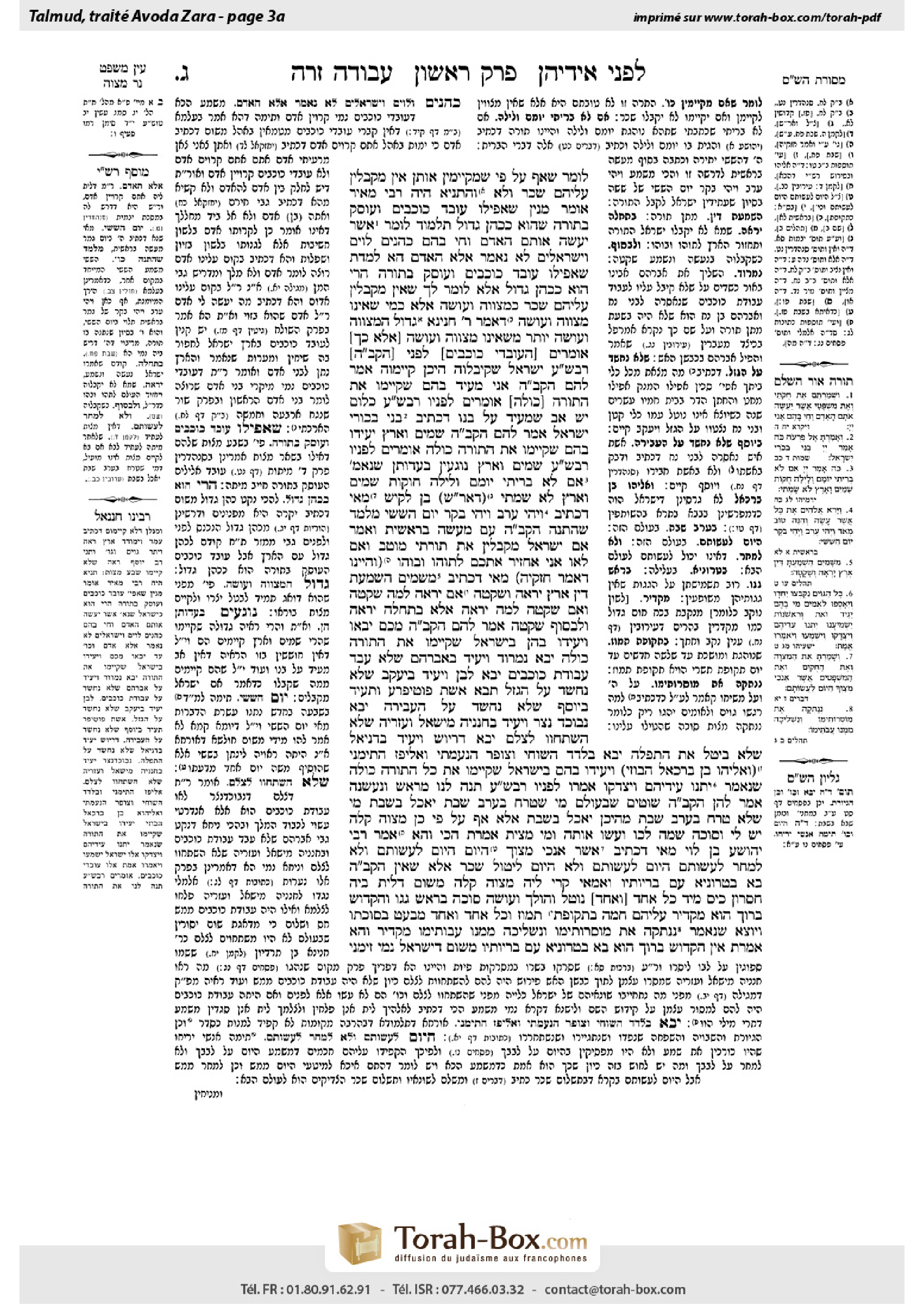
Avodah Zarah 3a: Talmud study for Daf Yomi
Study the Talmud for Daf Yomi with scanned pages, Hebrew text, English translations from Sefaria and AI-generated French translations.
Passage selection and English or AI-generated French translation are available where the scan has annotations. Daf Study is independent of Torah-Box and Sefaria.
Browse Avodah Zarah · עבודה זרה · All tractatesAvodah Zarah 3a text and translations
This page of Avodah Zarah includes the Aramaic text, an English translation and an AI-generated French translation, alongside the scan above.
עבודה זרה ג׳ א · Aramaic and Hebrew text
לוֹמַר, שֶׁאַף עַל פִּי שֶׁמְּקַיְּימִין אוֹתָן אֵין מְקַבְּלִין עֲלֵיהֶם שָׂכָר.
וְלָא? וְהָתַנְיָא: הָיָה רַבִּי מֵאִיר אוֹמֵר: מִנַּיִן שֶׁאֲפִילּוּ גּוֹי וְעוֹסֵק בַּתּוֹרָה שֶׁהוּא כְּכֹהֵן גָּדוֹל? תַּלְמוּד לוֹמַר: ״אֲשֶׁר יַעֲשֶׂה אֹתָם הָאָדָם וָחַי בָּהֶם״, כֹּהֲנִים לְוִיִּם וְיִשְׂרְאֵלִים לֹא נֶאֱמַר, אֶלָּא ״הָאָדָם״, הָא לָמַדְתָּ שֶׁאֲפִילּוּ גּוֹי וְעוֹסֵק בַּתּוֹרָה הֲרֵי הוּא כְּכֹהֵן גָּדוֹל.
אֶלָּא לוֹמַר לָךְ, שֶׁאֵין מְקַבְּלִין עֲלֵיהֶם שָׂכָר כִּמְצוֶּּוה וְעוֹשֶׂה, אֶלָּא כְּמִי שֶׁאֵינוֹ מְצוֶּּוה וְעוֹשֶׂה, דְּאָמַר רַבִּי חֲנִינָא: גָּדוֹל הַמְצוֶּּוה וְעוֹשֶׂה יוֹתֵר מִשֶּׁאֵינוֹ מְצוֶּּוה וְעוֹשֶׂה.
אֶלָּא כָּךְ אוֹמְרִים הַגּוֹיִם לִפְנֵי הַקָּדוֹשׁ בָּרוּךְ הוּא: רִבּוֹנוֹ שֶׁל עוֹלָם, יִשְׂרָאֵל שֶׁקִּיבְּלוּהָ הֵיכָן קִיְּימוּהָ?
אָמַר לָהֶם הַקָּדוֹשׁ בָּרוּךְ הוּא: אֲנִי מֵעִיד בָּהֶם שֶׁקִּיְּימוּ אֶת הַתּוֹרָה כּוּלָּהּ. אוֹמְרִים לְפָנָיו: רִבּוֹנוֹ שֶׁל עוֹלָם, כְּלוּם יֵשׁ אָב שֶׁמֵּעִיד עַל בְּנוֹ? דִּכְתִיב: ״בְּנִי בְּכוֹרִי יִשְׂרָאֵל״. אָמַר לָהֶם הַקָּדוֹשׁ בָּרוּךְ הוּא: שָׁמַיִם וָאָרֶץ יָעִידוּ בָּהֶם שֶׁקִּיְּימוּ אֶת הַתּוֹרָה כּוּלָּהּ.
אוֹמְרִים לְפָנָיו: רִבּוֹנוֹ שֶׁל עוֹלָם, שָׁמַיִם וָאָרֶץ נוֹגְעִין בְּעֵדוּתָן, שֶׁנֶּאֱמַר: ״אִם לֹא בְרִיתִי יוֹמָם וָלָיְלָה חֻקּוֹת שָׁמַיִם וָאָרֶץ לֹא שָׂמְתִּי״, (דְּאָמַר) [וְאָמַר] רַבִּי שִׁמְעוֹן בֶּן לָקִישׁ: מַאי דִּכְתִיב: ״וַיְהִי עֶרֶב וַיְהִי בֹקֶר יוֹם הַשִּׁשִּׁי״? מְלַמֵּד שֶׁהִתְנָה הַקָּדוֹשׁ בָּרוּךְ הוּא עִם מַעֲשֵׂה בְרֵאשִׁית, וְאָמַר: אִם יִשְׂרָאֵל מְקַבְּלִין אֶת תּוֹרָתִי מוּטָב, וְאִם לָאו — אֲנִי אַחֲזִיר אֶתְכֶם לְתוֹהוּ וָבוֹהוּ.
וְהַיְינוּ דְּאָמַר חִזְקִיָּה, מַאי דִּכְתִיב: ״מִשָּׁמַיִם הִשְׁמַעְתָּ דִּין אֶרֶץ יָרְאָה וְשָׁקָטָה״? אִם יָרְאָה לָמָּה שָׁקְטָה, וְאִם שָׁקְטָה לָמָּה יָרְאָה? אֶלָּא בַּתְּחִלָּה יָרְאָה, וּלְבַסּוֹף שָׁקְטָה.
אָמַר לָהֶם הַקָּדוֹשׁ בָּרוּךְ הוּא: מִכֶּם יָבֹאוּ וְיָעִידוּ בָּהֶן בְּיִשְׂרָאֵל שֶׁקִּיְּימוּ אֶת הַתּוֹרָה כּוּלָּהּ, יָבֹא נִמְרוֹד וְיָעִיד בְּאַבְרָהָם שֶׁלֹּא עָבַד עֲבוֹדָה זָרָה, יָבֹא לָבָן וְיָעִיד בְּיַעֲקֹב שֶׁלֹּא נֶחְשַׁד עַל הַגָּזֵל, תָּבֹא אֵשֶׁת פּוֹטִיפֶרַע וְתָעִיד בְּיוֹסֵף שֶׁלֹּא נֶחְשַׁד עַל הָעֲבֵירָה.
יָבֹא נְבוּכַדְנֶצַּר וְיָעִיד בַּחֲנַנְיָה מִישָׁאֵל וַעֲזַרְיָה שֶׁלֹּא הִשְׁתַּחֲווּ לַצֶּלֶם, יָבֹא דָּרְיָוֶשׁ וְיָעִיד בְּדָנִיֵּאל שֶׁלֹּא בִּיטֵּל אֶת הַתְּפִלָּה, יָבֹא בִּלְדַּד הַשּׁוּחִי וְצוֹפַר הַנַּעֲמָתִי וֶאֱלִיפַז הַתֵּימָנִי וֶאֱלִיהוּ בֶּן בַּרַכְאֵל הַבּוּזִי וְיָעִידוּ בָּהֶם בְּיִשְׂרָאֵל שֶׁקִּיְּימוּ אֶת כָּל הַתּוֹרָה כּוּלָּהּ, שֶׁנֶּאֱמַר: ״יִתְּנוּ עֵדֵיהֶם וְיִצְדָּקוּ״.
אָמְרוּ לְפָנָיו: רִבּוֹנוֹ שֶׁל עוֹלָם, תְּנֶהָ לָנוּ מֵרֹאשׁ וְנַעֲשֶׂנָּה. אָמַר לָהֶן הַקָּדוֹשׁ בָּרוּךְ הוּא: שׁוֹטִים שֶׁבָּעוֹלָם! מִי שֶׁטָּרַח בְּעֶרֶב שַׁבָּת יֹאכַל בְּשַׁבָּת, מִי שֶׁלֹּא טָרַח בְּעֶרֶב שַׁבָּת מֵהֵיכָן יֹאכַל בְּשַׁבָּת? אֶלָּא אַף עַל פִּי כֵן, מִצְוָה קַלָּה יֵשׁ לִי וְסוּכָּה שְׁמָהּ, לְכוּ וַעֲשׂוּ אוֹתָהּ.
וּמִי מָצֵית אָמְרַתְּ הָכִי? וְהָא אָמַר רַבִּי יְהוֹשֻׁעַ בֶּן לֵוִי: מַאי דִּכְתִיב ״אֲשֶׁר אָנֹכִי מְצַוְּךָ הַיּוֹם״, הַיּוֹם לַעֲשׂוֹתָם וְלֹא לְמָחָר לַעֲשׂוֹתָם, הַיּוֹם לַעֲשׂוֹתָם וְלֹא הַיּוֹם לִיטּוֹל שָׂכָר.
אֶלָּא, שֶׁאֵין הַקָּדוֹשׁ בָּרוּךְ הוּא בָּא בִּטְרוּנְיָא עִם בְּרִיּוֹתָיו. וְאַמַּאי קָרֵי לֵיהּ ״מִצְוָה קַלָּה״? מִשּׁוּם דְּלֵית בַּיהּ חֶסְרוֹן כִּיס.
מִיָּד כׇּל אֶחָד וְאֶחָד נוֹטֵל וְהוֹלֵךְ וְעוֹשֶׂה סוּכָּה בְּרֹאשׁ גַּגּוֹ, וְהַקָּדוֹשׁ בָּרוּךְ הוּא מַקְדִּיר עֲלֵיהֶם חַמָּה בִּתְקוּפַת תַּמּוּז, וְכׇל אֶחָד וְאֶחָד מְבַעֵט בְּסוּכָּתוֹ וְיוֹצֵא, שֶׁנֶּאֱמַר: ״נְנַתְּקָה אֶת מוֹסְרוֹתֵימוֹ וְנַשְׁלִיכָה מִמֶּנּוּ עֲבֹתֵימוֹ״. מַקְדִּיר? וְהָא אָמְרַתְּ: אֵין הַקָּדוֹשׁ בָּרוּךְ הוּא בָּא בִּטְרוּנְיָא עִם בְּרִיּוֹתָיו! מִשּׁוּם דְּיִשְׂרָאֵל נָמֵי זִימְנֵי
Avodah Zarah 3a · English translation
This serves to say that even if they fulfill the seven Noahide mitzvot they do not receive a reward for their fulfilment.
The Gemara asks: And are they not rewarded for fulfilling those mitzvot? But isn’t it taught in a baraita that Rabbi Meir would say: From where is it derived that even a gentile who engages in Torah study is considered like a High Priest? The verse states: “You shall therefore keep My statutes and My ordinances, which if a person do, and shall live by them” (Leviticus 18:5). It is not stated: Priests, Levites, and Israelites, but rather the general term “person.” From here you learn that even a gentile who engages in the study of Torah is like a High Priest. This demonstrates that gentiles are rewarded for fulfilling mitzvot, despite the fact that they are not commanded to do so.
Rather, the verse serves to tell you that they do not receive as great a reward for their fulfillment as one who is commanded and performs a mitzva. Rather, they receive a lesser reward, like that of one who is not commanded and still performs a mitzva. As Rabbi Ḥanina says: Greater is one who is commanded to do a mitzva and performs it than one who is not commanded and performs it.
The Gemara returns to the discussion between God and the nations of the world, whose claims are rejected with the rebuttal that they did not receive the Torah because they did not fulfill the seven Noahide mitzvot that were incumbent upon them. Rather, this is what the gentiles say before the Holy One, Blessed be He: Master of the Universe, as for the Jewish people who accepted the Torah, where is the evidence that they fulfilled its mitzvot?
The Holy One, Blessed be He, says to them in response: I will testify about the Jewish people that they fulfilled the Torah in its entirety. The nations say before Him: Master of the Universe, is there a father who can testify about his son? As it is written: “Israel is My son, My firstborn” (Exodus 4:22). Since God is considered the Father of the Jewish people, He is disqualified from testifying on their behalf. The Holy One, Blessed be He, said to them: Heaven and earth will testify about them that they fulfilled the Torah in its entirety.
The nations say before Him: Master of the Universe, in this matter the testimony of heaven and earth is tainted by a conflict of interest, as it is stated: “If My covenant be not with day and night, I would not have appointed the ordinances of heaven and earth” (Jeremiah 33:25). And concerning this verse, Rabbi Shimon ben Lakish says: What is the meaning of that which is written: “And there was evening and there was morning, the sixth day” (Genesis 1:31)? This teaches that the Holy One, Blessed be He, established a condition with the acts of Creation, and said: If the Jewish people accept My Torah at the revelation at Sinai, all is well, but if they do not accept it, I will return you to the primordial state of chaos and disorder.
And this is similar to that which Ḥizkiyya says with regard to a different matter: What is the meaning of that which is written: “You caused sentence to be heard from heaven; the earth feared, and was silent” (Psalms 76:9)? If the earth feared, why was it silent, and if it was silent, why did it fear? One who is afraid does not stay silent, and one who remains silent thereby demonstrates that he is not afraid. Rather, this is the meaning of the verse: At first, when God came to give the Torah to the Jewish people, the earth feared that they might not accept it, and it would be destroyed. This is alluded to by the phrase “You caused sentence to be heard.” But ultimately, when the Jews accepted the Torah, the earth was silent. Consequently, heaven and earth are interested parties and cannot testify about the Jewish people’s commitment to the Torah.
Instead, the Holy One, Blessed be He, says to the nations: Let the witnesses come from among you and testify that the Jewish people fulfilled the Torah in its entirety. Let Nimrod come and testify about Abraham that he did not engage in idol worship. Let Laban come and testify about Jacob that he is not suspect with regard to robbery (see Genesis 31:36–42). Let the wife of Potiphar come and testify about Joseph that he is not suspect with regard to the sin of adultery (see Genesis 39:7–12).
Let Nebuchadnezzar come and testify about Hananiah, Mishael, and Azariah that they did not prostrate themselves before a graven image. Let Darius come and testify about Daniel that he did not neglect his prayer (see Daniel 6). Let Bildad the Shuhite, and Zophar the Naamathite, and Eliphaz the Temanite, and Elihu, son of Barachel, the Buzite, friends of Job (see Job 2:11 and 32:2) come and testify about the Jewish people that they fulfilled the Torah in its entirety. As it is stated: “All the nations are gathered together…let them bring their witnesses, that they may be justified” (Isaiah 43:9), i.e., the gathered gentiles will submit testimony on behalf of the Jewish people and demonstrate the Jews’ righteousness.
The gentiles say before Him: Master of the Universe, give us the Torah afresh and we will perform its mitzvot. The Holy One, Blessed be He, says to them in response: Fools of the world! Do you think you can request this? One who takes pains on Shabbat eve will eat on Shabbat, but one who did not take pains on Shabbat eve, from where will he eat on Shabbat? The opportunity for performing mitzvot has already passed, and it is now too late to ask to perform them. But even so, I have an easy mitzva to fulfill, and its name is sukka; go and perform it.
The Gemara asks: And how can you say so, that it is possible to perform a mitzva after the end of this world? But doesn’t Rabbi Yehoshua ben Levi say: What is the meaning of that which is written: “You shall therefore keep the commandment, and the statutes, and the ordinances, which I command you this day, to do them” (Deuteronomy 7:11)? This verse teaches that today, in this world, is the time to do them, but tomorrow, in the World-to-Come, is not the time to do them. Furthermore, today is the time to do them, but today is not the time to receive one’s reward, which is granted in the World-to-Come.
The Gemara explains: But even so, God gave the nations an opportunity to perform a mitzva, as The Holy One, Blessed be He, does not deal tyrannically [beteruneya] with His creations, but wants them to feel that they have been judged fairly. The Gemara asks: And why does God call the mitzva of sukka an easy mitzva to fulfill? Because performing the mitzva involves no monetary loss.
Immediately, each and every gentile will take materials and go and construct a sukka on top of his roof. And the Holy One, Blessed be He, will set upon them the heat [makdir] of the sun in the season of Tammuz, i.e., the summer, and each and every one who is sitting in his sukka will be unable to stand the heat, and he will kick his sukka and leave, as it is stated: “Let us break their bands asunder, and cast away their cords from us” (Psalms 2:3). The Gemara asks: Why does God heat the sun over them? But didn’t you say that the Holy One, Blessed be He, does not deal tyrannically with His creations? The Gemara answers: This is not considered dealing tyrannically with the gentiles, because for the Jewish people as well, there are times
Avodah Zarah 3a · Traduction française (IA)
Cela permet de dire que même s'ils remplissent les sept commandements de Noé, ils ne reçoivent pas de récompense pour leur accomplissement.
La Guemara demande : Et ne sont-ils pas récompensés pour l'accomplissement de ces commandements ? Mais n'est-il pas enseigné dans une baraïta que Rabbi Meïr disait : D'où tire-t-on que même un non-Juif qui étudie la Torah est considéré comme un grand prêtre ? La Parashah dit : « Vous donc garderez mes statues et mes ordonnances, et celui qui les observera vivra par elles » (Lévitique 18:5). Il n'est pas dit : les prêtres, les Lévites et les Israélites, mais plutôt le terme général « personne ». D'où l'on tire que même un non-Juif qui étudie la Torah est comme un grand prêtre. Cela montre que les non-Juifs sont récompensés pour l'accomplissement des commandements, malgré le fait qu'ils ne sont pas commandés à le faire.
En réalité, la Parashah sert à vous dire que leur accomplissement ne leur vaut pas une récompense aussi grande que celui qui est commandé et qui accomplit un commandement. Ils reçoivent une récompense moindre, comme celui qui n'est pas commandé et qui accomplit toutefois un commandement. Comme Rabbi Ḥanina le dit : Celui qui est commandé à accomplir un commandement et l'accomplit est supérieur à celui qui n'est pas commandé et l'accomplit.
La Guemara reprend la discussion entre Dieu et les nations du monde, dont les revendications sont rejetées avec la réfutation selon laquelle ils n'ont pas reçu la Torah car ils n'ont pas accompli les sept commandements de Noé qui leur étaient imposés. En réalité, c'est ce que disent les nations devant le Saint des saints : Seigneur de l'Univers, concernant le peuple d'Israël qui a accepté la Torah, où est la preuve qu'ils ont accompli ses commandements ?
Le Saint des saints répond à leur sujet : Je témoignerai du peuple d'Israël qu'ils ont accompli la Torah dans son entier. Les nations disent devant Lui : Seigneur de l'Univers, y a-t-il un père qui puisse témoigner de son fils ? Comme il est écrit : « Israël est mon fils, mon premier-né » (Exode 4:22). Puisque Dieu est considéré comme le père du peuple d'Israël, Il est disqualifié pour témoigner à leur sujet. Le Saint des saints dit à leur sujet : Le ciel et la terre témoigneront d'eux qu'ils ont accompli la Torah dans son entier.
Les nations disent devant Lui : Seigneur de l'Univers, dans cette affaire, le témoignage du ciel et de la terre est souillé par un conflit d'intérêts, comme il est dit : « Si mon alliance n'était pas avec le jour et la nuit, je n'aurais pas établi les ordonnances du ciel et de la terre » (Jérémie 33:25). Et concernant cette citation, Rabbi Šimon ben Lakish dit : Quelle est la signification de ce qui est écrit : « Il y eut l'après-midi et il y eut le matin, le sixième jour » (Genèse 1:31) ? Cela enseigne que le Saint des saints a établi une condition avec les actes de la Création, et a dit : Si le peuple d'Israël accepte ma Torah à la révélation du Sinaï, tout va bien, mais s'ils ne l'acceptent pas, je les ramènerai à l'état primitif de chaos et de désordre.
Et cela est semblable à ce que Ḥizkiyya dit concernant une autre affaire : Quelle est la signification de ce qui est écrit : « Tu as fait entendre la sentence du ciel ; la terre tremblait et était muette » (Psaumes 76:9) ? Si la terre tremblait, pourquoi était-elle muette, et si elle était muette, pourquoi tremblait-elle ? Celui qui a peur ne reste pas muet, et celui qui reste muet démontre qu'il n'a pas peur. En réalité, c'est la signification de la parole : Au début, quand Dieu est venu donner la Torah au peuple d'Israël, la terre avait peur qu'ils ne l'acceptent pas et qu'elle soit détruite. Cela est allégué par la phrase « Tu as fait entendre la sentence ». Mais finalement, quand les Juifs ont accepté la Torah, la terre était muette. Ainsi, le ciel et la terre sont des parties prenantes et ne peuvent témoigner du dévouement du peuple d'Israël à la Torah.
Au lieu de cela, le Saint des saints dit aux nations : Faites venir des témoins parmi vous et témoignez que le peuple d'Israël a accompli la Torah dans son entier. Faites venir Nimrod et qu'il témoigne d'Abraham qu'il n'a pas pratiqué l'idolâtrie. Faites venir Laban et qu'il témoigne de Jacob qu'il n'est pas suspect concernant le vol (voir Genèse 31:36–42). Faites venir la femme de Potiphar et qu'elle témoigne de Joseph qu'il n'est pas suspect concernant le péché d'adultère (voir Genèse 39:7–12).
Faites venir Nebuchadnezzar et qu'il témoigne d'Hananiah, de Mishael et d'Azariah qu'ils n'ont pas prosterné devant une image gravée. Faites venir Darius et qu'il témoigne de Daniel qu'il n'a pas négligé sa prière (voir Daniel 6). Faites venir Bildad le Shuhite, et Zophar le Naamathite, et Eliphaz le Temanite, et Elihu, fils de Barachel le Buzite, amis de Job (voir Job 2:11 et 32:2) et qu'ils témoignent du peuple d'Israël qu'ils ont accompli la Torah dans son entier. Comme il est dit : « Toutes les nations sont réunies ensemble… qu'ils apportent leurs témoins, afin qu'ils soient justifiés » (Isaïe 43:9), c'est-à-dire que les nations réunies témoigneront en faveur du peuple d'Israël et démontreront la justesse des Juifs.
Les nations disent devant Lui : Seigneur de l'Univers, donne-nous la Torah à nouveau et nous accomplirons ses commandements. Le Saint des saints répond à leur sujet : Des imbéciles du monde ! Pensez-vous pouvoir demander cela ? Celui qui s'applique à la préparation du soir du Shabbat mangera le Shabbat, mais celui qui n'a pas pris de soins à la préparation du soir du Shabbat, d'où viendra-t-il manger le Shabbat ? L'opportunité d'accomplir des commandements est déjà passée, et il est maintenant trop tard pour les demander. Mais même ainsi, j'ai un commandement facile à accomplir, et son nom est la sukkah ; allez et accomplissez-le.
La Guemara pose la question : Et comment pouvez-vous dire cela, que l'on peut accomplir une Mitsva après la fin de ce monde ? Mais ne dit-il pas Rabbi Yéhoshua ben Lévi : Quelle est la signification de ce qui est écrit : « Vous donc garderez donc l'ordre, et les statuts, et les lois, que je vous commande aujourd'hui, pour les faire » (Deutéronome 7:11) ? Cette versette enseigne que aujourd'hui, dans ce monde, est le temps de les faire, mais demain, dans le Monde à Venir, ce n'est pas le temps de les faire. De plus, aujourd'hui est le temps de les faire, mais aujourd'hui n'est pas le temps de recevoir sa récompense, qui est donnée dans le Monde à Venir.
La Guemara explique : Mais même ainsi, Dieu a donné aux nations l'opportunité d'accomplir une Mitsva, car le Saint, le Très Haut, Béni soit-Il, ne traite pas tyranniquement [beteruneya] avec ses créatures, mais veut qu'elles se sentent jugées équitablement. La Guemara pose la question : Et pourquoi Dieu appelle-t-il la Mitsva de la succah une Mitsva facile à accomplir ? Parce que l'accomplissement de la Mitsva ne comporte pas de perte financière.
Immédiatement, chaque gentil construira des matériaux et ira construire une succah sur le toit de sa maison. Et le Saint, le Très Haut, Béni soit-Il, fera brûler le soleil [makdir] en Tammuz, c'est-à-dire en été, et chaque personne qui est assise dans sa succah ne pourra pas supporter la chaleur, et il kickera sa succah et la quittera, comme il est dit : « Faisons briser leurs chaînes, et jetons leurs cordes loin de nous » (Psaumes 2:3). La Guemara pose la question : Pourquoi Dieu fait-il brûler le soleil sur eux ? Mais n'avez-vous pas dit que le Saint, le Très Haut, Béni soit-Il, ne traite pas tyranniquement avec ses créatures ? La Guemara répond : Cela n'est pas considéré comme un traitement tyrannique des gentils, car pour le peuple juif également, il y a des moments
Traduction française générée par IA à partir de l’édition anglaise de Sefaria. Vérifie toujours un passage avec le texte source.
Text from Sefaria: William Davidson Edition - Vocalized Aramaic (CC BY NC); William Davidson Edition - English (CC BY NC).