Avodah Zarah 31a: Talmud study for Daf Yomi
Study the Talmud for Daf Yomi with scanned pages, Hebrew text, English translations from Sefaria and AI-generated French translations.
Passage selection and English or AI-generated French translation are available where the scan has annotations. Daf Study is independent of Torah-Box and Sefaria.
Browse Avodah Zarah · עבודה זרה · All tractatesAvodah Zarah 31a text and translations
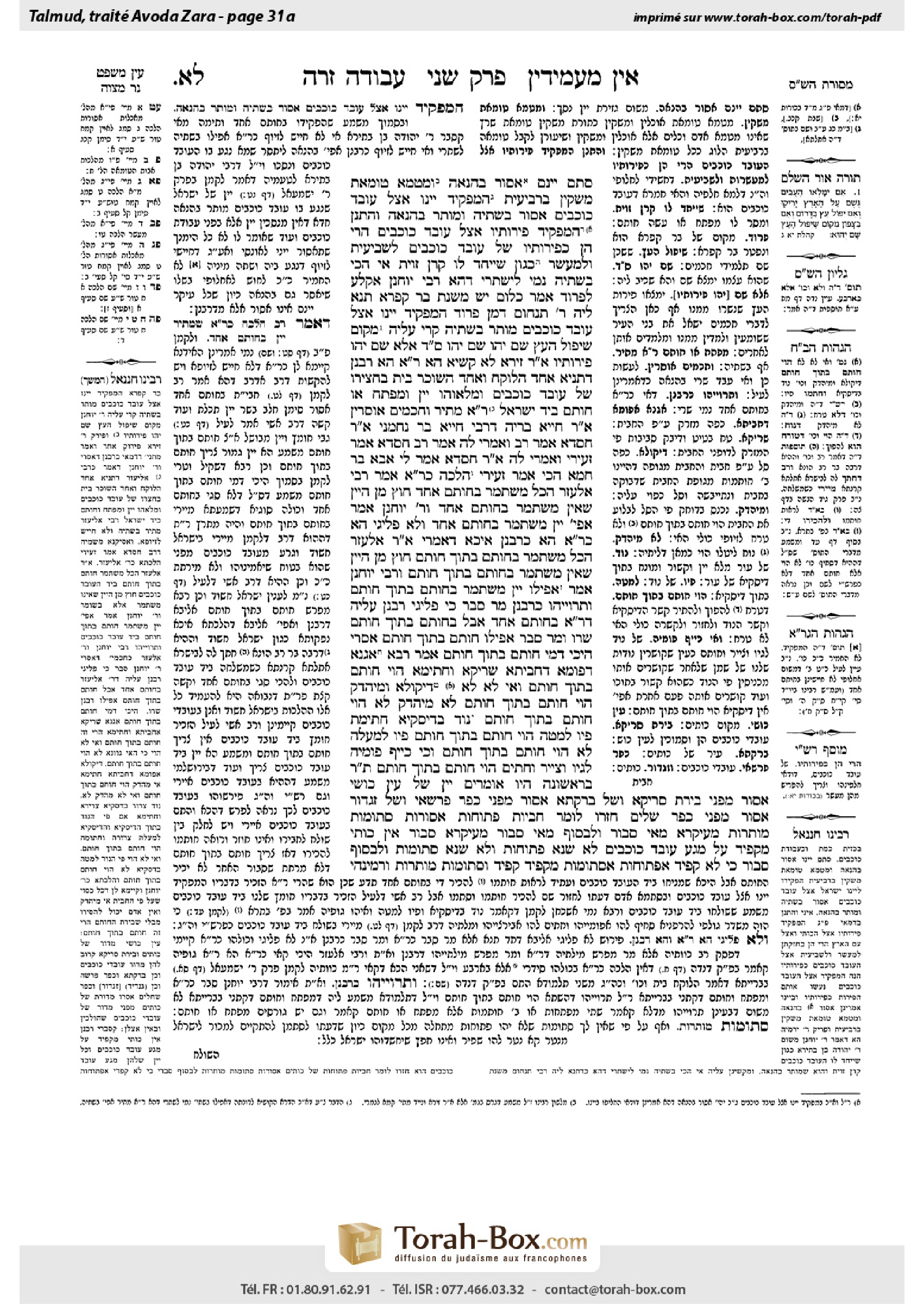
This page of Avodah Zarah includes the Aramaic text, an English translation and an AI-generated French translation, alongside the scan above.
עבודה זרה ל״א א · Aramaic and Hebrew text
סְתָם יֵינָם — אָסוּר בַּהֲנָאָה, וּמְטַמֵּא טוּמְאַת מַשְׁקִין בִּרְבִיעִית. הַמַּפְקִיד יֵינוֹ אֵצֶל גּוֹי — אָסוּר בִּשְׁתִיָּה, וּמוּתָּר בַּהֲנָאָה.
וְהָתְנַן: הַמַּפְקִיד פֵּירוֹתָיו אֵצֶל גּוֹי, הֲרֵי הֵן כְּפֵירוֹתָיו שֶׁל גּוֹי לִשְׁבִיעִית וּלְמַעֲשֵׂר! כְּגוֹן שֶׁיִּיחֵד לוֹ קֶרֶן זָוִית.
אִי הָכִי, בִּשְׁתִיָּה נָמֵי לִישְׁתְּרֵי! דְּהָא רַבִּי יוֹחָנָן אִקְּלַע לְפָרוֹד, אָמַר: כְּלוּם יֵשׁ מִשְׁנַת בַּר קַפָּרָא? תְּנָא לֵיהּ רַבִּי תַּנְחוּם דְּמִן פָּרוֹד: הַמַּפְקִיד יֵינוֹ אֵצֶל גּוֹי — מוּתָּר בִּשְׁתִיָּה.
קָרֵי עֲלֵיהּ ״מְקוֹם שֶׁיִּפּוֹל הָעֵץ שָׁם יְהוּ״, ״שָׁם יְהוּ״ סָלְקָא דַּעְתָּךְ? אֶלָּא שָׁם יְהוּ פֵּירוֹתָיו.
אָמַר רַבִּי זֵירָא: לָא קַשְׁיָא — הָא רַבִּי אֱלִיעֶזֶר, הָא רַבָּנַן.
דְּתַנְיָא: אֶחָד הַלּוֹקֵחַ וְאֶחָד הַשּׂוֹכֵר בַּיִת בַּחֲצֵירוֹ שֶׁל גּוֹי, וּמִלְּאוּהוּ יַיִן, וּמַפְתֵּחַ אוֹ חוֹתָם בְּיַד יִשְׂרָאֵל — רַבִּי אֱלִיעֶזֶר מַתִּיר, וַחֲכָמִים אוֹסְרִין.
אָמַר רַבִּי חִיָּיא בְּרֵיהּ דְּרַבִּי חִיָּיא בַּר נַחְמָנִי, אָמַר רַב חִסְדָּא אָמַר רַב, וְאָמְרִי לַהּ אָמַר רַב חִסְדָּא אָמַר זְעֵירִי, וְאָמְרִי לַהּ אָמַר רַב חִסְדָּא: אֲמַר לִי אַבָּא בַּר חָמָא, הָכִי אָמַר זְעֵירִי: הֲלָכָה כְּרַבִּי אֱלִיעֶזֶר.
אָמַר רַבִּי אֶלְעָזָר: הַכֹּל מִשְׁתַּמֵּר בְּחוֹתָם אֶחָד, חוּץ מִן הַיַּיִן שֶׁאֵין מִשְׁתַּמֵּר בְּחוֹתָם אֶחָד. וְרַבִּי יוֹחָנָן אָמַר: אֲפִילּוּ יַיִן מִשְׁתַּמֵּר בְּחוֹתָם אֶחָד. וְלָא פְּלִיגִי — הָא כְּרַבִּי אֱלִיעֶזֶר, הָא כְּרַבָּנַן.
אִיכָּא דְּאָמְרִי, אָמַר רַבִּי אֶלְעָזָר: הַכֹּל מִשְׁתַּמֵּר בְּחוֹתָם בְּתוֹךְ חוֹתָם, חוּץ מִן הַיַּיִן שֶׁאֵין מִשְׁתַּמֵּר בְּחוֹתָם בְּתוֹךְ חוֹתָם. וְרַבִּי יוֹחָנָן אָמַר: אֲפִילּוּ יַיִן מִשְׁתַּמֵּר בְּחוֹתָם בְּתוֹךְ חוֹתָם. וְתַרְוַיְיהוּ כְּרַבָּנַן, מָר סָבַר: כִּי פְּלִיגִי רַבָּנַן עֲלֵיהּ דְּרַבִּי אֱלִיעֶזֶר בְּחוֹתָם אֶחָד, אֲבָל בְּחוֹתָם בְּתוֹךְ חוֹתָם שָׁרוּ. וּמָר סָבַר: אֲפִילּוּ חוֹתָם בְּתוֹךְ חוֹתָם אָסְרִי.
הֵיכִי דָּמֵי חוֹתָם בְּתוֹךְ חוֹתָם? אָמַר רָבָא: אַגָּנָא דְּפוּמָּא דְּחָבִיתָא שְׁרִיקָא וַחֲתִימָא — הָוֵי חוֹתָם בְּתוֹךְ חוֹתָם, וְאִי לָא — לָא. דִּיקּוּלָא וּמִיהַדַּק — הָוֵי חוֹתָם בְּתוֹךְ חוֹתָם, לָא מִיהַדַּק — לָא הָוֵי חוֹתָם בְּתוֹךְ חוֹתָם. נוֹד בְּדִיסַקַּיָּא, חֲתִימַת פִּיו לְמַטָּה — הָוֵי חוֹתָם בְּתוֹךְ חוֹתָם, פִּיו לְמַעְלָה — לָא הָוֵי חוֹתָם בְּתוֹךְ חוֹתָם, וְכִי כַּיִיף פּוּמֵּיהּ לְגָיו וְצַיִיר וַחֲתִים — הָוֵי חוֹתָם בְּתוֹךְ חוֹתָם.
תָּנוּ רַבָּנַן, בָּרִאשׁוֹנָה הָיוּ אוֹמְרִים: יַיִן שֶׁל עֵין כּוּשִׁי אָסוּר מִפְּנֵי בִּירַת סְרִיקָא, וְשֶׁל בַּרְקָתָא אָסוּר מִפְּנֵי כְּפַר פַּרְשַׁאי, וְשֶׁל זַגְדוֹר אָסוּר מִפְּנֵי כְּפַר שָׁלֵים. חָזְרוּ לוֹמַר: חָבִיּוֹת פְּתוּחוֹת אֲסוּרוֹת, סְתוּמוֹת מוּתָּרוֹת.
מֵעִיקָּרָא מַאי סְבוּר, וּלְבַסּוֹף מַאי סְבוּר? מֵעִיקָּרָא סְבוּר: אֵין כּוּתִי מַקְפִּיד עַל מַגַּע גּוֹי, לָא שְׁנָא פְּתוּחוֹת וְלָא שְׁנָא סְתוּמוֹת. וּלְבַסּוֹף סְבוּר: כִּי לָא קָפֵיד אַפְּתוּחוֹת, אַסְּתוּמוֹת מִקְפָּיד קָפֵיד.
וּסְתוּמוֹת מוּתָּרוֹת? וּרְמִינְהִי:
Avodah Zarah 31a · English translation
It is prohibited to derive benefit from nondescript wine of a gentile, and the wine imparts the ritual impurity of liquids when it has the volume of one-quarter of a log. With regard to the wine of one who deposits his wine with a gentile, one is prohibited from drinking it, but one is permitted to derive benefit from it.
The Gemara raises a difficulty: But didn’t we learn in a mishna (Bekhorot 11b): With regard to one who deposits his produce with a gentile, it has the status of the produce of a gentile with regard to the halakhot of the Sabbatical Year and with regard to tithe, as the gentile might have exchanged the Jew’s produce with untithed produce or produce of the Sabbatical Year. According to this logic, wine deposited with a gentile should be entirely prohibited, due to the concern that the gentile exchanged it with his own. The Gemara answers: It is permitted for one to derive benefit from the wine in a case where the gentile designated a corner for the Jew’s wine, i.e., if the wine was locked away in a specific place to which only a Jew has access.
The Gemara questions this: If that is so, drinking from the wine should also be permitted. As Rabbi Yoḥanan once happened to come to Parod, where the deceased tanna bar Kappara had lived. When he arrived, he said: Is there any Mishna of bar Kappara here? In response, Rabbi Tanḥum of Parod taught him the following baraita, citing bar Kappara: With regard to one who deposits his wine with a gentile, drinking from the wine is permitted.
Upon hearing this, Rabbi Yoḥanan read the following verse about him: “Where the tree falls, there it shall be” (Ecclesiastes 11:3). Does it enter your mind that this means that the tree itself will be there? It is obvious that a fallen tree lands where it falls. Rather, the verse is saying: There its fruits shall be. The verse is a metaphor for a Sage, and its fruits represent his disciples. Rabbi Yoḥanan was intimating that although bar Kappara may have died, Rabbi Tanḥum, his disciple, perpetuates his wisdom.
In any event, it is apparent from the baraita quoted by Rabbi Tanḥum that there is a case in which it is permitted to drink wine deposited with a gentile. This contradicts the statement of Rabbi Yehuda ben Beteira. Rabbi Zeira said that it is not difficult. This baraita, which permits drinking wine deposited with a gentile, is in accordance with the opinion of Rabbi Eliezer, whereas that statement of Rabbi Yehuda ben Beteira is in accordance with the opinion of the Rabbis.
Rabbi Zeira elaborates: As it is taught in a baraita: With regard to both one who purchases or one who rents a house located in a gentile’s courtyard, and they filled the house with containers of wine, and the key to the house or a seal is in the possession of a Jew, so that the gentile cannot access the wine, in which case it is even more secure than when a corner is designated for the Jew’s wine, Rabbi Eliezer permits the wine, and the Rabbis prohibit it.
Rabbi Ḥiyya, son of Rabbi Ḥiyya bar Naḥmani, says that Rav Ḥisda says that Rav says, and some say that Rav Ḥisda says that Ze’eiri says, and some say that Rav Ḥisda says: Abba bar Ḥama said to me that this is what Ze’eiri said: The halakha is in accordance with the opinion of Rabbi Eliezer.
Rabbi Elazar says: All substances are sufficiently secured by one seal, except wine, which is not sufficiently secured by one seal. And Rabbi Yoḥanan says: Even wine is secured by one seal. And they do not disagree in their reasoning. Rather, this opinion of Rabbi Yoḥanan is in accordance with the opinion of Rabbi Eliezer, and that opinion of Rabbi Elazar is in accordance with the opinion of the Rabbis.
There are those who say that Rabbi Elazar says: All substances are secured by a seal within a seal, i.e., two seals, except wine, which is not secured by a seal within a seal. And Rabbi Yoḥanan says: Even wine is secured by a seal within a seal. And both hold in accordance with the opinion of the Rabbis: One Sage, Rabbi Yoḥanan, holds that when the Rabbis disagree with Rabbi Eliezer, it is with regard to one seal, but in the case of a seal within a seal, they concede that there is no concern that the gentile might have opened it, and therefore they permit the wine. And one Sage, Rabbi Elazar, holds that they prohibited even wine that was secured by a seal within a seal.
The Gemara asks: What is a seal within a seal like? Rava says: A basin placed over the mouth of a barrel that is smeared with clay and stamped with a seal is considered a seal within a seal. And if not, it is not considered a seal within a seal. If a basket is placed over a barrel and is fastened to it, this is a seal within a seal; if it is not fastened to the barrel, it is not a seal within a seal. With regard to a wineskin that is placed in a sack [disakaya], if the wineskin’s stopper is facing downward, this is a seal within a seal; if its stopper is facing upward, this is not a seal within a seal. And if he bends the wineskin’s bottleneck inward and ties the sack and seals it, this is also considered a seal within a seal.
§ The Sages taught: At first, the Sages would say that wine from the Samaritan city of Ein Kushi is prohibited, due to the concern that it might have come into contact with the idolatrous inhabitants of Birat Serika, and similarly the wine of Barkata is prohibited due to the idolatrous inhabitants of the village of Parshai, and the wine of Zagdor is prohibited due to the village of Shaleim. Subsequently, they retracted and began saying: Open barrels are prohibited but sealed barrels are permitted.
The Gemara asks: What did they reason initially, and what did they reason ultimately? The Gemara answers: Initially they reasoned: A Samaritan is not particular about the touch of an idolatrous gentile, and there is no difference in this regard between open barrels and sealed barrels. And ultimately they reasoned: When Samaritans are not particular about a gentile’s touch, this is only with regard to open barrels, but with regard to sealed barrels, they are particular. Since Samaritans ensure that gentiles do not handle sealed barrels of wine, this wine is permitted.
The Gemara asks: But are sealed barrels permitted? And the Gemara raises a contradiction against this notion
Avodah Zarah 31a · Traduction française (IA)
Il est interdit d'exploiter un vin non spécifié d'un non-Juif, et ce vin transmet la souillure rituelle des liquides lorsqu'il a un volume d'un quart de log. En ce qui concerne le vin d'une personne ayant déposé son vin chez un non-Juif, il est interdit de boire, mais on est autorisé à en tirer un bénéfice.
Le Guemara soulève une difficulté : Mais n'avons-nous pas appris dans une mitsna (Bekhorot 11b) : En ce qui concerne celui qui dépose ses produits chez un non-Juif, il a le statut des produits d'un non-Juif en ce qui concerne les halakhot de la année sainte et en ce qui concerne les dîmes, car le non-Juif pourrait avoir échangé les produits du Juif avec des produits non dîmés ou des produits de la année sainte. Selon cette logique, le vin déposé chez un non-Juif devrait être entièrement interdit, en raison de la crainte que le non-Juif l'ait échangé avec le sien. Le Guemara répond : Il est permis de tirer un bénéfice du vin dans le cas où le non-Juif a désigné un coin pour le vin du Juif, c'est-à-dire si le vin était enfermé dans un lieu spécifique auquel seul un Juif avait accès.
Le Guemara questionne cela : Si c'est ainsi, boire ce vin devrait aussi être permis. Comme Rabbi Yoḥanan a un jour eu l'occasion d'aller à Parod, où le tanna bar Kappara avait vécu. Lorsqu'il est arrivé, il a dit : Y a-t-il ici une mitsna de bar Kappara ? En réponse, Rabbi Tanḥum de Parod lui a enseigné la suivante baraïta, citant bar Kappara : En ce qui concerne celui qui dépose son vin chez un non-Juif, boire ce vin est permis.
En entendant cela, Rabbi Yoḥanan a lu le verset suivant à son sujet : « Où tombe l'arbre, là il sera » (Ecclésiaste 11:3). Est-ce que cela entre dans votre pensée que cela signifie que l'arbre lui-même sera là ? Il est évident qu'un arbre tombé se trouve là où il est tombé. Plutôt, le verset dit : Là seront ses fruits. Le verset est une métaphore pour un Sage, et ses fruits représentent ses disciples. Rabbi Yoḥanan faisait allusion au fait que bien que bar Kappara puisse être mort, Rabbi Tanḥum, son disciple, perpétue sa sagesse.
En tout cas, il est évident de la baraïta citée par Rabbi Tanḥum qu'il existe un cas où il est permis de boire du vin déposé chez un non-Juif. Cela contredit l'affirmation de Rabbi Yehuda ben Beteira. Rabbi Zeira a dit que cela n'est pas difficile. Cette baraïta, qui permet de boire du vin déposé chez un non-Juif, est selon l'opinion de Rabbi Eliezer, tandis que l'affirmation de Rabbi Yehuda ben Beteira est selon l'opinion des Rabbins.
Rabbi Zeira développe : Comme il est enseigné dans une baraïta : En ce qui concerne celui qui achète ou loue une maison située dans une cour d'un non-Juif, et qu'ils remplissent la maison de conteneurs de vin, et la clé de la maison ou le sceau sont en possession d'un Juif, de sorte que le non-Juif ne puisse pas accéder au vin, dans ce cas, il est même plus sûr que lorsqu'un coin est désigné pour le vin du Juif, Rabbi Eliezer permet le vin, et les Rabbins le prohibent.
Rabbi Ḥiyya, fils de Rabbi Ḥiyya bar Naḥmani, dit que Rav Ḥisda dit que Rav dit, et certains disent que Rav Ḥisda dit que Ze’eiri dit, et certains disent que Rav Ḥisda dit : Abba bar Ḥama m'a dit que c'est ce que Ze’eiri a dit : La halakha suit l'opinion de Rabbi Eliezer.
Rabbi Elazar dit : Tous les objets sont suffisamment sécurisés par un sceau, sauf le vin, qui n'est pas suffisamment sécurisé par un sceau. Et Rabbi Yoḥanan dit : Même le vin est sécurisé par un sceau. Et ils ne s'entendent pas sur leur raisonnement. Plutôt, cette opinion de Rabbi Yoḥanan suit l'opinion de Rabbi Eliezer, et celle de Rabbi Elazar suit l'opinion des Rabbins.
Certains disent que Rabbi Elazar dit : Tous les objets sont sécurisés par un sceau à l'intérieur d'un sceau, c'est-à-dire deux sceaux, sauf le vin, qui n'est pas sécurisé par un sceau à l'intérieur d'un sceau. Et Rabbi Yoḥanan dit : Même le vin est sécurisé par un sceau à l'intérieur d'un sceau. Et les deux suivent l'opinion des Rabbins : Un Sage, Rabbi Yoḥanan, dit que lorsque les Rabbins s'opposent à Rabbi Eliezer, c'est en ce qui concerne un seul sceau, mais dans le cas d'un sceau à l'intérieur d'un sceau, ils reconnaissent qu'il n'y a pas de crainte que le non-Juif puisse l'ouvrir, et donc ils permettent le vin. Et un Sage, Rabbi Elazar, dit qu'ils prohibent même le vin sécurisé par un sceau à l'intérieur d'un sceau.
Le Guemara demande : Qu'est-ce qu'un sceau à l'intérieur d'un sceau ? Rava dit : Un bassin placé sur la bouche d'un tonneau qui est recouvert de boue et scellé avec un sceau est considéré comme un sceau à l'intérieur d'un sceau. Et si ce n'est pas le cas, il n'est pas considéré comme un sceau à l'intérieur d'un sceau. Si un panier est placé sur un tonneau et est fixé à celui-ci, c'est un sceau à l'intérieur d'un sceau ; si ce n'est pas fixé au tonneau, ce n'est pas un sceau à l'intérieur d'un sceau. En ce qui concerne un vin de peau placé dans un sac [disakaya], si le bouchon du vin de peau est orienté vers le bas, c'est un sceau à l'intérieur d'un sceau ; si son bouchon est orienté vers le haut, ce n'est pas un sceau à l'intérieur d'un sceau. Et si l'on plie le bec du vin de peau vers l'intérieur et l'on attache le sac et le scelle, cela est également considéré comme un sceau à l'intérieur d'un sceau.
§ Les Sages ont enseigné : D'abord, les Sages disaient que le vin de la ville samaritaine d'Ein Kushi est interdit, en raison de la crainte qu'il ait pu entrer en contact avec les habitants idolâtres de Birat Serika, et de même le vin de Barkata est interdit en raison des habitants idolâtres du village de Parshai, et le vin de Zagdor est interdit en raison du village de Shaleim. Par la suite, ils ont rétracté et commencé à dire : Les tonneaux ouverts sont interdits, mais les tonneaux scellés sont permis.
La Guemara pose la question : Quel était leur raisonnement initial et quel était leur raisonnement final ? La Guemara répond : Ils raisonnaient initialement ainsi : Un Samaritain n’est pas exigeant quant au toucher d’un gentil idolâtre, et il n’y a pas de différence à cet égard entre les tonneaux ouverts et les tonneaux scellés. Et finalement, ils raisonnaient ainsi : Lorsque les Samaritains ne sont pas exigeants quant au toucher d’un gentil, cela concerne uniquement les tonneaux ouverts, mais concernant les tonneaux scellés, ils sont exigeants. Puisque les Samaritains assurent que les gentils ne manipulent pas les tonneaux scellés de vin, ce vin est permis.
La Guemara pose la question : Mais les tonneaux scellés sont-ils permis ? Et la Guemara soulève une contradiction à l’égard de cette notion.
Traduction française générée par IA à partir de l’édition anglaise de Sefaria. Vérifie toujours un passage avec le texte source.
Text from Sefaria: William Davidson Edition - Vocalized Aramaic (CC BY NC); William Davidson Edition - English (CC BY NC).