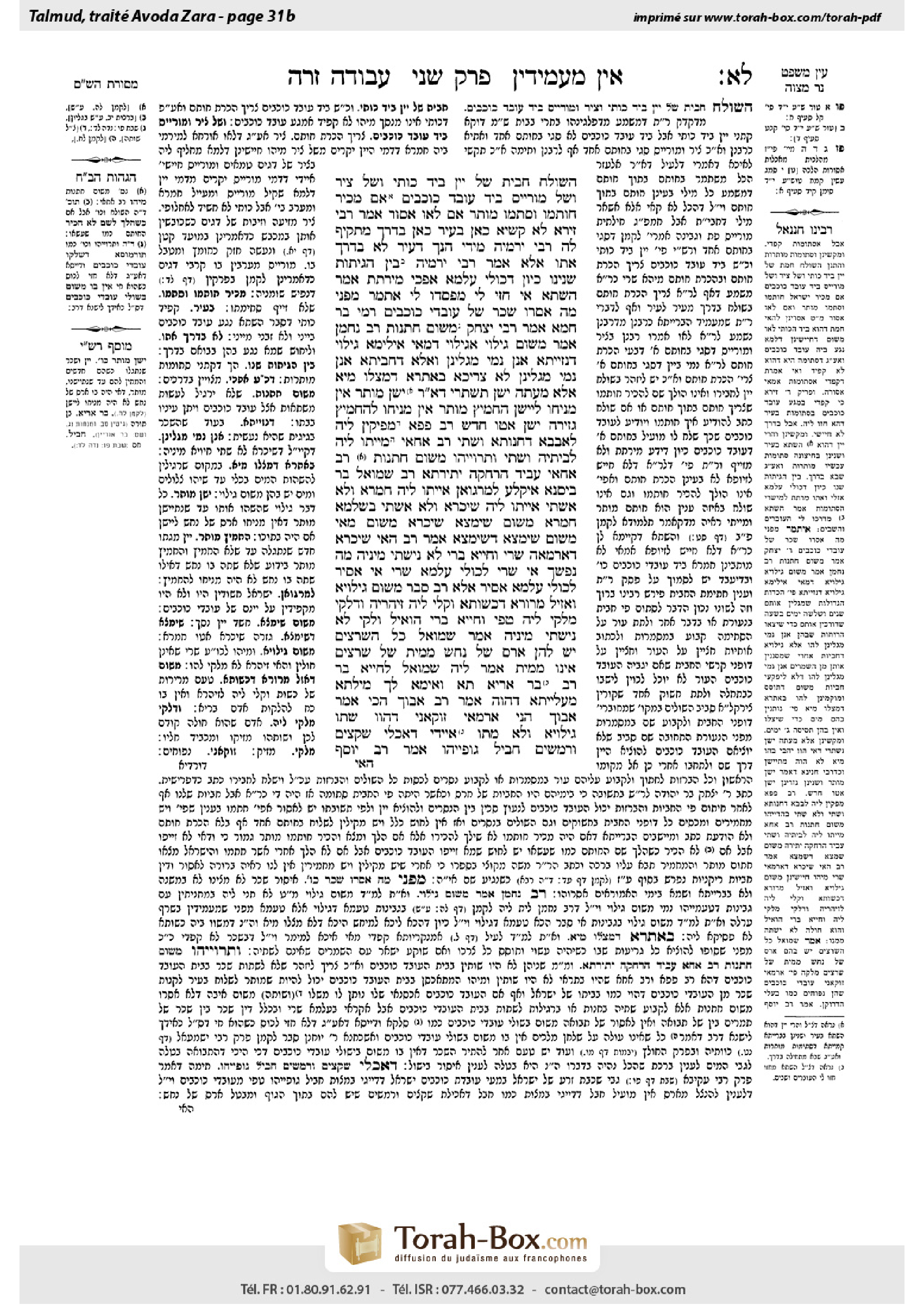
Avodah Zarah 31b: Talmud study for Daf Yomi
Study the Talmud for Daf Yomi with scanned pages, Hebrew text, English translations from Sefaria and AI-generated French translations.
Passage selection and English or AI-generated French translation are available where the scan has annotations. Daf Study is independent of Torah-Box and Sefaria.
Browse Avodah Zarah · עבודה זרה · All tractatesAvodah Zarah 31b text and translations
This page of Avodah Zarah includes the Aramaic text, an English translation and an AI-generated French translation, alongside the scan above.
עבודה זרה ל״א ב · Aramaic and Hebrew text
הַשּׁוֹלֵחַ חָבִית שֶׁל יַיִן בְּיַד כּוּתִי, וְשֶׁל צִיר וְשֶׁל מוּרְיָיס בְּיַד גּוֹי, אִם מַכִּיר חוֹתָמוֹ וּסְתָמוֹ — מוּתָּר, אִם לָאו — אָסוּר!
אָמַר רַבִּי זֵירָא: לָא קַשְׁיָא — כָּאן בָּעִיר, כָּאן בַּדֶּרֶךְ.
מַתְקֵיף לַהּ רַבִּי יִרְמְיָה: מִידֵּי הָנָךְ דְּעִיר לָא בְּדֶרֶךְ אָתוּ? אֶלָּא אָמַר רַבִּי יִרְמְיָה: בֵּין הַגִּיתּוֹת שָׁנִינוּ, כֵּיוָן דְּכוּלֵּי עָלְמָא אָפְכִי, מִירְתַת, אֲמַר: הַשְׁתָּא אִי חָזוּ לִי מַפְסְדוּ לִי.
אִתְּמַר: מִפְּנֵי מָה אָסְרוּ שֵׁכָר שֶׁל גּוֹיִם? רָמֵי בַּר חָמָא אָמַר רַבִּי יִצְחָק: מִשּׁוּם חַתְנוּת, רַב נַחְמָן אָמַר: מִשּׁוּם גִּילּוּי.
אַגִּילּוּי דְּמַאי? אִילֵּימָא גִּילּוּי דְּנַזְיָיתָא — אֲנַן נָמֵי מְגַלֵּינַן! וְאֶלָּא דְּחָבִיתָא — אֲנַן נָמֵי מְגַלֵּינַן! לָא צְרִיכָא, בְּאַתְרָא דִּמְצַלּוּ מַיָּא.
אֶלָּא מֵעַתָּה יָשָׁן תִּשְׁתְּרֵי! דְּאָמַר רַבִּי: יָשָׁן מוּתָּר — אֵין מַנִּיחוֹ לְיַישֵּׁן, הֶחְמִיץ מוּתָּר — אֵין מַנִּיחוֹ לְהַחְמִיץ. גְּזֵירָה יָשָׁן אַטּוּ חָדָשׁ.
רַב פָּפָּא מַפְּיקִין לֵיהּ (לאבבא) [אַבָּבָא] דְּחָנוּתָא, וְשָׁתֵי. רַב אַחַאי מַיְיתוּ לֵיהּ לְבֵיתֵיהּ, וְשָׁתֵי. וְתַרְוַיְיהוּ מִשּׁוּם חַתְנוּת, רַב אַחַאי עָבֵיד הַרְחָקָה יַתִּירְתָּא.
רַב שְׁמוּאֵל בַּר בִּיסְנָא אִיקְּלַע לְמַרְגְּוָאן, אַיְיתוֹ לֵיהּ חַמְרָא וְלָא אִשְׁתִּי, אַיְיתוֹ לֵיהּ שִׁיכְרָא וְלָא אִשְׁתִּי. בִּשְׁלָמָא חַמְרָא מִשּׁוּם שִׁימְצָא, שִׁיכְרָא מִשּׁוּם מַאי? מִשּׁוּם שִׁימְצָא דְּשִׁימְצָא.
אָמַר רַב: הַאי שִׁיכְרָא דַּאֲרַמָּאָה שְׁרֵי, וְחִיָּיא בְּרִי לָא נִישְׁתֵּי מִינֵּיהּ. מָה נַפְשָׁךְ? אִי שְׁרֵי — לְכוּלֵּי עָלְמָא שְׁרֵי, אִי אֲסִיר — לְכוּלֵּי עָלְמָא אֲסִיר!
אֶלָּא, רַב סָבַר מִשּׁוּם גִּילּוּיָא, וְאָזֵיל מְרוֹרָא דִּכְשׁוּתָא וְקָלֵי לֵיהּ זִיהֲרֵיהּ, וְדִלְקֵי מַלְקֵי לֵיהּ טְפֵי, וְחִיָּיא בְּרִי הוֹאִיל וּלְקֵי לָא נִישְׁתֵּי מִינֵּיהּ.
אָמַר שְׁמוּאֵל: כׇּל הַשְּׁרָצִים יֵשׁ לָהֶן אֶרֶס, שֶׁל נָחָשׁ מֵמִית, שֶׁל שְׁרָצִים אֵינוֹ מֵמִית. אֲמַר לֵיהּ שְׁמוּאֵל לְחִיָּיא בַּר רַב: בַּר אַרְיָא, תָּא וְאֵימָא לָךְ מִילְּתָא מְעַלְּיָיתָא דַּהֲוָה אָמַר רַב אֲבוּךְ, הָכִי אָמַר אֲבוּךְ: הָנֵי אַרַמָּאֵי זוּקָאנֵי — (דַּהֲווֹ שָׁתוּ) [מִשּׁוּם דְּשָׁתוּ] גִּילּוּיָא, (וְלָא מִתוּ) [וְהַאי דְּלָא מָיְיתִי] — אַיְּידֵי דְּאָכְלִי שְׁקָצִים וּרְמָשִׂים חֲבִיל גּוּפַיְיהוּ.
אָמַר רַב יוֹסֵף:
Avodah Zarah 31b · English translation
from the following baraita: With regard to one who sends a barrel of wine in the hands of a Samaritan, or a barrel of fish brine or a barrel of fish stew in the hands of a gentile, if he recognizes his seal and his manner of closing the barrel, it is permitted; if he does not recognize them, it is prohibited. Apparently, a sealed barrel is permitted only when it is recognizable.
Rabbi Zeira said that this is not difficult. Here, the first baraita is referring to barrels located in a city; there, the second baraita is referring to barrels that the Samaritan carries on the road. Sealed barrels are permitted in a city because the Samaritan is careful to ensure that gentiles do not touch them in front of anyone, so that he does not forfeit the business of Jews. While traveling he is not concerned, as he assumes that no one will discover that the gentile came into contact with the wine.
Rabbi Yirmeya objects to this: Didn’t these barrels located in the city come by the road as well? Rather, Rabbi Yirmeya says: We learned the baraita that permits sealed barrels only in reference to those that are located between the winepresses. Since everyone is found there, the Samaritan is apprehensive, as he says to himself: Now, if someone sees me allowing a gentile to handle the wine they will cause me to lose my profit, as Jews will not purchase it.
It was stated: For what reason did the Sages prohibit the beer of gentiles? Rami bar Ḥama says that Rabbi Yitzḥak says: It is due to the concern that Jews will befriend gentiles while drinking with them, which might lead to marriage with gentiles. Rav Naḥman said: It is due to the concern of exposure.
The Gemara asks: With regard to what form of exposure is there a concern? If we say that the concern is with regard to exposure of the vat, we too expose the vat, and there is no reason to prohibit gentiles’ beer more than that of Jews. And if you say: Rather, the concern is for exposure of the barrel, we also expose barrels. The Gemara answers: No, it is necessary to prohibit the beer in a place where the water used to brew it is allowed to settle.
The Gemara asks: If that is so, aged beer should be permitted, as Rabbi Yehuda HaNasi says: A substance that might contain exposed water but has aged is permitted, since the poison does not allow it to age, as it goes bad before it grows old. Similarly, if it soured it is permitted, because the poison impairs the taste but does not allow it to sour. Why, then, is all beer prohibited? The Gemara answers: The Sages issued a rabbinic decree with regard to aged beer due to the concern with regard to new beer.
§ The Gemara cites the opinions of various Sages with regard to beer. Rav Pappa had them bring out the beer belonging to gentiles from the store to the entrance of the store, and he would drink it outside the store. Rav Aḥai had them bring the beer to his house, and he would drink it there. And both of them drank the beer away from the presence of gentiles due to concern about marriage with gentiles. The Gemara notes that Rav Aḥai established an extreme preventive measure for himself beyond what is required by halakha.
The Gemara relates that Rav Shmuel bar Bisna happened to come to Marguan, and they brought him wine but he did not drink it. Next they brought him beer but he did not drink it. The Gemara asks: Granted, he did not drink the wine due to the trace [shimtza] of libations, but due to what reason did he refrain from drinking beer? It was due to concern for the trace of a trace, i.e., he did not drink beer due to concern about drinking wine.
Rav says: This Aramean beer is permitted, but my son Ḥiyya does not drink from it. The Gemara asks: Whichever way you look at this matter, Rav’s statement is difficult: If the beer is permitted, then it is permitted to everyone, and there is no reason for his son to refrain from drinking it. And if it is prohibited, it is prohibited to everyone, and why would Rav say it is permitted?
The Gemara explains: Rather, Rav holds that the prohibition is due to exposure, but the bitterness of the hops in the beer goes and impairs the snake’s venom, so that it is safe for an average person to drink. But a person of weak constitution is weakened further by the impaired venom, and Rav was saying: In the case of my son Ḥiyya, since he is weak, he does not drink from it.
Shmuel says: All creeping animals possess venom; that of a snake kills, whereas the venom of other creeping animals does not kill. Shmuel said to Ḥiyya bar Rav: Son of a lion! Come and I will say to you a superior matter that your father, Rav, said. This is what your father said: These Arameans are swollen [zukanei] because they drink exposed liquids, but they did not die from doing so since they eat repugnant creatures and creeping animals, which heat their bodies and thereby render them less susceptible to the venom.
Rav Yosef says:
Avodah Zarah 31b · Traduction française (IA)
d'après la suivante baraïta : Concernant celui qui envoie une barrique de vin entre les mains d'un Samaritain, ou une barrique de saumure de poisson ou une barrique de bouillon de poisson entre les mains d'un non-Juif, si l'on reconnaît son sceau et sa manière de fermer la barrique, cela est permis ; si l'on ne reconnaît pas ces choses, cela est interdit. Apparemment, une barrique scellée est permise uniquement lorsqu'elle est reconnaissable.
Rabbi Zeira dit que cela n'est pas difficile. Ici, la première baraïta fait référence à des barriques situées dans une ville ; là, la deuxième baraïta fait référence à des barriques que le Samaritain transporte sur la route. Les barriques scellées sont permises dans une ville car le Samaritain prend soin de s'assurer que les non-Juifs ne touchent pas à ces barriques devant les gens, afin qu'il ne perde pas la vente aux Juifs. En voyage, il n'a pas de préoccupation, car il suppose que personne ne découvrira que le non-Juif a touché au vin.
Rabbi Yirmeya s'oppose à cela : N'ont-elles pas ces barriques situées dans la ville également traversé la route ? Plutôt, Rabbi Yirmeya dit : Nous avons appris la baraïta qui permet les barriques scellées uniquement en référence à celles qui sont situées entre les pressoirs. Puisque tout le monde est trouvé là, le Samaritain est inquiet, car il se dit : Maintenant, si quelqu'un me voit permettre à un non-Juif de manipuler le vin, cela pourrait me faire perdre mon profit, car les Juifs ne l'achèteront pas.
Il a été dit : Pour quelle raison les Sages ont-ils interdit la bière des non-Juifs ? Rami bar Ḥama dit que Rabbi Yitzḥak dit : C'est en raison de la crainte que les Juifs s'associent aux non-Juifs en buvant avec eux, ce qui pourrait mener à des mariages avec des non-Juifs. Rav Naḥman dit : C'est en raison de la crainte de l'exposition.
La Guemara pose la question : Pour quelle forme d'exposition y a-t-il une crainte ? Si nous disons que la crainte est liée à l'exposition du tonneau, nous aussi nous exposons le tonneau, et il n'y a pas de raison d'interdire la bière des non-Juifs plus que celle des Juifs. Et si vous dites : Plutôt, la crainte est liée à l'exposition du baril, nous aussi nous exposons les barils. La Guemara répond : Non, il est nécessaire d'interdire la bière là où l'eau utilisée pour la faire bouillir est autorisée à se déposer.
La Guemara pose la question : Si c'est ainsi, la bière âgée devrait être permise, car Rabbi Yehuda HaNasi dit : Une substance qui pourrait contenir de l'eau exposée mais qui a vieilli est permise, car la poison ne permet pas qu'elle vieillisse, car elle se gâte avant de vieillir. De même, si elle a fermenté, elle est permise, car le poison altère le goût mais ne permet pas qu'elle fermentasse. Pourquoi, alors, toute la bière est-elle interdite ? La Guemara répond : Les Sages ont émis un décret rabbinique concernant la bière âgée en raison de la crainte liée à la bière fraîche.
§ La Guemara cite les opinions des divers Sages concernant la bière. Rav Pappa faisait apporter la bière des non-Juifs du magasin à l'entrée du magasin, et il buvait à l'extérieur du magasin. Rav Aḥai faisait apporter la bière à sa maison, et il buvait là. Et tous les deux buvaient la bière loin de la présence des non-Juifs en raison de la crainte des mariages avec des non-Juifs. La Guemara note que Rav Aḥai a établi une mesure préventive extrême pour lui-même au-delà de ce qui est requis par la halakha.
La Guemara rapporte que Rav Shmuel bar Bisna est venu à Marguan, et ils lui ont apporté du vin mais il ne l'a pas bu. Ensuite, ils lui ont apporté de la bière mais il ne l'a pas bu non plus. La Guemara pose la question : D'accord, il n'a pas bu le vin en raison de la trace [shimtza] des libations, mais en raison de quelle raison a-t-il refusé de boire la bière ? C'était en raison de la crainte de la trace d'une trace, c'est-à-dire, il n'a pas bu la bière en raison de la crainte de boire du vin.
Rav dit : Cette bière araméenne est permise, mais mon fils Ḥiyya ne boit pas dedans. La Guemara pose la question : Quel que soit le point de vue, l'affirmation de Rav est difficile : Si la bière est permise, alors elle est permise à tous, et il n'y a pas de raison pour que son fils s'en abstienne. Et si elle est interdite, elle est interdite à tous, et pourquoi dit-il que c'est permise ?
La Guemara explique : Plutôt, Rav considère que l'interdiction est en raison de l'exposition, mais la amertume des houblons dans la bière altère le venin des serpents, de sorte qu'il est sûr pour une personne normale de boire. Mais une personne de constitution faible est davantage affaiblie par le venin altéré, et Rav disait : Dans le cas de mon fils Ḥiyya, puisqu'il est faible, il ne boit pas dedans.
Shmuel dit : Tous les animaux rampants possèdent du venin ; celui du serpent tue, tandis que le venin des autres animaux rampants ne tue pas. Shmuel a dit à Ḥiyya bar Rav : Fils d'un lion ! Viens, je vais te dire une affaire supérieure que ton père, Rav, a dite. C'est ce que ton père a dit : Ces Araméens sont gonflés [zukanei] parce qu'ils boivent des liquides exposés, mais ils n'ont pas mouru en raison de cela, car ils mangent des créatures repoussantes et des animaux rampants, qui chauffent leur corps et ainsi les rendent moins sensibles au venin.
Rav Yosef dit :
Traduction française générée par IA à partir de l’édition anglaise de Sefaria. Vérifie toujours un passage avec le texte source.
Text from Sefaria: William Davidson Edition - Vocalized Aramaic (CC BY NC); William Davidson Edition - English (CC BY NC).