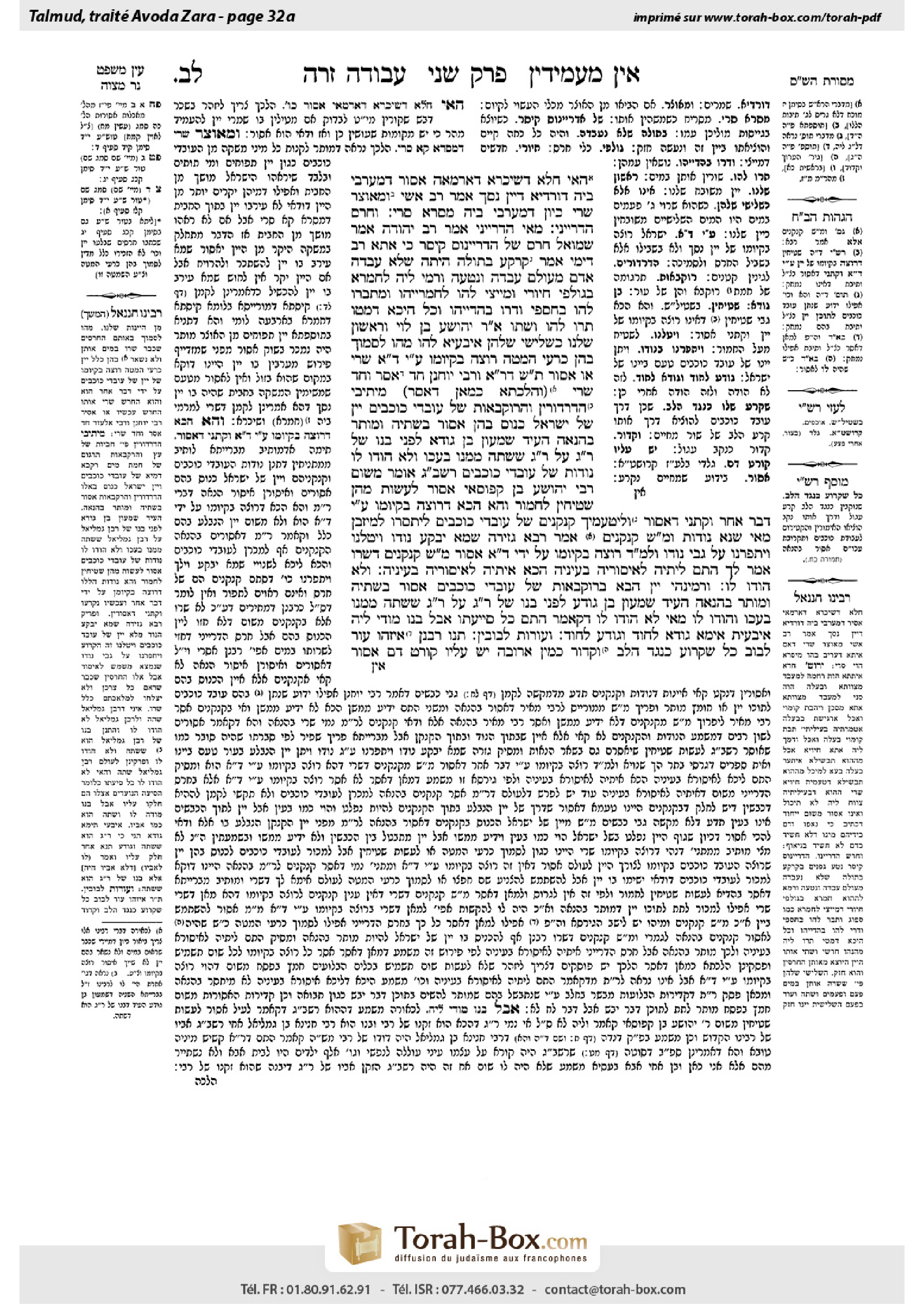
Avodah Zarah 32a: Talmud study for Daf Yomi
Study the Talmud for Daf Yomi with scanned pages, Hebrew text, English translations from Sefaria and AI-generated French translations.
Passage selection and English or AI-generated French translation are available where the scan has annotations. Daf Study is independent of Torah-Box and Sefaria.
Browse Avodah Zarah · עבודה זרה · All tractatesAvodah Zarah 32a text and translations
This page of Avodah Zarah includes the Aramaic text, an English translation and an AI-generated French translation, alongside the scan above.
עבודה זרה ל״ב א · Aramaic and Hebrew text
הַאי חַלָּא דְּשִׁיכְרָא דַּאֲרַמָּאָה אָסוּר, דִּמְעָרְבִי בֵּיהּ דּוּרְדְּיָא דְּיֵין נֶסֶךְ. אָמַר רַב אָשֵׁי: וּמֵאוֹצָר שְׁרֵי, כֵּיוָן דִּמְעָרְבִי בֵּיהּ מִסְרָא סְרֵי.
וָחֶרֶס הַדְרְיָינִי. מַאי הַדְרְיָינִי? אָמַר רַב יְהוּדָה אָמַר שְׁמוּאֵל: חֶרֶס שֶׁל הַדְרְיָינוּס קֵיסָר. כִּי אֲתָא רַב דִּימִי אָמַר: קַרְקַע בְּתוּלָה הָיְתָה שֶׁלֹּא עֲבָדָהּ אָדָם מֵעוֹלָם, עֲבָדָהּ וּנְטָעָהּ, וְרָמֵי לֵיהּ לְחַמְרָא בְּגוּלְפֵי חִיוָּרֵי, וּמָיְיצִי לְהוּ לְחַמְרַיְיהוּ, וּמְתַבְּרוּ לְהוּ בְּחַסְפֵי וְדָרוּ בַּהֲדַיְיהוּ, וְכֹל הֵיכָא דְּמָטוּ תָּרוּ לְהוּ וְשָׁתוּ. אָמַר רַבִּי יְהוֹשֻׁעַ בֶּן לֵוִי: וְרִאשׁוֹן שֶׁלָּנוּ כִּשְׁלִישִׁי שֶׁלָּהֶן.
אִיבַּעְיָא לְהוּ: מַהוּ לִסְמוֹךְ בָּהֶן כַּרְעֵי הַמִּטָּה? רוֹצֶה בְּקִיּוּמוֹ עַל יְדֵי דָּבָר אַחֵר — שְׁרֵי אוֹ אָסוּר?
תָּא שְׁמַע, דְּרַבִּי אֶלְעָזָר וְרַבִּי יוֹחָנָן: חַד אָסַר וְחַד שָׁרֵי, וְהִלְכְתָא כְּמַאן דְּאָסַר.
מֵיתִיבִי: הַדַּרְדּוּרִין וְהָרוּקְבָּאוֹת שֶׁל גּוֹיִם, יַיִן שֶׁל יִשְׂרָאֵל כָּנוּס בָּהֶן — אָסוּר בִּשְׁתִיָּה וּמוּתָּר בַּהֲנָאָה. הֵעִיד שִׁמְעוֹן בֶּן גּוּדָּא לִפְנֵי בְּנוֹ שֶׁל רַבָּן גַּמְלִיאֵל עַל רַבָּן גַּמְלִיאֵל, שֶׁשָּׁתָה מִמֶּנּוּ בְּעַכּוֹ, וְלֹא הוֹדוּ לוֹ.
נוֹדוֹת שֶׁל גּוֹיִם — רַבָּן שִׁמְעוֹן בֶּן גַּמְלִיאֵל אוֹמֵר מִשּׁוּם רַבִּי יְהוֹשֻׁעַ בֶּן קַפּוֹסַאי: אָסוּר לַעֲשׂוֹת מֵהֶן שְׁטִיחִין לַחֲמוֹר, וְהָא הָכָא דְּרוֹצֶה בְּקִיּוּמוֹ עַל יְדֵי דָּבָר אַחֵר, וְקָתָנֵי דְּאָסוּר!
וְלִיטַעְמָיךְ, קַנְקַנִּים שֶׁל גּוֹיִם לִיתַּסְרוּ לְמִיזְבַּן! מַאי שְׁנָא נוֹדוֹת וּמַאי שְׁנָא קַנְקַנִּים? אָמַר רָבָא: גְּזֵירָה שֶׁמָּא יִבָּקַע נוֹדוֹ וְיִטְּלֶנּוּ וְיִתְפְּרֶנּוּ עַל גַּבֵּי נוֹדוֹ.
וּלְמַאן דְּאָמַר רוֹצֶה בְּקִיּוּמוֹ עַל יְדֵי דָּבָר אַחֵר אָסוּר, מַאי שְׁנָא קַנְקַנִּים דִּשְׁרוּ? אָמַר לָךְ: הָתָם לֵיתֵיהּ לְאִיסּוּרֵיהּ בְּעֵינֵיהּ, הָכָא אִיתֵיהּ לְאִיסּוּרֵיהּ בְּעֵינֵיהּ.
וְלֹא הוֹדוּ לוֹ. וּרְמִינְהִי: יַיִן הַבָּא בְּרוּקְבָּאוֹת שֶׁל גּוֹיִם אָסוּר בִּשְׁתִיָּה וּמוּתָּר בַּהֲנָאָה, הֵעִיד שִׁמְעוֹן בֶּן גּוּדָּע לִפְנֵי בְּנוֹ שֶׁל רַבָּן גַּמְלִיאֵל עַל רַבָּן גַּמְלִיאֵל שֶׁשָּׁתָה מִמֶּנּוּ בְּעַכּוֹ, וְהוֹדוּ לוֹ!
מַאי ״לֹא הוֹדוּ לוֹ״ דְּקָאָמַר הָתָם? כׇּל סִיעָתוֹ, אֲבָל בְּנוֹ מוֹדֵי לֵיהּ. אִיבָּעֵית אֵימָא: גּוּדָּא לְחוֹד, וְגוּדָּע לְחוֹד.
וְעוֹרוֹת לְבוּבִין. תָּנוּ רַבָּנַן: אֵיזֶהוּ עוֹר לָבוּב? כָּל שֶׁקָּרוּעַ כְּנֶגֶד הַלֵּב וְקָדוּר כְּמִין אֲרוּבָּה, יֵשׁ עָלָיו קוֹרֶט דָּם — אָסוּר,
Avodah Zarah 32a · English translation
This vinegar made of Aramean beer is prohibited, as they mix in it yeast of wine used for a libation. Rav Ashi said: But vinegar from a storeroom is permitted, since if another substance is mixed with it, it would spoil over time.
§ The mishna teaches: And Hadrianic earthenware is prohibited. The Gemara asks: What is Hadrianic earthenware? Rav Yehuda says that Shmuel says: It is earthenware of Emperor Hadrian. When Rav Dimi came, he said: There was an expanse of virgin soil that no man had ever tilled before, and Hadrian tilled it and planted grapevines in it, which yielded wine of the highest quality. And they placed this wine in white jugs, and the jugs absorbed the wine. And they would break the jugs into shards and carry the shards with them, and anywhere that they stopped, they soaked these shards in water and drank the water. The Gemara notes that Rabbi Yehoshua ben Levi says: And our first-rate wine is like the wine produced by the third usage of their Hadrianic earthenware.
A dilemma was raised before the Sages: What is the halakha if one wishes to use such shards to support the legs of a bed with them? Is one who desires a prohibited item’s continued existence in order to use it for another matter, i.e., not for the prohibited purpose, permitted to use it or prohibited from doing so? In this case, no benefit whatsoever is derived from the wine absorbed within the shards, but the shards themselves are being used to support the bed.
The Gemara suggests: Come and hear a resolution to the dilemma, as Rabbi Elazar and Rabbi Yoḥanan engaged in a dispute in this case: One prohibited using the shards in such a fashion, and one permitted this practice. The Gemara adds: And the halakha is in accordance with the opinion of the Sage who prohibited it.
The Gemara raises an objection from a baraita to the Sage who deems it permitted: With regard to the jugs [dardurin] and flagons [rokva’ot] of gentiles that have a Jew’s wine contained in them, one is prohibited from drinking the wine, but one is permitted to derive benefit from it. The Gemara notes that Shimon ben Guda testified before the son of Rabban Gamliel with regard to Rabban Gamliel that he drank from it in Akko, but the Sages did not concede to the ramifications of his testimony.
Concerning wineskins that belong to gentiles, Rabban Shimon ben Gamliel says in the name of Rabbi Yehoshua ben Kefusai: It is prohibited to fashion from them items such as blankets to cover a donkey, as one derives benefit from them. The Gemara explains the objection: And here, in the case of wineskins used as donkey covers, he desires its continued existence for another matter, and yet the baraita teaches that it is prohibited to use it for this purpose.
The Gemara retorts: And according to your reasoning, it should be prohibited to sell jugs belonging to gentiles, and yet Jews sell them frequently; what is different about wineskins, from which one may not derive indirect benefit, and what is different about jugs, which may be sold for indirect benefit? The Gemara answers that Rava says: There is a rabbinic decree that one may not sell wineskins of gentiles lest his own wineskin break open, and to repair it he would take the gentile’s wineskin and sew it onto his wineskin. This would cause the wine absorbed in the gentile’s wineskin to mix with the wine of the Jew and render it forbidden.
The Gemara asks: And according to the one who says that someone who desires the continued existence of a prohibited item for another matter is prohibited from using the item in this way, what is different about jugs that purchasing them is permitted? The Gemara explains that this Sage could have said to you: There, with regard to the jugs, there is no substantive prohibited entity, whereas here, in the case of Hadrianic earthenware, there is a substantive prohibited entity, as the wine is recognizable in the earthenware.
§ It was stated that Shimon ben Guda provided testimony, but the Sages did not concede to its ramifications. And the Gemara raises a contradiction: With regard to wine that comes in the flagons of gentiles, one is prohibited from drinking the wine, but one is permitted to derive benefit from it. Shimon ben Guda testified before the son of Rabban Gamliel with regard to Rabban Gamliel that he drank from it in Akko, and they conceded to him. This directly contradicts the episode cited above.
The Gemara explains: What is the meaning of the sentence: But they did not concede to the ramifications of his testimony, which was stated there, in the first account? The meaning is that the rest of his entire company, i.e., the Sages, did not concede, but his son did concede to him. If you wish, say instead that Guda with the letter alef, as stated in the first episode, is discrete, and Guda with an ayin, in the second account, is discrete, i.e., the two incidents are not referring to the same individual.
§ The mishna further teaches: And hides with a tear opposite the heart are prohibited. The Sages taught: What is considered a hide with a tear opposite the heart? Any hide that is torn opposite the heart and incised in a shape similar to an aperture, and which has a trace of coagulated blood on it, is prohibited.
Avodah Zarah 32a · Traduction française (IA)
Ce vinaigre fait à partir de la bière araméenne est interdit, car on y mélange du levain de vin utilisé pour une libation. Rav Ashi a dit : Mais le vinaigre provenant d'une cave est permis, car si un autre ingrédient est mêlé à ce vinaigre, il se corromprait avec le temps.
§ La mitsna enseigne : Et les céramiques de Hadrien sont interdites. La Guemara pose la question : Qu'est-ce que les céramiques de Hadrien ? Rav Yehuda dit que Shmuel dit : Ce sont des céramiques de l'empereur Hadrien. Lorsque Rav Dimi est arrivé, il a dit : Il y avait une étendue de terre vierge que personne n'avait jamais cultivée auparavant, et Hadrien l'a cultivée et planté des vignes, qui ont produit un vin de très haute qualité. Et ils ont mis ce vin dans des jarres blanches, et les jarres absorbaient le vin. Et ils cassaient les jarres en morceaux et portaient ces morceaux avec eux, et partout où ils s'arrêtaient, ils trempaient ces morceaux dans l'eau et buvaient l'eau. La Guemara note que Rabbi Yehoshua ben Levi dit : Et notre vin de premier choix est comme le vin produit par la troisième utilisation de leurs céramiques de Hadrien.
Un dilemme a été soulevé devant les Sages : Quelle est la halakha si l'on souhaite utiliser ces morceaux pour soutenir les pieds d'un lit ? Est-ce que celui qui désire la continuation d'un objet interdit pour une autre utilisation, c'est-à-dire pas à des fins interdites, est autorisé à l'utiliser ou interdit à le faire ? Dans ce cas, aucun bénéfice n'est tiré du vin absorbé dans les morceaux, mais les morceaux eux-mêmes sont utilisés pour soutenir le lit.
La Guemara suggère : Venez écouter une résolution à ce dilemme, car Rabbi Elazar et Rabbi Yoḥanan ont eu un débat sur ce cas : l'un interdisait d'utiliser les morceaux ainsi, et l'autre permettait cette pratique. La Guemara ajoute : Et la halakha suit l'opinion du Sage qui l'interdisait.
La Guemara soulève une objection à l'égard du Sage qui considère cela comme permis : concernant les jarres [dardurin] et les flagons [rokva’ot] des non-Juifs qui contiennent du vin juif, on est interdit de boire ce vin, mais on est autorisé à en tirer un bénéfice. La Guemara note que Shimon ben Guda a témoigné devant le fils de Rabban Gamliel concernant Rabban Gamliel qu'il avait bu de ce vin à Akko, mais les Sages n'ont pas accepté les conséquences de son témoignage.
Concernant les peaux de vins appartenant aux non-Juifs, Rabban Shimon ben Gamliel dit en nom de Rabbi Yehoshua ben Kefusai : il est interdit de fabriquer à partir d'elles des objets tels que des couvertures pour un âne, car on en tire un bénéfice. La Guemara explique l'objection : et ici, dans le cas des peaux de vins utilisées comme couvertures pour des ânes, il désire la continuation de l'objet interdit pour une autre utilisation, et pourtant la baraïta enseigne qu'il est interdit d'utiliser cet objet à cette fin.
La Guemara rétorque : Et selon votre raisonnement, il devrait être interdit de vendre les jarres appartenant aux non-Juifs, et pourtant les Juifs les vendent fréquemment ; qu'y a-t-il de différent entre les peaux de vins, d'où on ne peut tirer un bénéfice indirect, et les jarres, qui peuvent être vendues pour un bénéfice indirect ? La Guemara répond que Rava dit : Il y a un décret rabbinique qui interdit de vendre les peaux de vins des non-Juifs de peur que sa propre peau de vin ne se déchire, et pour la réparer, il prendrait la peau de vin du non-Juif et la cousait à sa propre peau de vin. Cela provoquerait que le vin absorbé dans la peau de vin du non-Juif mélange avec le vin du Juif et le rende interdit.
La Guemara pose la question : Et selon celui qui dit que celui qui désire la continuation d'un objet interdit pour une autre utilisation est interdit à l'utiliser ainsi, qu'y a-t-il de différent concernant les jarres dont l'achat est permis ? La Guemara explique que ce Sage pourrait avoir dit à vous : Là, concernant les jarres, il n'y a pas d'entité interdite substantielle, tandis que ici, dans le cas des céramiques de Hadrien, il y a une entité interdite substantielle, car le vin est reconnaissable dans les céramiques.
§ Il a été dit que Shimon ben Guda a témoigné, mais les Sages n'ont pas accepté ses conséquences. Et la Guemara soulève une contradiction : Concernant le vin qui vient des flagons des non-Juifs, on est interdit de boire le vin, mais on est autorisé à en tirer un bénéfice. Shimon ben Guda a témoigné devant le fils de Rabban Gamliel concernant Rabban Gamliel qu'il avait bu de ce vin à Akko, et ils ont accepté son témoignage. Cela contredit directement l'incident cité ci-dessus.
La Guemara explique : Quelle est la signification de la phrase : Mais ils n'ont pas accepté les conséquences de son témoignage, qui a été dit là, dans le premier récit ? La signification est que le reste de son groupe entier, c'est-à-dire les Sages, n'a pas accepté, mais son fils a accepté son témoignage. Si vous le souhaitez, dites plutôt que Guda avec la lettre alef, comme dit dans le premier récit, est discret, et Guda avec l'ayin, dans le second récit, est discret, c'est-à-dire que les deux incidents ne font pas référence à la même personne.
§ La Michna enseigne davantage : Et les peaux de bête percées au niveau du cœur sont interdites. Les Sages ont enseigné : Qu'est-ce qui est considéré comme une peau percée au niveau du cœur ? Toute peau percée au niveau du cœur et incisée dans une forme semblable à une ouverture, et qui a une trace de sang coagulé dessus, est interdite.
Traduction française générée par IA à partir de l’édition anglaise de Sefaria. Vérifie toujours un passage avec le texte source.
Text from Sefaria: William Davidson Edition - Vocalized Aramaic (CC BY NC); William Davidson Edition - English (CC BY NC).