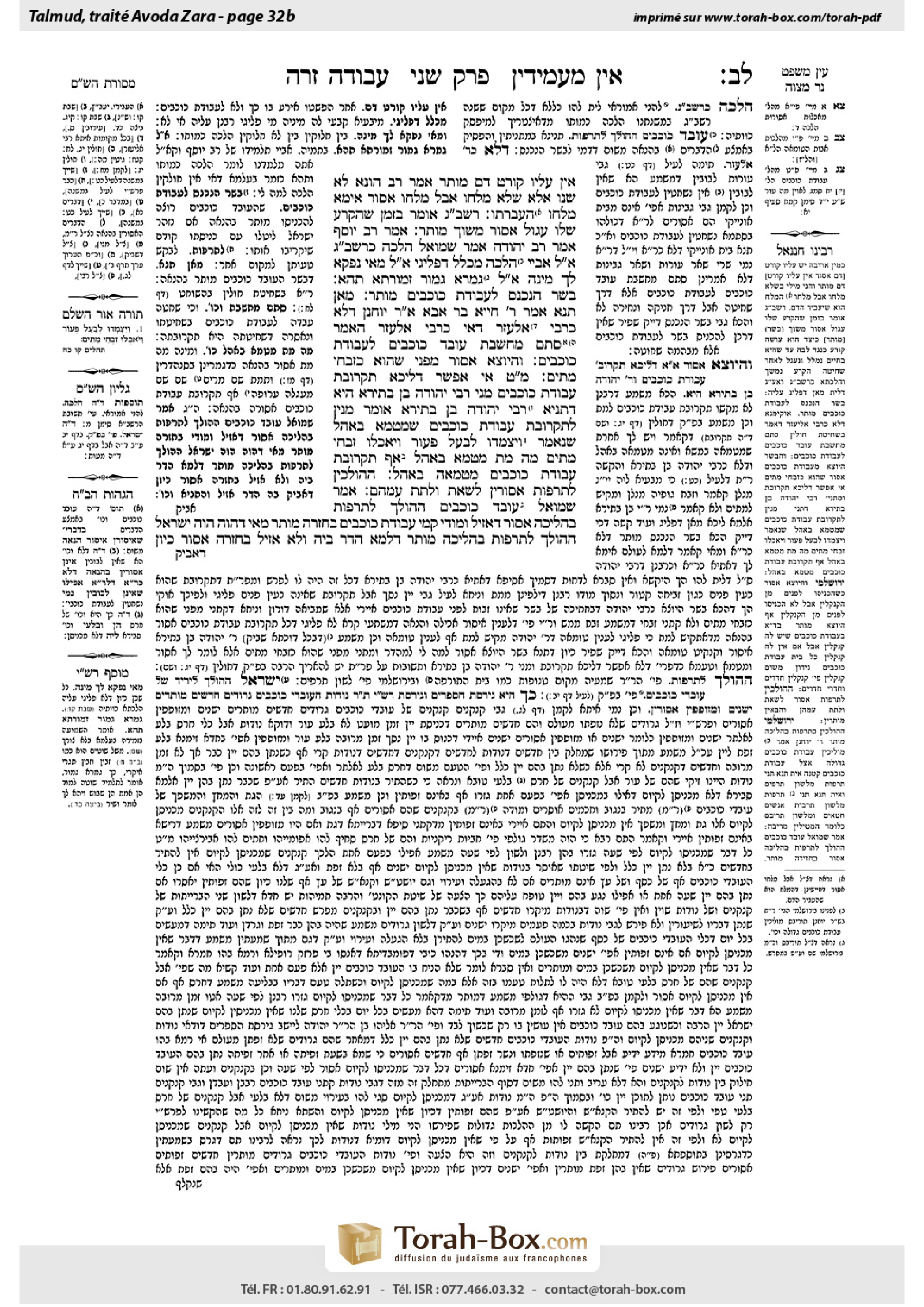
Avodah Zarah 32b: Talmud study for Daf Yomi
Study the Talmud for Daf Yomi with scanned pages, Hebrew text, English translations from Sefaria and AI-generated French translations.
Passage selection and English or AI-generated French translation are available where the scan has annotations. Daf Study is independent of Torah-Box and Sefaria.
Browse Avodah Zarah · עבודה זרה · All tractatesAvodah Zarah 32b text and translations
This page of Avodah Zarah includes the Aramaic text, an English translation and an AI-generated French translation, alongside the scan above.
עבודה זרה ל״ב ב · Aramaic and Hebrew text
אֵין עָלָיו קוֹרֶט דָּם — מוּתָּר. אָמַר רַב הוּנָא: לֹא שָׁנוּ אֶלָּא שֶׁלֹּא מְלָחוֹ, אֲבָל מְלָחוֹ — אָסוּר. אֵימָא: מִלְחוֹ הֶעֱבִרַתּוּ.
רַבָּן שִׁמְעוֹן בֶּן גַּמְלִיאֵל אוֹמֵר: בִּזְמַן שֶׁהַקֶּרַע שֶׁלּוֹ עָגוֹל — אָסוּר, מָשׁוּךְ — מוּתָּר. אָמַר רַב יוֹסֵף, אָמַר רַב יְהוּדָה אָמַר שְׁמוּאֵל: הֲלָכָה כְּרַבָּן שִׁמְעוֹן בֶּן גַּמְלִיאֵל.
אֲמַר לֵיהּ אַבָּיֵי: הֲלָכָה — מִכְּלָל דִּפְלִיגִי? אֲמַר לֵיהּ: מַאי נָפְקָא לָךְ מִינַּהּ? אֲמַר לֵיהּ: גְּמָרָא גְּמוֹר, זְמוֹרְתָּא תְּהֵא?
בָּשָׂר הַנִּכְנָס לַעֲבוֹדָה זָרָה מוּתָּר. מַאן תַּנָּא? אָמַר רַבִּי חִיָּיא בַּר אַבָּא אָמַר רַבִּי יוֹחָנָן: דְּלָא כְּרַבִּי אֶלְעָזָר, דְּאִי כְּרַבִּי אֶלְעָזָר, הָאָמַר: סְתָם מַחְשֶׁבֶת גּוֹי לַעֲבוֹדָה זָרָה.
וְהַיּוֹצֵא אָסוּר, מִפְּנֵי שֶׁהוּא כְּזִבְחֵי מֵתִים. מַאי טַעְמָא? אִי אֶפְשָׁר דְּלֵיכָּא תִּקְרוֹבֶת עֲבוֹדָה זָרָה. מַנִּי? רַבִּי יְהוּדָה בֶּן בְּתֵירָא הִיא.
דְּתַנְיָא: רַבִּי יְהוּדָה בֶּן בְּתִירָא אוֹמֵר: מִנַּיִן לְתִקְרוֹבֶת עֲבוֹדָה זָרָה שֶׁמְּטַמֵּא בְּאֹהֶל? שֶׁנֶּאֱמַר: ״וַיִּצָּמְדוּ לְבַעַל פְּעוֹר וַיֹּאכְלוּ זִבְחֵי מֵתִים״, מָה מֵת מְטַמֵּא בְּאֹהֶל, אַף תִּקְרוֹבֶת עֲבוֹדָה זָרָה מְטַמְּאָה בְּאֹהֶל.
הַהוֹלְכִין לַתַּרְפּוּת — אֲסוּרִין לָשֵׂאת וְלָתֵת עִמָּהֶם. אָמַר שְׁמוּאֵל: גּוֹי הַהוֹלֵךְ לַתַּרְפּוּת, בַּהֲלִיכָה — אָסוּר, דְּאָזֵיל וּמוֹדֵי קַמֵּי עֲבוֹדָה זָרָה, בַּחֲזָרָה — מוּתָּר, מַאי דַהֲוָה הֲוָה.
יִשְׂרָאֵל הַהוֹלֵךְ לַתַּרְפּוּת — בַּהֲלִיכָה מוּתָּר, דִּלְמָא הָדַר בֵּיהּ וְלָא אָזֵיל; בַּחֲזָרָה אָסוּר, כֵּיוָן
Avodah Zarah 32b · English translation
If it does not have a trace of blood upon it, then it is permitted. Rav Huna says: They taught that a bloodless hide is permitted only in a case where the gentile did not salt it, but if he salted it, it is prohibited, as I say: Its salting removed the trace of blood.
§ The mishna teaches that Rabban Shimon ben Gamliel says: A hide is prohibited only when the tear around its heart is circular, but if it is elongated, it is permitted. The Gemara notes: Rav Yosef says that Rav Yehuda says that Shmuel says: The halakha is in accordance with the opinion of Rabban Shimon ben Gamliel.
Abaye said to Rav Yosef: If one rules that the halakha is in accordance with the opinion of Rabban Shimon ben Gamliel, does that mean by inference that the Rabbis disagree, or perhaps there is no dispute and everyone accepts the opinion of Rabban Shimon ben Gamliel? Rav Yosef said to him: What difference is there to you whether or not the Rabbis disagree? In either case the halakha is in accordance with the opinion of Rabban Shimon ben Gamliel. Abaye said to him, invoking a folk expression with regard to one who learns without achieving understanding: Is it simply learn the lesson; let it be like a song? In other words, is it sufficient to simply parrot the halakhic ruling? No; it is necessary to examine an issue to understand it even if it does not yield a practical halakhic difference.
§ The mishna further teaches: Meat that enters the house of idol worship, before it is sacrificed, is permitted. The Gemara asks: Who is the tanna who taught this? Rabbi Ḥiyya bar Abba said that Rabbi Yoḥanan said: It is not in accordance with the opinion of Rabbi Elazar, as if one were to posit that it is in accordance with the opinion of Rabbi Elazar, this would be difficult: Doesn’t he say: When slaughtering an animal, a gentile’s unspecified intention is to use it for idol worship? Accordingly, Rabbi Elazar would disagree with the ruling of the mishna that meat entering a house of idol worship is permitted.
The mishna teaches: And meat that exits the house of idol worship is prohibited because it is considered as offerings to the dead, i.e., idols. The Gemara asks: What is the reason that it is classified as such? It is because it is impossible that it is not an idolatrous offering. The Gemara asks: Whose opinion does this reflect? It is the opinion of Rabbi Yehuda ben Beteira.
As it is taught in a baraita: Rabbi Yehuda ben Beteira says: From where is it derived that an idolatrous offering imparts ritual impurity by means of a tent to an individual or item situated together with it under the same structure, even if they do not come into direct contact? As it is stated: “They joined themselves also unto Baal of Peor, and ate the offerings to the dead” (Psalms 106:28). Just as a corpse imparts ritual impurity by means of a tent, so too idolatrous offerings impart ritual impurity by means of a tent. Similarly, Rabbi Yehuda ben Beteira would hold that just as it is prohibited to derive benefit from a corpse, so too it is prohibited to derive benefit from idolatrous offerings.
§ The mishna teaches: With regard to those going to a festival of idolatry, it is prohibited to engage with them in business. The Gemara notes that Shmuel says: In the case of a gentile who goes to a festival of idolatry, if he is on his way to the festival it is prohibited to engage in business with him, as he subsequently goes and offers thanks before the object of idol worship. Upon his return it is permitted, as what was, was, i.e., he has already finished his worship, and refraining from engaging in business with the gentile at this stage will accomplish nothing.
Conversely, with regard to a Jew who goes to a festival of idolatry, if he is on his way to the festival it is permitted to engage in business with him, as perhaps he will retract from his plan and will not go. Upon his return, it is prohibited, since
Avodah Zarah 32b · Traduction française (IA)
Si elle ne présente pas de trace de sang, elle est permise. Rav Huna dit : Ils enseignent que la peau sans sang est permise uniquement dans le cas où le gentil ne l’a pas salé, mais si on l’a salé, elle est interdite, comme je le dis : son salage a supprimé la trace de sang.
§ La mitsva enseigne que Rabban Shimon ben Gamliel dit : Une peau est interdite uniquement lorsque la déchirure autour de son cœur est circulaire, mais si elle est allongée, elle est permise. La Guemara note : Rav Yosef dit que Rav Yehuda dit que Shmuel dit : la halakha suit l'opinion de Rabban Shimon ben Gamliel.
Abaye dit à Rav Yosef : Si l'on considère que la halakha suit l'opinion de Rabban Shimon ben Gamliel, cela signifie-t-il par conséquence que les Rabbins sont en désaccord, ou peut-être qu'il n'y a pas de dispute et que tout le monde accepte l'opinion de Rabban Shimon ben Gamliel ? Rav Yosef dit à lui : Quelle différence y a-t-il pour vous que les Rabbins soient en désaccord ou non ? Dans les deux cas, la halakha suit l'opinion de Rabban Shimon ben Gamliel. Abaye dit à lui, en invoquant une expression populaire concernant celui qui apprend sans comprendre : Est-ce simplement apprendre la leçon ; qu'elle soit comme une chanson ? Autrement dit, est-ce suffisant de simplement répéter la décision halakhique ? Non ; il est nécessaire d'examiner une question pour la comprendre, même si elle ne donne pas lieu à une différence halakhique pratique.
§ La mitsva enseigne davantage : la viande qui entre dans la maison d'idolâtrie, avant qu'elle ne soit sacrifiée, est permise. La Guemara pose la question : Qui est le tanna qui a enseigné cela ? Rabbi Ḥiyya bar Abba dit que Rabbi Yoḥanan dit : Ce n'est pas selon l'opinion de Rabbi Elazar, car si l'on affirmait qu'il est selon l'opinion de Rabbi Elazar, cela serait difficile : N'a-t-il pas dit : Lors de la bête, l'intention indéterminée du gentil est d'utiliser l'animal pour l'idolâtrie ? Ainsi, Rabbi Elazar serait en désaccord avec la décision de la mitsva selon laquelle la viande entrant dans la maison d'idolâtrie est permise.
La mitsva enseigne : Et la viande qui sort de la maison d'idolâtrie est interdite, car elle est considérée comme des offrandes aux morts, c'est-à-dire aux idoles. La Guemara pose la question : Quelle est la raison pour laquelle elle est classée ainsi ? C'est parce qu'il est impossible qu'elle ne soit pas une offrande idolâtre. La Guemara pose la question : Quelle est l'opinion qui reflète cela ? C'est l'opinion de Rabbi Yehuda ben Beteira.
Comme il est enseigné dans une baraïta : Rabbi Yehuda ben Beteira dit : D'où est tiré que l'offrande idolâtre transmet l'impureté rituelle par le moyen d'une tente à un individu ou à un objet situé avec elle sous la même structure, même s'ils ne sont pas en contact direct ? Comme il est dit : « Ils se sont joints également à Baal de Peor, et ont mangé les offrandes aux morts » (Psaumes 106:28). Aussi bien qu'un cadavre transmet l'impureté rituelle par le moyen d'une tente, ainsi l'offrande idolâtre transmet l'impureté rituelle par le moyen d'une tente. De même, Rabbi Yehuda ben Beteira soutient que tout comme il est interdit d'exploiter un cadavre, ainsi il est interdit d'exploiter des offrandes idolâtres.
§ La mitsva enseigne : Concernant ceux qui vont à un festival d'idolâtrie, il est interdit d'entreprendre des affaires avec eux. La Guemara note que Shmuel dit : Dans le cas d'un gentil qui va à un festival d'idolâtrie, si il est en route vers le festival, il est interdit d'entreprendre des affaires avec lui, car il va ensuite rendre grâce devant l'objet d'idolâtrie. À son retour, il est permis, car ce qui était, est, c'est-à-dire il a déjà terminé son culte, et l'abstention de faire des affaires avec le gentil à cette étape ne servirait à rien.
À l'inverse, concernant un Juif qui va à un festival d'idolâtrie, si il est en route vers le festival, il est permis d'entreprendre des affaires avec lui, car peut-être il changera de projet et ne viendra pas. À son retour, il est interdit, car il a déjà accompli son acte de culte et il est trop tard pour l'empêcher.
Traduction française générée par IA à partir de l’édition anglaise de Sefaria. Vérifie toujours un passage avec le texte source.
Text from Sefaria: William Davidson Edition - Vocalized Aramaic (CC BY NC); William Davidson Edition - English (CC BY NC).