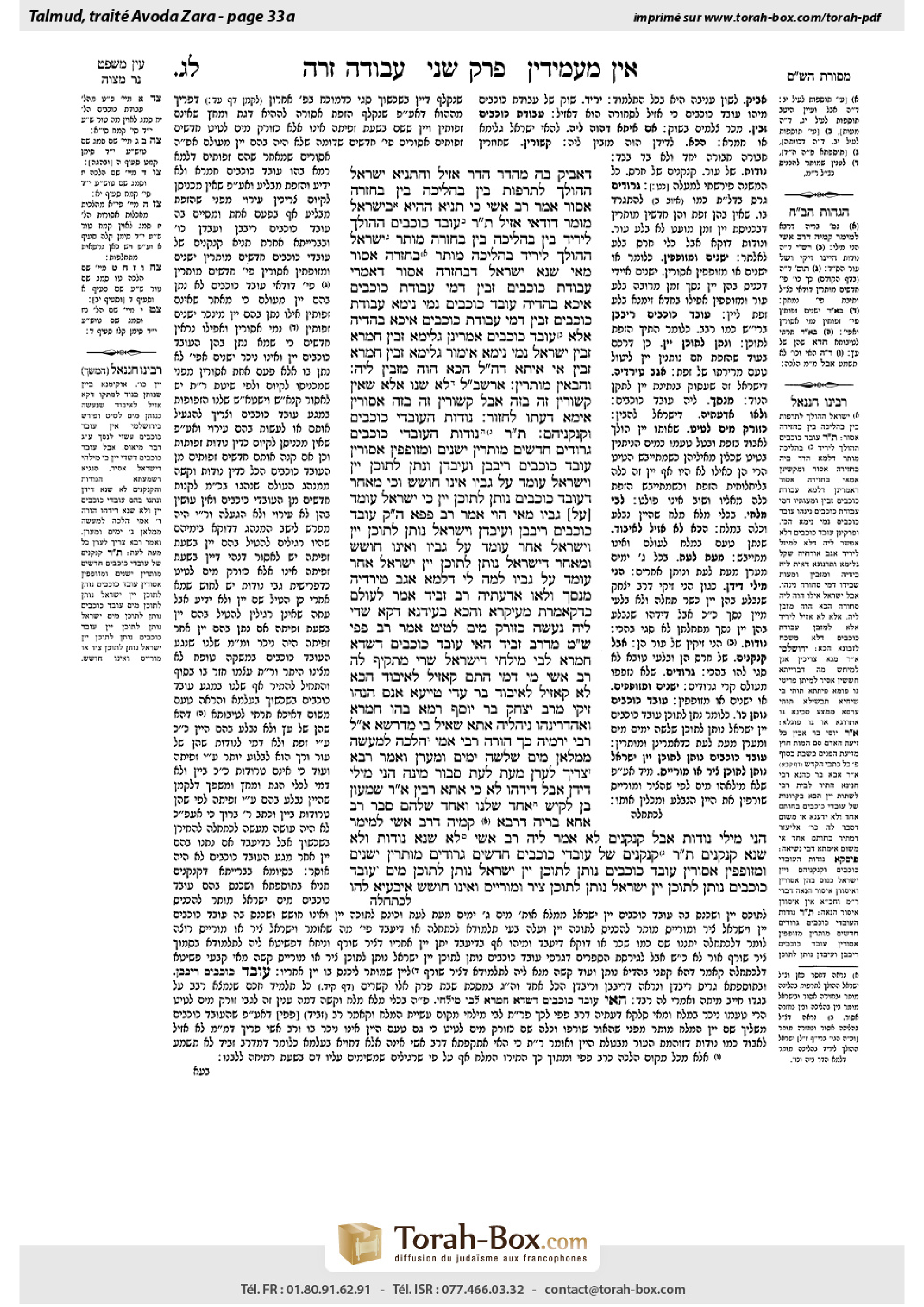
Avodah Zarah 33a: Talmud study for Daf Yomi
Study the Talmud for Daf Yomi with scanned pages, Hebrew text, English translations from Sefaria and AI-generated French translations.
Passage selection and English or AI-generated French translation are available where the scan has annotations. Daf Study is independent of Torah-Box and Sefaria.
Browse Avodah Zarah · עבודה זרה · All tractatesAvodah Zarah 33a text and translations
This page of Avodah Zarah includes the Aramaic text, an English translation and an AI-generated French translation, alongside the scan above.
עבודה זרה ל״ג א · Aramaic and Hebrew text
דַּאֲבִיק בַּהּ, מִהְדָּר הָדַר אָזֵיל.
וְהָתַנְיָא: יִשְׂרָאֵל הַהוֹלֵךְ לַתַּרְפּוּת, בֵּין בַּהֲלִיכָה בֵּין בַּחֲזָרָה — אָסוּר! אָמַר רַב אָשֵׁי: כִּי תַּנְיָא הָהִיא בְּיִשְׂרָאֵל מְשׁוּמָּד, דְּוַדַּאי אָזֵיל.
תָּנוּ רַבָּנַן: גּוֹי הַהוֹלֵךְ לְיָרִיד, בֵּין בַּהֲלִיכָה בֵּין בַּחֲזָרָה — מוּתָּר. יִשְׂרָאֵל הַהוֹלֵךְ לְיָרִיד, בַּהֲלִיכָה — מוּתָּר, בַּחֲזָרָה — אָסוּר.
מַאי שְׁנָא יִשְׂרָאֵל דְּבַחֲזָרָה אָסוּר? דְּאָמְרִי: עֲבוֹדָה זָרָה זַבֵּין, דְּמֵי עֲבוֹדָה זָרָה אִיכָּא בַּהֲדֵיהּ. גּוֹי נָמֵי נֵימָא: עֲבוֹדָה זָרָה זַבֵּין, דְּמֵי עֲבוֹדָה זָרָה אִיכָּא בַּהֲדֵיהּ!
אֶלָּא גּוֹי, אָמְרִינַן: גְּלִימָא זַבֵּין, חַמְרָא זַבֵּין; יִשְׂרָאֵל נָמֵי נֵימָא: אֵימוֹר גְּלִימָא זַבֵּין, חַמְרָא זַבֵּין! אִי אִיתָא דַּהֲוָה לֵיהּ הָכָא, הֲוָה מְזַבֵּין לֵיהּ.
וְהַבָּאִין מוּתָּרִין. אָמַר רַבִּי שִׁמְעוֹן בֶּן לָקִישׁ: לֹא שָׁנוּ אֶלָּא שֶׁאֵין קְשׁוּרִין זֶה בָּזֶה, אֲבָל קְשׁוּרִין זֶה בָּזֶה — אֲסוּרִין, אֵימָא דַּעְתּוֹ לַחְזוֹר.
נוֹדוֹת הַגּוֹיִם וְקַנְקַנֵּיהֶם. תָּנוּ רַבָּנַן: נוֹדוֹת הַגּוֹיִם, גְּרוּדִים חֲדָשִׁים — מוּתָּרִין, יְשָׁנִים וּמְזוּפָּפִין — אֲסוּרִין. גּוֹי רִיבְּבָן וְעִיבְּדָן וְנָתַן לְתוֹכָן יַיִן, וְיִשְׂרָאֵל עוֹמֵד עַל גַּבָּיו — אֵינוֹ חוֹשֵׁשׁ.
וְכִי מֵאַחַר דְּגוֹי נוֹתֵן לְתוֹכָן יַיִן, כִּי יִשְׂרָאֵל עוֹמֵד עַל גַּבָּיו מַאי הָוֵי? אָמַר רַב פָּפָּא: הָכִי קָאָמַר — גּוֹי רִיבְּבָן וְעִיבְּדָן, וְיִשְׂרָאֵל נוֹתֵן לְתוֹכָן יַיִן, וְיִשְׂרָאֵל אַחֵר עוֹמֵד עַל גַּבָּיו וְאֵינוֹ חוֹשֵׁשׁ.
וּמֵאַחַר דְּיִשְׂרָאֵל נוֹתֵן לְתוֹכָן יַיִן, יִשְׂרָאֵל אַחֵר עוֹמֵד עַל גַּבָּיו לְמָה לִי? דִּלְמָא אַגַּב טִירְדֵּיהּ מְנַסֵּךְ, וְלָאו אַדַּעְתֵּיהּ.
רַב זְבִיד אָמַר: לְעוֹלָם כִּדְקָאָמְרַתְּ מֵעִיקָּרָא, וְהָכָא בְּעִידָּנָא דְּקָא שָׁדֵי לֵיהּ נַעֲשֶׂה כְּזוֹרֵק מַיִם לְטִיט. אָמַר רַב פַּפֵּי: שְׁמַע מִינַּהּ מִדְּרַב זְבִיד, הַאי גּוֹי דִּשְׁדָא חַמְרָא לְבֵי מִילְחֵי דְּיִשְׂרָאֵל — שְׁרֵי.
מַתְקֵיף לַהּ רַב אָשֵׁי: מִי דָּמֵי? הָתָם קָאָזֵיל לְאִיבּוּד, הָכָא לָא קָאָזֵיל לְאִיבּוּד.
בַּר עֲדִי טַיָּיעָא אֲנַס הָנְהוּ זִיקֵי מֵרַב יִצְחָק בַּר יוֹסֵף, רְמָא בְּהוּ חַמְרָא וְאַהְדְּרִינְהוּ נִיהֲלֵיהּ, אֲתָא שְׁאֵיל בֵּי מִדְרְשָׁא. אֲמַר לֵיהּ רַבִּי יִרְמְיָה: כָּךְ הוֹרָה רַבִּי אַמֵּי הֲלָכָה לְמַעֲשֶׂה — מְמַלְּאָן מַיִם שְׁלֹשָׁה יָמִים וּמְעָרָן. וְאָמַר רָבָא: צָרִיךְ לְעָרָן מֵעֵת לְעֵת.
סְבוּר מִינַּהּ: הָנֵי מִילֵּי דִּידַן, אֲבָל דִּידְהוּ — לָא. כִּי אֲתָא רָבִין אָמַר רַבִּי שִׁמְעוֹן בֶּן לָקִישׁ: אֶחָד שֶׁלָּנוּ וְאֶחָד שֶׁלָּהֶם. סְבַר רַב אַחָא בְּרֵיהּ דְּרָבָא קַמֵּיהּ דְּרַב אָשֵׁי לְמֵימַר: הָנֵי מִילֵּי נוֹדוֹת, אֲבָל קַנְקַנִּים — לָא. אֲמַר לֵיהּ רַב אָשֵׁי: לָא שְׁנָא נוֹדוֹת וְלָא שְׁנָא קַנְקַנִּים.
תָּנוּ רַבָּנַן: קַנְקַנִּים שֶׁל גּוֹיִם, חֲדָשִׁים גְּרוּדִים — מוּתָּרִין, יְשָׁנִים וּמְזוּפָּפִין — אֲסוּרִין. גּוֹי נוֹתֵן לְתוֹכָן יַיִן — יִשְׂרָאֵל נוֹתֵן לְתוֹכָן מַיִם, גּוֹי נוֹתֵן לְתוֹכָן יַיִן — יִשְׂרָאֵל נוֹתֵן לְתוֹכָן צִיר וּמוּרְיָיס, וְאֵינוֹ חוֹשֵׁשׁ.
אִיבַּעְיָא לְהוּ:
Avodah Zarah 33a · English translation
he will cleave to it and go to worship idolatry once again.
The Gemara asks: But isn’t it taught in a baraita that with regard to a Jew who goes to a festival of idolatry, whether he is on the way there or returning from it, it is prohibited to engage in business with him? The Gemara answers that Rav Ashi said: When that baraita is taught, it is in reference to an apostate Jew, who will certainly go to the festival, and will certainly not change his mind.
The Sages taught: With regard to a gentile who goes to a fair, where goods and idols are bought and sold, whether he is on the way there or returning from it, it is permitted to engage in business with him. With regard to a Jew who goes to a fair, when he is on the way there, it is permitted to engage in business with him, but if he is returning from it, it is prohibited.
The Gemara asks: What is different about a Jew that it is prohibited to engage in business with him when he is returning? The Gemara answers that this is in accordance with that which the Sages say: He sold objects of idol worship, and therefore money gained from idol worship is in his possession. Since the money in his possession is assumed to have been gained through objects of idolatry, it is prohibited to engage in business with the Jew. The Gemara challenges: But with regard to a gentile, also, let us say: He sold objects of idol worship, and therefore money gained from idol worship is in his possession. Why is it prohibited to do business only with the Jew?
The Gemara suggests: Rather, with regard to a gentile, we say: He sold clothing or he sold wine, but not idols. The Gemara questions this: Then with regard to a Jew, also, let us say: One should say that he sold clothing or he sold wine, but not idols. The Gemara explains: If he had only wine or clothing to sell, he would have sold them here instead of going to the fair. The fact that he exerted himself to travel to a fair of gentiles indicates that he intended to sell idols.
§ The mishna teaches: And with regard to those who are coming from a festival of idolatry, it is permitted to engage with them in business. Rabbi Shimon ben Lakish says: The Sages taught this only with regard to a case where those returning are not attached to one another, i.e., they are not traveling in groups. But where they are attached to one another it is prohibited to engage in business with them, as I say: The gentile intends to return to the festival with his companions.
§ The mishna further teaches: Wineskins and jugs that belong to gentiles and that have a Jew’s wine contained in them are prohibited. The Sages taught: With regard to wineskins of gentiles, if they are stripped and free from tar, and new, they are permitted, but old and tarred containers are prohibited. Nevertheless, if a gentile pitched them [ribbevan] and lined them and added wine to them to negate the flavor of the tar while a Jew stands over him, one need not be concerned for a prohibition.
The Gemara asks: But once we have established that a gentile places wine in the containers, what of the fact that a Jew stands over him? Why does this affect the halakha? The Gemara explains: Rav Pappa said that this is what the baraita is saying: If a gentile pitched the containers and lined them, and a Jew then placed wine in them while another Jew stood over him, one need not be concerned that it is prohibited.
The Gemara asks: But since a Jew is the one who places wine in them, why do I need another Jew to stand over him? The Gemara answers: It is necessary as perhaps due to the Jew’s preoccupation with pouring the wine, the gentile will manage to libate the wine, and the Jew will be unaware of it.
The Gemara presents an alternative interpretation. Rav Zevid said: Actually, it should be as you initially said, that the gentile himself pours the wine. And here, when he pours the wine into the container, he is considered as one who splashes water in clay and does not intend to use it as a libation. Rav Pappi said: Conclude from the statement of Rav Zevid that with regard to this incident involving a gentile who casts wine into the salt receptacle of a Jew, the salt is permitted, as the gentile has no intention of using the wine as a libation.
Rav Ashi objects to this: Are the two cases comparable? There, with regard to the pitched container, the flavor of the wine is going to be lost, due to the tar. But here, in the case of the salt receptacle, the flavor of the wine is not going to be lost. Therefore there is no reason to rule that the salt is permitted.
The Gemara relates a relevant incident. Bar Adi the Arab seized certain wineskins from Rav Yitzḥak bar Yosef, placed wine in them for an extended period of time, and then returned them to him. Rav Yitzḥak bar Yosef came and asked in the study hall what course of action he should take. Rabbi Yirmeya said to him: This is what Rabbi Ami instructed me to do in terms of practical halakha: One fills the skins with water for three days, so that the water will absorb the flavor of the wine, and then pours the water out. And Rava says: In addition, one must pour out the water in them every twenty-four-hour period and then refill them. Once this has been performed, the wineskins will be permitted.
It was understood from the above incident that this matter, i.e., that one may fill the wineskins with water for three days to render them permitted, applies only to our wineskins that were taken by gentiles. But with regard to their own wineskins, it does not apply, as they are permanently prohibited. When Ravin came from Eretz Yisrael to Babylonia, he said that Rabbi Shimon ben Lakish says: Both ours and theirs can be rendered permitted in this manner. Similarly, Rav Aḥa, son of Rava, thought to say before Rav Ashi: This matter applies only to wineskins, but not to jugs. Rav Ashi said to him: There is no difference between wineskins and jugs, as both can be rendered permitted in this manner.
§ The Gemara continues to discuss the halakhic status of various wineskins. The Sages taught: With regard to wineskins of gentiles, if they are new and stripped free from tar, they are permitted, but old and tarred containers are prohibited. If a gentile places wine in them, the Jew should put water in them. Additionally, if a gentile places wine in them, the Jew may put brine and fish stew in them immediately, and he need not be concerned.
A dilemma was raised before the Sages:
Avodah Zarah 33a · Traduction française (IA)
il s'attache à lui et revient à l'idolâtrie.
La Guemara pose la question : Mais n'est-il pas enseigné dans une baraïta que concernant un Juif qui va à un festival d'idolâtrie, qu'il soit en route vers ce festival ou en revenant de celui-ci, il est interdit d'entreprendre un commerce avec lui ? La Guemara répond que Rav Ashi a dit : Lorsque cette baraïta est enseignée, elle fait référence à un Juif apostat, qui ira certainement au festival et ne changera pas d'avis.
Les Sages ont enseigné : Concernant un non-Juif qui va à un marché, où des marchandises et des idoles sont achetées et vendues, qu'il soit en route vers ce marché ou en revenant de celui-ci, il est permis d'entreprendre un commerce avec lui. Concernant un Juif qui va à un marché, lorsqu'il est en route vers ce marché, il est permis d'entreprendre un commerce avec lui, mais s'il revient de ce marché, il est interdit.
La Guemara pose la question : Qu'est-ce qui diffère dans le cas du Juif qui rend le commerce interdit ? La Guemara répond que cela correspond à ce que les Sages ont dit : Il a vendu des objets d'idolâtrie, et donc l'argent gagné à l'idolâtrie est en son possession. Puisque l'argent en son possession est considéré comme ayant été gagné grâce à des objets d'idolâtrie, il est interdit d'entreprendre un commerce avec ce Juif. La Guemara conteste : Mais concernant un non-Juif également, disons : Il a vendu des objets d'idolâtrie, et donc l'argent gagné à l'idolâtrie est en son possession. Pourquoi est-il interdit de faire du commerce uniquement avec le Juif ?
La Guemara suggère : Plutôt, concernant un non-Juif, nous disons : Il a vendu des vêtements ou du vin, mais pas des idoles. La Guemara questionne cela : Alors concernant un Juif également, disons : On devrait dire qu'il a vendu des vêtements ou du vin, mais pas des idoles. La Guemara explique : S'il avait seulement du vin ou des vêtements à vendre, il les aurait vendus ici plutôt que d'aller au marché. Le fait qu'il ait pris la peine de voyager vers un marché des non-Juifs indique qu'il avait l'intention de vendre des idoles.
§ La mitsva enseigne : Et concernant ceux qui reviennent d'un festival d'idolâtrie, il est permis d'entreprendre un commerce avec eux. Rabbi Shimon ben Lakish dit : Les Sages ont enseigné cela uniquement dans le cas où ceux qui reviennent ne sont pas attachés les uns aux autres, c'est-à-dire qu'ils ne voyagent pas en groupe. Mais là où ils sont attachés les uns aux autres, il est interdit d'entreprendre un commerce avec eux, comme je le dis : Le non-Juif veut revenir au festival avec ses compagnons.
§ La mitsva enseigne davantage : Les outres et les tonneaux appartenant aux non-Juifs qui contiennent du vin juif sont interdits. Les Sages ont enseigné : Concernant les outres des non-Juifs, si elles sont dépouillées et libérées de la cire, et neuves, elles sont permises, mais les conteneurs anciens et recouverts de cire sont interdits. Cependant, si un non-Juif a recouvert les conteneurs [ribbevan], les a tapissés et a ajouté du vin pour éliminer le goût de la cire, tandis qu'un Juif est présent, on n'a pas à craindre une interdiction.
La Guemara pose la question : Mais une fois que nous avons établi que le non-Juif place du vin dans les conteneurs, que devient le fait qu'un Juif soit présent ? Pourquoi cela affecte-t-il la halakha ? La Guemara explique : Rav Pappa a dit que c'est ce que la baraïta dit : Si un non-Juif a recouvert les conteneurs et les a tapissés, et qu'un Juif a ensuite mis du vin dedans tandis qu'un autre Juif était présent, on n'a pas à craindre une interdiction.
La Guemara pose la question : Mais puisque c'est le Juif qui met du vin dedans, pourquoi ai-je besoin d'un autre Juif pour être présent ? La Guemara répond : C'est nécessaire car, peut-être, à cause de l'occupation du Juif pour verser le vin, le non-Juif pourra libater le vin, et le Juif ne le saura pas.
La Guemara présente une interprétation alternative. Rav Zevid a dit : En réalité, il devrait être comme vous l'avez dit initialement, que c'est le non-Juif lui-même qui verse le vin. Et ici, lorsqu'il verse le vin dans le contenant, il est considéré comme celui qui verse de l'eau dans la terre et n'a pas l'intention d'utiliser ce vin pour une libation. Rav Pappi a dit : Concluez de la déclaration de Rav Zevid que concernant ce cas d'un non-Juif qui verse du vin dans le récipient de sel d'un Juif, le sel est permis, car le non-Juif n'a pas l'intention d'utiliser le vin pour une libation.
Rav Ashi s'oppose à cela : Les deux cas sont-ils comparables ? Là, concernant le contenant recouvert, le goût du vin sera perdu à cause de la cire. Mais ici, dans le cas du récipient de sel, le goût du vin ne sera pas perdu. Par conséquent, il n'y a pas de raison de décider que le sel est permis.
La Guemara rapporte un incident pertinent. Bar Adi l'Arabe a pris certaines outres de vin de Rav Yitzḥak bar Yosef, a mis du vin dedans pendant une longue période et les a ensuite rendues à lui. Rav Yitzḥak bar Yosef est venu demander dans la salle de étude quelle action il devait entreprendre. Rabbi Yirmeya lui a dit : C'est ce que Rabbi Ami m'a instruit en matière de halakha pratique : On remplit les outres d'eau pendant trois jours, de sorte que l'eau absorbe le goût du vin, puis on jette l'eau. Et Rava dit : En outre, on doit vider l'eau toutes les vingt-quatre heures et puis les remplir à nouveau. Une fois cela fait, les outres seront permises.
On a compris de l'incident mentionné ci-dessus que cette affaire, c'est-à-dire que l'on peut remplir les outres à vin avec de l'eau pendant trois jours afin de les rendre permises, s'applique uniquement à nos outres à vin qui ont été prises par les nations. En revanche, concernant leurs propres outres à vin, cela ne s'applique pas, car elles sont définitivement interdites. Lorsque Rabin est venu de la Terre d'Israël en Babylone, il a dit que Rabbi Simon ben Lakish dit : Les nôtres et les leurs peuvent être rendus permis de cette manière. De même, Rav Acha, fils de Rava, avait l'intention de dire devant Rav Ashi : Cette affaire s'applique uniquement aux outres à vin, mais pas aux tonneaux. Rav Ashi a répondu à lui : Il n'y a pas de différence entre les outres à vin et les tonneaux, car les deux peuvent être rendus permis de cette manière.
§ La Guemara continue à discuter du statut halakhique de diverses outres à vin. Les Sages ont enseigné : Concernant les outres à vin des nations, si elles sont neuves et détartrées, elles sont permises, mais si elles sont anciennes et tartrées, elles sont interdites. Si un gentil y verse du vin, le Juif devrait y verser de l'eau. De plus, si un gentil y verse du vin, le Juif peut immédiatement y verser de la saumure et une bouillie de poisson, et il n'a pas besoin de s'en inquiéter.
Un dilemme a été soulevé devant les Sages :
Traduction française générée par IA à partir de l’édition anglaise de Sefaria. Vérifie toujours un passage avec le texte source.
Text from Sefaria: William Davidson Edition - Vocalized Aramaic (CC BY NC); William Davidson Edition - English (CC BY NC).