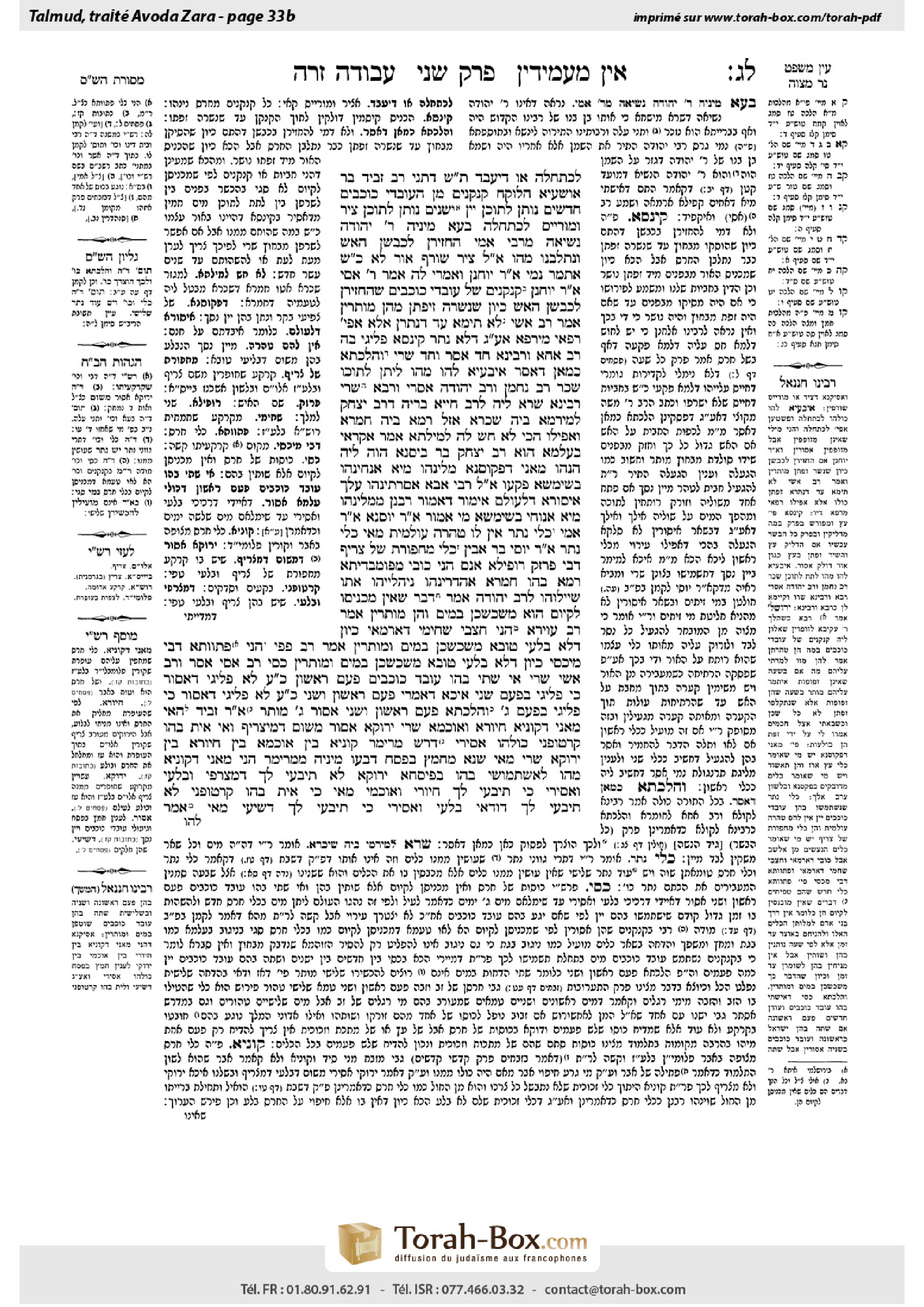
Avodah Zarah 33b: Talmud study for Daf Yomi
Study the Talmud for Daf Yomi with scanned pages, Hebrew text, English translations from Sefaria and AI-generated French translations.
Passage selection and English or AI-generated French translation are available where the scan has annotations. Daf Study is independent of Torah-Box and Sefaria.
Browse Avodah Zarah · עבודה זרה · All tractatesAvodah Zarah 33b text and translations
This page of Avodah Zarah includes the Aramaic text, an English translation and an AI-generated French translation, alongside the scan above.
עבודה זרה ל״ג ב · Aramaic and Hebrew text
לְכַתְּחִלָּה אוֹ דִיעֲבַד? תָּא שְׁמַע, דְּתָנֵי רַב זְבִיד בַּר אוֹשַׁעְיָא: הַלּוֹקֵחַ קַנְקַנִּים מִן הַגּוֹיִם — חֲדָשִׁים נוֹתֵן לְתוֹכָן יַיִן, יְשָׁנִים — נוֹתֵן לְתוֹכָן צִיר וּמוּרְיָיס לְכַתְּחִלָּה.
בְּעָא מִינֵּיהּ רַבִּי יְהוּדָה נְשִׂיאָה מֵרַבִּי אַמֵּי: הֶחְזִירָן לְכִבְשַׁן הָאֵשׁ וְנִתְלַבְּנוּ, מַהוּ? אֲמַר לֵיהּ: צִיר שׂוֹרֵף, אוּר לֹא כׇּל שֶׁכֵּן?! אִתְּמַר נָמֵי: אָמַר רַבִּי יוֹחָנָן, וְאָמְרִי לַהּ אָמַר רַבִּי אַסִּי אָמַר רַבִּי יוֹחָנָן: קַנְקַנִּים שֶׁל גּוֹיִם שֶׁהֶחְזִירָן לְכִבְשַׁן הָאֵשׁ, כֵּיוָן שֶׁנָּשְׁרָה זִיפְתָּן מֵהֶן — מוּתָּרִין.
אָמַר רַב אָשֵׁי: לָא תֵּימָא עַד דְּנָתְרָן, אֶלָּא אֲפִילּוּ רְפַאי מִירְפָא, אַף עַל גַּב דְּלָא נְתַר. קִינְסָא — פְּלִיגִי בַּהּ רַב אַחָא וְרָבִינָא, חַד אָסַר וְחַד שָׁרֵי, וְהִלְכְתָא כְּמַאן דְּאָסַר.
אִיבַּעְיָא לְהוּ: מַהוּ לִיתֵּן לְתוֹכוֹ שֵׁכָר? רַב נַחְמָן וְרַב יְהוּדָה אָסְרִי, וְרָבָא שָׁרֵי. רָבִינָא שְׁרָא לֵיהּ לְרַב חִיָּיא בְּרֵיהּ דְּרַב יִצְחָק לְמִירְמָא בֵּיהּ שִׁכְרָא, אֲזַל רְמָא בֵּיהּ חַמְרָא, וַאֲפִילּוּ הָכִי לָא חַשׁ לַהּ לְמִילְּתָא, אֲמַר: אַקְרַאי בְּעָלְמָא הוּא.
רַב יִצְחָק בַּר בִּיסְנָא הֲוָה לֵיהּ הָנְהוּ מָאנֵי דְּפָקוּסְנָא, מַלִּינְהוּ מַיָּא, אַנְּחִינְהוּ בְּשִׁימְשָׁא, פְּקַעוּ. אֲמַר לֵיהּ רַבִּי אַבָּא: אֲסַרְתִּינְהוּ עֲלָךְ אִיסּוּרָא דִּלְעָלַם. אֵימוֹר דַּאֲמוּר רַבָּנַן מְמַלִּינְהוּ מַיָּא, אַנּוֹחֵי בְּשִׁימְשָׁא מִי אֲמוּר?
אָמַר רַבִּי יוֹסְנָא אָמַר רַבִּי אַמֵּי: כְּלֵי נֶתֶר אֵין (לוֹ) [לָהֶן] טׇהֳרָה עוֹלָמִית. מַאי כְּלֵי נֶתֶר? אָמַר רַבִּי יוֹסֵי בַּר אָבִין: כְּלֵי מַחְפּוֹרֶת שֶׁל צְרִיף.
דְּבֵי פַּרְזַק רוּפִילָא אֲנַס הָנֵי כּוּבֵי מִפּוּמְבְּדִיתָא, רְמָא בְּהוּ חַמְרָא, אַהְדְּרִינְהוּ נִיהֲלַיְיהוּ. אֲתוֹ שַׁיְילוּהּ לְרַב יְהוּדָה, אָמַר: דָּבָר שֶׁאֵין מַכְנִיסוֹ לְקִיּוּם הוּא, מְשַׁכְשְׁכָן בְּמַיִם וְהֵן מוּתָּרִין.
אָמַר רַב עַוִּירָא: הָנֵי חַצְבֵי שְׁחִימֵי דַּאֲרַמָּאֵי, כֵּיוָן דְּלָא בָּלְעִי טוּבָא — מְשַׁכְשְׁכָן בְּמַיִם וּמוּתָּרִין. אָמַר רַב פַּפִּי: הָנֵי פַּתְוָותָא דְּבֵי מִיכְסֵי, כֵּיוָן דְּלָא בָּלְעִי טוּבָא — מְשַׁכְשְׁכָן בְּמַיִם וּמוּתָּרִין.
כָּסֵי — רַב אַסִּי אָסַר, וְרַב אָשֵׁי שְׁרֵי. אִי שָׁתֵי בְּהוּ גּוֹי פַּעַם רִאשׁוֹן — כּוּלֵּי עָלְמָא לָא פְּלִיגִי דַּאֲסִיר, כִּי פְּלִיגִי בְּפַעַם שֵׁנִי.
אִיכָּא דְּאָמְרִי: פַּעַם רִאשׁוֹן וְשֵׁנִי — כּוּלֵּי עָלְמָא לָא פְּלִיגִי דַּאֲסִיר, כִּי פְּלִיגִי בְּפַעַם שְׁלִישִׁי. וְהִלְכְתָא: פַּעַם רִאשׁוֹן וְשֵׁנִי — אָסוּר, שְׁלִישִׁי — מוּתָּר.
אָמַר רַב זְבִיד: הַאי מָאנֵי דְקוּנְיָא, חִיוָּרָא וְאוּכָּמָא — שְׁרֵי, יְרוֹקָא — אֲסִיר, מִשּׁוּם דְּמִיצְּרִיף. וְאִי אִית בְּהוּ קַרְטוּפָנֵי — כּוּלְּהוּ אֲסִירִי. דָּרֵשׁ מָרִימָר: קוּנְיָא, בֵּין אוּכָּמָא בֵּין חִיוָּרָא בֵּין יְרוֹקָא — שְׁרֵי.
מַאי שְׁנָא מֵחָמֵץ בַּפֶּסַח, דִּבְעוֹ מִינֵּיהּ מִמָּרִימָר: הָנֵי מָאנֵי דְקוּנְיָא, מַהוּ לְאִשְׁתַּמּוֹשֵׁי בְּהוּ בְּפִיסְחָא? יְרוּקֵּי לָא תִּיבְּעֵי לָךְ, דְּמִצָּרְפִי וּבָלְעִי וַאֲסִירִי. כִּי תִּיבְּעֵי לָךְ — חִיוָּרֵי וְאוּכָּמֵי מַאי?
כִּי אִית בְּהוּ קַרְטוּפָנֵי, לָא תִּיבְּעֵי לָךְ, דְּוַדַּאי בָּלְעִי וַאֲסִירִי. כִּי תִּיבְּעֵי לָךְ — דְּשִׁיעִי מַאי? אֲמַר
Avodah Zarah 33b · English translation
Is it permitted to put brine or fish stew in the wineskins ab initio, or is the substance permitted only after the fact? The Gemara suggests: Come and hear a resolution to the dilemma, as Rav Zevid bar Oshaya teaches: With regard to one who purchases jugs from gentiles, if they are new, he may place wine in them, and if they are old, he may place brine and fish stew in them ab initio.
§ The Gemara discusses the effect of fire on prohibited vessels. Rabbi Yehuda Nesia raised a dilemma before Rabbi Ami: If one returned prohibited containers to the furnace and they whitened due to its heat, what is the halakha? Is the fire assumed to expunge the absorbed wine or not? Rabbi Ami said to him: If brine burns away the wine, all the more so is it not clear that fire does as well? It was also stated that Rabbi Yoḥanan says, and some say Rabbi Asi says that Rabbi Yoḥanan says: With regard to jugs belonging to gentiles that one returned to the furnace, once their tar has disintegrated they are permitted.
Rav Ashi said: Do not say that the jugs must stay in the furnace until the tar falls apart entirely; rather, even if it only softens, the jug is permitted, despite the fact that the tar did not fall off. The Gemara adds: With regard to a situation in which the tar was removed by dropping ignited splinters of wood [kinsa] into the jug, Rav Aḥa and Ravina disagree: One deemed the jug prohibited, and one deemed it permitted. The Gemara adds: And the halakha is in accordance with the opinion of the one who deemed it prohibited.
The Gemara discusses the halakha with regard to beer kept in a prohibited vessel. A dilemma was raised before the Sages: What is the halakha with regard to putting beer in it? Rav Naḥman and Rav Yehuda prohibited this, and Rava permitted it. The Gemara notes that Ravina permitted Rav Ḥiyya, son of Rav Yitzḥak, to pour beer into such a jug, but he went and poured wine into it instead. And even so, Ravina was not concerned over the matter, as he said to himself: It is merely an incidental occurrence. The fact that Rav Ḥiyya mistakenly poured wine into the jug instead of beer is not a reason to prohibit filling it with beer in general.
§ The Gemara discusses different vessels and the halakhot that pertain to them. Rav Yitzḥak bar Bisna had certain vessels made of cow dung [defakosna] that had contained wine of gentiles, which he filled with water and placed in the sun in order to rid them of the forbidden substance they had absorbed. As a result, they burst. Rabbi Abba then said to him in jest: You have rendered them prohibited to you forever, i.e., you have destroyed them completely. You may say that the Sages said that one should fill the containers with water, but did anyone say that you should place them in the sun?
Rabbi Yusna says that Rabbi Ami says: A natron vessel has no ritual purification, i.e., it cannot be rendered suitable for use, ever. The reason is that this material is highly absorbent. The Gemara asks: What is a natron vessel? Rabbi Yosei bar Avin says: It is a vessel crafted from the excavation of alum powder.
The Gemara relates that an individual named Parzak, from the house of the vizier [rofila], seized certain vessels from Jews of Pumbedita, placed wine of gentiles in them, and later returned the containers to them. They went and asked Rav Yehuda for a halakhic ruling on this matter. Rav Yehuda said: This vessel is an item that is not brought into storage for preservation. Accordingly, one may simply scrub such vessels in water, and they are permitted.
Rav Avira said: With regard to these dark brown Aramean jugs, since they do not absorb substances well, one need only scrub them in water and they are permitted. Rav Pappi likewise said: With regard to these earthenware vessels from Bei Mikhsei, since they do not absorb substances well, one need only scrub them in water, and they are permitted.
The Gemara continues: The halakha with regard to cups, which hold wine only temporarily, is subject to a dispute: Rav Asi prohibited them, and Rav Ashi permitted them. The Gemara comments: If a gentile drank from a cup for the first time, i.e., it had never been used before, everyone agrees that it is prohibited, as a new cup absorbs a great deal of wine in its first usage. They disagree when it is being used for a second time, i.e., the cup has already absorbed a permitted liquid, and therefore its capacity to absorb the gentile’s wine is impaired.
And there are those who say: If the cup is used for the first or the second time by a gentile, everyone agrees that it is prohibited. They disagree when it is being used for the third time. And the halakha is that a cup used for the first or the second time by a gentile is rendered prohibited, but with regard to the third time, it is permitted.
Rav Zevid said: With regard to these glazed earthenware vessels, white and black ones are permitted. Green ones are prohibited, because they contain alum, which absorbs liquids well. And if any of these vessels have cracks in them, they are all prohibited. Mareimar taught: Glazed earthenware [kunya] is permitted, whether it is black or white or green, because the coating impairs the capacity of the container to absorb liquids.
The Gemara asks: In what way is this case different from the case of leavened bread on Passover, which is also absorbed? The Gemara explains its question: As they once asked Mareimar: With regard to these glazed earthenware vessels, what is the halakha concerning using them on Passover? The Gemara interjects: With regard to green earthenware, do not raise the dilemma, as it contains alum and as a result absorbs leaven well, and it is therefore prohibited. Rather, let the dilemma be raised with regard to white and black earthenware. What is the halakha?
The Gemara qualifies the question further: Where they have cracks in them, do not raise the dilemma, as they certainly absorb that which was placed in them and are therefore prohibited. Rather, let the dilemma be raised where they are perfectly smooth: What is the halakha in such a case? Mareimar said
Avodah Zarah 33b · Traduction française (IA)
Est-il permis de mettre de la saumure ou un bouillon de poisson dans les outres à l'avance, ou la substance est-elle permise uniquement après coup ? La Guemara suggère : Viens écouter une solution à ce dilemme, car Rav Zévid bar Oshaya enseigne : En ce qui concerne celui qui achète des outres des non-Juifs, s'il s'agit de nouvelles, il peut y verser du vin, et s'il s'agit de vieilles, il peut y mettre de la saumure et un bouillon de poisson à l'avance.
§ La Guemara discute de l'effet du feu sur les récipients interdits. Rabbi Yéhuda Nesia a soulevé un dilemme devant Rabbi Ami : Si l'on a rendu à la forge des récipients interdits et qu'ils sont devenus blancs à cause de la chaleur, quelle est la halakha ? Le feu est-il considéré comme expulsant le vin absorbé ou non ? Rabbi Ami a répondu à lui : Si la saumure brûle le vin, à plus forte raison le feu le fait-il aussi ? Il a également été dit que Rabbi Yoḥanan dit, et certains disent que Rabbi Asi dit que Rabbi Yoḥanan dit : En ce qui concerne les outres des non-Juifs que l'on a rendues à la forge, une fois que leur cire s'est désintégrée, elles sont permises.
Rav Ashi a dit : N'affirme pas que les outres doivent rester dans la forge jusqu'à ce que la cire tombe entièrement ; plutôt, même si elle ne fait que se ramollir, l'outre est permise, malgré le fait que la cire n'ait pas tombé. La Guemara ajoute : En ce qui concerne un cas où la cire a été retirée en jetant des éclats de bois allumés [kinsa] dans l'outre, Rav Aḥa et Ravina sont en désaccord : l'un considérait l'outre comme interdite, l'autre comme permise. La Guemara ajoute : Et la halakha suit l'opinion de celui qui considérait l'outre comme interdite.
La Guemara discute de la halakha concernant la bière conservée dans un récipient interdit. Un dilemme a été soulevé devant les Sages : quelle est la halakha concernant le fait de mettre de la bière dans un tel récipient ? Rav Naḥman et Rav Yéhuda l'ont interdit, et Rava l'a permis. La Guemara note que Ravina a permis à Rav Ḥiyya, fils de Rav Yitzḥak, de verser de la bière dans un tel récipient, mais il est allé plutôt verser du vin dedans. Et même ainsi, Ravina n'était pas inquiet à ce sujet, car il se disait : C'est simplement un événement accidentel. Le fait que Rav Ḥiyya ait mal versé du vin dans le récipient au lieu de la bière n'est pas une raison pour interdire de remplir ce récipient avec de la bière en général.
§ La Guemara discute de différents récipients et des halakhot qui s'appliquent à eux. Rav Yitzḥak bar Bisna avait certains récipients en crottin [defakosna] qui avaient contenu du vin des non-Juifs, qu'il avait remplis d'eau et placés au soleil afin de les débarrasser de la substance interdite qu'ils avaient absorbée. En conséquence, ils ont éclaté. Rabbi Abba a alors dit à lui en plaisantant : Tu as rendu ces récipients interdits à jamais, c'est-à-dire tu les as complètement détruits. Tu peux dire que les Sages ont dit qu'on devrait remplir les récipients d'eau, mais personne n'a dit qu'on devait les placer au soleil.
Rabbi Yusna dit que Rabbi Ami dit : Un récipient en natron n'a pas de purification rituelle, c'est-à-dire qu'il ne peut jamais être rendu propre à l'usage. La raison est que ce matériau est très absorbant. La Guemara pose la question : Qu'est-ce qu'un récipient en natron ? Rabbi Yosei bar Avin dit : C'est un récipient fabriqué à partir de la poudre d'alun.
La Guemara rapporte qu'un individu nommé Parzak, de la maison du vizier [rofila], avait pris certains récipients des Juifs de Pumbedita, y avait mis du vin des non-Juifs, et avait ensuite rendu les récipients à ces Juifs. Ils sont allés demander un avis halakhique à Rav Yéhuda sur cette affaire. Rav Yéhuda a dit : Ce récipient est un objet qui n'est pas conservé pour la préservation. Ainsi, on peut simplement le laver à l'eau et il est permis.
Rav Avira a dit : En ce qui concerne ces outres araméennes sombres, puisqu'elles n'absorbent pas bien les substances, il suffit de les laver à l'eau et elles sont permises. Rav Pappi a également dit : En ce qui concerne ces récipients en terre de Bei Mikhsei, puisqu'ils n'absorbent pas bien les substances, il suffit de les laver à l'eau et elles sont permises.
La Guemara continue : La halakha concernant les coupes, qui contiennent du vin seulement temporairement, est sujette à un débat : Rav Asi les interdit, et Rav Ashi les permet. La Guemara commente : Si un non-Juif a bu d'une coupe pour la première fois, c'est-à-dire qu'elle n'avait jamais été utilisée auparavant, tout le monde convient qu'elle est interdite, car une coupe neuve absorbe beaucoup de vin lors de sa première utilisation. Ils sont en désaccord lorsqu'il s'agit d'une utilisation pour la deuxième fois, c'est-à-dire que la coupe a déjà absorbé un liquide permis, et donc sa capacité à absorber le vin des non-Juifs est affaiblie.
Et il y a ceux qui disent : Si la coupe est utilisée pour la première ou la deuxième fois par un non-Juif, tout le monde convient qu'elle est interdite. Ils sont en désaccord lorsqu'il s'agit d'une utilisation pour la troisième fois. Et la halakha est que la coupe utilisée pour la première ou la deuxième fois par un non-Juif est rendue interdite, mais en ce qui concerne la troisième fois, elle est permise.
Rav Zévid a dit : En ce qui concerne ces récipients en terre vernissée, les blancs et les noirs sont permis. Les verts sont interdits, car ils contiennent de l'alun, qui absorbe bien les liquides. Et si l'un de ces récipients présente des fissures, ils sont tous interdits. Mareimar a enseigné : Le récipient en terre vernissée [kunya] est permis, qu'il soit noir, blanc ou vert, car la couche réduit la capacité du récipient à absorber les liquides.
La Guemara pose la question : De quelle manière ce cas diffère-t-il du cas du pain levé pendant la Pâque, qui est également absorbé ? La Guemara explique sa question : Comme ils ont autrefois demandé à Mareimar : En ce qui concerne ces récipients en terre vernissée, quelle est la halakha concernant leur utilisation pendant la Pâque ? La Guemara intercale : En ce qui concerne les récipients en terre verts, ne soulevez pas ce dilemme, car ils contiennent de l'alun et donc absorbent bien le pain levé, et sont donc interdits. Plutôt, soulevez le dilemme en ce qui concerne les récipients blancs et noirs. Quelle est la halakha ?
La Guemara précise davantage la question : Lorsqu'ils ont des fissures, ne posez pas de problème, car ils absorbent certainement ce qui a été placé dedans et sont donc interdits. Au contraire, posez le problème lorsque ils sont parfaitement lisses : quelle est la halakha dans ce cas ? Mareimar a dit
Traduction française générée par IA à partir de l’édition anglaise de Sefaria. Vérifie toujours un passage avec le texte source.
Text from Sefaria: William Davidson Edition - Vocalized Aramaic (CC BY NC); William Davidson Edition - English (CC BY NC).