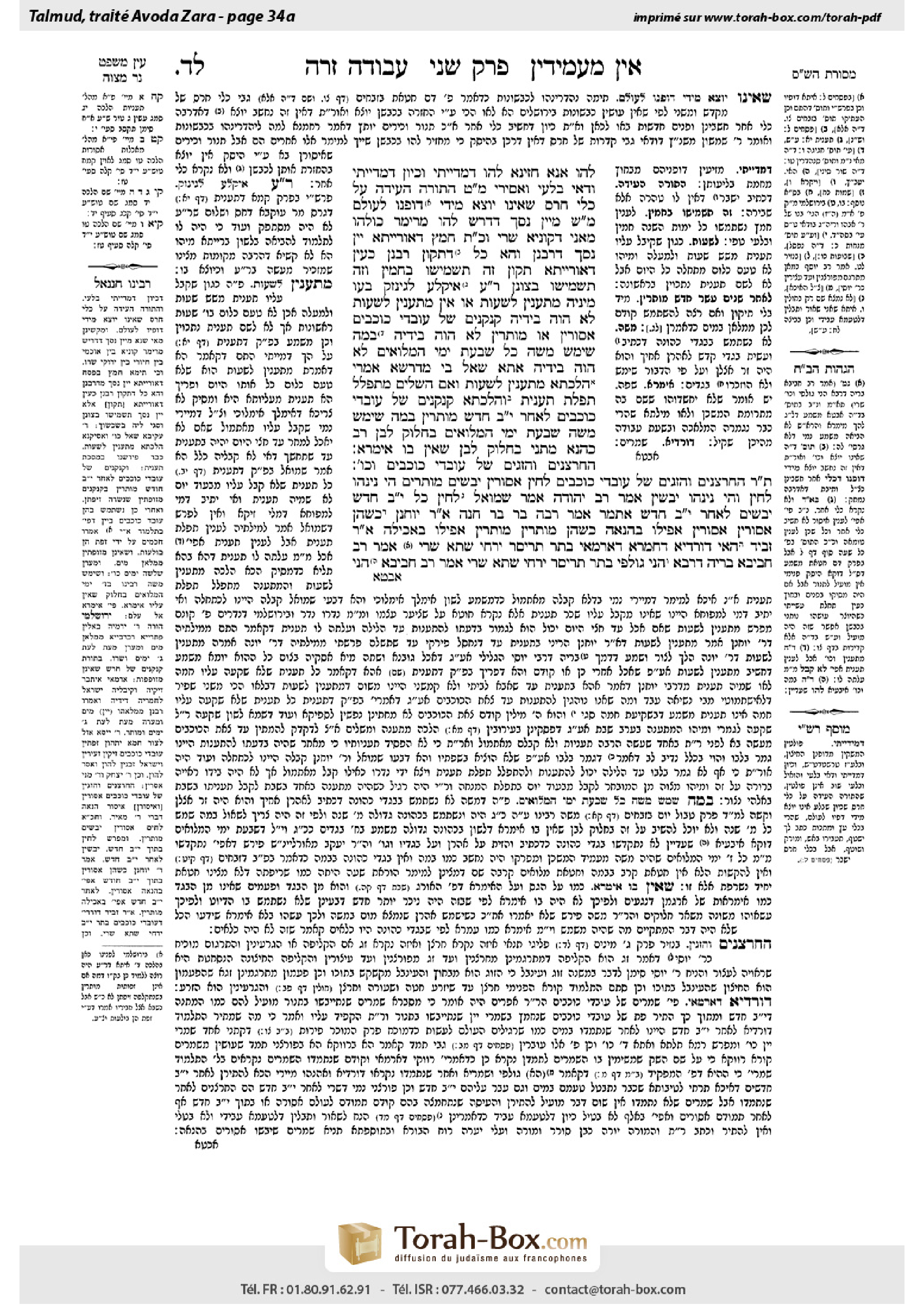
Avodah Zarah 34a: Talmud study for Daf Yomi
Study the Talmud for Daf Yomi with scanned pages, Hebrew text, English translations from Sefaria and AI-generated French translations.
Passage selection and English or AI-generated French translation are available where the scan has annotations. Daf Study is independent of Torah-Box and Sefaria.
Browse Avodah Zarah · עבודה זרה · All tractatesAvodah Zarah 34a text and translations
This page of Avodah Zarah includes the Aramaic text, an English translation and an AI-generated French translation, alongside the scan above.
עבודה זרה ל״ד א · Aramaic and Hebrew text
לְהוּ: אֲנָא חָזֵינָא לְהוּ דְּמִדַּיְּיתִי, וְכֵיוָן דְּמִדַּיְּיתִי וַדַּאי בָּלְעִי וַאֲסִירִי. מַאי טַעְמָא? הַתּוֹרָה הֵעִידָה עַל כְּלִי חֶרֶס שֶׁאֵינוֹ יוֹצֵא מִידֵי דּוֹפְנוֹ לְעוֹלָם.
מַאי שְׁנָא מִיַּיִן נֶסֶךְ, דְּדָרֵשׁ לְהוּ מָרִימָר: כּוּלְּהוּ מָאנֵי דְקוּנְיָא שְׁרֵי?
וְכִי תֵּימָא: חָמֵץ דְּאוֹרָיְיתָא, יֵין נֶסֶךְ דְּרַבָּנַן — וְהָא כֹּל דְּתַקּוּן רַבָּנַן כְּעֵין דְּאוֹרָיְיתָא תַּקּוּן! זֶה תַּשְׁמִישׁוֹ בְּחַמִּין, וְזֶה תַּשְׁמִישׁוֹ בְּצוֹנֵן.
רַבִּי עֲקִיבָא אִיקְּלַע לְגִינְזַק, בְּעוֹ מִינֵּיהּ: מִתְעַנִּין לְשָׁעוֹת אוֹ אֵין מִתְעַנִּין לְשָׁעוֹת? לָא הֲוָה בִּידֵיהּ. קַנְקַנִּים שֶׁל גּוֹיִם אֲסוּרִין אוֹ מוּתָּרִין? לָא הֲוָה בִּידֵיהּ. בַּמֶּה שִׁימֵּשׁ מֹשֶׁה כׇּל שִׁבְעַת יְמֵי הַמִּלּוּאִים? לָא הֲוָה בִּידֵיהּ.
אֲתָא שְׁאֵל בֵּי מִדְרְשָׁא, אָמְרִי: הִלְכְתָא מִתְעַנִּין לְשָׁעוֹת, וְאִם הִשְׁלִים — מִתְפַּלֵּל תְּפִלַּת תַּעֲנִית. וְהִלְכְתָא קַנְקַנִּים שֶׁל גּוֹיִם לְאַחַר שְׁנֵים עָשָׂר חֹדֶשׁ מוּתָּרִין. בַּמֶּה שִׁימֵּשׁ מֹשֶׁה שִׁבְעַת יְמֵי הַמִּלּוּאִים? בְּחָלוּק לָבָן. רַב כָּהֲנָא מַתְנֵי: בְּחָלוּק לָבָן שֶׁאֵין בּוֹ אִימְּרָא.
הַחַרְצַנִּים וְהַזַּגִּים שֶׁל גּוֹיִם וְכוּ׳. תָּנוּ רַבָּנַן: הַחַרְצַנִּים וְהַזַּגִּים שֶׁל גּוֹיִם, לַחִין — אֲסוּרִין, יְבֵשִׁים — מוּתָּרִים. הֵי נִינְהוּ לַחִין וְהֵי נִינְהוּ יְבֵשִׁין? אָמַר רַב יְהוּדָה אָמַר שְׁמוּאֵל: לַחִין — כׇּל שְׁנֵים עָשָׂר חֹדֶשׁ, יְבֵשִׁים — לְאַחַר שְׁנֵים עָשָׂר חֹדֶשׁ.
אִתְּמַר, אָמַר רַבָּה בַּר בַּר חָנָה אָמַר רַבִּי יוֹחָנָן: כְּשֶׁהֵן אֲסוּרִין — אֲסוּרִין אֲפִילּוּ בַּהֲנָאָה, כְּשֶׁהֵן מוּתָּרִין — מוּתָּרִין אֲפִילּוּ בַּאֲכִילָה.
אָמַר רַב זְבִיד: הַאי דּוּרְדְּיָּא דְּחַמְרָא דַּאֲרַמָּאֵי, בָּתַר תְּרֵיסַר יַרְחֵי שַׁתָּא שָׁרֵי. אָמַר רַב חֲבִיבָא בְּרֵיהּ דְּרָבָא: הָנֵי גּוּלְפֵי, בָּתַר תְּרֵיסַר יַרְחֵי שַׁתָּא שָׁרֵי. אָמַר רַב חֲבִיבָא: הָנֵי
Avodah Zarah 34a · English translation
to them: I observe that they sweat, i.e., they exude liquid from their exterior. And since they sweat, they certainly absorb, and are therefore prohibited. The Gemara asks: What is the reason that they cannot be rendered permitted by purging with hot water? It is because the Torah attested with regard to an earthenware vessel that substances absorbed in it are never expelled from its walls.
The Gemara reiterates its question: Mareimar ruled that glazed earthenware absorbs leavened bread permanently, but he did not rule likewise with regard to wine. But in what way is leavened bread different from wine used for an idolatrous libation? Why is it that Mareimar taught with regard to them: All glazed earthenware vessels are permitted, even if they have contained wine of gentiles?
The Gemara adds: And if you would say that these cases are different, as leavened bread is prohibited by Torah law whereas wine used for a libation is prohibited by rabbinic law, that is difficult: But there is a principle that all ordinances that the Sages instituted, they instituted them parallel to Torah law. Although this wine is prohibited by rabbinic law, it is subject to the same halakhot as leavened bread. The Gemara answers: This one’s use is with hot substances, and that one’s use is with cold substances. Wine is drunk while it is cold and is therefore absorbed to a lesser extent than leavened bread, which is often cooked in the vessel.
The Gemara relates: Rabbi Akiva happened to come to the city of Ginzak, whose residents asked him three questions to which he did not know the answer: First, does one fast for hours, or does one not fast for hours? The answer to the question was not available to Rabbi Akiva. Second, are clay jars that belong to gentiles permanently prohibited, or can they be rendered permitted? The answer was not available to him. Third, in what garments did Moses serve all seven days of the Tabernacle’s inauguration, as acting priest when Aaron and his sons were initiated into the priesthood? Moses presumably did not wear the priestly vestments, as he himself was not a priest. Once again, the answer was not available to him.
Rabbi Akiva came and asked these questions in the study hall. They said to him: The halakha is that one fasts for hours, and if he completed the fast he prays the prayer of a fast. And the halakha is that the jars that belong to gentiles are permitted after they have not been used for twelve months. Finally, in what garments did Moses serve during the seven days of inauguration? He did not serve in his own clothes, nor in the regular priestly vestments, but in a special white cloak. Rav Kahana teaches: Moses served in a white cloak without a hem.
§ The mishna teaches that residual grape seeds and grape skins that belong to gentiles are prohibited. The Sages taught: Moist grape seeds and grape skins that belong to gentiles are prohibited, but dry ones are permitted. The Gemara asks: Which are considered moist and which are considered dry? Rav Yehuda says that Shmuel says: Grape residues are considered moist for all of the first twelve months after the grapes were pressed, and dry after the first twelve months.
It was stated that Rabba bar bar Ḥana says that Rabbi Yoḥanan says: When these grape residues are prohibited, one is prohibited even from deriving benefit from them. When they are permitted, they are permitted even with regard to consumption.
Rav Zevid says: With regard to these yeasts produced from the wine of Arameans, after twelve months of the year they are permitted. Rav Ḥaviva, son of Rava, says: With regard to these jugs that belong to gentiles, after twelve months of the year they are permitted. Rav Ḥaviva says: With regard to these
Avodah Zarah 34a · Traduction française (IA)
ils disent : Je constate qu'ils transpirent, c'est-à-dire qu'ils exhalent un liquide de leur surface externe. Et puisque ils transpirent, ils absorbent certainement, et sont donc interdits. La Guemara pose la question : Pourquoi ne peuvent-ils pas être rendus permis par le lavage à l'eau chaude ? C'est parce que la Torah a témoigné concernant un vase en terre que les substances absorbées ne peuvent jamais être expulsées de ses parois.
La Guemara répète sa question : Mareimar a décidé que les vases en terre polis absorbent le pain aisé de manière permanente, mais il n'a pas décidé ainsi concernant le vin. Mais en quoi le pain aisé diffère-t-il du vin utilisé pour une libation idolâtre ? Pourquoi est-ce que Mareimar a enseigné concernant eux : Tous les vases en terre polis sont permis, même s'ils ont contenu du vin des non-juifs ?
La Guemara ajoute : Et si vous dites que ces cas sont différents, car le pain aisé est interdit par la Loi divine tandis que le vin utilisé pour une libation est interdit par la Loi rabbinique, cela est difficile : Mais il y a un principe selon lequel toutes les ordonnances que les Sages ont instituées, ils les ont instituées parallèlement à la Loi divine. Bien que ce vin soit interdit par la Loi rabbinique, il est soumis aux mêmes halakhot que le pain aisé. La Guemara répond : L'un est utilisé avec des substances chaudes, et l'autre avec des substances froides. Le vin est bu à température ambiante et est donc absorbé moins que le pain aisé, qui est souvent cuit dans le vase.
La Guemara rapporte : Rabbi Akiva est arrivé dans la ville de Ginzak, dont les habitants lui ont posé trois questions auxquelles il ne savait pas répondre : Premièrement, est-ce qu'on jeûne pendant des heures, ou est-ce qu'on ne jeûne pas pendant des heures ? La réponse à cette question n'était pas connue de Rabbi Akiva. Deuxièmement, les jarres en terre appartenant aux non-juifs sont-elles définitivement interdites, ou peuvent-elles être rendues permises ? La réponse n'était pas connue pour lui. Troisièmement, dans quelles vêtements Moïse a-t-il servi pendant les sept jours de l'inauguration du Tabernacle, en tant que prêtre lors de l'initiation d'Aaron et de ses fils au sacerdoce ? Moïse n'a probablement pas porté les vêtements sacerdotaux, car il n'était pas lui-même un prêtre. Une fois de plus, la réponse n'était pas connue pour lui.
Rabbi Akiva est venu et a posé ces questions dans la salle de étude. Ils lui dirent : La halakha est qu'on jeûne pendant des heures, et si l'on a accompli le jeûne, on prie la prière du jeûne. Et la halakha est que les jarres appartenant aux non-juifs sont permises après qu'elles n'ont pas été utilisées pendant douze mois. Enfin, dans quelles vêtements Moïse a-t-il servi pendant les sept jours de l'inauguration ? Il n'a pas servi dans ses propres vêtements, ni dans les vêtements sacerdotaux ordinaires, mais dans une robe blanche spéciale. Rav Kahana enseigne : Moïse a servi dans une robe blanche sans ourlet.
§ La mitsna enseigne que les résidus de raisin et les peaux de raisin appartenant aux non-juifs sont interdits. Les Sages ont enseigné : Les résidus de raisin et les peaux de raisin humides appartenant aux non-juifs sont interdits, mais les secs sont permis. La Guemara pose la question : Quels sont considérés comme humides et quels comme secs ? Rav Yéhuda dit que Shmuel dit : Les résidus de raisin sont considérés comme humides pendant les douze premiers mois après la récolte, et secs après ces douze mois.
Il a été dit que Rabba bar bar Ḥana dit que Rabbi Yoḥanan dit : Lorsque ces résidus de raisin sont interdits, on est interdit même d'en tirer un bénéfice. Lorsqu'ils sont permis, ils sont permis même en ce qui concerne leur consommation.
Rav Zévid dit : Concernant ces levures produites à partir du vin des Araméens, après douze mois de l'année, elles sont permises. Rav Ḥaviva, fils de Rava, dit : Concernant ces jarres appartenant aux non-juifs, après douze mois de l'année, elles sont permises. Rav Ḥaviva dit : Concernant ces
Traduction française générée par IA à partir de l’édition anglaise de Sefaria. Vérifie toujours un passage avec le texte source.
Text from Sefaria: William Davidson Edition - Vocalized Aramaic (CC BY NC); William Davidson Edition - English (CC BY NC).