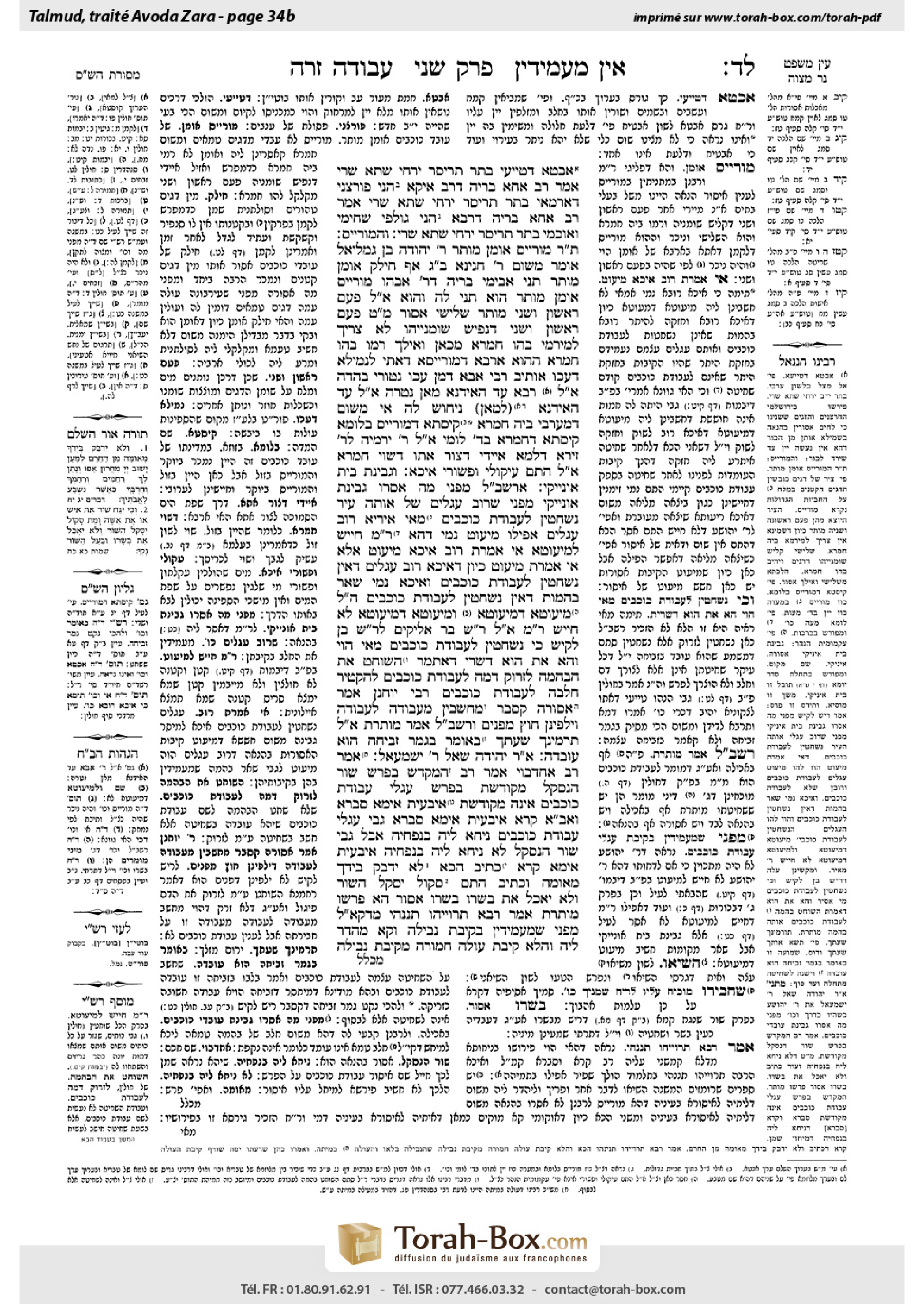
Avodah Zarah 34b: Talmud study for Daf Yomi
Study the Talmud for Daf Yomi with scanned pages, Hebrew text, English translations from Sefaria and AI-generated French translations.
Passage selection and English or AI-generated French translation are available where the scan has annotations. Daf Study is independent of Torah-Box and Sefaria.
Browse Avodah Zarah · עבודה זרה · All tractatesAvodah Zarah 34b text and translations
This page of Avodah Zarah includes the Aramaic text, an English translation and an AI-generated French translation, alongside the scan above.
עבודה זרה ל״ד ב · Aramaic and Hebrew text
אֲבַטָּא דְּטַיָּיעֵי, בָּתַר תְּרֵיסַר יַרְחֵי שַׁתָּא שְׁרֵי. אָמַר רַב אַחָא בְּרֵיהּ דְּרַב אִיקָא: הָנֵי פּוּרְצָנֵי דַּאֲרַמָּאֵי, בָּתַר תְּרֵיסַר יַרְחֵי שַׁתָּא שָׁרֵי. אָמַר רַב אַחָא בְּרֵיהּ דְּרָבָא: הָנֵי גּוּלְפֵי שְׁחִימֵי וְאוּכָּמֵי, בָּתַר תְּרֵיסַר יַרְחֵי שַׁתָּא שְׁרֵי.
וְהַמּוּרְיָיס. תָּנוּ רַבָּנַן: מוּרְיָיס אוּמָּן — מוּתָּר. רַבִּי יְהוּדָה בֶּן גַּמְלִיאֵל אוֹמֵר מִשּׁוּם רַבִּי חֲנִינָא בֶּן גַּמְלִיאֵל: אַף חִילָק אוּמָּן — מוּתָּר.
תָּנֵי אֲבִימִי בְּרֵיהּ דְּרַבִּי אֲבָהוּ: מוּרְיָיס אוּמָּן מוּתָּר. הוּא תָּנֵי לַהּ וְהוּא אָמַר לַהּ: פַּעַם רִאשׁוֹן וְשֵׁנִי מוּתָּר, שְׁלִישִׁי אָסוּר. מַאי טַעְמָא? פַּעַם רִאשׁוֹן וְשֵׁנִי דִּנְפִישׁ שׁוּמְנַיְיהוּ — לָא צְרִיךְ לְמִירְמֵי בְּהוּ חַמְרָא, מִכָּאן וְאֵילָךְ רָמוּ בְּהוּ חַמְרָא.
הָהוּא אַרְבָּא דְּמוּרְיְיסָא דַּאֲתַי לִנְמֵילָא דְּעַכּוֹ, אוֹתֵיב רַבִּי אַבָּא דְּמִן עַכּוֹ נָטוֹרֵי בַּהֲדַהּ. אֲמַר לֵיהּ רָבָא: עַד הָאִידָּנָא מַאן נַטְרַהּ? אֲמַר לֵיהּ: עַד הָאִידָּנָא (לְמַאן) [לְמַאי] נֵיחוּשׁ לַהּ? אִי מִשּׁוּם דִּמְעָרְבִי בֵּיהּ חַמְרָא — קִיסְתָּא דְּמוּרְיָיס בְּלוּמָא, קִיסְתָּא דְּחַמְרָא בְּאַרְבְּעָה לוּמֵי.
אֲמַר לֵיהּ רַבִּי יִרְמְיָה לְרַבִּי זֵירָא: דִּלְמָא אַיְּידֵי דְּצוֹר אֲתוֹ דְּשָׁוֵי חַמְרָא? אֲמַר לֵיהּ: הָתָם עִיקּוּלֵי וּפָשׁוֹרֵי אִיכָּא.
וּגְבִינַת בֵּית אוּנְיָיקֵי. אָמַר רַבִּי שִׁמְעוֹן בֶּן לָקִישׁ: מִפְּנֵי מָה אָסְרוּ גְּבִינַת אוּנְיָיקֵי? מִפְּנֵי שֶׁרוֹב עֲגָלִים שֶׁל אוֹתָהּ עִיר נִשְׁחָטִין לַעֲבוֹדָה זָרָה. מַאי אִירְיָא רוֹב עֲגָלִים? אֲפִילּוּ מִיעוּט נָמֵי, דְּהָא רַבִּי מֵאִיר חָיֵישׁ לְמִיעוּטָא!
אִי אָמְרַתְּ רוֹב — אִיכָּא מִיעוּט.
אֶלָּא אִי אָמְרַתְּ מִיעוּט, כֵּיוָן דְּאִיכָּא רוֹב עֲגָלִים דְּאֵין נִשְׁחָטִין לַעֲבוֹדָה זָרָה, וְאִיכָּא נָמֵי שְׁאָר בְּהֵמוֹת דְּאֵין נִשְׁחָטִין לַעֲבוֹדָה זָרָה — הָוֵה לֵיהּ מִיעוּטָא דְּמִיעוּטָא, וּמִיעוּטָא דְּמִיעוּטָא לָא חָיֵישׁ רַבִּי מֵאִיר.
אֲמַר לֵיהּ רַבִּי שִׁמְעוֹן בַּר אֶלְיָקִים לְרַבִּי שִׁמְעוֹן בֶּן לָקִישׁ: כִּי נִשְׁחָטִין לַעֲבוֹדָה זָרָה מַאי הָוֵי? וְהָא אַתְּ הוּא דְּשָׁרֵי!
דְּאִתְּמַר: הַשּׁוֹחֵט אֶת הַבְּהֵמָה לִזְרוֹק דָּמָהּ לַעֲבוֹדָה זָרָה, לְהַקְטִיר חֶלְבָּהּ לַעֲבוֹדָה זָרָה, רַבִּי יוֹחָנָן אָמַר: אֲסוּרָה, קָסָבַר מְחַשְּׁבִין מֵעֲבוֹדָה לַעֲבוֹדָה, וְיָלְפִינַן חוּץ מִפְּנִים.
וְרַבִּי שִׁמְעוֹן בֶּן לָקִישׁ אָמַר: מוּתֶּרֶת!
אֲמַר לֵיהּ: תִּרְמִינָךְ שַׁעְתָּךְ, בְּאוֹמֵר: בִּגְמַר זְבִיחָה הוּא עוֹבְדָהּ.
אָמַר רַבִּי יְהוּדָה: שָׁאַל רַבִּי יִשְׁמָעֵאל. אָמַר רַב אַחָדְבוּי אָמַר רַב: הַמְקַדֵּשׁ בְּפֶרֶשׁ שׁוֹר הַנִּסְקָל — מְקוּדֶּשֶׁת, בְּפֶרֶשׁ עֶגְלֵי עֲבוֹדָה זָרָה — אֵינָהּ מְקוּדֶּשֶׁת. אִיבָּעֵית אֵימָא סְבָרָא, וְאִיבָּעֵית אֵימָא קְרָא.
אִיבָּעֵית אֵימָא סְבָרָא: גַּבֵּי עֶגְלֵי עֲבוֹדָה זָרָה נִיחָא לֵיהּ בְּנִפְחֵיהּ, אֲבָל גַּבֵּי שׁוֹר הַנִּסְקָל לָא נִיחָא לֵיהּ בְּנִפְחֵיהּ.
אִיבָּעֵית אֵימָא קְרָא: כְּתִיב הָכָא: ״לָא יִדְבַּק בְּיָדְךָ מְאוּמָה״, וּכְתִיב הָתָם: ״סָקוֹל יִסָּקֵל הַשּׁוֹר וְלֹא יֵאָכֵל אֶת בְּשָׂרוֹ״, בְּשָׂרוֹ אָסוּר, הָא פִּרְשׁוֹ מוּתֶּרֶת.
אָמַר רָבָא: תַּרְוַיְיהוּ תְּנַנְהִי, מִדְּקָאָמַר לֵיהּ: מִפְּנֵי שֶׁמַּעֲמִידִין בְּקֵיבַת נְבֵילָה, וְקָא מַהְדַּר לֵיהּ: וַהֲלֹא קֵיבַת עוֹלָה חֲמוּרָה מִקֵּיבַת נְבֵילָה.
Avodah Zarah 34b · English translation
canteens belonging to Arabs, after twelve months of the year they are permitted. Rav Aḥa, son of Rav Ika, says: With regard to these Aramean grape pits, after twelve months of the year they are permitted. Rav Aḥa, son of Rava, says: With regard to these brown and black jugs, after twelve months of the year they are permitted.
§ The mishna teaches that fish stew is prohibited. The Sages taught: Fish stew prepared by an expert is permitted, as professionals do not mix wine in it. Rabbi Yehuda ben Gamliel says in the name of Rabbi Ḥanina ben Gamliel: Ḥilak prepared by an expert is also permitted.
Avimi, son of Rabbi Abbahu, would teach: Fish stew prepared by an expert is permitted. He would teach this baraita that he received through tradition, and then he would say its explanation: The first time and the second time that fish stew is prepared from a fish, it is permitted, but the third time it is prohibited. What is the reason? With regard to the first time and the second time, as the fish’s oil is plentiful, there is no need to place wine in it. From this point forward, one might place wine in it to compensate for the insufficient fish oil.
The Gemara relates that there was a certain boat carrying fish stew which came to the port of Akko, and Rabbi Abba from Akko placed guards over it to ensure that no wine would be added to the fish stew. Rava said to him: Until now, who guarded it? Rabbi Abba said to him: Until now, for what should we be concerned? If the problem is due to the concern that they mix wine in it, that concern is unfounded, as in the place where this fish stew was produced, a kista of fish stew sells for one luma while a kista of wine sells for four luma. Since wine was more expensive than fish stew, there is no reason to suspect that wine was added to the stew before it reached Akko, where fish stew is sold at a higher price than wine.
Upon hearing this, Rabbi Yirmeya said to Rabbi Zeira: But perhaps they came by means of Tyre, where wine is inexpensive and therefore likely to be added to the fish stew to increase its volume. Rabbi Zeira said to him: There, by way of Tyre, there are impediments and melted snow, which make travel very difficult, and the boat would not have sailed through that route.
§ The mishna teaches: And cheese of Beit Unyaki is prohibited. Rabbi Shimon ben Lakish says: For what reason did they prohibit deriving benefit from the cheese of Beit Unyaki? It is because most of the calves of that city are slaughtered for the sake of idol worship, and the milk curdled in their stomach contents is prohibited. The Gemara asks: Why does this explanation specifically mention most calves? Even if a minority of calves were slaughtered for idol worship, this would also be reason enough, as Rabbi Meir, who is the tanna of unattributed opinions in a mishna, is generally concerned about a minority.
The Gemara explains: If you say that the reason for the prohibition is due to a majority of calves slaughtered for idol worship, then despite the fact that the majority of animals in general used to curdle cheese are not slaughtered for idolatrous purposes, there are nevertheless a minority of animals altogether, i.e., the majority of calves, that are, and this minority of calves are cause for concern according to Rabbi Meir.
The Gemara continues: But if you say that Rabbi Meir prohibits the cheese due to a minority of calves, since there are a majority of calves that are not slaughtered for idol worship, and there are also a wider majority of the remaining animals used to curdle milk that are not slaughtered for idol worship at all, this would constitute a minority of a minority, and Rabbi Meir is not concerned for a minority of a minority. Since only a particular minority of animals used to curdle cheese, i.e., calves, are ever slaughtered for idolatry, and even within that group, only a minority are actually slaughtered, even Rabbi Meir would not be concerned.
Rabbi Shimon bar Elyakim said to Rabbi Shimon ben Lakish: Even when calves are slaughtered for the sake of idol worship, what of it? But are you not the one who permits animals slaughtered with idolatrous intentions?
As it was stated: The halakha with regard to one who slaughters an animal in order to sprinkle its blood for the sake of idol worship, or to burn its prohibited fat for idol worship, is subject to a dispute between amora’im. Rabbi Yoḥanan says: Deriving benefit from the animal is prohibited, as he holds that one can intend from one rite to another rite. In other words, idolatrous intent while slaughtering an animal renders it prohibited, even if the intention pertains not to the slaughter itself but to sprinkling the blood or burning the fat. And he maintains that we derive halakhot concerning intent outside the Temple from the halakhot concerning intent inside the Temple. Since such intentions at the time of slaughter render an animal prohibited within the Temple, they render it prohibited outside the Temple as well, with regard to idol worship.
And Rabbi Shimon ben Lakish says: Deriving benefit from the animal is permitted. Apparently, Rabbi Shimon ben Lakish holds that slaughtering an animal for the sake of idol worship does not render it prohibited. This contradicts his previous assertion that it is prohibited to derive benefit from calves that have been slaughtered for the sake of idol worship.
Rabbi Shimon ben Lakish said to Rabbi Shimon bar Elyakim: May your fortune be auspicious; the case here is where one says that he is worshipping the idol at the conclusion of the slaughter. Since the act of slaughtering itself is an act of worship, the calf is rendered prohibited immediately.
§ The mishna teaches that Rabbi Yehuda said: Rabbi Yishmael asked Rabbi Yehoshua a series of questions. The Gemara notes that Rav Aḥadevoi says that Rav says: With regard to one who betroths a woman by giving her the excrement of an ox that is to be stoned, the woman is betrothed, provided that the excrement was worth one peruta. Although no benefit may be derived from the ox itself, it is permitted to derive benefit from its excrement. But if one attempts to betroth her with the excrement of calves that were used as offerings of idol worship, she is not betrothed, as even their excrement is forbidden. The Gemara remarks: If you wish, propose logical reasoning, and if you wish, cite a verse to substantiate this claim.
The Gemara elaborates: If you wish, propose logical reasoning: With regard to calves used for idol worship, a calf’s additional girth derived from the excrement stored in its body is satisfactory for the worshipper, as fatter animals are more impressive offerings. Since the excrement is part of the offering, it is also forbidden. But with regard to an ox that is to be stoned, its additional girth is not satisfactory for the owner, as he gains nothing from it.
If you wish, cite a verse: It is written here, with regard to an animal used for idol worship: “And there shall cleave naught of the dedicated thing to your hand” (Deuteronomy 13:18), which indicates that the entire animal is forbidden. And it is written there, with regard to an ox to be stoned: “The ox shall be stoned, and its flesh shall not be eaten” (Exodus 21:28). This teaches that its flesh is forbidden, but its excrement is permitted.
Rava said: We learned both of these halakhot from the mishna. He elaborates: From the fact that Rabbi Yehoshua said to Rabbi Yishmael that cheese of gentiles is prohibited because they curdle it in the stomach contents of an unslaughtered animal carcass, one can derive the halakha of the excrement of an ox that is to be stoned. The reason is that Rabbi Yishmael responded to Rabbi Yehoshua: But isn’t the stomach of a burnt-offering subject to a more stringent halakha than the stomach of an unslaughtered animal carcass, and yet although one may not derive benefit from the stomach of a burnt-offering ab initio, if one did derive benefit from it he is not liable for misuse of property consecrated to the Temple?
Avodah Zarah 34b · Traduction française (IA)
Les récipients appartenant aux Arabes sont permis après un an. Rav Aḥa, fils de Rav Ika, dit : Concernant ces noyaux de raisin araméens, ils sont permis après un an. Rav Aḥa, fils de Rava, dit : Concernant ces jarres brunes et noires, ils sont permis après un an.
§ La mitsva enseigne que la bouillie de poisson est interdite. Les Sages enseignent : La bouillie de poisson préparée par un expert est permise, car les professionnels n'ajoutent pas de vin. Rabbi Yehuda ben Gamliel dit au nom de Rabbi Ḥanina ben Gamliel : La bouillie de poisson préparée par un expert est également permise.
Avimi, fils de Rabbi Abbahu, enseignait : La bouillie de poisson préparée par un expert est permise. Il enseignait cette baraïta qu'il avait reçue par tradition, puis il disait son explication : La première et la deuxième fois que la bouillie de poisson est préparée à partir d'un poisson, elle est permise, mais la troisième fois elle est interdite. Pourquoi ? Parce que, la première et la deuxième fois, l'huile du poisson est abondante, il n'y a donc pas besoin d'ajouter du vin. À partir de ce moment, on pourrait ajouter du vin pour compenser l'insuffisance d'huile de poisson.
La Guemara rapporte qu'il y avait un bateau transportant de la bouillie de poisson qui est arrivé au port d'Akkô, et Rabbi Abba d'Akkô a mis des gardes sur elle pour s'assurer que du vin ne serait pas ajouté à la bouillie de poisson. Rava lui a dit : Jusqu'à présent, qui a gardé cela ? Rabbi Abba lui a répondu : Jusqu'à présent, à quoi bon s'inquiéter ? Si le problème est dû à l'inquiétude qu'on mélange du vin, cette inquiétude est infondée, car dans le lieu où cette bouillie de poisson a été produite, une kista de bouillie de poisson se vend pour un luma, tandis qu'une kista de vin se vend pour quatre luma. Puisque le vin était plus cher que la bouillie de poisson, il n'y a pas de raison de soupçonner qu'on a ajouté du vin à la bouillie avant qu'elle n'arrive à Akko, où la bouillie de poisson est vendue à un prix plus élevé que le vin.
En entendant cela, Rabbi Yirmeya a dit à Rabbi Zeira : Mais peut-être qu'ils sont arrivés par le biais de Tyr, où le vin est peu cher et donc susceptible d'être ajouté à la bouillie de poisson pour augmenter son volume. Rabbi Zeira lui a répondu : Là-bas, par le biais de Tyr, il y a des obstacles et de la neige fondue, ce qui rend le voyage très difficile, et le bateau n'aurait pas navigué par ce chemin.
§ La mitsva enseigne : Et le fromage de Beit Unyaki est interdit. Rabbi Shimon ben Lakish dit : Pour quelle raison interdisent-ils d'exploiter le fromage de Beit Unyaki ? C'est parce que la plupart des veaux de cette ville sont sacrifiés pour l'idolâtrie, et le lait coagulé dans leur contenu est interdit. La Guemara pose la question : Pourquoi cette explication spécifiquement mentionne-t-elle la plupart des veaux ? Même si une minorité de veaux avait été sacrifiée pour l'idolâtrie, cela suffirait déjà, car Rabbi Meir, qui est le tanna des opinions non attribuées dans une mitsva, est généralement préoccupé par une minorité.
La Guemara explique : Si vous dites que l'interdiction provient du fait que la plupart des veaux sont sacrifiés pour l'idolâtrie, alors malgré le fait que la plupart des animaux en général utilisés pour coaguler le fromage ne sont pas sacrifiés pour l'idolâtrie, il y a tout de même une minorité d'animaux, c'est-à-dire la plupart des veaux, qui sont sacrifiés, et cette minorité de veaux est source d'inquiétude selon Rabbi Meir.
La Guemara continue : Mais si vous dites que Rabbi Meir interdit le fromage en raison d'une minorité de veaux, puisque la plupart des veaux ne sont pas sacrifiés pour l'idolâtrie, et qu'il y a aussi une majorité d'autres animaux utilisés pour coaguler le lait qui ne sont pas sacrifiés pour l'idolâtrie du tout, cela constituerait une minorité d'une minorité, et Rabbi Meir n'est pas préoccupé par une minorité d'une minorité. Puisque seul une minorité d'animaux utilisés pour coaguler le fromage, c'est-à-dire les veaux, sont sacrifiés pour l'idolâtrie, et même au sein de ce groupe, seule une minorité est sacrifiée, même Rabbi Meir ne serait pas préoccupé.
Rabbi Shimon bar Elyakim a dit à Rabbi Shimon ben Lakish : Même quand les veaux sont sacrifiés pour l'idolâtrie, qu'y a-t-il de grave ? Mais ne vous n'êtes-vous pas vous-même celui qui permet l'usage d'animaux sacrifiés avec des intentions idolâtres ?
Comme il a été dit : La halakha concernant celui qui tue un animal afin de verser son sang pour l'idolâtrie, ou afin de brûler sa graisse interdite pour l'idolâtrie, est sujette à un débat entre les amoraïm. Rabbi Yoḥanan dit : Il est interdit d'en tirer un bénéfice, car il considère que l'intention d'une cérémonie peut être transférée à une autre cérémonie. En d'autres termes, l'intention idolâtre lors de la tue d'un animal rend l'animal interdit, même si l'intention concerne non pas la tue elle-même mais le versement du sang ou la combustion de la graisse. Et il maintient que nous dérivons les halakhot concernant l'intention en dehors du Temple à partir des halakhot concernant l'intention dans le Temple. Puisque de telles intentions au moment de la tue rendent un animal interdit dans le Temple, elles le rendent également interdit en dehors du Temple concernant l'idolâtrie.
Et Rabbi Shimon ben Lakish dit : Il est permis d'en tirer un bénéfice. Apparemment, Rabbi Shimon ben Lakish considère que la tue d'un animal pour l'idolâtrie ne rend pas l'animal interdit. Cela contredit son affirmation précédente selon laquelle il est interdit d'exploiter les veaux sacrifiés pour l'idolâtrie.
Rabbi Shimon ben Lakish a dit à Rabbi Shimon bar Elyakim : Que votre fortune soit favorable ; le cas ici est celui où l'on dit qu'il adore l'idole à la fin de la tue. Puisque l'acte de tue lui-même est un acte de culte, le veau est immédiatement interdit.
§ La Michna enseigne que Rabbi Yehuda a dit : Rabbi Yishmael a posé à Rabbi Yehoshua une série de questions. La Guemara note que Rav Aḥadevoi dit que Rav a dit : En ce qui concerne celui qui épouse une femme en lui donnant les déjections d'un bœuf à lapider, la femme est épousée, à condition que les déjections valent un peruta. Bien qu'on ne puisse pas tirer un bénéfice du bœuf lui-même, il est permis de tirer un bénéfice de ses déjections. Mais si l'on tente de l'épouser avec les déjections de veaux utilisés comme offrandes d'idolâtrie, elle n'est pas épousée, car même leurs déjections sont interdites. La Guemara remarque : Si vous le souhaitez, proposez un raisonnement logique, et si vous le souhaitez, citez un verset pour appuyer cette affirmation.
La Guemara développe : Si vous le souhaitez, proposez un raisonnement logique : En ce qui concerne les veaux utilisés pour l'idolâtrie, la corpulence supplémentaire dérivée des déjections stockées dans leur corps est satisfaisante pour le vénérant, car des animaux plus gras sont des offrandes plus impressionnantes. Puisque les déjections font partie de l'offrande, elles sont également interdites. En ce qui concerne un bœuf à lapider, sa corpulence supplémentaire n'est pas satisfaisante pour l'propriétaire, car il n'en tire aucun bénéfice.
Si vous le souhaitez, citez un verset : Il est écrit ici, en ce qui concerne un animal utilisé pour l'idolâtrie : « Et il ne restera rien de l'offrande consacrée à votre main » (Deutéronome 13:18), ce qui indique que l'animal entier est interdit. Et il est écrit là, en ce qui concerne un bœuf à lapider : « Le bœuf sera lapidé, et sa chair ne sera pas mangée » (Exode 21:28). Cela enseigne que sa chair est interdite, mais ses déjections sont permises.
Rava a dit : Nous avons appris ces deux halakhot à partir de la Michna. Il développe : À partir du fait que Rabbi Yehoshua a dit à Rabbi Yishmael que le fromage des païens est interdit car ils le ferment dans les contenus de l'estomac d'un cadavre non sacrifié, on peut déduire la halakha des déjections d'un bœuf à lapider. La raison est que Rabbi Yishmael a répondu à Rabbi Yehoshua : Mais n'est-ce pas l'estomac d'une offrande brûlée soumis à une halakha plus stricte que l'estomac d'un cadavre non sacrifié, et pourtant, bien qu'on ne puisse pas tirer un bénéfice de l'estomac d'une offrande brûlée dès le début, si l'on a tiré un bénéfice de celui-ci, on n'est pas tenu responsable de l'usage incorrect d'une propriété consacrée au Temple ?
Traduction française générée par IA à partir de l’édition anglaise de Sefaria. Vérifie toujours un passage avec le texte source.
Text from Sefaria: William Davidson Edition - Vocalized Aramaic (CC BY NC); William Davidson Edition - English (CC BY NC).