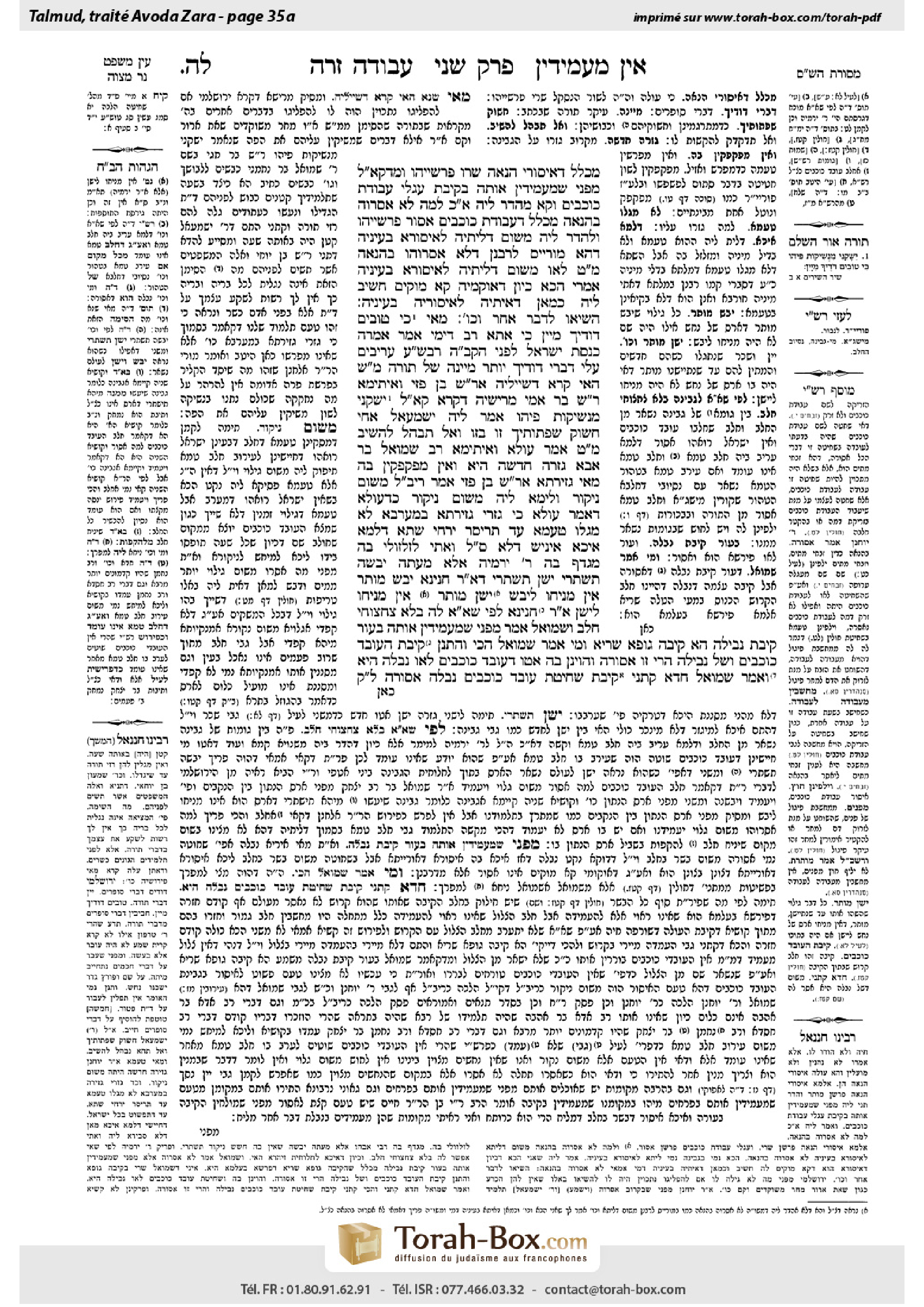
Avodah Zarah 35a: Talmud study for Daf Yomi
Study the Talmud for Daf Yomi with scanned pages, Hebrew text, English translations from Sefaria and AI-generated French translations.
Passage selection and English or AI-generated French translation are available where the scan has annotations. Daf Study is independent of Torah-Box and Sefaria.
Browse Avodah Zarah · עבודה זרה · All tractatesAvodah Zarah 35a text and translations
This page of Avodah Zarah includes the Aramaic text, an English translation and an AI-generated French translation, alongside the scan above.
עבודה זרה ל״ה א · Aramaic and Hebrew text
מִכְּלָל דְּאִיסּוּרֵי הֲנָאָה שָׁרוּ פִּרְשַׁיְיהוּ.
וּמִדְּקָאָמַר לֵיהּ מִפְּנֵי שֶׁמַּעֲמִידִין אוֹתָהּ בְּקֵיבַת עֶגְלֵי עֲבוֹדָה זָרָה, וְקָא מַהְדַּר לֵיהּ: אִם כֵּן לָמָּה לֹא אֲסָרוּהָ בַּהֲנָאָה — מִכְּלָל דַּעֲבוֹדָה זָרָה אֲסִיר פִּרְשַׁיְיהוּ.
וְלַהְדַּר לֵיהּ, מִשּׁוּם דְּלֵיתֵיהּ לְאִיסּוּרָא בְּעֵינֵיהּ!
דְּהָא מוּרְיָיס, לְרַבָּנַן דְּלָא אַסְרוּהּ בַּהֲנָאָה, מַאי טַעְמָא? לָאו מִשּׁוּם דְּלֵיתֵיהּ לְאִיסּוּרָא בְּעֵינֵיהּ?
אָמְרִי: הָכָא, כֵּיוָן דְּאוֹקֹמֵיה קָא מוֹקֵים, חֲשִׁיב לֵיהּ כְּמַאן דְּאִיתֵיהּ לְאִיסּוּרֵיהּ בְּעֵינֵיהּ.
הִשִּׂיאוֹ לְדָבָר אַחֵר וְכוּ׳. מַאי ״כִּי טוֹבִים דֹּדֶיךָ מִיָּיִן״? כִּי אֲתָא רַב דִּימִי אָמַר: אָמְרָה כְּנֶסֶת יִשְׂרָאֵל לִפְנֵי הַקָּדוֹשׁ בָּרוּךְ הוּא: רִבּוֹנוֹ שֶׁל עוֹלָם, עֲרֵיבִים עָלַי דִּבְרֵי דוֹדֶיךָ יוֹתֵר מִיֵּינָהּ שֶׁל תּוֹרָה.
מַאי שְׁנָא הַאי קְרָא דְּשַׁיְילֵיהּ? אָמַר רַבִּי שִׁמְעוֹן בֶּן פַּזִּי, וְאִיתֵּימָא רַבִּי שִׁמְעוֹן בַּר אַמֵּי: מֵרֵישֵׁיהּ דִּקְרָא קָאָמַר לֵיהּ, ״יִשָּׁקֵנִי מִנְּשִׁיקוֹת פִּיהוּ״. אֲמַר לֵיהּ: יִשְׁמָעֵאל אָחִי, חֲשׁוֹק שִׂפְתוֹתֶיךָ זוֹ בָּזוֹ וְאַל תִּבָּהֵל לְהָשִׁיב.
מַאי טַעְמָא? אָמַר עוּלָּא, וְאִיתֵּימָא רַב שְׁמוּאֵל בַּר אַבָּא: גְּזֵרָה חֲדָשָׁה הִיא, וְאֵין מְפַקְפְּקִין בַּהּ. מַאי גְּזֵירְתָּא? אָמַר רַבִּי שִׁמְעוֹן בֶּן פַּזִּי אָמַר רַבִּי יְהוֹשֻׁעַ בֶּן לֵוִי: מִשּׁוּם נִיקּוּר.
וְלֵימָא לֵיהּ מִשּׁוּם נִיקּוּר! כִּדְעוּלָּא, דְּאָמַר עוּלָּא: כִּי גָּזְרִי גְּזֵירְתָּא בְּמַעְרְבָא לָא מְגַלּוּ טַעְמָא עַד תְּרֵיסַר יַרְחֵי שַׁתָּא, דִּלְמָא אִיכָּא אִינִישׁ דְּלָא סְבִירָא לֵיהּ וְאָתֵי לְזַלְזוֹלֵי בַּהּ.
מְגַדֵּף בַּהּ רַבִּי יִרְמְיָה: אֶלָּא מֵעַתָּה, יְבֵשָׁה תִּשְׁתְּרֵי, יָשָׁן תִּשְׁתְּרֵי! דְּאָמַר רַבִּי חֲנִינָא: יָבֵשׁ מוּתָּר, אֵין מַנִּיחוֹ לְיַבֵּשׁ, יָשָׁן מוּתָּר, אֵין מַנִּיחוֹ לְיַשֵּׁן.
אָמַר רַבִּי חֲנִינָא: לְפִי שֶׁאִי אֶפְשָׁר לָהּ בְּלֹא צִחְצוּחֵי חָלָב, וּשְׁמוּאֵל אָמַר: מִפְּנֵי שֶׁמַּעֲמִידִין אוֹתָהּ בְּעוֹר קֵיבַת נְבֵילָה.
הָא קֵיבָה גּוּפָא שַׁרְיָא, וּמִי אָמַר שְׁמוּאֵל הָכִי? וְהָתְנַן: קֵיבַת הַגּוֹי וְשֶׁל נְבֵילָה — הֲרֵי זוֹ אֲסוּרָה,
וְהָוֵינַן בַּהּ, אַטּוּ דְּגוֹי לָאו נְבֵלָה הִיא?
וְאָמַר שְׁמוּאֵל: חֲדָא קָתָנֵי, קֵיבַת שְׁחִיטַת גּוֹי — נְבֵלָה אֲסוּרָה!
לָא קַשְׁיָא.
Avodah Zarah 35a · English translation
One can learn by inference from here that with regard to animals from which deriving benefit is prohibited, their excrement, which is the content of their stomach, is permitted. Although deriving benefit from both a burnt-offering and an unslaughtered animal carcass is prohibited, the excrement of each is permitted. Similarly, although deriving benefit from an ox that is to be stoned is prohibited, its excrement is permitted.
And from the fact that Rabbi Yehoshua said to Rabbi Yishmael: Cheese of gentiles is prohibited because they curdle it with the stomach contents of calves used for idol worship, and that Rabbi Yishmael responded to him: If that is so, why didn’t the Sages prohibit deriving benefit from the cheese, one may learn by inference that with regard to animals of idol worship, their excrement is prohibited. Since the cheese formed with the stomach contents of an animal of idol worship is prohibited, it is evident that the excrement formed in the stomach of such an animal is also prohibited.
The mishna related that rather than addressing Rabbi Yishmael’s final difficulty, Rabbi Yehoshua diverted his attention to another matter. The Gemara inquires: But let him respond to Rabbi Yishmael’s query by explaining that the Sages did not prohibit deriving benefit from cheese curdled in the stomach contents of an animal used for idolatry because there is no substantive prohibited entity in such cheese.
The Gemara reinforces its question: After all, isn’t the halakha with regard to fish stew, according to the opinion of the Rabbis, an application of this rationale, as they did not prohibit deriving benefit from fish stew prepared by a gentile? What is the reason for this leniency? Is it not because there is no substantive prohibited entity in it? Although fish stew may contain the wine of a gentile, deriving benefit from it is not prohibited because the wine is not discernible. Why didn’t Rabbi Yehoshua explain that deriving benefit from cheese of a gentile is similarly permitted because it contains no substantive prohibited entity?
The Gemara rejects this possibility: The Sages say in response that here, with regard to cheese, since the rennet curdles it, it is considered like an item that contains a substantive prohibited entity. Although the prohibited rennet is not discernible in the cheese, it is nevertheless considered a substantive prohibited entity because it is essential to the formation of the cheese.
§ The mishna teaches that Rabbi Yehoshua diverted Rabbi Yishmael’s attention to another matter, and began discussing the verse: “For your love is better than wine” (Song of Songs 1:2). The Gemara asks: What is the meaning of the verse: “For your love [dodekha] is better than wine”? When Rav Dimi came from Eretz Yisrael to Babylonia, he said: The congregation of Israel said before the Holy One, Blessed be He: Master of the Universe, the statements of Your beloved ones [dodekha], i.e., the Sages, are more pleasant to me than the wine of the written Torah itself.
The Gemara asks: What is different about this verse that led Rabbi Yehoshua to ask Rabbi Yishmael a question specifically with regard to it? Rabbi Shimon ben Pazi said, and some say Rabbi Shimon bar Ami said: He chose that verse because he sought to tell him a message that can be derived from the beginning of the verse: “Let him kiss me with the kisses of his mouth” (Song of Songs 1:2). In essence, Rabbi Yehoshua said to him: Yishmael, my brother, press your lips one to the other, and do not be so hasty to retort, i.e., do not persist in your questioning.
The Gemara asks: What is the reason that Rabbi Yehoshua instructed Rabbi Yishmael not to question him further? Ulla says, and some say Rav Shmuel bar Abba says: The ordinance prohibiting the cheese of gentiles was a new decree, and therefore one does not scrutinize its origins. The Gemara asks: What was, in fact, the reason for the Sages’ decree prohibiting the cheese of gentiles? Rabbi Shimon ben Pazi says that Rabbi Yehoshua ben Levi says: It was due to the concern for puncturing, i.e., the concern that a snake might have deposited its venom in the cheese, as gentiles are not assumed to be careful about this.
The Gemara comments: But if so, let Rabbi Yehoshua simply say to Rabbi Yishmael: It is prohibited due to the concern for puncturing. Why did he choose to avoid answering? The Gemara explains: Rabbi Yehoshua reasoned in accordance with a statement of Ulla, as Ulla said: When the Sages decreed a decree in the West, Eretz Yisrael, they would not reveal the reason behind it until twelve months of the year had passed, lest there be a person who does not agree with it and will come to treat it with contempt.
Rabbi Yirmeya would ridicule [megaddef ] Rabbi Yehoshua ben Levi’s explanation that the prohibition was due to the concern for puncturing: If that is so, dry cheese should be permitted, and likewise aged cheese should be permitted, as Rabbi Ḥanina says: With regard to exposure, a dry substance is permitted even if it was originally in the form of an uncovered liquid, because a snake’s venom does not let it dry, i.e., congeal. And an aged liquid is permitted, as a snake’s venom does not let it age, as it causes it to spoil instead.
The Gemara presents two alternative reasons for this decree of the Sages. Rabbi Ḥanina says: The cheese is prohibited because it is not possible for it to have been made without containing particles of non-kosher milk. And Shmuel says: The cheese is prohibited because it is curdled with the skin of the stomach of an unslaughtered animal carcass.
The Gemara comments: Shmuel’s statement indicates that only the skin of the animal’s stomach is prohibited, whereas the contents of the stomach, i.e., the rennet itself, is permitted. The Gemara asks: And did Shmuel actually say this? But didn’t we learn in a mishna (Ḥullin 116a): With regard to the stomach contents of an animal slaughtered by a gentile and the stomach contents of an unslaughtered animal carcass, each of these is prohibited.
And we discussed it and asked: Why does the mishna mention both an animal slaughtered by a gentile and an unslaughtered animal carcass? Is that to say that an animal slaughtered by a gentile is not classified as an animal carcass? By mentioning each of these separately, the mishna indicates that generally they are subject to different halakhot. This is difficult, as an animal slaughtered by a gentile has the halakhic status of an unslaughtered animal carcass.
And in answer to this difficulty, Shmuel says: The mishna is in fact teaching a single halakha, which is that the stomach contents of an animal slaughtered by a gentile are considered to be like the stomach contents of an unslaughtered animal carcass and are therefore prohibited. Earlier, Shmuel asserted that only the physical skin of an animal’s stomach is prohibited, which indicates that the stomach contents are permitted. In his explanation of the mishna in Ḥullin, Shmuel posits that the stomach contents of an unslaughtered animal are prohibited.
The Gemara explains that this is not difficult:
Avodah Zarah 35a · Traduction française (IA)
On peut en déduire par l'inférence que concernant les animaux d'où il est interdit d'extraire un bénéfice, leurs déjections, c'est-à-dire le contenu de leur estomac, sont permises. Bien que l'extraire un bénéfice d'un holocauste ou d'un cadavre non sacrifié soit interdit, les déjections de chacun sont permises. De même, bien que l'extraire un bénéfice d'un bœuf à lapider soit interdit, ses déjections sont permises.
Et du fait que Rabbi Yéhoshua a dit à Rabbi Yishmaël : Le fromage des païens est interdit car ils le ferment avec le contenu de l'estomac de veaux utilisés pour l'idolâtrie, et que Rabbi Yishmaël lui a répondu : Si c'est ainsi, pourquoi les Sages n'ont-ils pas interdit l'extraire un bénéfice du fromage, on peut en déduire par l'inférence que concernant les animaux d'idolâtrie, leurs déjections sont interdites. Puisque le fromage formé avec le contenu de l'estomac d'un animal d'idolâtrie est interdit, il est évident que les déjections formées dans l'estomac de tels animaux sont également interdites.
La mitsva rapporte que plutôt que de répondre à la difficulté finale de Rabbi Yishmaël, Rabbi Yéhoshua a détourné son attention vers une autre question. La Guemara interroge : Mais laissez-le répondre à la question de Rabbi Yishmaël en expliquant que les Sages n'ont pas interdit l'extraire un bénéfice du fromage fermenté avec le contenu de l'estomac d'un animal d'idolâtrie car il n'y a pas d'entité interdite substantielle dans ce fromage.
La Guemara renforce sa question : Après tout, n'est-ce pas la halakha concernant la bouillie de poisson, selon l'opinion des Rabbins, une application de ce raisonnement, car ils n'ont pas interdit d'extraire un bénéfice de la bouillie de poisson préparée par un païen ? Quel est le motif de cette leniavité ? N'est-ce pas parce qu'il n'y a pas d'entité interdite substantielle dedans ? Bien que la bouillie de poisson puisse contenir le vin d'un païen, l'extraire un bénéfice d'elle n'est pas interdit car le vin n'est pas discernable. Pourquoi Rabbi Yéhoshua n'a-t-il pas expliqué que l'extraire un bénéfice du fromage des païens est également permis car il ne contient pas d'entité interdite substantielle ?
La Guemara rejette cette possibilité : Les Sages répondent en disant que ici, concernant le fromage, puisque la chaux le fermente, il est considéré comme un objet contenant une entité interdite substantielle. Bien que la chaux interdite ne soit pas discernable dans le fromage, elle est toutefois considérée comme une entité interdite substantielle car elle est essentielle à la formation du fromage.
§ La mitsna enseigne que Rabbi Yéhoshua a détourné l'attention de Rabbi Yishmaël vers une autre question, et a commencé à discuter de la parole : « Car ton amour [dodekha] est meilleur que le vin » (Cantique des Cantiques 1:2). La Guemara interroge : Quel est le sens de la parole : « Car ton amour [dodekha] est meilleur que le vin » ? Lorsque Rav Dimi est venu de la Terre d'Israël vers Babylone, il a dit : La congrégation d'Israël a dit devant le Saint, le Très Haut : Le discours de tes chers [dodekha], c'est-à-dire les Sages, est plus agréable à mes yeux que le vin de la Torah écrite elle-même.
La Guemara interroge : Qu'est-ce qui rend ce verset particulier qui a conduit Rabbi Yéhoshua à poser une question spécifiquement à Rabbi Yishmaël ? Rabbi Shimon ben Pazi a dit, et certains disent Rabbi Shimon bar Ami a dit : Il a choisi ce verset car il voulait lui transmettre un message qui peut être déduit du début du verset : « Qu'il m'embrasse avec les baisers de sa bouche » (Cantique des Cantiques 1:2). En substance, Rabbi Yéhoshua a dit à lui : Yishmaël, mon frère, presse tes lèvres l'une contre l'autre, et ne sois pas si hâtif à rétorquer, c'est-à-dire ne persiste pas dans tes questions.
La Guemara interroge : Quel est le motif pour lequel Rabbi Yéhoshua a instruit Rabbi Yishmaël de ne plus le questionner davantage ? Ulla dit, et certains disent Rav Shmuel bar Abba dit : L'interdiction concernant le fromage des païens était un nouveau décret, et par conséquent on ne cherche pas à en établir l'origine. La Guemara interroge : Quel était, en réalité, le motif du décret des Sages concernant l'interdiction du fromage des païens ? Rabbi Shimon ben Pazi dit que Rabbi Yéhoshua ben Levi dit : C'était en raison de la crainte de la perforation, c'est-à-dire la crainte qu'un serpent ait déposé son venin dans le fromage, car les païens ne sont pas supposés être vigilants à cet égard.
La Guemara commente : Mais si c'est ainsi, laissez Rabbi Yéhoshua simplement dire à Rabbi Yishmaël : Il est interdit en raison de la crainte de la perforation. Pourquoi a-t-il choisi d'éviter de répondre ? La Guemara explique : Rabbi Yéhoshua raisonnait selon un enseignement d'Ulla, car Ulla a dit : Lorsque les Sages ont édicté un décret en Occident, en Terre d'Israël, ils ne révélaient pas la raison derrière ce décret jusqu'à ce qu'un an s'était écoulé, de peur qu'il y ait une personne qui ne soit pas d'accord avec ce décret et vienne à le mépriser.
Rabbi Yirmeya ridiculiserait [megaddef] l'explication de Rabbi Yéhoshua ben Levi selon laquelle l'interdiction était en raison de la crainte de la perforation : Si c'est ainsi, le fromage sec devrait être permis, ainsi que le fromage âgé, car Rabbi Ḥanina dit : Concernant l'exposition, une substance sèche est permise même s'il s'agissait initialement d'un liquide découvert, car le venin d'un serpent ne permet pas qu'il sèche, c'est-à-dire qu'il s'épaississe. Et un liquide âgé est permis, car le venin d'un serpent ne permet pas qu'il vieillisse, car il le fait pourrir plutôt.
La Guemara présente deux raisons alternatives pour ce décret des Sages. Rabbi Ḥanina dit : Le fromage est interdit car il est impossible qu'il ait été fait sans contenir des particules de lait non kasher. Et Shmuel dit : Le fromage est interdit car il est curdé avec la peau de l'estomac d'un cadavre non sacrifié.
La Guemara commente : La déclaration de Shmuel indique que seul la peau de l’estomac de l’animal est interdite, tandis que le contenu de l’estomac, c’est-à-dire le rennet lui-même, est permis. La Guemara demande : Et Shmuel a-t-il vraiment dit cela ? Mais n’avons-nous pas appris dans une mitsva (Ḥullin 116a) : En ce qui concerne les contenus d’estomac d’un animal sacrifié par un non-juif et les contenus d’estomac d’un cadavre d’animal non sacrifié, chacun de ces deux cas est interdit.
Et nous avons discuté et demandé : Pourquoi la mitsva mentionne-t-elle à la fois un animal sacrifié par un non-juif et un cadavre d’animal non sacrifié ? Est-ce pour dire qu’un animal sacrifié par un non-juif n’est pas considéré comme un cadavre d’animal ? En mentionnant chacun de ces deux cas séparément, la mitsva indique que généralement ils sont soumis à des halakhot différentes. Cela est difficile, car un animal sacrifié par un non-juif a le statut halakhique d’un cadavre d’animal non sacrifié.
Et en réponse à cette difficulté, Shmuel dit : La mitsva enseigne en fait une seule halakha, à savoir que les contenus d’estomac d’un animal sacrifié par un non-juif sont considérés comme étant comme les contenus d’estomac d’un cadavre d’animal non sacrifié et sont donc interdits. Plus tôt, Shmuel affirmait que seul la peau physique de l’estomac de l’animal est interdite, ce qui indique que les contenus d’estomac sont permis. Dans son explication de la mitsva dans Ḥullin, Shmuel affirme que les contenus d’estomac d’un animal non sacrifié sont interdits.
La Guemara explique que cela n’est pas difficile :
Traduction française générée par IA à partir de l’édition anglaise de Sefaria. Vérifie toujours un passage avec le texte source.
Text from Sefaria: William Davidson Edition - Vocalized Aramaic (CC BY NC); William Davidson Edition - English (CC BY NC).