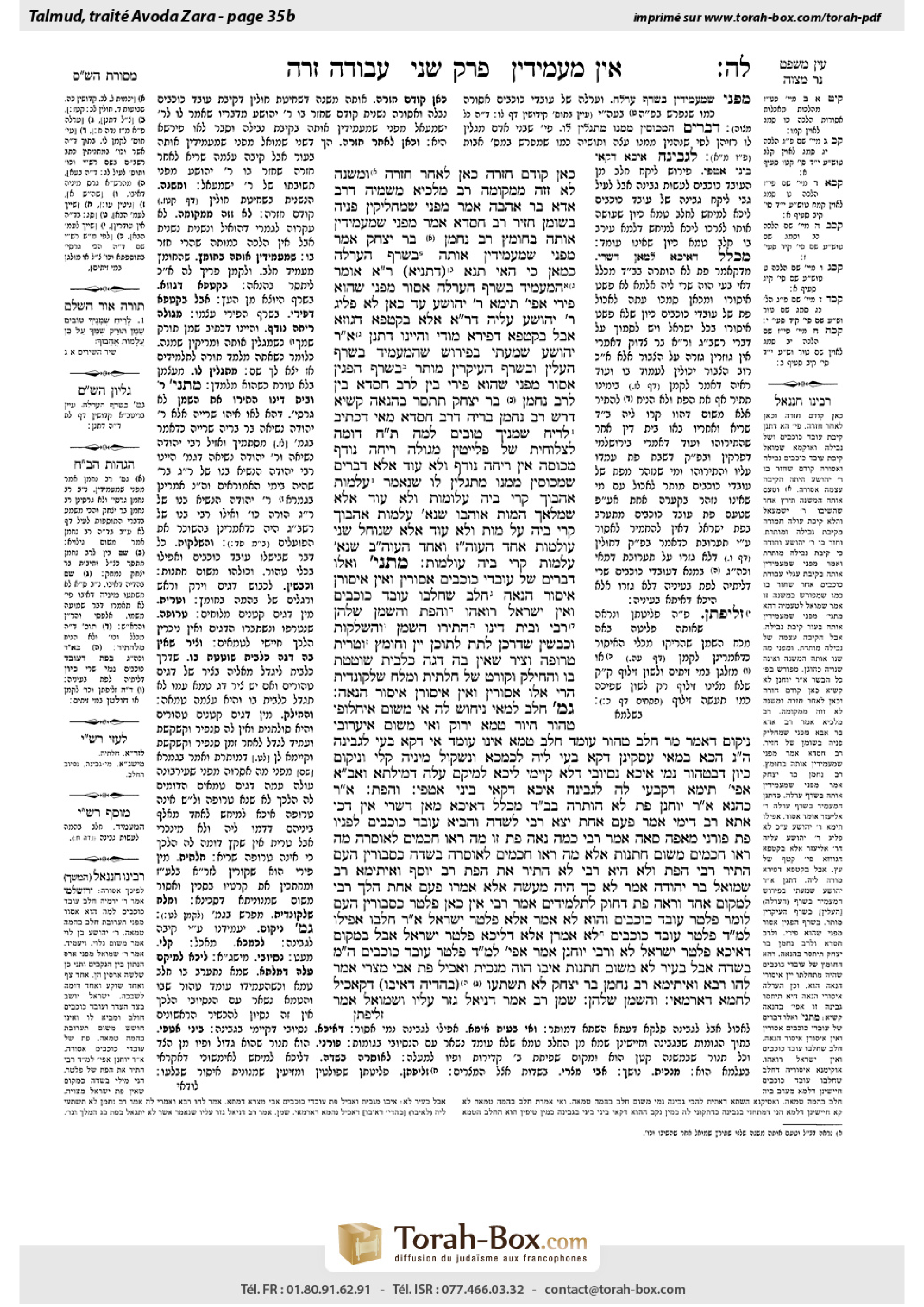
Avodah Zarah 35b: Talmud study for Daf Yomi
Study the Talmud for Daf Yomi with scanned pages, Hebrew text, English translations from Sefaria and AI-generated French translations.
Passage selection and English or AI-generated French translation are available where the scan has annotations. Daf Study is independent of Torah-Box and Sefaria.
Browse Avodah Zarah · עבודה זרה · All tractatesAvodah Zarah 35b text and translations
This page of Avodah Zarah includes the Aramaic text, an English translation and an AI-generated French translation, alongside the scan above.
עבודה זרה ל״ה ב · Aramaic and Hebrew text
כָּאן קוֹדֶם חֲזָרָה, כָּאן לְאַחַר חֲזָרָה, וּמִשְׁנָה לֹא זָזָה מִמְּקוֹמָהּ.
רַב מַלְכִּיָּא מִשְּׁמֵיהּ דְּרַב אַדָּא בַּר אַהֲבָה אָמַר: מִפְּנֵי שֶׁמַּחְלִיקִין פָּנֶיהָ בְּשׁוּמַּן חֲזִיר. רַב חִסְדָּא אָמַר: מִפְּנֵי שֶׁמַּעֲמִידִין אוֹתָהּ בְּחוֹמֶץ. רַב נַחְמָן בַּר יִצְחָק אָמַר: מִפְּנֵי שֶׁמַּעֲמִידִין אוֹתָהּ בִּשְׂרַף הָעׇרְלָה.
כְּמַאן? כִּי הַאי תַּנָּא, דְּתַנְיָא, רַבִּי אֱלִיעֶזֶר אוֹמֵר: הַמַּעֲמִיד בִּשְׂרַף הָעׇרְלָה — אָסוּר, מִפְּנֵי שֶׁהוּא פֶּירִי.
אֲפִילּוּ תֵּימָא רַבִּי יְהוֹשֻׁעַ, עַד כָּאן לָא פְּלִיג רַבִּי יְהוֹשֻׁעַ עֲלֵיהּ דְּרַבִּי אֱלִיעֶזֶר אֶלָּא בְּקִטְפָא דִּגְוָזָא, אֲבָל בְּקִטְפָא דְּפֵירָא מוֹדֵי.
וְהַיְינוּ דִּתְנַן, אָמַר רַבִּי יְהוֹשֻׁעַ: שָׁמַעְתִּי בְּפֵירוּשׁ, שֶׁהַמַּעֲמִיד בִּשְׂרַף הֶעָלִין וּבִשְׂרַף הָעִיקָּרִין — מוּתָּר, בִּשְׂרַף הַפַּגִּין — אָסוּר, מִפְּנֵי שֶׁהוּא פֶּירִי.
בֵּין לְרַב חִסְדָּא, בֵּין לְרַב נַחְמָן בַּר יִצְחָק, תִּתְּסַר בַּהֲנָאָה, קַשְׁיָא.
דָּרַשׁ רַב נַחְמָן בְּרֵיהּ דְּרַב חִסְדָּא, מַאי דִּכְתִיב: ״לְרֵיחַ שְׁמָנֶיךָ טוֹבִים״, לְמָה תַּלְמִיד חָכָם דּוֹמֶה? לִצְלוֹחִית שֶׁל פִּלְיָיטֹין: מְגוּלָּה — רֵיחָהּ נוֹדֵף, מְכוּסָּה — אֵין רֵיחָהּ נוֹדֵף.
וְלֹא עוֹד, אֶלָּא דְּבָרִים שֶׁמְּכוּסִּין מִמֶּנּוּ מִתְגַּלִּין לוֹ, שֶׁנֶּאֱמַר: ״עֲלָמוֹת אֲהֵבוּךָ״, קְרִי בֵּיהּ ״עֲלוּמוֹת״; וְלֹא עוֹד, אֶלָּא שֶׁמַּלְאַךְ הַמָּוֶת אוֹהֲבוֹ, שֶׁנֶּאֱמַר: ״עֲלָמוֹת אֲהֵבוּךָ״, קְרִי בֵּיהּ ״עַל מָוֶת״; וְלֹא עוֹד, אֶלָּא שֶׁנּוֹחֵל שְׁנֵי עוֹלָמוֹת, אֶחָד הָעוֹלָם הַזֶּה וְאֶחָד הָעוֹלָם הַבָּא, שֶׁנֶּאֱמַר: ״עֲלָמוֹת״, קְרִי בֵּיהּ ״עוֹלָמוֹת״.
מַתְנִי׳ וְאֵלּוּ דְּבָרִים שֶׁל גּוֹיִם אֲסוּרִין וְאֵין אִיסּוּרָן אִיסּוּר הֲנָאָה: חָלָב שֶׁחֲלָבוֹ גּוֹי וְאֵין יִשְׂרָאֵל רוֹאֵהוּ, וְהַפַּת וְהַשֶּׁמֶן שֶׁלָּהֶן. רַבִּי וּבֵית דִּינוֹ הִתִּירוּ הַשֶּׁמֶן.
וְהַשְּׁלָקוֹת, וּכְבָשִׁין שֶׁדַּרְכָּן לָתֵת לְתוֹכָן יַיִן וָחוֹמֶץ, וְטָרִית טְרוּפָה, וְצִיר שֶׁאֵין בָּהּ דָּגָה כִּלְבִּית שׁוֹטֶטֶת בּוֹ, וְהַחִילֵּק, וְקוֹרֶט שֶׁל חִלְתִּית, וּמֶלַח שְׂלָקוֹנְדִית — הֲרֵי אֵלּוּ אֲסוּרִין, וְאֵין אִיסּוּרָן אִיסּוּר הֲנָאָה.
גְּמָ׳ חָלָב לְמַאי נֵיחוּשׁ לַהּ? אִי מִשּׁוּם אִיחַלּוֹפֵי — טָהוֹר חִיוָּר, טָמֵא יָרוֹק! וְאִי מִשּׁוּם אִיעָרוֹבֵי — נֵיקוּם! דְּאָמַר מָר: חָלָב טָהוֹר עוֹמֵד, חָלָב טָמֵא אֵינוֹ עוֹמֵד.
אִי דְּקָא בָעֵי לִגְבִינָה, הָכִי נָמֵי. הָכָא בְּמַאי עָסְקִינַן? דְּקָא בָעֵי לֵיהּ לְכַמְכָּא.
וְנִשְׁקוֹל מִינֵּיהּ קַלִּי וְנֵיקוּם! כֵּיוָן דִּבְטָהוֹר נָמֵי אִיכָּא נַסְיוּבֵי דְּלָא קָיְימִי, לֵיכָּא לְמֵיקַם עֲלַהּ דְּמִילְּתָא.
וְאִיבָּעֵית אֵימָא: אֲפִילּוּ תֵּימָא דְּקָבָעֵי לֵהּ לִגְבִינָה, אִיכָּא דְּקָאֵי בֵּינֵי אִטְפֵי.
וְהַפַּת. אָמַר רַב כָּהֲנָא אָמַר רַבִּי יוֹחָנָן: פַּת לֹא הוּתְּרָה בְּבֵית דִּין, מִכְּלָל דְּאִיכָּא מַאן דְּשָׁרֵי?
אִין, דְּכִי אֲתָא רַב דִּימִי אָמַר: פַּעַם אַחַת יָצָא רַבִּי לַשָּׂדֶה, וְהֵבִיא גּוֹי לְפָנָיו פַּת פּוּרְנִי מַאֲפֵה סְאָה. אָמַר רַבִּי: כַּמָּה נָאָה פַּת זוֹ, מָה רָאוּ חֲכָמִים לְאוֹסְרָהּ? מָה רָאוּ חֲכָמִים?! מִשּׁוּם חַתְנוּת!
אֶלָּא, מָה רָאוּ חֲכָמִים לְאוֹסְרָהּ בַּשָּׂדֶה. כִּסְבוּרִין הָעָם הִתִּיר רַבִּי הַפַּת, וְלָא הִיא, רַבִּי לֹא הִתִּיר אֶת הַפַּת.
רַב יוֹסֵף, וְאִיתֵּימָא רַב שְׁמוּאֵל בַּר יְהוּדָה, אָמַר: לֹא כָּךְ הָיָה מַעֲשֶׂה, אֶלָּא אָמְרוּ: פַּעַם אַחַת הָלַךְ רַבִּי לְמָקוֹם אֶחָד וְרָאָה פַּת דָּחוּק לַתַּלְמִידִים, אָמַר רַבִּי: אֵין כָּאן פַּלְטֵר? כִּסְבוּרִין הָעָם לוֹמַר פַּלְטֵר גּוֹי, וְהוּא לֹא אָמַר אֶלָּא פַּלְטֵר יִשְׂרָאֵל.
אָמַר רַבִּי חֶלְבּוֹ: אֲפִילּוּ לְמַאן דְּאָמַר פַּלְטֵר גּוֹי, לָא אֲמַרַן אֶלָּא דְּלֵיכָּא פַּלְטֵר יִשְׂרָאֵל, אֲבָל בִּמְקוֹם דְּאִיכָּא פַּלְטֵר יִשְׂרָאֵל — לָא. וְרַבִּי יוֹחָנָן אָמַר: אֲפִילּוּ לְמַאן דְּאָמַר פַּלְטֵר גּוֹי, הָנֵי מִילֵּי בַּשָּׂדֶה, אֲבָל בָּעִיר — לָא, מִשּׁוּם חַתְנוּת.
אַיְבוּ הֲוָה מְנַכֵּית וְאָכֵיל פַּת אַבֵּי מִצְרֵי, אֲמַר לְהוּ רָבָא, וְאִיתֵּימָא רַב נַחְמָן בַּר יִצְחָק: לָא תִּשְׁתַּעוּ בַּהֲדֵיהּ דְּאַיְבוּ, דְּקָאָכֵיל לַחְמָא דַּאֲרַמָּאֵי.
וְהַשֶּׁמֶן שֶׁלָּהֶן. שֶׁמֶן, רַב אָמַר: דָּנִיאֵל גָּזַר עָלָיו, וּשְׁמוּאֵל אָמַר:
Avodah Zarah 35b · English translation
Here, with regard to the mishna in Ḥullin, Shmuel’s comment reflects the explanation of Rabbi Yehoshua before Rabbi Yehoshua’s retraction of the assertion that it is prohibited to derive benefit from the stomach contents of an animal carcass. There, with regard to the mishna in Avoda Zara, Shmuel’s statement is in accordance with the opinion of Rabbi Yehoshua after his retraction of that claim. And although this indicates that the mishna in Ḥullin presents an outdated ruling that was later rescinded, a mishna does not move from its place. In other words, once it has been taught in a certain manner, the tanna will not change the text of a mishna in order to reflect a change of opinion, so as to avoid confusion.
The Gemara suggests additional reasons for the decree of the Sages. Rav Malkiyya says in the name of Rav Adda bar Ahava: The cheese is prohibited because gentiles smooth its surface with pig fat. Rav Ḥisda says: It is because they curdle it with vinegar produced from their wine, from which it is prohibited to derive benefit. Rav Naḥman bar Yitzḥak says: It is because they curdle it with sap that is subject to the prohibition against consuming the fruit of a tree during the first three years after its planting [orla].
Parenthetically, the Gemara asks: In accordance with whose opinion is Rav Naḥman’s claim that the cheese of gentiles is prohibited because it is curdled in the sap of orla? The Gemara answers: It is in accordance with the opinion of this tanna, as it is taught in a mishna (Orla 1:7): Rabbi Eliezer says: With regard to one who curdles cheese with the sap of orla, the cheese is prohibited, because the sap is considered to be fruit of the tree.
The Gemara comments: You may even say that the statement is in accordance with the opinion of Rabbi Yehoshua, who disagrees with the opinion of Rabbi Eliezer, as Rabbi Yehoshua disagrees with Rabbi Eliezer only with regard to the sap of a branch, but with regard to the sap of a fruit Rabbi Yehoshua concedes that it is prohibited as orla. Rav Naḥman’s statement can be understood as referring specifically to the sap of the fruit, which would mean that it is in accordance with the opinions of both Rabbi Eliezer and Rabbi Yehoshua.
The Gemara adds: And this is in accordance with that which we learned in the continuation of that mishna: Rabbi Yehoshua said: I heard explicitly that with regard to one who curdles cheese with the sap of the leaves and the sap of the roots of an orla tree, the cheese is permitted. But if it is curdled with the sap of unripe figs it is prohibited, because that sap is considered to be fruit.
The Gemara raises a difficulty against the last two suggested reasons for the decree of the Sages. According to both Rav Ḥisda, who holds that the cheese is prohibited because it is curdled with vinegar made from wine of gentiles, and Rav Naḥman bar Yitzḥak, who maintains that it is prohibited because it is curdled with the sap of orla, one should be prohibited from deriving benefit from the cheese, as one may not derive benefit from either the wine of gentiles or orla. The Gemara concludes: Indeed, this is difficult.
§ Rav Naḥman, son of Rav Ḥisda, interpreted a verse homiletically: What is the meaning of that which is written: “Your ointments have a goodly fragrance” (Song of Songs 1:3)? This is a metaphor for a Torah scholar: To what is a Torah scholar comparable? To a flask of pelaitin: When it is exposed, its scent diffuses; when it is covered, its scent does not diffuse.
The Gemara remarks: And moreover, when a Torah scholar spreads his knowledge, matters that are generally hidden from him are revealed to him, as it is stated: “Maidens [alamot] love You” (Song of Songs 1:3), and one may read into the verse: The hidden [alumot]. And moreover, the Angel of Death loves him, as it is stated: “Maidens [alamot] love You,” and one may read into the verse: The one appointed over death [al mot] loves you. And moreover, a Torah scholar inherits two worlds: One is this world, and the other one is the World-to-Come, as it is stated: “Maidens [alamot] love You,” and one may read into the verse: Worlds [olamot].
MISHNA: This mishna lists items belonging to gentiles which it is prohibited to consume, but from which it is permitted to derive benefit. And these are items that belong to gentiles and are prohibited, but their prohibition is not that of an item from which deriving benefit is prohibited: Milk that was milked by a gentile and a Jew did not see him performing this action, and their bread and oil. The mishna notes that Rabbi Yehuda HaNasi and his court permitted the oil of gentiles entirely.
The mishna resumes its list: And boiled and pickled vegetables, whose usual manner of preparation involves adding wine and vinegar to them, and minced tarit fish, and brine that does not have a kilbit fish floating in it, and ḥilak, and a sliver of ḥiltit, and salkondit salt (see 39b); all these are prohibited, but their prohibition is not that of an item from which deriving benefit is prohibited.
GEMARA: The Gemara asks: Concerning milk, with regard to what need we be concerned? Why is the milk prohibited? If it is due to the concern that a gentile might exchange the milk of a kosher animal with the milk of a non-kosher animal, this concern is unfounded, as kosher milk is white whereas non-kosher milk has a green tinge to it, and therefore they are easily distinguishable. And if it is prohibited due to the concern that it might be mixed with non-kosher milk, let the Jew curdle the milk obtained from the gentile, as the Master said: Milk from a kosher animal curdles, but milk from a non-kosher animal does not curdle.
The Gemara answers: If one desires to eat it as cheese, indeed, one can simply curdle it, as the milk of non-kosher animals does not curdle. What are we dealing with here? We are dealing with a case where one desires to use the milk in kamkha, also known as kutaḥ, a food item that contains milk.
The Gemara raises a difficulty: But in that case, let him take a bit of milk and curdle it, to test whether or not it has been mixed with the milk of a non-kosher animal: If it curdles completely, it is kosher; if some milk is left over, it is not. The Gemara explains: Since there is also whey in kosher milk, which does not curdle, there is no way to establish the halakhic matter with regard to it. Even kosher milk will not curdle completely, and therefore this is not a reliable method to determine the halakhic status of the milk.
The Gemara presents an alternative suggestion: And if you wish, say instead that you may even say that the concern applies where he intends to use the milk to make cheese, as there is milk that remains between the crevices of curdled cheese, and therefore there is a concern that drops of non-kosher milk might be mixed with it.
§ The mishna teaches: And bread belonging to gentiles is prohibited for consumption. Rav Kahana says that Rabbi Yoḥanan says: Unlike oil, bread was not permitted by a court. The Gemara asks: From the fact that Rabbi Yoḥanan states that bread was not permitted in court, can it be inferred that there is a different opinion that claims that a court did permit it?
The Gemara answers: Yes, as when Rav Dimi came from Eretz Yisrael to Babylonia, he said: Once Rabbi Yehuda HaNasi went out to the field, and a gentile brought before him a se’a of bread baked in a large baker’s oven [purnei]. Rabbi Yehuda HaNasi said: How exquisite is this loaf of bread! What did the Sages see that caused them to prohibit it? The Gemara asks, incredulously: What did the Sages see that caused them to prohibit it? It was prohibited due to the concern that Jews might befriend gentiles while breaking bread with them, which could lead to marriage with gentiles.
The Gemara explains that Rabbi Yehuda HaNasi was not asking why bread was prohibited in general. Rather, he asked: What did the Sages see that caused them to prohibit bread even in the field, where this concern does not apply? The Gemara notes that upon hearing of this incident the people thought that Rabbi Yehuda HaNasi permitted the bread of gentiles. But that is not so; Rabbi Yehuda HaNasi did not actually permit such bread. This is why Rabbi Yoḥanan emphasized that the bread of gentiles was never permitted by Rabbi Yehuda HaNasi’s court.
The Gemara records an alternate version of this episode. Rav Yosef, and some say Rav Shmuel bar Yehuda, says: The incident did not occur in this manner. Rather, they said: Once Rabbi Yehuda HaNasi went to a certain place and saw that bread was scarce for the students in the study hall. Rabbi Yehuda HaNasi said: Is there no baker [palter] here who can prepare bread? Upon hearing of this incident, the people thought to say that Rabbi Yehuda HaNasi was referring to a gentile baker, which would indicate that bread baked by a professional baker is permitted, even if he is a gentile. But in reality, Rabbi Yehuda HaNasi stated his question only in reference to a Jewish baker.
The Gemara cites two qualifications of the leniency that people inferred from the above incident. Rabbi Ḥelbo said: Even according to the one who thought to say that Rabbi Yehuda HaNasi was referring to a gentile baker, we said that the bread is permitted only where there is no Jewish baker, but in a place where there is a Jewish baker, the leniency would certainly not apply. And Rabbi Yoḥanan said: Even according to the one who thought to say that Rabbi Yehuda HaNasi was referring to a gentile baker, that statement applies only in the field, but in the city it would not apply, and the bread would still be prohibited due to the possibility of marriage with a gentile.
The Gemara relates: Aivu would bite and eat bread of gentiles at the boundaries of the fields. Rava said to the students in the study hall, and some say that it was Rav Naḥman bar Yitzḥak who said to them: Do not speak with Aivu, as he eats bread of Arameans in deliberate violation of a rabbinic decree.
§ The mishna teaches: And their oil was originally prohibited but later permitted by Rabbi Yehuda HaNasi and his court. The Gemara cites a dispute with regard to the origin of the prohibition of oil. Rav says: Daniel decreed that oil is prohibited, and Shmuel says:
Avodah Zarah 35b · Traduction française (IA)
Ici, concernant la mishna dans Ḥullin, la remarque de Shmuel reflète l'explication du Rabbi Yehoshua avant que ce dernier ne retire son affirmation selon laquelle il est interdit d'exploiter les contenus du ventre d'un cadavre d'animaux. Là, concernant la mishna dans Avoda Zara, l'affirmation de Shmuel s'inscrit dans l'opinion du Rabbi Yehoshua après qu'il ait retiré cette affirmation. Et bien que cela indique que la mishna dans Ḥullin présente un jugement obsolète qui a été révoqué plus tard, une mishna ne change pas de place. En d'autres termes, une fois qu'elle a été enseignée d'une certaine manière, le tanna ne modifiera pas le texte d'une mishna pour refléter un changement d'opinion, afin d'éviter la confusion.
Le Guemara suggère d'autres raisons pour le décret des Sages. Rav Malkiyya dit en nom de Rav Adda bar Ahava : Le fromage est interdit car les gentils lisent sa surface avec de la graisse de porc. Rav Ḥisda dit : C'est parce qu'ils coagulent le lait avec du vinaigre produit à partir de leur vin, duquel il est interdit d'exploiter les bénéfices. Rav Naḥman bar Yitzḥak dit : C'est parce qu'ils coagulent le lait avec du sirop soumis à l'interdiction de consommer les fruits d'un arbre durant les trois premières années après sa plantation [orla].
Par parenthèse, le Guemara pose la question : selon l'opinion de qui est l'affirmation de Rav Naḥman selon laquelle le fromage des gentils est interdit car il est coagulé avec le sirop d'orla ? Le Guemara répond : selon l'opinion de ce tanna, comme il est enseigné dans une mishna (Orla 1:7) : Rabbi Eliezer dit : concernant celui qui coagule du fromage avec le sirop d'orla, le fromage est interdit, car le sirop est considéré comme un fruit de l'arbre.
Le Guemara commente : On peut même dire que l'affirmation s'inscrit dans l'opinion de Rabbi Yehoshua, qui s'oppose à celle de Rabbi Eliezer, car Rabbi Yehoshua s'oppose à Rabbi Eliezer uniquement concernant le sirop d'une branche, mais concernant le sirop d'un fruit, Rabbi Yehoshua reconnaît qu'il est interdit comme orla. L'affirmation de Rav Naḥman peut être interprétée comme se référant spécifiquement au sirop du fruit, ce qui signifierait qu'elle s'inscrit dans l'opinion de Rabbi Eliezer et de Rabbi Yehoshua.
Le Guemara ajoute : et cela s'inscrit dans ce que nous avons appris dans la continuation de cette mishna : Rabbi Yehoshua dit : j'ai entendu explicitement que concernant celui qui coagule du fromage avec le sirop des feuilles et du sirop des racines d'un arbre orla, le fromage est permis. Mais si c'est avec le sirop des figues vertes, il est interdit, car ce sirop est considéré comme un fruit.
Le Guemara soulève une difficulté contre les deux dernières raisons suggérées pour le décret des Sages. Selon les deux, Rav Ḥisda, qui considère que le fromage est interdit car il est coagulé avec du vinaigre produit à partir du vin des gentils, et Rav Naḥman bar Yitzḥak, qui affirme qu'il est interdit car il est coagulé avec le sirop d'orla, l'interdiction d'exploiter les bénéfices du fromage devrait être appliquée, car l'exploitation des bénéfices du vin des gentils ou de l'orla est interdite. Le Guemara conclut : En effet, cela est difficile.
§ Rav Naḥman, fils de Rav Ḥisda, interprète un verset de manière allégorique : Quel est le sens de ce qui est écrit : « Vos onguents ont un parfum agréable » (Cantique des Cantiques 1:3) ? Cela est une métaphore d'un savant de la Torah : à quoi est comparable un savant de la Torah ? À une bouteille de pelaitin : quand elle est exposée, son parfum se diffuse ; quand elle est couverte, son parfum ne se diffuse pas.
Le Guemara observe : Et de plus, quand un savant de la Torah diffuse ses connaissances, les choses généralement cachées à lui deviennent révélées à lui, comme il est dit : « Les jeunes filles [alamot] vous aiment » (Cantique des Cantiques 1:3), et l'on peut lire dans le verset : Les cachés [alumot]. Et de plus, l'Ange de la Mort l'aime, comme il est dit : « Les jeunes filles [alamot] vous aiment », et l'on peut lire dans le verset : Celui désigné pour la mort [al mot] vous aime. Et de plus, un savant de la Torah hérite de deux mondes : l'un est ce monde, et l'autre est le Monde à Venir, comme il est dit : « Les jeunes filles [alamot] vous aiment », et l'on peut lire dans le verset : Les mondes [olamot].
MICHNA : Cette mishna liste les objets appartenant aux gentils qui sont interdits de consommer, mais permis d'exploiter. Et ces objets appartiennent aux gentils et sont interdits, mais leur interdiction n'est pas celle d'un objet dont l'exploitation est interdite : le lait qui a été laité par un gentil et que n'a pas vu un Juif accomplir l'acte, et leur pain et leur huile. La mishna note que Rabbi Yehuda HaNasi et son tribunal ont autorisé entièrement l'huile des gentils.
La Michna reprend sa liste : Et les légumes bouillis et marinés, dont la préparation habituelle implique d'ajouter du vin et du vinaigre, et le poisson mincé de tarit, et la saumure qui ne contient pas un poisson kilbit flottant dedans, et ḥilak, et une fine lame de ḥiltit, et salkondit sel (voir 39b) ; toutes ces choses sont interdites, mais leur interdiction n'est pas celle d'un objet dont l'usage est interdit.
GUEMARA : Le Guemara pose la question : concernant le lait, à propos de quoi devons-nous avoir des craintes ? Pourquoi est-il interdit ? Si c'est à cause de la crainte qu'un gentil puisse échanger le lait d'un animal kasher avec le lait d'un animal non kasher, cette crainte est infondée, car le lait kasher est blanc alors que le lait non kasher a une teinte verte, et donc ils sont facilement distinguables. Et si l'interdiction est due à la crainte qu'il puisse être mélangé avec du lait non kasher, faites coaguler le lait obtenu du gentil, car le Maître a dit : le lait d'un animal kasher coagule, mais le lait d'un animal non kasher ne coagule pas.
Le Guemara répond : Si l'on désire manger du fromage, en effet, l'on peut simplement coaguler le lait, car le lait d'animaux non kashers ne coagule pas. De quoi s'agit-il ici ? Nous nous trouvons dans un cas où l'on désire utiliser le lait pour la préparation de kamkha, également connu sous le nom de kutaḥ, un aliment contenant du lait.
La Guemara soulève une difficulté : Mais dans ce cas, qu'il prenne une petite quantité de lait et le coagule, afin de tester si ce lait n'a pas été mélangé avec le lait d'un animal non-kosher : Si le lait coagule complètement, il est kosher ; si du lait reste, il ne l'est pas. La Guemara explique : Puisque le lait kosher contient également du lait de veau, qui ne coagule pas, il n'y a aucun moyen d'établir la question halakhique concernant celui-ci. Même le lait kosher ne coagule pas complètement, et par conséquent cette méthode n'est pas fiable pour déterminer le statut halakhique du lait.
La Guemara présente une suggestion alternative : Et si vous le souhaitez, dites plutôt que l'on peut même affirmer que l'inquiétude s'applique dans le cas où l'on veut utiliser le lait pour faire du fromage, car il y a du lait qui reste entre les interstices du fromage coagulé, et par conséquent il y a une inquiétude que des gouttes de lait non-kosher puissent s'y mélanger.
§ La mitsna enseigne : Et le pain des non-juifs est interdit à la consommation. Rav Kahana dit que Rabbi Yoḥanan dit : Contrairement à l'huile, le pain n'a jamais été autorisé par un tribunal. La Guemara demande : À partir du fait que Rabbi Yoḥanan affirme que le pain n'était pas autorisé par le tribunal, peut-on en déduire qu'il existe une opinion différente qui affirme que le tribunal l'avait autorisé ?
La Guemara répond : Oui, car lorsque Rav Dimi est venu d'Eretz Yisrael vers Babylone, il a dit : Un jour, Rabbi Yehuda HaNasi est sorti dans les champs, et un non-juif lui a présenté un se'a de pain cuit dans un grand four de boulanger [purnei]. Rabbi Yehuda HaNasi a dit : Quel délice est ce pain ! Qu'ont vu les Sages qui les a fait interdire ? La Guemara demande, incrédule : Qu'ont vu les Sages qui les a fait interdire ? Il était interdit en raison de l'inquiétude que les Juifs puissent s'associer aux non-juifs en partageant du pain avec eux, ce qui pourrait mener à des mariages avec des non-juifs.
La Guemara explique que Rabbi Yehuda HaNasi ne posait pas la question sur l'interdiction générale du pain. Plutôt, il demandait : Qu'ont vu les Sages qui les a fait interdire le pain même dans les champs, où cette inquiétude ne s'applique pas ? La Guemara note que, lorsqu'ils ont entendu ce récit, les gens ont pensé que Rabbi Yehuda HaNasi autorisait le pain des non-juifs. Mais ce n'est pas le cas ; Rabbi Yehuda HaNasi n'a pas réellement autorisé ce genre de pain. C'est pourquoi Rabbi Yoḥanan a insisté sur le fait que le pain des non-juifs n'avait jamais été autorisé par le tribunal de Rabbi Yehuda HaNasi.
La Guemara rapporte une version alternative de cet épisode. Rav Yosef, et certains disent Rav Shmuel bar Yehuda, dit : L'incident n'a pas eu lieu ainsi. Plutôt, ils dirent : Un jour, Rabbi Yehuda HaNasi est allé à un certain endroit et a vu que le pain était rare pour les étudiants dans la salle de étude. Rabbi Yehuda HaNasi dit : N'y a-t-il pas de boulanger [palter] ici qui puisse préparer du pain ? En entendant ce récit, les gens ont pensé que Rabbi Yehuda HaNasi faisait référence à un boulanger non-juif, ce qui indiquerait que le pain cuit par un boulanger professionnel est autorisé, même s'il est non-juif. Mais en réalité, Rabbi Yehuda HaNasi a posé sa question uniquement en référence à un boulanger juif.
La Guemara cite deux qualifications de la leniance que les gens ont inféré de l'incident ci-dessus. Rabbi Ḥelbo dit : Même selon celui qui pensait que Rabbi Yehuda HaNasi faisait référence à un boulanger non-juif, nous avons dit que le pain est autorisé uniquement là où il n'y a pas de boulanger juif, mais dans un lieu où il y a un boulanger juif, cette leniance ne s'appliquerait pas. Et Rabbi Yoḥanan dit : Même selon celui qui pensait que Rabbi Yehuda HaNasi faisait référence à un boulanger non-juif, cette déclaration s'applique uniquement dans les champs, mais en ville elle ne s'appliquerait pas, et le pain resterait interdit en raison de la possibilité de mariage avec un non-juif.
La Guemara rapporte : Aivu mordait et mangeait du pain des non-juifs aux limites des champs. Rava dit aux étudiants dans la salle de étude, et certains disent que c'était Rav Naḥman bar Yitzḥak qui a dit à eux : Ne parlez pas avec Aivu, car il mange du pain des Araméens en violation délibérée d'un décret rabbinique.
§ La mitsna enseigne : Et leur huile était initialement interdite mais a été autorisée par Rabbi Yehuda HaNasi et son tribunal. La Guemara cite un débat concernant l'origine de l'interdiction de l'huile. Rav dit : Daniel a décrété que l'huile est interdite, et Shmuel dit :
Traduction française générée par IA à partir de l’édition anglaise de Sefaria. Vérifie toujours un passage avec le texte source.
Text from Sefaria: William Davidson Edition - Vocalized Aramaic (CC BY NC); William Davidson Edition - English (CC BY NC).