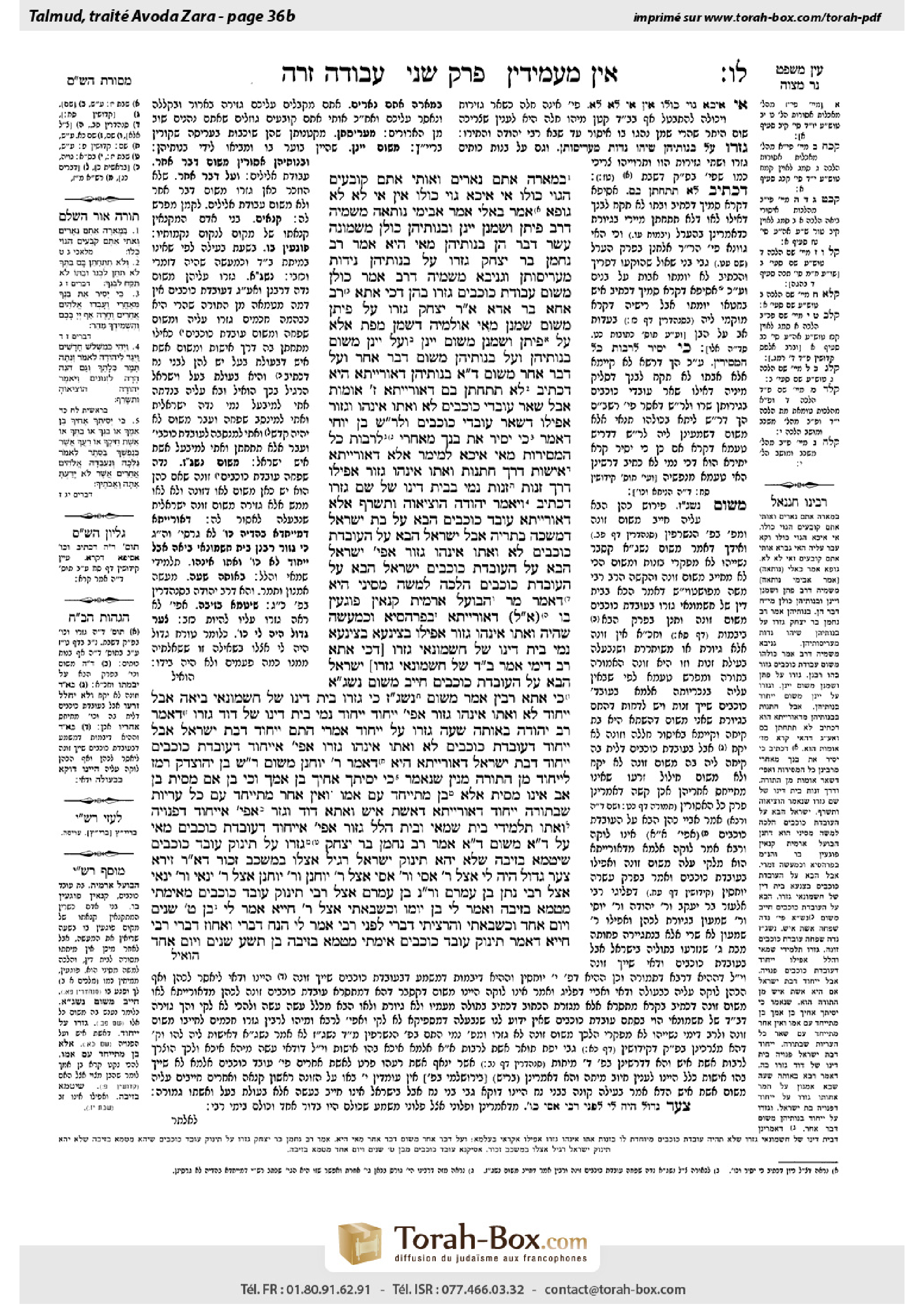
Avodah Zarah 36b: Talmud study for Daf Yomi
Study the Talmud for Daf Yomi with scanned pages, Hebrew text, English translations from Sefaria and AI-generated French translations.
Passage selection and English or AI-generated French translation are available where the scan has annotations. Daf Study is independent of Torah-Box and Sefaria.
Browse Avodah Zarah · עבודה זרה · All tractatesAvodah Zarah 36b text and translations
This page of Avodah Zarah includes the Aramaic text, an English translation and an AI-generated French translation, alongside the scan above.
עבודה זרה ל״ו ב · Aramaic and Hebrew text
״בַּמְּאֵרָה אַתֶּם נֵאָרִים וְאֹתִי אַתֶּם קֹבְעִים הַגּוֹי כֻּלּוֹ״, אִי אִיכָּא גּוֹי כּוּלּוֹ — אִין, אִי לָא — לָא.
גּוּפָא, אָמַר בָּאלִי אָמַר אֲבִימִי נִוְתָאָה מִשְּׁמֵיהּ דְּרַב: פִּיתָּן וְשַׁמְנָן, יֵינָן וּבְנוֹתֵיהֶן — כּוּלָּן מִשְּׁמוֹנָה עָשָׂר דָּבָר הֵן. בְּנוֹתֵיהֶן מַאי הִיא? אָמַר רַב נַחְמָן בַּר יִצְחָק: גָּזְרוּ עַל בְּנוֹתֵיהֶן נִידּוֹת מֵעֲרִיסוֹתָן.
וּגְנִיבָא מִשְּׁמֵיהּ דְּרַב אָמַר: כּוּלָּן מִשּׁוּם עֲבוֹדָה זָרָה גָּזְרוּ בָּהֶן, דְּכִי אֲתָא רַב אַחָא בַּר אַדָּא אָמַר רַבִּי יִצְחָק: גָּזְרוּ עַל פִּיתָּן מִשּׁוּם שַׁמְנָן, מַאי אוּלְמֵיהּ דְּשֶׁמֶן מִפַּת?
אֶלָּא, עַל פִּיתָּן וְשַׁמְנָן מִשּׁוּם יֵינָן, וְעַל יֵינָן מִשּׁוּם בְּנוֹתֵיהֶן, וְעַל בְּנוֹתֵיהֶן מִשּׁוּם דָּבָר אַחֵר, וְעַל דָּבָר אַחֵר מִשּׁוּם דָּבָר אַחֵר.
בְּנוֹתֵיהֶן, דְּאוֹרָיְיתָא הִיא, דִּכְתִיב: ״לֹא תִתְחַתֵּן בָּם״, דְּאוֹרָיְיתָא שִׁבְעָה גּוֹיִם, אֲבָל שְׁאָר אוּמּוֹת — לָא, וַאֲתוֹ אִינְהוּ וּגְזוּר אֲפִילּוּ דִּשְׁאָר אוּמּוֹת.
וּלְרַבִּי שִׁמְעוֹן בֶּן יוֹחַי, דְּאָמַר: ״כִּי יָסִיר אֶת בִּנְךָ מֵאַחֲרַי״ לְרַבּוֹת כׇּל הַמְּסִירוֹת, מַאי אִיכָּא לְמֵימַר? אֶלָּא דְּאוֹרָיְיתָא אִישׁוּת דֶּרֶךְ חַתְנוּת, וַאֲתוֹ אִינְהוּ גְּזוּר אֲפִילּוּ דֶּרֶךְ זְנוּת.
זְנוּת נָמֵי בְּבֵית דִּינוֹ שֶׁל שֵׁם גָּזְרוּ, דִּכְתִיב: ״וַיֹּאמֶר יְהוּדָה הוֹצִיאוּהָ וְתִשָּׂרֵף״!
אֶלָּא, דְּאוֹרָיְיתָא — גּוֹי הַבָּא עַל בַּת יִשְׂרָאֵל, דְּמָשְׁכָה בָּתְרֵיהּ; אֲבָל יִשְׂרָאֵל הַבָּא עַל הַגּוֹיָה — לָא, וַאֲתוֹ אִינְהוּ גְּזוּר אֲפִילּוּ יִשְׂרָאֵל הַבָּא עַל הַגּוֹיָה.
יִשְׂרָאֵל הַבָּא עַל הַגּוֹיָה — הֲלָכָה לְמֹשֶׁה מִסִּינַי הִיא, דְּאָמַר מָר: הַבּוֹעֵל אֲרַמִּית — קַנָּאִין פּוֹגְעִין בּוֹ.
אֲמַר לֵיהּ: דְּאוֹרָיְיתָא בְּפַרְהֶסְיָא, וּכְמַעֲשֶׂה שֶׁהָיָה, וַאֲתוֹ אִינְהוּ גְּזוּר אֲפִילּוּ בְּצִינְעָא. בְּצִינְעָא נָמֵי בֵּית דִּינוֹ שֶׁל חַשְׁמוֹנַאי גָּזְרוּ!
דְּכִי אֲתָא רַב דִּימִי אָמַר: בֵּית דִּין שֶׁל חַשְׁמוֹנַאי גָּזְרוּ, יִשְׂרָאֵל הַבָּא עַל הַגּוֹיָה חַיָּיב מִשּׁוּם נשג״א.
כִּי אֲתָא רָבִין אָמַר מִשּׁוּם נשג״ז.
כִּי גָּזְרוּ בֵּית דִּינוֹ שֶׁל חַשְׁמוֹנַאי בִּיאָה, אֲבָל יִיחוּד לָא, וַאֲתוֹ אִינְהוּ גְּזוּר אֲפִילּוּ יִיחוּד. יִיחוּד נָמֵי בֵּית דִּינוֹ שֶׁל דָּוִד גָּזְרוּ!
דְּאָמַר רַב יְהוּדָה: בְּאוֹתָהּ שָׁעָה גָּזְרוּ עַל יִיחוּד. אָמְרִי: הָתָם יִיחוּד דְּבַת יִשְׂרָאֵל, אֲבָל יִיחוּד דְּגוֹיָה — לָא, וַאֲתוֹ אִינְהוּ גְּזַרוּ אֲפִילּוּ אַיִּיחוּד דְּגוֹיָה.
יִיחוּד דְּבַת יִשְׂרָאֵל דְּאוֹרָיְיתָא הִיא! דְּאָמַר רַבִּי יוֹחָנָן מִשּׁוּם רַבִּי שִׁמְעוֹן בֶּן יְהוֹצָדָק: רֶמֶז לְיִיחוּד מִן הַתּוֹרָה מִנַּיִן? שֶׁנֶּאֱמַר: ״כִּי יְסִיתְךָ אָחִיךָ בֶן אִמֶּךָ״, וְכִי בֶּן אֵם מֵסִית, בֶּן אָב אֵינוֹ מֵסִית?
אֶלָּא, בֵּן מִתְיַיחֵד עִם אִמּוֹ, וְאֵין אַחֵר מִתְיַיחֵד עִם כׇּל עֲרָיוֹת שֶׁבַּתּוֹרָה!
יִיחוּד דְּאוֹרָיְיתָא דְּאֵשֶׁת אִישׁ, וַאֲתָא דָּוִד וּגְזַר אֲפִילּוּ אַיִּיחוּד דִּפְנוּיָה, וַאֲתוֹ תַּלְמִידֵי בֵּית שַׁמַּאי וּבֵית הִלֵּל גְּזוּר אֲפִילּוּ אַיִּיחוּד דְּגוֹיָה.
מַאי עַל דָּבָר אַחֵר מִשּׁוּם דָּבָר אַחֵר? אָמַר רַב נַחְמָן בַּר יִצְחָק: גָּזְרוּ עַל תִּינוֹק גּוֹי שֶׁיְּטַמֵּא בְּזִיבָה, שֶׁלֹּא יְהֵא תִּינוֹק יִשְׂרָאֵל רָגִיל אֶצְלוֹ בְּמִשְׁכַּב זְכוּר.
דְּאָמַר רַבִּי זֵירָא: צַעַר גָּדוֹל הָיָה לִי אֵצֶל רַבִּי אַסִּי, וְרַבִּי אַסִּי אֵצֶל רַבִּי יוֹחָנָן, וְרַבִּי יוֹחָנָן אֵצֶל רַבִּי יַנַּאי, וְרַבִּי יַנַּאי אֵצֶל רַבִּי נָתָן בֶּן עַמְרָם, וְרַבִּי נָתָן בֶּן עַמְרָם אֵצֶל רַבִּי: תִּינוֹק גּוֹי מֵאֵימָתַי מְטַמֵּא בְּזִיבָה? וְאָמַר לִי: בֶּן יוֹמוֹ, וּכְשֶׁבָּאתִי אֵצֶל רַבִּי חִיָּיא אָמַר לִי: בֶּן תֵּשַׁע שָׁנִים וְיוֹם אֶחָד.
וּכְשֶׁבָּאתִי וְהִרְצֵיתִי דְּבָרַי לִפְנֵי רַבִּי, אָמַר לִי: הַנַּח דְּבָרַי וֶאֱחוֹז דִּבְרֵי רַבִּי חִיָּיא. דְּאָמַר: תִּינוֹק גּוֹי אֵימָתַי מְטַמֵּא בְּזִיבָה — בֶּן תֵּשַׁע שָׁנִים וְיוֹם אֶחָד,
Avodah Zarah 36b · English translation
It is the verse: “You are cursed with the curse, yet you rob Me, even this whole nation” (Malachi 3:9). This teaches that if there is the acceptance of the whole nation, yes, an ordinance may be instituted, but if not, no, the ordinance may not be instituted.
§ The Gemara discusses the matter itself: Balei says that Avimi of Nota says in the name of Rav: The prohibitions with regard to gentiles’ bread and their oil, their wine and their daughters, are all from the eighteen matters issued in a single day in the time of the students of Shammai and Hillel. The Gemara asks: With regard to their daughters, what is the decree? Rabbi Naḥman bar Yitzḥak says: They decreed upon their daughters that they should be classified as menstruating women from the time they are in their cradle, i.e., they decreed that from when they are young, gentile women are always considered to be menstruating.
The Gemara presents another opinion. And Geneiva says in the name of Rav: Gentiles’ bread, oil, wine, and daughters were all decreed upon due to the concern that Jews might participate in idol worship with gentiles as a result of intermingling with them. As, when Rav Aḥa bar Adda came from Eretz Yisrael to Babylonia he said that Rabbi Yitzḥak says: They decreed a prohibition upon their bread due to their oil. The Gemara asks: In what way is the prohibition with regard to oil stronger than the prohibition with regard to bread? That is, why does the primary concern relate to the oil of gentiles rather than their bread?
The Gemara offers a different interpretation: Rather, they issued a decree prohibiting their bread and their oil due to their wine. And they issued the decree prohibiting their wine due to the fact that this leads to familiarity, and Jews will come to marry their daughters. And they issued a decree prohibiting their daughters due to something else, idolatry. And they further issued a decree on something else due to something else, which will be explained by the Gemara.
It was stated that the prohibition against marrying the daughters of gentiles was decreed on account of idolatry. The Gemara raises an objection: But the prohibition against marrying their daughters is prescribed by Torah law, as it is written: “Neither shall you make marriages with them” (Deuteronomy 7:3). The Gemara explains: By Torah law intermarriage is prohibited only with the seven Canaanite nations, but intermarriage with the other nations of the world is not prohibited, and the students of Shammai and Hillel came and decreed that intermarriage is prohibited even with the other nations.
The Gemara asks: And according to the opinion of Rabbi Shimon ben Yoḥai, who says that the subsequent verse: “For he will turn away your son from following Me” (Deuteronomy 7:4) serves to include all who turn away one’s son from God, i.e., all gentiles, what is there to say? Rather, by Torah law only sexual relations by way of marriage are prohibited, and they came and decreed that sexual relations are prohibited even by way of licentiousness.
The Gemara raises an objection: Licentious sexual intercourse was also prohibited earlier, as they decreed a prohibition in this regard in the court of Shem, as it is written: “It was told to Judah, saying: Tamar your daughter-in-law has played the harlot; and moreover, behold, she is with child by harlotry. And Judah said: Bring her forth, and let her be burned” (Genesis 38:24). This proves that the prohibition against licentious intercourse with a gentile was in force long before the time of the students of Shammai and Hillel.
The Gemara explains: Rather, the prohibition prescribed by Torah law applies to the case of a gentile who engaged in intercourse with a Jewish woman, as she is drawn after him toward idolatry, but the case of a Jew who engaged in intercourse with a gentile woman is not included in the prohibition by Torah law. And the students of Shammai and Hillel came and decreed that the prohibition applies even to a Jew who engaged in intercourse with a gentile woman.
The Gemara rejects this: The prohibition concerning a Jew who engaged in intercourse with a gentile woman is a halakha transmitted to Moses from Sinai, not a rabbinic ordinance. As the Master said: With regard to one who engages in intercourse with an Aramean woman, zealots may attack him, as Pinehas did to Zimri in the wilderness (see Numbers 25:6–8).
He said to him: By Torah law intercourse with a gentile is prohibited in public, and only in situations like the incident that occurred, as described in Numbers, chapter 25. And the students of Shammai and Hillel came and decreed that the prohibition applies even in private. The Gemara raises another difficulty: This was also prohibited in private, as the court of the Hasmoneans decreed that it is prohibited.
As when Rav Dimi came from Eretz Yisrael to Babylonia, he said: The court of the Hasmoneans decreed that a Jew who engaged in intercourse with a gentile woman bears liability for transgressing four prohibitions, represented by the mnemonic: Nun, shin, gimmel, alef. These letters stands for: Menstruating woman [nidda], maidservant [shifḥa], gentile [goya], and married woman [eshet ish]. By rabbinic law, a man who engages in intercourse with a gentile woman is considered to have violated the prohibitions involved in having intercourse with all four of these women.
And when Ravin came from Eretz Yisrael to Babylonia, he said: He bears liability for four prohibitions represented by the mnemonic: Nun, shin, gimmel, zayin, which stands for: Menstruating woman [nidda], maidservant [shifḥa], gentile [goya], and prostitute [zona]. In any case, it is apparent that this decree was in force before the time of the students of Shammai and Hillel.
The Gemara answers: When the court of the Hasmoneans decreed, they prohibited only sexual intercourse, but with regard to seclusion with a gentile woman, no, they did not prohibit that. And the students of Shammai and Hillel came and decreed that even seclusion with a gentile woman is prohibited. The Gemara raises an objection: Seclusion was also prohibited earlier, as the court of King David decreed that with regard to this matter.
As Rav Yehuda says: At that time, after the incident involving Amnon and Tamar (see II Samuel 13:1–19), they decreed with regard to seclusion. The Sages said in response to the objection: There, in David’s court, seclusion with a Jewish woman was prohibited, but seclusion with a gentile woman was not prohibited. And the students of Shammai and Hillel came and decreed a prohibition even with regard to seclusion with a gentile woman.
The Gemara raises yet another difficulty: Seclusion with a Jewish woman is prohibited by Torah law, as Rabbi Yoḥanan says in the name of Rabbi Shimon ben Yehotzadak: Where is there an allusion in the Torah to the prohibition against seclusion? As it is stated: “If your brother, the son of your mother, entices you” (Deuteronomy 13:7). And does only a half brother who is the son of a mother entice one to sin, whereas the son of a father does not entice?
Rather, there is a greater concern that a maternal half brother might entice one to sin, as a son secludes himself with his mother, and no other may seclude himself with any of those with whom relations are forbidden by the Torah. Since an individual and his maternal half brother both seclude themselves with their shared mother, they are frequently together in private, and this facilitates enticement. In any case, it is clear that the prohibition against seclusion with a Jewish woman preceded King David.
The Gemara explains: The prohibition against seclusion prescribed by Torah law applies specifically to a married woman, and David came and decreed a prohibition even with regard to seclusion with an unmarried woman. And later the students of Beit Shammai and Beit Hillel came and decreed even with regard to seclusion with a gentile woman.
§ It was stated above that they issued a decree prohibiting the daughters of gentiles due to something else, idolatry. And they further issued a decree on something else due to something else. The Gemara asks: What is the meaning of: And they further issued a decree on something else due to something else? Rav Naḥman bar Yitzḥak says: They decreed upon a male gentile child that he imparts ritual impurity as though he were a Jew who experienced a gonorrhea-like discharge [ziva], so that a Jewish child will not become familiar with him, leading to homosexual intercourse. The Sages employed a euphemism when referring to this decree.
As Rabbi Zeira says: I had great trouble with Rabbi Asi when I asked him the following question, and likewise Rabbi Asi experienced trouble with Rabbi Yoḥanan when he posed it to him. And Rabbi Yoḥanan had trouble with Rabbi Yannai, and Rabbi Yannai had trouble with Rabbi Natan ben Amram, and Rabbi Natan ben Amram had trouble with Rabbi Yehuda HaNasi. The inquiry was as follows: With regard to a male gentile child, from when, i.e., from what age, does he impart ritual impurity as one who experiences ziva? And Rabbi Yehuda HaNasi said to me: From when he is one day old. And when I came to Rabbi Ḥiyya, he said to me: From when he is nine years and one day old.
And when I came back and relayed Rabbi Ḥiyya’s statement before Rabbi Yehuda HaNasi, he said to me: Discard my statement, and grasp the statement of Rabbi Ḥiyya, who says: From when does a gentile child impart ritual impurity as one who experiences ziva? From when he is nine years and one day old.
Avodah Zarah 36b · Traduction française (IA)
C'est la parole : « Vous êtes maudits, et pourtant vous me volez, même cette nation entière » (Malachie 3:9). Cela enseigne que si toute la nation est acceptée, oui, une ordonnance peut être instituée, mais si ce n'est pas le cas, non, l'ordonnance ne peut pas être instituée.
§ La Guemara discute la question elle-même : Balei dit que Avimi de Nota dit en nom de Rav : Les interdits concernant le pain et l'huile des non-Juifs, leur vin et leurs filles, proviennent tous des dix-huit choses édictées en un seul jour pendant la période des élèves de Shammai et Hillel. La Guemara demande : En ce qui concerne leurs filles, quelle est la sanction ? Rabbi Naḥman bar Yitzḥak dit : Ils ont édicté que leurs filles doivent être considérées comme des femmes en période de ménstruation dès leur berceau, c'est-à-dire qu'ils ont édicté que, dès leur jeunesse, les femmes non-Juives sont toujours considérées comme en période de ménstruation.
La Guemara présente un autre avis. Et Geneiva dit en nom de Rav : Le pain, l'huile, le vin et les filles des non-Juifs furent tous édictés en raison de la crainte que les Juifs puissent participer à l'idolâtrie avec les non-Juifs en raison de leur mélange. Comme, lorsque Rav Aḥa bar Adda est venu de la Terre d'Israël en Mésopotamie, il a dit que Rabbi Yitzḥak dit : Ils ont édicté un interdit concernant leur pain en raison de leur huile. La Guemara demande : De quelle manière l'interdit concernant l'huile est-il plus fort que celui concernant le pain ? C'est-à-dire, pourquoi la préoccupation principale concerne l'huile des non-Juifs plutôt que leur pain ?
La Guemara propose une autre interprétation : Plutôt, ils ont édicté un interdit concernant leur pain et leur huile en raison de leur vin. Et ils ont édicté un interdit concernant leur vin en raison du fait qu'il mène à la familiarité, et les Juifs viendront à épouser leurs filles. Et ils ont édicté un interdit concernant leurs filles en raison d'une autre chose, l'idolâtrie. Et ils ont encore édicté un autre interdit en raison d'une autre chose, ce qui sera expliqué par la Guemara.
On a dit que l'interdiction d'épouser les filles des non-Juifs fut édictée en raison de l'idolâtrie. La Guemara soulève une objection : Mais l'interdiction d'épouser leurs filles est prescrite par la Torah, comme il est écrit : « Vous ne vous marierez pas avec elles » (Deutéronome 7:3). La Guemara explique : Selon la Torah, l'interdiction de mariage est seulement applicable aux sept nations cananéennes, mais l'interdiction de mariage avec les autres nations du monde n'est pas prescrite, et les élèves de Shammai et Hillel sont venus et ont édicté que l'interdiction de mariage s'applique même aux autres nations.
La Guemara demande : Et selon l'opinion de Rabbi Shimon ben Yoḥai, qui dit que le verset suivant : « Car il vous éloignera votre fils de me suivre » (Deutéronome 7:4) sert à inclure tous ceux qui éloignent un fils de Dieu, c'est-à-dire tous les non-Juifs, que dire alors ? Plutôt, selon la Torah, seule la relation sexuelle par le mariage est interdite, et ils sont venus et ont édicté que la relation sexuelle est interdite même par la luxure.
La Guemara soulève une objection : L'adultère sexuel était aussi interdit plus tôt, car ils ont édicté un interdit à ce sujet dans le tribunal de Shem, comme il est écrit : « On dit à Jéhuda : Tamar, ta femme de chambre, a commis l'adultère ; et de plus, voici qu'elle est enceinte par l'adultère. Et Jéhuda dit : Apporte-la-moi, et brûle-la » (Genèse 38:24). Cela prouve que l'interdiction de l'adultère sexuel avec un non-Juif était en vigueur bien avant l'époque des élèves de Shammai et Hillel.
La Guemara explique : Plutôt, l'interdiction prescrite par la Torah s'applique au cas d'un non-Juif qui a eu des relations sexuelles avec une femme juive, car elle est attirée par lui vers l'idolâtrie, mais le cas d'un Juif qui a eu des relations sexuelles avec une femme non-Juive n'est pas inclus dans l'interdiction par la Torah. Et les élèves de Shammai et Hillel sont venus et ont édicté que l'interdiction s'applique même à un Juif qui a eu des relations sexuelles avec une femme non-Juive.
La Guemara rejette cela : L'interdiction concernant un Juif qui a eu des relations sexuelles avec une femme non-Juive est une halakha transmise à Moïse depuis le Sinaï, et non une ordonnance rabbinique. Comme le Maître a dit : Concernant celui qui a eu des relations sexuelles avec une femme Araméenne, les zélotes peuvent l'attaquer, comme Pinḥas l'a fait avec Zimri dans le désert (voir Nombres 25:6–8).
Il lui a dit : Selon la Torah, les relations sexuelles avec un non-Juif sont interdites en public, et seulement dans des situations comme celle qui s'est produite, comme décrite dans le livre de Nombres, chapitre 25. Et les élèves de Shammai et Hillel sont venus et ont édicté que l'interdiction s'applique même en privé. La Guemara soulève une autre difficulté : Cela était aussi interdit en privé, car le tribunal des Hasmonéens a édicté qu'il est interdit.
Comme lorsque Rav Dimi est venu de la Terre d'Israël en Mésopotamie, il a dit : Le tribunal des Hasmonéens a édicté que celui qui a eu des relations sexuelles avec une femme non-Juive est tenu responsable de quatre interdits, représentés par l'acronyme : Nun, Shin, Gimmel, Alef. Ces lettres représentent : la femme en période de ménstruation [nidda], la servante [shifḥa], le non-Juif [goy], et la femme mariée [eshet ish]. Selon la loi rabbinique, un homme qui a eu des relations sexuelles avec une femme non-Juive est considéré comme ayant violé les interdits concernant les relations sexuelles avec ces quatre femmes.
Et lorsque Ravin est venu de la Terre d'Israël en Mésopotamie, il a dit : Il est tenu responsable de quatre interdits représentés par l'acronyme : Nun, Shin, Gimmel, Zayin, qui représentent : la femme en période de ménstruation [nidda], la servante [shifḥa], le non-Juif [goy], et la prostituée [zona]. En tout cas, il est évident que cette ordonnance était en vigueur avant l'époque des élèves de Shammai et Hillel.
La Guemara répond : Lorsque le tribunal des Hasmoneens a rendu un jugement, ils ont interdit uniquement les relations sexuelles, mais concernant la solitude avec une femme païenne, non, ils n'ont pas interdit cela. Et les élèves de Shammai et Hillel sont venus et ont rendu un jugement selon lequel même la solitude avec une femme païenne est interdite. La Guemara soulève une objection : La solitude était déjà interdite plus tôt, car le tribunal du roi David avait rendu un jugement concernant cette affaire.
Comme Rav Yéhuda le dit : À cette époque, après l'incident d'Amnon et de Tamar (voir II Samuel 13:1–19), ils ont rendu un jugement concernant la solitude. Les Sages ont répondu à l'objection : Là, dans le tribunal de David, la solitude avec une femme juive était interdite, mais la solitude avec une femme païenne ne l'était pas. Et les élèves de Shammai et Hillel sont venus et ont rendu un jugement interdisant même la solitude avec une femme païenne.
La Guemara soulève une autre difficulté : La solitude avec une femme juive est interdite par la Loi juive, comme le dit Rabbi Yoḥanan en nom de Rabbi Shimon ben Yéhotzadak : Où est l'indice dans la Torah de l'interdiction de la solitude ? Il est dit : « Si ton frère, le fils de ta mère, t'entraîne » (Deutéronome 13:7). Et est-ce que seul un demi-frère maternel qui est le fils d'une mère t'entraîne à pécher, alors que le fils d'un père ne t'entraîne pas ?
En réalité, il y a une préoccupation plus grande qu'un demi-frère maternel t'entraîne à pécher, car un fils se retrouve seul avec sa mère, et aucun autre ne peut se retrouver seul avec ceux avec qui les relations sont interdites par la Torah. Puisque l'individu et son demi-frère maternel se retrouvent tous deux avec leur mère commune, ils sont fréquemment ensemble en privé, ce qui facilite l'entraînement à la pécherie. En tout cas, il est clair que l'interdiction de la solitude avec une femme juive a précédé le roi David.
La Guemara explique : L'interdiction de la solitude prescrite par la Loi juive s'applique spécifiquement à une femme mariée, et David est venu et a rendu un jugement interdisant même la solitude avec une femme non mariée. Plus tard, les élèves de Beit Shammai et Beit Hillel sont venus et ont rendu un jugement interdisant même la solitude avec une femme païenne.
§ Il a été dit ci-dessus qu'ils avaient rendu un jugement interdisant les filles des païens en raison d'une autre raison, l'idolâtrie. Et ils ont également rendu un autre jugement en raison d'une autre raison. La Guemara demande : Quelle est la signification de : Et ils ont également rendu un autre jugement en raison d'une autre raison ? Rav Naḥman bar Yitzḥak dit : Ils ont rendu un jugement concernant un enfant païen masculin, qui transmet l'impureté rituelle comme s'il était un Juif qui avait une émission de ziva, afin qu'un enfant juif ne devienne familier avec lui, ce qui pourrait entraîner des relations homosexuelles. Les Sages ont utilisé un euphémisme lorsqu'ils faisaient référence à ce jugement.
Comme Rabbi Zéira le dit : J'ai eu beaucoup de difficulté avec Rabbi Asi lorsque j'ai posé cette question à lui, et de même Rabbi Asi a eu de la difficulté avec Rabbi Yoḥanan lorsqu'il l'a posée à lui. Et Rabbi Yoḥanan a eu de la difficulté avec Rabbi Yannai, et Rabbi Yannai avec Rabbi Natan ben Amram, et Rabbi Natan ben Amram avec Rabbi Yéhuda HaNasi. La question était la suivante : Concernant un enfant païen masculin, à partir de quel âge, c'est-à-dire à partir de quel âge, transmet-il l'impureté rituelle comme s'il avait une émission de ziva ? Et Rabbi Yéhuda HaNasi m'a dit : À partir de l'âge de un jour. Et lorsque je suis allé à Rabbi Ḥiyya, il m'a dit : À partir de l'âge de neuf ans et un jour.
Et lorsque je suis revenu et ai rapporté la déclaration de Rabbi Ḥiyya à Rabbi Yéhuda HaNasi, il m'a dit : Oublie ma déclaration, et retiens celle de Rabbi Ḥiyya, qui dit : À partir de quel âge un enfant païen transmet-il l'impureté rituelle comme s'il avait une émission de ziva ? À partir de l'âge de neuf ans et un jour.
Traduction française générée par IA à partir de l’édition anglaise de Sefaria. Vérifie toujours un passage avec le texte source.
Text from Sefaria: William Davidson Edition - Vocalized Aramaic (CC BY NC); William Davidson Edition - English (CC BY NC).