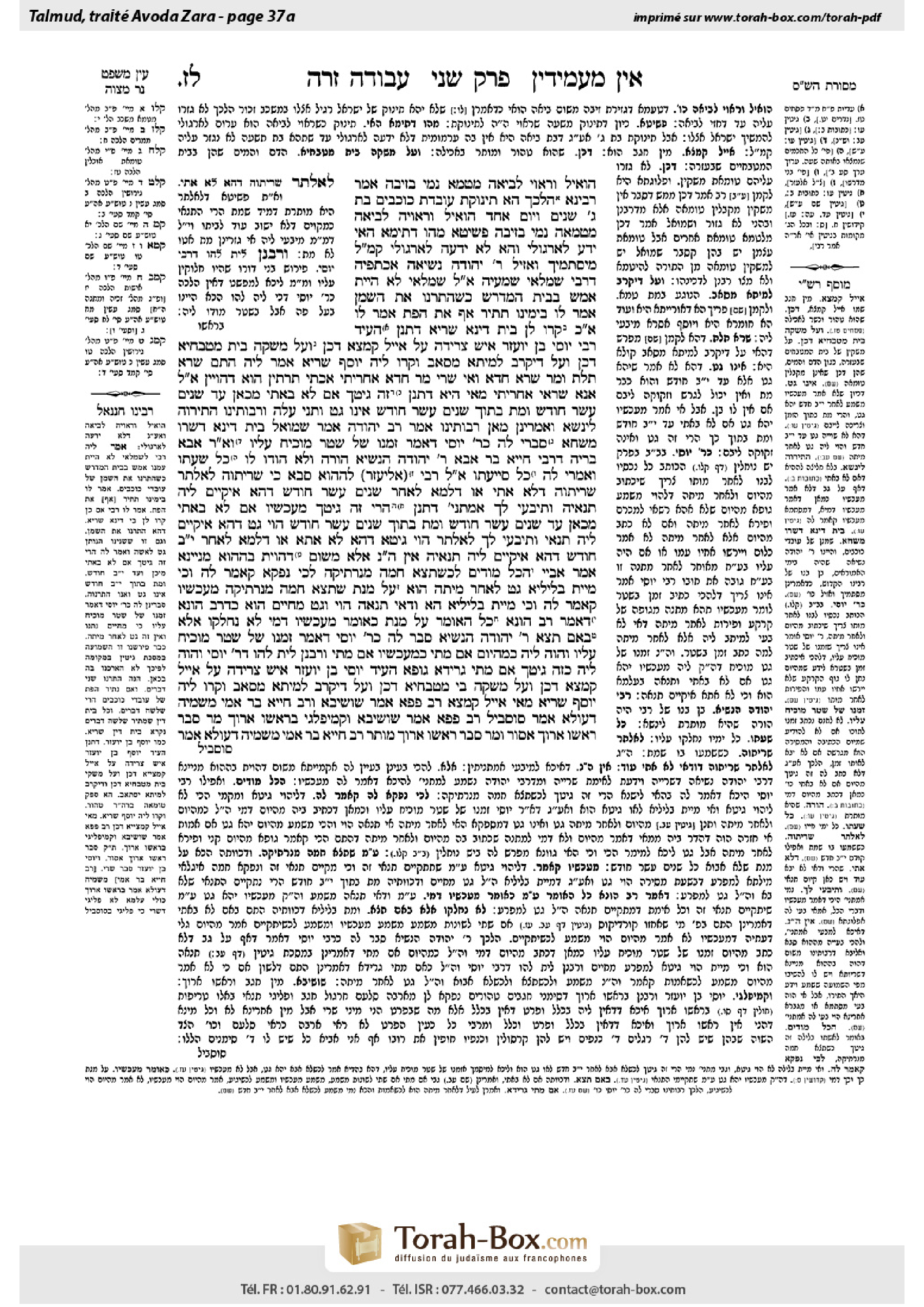
Avodah Zarah 37a: Talmud study for Daf Yomi
Study the Talmud for Daf Yomi with scanned pages, Hebrew text, English translations from Sefaria and AI-generated French translations.
Passage selection and English or AI-generated French translation are available where the scan has annotations. Daf Study is independent of Torah-Box and Sefaria.
Browse Avodah Zarah · עבודה זרה · All tractatesAvodah Zarah 37a text and translations
This page of Avodah Zarah includes the Aramaic text, an English translation and an AI-generated French translation, alongside the scan above.
עבודה זרה ל״ז א · Aramaic and Hebrew text
הוֹאִיל וְרָאוּי לְבִיאָה, מְטַמֵּא נָמֵי בְּזִיבָה. אָמַר רָבִינָא: הִלְכָּךְ, הָא תִּינוֹקֶת גּוֹיָה בַּת שָׁלֹשׁ שָׁנִים וְיוֹם אֶחָד, הוֹאִיל וּרְאוּיָה לְבִיאָה, מְטַמְּאָה נָמֵי בְּזִיבָה.
פְּשִׁיטָא! מַהוּ דְּתֵימָא: הַאי יָדַע לְאַרְגּוֹלֵי, וְהָא לָא יָדְעָה לְאַרְגּוֹלֵי? קָא מַשְׁמַע לַן.
מִיסְתְּמִיךְ וְאָזֵיל רַבִּי יְהוּדָה נְשִׂיאָה אַכַּתְפֵּיהּ דְּרַבִּי שִׂמְלַאי שַׁמָּעֵיהּ, אָמַר לוֹ: שִׂמְלַאי, לֹא הָיִיתָ אֶמֶשׁ בְּבֵית הַמִּדְרָשׁ כְּשֶׁהִתַּרְנוּ אֶת הַשֶּׁמֶן. אָמַר לוֹ: בְּיָמֵינוּ תַּתִּיר אַף אֶת הַפַּת! אָמַר לוֹ: אִם כֵּן קָרוּ לַן ״בֵּית דִּינָא שָׁרְיָא״! דִּתְנַן: הֵעִיד רַבִּי יוֹסֵי בֶּן יוֹעֶזֶר אִישׁ צְרֵידָה עַל אַיַּיל קַמְצָא דְּכַן, וְעַל מַשְׁקֵה בֵּית מַטְבְּחַיָּא דְּכַן, וְעַל דְּיִקְרַב לְמִיתָא מְסָאַב, וְקָרוּ לֵיהּ ״יוֹסֵף שָׁרְיָא״.
אֲמַר לֵיהּ: הָתָם שְׁרָא תְּלָת, וּמַר שְׁרָא חֲדָא, וְאִי שָׁרֵי מָר חֲדָא אַחֲרִיתִי, אַכַּתִּי תַּרְתֵּין הוּא דְּהָוְיָין! אֲמַר לֵיהּ: אֲנָא [נָמֵי] שְׁרַאי אַחֲרִיתִי. מַאי הִיא?
דִּתְנַן: זֶה גִּיטִּיךְ אִם לֹא בָּאתִי מִכָּאן עַד שְׁנֵים עָשָׂר חוֹדֶשׁ, וּמֵת בְּתוֹךְ שְׁנֵים עָשָׂר חוֹדֶשׁ — אֵינוֹ גֵּט, וְתָנֵי עֲלַהּ: וְרַבּוֹתֵינוּ הִתִּירוּהָ לִינָּשֵׂא, וְאָמְרִינַן: מַאן ״רַבּוֹתֵינוּ״? אָמַר רַב יְהוּדָה אָמַר שְׁמוּאֵל: בֵּית דִּינָא דִּשְׁרוֹ מִשְׁחָא.
סָבְרִי לַהּ כְּרַבִּי יוֹסֵי, דְּאָמַר: זְמַנּוֹ שֶׁל שְׁטָר מוֹכִיחַ עָלָיו. וְאָמַר רַבִּי אַבָּא בְּרֵיהּ דְּרַבִּי חִיָּיא בַּר אַבָּא: רַבִּי יְהוּדָה הַנָּשִׂיא הוֹרָה, וְלֹא הוֹדוּ לוֹ כׇּל שְׁעָתוֹ, וְאָמְרִי לָהּ: כׇּל סִיעָתוֹ.
אֲמַר לֵיהּ רַבִּי (אֱלִיעֶזֶר) [אֶלְעָזָר] לְהָהוּא סָבָא: כִּי שְׁרִיתוּהָ — לְאַלְתַּר שְׁרִיתוּהָ, דְּלָא אָתֵי, אוֹ דִלְמָא לְאַחַר שְׁנֵים עָשָׂר חוֹדֶשׁ, דְּהָא אִיקַּיַּים לֵיהּ תְּנָאֵיהּ?
וְתִיבְּעֵי לָךְ אַמַּתְנִיתִין, דִּתְנַן: ״הֲרֵי זֶה גִּיטִּיךְ מֵעַכְשָׁיו אִם לֹא בָּאתִי מִכָּאן עַד שְׁנֵים עָשָׂר חוֹדֶשׁ״, וּמֵת בְּתוֹךְ שְׁנֵים עָשָׂר חוֹדֶשׁ — הָוֵי גֵּט, דְּהָא אִיקַּיַּים לֵיהּ תְּנַאי.
וְתִיבְּעֵי לָךְ: לְאַלְתַּר הָוֵי גִּיטָּא, דְּהָא לָא אֲתָא, אוֹ דִּלְמָא לְאַחַר שְׁנֵים עָשָׂר חוֹדֶשׁ, דְּהָא אִיקַּיַּים לֵיהּ תְּנָאֵיהּ? אִין הָכִי נָמֵי, אֶלָּא מִשּׁוּם דַּהֲוֵית בְּהָהוּא מִנְיָינָא.
אָמַר אַבָּיֵי: הַכֹּל מוֹדִים ״לִכְשֶׁתֵּצֵא חַמָּה מִנַּרְתִּיקָהּ״ — לְכִי נָפְקָא קָאָמַר לַהּ, וְכִי מָיֵית בְּלֵילְיָא — גֵּט לְאַחַר מִיתָה הוּא.
״עַל מְנָת שֶׁתֵּצֵא חַמָּה מִנַּרְתִּיקָהּ״ — מֵעַכְשָׁיו קָאָמַר לָהּ, וְכִי מָיֵית בְּלֵילְיָא — הָא וַדַּאי תְּנָאָה הָוֵי, וְגֵט מֵחַיִּים הוּא, כִּדְרַב הוּנָא, דְּאָמַר רַב הוּנָא: כׇּל הָאוֹמֵר ״עַל מְנָת״ כְּאוֹמֵר ״מֵעַכְשָׁיו״ דָּמֵי.
לֹא נֶחְלְקוּ אֶלָּא בְּ״אִם תֵּצֵא״, רַבִּי יְהוּדָה הַנָּשִׂיא סָבַר לַהּ כְּרַבִּי יוֹסֵי, דְּאָמַר: זְמַנּוֹ שֶׁל שְׁטָר מוֹכִיחַ עָלָיו, וְהָוֵה לֵיהּ כְּ״מֵהַיּוֹם אִם מַתִּי״, כְּ״מֵעַכְשָׁיו אִם מַתִּי״, וְרַבָּנַן לֵית לְהוּ דְּרַבִּי יוֹסֵי, וְהָוֵה לֵיהּ כְּ״זֶה גִּיטִּיךְ אִם מַתִּי״ גְּרֵידָא.
גּוּפָא: הֵעִיד יוֹסֵי בֶּן יוֹעֶזֶר אִישׁ צְרֵידָה עַל אַיַּיל קַמְצָא דְּכַן, וְעַל מַשְׁקֵה בֵּי מַטְבְּחַיָּא דְּכַן, וְעַל דְּיִקְרַב לְמִיתָא מְסָאַב, וְקָרוּ לֵיהּ ״יוֹסֵף שָׁרְיָא״. מַאי אַיַּיל קַמְצָא? רַב פָּפָּא אָמַר: שׁוֹשִׁיבָא, וְרַב חִיָּיא בַּר אַמֵּי מִשְּׁמֵיהּ דְּעוּלָּא אָמַר: סוּסְבִּיל.
רַב פָּפָּא אָמַר: שׁוֹשִׁיבָא, וְקָמִיפַּלְגִי בְּרֹאשׁוֹ אָרוֹךְ. מָר סָבַר: רֹאשׁוֹ אָרוֹךְ אָסוּר, וּמָר סָבַר: רֹאשׁוֹ אָרוֹךְ מוּתָּר. רַב חִיָּיא בַּר אַמֵּי מִשְּׁמֵיהּ דְּעוּלָּא אָמַר:
Avodah Zarah 37a · English translation
The Gemara explains the reason for this opinion: Since a nine-year-old boy is fit to engage in intercourse, he also imparts ritual impurity as one who experienced ziva. Ravina said: Therefore, with regard to a female gentile child who is three years and one day old, since she is fit to engage in intercourse at that age, she also imparts impurity as one who experienced ziva.
The Gemara asks: Isn’t that obvious? The Gemara explains: It was necessary to state this ruling, lest you say that the halakha that a gentile who is suited for intercourse imparts impurity does not apply to a female. The possible difference between a male and female child is based on the fact that whereas that child, a nine-year-old male gentile, knows how to accustom others to sin by employing persuasion, this child, a three-year-old female gentile, does not know how to accustom others to sin until she matures. Therefore, Ravina teaches us that the halakha nevertheless applies to both male and female children.
The Gemara relates a relevant incident: Rabbi Yehuda Nesia was traveling while leaning upon the shoulder of Rabbi Simlai, his attendant. Rabbi Yehuda Nesia said to him: Simlai, you were not in the study hall last night when we permitted the oil of gentiles. Rabbi Simlai said to him: In our days, you will permit bread of gentiles as well. Rabbi Yehuda Nesia said to him: If so, people will call us a permissive court. As we learned in a mishna (Eduyyot 8:4): Rabbi Yosei ben Yo’ezer of Tzereida testified with regard to the eil kamtza, a type of locust, that it is kosher, and with regard to the liquids of the slaughterhouse in the Temple that they are ritually pure, and with regard to one who touches a corpse that he is impure, as soon explained by the Gemara. And as a result, they called him: Yosef the Permissive.
Rabbi Simlai said to him: There, Yosei ben Yo’ezer permitted three matters, but the Master has permitted only one, and even if the Master permits one other matter, these will still constitute only two permissive rulings. Rabbi Yehuda Nesia said to him: I have already permitted another matter. The Gemara asks: What is the other matter that he permitted?
The Gemara explains that this is as we learned in a mishna (Gittin 76b) that if one says to his wife: This is your bill of divorce if I do not arrive from now until twelve months’ time, and he died within twelve months, then it is not a valid bill of divorce because it would not take effect until after the husband’s death. And it is taught with regard to that mishna that our Rabbis nevertheless permitted her to marry. The Gemara continues: And we say: Who is the mishna referring to when it mentions our Rabbis? Rav Yehuda said that Shmuel said: This is referring to the court that permitted the oil of gentiles.
Tangentially, the Gemara examines the reason for the ruling of Rabbi Yehuda Nesia’s court concerning a bill of divorce. They hold in accordance with the opinion of Rabbi Yosei, who says: The date written in a document proves when it takes effect. In other words, the bill of divorce takes effect at the time written on it. Therefore, the divorce actually goes into effect before the husband’s death, because it is retroactively initiated on the day that the bill was issued. The Gemara adds: And Rabbi Abba, son of Rabbi Ḥiyya bar Abba, says: In an earlier period, Rabbi Yehuda HaNasi also ruled that the bill of divorce should be valid, but the other Sages did not concede to his opinion during his entire lifetime [sha’ato]. And some say that all of his colleagues [si’ato] did not concede to his opinion.
Rabbi Elazar said to a certain elderly man, who was a member of Rabbi Yehuda Nesia’s court: When you permitted this woman to remarry, did you permit her immediately after the husband died, as he certainly will not arrive within the twelve months, or perhaps you permitted her only after twelve months, because only then was the condition fulfilled?
That elderly man said to Rabbi Elazar: And let the dilemma be raised with regard to the mishna itself, as we learned in the next line of the mishna in Gittin: If one says to his wife: This is your bill of divorce from now if I do not arrive from now until twelve months have elapsed, and he died within twelve months, this is a valid bill of divorce. The reason is that its condition was fulfilled, as the husband stated explicitly that the bill takes effect immediately.
He explains: And let the dilemma be raised with regard to this case: Is the bill of divorce valid immediately upon the husband’s death because he will certainly not arrive? Or perhaps the bill of divorce is valid only after twelve months have elapsed, because only then is his condition fulfilled? Rabbi Elazar answered: Yes, it is indeed so; this question can be asked with regard to the case of the mishna itself. The Gemara adds: But Rabbi Elazar asked that elder about the decision of Rabbi Yehuda Nesia’s court because he was present at that assembly, and therefore he could report on what had actually occurred.
Abaye says: All concede that one who says that a bill of divorce will take effect once the sun emerges from its sheath is saying to his wife that it will be valid once the sun comes out in the morning. And therefore, if the husband dies during the night, before sunrise, it is a posthumous bill of divorce, which is invalid.
Furthermore, if he said to her: On the condition that the sun will come out of its sheath, then he is saying to his wife that the bill of divorce will take effect retroactively from now, on the condition that the sun emerges. And accordingly, if he dies during the night, this is certainly a fulfilled condition, and it is a bill of divorce which takes effect retroactively, while he is alive; in accordance with the statement of Rav Huna. As Rav Huna says: With regard to anyone who states a provision employing the language: On the condition, it is tantamount to his stating in the provision that the document takes effect retroactively from now.
They disagreed only in the case of one who said to his wife: This will be your bill of divorce if the sun emerges from its sheath, and the husband died during the night. Rabbi Yehuda HaNasi holds in accordance with the opinion of Rabbi Yosei, who says that the date written in a document proves when it takes effect, and it is therefore considered as though the husband said: From today if I die, or as though he said: From now if I die. And the Sages do not accept the opinion of Rabbi Yosei, and consequently they maintain that it is considered as though the husband said only: This is your bill of divorce if I die, in which case the bill of divorce is not valid, as it would take effect only after the husband’s death.
§ The Gemara returns to the matter itself: Yosei ben Yo’ezer of Tzereida testified with regard to the eil kamtza that it is kosher, and with regard to the liquids of the slaughterhouse in the Temple that they are ritually pure, and with regard to one who touches a corpse that he is impure. And as a result, they called him: Yosef the Permissive. The Gemara asks: What is the eil kamtza? Rav Pappa says: It is a long-headed locust called shoshiva, and Rav Ḥiyya bar Ami says in the name of Ulla: It is a locust called susbil.
The Gemara explains: Rav Pappa says it is a shoshiva, and accordingly Yosei ben Yo’ezer and the other Rabbis disagree with regard to a long-headed locust: One Sage, the Rabbis, holds that a long-headed locust is prohibited, and one Sage, Yosei ben Yo’ezer, holds that a long-headed locust is permitted. Rav Ḥiyya bar Ami says in the name of Ulla that
Avodah Zarah 37a · Traduction française (IA)
La Guemara explique la raison de cet avis : Puisque un garçon de neuf ans est capable d'engager des relations sexuelles, il transmet également la souillure rituelle comme celui qui a connu la ziva. Ravina dit : Par conséquent, concernant une enfant païenne de trois ans et un jour, puisque celle-ci est capable d'engager des relations sexuelles à cet âge, elle transmet également la souillure comme celle qui a connu la ziva.
La Guemara pose la question : N'est-ce pas évident ? La Guemara explique : Il était nécessaire d'énoncer cette décision, afin que l'on ne dise pas que la halakha selon laquelle un païen capable d'engager des relations sexuelles transmet la souillure ne s'applique pas à une femme. La différence possible entre un enfant masculin et féminin repose sur le fait que, tandis que cet enfant, un garçon païen de neuf ans, sait comment accoutumer les autres à pécher par la persuasion, cet enfant, une fille païenne de trois ans, ne sait pas encore comment accoutumer les autres à pécher jusqu'à ce qu'elle mûrisse. Par conséquent, Ravina nous apprend que cette halakha s'applique tout aussi bien aux enfants masculins et féminins.
La Guemara rapporte un incident pertinent : Rabbi Yehuda Nesia voyageait en s'appuyant sur l'épaule de Rabbi Simlai, son serviteur. Rabbi Yehuda Nesia dit à lui : Simlai, tu n'étais pas dans la salle de study hier soir quand nous avons permis l'huile des païens. Rabbi Simlai dit à lui : Dans nos jours, tu permettras aussi le pain des païens. Rabbi Yehuda Nesia dit à lui : Si c'est ainsi, les gens nous appelleront un tribunal permissif. Comme nous avons appris dans une mitsna (Eduyyot 8:4) : Rabbi Yosei ben Yo’ezer de Tzereida témoigna concernant l'ail kamtza, un type de locustes, qu'il est acceptable, et concernant les liquides de la boucherie du Temple qu'ils sont rituellement purs, et concernant celui qui touche un cadavre qu'il est souillé, comme l'explique la Guemara. Et comme résultat, on l'appelait : Yosef le Permissif.
Rabbi Simlai dit à lui : Là, Yosei ben Yo’ezer a permis trois choses, mais le Maître a permis seulement une, et même si le Maître permet une autre chose, cela restera seulement deux décisions permissives. Rabbi Yehuda Nesia dit à lui : J'ai déjà permis une autre chose. La Guemara pose la question : Quelle est l'autre chose qu'il a permis ?
La Guemara explique que cela correspond à ce que nous avons appris dans une mitsva (Gittin 76b) : si l'on dit à sa femme : C'est votre divorce si je ne reviens pas d'ici à douze mois, et qu'il meurt dans les douze mois, alors ce n'est pas un divorce valide, car il ne prendrait effet qu'après la mort du mari. Et cela est enseigné concernant cette mitsva que nos Rabbins ont tout de même permis qu'elle épouse. La Guemara continue : Et nous disons : À qui la mitsva fait-elle référence lorsqu'elle mentionne nos Rabbins ? Rav Yehuda dit que Shmuel a dit : Cela fait référence au tribunal qui a permis l'huile des païens.
De manière tangentielle, la Guemara examine la raison de la décision du tribunal de Rabbi Yehuda Nesia concernant un divorce. Ils suivent l'opinion de Rabbi Yosei, qui dit : La date inscrite dans un document prouve quand il prend effet. En d'autres termes, le divorce prend effet à la date inscrite. Par conséquent, le divorce entre en effet avant la mort du mari, car il est initié rétroactivement le jour où le document a été émis. La Guemara ajoute : Et Rabbi Abba, fils de Rabbi Ḥiyya bar Abba, dit : Dans une époque antérieure, Rabbi Yehuda HaNasi a également régi que le divorce devait être valide, mais les autres Sages n'ont pas accepté son avis durant toute sa vie [sha’ato]. Et certains disent que tous ses collègues [si’ato] n'ont pas accepté son avis.
Rabbi Elazar dit à un certain homme âgé, membre du tribunal de Rabbi Yehuda Nesia : Lorsque vous avez permis cette femme de remettre mariage, avez-vous permis immédiatement après la mort du mari, comme il ne reviendra certainement pas dans les douze mois, ou peut-être avez-vous permis seulement après douze mois, car c'est à ce moment-là que la condition était remplie ?
Cet homme âgé dit à Rabbi Elazar : Et que l'interrogatoire soit soulevé concernant la mitsva elle-même, comme nous avons appris dans la ligne suivante de la mitsva dans Gittin : Si l'on dit à sa femme : C'est votre divorce dès maintenant si je ne reviens pas d'ici à douze mois, et qu'il meurt dans les douze mois, c'est un divorce valide. La raison est que sa condition a été remplie, car l'homme a explicitement dit que le divorce prend effet immédiatement.
Il explique : Et que l'interrogatoire soit soulevé concernant ce cas : Le divorce est-il valide immédiatement après la mort du mari, car il ne reviendra certainement pas ? Ou peut-être le divorce est-il valide seulement après douze mois, car c'est à ce moment-là que sa condition est remplie ? Rabbi Elazar répondit : Oui, c'est effectivement ainsi ; cette question peut être posée concernant le cas de la mitsva elle-même. La Guemara ajoute : Mais Rabbi Elazar a posé cette question à cet homme âgé car il était présent à cette assemblée, et donc il pouvait rapporter ce qui s'était réellement produit.
Abaye dit : Tout le monde reconnaît que celui qui dit qu'un divorce prend effet une fois que le soleil sort de son fourreau dit à sa femme qu'il sera valide une fois que le soleil sortira le matin. Par conséquent, si le mari meurt pendant la nuit, avant l'aube, c'est un divorce posthume, qui est invalide.
De plus, si il dit à elle : Sur la condition que le soleil sortira de son fourreau, alors il dit à sa femme que le divorce prend effet rétroactivement à partir de maintenant, sur la condition que le soleil sorte. Par conséquent, si il meurt pendant la nuit, c'est certainement une condition remplie, et c'est un divorce qui prend effet rétroactivement pendant qu'il est vivant ; conformément à l'affirmation de Rav Huna. Comme Rav Huna dit : Concernant quiconque formule une condition en utilisant la formule : Sur la condition, cela équivaut à son affirmation dans la condition que le document prend effet rétroactivement à partir de maintenant.
Ils n'ont divergé que dans le cas d'une personne qui disait à sa femme : Cela sera votre gueur de divorce si le soleil sort de son fourreau, et le mari est mort pendant la nuit. Rabbi Yehuda HaNasi suit l'opinion de Rabbi Yosei, qui affirme que la date inscrite dans un document prouve quand il prend effet, et qu'il est donc considéré comme si le mari avait dit : À partir d'aujourd'hui si je meurs, ou comme s'il avait dit : À partir de maintenant si je meurs. Les Sages ne suivent pas l'opinion de Rabbi Yosei, et par conséquent ils maintiennent qu'il est considéré comme si le mari avait dit seulement : Cela est votre gueur de divorce si je meurs, dans ce cas le gueur de divorce n'est pas valide, car il ne prend effet qu'après la mort du mari.
§ La Guemara reprend le sujet : Yosei ben Yo’ezer de Tzereida a témoigné concernant l'ail kamtza qu'il est acceptable, concernant les liquides de la boucherie du Temple qu'ils sont rituellement purs, et concernant celui qui touche un cadavre qu'il est impur. Et en conséquence, on l'a appelé : Yosef le Permissif. La Guemara pose la question : Qu'est-ce que l'ail kamtza ? Rav Pappa dit : C'est un criquet à longue tête appelé shoshiva, et Rav Ḥiyya bar Ami dit en nom de Ulla : C'est un criquet appelé susbil.
La Guemara explique : Rav Pappa dit qu'il s'agit d'un shoshiva, et par conséquent Yosei ben Yo’ezer et les autres Rabbins divergent concernant un criquet à longue tête : Un Sage, les Rabbins, pensent qu'un criquet à longue tête est interdit, et un Sage, Yosei ben Yo’ezer, pense qu'un criquet à longue tête est permis. Rav Ḥiyya bar Ami dit en nom de Ulla que
Traduction française générée par IA à partir de l’édition anglaise de Sefaria. Vérifie toujours un passage avec le texte source.
Text from Sefaria: William Davidson Edition - Vocalized Aramaic (CC BY NC); William Davidson Edition - English (CC BY NC).