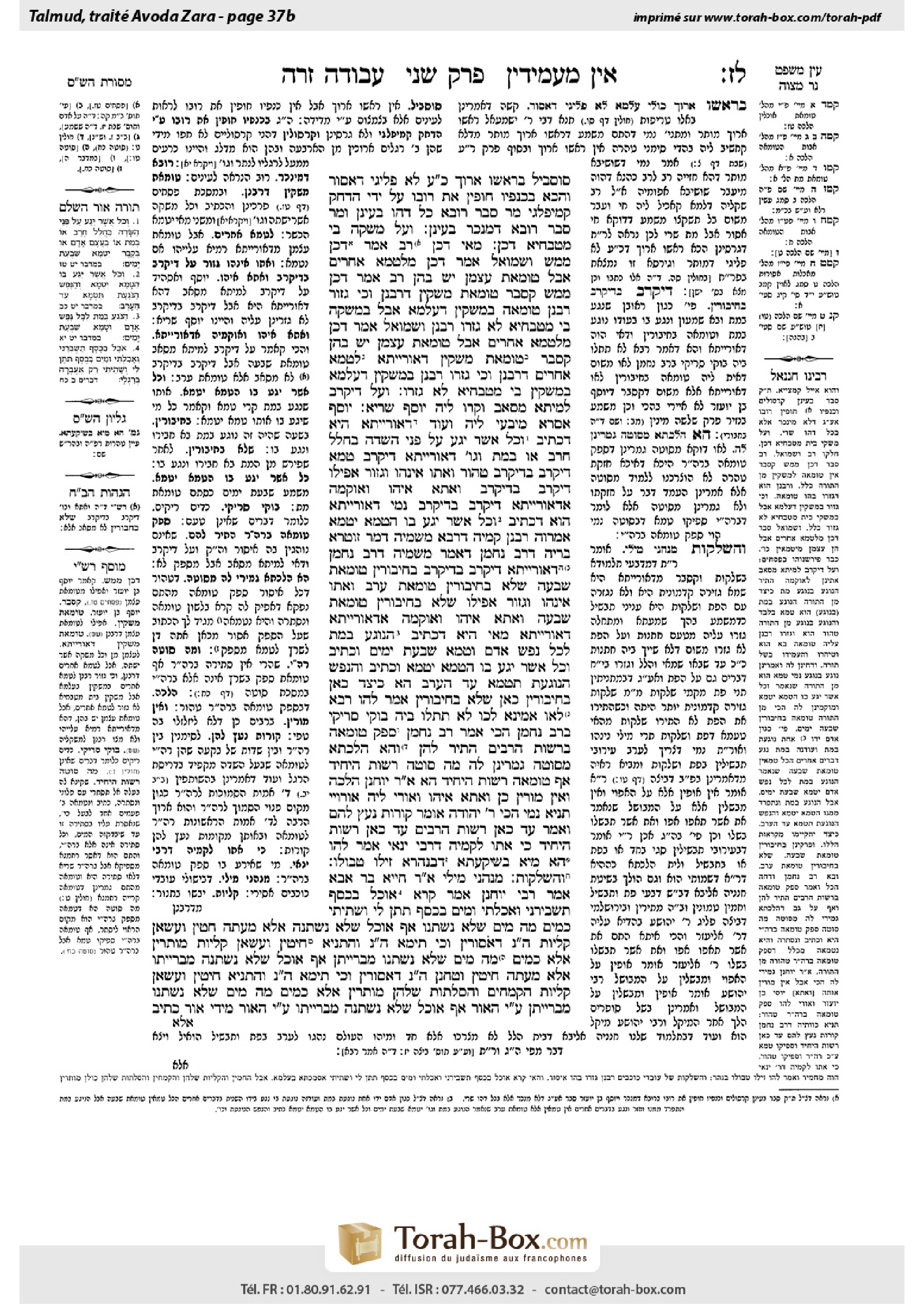
Avodah Zarah 37b: Talmud study for Daf Yomi
Study the Talmud for Daf Yomi with scanned pages, Hebrew text, English translations from Sefaria and AI-generated French translations.
Passage selection and English or AI-generated French translation are available where the scan has annotations. Daf Study is independent of Torah-Box and Sefaria.
Browse Avodah Zarah · עבודה זרה · All tractatesAvodah Zarah 37b text and translations
This page of Avodah Zarah includes the Aramaic text, an English translation and an AI-generated French translation, alongside the scan above.
עבודה זרה ל״ז ב · Aramaic and Hebrew text
סוּסְבִּיל, בְּרֹאשׁוֹ אָרוֹךְ — כּוּלֵּי עָלְמָא לָא פְּלִיגִי דְּאָסוּר, וְהָכָא בִּכְנָפָיו חוֹפִין אֶת רוּבּוֹ עַל יְדֵי הַדְּחָק קָמִיפַּלְגִי: מָר סָבַר רוּבָּא כֹּל דְּהוּ בָּעֵינַן, וּמָר סָבַר רוּבָּא דְּמִנְּכַר בָּעֵינַן.
וְעַל מַשְׁקֵה בֵּי מַטְבְּחַיָּא דְּכַן. מַאי ״דְּכַן״? רַב אָמַר: דְּכַן מַמָּשׁ, וּשְׁמוּאֵל אָמַר: דְּכַן מִלְּטַמֵּא אֲחֵרִים, אֲבָל טוּמְאַת עַצְמָן יֵשׁ בָּהֶן.
רַב אָמַר: ״דְּכַן מַמָּשׁ״, קָסָבַר: טוּמְאַת מַשְׁקִין דְּרַבָּנַן, וְכִי גְּזוּר רַבָּנַן טוּמְאָה בְּמַשְׁקִין דְּעָלְמָא, אֲבָל בְּמַשְׁקֵה בֵּי מַטְבְּחַיָּא לָא גְּזַרוּ רַבָּנַן.
וּשְׁמוּאֵל אָמַר: דְּכַן מִלְּטַמֵּא אֲחֵרִים, אֲבָל טוּמְאַת עַצְמָן יֵשׁ בָּהֶן, קָסָבַר: טוּמְאַת מַשְׁקִין דְּאוֹרָיְיתָא לְטַמֵּא אֲחֵרִים דְּרַבָּנַן, וְכִי גְּזַרוּ רַבָּנַן בְּמַשְׁקִין דְּעָלְמָא, בְּמַשְׁקִין בֵּי מַטְבְּחַיָּא לָא גְּזַרוּ.
וְעַל דְּיִקְרַב לְמִיתָא מְסָאַב, וְקָרוּ לֵיהּ ״יוֹסֵף שָׁרְיָא״. ״יוֹסֵף אָסְרָא״ מִיבְּעֵי לֵיהּ! וְעוֹד, דְּאוֹרָיְיתָא הִיא, דִּכְתִיב: ״וְכֹל אֲשֶׁר יִגַּע עַל פְּנֵי הַשָּׂדֶה בַּחֲלַל חֶרֶב אוֹ בְמֵת וְגוֹ׳״!
דְּאוֹרָיְיתָא, דְּיִקְרַב — טָמֵא, דְּיִקְרַב בִּדְיִקְרַב — טָהוֹר, וַאֲתוֹ אִינְהוּ וּגְזוּר אֲפִילּוּ דְּיִקְרַב בִּדְיִקְרַב, וַאֲתָא אִיהוּ וְאוֹקְמַהּ אַדְּאוֹרָיְיתָא.
דְּיִקְרַב בִּדְיִקְרַב נָמֵי דְּאוֹרָיְיתָא הוּא, דִּכְתִיב: ״וְכֹל אֲשֶׁר יִגַּע בּוֹ הַטָּמֵא יִטְמָא״!
אַמְרוּהָ רַבָּנַן קַמֵּיהּ דְּרָבָא, מִשְּׁמֵיהּ דְּמָר זוּטְרָא בְּרֵיהּ דְּרַב נַחְמָן, דְּאָמַר מִשְּׁמֵיהּ דְּרַב נַחְמָן: דְּאוֹרָיְיתָא דְּיִקְרַב בִּדְיִקְרַב, בְּחִיבּוּרִין — טוּמְאַת שִׁבְעָה, שֶׁלֹּא בְּחִיבּוּרִין — טוּמְאַת עֶרֶב, וַאֲתוֹ אִינְהוּ וּגְזוּר אֲפִילּוּ שֶׁלֹּא בְּחִיבּוּרִין טוּמְאַת שִׁבְעָה, וַאֲתָא אִיהוּ וְאוֹקְמַהּ אַדְּאוֹרָיְיתָא.
דְּאוֹרָיְיתָא מַאי הִיא? דִּכְתִיב: ״הַנֹּגֵעַ בְּמֵת לְכׇל נֶפֶשׁ אָדָם וְטָמֵא שִׁבְעַת יָמִים״, וּכְתִיב: ״וְכֹל אֲשֶׁר יִגַּע בּוֹ הַטָּמֵא יִטְמָא״, וּכְתִיב: ״וְהַנֶּפֶשׁ הַנֹּגַעַת תִּטְמָא עַד הָעָרֶב״, הָא כֵּיצַד?
כָּאן בְּחִיבּוּרִין, כָּאן שֶׁלֹּא בְּחִיבּוּרִין.
אֲמַר לְהוּ רָבָא: לָאו אָמֵינָא לְכוּ לָא תִּתְלוֹ בֵּיהּ בּוּקֵי סְרִיקֵי בְּרַב נַחְמָן? הָכִי אָמַר רַב נַחְמָן: סְפֵק טוּמְאָה בִּרְשׁוּת הָרַבִּים הִתִּיר לָהֶן.
וְהָא הִלְכְתָא מִסּוֹטָה גָּמְרִינַן לַהּ, מָה סוֹטָה רְשׁוּת הַיָּחִיד, אַף טוּמְאָה רְשׁוּת הַיָּחִיד!
הָא אָמַר רַבִּי יוֹחָנָן: הֲלָכָה וְאֵין מוֹרִין כֵּן, וַאֲתָא אִיהוּ וְאוֹרִי לֵיהּ אוֹרוֹיֵי.
תַּנְיָא נָמֵי הָכִי: רַבִּי יְהוּדָה אוֹמֵר, קוֹרוֹת נָעַץ לָהֶם, וְאָמַר: עַד כָּאן רְשׁוּת הָרַבִּים, עַד כָּאן רְשׁוּת הַיָּחִיד. כִּי אֲתוֹ לְקַמֵּיהּ דְּרַבִּי יַנַּאי, אֲמַר לְהוּ: הָא מַיָּא בְּשִׁיקַעְתָּא דִּבְנַהֲרָא, זִילוּ טְבוּלוּ.
וְהַשְּׁלָקוֹת. מְנָהָנֵי מִילֵּי? אָמַר רַבִּי חִיָּיא בַּר אַבָּא אָמַר רַבִּי יוֹחָנָן: אָמַר קְרָא ״אֹכֶל בַּכֶּסֶף תַּשְׁבִּרֵנִי וְאָכַלְתִּי וּמַיִם בַּכֶּסֶף תִּתֶּן לִי וְשָׁתִיתִי״, כַּמָּיִם — מָה מַיִם שֶׁלֹּא נִשְׁתַּנּוּ, אַף אוֹכֶל שֶׁלֹּא נִשְׁתַּנָּה.
אֶלָּא מֵעַתָּה, חִטִּין וַעֲשָׂאָן קְלָיוֹת — הָכִי נָמֵי דַּאֲסוּרִין? וְכִי תֵּימָא הָכִי נָמֵי, וְהָתַנְיָא: חִיטִּין וַעֲשָׂאָן קְלָיוֹת — מוּתָּרִין! אֶלָּא, כְּמַיִם — מָה מַיִם שֶׁלֹּא נִשְׁתַּנּוּ מִבְּרִיָּיתָן, אַף אוֹכֶל שֶׁלֹּא נִשְׁתַּנָּה מִבְּרִיָּיתוֹ.
אֶלָּא מֵעַתָּה, חִיטִּין וּטְחָנָן הָכִי נָמֵי דַּאֲסוּרִין? וְכִי תֵּימָא הָכִי נָמֵי, וְהָתַנְיָא: חִיטִּין וַעֲשָׂאָן קְלָיוֹת, הַקְּמָחִים וְהַסְּלָתוֹת שֶׁלָּהֶן מוּתָּרִין! אֶלָּא כַּמָּיִם — מָה מַיִם שֶׁלֹּא נִשְׁתַּנּוּ מִבְּרִיָּיתָן עַל יְדֵי הָאוּר, אַף אוֹכֶל שֶׁלֹּא נִשְׁתַּנָּה מִבְּרִיָּיתוֹ עַל יְדֵי הָאוּר.
מִידֵּי אוּר כְּתִיב?
Avodah Zarah 37b · English translation
it is a susbil, and accordingly, with regard to a long-headed locust, everyone agrees that it is prohibited. And here they disagree with regard to a locust whose wings barely cover most of its body: One Sage, Yosei ben Yo’ezer, holds that we require only a minimal majority of the locust’s body to be covered by its wings, and one Sage, the Rabbis, holds that we require a noticeable majority of the body to be covered.
§ It was stated above: And Yosei ben Yo’ezer testified with regard to the liquids of the slaughterhouse in the Temple that they are ritually pure. The Gemara asks: What did Yosei ben Yo’ezer mean when he said they are pure? Rav says: He meant that they are actually ritually pure. And Shmuel says: They are pure in the sense that they do not impart ritual impurity to other substances; but they themselves can contract impurity.
The Gemara explains the reasons for these opinions. Rav says that these liquids are actually pure, as he maintains that the ritual impurity of liquids applies by rabbinic law, and when the Sages decreed impurity upon liquids, they did so only with regard to ordinary liquids. But the Sages did not issue their decree with regard to the liquids of the slaughterhouse in the Temple.
And Shmuel says: The liquids are ritually pure in the sense that they do not impart impurity to other substances; but they themselves can contract impurity, as Shmuel maintains that the ritual impurity of liquids themselves is by Torah law, whereas their capacity to impart impurity to other substances is by rabbinic law. And when the Sages issued this decree, they did so only with regard to ordinary liquids. But they did not issue their decree with regard to the liquids of the slaughterhouse in the Temple.
§ It was stated: And Yosei ben Yo’ezer testified with regard to one who touches a corpse that he is impure, and as a result they called him: Yosef the Permissive. The Gemara questions this: Since he issued a stringent ruling, they should have called him: Yosef the Prohibiting. And furthermore, this halakha is explicitly written in the Torah, as it is written: “And whosoever in the open field touches one that is slain with a sword, or one that is dead, or a bone of a man, or a grave, shall be impure seven days” (Numbers 19:16).
The Gemara explains: By Torah law one who touches a corpse is ritually impure, but one who touches another who has touched a corpse is pure. And the Sages came and decreed that even one who touches another who has touched a corpse is also impure. And Yosei ben Yo’ezer came and established the halakha in accordance with the original, more lenient Torah law.
The Gemara raises a difficulty: One who touches another who has touched a corpse is also rendered impure by Torah law, as it is written: “And whatsoever the impure person touches shall be impure” (Numbers 19:22).
The Sages stated this difficulty before Rava in the name of Mar Zutra, the son of Rav Naḥman, who said a response in the name of Rav Naḥman: By Torah law, one who touches another who touches a corpse while the second individual is in concurrent contact with the corpse is impure with seven-day impurity. If this occurs while the second individual is not in concurrent contact with the corpse, he contracts impurity until the evening. And the Sages came and decreed that even where there is no concurrent contact, one still contracts seven-day impurity when he touches someone who touched a corpse. And subsequently Yosei ben Yo’ezer came and established the halakha in accordance with the original Torah law.
The Gemara asks: What is the source of this halakha, prescribed by Torah law? As it is written: “He that touches the dead, even any man’s dead body, shall be impure seven days” (Numbers 19:11), and it is written: “And whatsoever the impure person touches shall be impure” (Numbers 19:22). These two verses indicate that one contracts ritual impurity for seven days. And yet it is also written: “And the soul that touches him shall be impure until evening” (Numbers 19:22). How can these texts be reconciled?
The Gemara answers: Here, in the first two verses, the Torah is discussing concurrent contact, which results in impurity of seven days; there, in the last verse, it is discussing a case where there is no concurrent contact, and therefore the individual in question is impure only until the evening.
Rava said to the Sages who suggested that explanation citing Rav Naḥman: Didn’t I tell you not to hang empty pitchers [bukei] upon Rav Naḥman, i.e., not to attribute incorrect statements to him? Rather, this is what Rav Naḥman said: Yosei ben Yo’ezer permitted for them a case of uncertain impurity contracted in a public domain. In other words, Yosei ben Yo’ezer ruled leniently that one who is unsure whether or not he came in contact with a corpse in the public domain is ritually pure.
The Gemara raises a difficulty: But didn’t we learn this halakha from the case of a woman suspected by her husband of having been unfaithful [sota]: Just as a sota can be made to drink the bitter waters only when she is suspected of engaging in adultery in a private domain, so too, uncertain ritual impurity is considered impure only when one suspects that he came into contact with it in a private domain? This shows that even by Torah law one who is unsure whether or not he touched a corpse in the public domain remains pure.
Rabbi Yoḥanan said in explanation: This is the halakha, but a public ruling is not issued to that effect. Consequently, the masses treated this matter with stringency. And Yosei ben Yo’ezer came and instructed the masses to follow the original instruction of the Torah. Therefore, his ruling was in fact a leniency.
The Gemara provides support for Rabbi Yoḥanan’s explanation. This is also taught in a baraita: Rabbi Yehuda says that Yosei ben Yo’ezer drove stakes into the ground for the people and said: Until here is the public domain, and until there is the private domain, so that they would know the halakha if they suspected that they had touched a corpse. The Gemara relates that when people came before Rabbi Yannai because they suspected that they might have come into contact with a source of impurity in the public domain, he said to them: Why involve yourselves in matters of uncertainty? There is deep water in the river; go immerse yourselves in it, and resolve the problem in this manner.
§ The mishna teaches: And boiled vegetables prepared by gentiles are prohibited. The Gemara asks: From where is this matter derived? Rabbi Ḥiyya bar Abba says that Rabbi Yoḥanan says: The verse states that when Moses asked Sihon, King of the Amorites, for passage through his land, he said: “You shall sell me food for money, that I may eat; and give me water for money, that I may drink” (Deuteronomy 2:28). By juxtaposing food and water, the verse teaches that food is like water: Just as Moses wished to purchase water that was unchanged, so too, he wished to purchase food that was unchanged, i.e., uncooked. Evidently, this is because foods cooked by gentiles are prohibited.
The Gemara raises a difficulty: If that is so, then in a case where a gentile had wheat and made it into roasted grains by roasting it in the oven, the wheat should also be prohibited, as it was cooked. And if you would say: Indeed that is so, this cannot be the halakha, as isn’t it taught in baraita: If a gentile had wheat and made it into roasted grains, it is permitted? The Gemara suggests a different explanation: Rather, food is like water in the following manner: Just as Moses wished to purchase water that was not altered from its original state, so too, he wished to purchase food that was not altered from its original state. Roasting wheat kernels does not alter their original state.
The Gemara raises another difficulty: If that is so, then if a gentile had wheat and ground it into flour, the flour should also be prohibited, as the wheat has been altered from its original state. And if you would say: Indeed that is so, this cannot be the case, as isn’t it taught in baraita: If a gentile had wheat and made it into roasted grains, it is permitted; similarly, flours and fine flours belonging to gentiles are permitted? Rather, food is like water in the following manner: Just as Moses wished to purchase water that was not altered from its original state by fire, so too, he wished to purchase food that was not altered from its original state by fire. Although wheat ground into flour is altered from its original state, this change is not accomplished by means of fire.
The Gemara raises a difficulty: Is fire written in the verse? There is no mention of fire in the verse at all. How can it be assumed that this is the similarity between water and food?
Avodah Zarah 37b · Traduction française (IA)
il s'agit d'un locust à longue tête, et ainsi, concernant un locust à longue tête, tout le monde est d'accord sur le fait qu'il est interdit. Et ici, ils s'entendent sur un locust dont les ailes couvrent à peine la majeure partie de son corps : un Sage, Yosei ben Yo’ezer, affirme que nous exigeons seulement une minorité minimale du corps du locust à être couverte par ses ailes, et un autre Sage, les Rabbins, affirme que nous exigeons une majorité notable du corps à être couverte.
§ Il a été dit précédemment : Et Yosei ben Yo’ezer a témoigné concernant les liquides de la boucherie du Temple qu'ils sont rituellement purs. La Guemara pose la question : De quoi Yosei ben Yo’ezer voulait-il dire lorsqu'il a dit qu'ils sont purs ? Rav dit : Il voulait dire qu'ils sont effectivement rituellement purs. Et Shmuel dit : Ils sont purs au sens où ils ne transmettent pas la souillure rituelle à d'autres substances ; mais eux-mêmes peuvent contracter la souillure.
La Guemara explique les raisons de ces opinions. Rav dit que ces liquides sont effectivement purs, car il maintient que la souillure rituelle des liquides s'applique par la loi rabbinique, et lorsque les Sages ont décrété la souillure sur les liquides, ils l'ont fait uniquement concernant les liquides ordinaires. Mais les Sages n'ont pas émis leur décret concernant les liquides de la boucherie du Temple.
Et Shmuel dit : Les liquides sont rituellement purs au sens où ils ne transmettent pas la souillure à d'autres substances ; mais eux-mêmes peuvent contracter la souillure, car Shmuel affirme que la souillure rituelle des liquides eux-mêmes est établie par la loi de la Torah, tandis que leur capacité à transmettre la souillure à d'autres substances est établie par la loi rabbinique. Et lorsque les Sages ont émis ce décret, ils l'ont fait uniquement concernant les liquides ordinaires. Mais ils n'ont pas émis leur décret concernant les liquides de la boucherie du Temple.
§ Il a été dit : Et Yosei ben Yo’ezer a témoigné concernant celui qui touche un cadavre qu'il est souillé, et en conséquence, on l'a appelé : Yosef le Permissif. La Guemara questionne cela : Puisqu'il a émis une décision stricte, on devrait l'avoir appelé : Yosef le Prohibiteur. Et de plus, cette halakha est explicitement écrite dans la Torah, car il est écrit : « Et celui qui en plein champ touche celui qui est tué par l'épée, ou celui qui est mort, ou un os d'un homme, ou une tombe, sera souillé sept jours » (Nombres 19:16).
La Guemara explique : Par la loi de la Torah, celui qui touche un cadavre est rituellement souillé, mais celui qui touche celui qui a touché un cadavre est pur. Et les Sages sont venus et ont décrété que même celui qui touche celui qui a touché un cadavre est également souillé. Et Yosei ben Yo’ezer est venu et a établi la halakha conformément à la loi originale, plus clémente de la Torah.
La Guemara soulève une difficulté : Celui qui touche celui qui a touché un cadavre est également rendu impur par la loi de la Torah, car il est écrit : « Et tout ce que l'impur touche sera impur » (Nombres 19:22).
Les Sages ont formulé cette difficulté devant Rava en nom de Mar Zutra, fils de Rav Naḥman, qui a dit une réponse en nom de Rav Naḥman : Par la loi de la Torah, celui qui touche celui qui touche un cadavre tout en étant en contact simultané avec le cadavre est impur avec une impureté de sept jours. Si cela se produit alors que l'individu second n'est pas en contact simultané avec le cadavre, il contracte l'impureté jusqu'au soir. Et les Sages sont venus et ont décrété que même dans le cas où il n'y a pas de contact simultané, celui qui touche celui qui a touché un cadavre contracte une impureté de sept jours. Et ensuite Yosei ben Yo’ezer est venu et a établi la halakha conformément à la loi originale de la Torah.
La Guemara pose la question : Quelle est la source de cette halakha, prescrite par la loi de la Torah ? Car il est écrit : « Celui qui touche le mort, même le corps mort d'un homme, sera impur sept jours » (Nombres 19:11), et il est écrit : « Et tout ce que l'impur touche sera impur » (Nombres 19:22). Ces deux versets indiquent que l'on contracte une impureté rituelle pendant sept jours. Et pourtant, il est aussi écrit : « Et l'âme qui touche lui sera impure jusqu'au soir » (Nombres 19:22). Comment ces textes peuvent-ils être conciliés ?
La Guemara répond : Ici, dans les deux premiers versets, la Torah parle d'un contact simultané, qui entraîne une souillure de sept jours ; là, dans le dernier verset, il s'agit d'un cas où il n'y a pas de contact simultané, et donc l'individu en question est souillé uniquement jusqu'au soir.
Rava a dit aux Sages qui avaient suggéré cette explication en citant Rav Naḥman : N'ai-je pas dit que vous ne deviez pas accrocher des seaux vides [bukei] à Rav Naḥman, c'est-à-dire ne pas attribuer des déclarations incorrectes à lui ? Plutôt, c'est ce que Rav Naḥman a dit : Yosei ben Yo’ezer a permis à ceux-ci un cas de souillure incertaine contractée dans un domaine public. En d'autres termes, Yosei ben Yo’ezer a décidé de manière clémente que celui qui est incertain quant à s'être mis en contact avec un cadavre dans un domaine public est rituellement pur.
La Guemara soulève une difficulté : N'avons-nous pas appris cette halakha du cas de la femme soupçonnée par son mari d'avoir été infidèle [sota] : Tout comme une sota peut être fait boire les eaux amères uniquement lorsqu'elle est soupçonnée d'avoir commis l'adultère dans un domaine privé, de même, la souillure rituelle incertaine est considérée comme impure uniquement lorsqu'on soupçonne qu'il a été en contact avec elle dans un domaine privé ? Cela montre que même par la loi de la Torah, celui qui est incertain quant à s'être mis en contact avec un cadavre dans un domaine public reste pur.
Rabbi Yoḥanan a dit en explication : C'est la halakha, mais une décision publique n'est pas rendue à cet effet. Ainsi, le peuple a traité cette affaire avec une stricte rigueur. Et Yosei ben Yo’ezer est venu et a instruit le peuple à suivre l'instruction originale de la Torah. Ainsi, son jugement était en fait une leniavité.
La Guemara apporte un soutien à l'explication du maître Yochanan. Cela est également enseigné dans une baraïta : Rabbi Yéhuda dit que Yosei ben Yoézer a planté des piquets dans le sol pour le peuple et a dit : Jusqu'ici est le domaine public, et jusqu'ici est le domaine privé, afin qu'ils sachent la halakha s'ils soupçinaient d'avoir touché un cadavre. La Guemara rapporte que lorsqu'on vint devant Rabbi Yannai parce qu'on soupçonnait avoir pu entrer en contact avec une source de souillure dans le domaine public, il leur dit : Pourquoi vous encombrer de questions incertaines ? Il y a de l'eau profonde dans le fleuve ; plongez-vous dedans et résolvez ainsi le problème.
§ La mitsna enseigne : Les légumes bouillis préparés par les non-Juifs sont interdits. La Guemara pose la question : D'où cette matière est-elle dérivée ? Rabbi Chiyah bar Abba dit que Rabbi Yoḥanan dit : L'écriture dit que lorsque Moïse demanda à Sihon, roi des Amorites, le passage par son pays, il dit : « Vous me vendez de la nourriture pour de l'argent, afin que je mange ; et vous me donnez de l'eau pour de l'argent, afin que je boive » (Deutéronome 2:28). En juxtaposant la nourriture et l'eau, l'écriture enseigne que la nourriture est comme l'eau : Tout comme Moïse souhaitait acheter de l'eau non altérée, ainsi aussi souhaitait-il acheter de la nourriture non cuite, c'est-à-dire non cuite. Évidemment, cela est parce que les aliments cuits par les non-Juifs sont interdits.
La Guemara soulève une difficulté : Si c'est ainsi, alors dans le cas où un non-Juif avait du blé et l'avait transformé en grains rôtis en le cuisant dans le four, le blé devrait être également interdit, car il avait été cuisiné. Et si vous dites : En effet, c'est ainsi, cela ne peut pas être la halakha, car n'est-ce pas enseigné dans une baraïta : Si un non-Juif avait du blé et l'avait transformé en grains rôtis, cela est permis ? La Guemara suggère une autre explication : Plutôt, la nourriture est comme l'eau de la manière suivante : Tout comme Moïse souhaitait acheter de l'eau non altérée de son état originel, ainsi aussi souhaitait-il acheter de la nourriture non altérée de son état originel. Le rôti des grains de blé ne modifie pas leur état originel.
La Guemara soulève une autre difficulté : Si c'est ainsi, alors si un non-Juif avait du blé et l'avait moulue en farine, la farine devrait être également interdite, car le blé a été modifié de son état originel. Et si vous dites : En effet, c'est ainsi, cela ne peut pas être le cas, car n'est-ce pas enseigné dans une baraïta : Si un non-Juif avait du blé et l'avait transformé en grains rôtis, cela est permis ; de même, les farines et les farines fines appartenant aux non-Juifs sont permises ? Plutôt, la nourriture est comme l'eau de la manière suivante : Tout comme Moïse souhaitait acheter de l'eau non altérée par le feu, ainsi aussi souhaitait-il acheter de la nourriture non altérée par le feu. Bien que la farine obtenue en moulant le blé soit modifiée de son état originel, cette modification n'est pas accomplie par le feu.
La Guemara soulève une difficulté : Le feu est-il mentionné dans l'écriture ? Il n'y a aucune mention du feu dans l'écriture. Comment peut-on supposer que c'est la similitude entre l'eau et la nourriture ?
Traduction française générée par IA à partir de l’édition anglaise de Sefaria. Vérifie toujours un passage avec le texte source.
Text from Sefaria: William Davidson Edition - Vocalized Aramaic (CC BY NC); William Davidson Edition - English (CC BY NC).