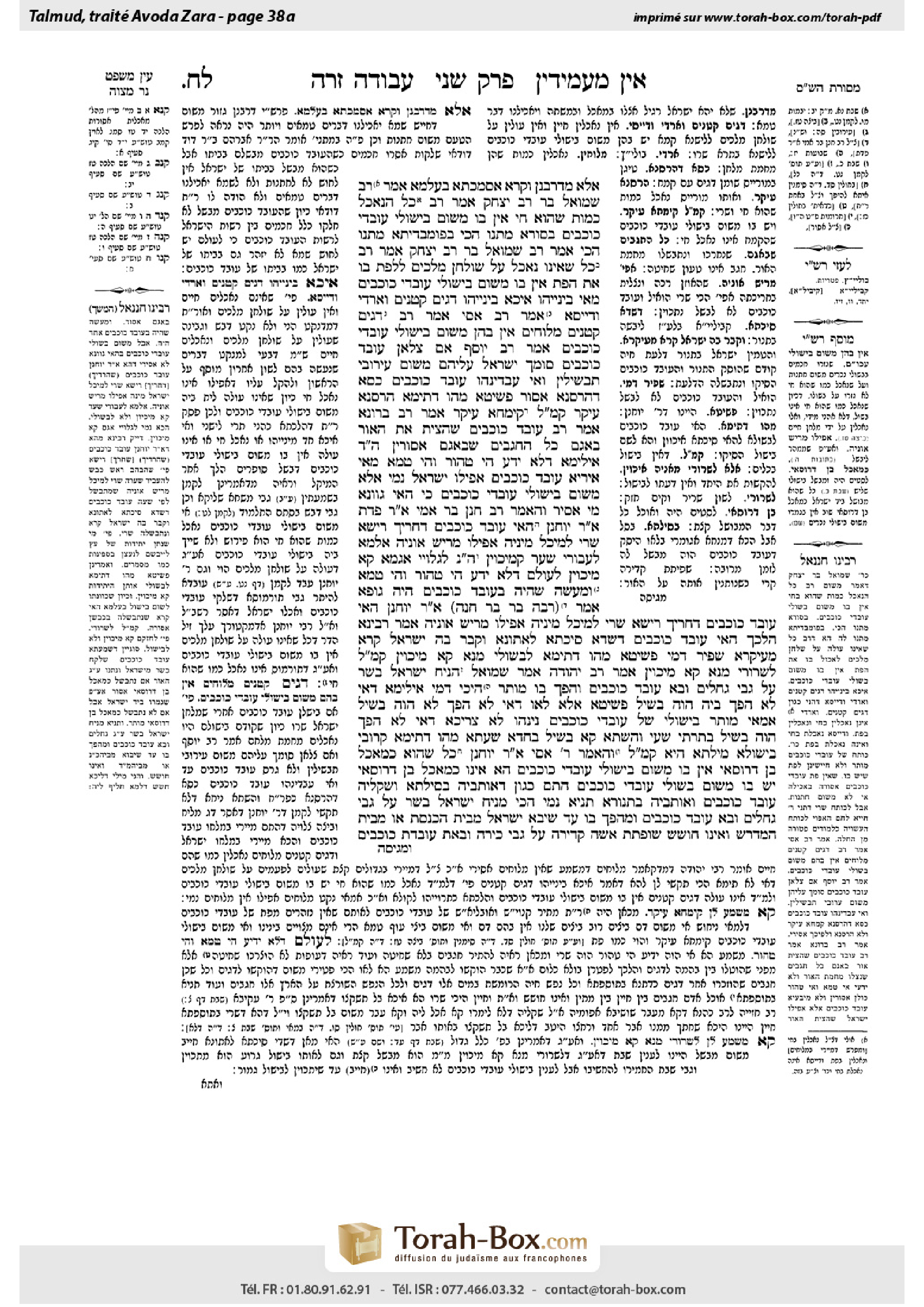
Avodah Zarah 38a: Talmud study for Daf Yomi
Study the Talmud for Daf Yomi with scanned pages, Hebrew text, English translations from Sefaria and AI-generated French translations.
Passage selection and English or AI-generated French translation are available where the scan has annotations. Daf Study is independent of Torah-Box and Sefaria.
Browse Avodah Zarah · עבודה זרה · All tractatesAvodah Zarah 38a text and translations
This page of Avodah Zarah includes the Aramaic text, an English translation and an AI-generated French translation, alongside the scan above.
עבודה זרה ל״ח א · Aramaic and Hebrew text
אֶלָּא מִדְּרַבָּנַן, וּקְרָא אַסְמַכְתָּא בְּעָלְמָא.
אָמַר רַב שְׁמוּאֵל בַּר רַב יִצְחָק אָמַר רַב: כָּל הַנֶּאֱכָל כְּמוֹת שֶׁהוּא חַי — אֵין בּוֹ מִשּׁוּם בִּישּׁוּלֵי גוֹיִם. בְּסוּרָא מַתְנוּ הָכִי, בְּפוּמְבְּדִיתָא מַתְנוּ הָכִי: אָמַר רַב שְׁמוּאֵל בַּר רַב יִצְחָק אָמַר רַב: כׇּל שֶׁאֵינוֹ נֶאֱכָל עַל שׁוּלְחַן מְלָכִים לְלַפֵּת בּוֹ אֶת הַפַּת — אֵין בּוֹ מִשּׁוּם בִּישּׁוּלֵי גוֹיִם.
מַאי בֵּינַיְיהוּ? אִיכָּא בֵּינַיְיהוּ: דָּגִים קְטַנִּים, וְאַרְדֵי, וְדַיְיסָא.
אָמַר רַב אַסִּי אָמַר רַב: דָּגִים קְטַנִּים מְלוּחִים אֵין בָּהֶן מִשּׁוּם בִּישּׁוּלֵי גוֹיִם. אָמַר רַב יוֹסֵף: אִם צְלָאָן גּוֹי סוֹמֵךְ יִשְׂרָאֵל עֲלֵיהֶם מִשּׁוּם עֵירוּבֵי תַבְשִׁילִין, וְאִי עַבְדִינְהוּ גּוֹי כָּסָא דְּהַרְסָנָא — אָסוּר.
פְּשִׁיטָא! מַהוּ דְּתֵימָא: הַרְסָנָא עִיקָּר, קָא מַשְׁמַע לַן: קִימְחָא עִיקָּר.
אָמַר רַב בְּרוֹנָא אָמַר רַב: גּוֹי שֶׁהִצִּית אֶת הָאוּר בַּאֲגַם — כָּל הַחֲגָבִים שֶׁבָּאֲגַם אֲסוּרִין. הֵיכִי דָמֵי? אִילֵּימָא דְּלָא יָדַע הֵי טָהוֹר וְהֵי טָמֵא, מַאי אִירְיָא גּוֹי? אֲפִילּוּ יִשְׂרָאֵל נָמֵי! אֶלָּא מִשּׁוּם בִּישּׁוּלֵי גוֹיִם.
כִּי הַאי גַּוְונָא מִי אֲסִיר? וְהָאָמַר רַב חָנָן בַּר אַמֵּי אָמַר רַבִּי פְּדָת אָמַר רַבִּי יוֹחָנָן: הַאי גּוֹי דְּחָרֵיךְ רֵישָׁא שְׁרֵי לְמֵיכַל מִינֵּיהּ, אֲפִילּוּ מֵרֵישׁ אוּנֵּיהּ. אַלְמָא לְעַבּוֹרֵי שֵׂעָר קָמִיכַּוֵּין, הָכָא נָמֵי לְגַלּוֹיֵי אַגְמָא קָא מִיכַּוֵּין!
לְעוֹלָם, דְּלָא יָדַע הֵי טָהוֹר וְהֵי טָמֵא, וּמַעֲשֶׂה שֶׁהָיָה בְּגוֹי הָיָה.
גּוּפָא, אָמַר רַבָּה בַּר בַּר חָנָה אָמַר רַבִּי יוֹחָנָן: הַאי גּוֹי דְּחָרֵיךְ רֵישָׁא — שְׁרֵי לְמֵיכַל מִינֵּיהּ, אֲפִילּוּ מֵרֵישׁ אוּנֵּיה. אָמַר רָבִינָא: הִלְכָּךְ, הַאי גּוֹי דִּשְׁדָא סִיכְּתָא לְאַתּוּנָא, וּקְבַר בָּהּ יִשְׂרָאֵל קָרָא מֵעִיקָּרָא — שַׁפִּיר דָּמֵי. פְּשִׁיטָא! מַהוּ דְּתֵימָא: לְבַשּׁוֹלֵי מָנָא קָא מִיכַּוֵּין, קָא מַשְׁמַע לַן: לְשָׁרוֹרֵי מָנָא קָא מִיכַּוֵּין.
אָמַר רַב יְהוּדָה אָמַר שְׁמוּאֵל: הִנִּיחַ יִשְׂרָאֵל בָּשָׂר עַל גַּבֵּי גֶּחָלִים, וּבָא גּוֹי וְהִפֵּךְ בּוֹ — מוּתָּר. הֵיכִי דָמֵי? אִילֵּימָא דְּאִי לָא הַפֵּךְ בֵּיהּ הֲוָה בְּשִׁיל — פְּשִׁיטָא! אֶלָּא לָאו דְּאִי לָא הַפֵּךְ לָא הֲוָה בְּשִׁיל, אַמַּאי מוּתָּר? בִּישּׁוּלֵי שֶׁל גּוֹיִם נִינְהוּ!
לָא צְרִיכָא, דְּאִי לָא הַפֵּךְ הֲוָה בְּשִׁיל בְּתַרְתֵּי שָׁעֵי, וְהַשְׁתָּא קָא בְשִׁיל בַּחֲדָא שַׁעְתָּא, מַהוּ דְּתֵימָא: קָרוֹבֵי בִּישּׁוּלָא מִילְּתָא הִיא, קָא מַשְׁמַע לַן.
וְהָאָמַר רַבִּי אַסִּי אָמַר רַבִּי יוֹחָנָן: כׇּל שֶׁהוּא כְּמַאֲכַל בֶּן דְּרוֹסַאי — אֵין בּוֹ מִשּׁוּם בִּישּׁוּלֵי גוֹיִם, הָא אֵינוֹ כְּמַאֲכַל בֶּן דְּרוֹסַאי — יֵשׁ בּוֹ מִשּׁוּם בִּשּׁוּלֵי גוֹיִם!
הָתָם, כְּגוֹן דְּאוֹתְבֵיהּ בְּסִילְתָּא, וְשַׁקְלֵיהּ גּוֹי וְאוֹתְבֵיהּ בְּתַנּוּרָא.
תַּנְיָא נָמֵי הָכִי: מַנִּיחַ יִשְׂרָאֵל בָּשָׂר עַל גַּבֵּי גֶּחָלִים, וּבָא גּוֹי וּמְהַפֵּךְ בּוֹ עַד שֶׁיָּבֹא יִשְׂרָאֵל מִבֵּית הַכְּנֶסֶת אוֹ מִבֵּית הַמִּדְרָשׁ, וְאֵינוֹ חוֹשֵׁשׁ. שׁוֹפֶתֶת אִשָּׁה קְדֵירָה עַל גַּבֵּי כִּירָה, וּבָאת גּוֹיָה
Avodah Zarah 38a · English translation
Rather, the cooking of gentiles is prohibited by rabbinic law, and the verse is cited as a mere support.
The Gemara discusses the particulars of the prohibition against eating the cooking of gentiles. Rav Shmuel bar Rav Yitzḥak says that Rav says: Any item that is eaten as it is, i.e., raw, is not subject to the prohibition against eating the cooking of gentiles. The Gemara remarks: In the study hall in Sura, they taught it this way. In Pumbedita, they taught it like this: Rav Shmuel bar Rav Yitzḥak says that Rav says: Any item that is not eaten together with bread on the table of kings is not subject to the prohibition against eating the cooking of gentiles. In other words, foods that are not eaten by distinguished individuals are not subject to this prohibition.
The Gemara asks: What is the practical difference between these two opinions? The practical difference between them is with regard to small fish, mushrooms, and porridge. These foods are not eaten raw, but they are not eaten by distinguished individuals. Consequently, these foods are prohibited according to the version taught in Sura, but permitted according to the version taught in Pumbedita.
Rav Asi says that Rav says: Small, salted fish are not subject to the prohibition of the cooking of gentiles, because they can be eaten raw. Rav Yosef says: If a gentile roasted these fish, a Jew may rely upon them for use in the mitzva of a joining of cooked foods, which must be prepared in order to permit cooking for Shabbat on a Festival that occurs on a Friday. And if a gentile made them into kasa deharsena, a dish of fish fried in oil and flour, the dish is prohibited. In this case, since the flour had not been edible, it is considered the cooked food of a gentile.
The Gemara asks: Isn’t that obvious? What reason would there be to think that kasa deharsena prepared by a gentile is permitted? The Gemara answers: This is taught lest you say that the salted fish, which one is permitted to eat even if cooked by gentiles, is the essential component. Therefore, Rav Yosef teaches us that the flour is the essential component, and the dish is therefore considered the cooked food of a gentile.
Rav Beruna says that Rav says: In the case of a gentile who ignited a fire in the meadow, all the locusts that were burned in the meadow are prohibited. The Gemara asks: What are the circumstances of this case? If we say that the reason they are prohibited is that one no longer knows which are kosher and which are non-kosher as a result of their burning, why does Rav Beruna specifically discuss a case involving a gentile? Even if a Jew burned the meadow, they would also be prohibited for the same reason. Rather, this is referring to a case where all the locusts were kosher, and the prohibition is due to the cooking of gentiles, as the locusts were effectively cooked by a gentile.
The Gemara raises an objection: Does anyone actually prohibit the cooking of gentiles in a case like this? But doesn’t Rav Ḥanan bar Ami say that Rabbi Pedat says that Rabbi Yoḥanan says: With regard to this gentile who singed the head of an animal, it is permitted to eat part of it, even from the tip of the ear, which is fully cooked? The Gemara remarks: Evidently, this is permitted because the gentile merely intends to remove the hair and not to cook the ears. Here, too, it ought to be permitted because he merely intends to clear the meadow, not to cook the locusts.
The Gemara answers: Actually, this is referring to a case where there is a mixture of different types of locusts, and they are prohibited because one does not know which are kosher and which are non-kosher. And the reason Rav Beruna specified that the case involved a gentile is because the incident that occurred happened to have occurred with the involvement of a gentile.
§ The Gemara addresses the matter itself: Rabba bar bar Ḥana says that Rabbi Yoḥanan says: With regard to this gentile who singed the head of an animal, it is permitted to eat part of it, even from the tip of the ear, which is fully cooked. Ravina said: Therefore, with regard to this gentile who threw a moist peg into the oven in order to dry it out and harden it, and a Jew had already inserted a gourd in the oven from the outset, the gourd is permitted, even though it was in effect cooked by a gentile. The reason is that the gentile had no intention to cook the vegetable. The Gemara asks: Isn’t that obvious? The Gemara answers: It was necessary to teach this, lest you say that the gentile intends to cook the vessel, i.e., the peg, by softening it. Therefore Ravina teaches us that he intends only to harden the vessel.
§ The Gemara continues the discussion with regard to the cooking of gentiles by examining the halakha of meat cooked by both a gentile and a Jew. Rav Yehuda says that Shmuel says: If a Jew placed meat upon flaming coals and a gentile came and turned the meat over, the meat is permitted. The Gemara asks: What are the circumstances of this case? If we say that it is a case where if the gentile had not turned over the meat it would have cooked anyway, it is obvious that the meat is permitted, as the gentile’s actions did not actually alter the food. The Gemara suggests: Rather, is it not a case where, if the gentile had not turned it over, it would not have cooked? But if so, why is it permitted? In such a case, the meat is certainly considered to be the cooking of gentiles and ought to be prohibited.
The Gemara explains: No, it is necessary to teach this halakha with regard to a case where if the gentile had not turned over the meat, it would have cooked in two hours, and now that he did turn it over, it will cook in only one hour. Lest you say that hastening the cooking process is a significant matter, and therefore food whose preparation is expedited by a gentile is prohibited, Ravina teaches us otherwise.
The Gemara asks: But doesn’t Rabbi Asi say that Rabbi Yoḥanan says: Any item that has been cooked like the food of ben Derosai, i.e., partially cooked so that it is just about edible, is not subject to the prohibition of the cooking of gentiles? Consequently, if it is not cooked like the food of ben Derosai, it is subject to the prohibition of the cooking of gentiles. Accordingly, meat whose cooking was expedited by a gentile ought to be prohibited, as this ruling includes cases where it had not been cooked like the food of ben Derosai at the time of the gentile’s intervention.
The Gemara answers: There, Rabbi Asi was referring to a case where the Jew had placed the meat that was not yet cooked like the food of ben Derosai in a basket where it would not have cooked at all, and a gentile took it and placed it in the oven. Rabbi Asi was teaching that in such a case, when the current cooking process has yet to begin, the meat is prohibited if it had not already been cooked like the food of ben Derosai. By contrast, in the case addressed by Rabbi Yehuda, the meat was already cooking and the gentile’s actions hastened the process, but did not initiate it. In other words, the issue of cooked food like the food of ben Derosai is relevant only if the gentile takes a dish that is not being cooked at present.
The Gemara adds: This is also taught in a baraita: A Jew may place meat on hot coals and let a gentile come and turn it over as necessary until the Jew comes back from the synagogue or from the study hall, and the Jew need not be concerned for the prohibition of eating cooking of gentiles. Similarly, a Jewish woman may set a pot upon the stove and let a gentile woman come
Avodah Zarah 38a · Traduction française (IA)
En réalité, la cuisson des idolâtres est interdite par la loi rabbinique, et la versette est citée comme simple appui.
La Guemara discute des détails de l'interdiction de manger la cuisson des idolâtres. Rav Shmuel bar Rav Yitzḥak dit que Rav dit : Tout ce qui est mangé tel quel, c'est-à-dire cru, n'est pas soumis à l'interdiction de manger la cuisson des idolâtres. La Guemara remarque : Dans la salle d'étude de Sura, ils l'enseignaient ainsi. À Pumbedita, ils l'enseignaient ainsi : Rav Shmuel bar Rav Yitzḥak dit que Rav dit : Tout ce qui n'est pas mangé avec du pain sur la table des rois n'est pas soumis à l'interdiction de manger la cuisson des idolâtres. En d'autres termes, les aliments qui ne sont pas mangés par des personnes distinguées ne sont pas soumis à cette interdiction.
La Guemara pose la question : Quelle est la différence pratique entre ces deux opinions ? La différence pratique entre eux concerne les petits poissons, les champignons et la semoule. Ces aliments ne sont pas mangés crus, mais ils ne sont pas mangés par des personnes distinguées. Par conséquent, ces aliments sont interdits selon la version enseignée à Sura, mais permis selon la version enseignée à Pumbedita.
Rav Asi dit que Rav dit : Les petits poissons salés ne sont pas soumis à l'interdiction de la cuisson des idolâtres, car ils peuvent être mangés crus. Rav Yosef dit : Si un idolâtre a grillé ces poissons, un Juif peut compter sur eux pour l'accomplissement de la mitsva de la cuisson des aliments, qui doit être préparée afin de permettre la cuisson pour le Shabbat lors d'un festival qui tombe un vendredi. Et si un idolâtre les a préparés en kasa deharsena, un plat de poissons frit dans l'huile et la farine, le plat est interdit. Dans ce cas, puisque la farine n'était pas comestible, il est considéré comme la nourriture cuite d'un idolâtre.
La Guemara pose la question : N'est-ce pas évident ? Quel serait le motif de penser que le kasa deharsena préparé par un idolâtre est permis ? La Guemara répond : Cela est enseigné afin que vous ne disiez pas que les poissons salés, qui sont permis même s'ils sont cuits par des idolâtres, sont l'ingrédient principal. Par conséquent, Rav Yosef nous enseigne que la farine est l'ingrédient principal, et le plat est donc considéré comme la nourriture cuite d'un idolâtre.
Rav Beruna dit que Rav dit : Dans le cas d'un idolâtre qui a allumé un feu dans la prairie, tous les criquets brûlés dans la prairie sont interdits. La Guemara pose la question : Quelles sont les circonstances de ce cas ? Si nous disons que l'interdiction est due au fait qu'on ne sait plus quels sont kasher et quels ne le sont pas en raison de leur cuisson, pourquoi Rav Beruna spécifiquement discute-t-il d'un cas impliquant un idolâtre ? Même si un Juif avait brûlé la prairie, ils seraient également interdits pour la même raison. En réalité, cela fait référence à un cas où tous les criquets étaient kasher, et l'interdiction est due à la cuisson des idolâtres, car les criquets ont été effectivement cuits par un idolâtre.
La Guemara soulève une objection : N'y a-t-il pas quelqu'un qui interdise la cuisson des non-Juifs dans un cas comme celui-ci ? Mais n'a-t-il pas dit Rav Ḥanan bar Ami que Rabbi Pedat dit que Rabbi Yoḥanan dit : Concernant ce non-Juif qui a brûlé la tête d'un animal, il est permis de manger une partie d'entre eux, même de la pointe de l'oreille, qui est entièrement cuit ? La Guemara remarque : Évidemment, cela est permis car le non-Juif n'avait qu'intention de retirer la fourrure et non de cuire les oreilles. Ici aussi, cela devrait être permis car il n'avait qu'intention de dégager la prairie, pas de cuire les criquets.
La Guemara répond : En réalité, cela fait référence à un cas où il y a un mélange de différents types de criquets, et ils sont interdits car on ne sait plus quels sont kasher et quels ne le sont pas. Et la raison pour laquelle Rav Beruna spécifie que le cas implique un non-Juif est parce que l'incident s'est produit en impliquant un non-Juif.
§ La Guemara aborde la question elle-même : Rabba bar bar Ḥana dit que Rabbi Yoḥanan dit : Concernant ce non-Juif qui a brûlé la tête d'un animal, il est permis de manger une partie d'entre eux, même de la pointe de l'oreille, qui est entièrement cuit. Ravina dit : Par conséquent, concernant ce non-Juif qui a jeté un bâton humide dans le four afin de le sécher et de le durcir, et un Juif avait déjà inséré un citron dans le four depuis le début, le citron est permis, même s'il a été effectivement cuit par un non-Juif. La raison est que le non-Juif n'avait pas l'intention de cuire la légume. La Guemara pose la question : N'est-ce pas évident ? La Guemara répond : Il fallait enseigner cela, afin que vous ne disiez pas que le non-Juif a l'intention de cuire le récipient, c'est-à-dire le bâton, en le ramollissant. Par conséquent, Ravina nous enseigne qu'il n'avait qu'intention de durcir le récipient.
§ La Guemara poursuit la discussion concernant la cuisson des idolâtres en examinant la halakha de la viande cuite à la fois par un idolâtre et un Juif. Rav Yehuda dit que Shmuel dit : Si un Juif a mis de la viande sur des braises et un idolâtre est venu et a retourné la viande, la viande est permise. La Guemara pose la question : Quelles sont les circonstances de ce cas ? Si nous disons que c'est un cas où, si l'idolâtre n'avait pas retourné la viande, elle aurait cuite de toute façon, il est évident que la viande est permise, car les actions de l'idolâtre n'ont pas réellement modifié la nourriture. La Guemara suggère : Plutôt, n'est-ce pas un cas où, si l'idolâtre n'avait pas retourné la viande, elle n'aurait pas cuite ? Mais si c'est le cas, pourquoi est-elle permise ? Dans ce cas, la viande est certainement considérée comme la cuisson des idolâtres et devrait être interdite.
La Guemara explique : Non, il est nécessaire d'enseigner cette halakha concernant un cas où, si l'idolâtre n'avait pas retourné la viande, elle aurait cuis en deux heures, et maintenant qu'il l'a retournée, elle cuis en une heure seulement. Lefoin de dire que l'accélération de la cuisson est une affaire importante, et donc la nourriture dont la préparation est accélérée par un idolâtre est interdite, Ravina nous enseigne le contraire.
La Guemara pose la question : Mais ne dit pas Rabbi Asi que Rabbi Yochanan dit : Tout objet qui a été cuit comme la nourriture de ben Derosai, c'est-à-dire partiellement cuit jusqu'à ce qu'il soit presque comestible, n'est pas soumis à l'interdiction de la cuisson des non-juifs ? Ainsi, si ce n'est pas cuit comme la nourriture de ben Derosai, il est soumis à l'interdiction de la cuisson des non-juifs. Par conséquent, la viande dont la cuisson a été accélérée par un non-juif devrait être interdite, car cette décision inclut les cas où elle n'avait pas été cuite comme la nourriture de ben Derosai au moment de l'intervention du non-juif.
La Guemara répond : Là, Rabbi Asi faisait référence à un cas où le Juif avait mis la viande qui n'était pas encore cuite comme la nourriture de ben Derosai dans un panier où elle ne serait pas cuite du tout, et un non-juif l'avait prise et mise dans le four. Rabbi Asi enseignait que dans un tel cas, lorsque le processus de cuisson actuel n'a pas encore commencé, la viande est interdite si elle n'avait pas déjà été cuite comme la nourriture de ben Derosai. À l'inverse, dans le cas abordé par Rabbi Yéhuda, la viande était déjà en train de cuire et l'action du non-juif a accéléré le processus, mais ne l'a pas initié. En d'autres termes, la question de la nourriture cuite comme la nourriture de ben Derosai est pertinente uniquement si le non-juif prend un plat qui n'est pas en train de cuire actuellement.
La Guemara ajoute : Cela est également enseigné dans une baraïta : Un Juif peut mettre de la viande sur des braises et laisser un non-juif venir la retourner selon les besoins jusqu'à ce que le Juif revienne de la synagogue ou de la salle de study, et le Juif n'a pas à craindre l'interdiction de la cuisson des non-juifs. De même, une femme juive peut mettre une marmite sur le feu et laisser une femme non-juive venir
Traduction française générée par IA à partir de l’édition anglaise de Sefaria. Vérifie toujours un passage avec le texte source.
Text from Sefaria: William Davidson Edition - Vocalized Aramaic (CC BY NC); William Davidson Edition - English (CC BY NC).