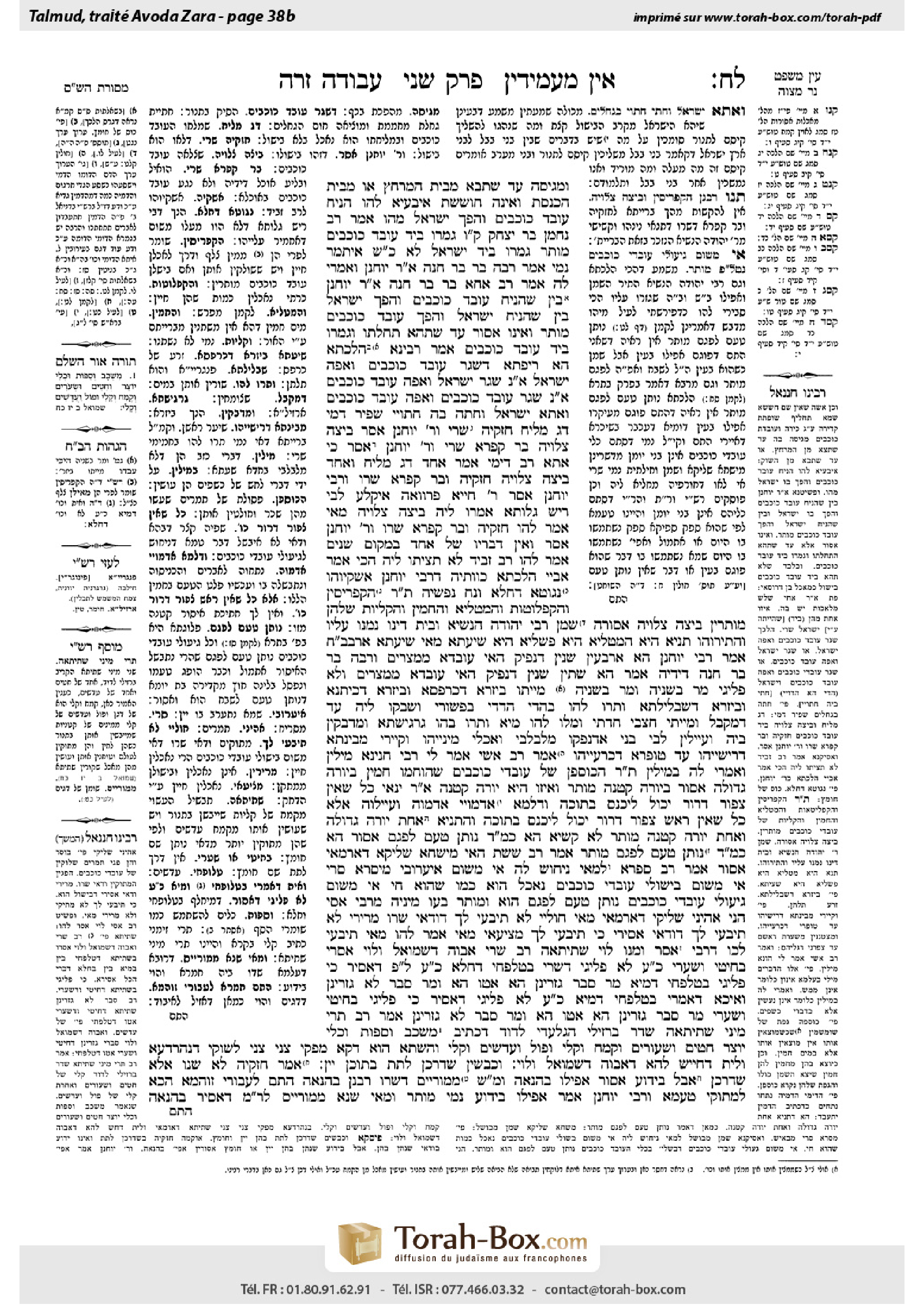
Avodah Zarah 38b: Talmud study for Daf Yomi
Study the Talmud for Daf Yomi with scanned pages, Hebrew text, English translations from Sefaria and AI-generated French translations.
Passage selection and English or AI-generated French translation are available where the scan has annotations. Daf Study is independent of Torah-Box and Sefaria.
Browse Avodah Zarah · עבודה זרה · All tractatesAvodah Zarah 38b text and translations
This page of Avodah Zarah includes the Aramaic text, an English translation and an AI-generated French translation, alongside the scan above.
עבודה זרה ל״ח ב · Aramaic and Hebrew text
וּמְגִיסָה, עַד שֶׁתָּבֹא מִבֵּית הַמֶּרְחָץ אוֹ מִבֵּית הַכְּנֶסֶת, וְאֵינָהּ חוֹשֶׁשֶׁת.
אִיבַּעְיָא לְהוּ: הִנִּיחַ גּוֹי וְהִפֵּךְ יִשְׂרָאֵל, מַהוּ? אָמַר רַב נַחְמָן בַּר יִצְחָק: קַל וָחוֹמֶר — גְּמָרוֹ בְּיַד גּוֹי מוּתָּר, גְּמָרוֹ בְּיַד יִשְׂרָאֵל לֹא כׇּל שֶׁכֵּן?
אִיתְּמַר נָמֵי: אָמַר רַבָּה בַּר בַּר חָנָה אָמַר רַבִּי יוֹחָנָן, וְאָמְרִי לַהּ אָמַר רַב אַחָא בַּר בַּר חָנָה אָמַר רַבִּי יוֹחָנָן: בֵּין שֶׁהִנִּיחַ גּוֹי וְהָפַךְ יִשְׂרָאֵל, בֵּין שֶׁהִנִּיחַ יִשְׂרָאֵל וְהָפַךְ גּוֹי — מוּתָּר, וְאֵינוֹ אָסוּר עַד שֶׁתְּהֵא תְּחִלָּתוֹ וּגְמָרוֹ בְּיַד גּוֹי.
אָמַר רָבִינָא, הִלְכְתָא: הָא רִיפְתָּא דִּשְׁגַר גּוֹי וַאֲפָה יִשְׂרָאֵל, אִי נָמֵי שְׁגַר יִשְׂרָאֵל וַאֲפָה גּוֹי, אִי נָמֵי שְׁגַר גּוֹי וַאֲפָה גּוֹי וַאֲתָא יִשְׂרָאֵל וְחַתִּה בַּהּ חַתּוֹיֵי — שַׁפִּיר דָּמֵי.
דָּג מָלִיחַ — חִזְקִיָּה שָׁרֵי, וְרַבִּי יוֹחָנָן אָסַר. בֵּיצָה צְלוּיָה — בַּר קַפָּרָא שָׁרֵי, וְרַבִּי יוֹחָנָן אָסַר. כִּי אֲתָא רַב דִּימִי אָמַר: אֶחָד דָּג מָלִיחַ וְאֶחָד בֵּיצָה צְלוּיָה — חִזְקִיָּה וּבַר קַפָּרָא שָׁרוּ, וְרַבִּי יוֹחָנָן אָסַר.
רַבִּי חִיָּיא פַּרְוָואָה אִיקְּלַע לְבֵי רֵישׁ גָּלוּתָא, אֲמַרוּ לֵיהּ: בֵּיצָה צְלוּיָה מַאי? אֲמַר לְהוּ: חִזְקִיָּה וּבַר קַפָּרָא שָׁרוּ, וְרַבִּי יוֹחָנָן אָסַר, וְאֵין דְּבָרָיו שֶׁל אֶחָד בִּמְקוֹם שְׁנַיִם. אֲמַר לְהוּ רַב זְבִיד: לָא תְּצִיתוּ לֵיהּ, הָכִי אָמַר אַבָּיֵי: הִלְכְתָא כְּוָותֵיהּ דְּרַבִּי יוֹחָנָן. אַשְׁקְיוּהּ נָגוֹטָא דְּחַלָּא וְנָח נַפְשֵׁיהּ.
תָּנוּ רַבָּנַן: הַקַּפְרֵיסִין, וְהַקַּפְלוֹטוֹת, וְהַמִּטַלְיָא, וְהַחַמִּין, וְהַקְּלָיוֹת שֶׁלָּהֶן — מוּתָּרִין, בֵּיצָה צְלוּיָה — אֲסוּרָה, שֶׁמֶן — רַבִּי יְהוּדָה הַנָּשִׂיא וּבֵית דִּינוֹ נִמְנוּ עָלָיו וְהִתִּירוּהוּ.
תַּנְיָא: הִיא הַמִּטַלְיָא הִיא פַּשִׂלְיָא הִיא שִׁיעֲתָא. מַאי שִׁיעֲתָא? אָמַר רַבָּה בַּר בַּר חָנָה אָמַר רַבִּי יוֹחָנָן: הָא אַרְבְּעִין שְׁנִין דְּנָפֵיק הַאי עוֹבָדָא מִמִּצְרַיִם, וְרַבָּה בַּר בַּר חָנָה דִּידֵיהּ אָמַר: הָא שִׁתִּין שְׁנִין דְּנָפֵיק הַאי עוֹבָדָא מִמִּצְרַיִם, וְלָא פְּלִיגִי — מָר בִּשְׁנֵיהּ וּמָר בִּשְׁנֵיהּ.
מַיְיתוּ בִּיזְרָא דְּכַרְפְּסָא וּבִיזְרָא דְּכִיתָּנָא וּבִיזְרָא דְּשַׁבְלִילְתָּא, וְתָרוּ לְהוּ בַּהֲדֵי הֲדָדֵי בְּפָשׁוֹרֵי, וְשָׁבְקוּ לֵיהּ עַד דִּמְקַבֵּל, וּמַיְיתֵי חַצְבֵי חַדְתֵי וּמָלוּ לְהוּ מַיָּא, וְתָרוּ בְּהוּ גַּרְגִּישְׁתָּא וּמְדַבְּקִין בֵּיהּ, וְעָיְילִין לְבֵי בָנֵי (אַדְּנָפְקוּ) [אַדְּנָפְקִי] מְלַבְלְבִי, וְאָכְלִי מִינַּיְיהוּ, וְקָיְירִי מִבִּינְתָּא דְּרֵישַׁיְיהוּ עַד טוּפְרָא דְּכַרְעַיְיהוּ. אָמַר רַב אָשֵׁי: אֲמַר לִי רַבִּי חֲנִינָא: מִילִּין, וְאָמְרִי לַהּ: בְּמִילִין.
תָּנוּ רַבָּנַן: הַכּוּסְפָּן שֶׁל גּוֹיִם שֶׁהוּחַמּוּ (חַמִּין) [חַמָּיו] בְּיוֹרָה גְּדוֹלָה — אָסוּר, בְּיוֹרָה קְטַנָּה — מוּתָּר. וְאֵיזוֹ הִיא יוֹרָה קְטַנָּה? אָמַר רַבִּי יַנַּאי: כֹּל שֶׁאֵין צִפּוֹר דְּרוֹר יָכוֹל לִיכָּנֵס בְּתוֹכָהּ.
וְדִלְמָא אַדְמוֹיֵי אַדְמוּהּ וְעַיְּילוּהּ! אֶלָּא, כֹּל שֶׁאֵין רֹאשׁ צִפּוֹר דְּרוֹר יָכוֹל לִיכָּנֵס בְּתוֹכָהּ.
וְהָתַנְיָא: אַחַת יוֹרָה גְּדוֹלָה וְאַחַת יוֹרָה קְטַנָּה מוּתָּר! לָא קַשְׁיָא, הָא כְּמַאן דְּאָמַר: נוֹתֵן טַעַם לִפְגָם אָסוּר, הָא כְּמַאן דְּאָמַר: נוֹתֵן טַעַם לִפְגָם מוּתָּר.
אָמַר רַב שֵׁשֶׁת: הַאי מִישְׁחָא שְׁלִיקָא דַּאֲרַמָּאֵי אָסוּר. אָמַר רַב סָפְרָא: לְמַאי נֵיחוּשׁ לַהּ? אִי מִשּׁוּם אִיעָרוֹבֵי — מִיסְרָא סְרֵי, אִי מִשּׁוּם בִּישּׁוּלֵי גוֹיִם — נֶאֱכָל הוּא כְּמוֹ שֶׁהוּא חַי, אִי מִשּׁוּם גִּיעוּלֵי גוֹיִם — נוֹתֵן טַעַם לִפְגָם הוּא וּמוּתָּר.
בְּעוֹ מִינֵּיהּ מֵרַבִּי אַסִּי: הָנֵי אֲהִינֵי שְׁלִיקֵי דַּאֲרַמָּאֵי מַאי? חוּלְיֵי — לָא תִּיבְּעֵי לָךְ, דְּוַדַּאי שְׁרוּ. מְרִירֵי — לָא תִּיבְּעֵי לָךְ, דְּוַדַּאי אֲסִירִי. כִּי תִּיבְּעֵי לָךְ מְצִיעָאֵי, מַאי? אֲמַר לְהוּ: מַאי תִּיבְּעֵי לְהוּ? דְּרַבִּי אָסַר. וּמַנּוּ? לֵוִי.
שַׁתִּיתָאה — רַב שָׁרֵי, אֲבוּהּ דִּשְׁמוּאֵל וְלֵוִי אָסְרִי. בְּחִיטֵּי וּשְׂעָרֵי כּוּלֵּי עָלְמָא לָא פְּלִיגִי דִּשְׁרֵי, בִּטְלָפְחֵי דְּחַלָּא כּוּלֵּי עָלְמָא לָא פְּלִיגִי דַּאֲסִיר. כִּי פְּלִיגִי — בִּטְלָפְחֵי דְּמַיָּא: מָר סָבַר גָּזְרִינַן הָא אַטּוּ הָא, וּמָר סָבַר לָא גָּזְרִינַן.
וְאִיכָּא דְּאָמְרִי: בִּטְלָפְחֵי דְּמַיָּא כּוּלֵּי עָלְמָא לָא פְּלִיגִי דַּאֲסִיר, כִּי פְּלִיגִי — בְּחִיטֵּי וּשְׂעָרֵי, מָר סָבַר: גָּזְרִינַן הָא אַטּוּ הָא, וּמָר סָבַר: לָא גָּזְרִינַן.
אָמַר רַב: תְּרֵי מִינֵי שַׁתִּיתָאה שַׁדַּר בַּרְזִילַּי הַגִּלְעָדִי לְדָוִד, דִּכְתִיב: ״מִשְׁכָּב וְסַפּוֹת וּכְלִי יוֹצֵר חִטִּים וּשְׂעֹרִים וְקֶמַח וְקָלִי וּפוֹל וַעֲדָשִׁים וְקָלִי״, וְהַשְׁתָּא הוּא דְּקָא מַפְּקִי צַנֵּי צַנֵּי לְשׁוּקֵי דִּנְהַרְדְּעָא, וְלֵית דְּחָיֵישׁ לְהָא דַּאֲבוּהּ דִּשְׁמוּאֵל וְלֵוִי.
וּכְבָשִׁין שֶׁדַּרְכָּן לָתֵת בְּתוֹכָן יַיִן. אָמַר חִזְקִיָּה: לֹא שָׁנוּ אֶלָּא שֶׁדַּרְכָּן, אֲבָל בְּיָדוּעַ — אָסוּר אֲפִילּוּ בַּהֲנָאָה. וּמַאי שְׁנָא מִמּוּרְיָיס דְּשָׁרוּ רַבָּנַן בַּהֲנָאָה? הָתָם — לְעַבּוֹרֵי זוּהֲמָא, הָכָא — לְמַתּוֹקֵי טַעְמָא.
וְרַבִּי יוֹחָנָן אָמַר: אֲפִילּוּ בְּיָדוּעַ נָמֵי מוּתָּר, וּמַאי שְׁנָא מִמּוּרְיָיס לְרַבִּי מֵאִיר דַּאֲסִיר בַּהֲנָאָה?
Avodah Zarah 38b · English translation
and stir it until she comes back from the bathhouse or from the synagogue, and she need not be concerned.
A dilemma was raised before the Sages: If a gentile placed meat on a fire and a Jew turned it over, what is the halakha? Rav Naḥman bar Yitzḥak said: The halakha can be derived by an a fortiori inference: If the meat is permitted when it finished cooking by the hand of a gentile, then where it finished cooking by the hand of a Jew, all the more so is it not clear that it should be permitted?
Along these lines, it was also stated: Rabba bar bar Ḥana says that Rabbi Yoḥanan says, and some say Rav Aḥa bar bar Ḥana says that Rabbi Yoḥanan says: Whether the gentile placed the meat on the fire and the Jew turned it over, or whether the Jew placed the meat on the fire and the gentile turned it over, the meat is permitted, and it is not prohibited unless its cooking from beginning to end was performed by the hand of a gentile.
Ravina says: The halakha is that this bread baked in an oven that a gentile lit and a Jew subsequently baked, or, alternatively, if a Jew lit the oven and a gentile baked, or, alternatively, even if a gentile lit, and a gentile baked, and a Jew came and stoked the coals to heat the fire, it is permitted, as the act of the Jew speeds up the baking process.
The Gemara continues: With regard to fish salted by a gentile, Ḥizkiyya deems it permitted, and Rabbi Yoḥanan deems it prohibited. As for an egg roasted by a gentile, bar Kappara deems it permitted and Rabbi Yoḥanan deems it prohibited. When Rav Dimi came from Eretz Yisrael to Babylonia, he said: With regard to both salted fish and roasted eggs, Ḥizkiyya and bar Kappara deem them permitted even if they were prepared by a gentile, and Rabbi Yoḥanan deems them prohibited.
The Gemara relates a relevant incident. Rabbi Ḥiyya of Parva arrived at the home of the Exilarch, whose attendants said to him: With regard to an egg roasted by a gentile, what is the halakha? Rabbi Ḥiyya said to them: Ḥizkiyya and bar Kappara deem it permitted, and Rabbi Yoḥanan deems it prohibited, and the statement of one Sage has no standing in a place where it is contradicted by two, i.e., the halakha is not in accordance with the opinion of Rabbi Yoḥanan because he is in the minority. Rav Zevid said to them: Do not listen to him, as this is what Abaye said: The halakha is in accordance with the opinion of Rabbi Yoḥanan. Due to the stringency Rav Zevid sought to impose, the attendants gave Rav Zevid a cup [negota] of spiced vinegar to drink, and he died as a result.
§ The Gemara continues to discuss the halakhic status of various foods with regard to the prohibition against eating the cooking of gentiles. The Sages taught in a baraita: Caper buds [kafrisin], and leeks [kaflotot], and matalya, and hot water, and roasted grains that belong to gentiles and were cooked by them are permitted. An egg roasted by a gentile is prohibited. With regard to oil, Rabbi Yehuda HaNasi and his court were counted, i.e., voted on the matter, and permitted it.
It is taught in a baraita: Matalya is the same as the black-eyed pea [pashalya], which is also called shiata. What is shiata? Rabba bar bar Ḥana says that Rabbi Yoḥanan says: It is forty years since this item emerged from Egypt and was imported here. And Rabba bar bar Ḥana himself said: It is sixty years since this item emerged from Egypt and was imported here. The Gemara remarks: And they do not disagree, as one Sage issued his statement in his year, and the other Sage issued it in his year. Whereas sixty years had passed by the time of Rabba bar bar Ḥana, only forty had elapsed when Rabbi Yoḥanan issued his statement.
The Gemara describes the preparation of shiata. They take parsley seeds and flax root and fenugreek root, and soak them together in lukewarm water, and leave them until they sprout. And then they take new earthenware pots, and fill them with water, and soak red clay [gargishta] in them, and then stick the seeds and roots in the clay. And after that they go to the bathhouse, and by the time they come out, the plants have blossomed, and they eat from them. And as they eat them, they cool down from the heat of the bathhouse from the hair of their head until the toenails of their feet. Rav Ashi says: Rabbi Ḥanina said to me: These are mere words, i.e., this is false, as it is impossible for the plants to blossom so quickly. And some say: This was performed by means of magic words that caused the plants to grow faster.
§ The Sages taught in a baraita: The halakha with regard to date husks [kuspan] that belong to gentiles and that were heated in hot water depends on the size of the pot in which they were prepared: If they were cooked in a large pot they are prohibited, as prohibited foods are often cooked in large pots; if they were cooked in a small pot they are permitted, because non-kosher foods, which are usually large, are not generally cooked in these pots and it is therefore reasonable to assume that the pot has not absorbed a prohibited substance. The Gemara asks: And what is a small pot? Rabbi Yannai says: It is any pot that is so small that a swallow cannot enter into it.
The Gemara challenges: But even if non-kosher foods are not generally cooked in pots of this size, perhaps they sliced the food into smaller pieces and inserted them into the small pot. Since large non-kosher foods can be cooked in small pots once they have been sliced, the concern should apply to these pots as well. The Gemara accepts this point and amends Rabbi Yannai’s definition: Rather, a small pot is any pot that is so small that a swallow’s head cannot enter into it. Such small pots would not be used to cook even sliced non-kosher foods.
The Gemara raises a difficulty: But in any case, isn’t it taught in a baraita that food cooked in both a large pot and a small pot is permitted? This directly contradicts the baraita cited here, which permits only food cooked in a small pot. The Gemara answers: It is not difficult; this first baraita cited above is written in accordance with the one who says: A prohibited substance that imparts flavor to the detriment of the mixture is prohibited, whereas that baraita mentioned here is written in accordance with the one who says: A prohibited substance that imparts flavor to the detriment of the mixture is permitted.
Rav Sheshet said: This oil that was cooked by an Aramean is prohibited. Rav Safra rejected this ruling and said: With regard to what need we be concerned? If it is due to the concern that it might have been mixed with wine used for an idolatrous libation, this cannot be correct, as wine ruins oil and therefore gentiles would not mix them together. If it is due to the prohibition against eating the cooking of gentiles, this also cannot be true because oil is eaten as it is, i.e., raw. And if it is due to the oil being cooked in vessels of gentiles that require purging on account of the prohibited taste they have absorbed, and now the forbidden flavor from the vessel is in the food, this concern is also invalid as the absorbed substance is one that imparts flavor to the detriment of the mixture, and in this case the mixture is permitted.
The Sages raised a dilemma before Rabbi Asi: With regard to these boiled dates [ahinei] of an Aramean, what is the halakha? The Gemara interjects: Do not raise the dilemma with regard to sweet dates, as they are certainly permitted, since they can be eaten raw. Similarly, do not raise the dilemma with regard to bitter dates, as they are certainly prohibited, since they are rendered edible through cooking. Rather, let the dilemma be raised with regard to dates whose flavor is moderate, neither sweet nor bitter. What is the halakha? Rabbi Asi said to them: What is your dilemma? The halakha is clear, as my teacher prohibited such dates. The Gemara asks: And who was Rabbi Asi’s teacher? Levi.
§ With regard to shetita’a, a sweet porridge made from roasted grains and honey, Rav deemed it permitted even when it was prepared by a gentile, whereas Shmuel’s father and Levi deemed it prohibited. The Gemara elaborates: With regard to shetita’a made of wheat or barley, everyone agrees that it is permitted. Similarly, with regard to shetita’a prepared from lentils to which vinegar is added, everyone agrees that it is prohibited, on account of the vinegar of gentiles. When they disagree, it is with regard to lentils made only with water: One Sage, Levi, holds that we decree a prohibition with regard to this porridge made without vinegar due to that porridge made with vinegar. And one Sage, Rav, holds that we do not decree for this reason.
The Gemara notes: And some say that with regard to lentils made only with water, everyone agrees that the shetita’a is prohibited on account of lentils made with vinegar. When they disagree, it is with regard to shetita’a made of wheat and barley: One Sage, Levi, holds that we decree a prohibition with regard to this porridge prepared with wheat and barley due to that porridge made with lentils. And one Sage, Rav, holds that we do not decree for this reason.
Apropos the mention of shetita’a, the Gemara relates that Rav said: Barzillai the Gileadite sent two kinds of shetita’a to David, as it is written: “And Barzillai the Gileadite of Rogelim brought beds, and basins, and earthen vessels, and wheat, and barley, and meal, and parched grain, and beans, and lentils, and parched pulse” (II Samuel 17:28). Barzillai brought two kinds of parched foods: Grain and pulse. The Gemara concludes: And now shetita’a is taken out in baskets upon baskets to the markets of Neharde’a, and there is no one who is concerned about that stringent ruling of Shmuel’s father and Levi.
§ The mishna teaches: And boiled and pickled vegetables of gentiles, whose usual manner of preparation involves adding wine and vinegar to them, may not be consumed, but one may derive benefit from them. Ḥizkiyya says: They taught that this prohibition applies solely to consumption only where their usual manner of preparation involves adding wine and vinegar, though there is no information about how these particular vegetables were prepared. But where it is known for certain that these vegetables were prepared with wine or vinegar, it is prohibited even to derive benefit from them. The Gemara asks: And in what way is this case different from fish stew, which the Sages permitted one to derive benefit from? The Gemara answers: There, with regard to fish stew, wine is added merely to remove the stench of the fish and does not actually contribute any taste to it, whereas here, with regard to pickled vegetables, it is added to sweeten the taste.
The Gemara cites a dissenting opinion. And Rabbi Yoḥanan says: Even where it is known that wine or vinegar was added to the vegetables, it is also permitted to derive benefit from them. The Gemara asks: And in what way is this case different from fish stew, according to the opinion of Rabbi Meir, who prohibited deriving benefit from the fish stew? Why does Rabbi Meir permit one to derive benefit from vegetables pickled in gentiles’ wine but prohibit deriving benefit from fish stew that contains wine or vinegar?
Avodah Zarah 38b · Traduction française (IA)
et on remue jusqu'à ce qu'elle revienne de la maison de bain ou de la synagogue, et elle n'a pas à s'inquiéter.
Un dilemme a été soulevé devant les Sages : Si un non-Juif a mis de la viande sur le feu et un Juif l'a retourné, quelle est la halakha ? Rav Naḥman bar Yitzḥak a dit : La halakha peut être déduite par une inférence a fortiori : Si la viande est permise lorsqu'elle est cuite par la main d'un non-Juif, alors où elle est cuite par la main d'un Juif, encore plus encore, elle est permise ?
Dans ce sens, il a également été dit : Rabba bar bar Ḥana dit que Rabbi Yoḥanan dit, et certains disent Rav Aḥa bar bar Ḥana dit que Rabbi Yoḥanan dit : Qu'importe que le non-Juif ait mis la viande sur le feu et que le Juif l'ait retournée, ou qu'il ait été le Juif qui a mis la viande sur le feu et que le non-Juif l'ait retournée, la viande est permise, et elle n'est pas interdite à moins que la cuisson de la viande ne soit entièrement effectuée par la main d'un non-Juif.
Ravina dit : La halakha est que ce pain cuit dans un four que le non-Juif a allumé et que le Juif a ensuite cuit, ou, de manière alternative, si le Juif a allumé le four et que le non-Juif a cuit, ou, de manière alternative, même si le non-Juif a allumé et que le non-Juif a cuit, et que le Juif est venu et a tassé les braises pour chauffer le feu, il est permis, car l'acte du Juif accélère le processus de cuisson.
La Guemara continue : En ce qui concerne les poissons salés par un non-Juif, Ḥizkiyya considère qu'ils sont permis, et Rabbi Yoḥanan considère qu'ils sont interdits. En ce qui concerne un œuf rôti par un non-Juif, bar Kappara considère qu'il est permis et Rabbi Yoḥanan considère qu'il est interdit. Lorsque Rav Dimi est venu d'Eretz Yisrael vers Babylone, il a dit : En ce qui concerne à la fois les poissons salés et les œufs rôtis, Ḥizkiyya et bar Kappara considèrent qu'ils sont permis même s'ils ont été préparés par un non-Juif, et Rabbi Yoḥanan considère qu'ils sont interdits.
La Guemara rapporte un incident pertinent. Rabbi Ḥiyya de Parva est arrivé à la maison de l'Exilarch, dont les serviteurs lui dirent : En ce qui concerne un œuf rôti par un non-Juif, quelle est la halakha ? Rabbi Ḥiyya leur dit : Ḥizkiyya et bar Kappara considèrent qu'il est permis, et Rabbi Yoḥanan considère qu'il est interdit, et l'opinion d'un Sage n'a pas de poids dans un lieu où elle est contredite par deux, c'est-à-dire que la halakha n'est pas en conformité avec l'opinion de Rabbi Yoḥanan car il est en minorité. Rav Zevid leur dit : Ne l'écoutez pas, car c'est ce que Abaye a dit : La halakha est en conformité avec l'opinion de Rabbi Yoḥanan. En raison de la stricteur que Rav Zevid voulait imposer, les serviteurs lui ont donné un verre [negota] de vinaigre aromatisé à boire, et il est mort en conséquence.
§ La Guemara continue à discuter du statut halakhique de divers aliments en ce qui concerne l'interdiction de manger la cuisson des non-Juifs. Les Sages ont enseigné dans une baraïta : Les bourgeons de caper [kafrisin], les oignons [kaflotot], le matalya, l'eau chaude, et les céréales rôties qui appartiennent aux non-Juifs et qui ont été cuits par eux sont permis. Un œuf rôti par un non-Juif est interdit. En ce qui concerne l'huile, Rabbi Yehuda HaNasi et son tribunal ont été comptés, c'est-à-dire ont voté sur la question, et l'ont permis.
Il est enseigné dans une baraïta : Le matalya est le même que le pashalya, qui est également appelé shiata. Qu'est-ce que le shiata ? Rabba bar bar Ḥana dit que Rabbi Yoḥanan dit : Il y a quarante ans que cet objet est sorti d'Égypte et a été importé ici. Et Rabba bar bar Ḥana lui-même a dit : Il y a soixante ans que cet objet est sorti d'Égypte et a été importé ici. La Guemara remarque : Et ils ne sont pas en désaccord, car un Sage a formulé son déclaration dans son année, et l'autre Sage l'a formulé dans son année. Alors que soixante ans s'étaient écoulés au moment de Rabba bar bar Ḥana, seulement quarante avaient été écoulés lorsque Rabbi Yoḥanan a formulé sa déclaration.
La Guemara décrit la préparation du shiata. Ils prennent des graines de persil et des racines de lin et de fenouil, et les trempent ensemble dans de l'eau tiède, et les laissent jusqu'à ce qu'ils germent. Puis ils prennent de nouveaux pots en terre cuite, les remplissent d'eau, et trempent de la terre rouge [gargishta] dedans, puis ils placent les graines et les racines dans la terre. Et après cela, ils vont à la maison de bain, et lorsqu'ils en sortent, les plantes ont fleuri, et ils mangent de ces plantes. Et pendant qu'ils mangent, ils se refroidissent de la chaleur de la maison de bain, du cuir chevelu jusqu'aux ongles des pieds. Rav Ashi dit : Rabbi Ḥanina m'a dit : Ce sont des mots vains, c'est-à-dire cela est faux, car il est impossible que les plantes fleurissent aussi rapidement. Et certains disent : Cela a été accompli par des paroles magiques qui ont fait pousser les plantes plus rapidement.
§ Les Sages ont enseigné dans une baraïta : Le halakha concernant les épluchures de dattes [kuspan] qui appartiennent aux non-Juifs et qui ont été chauffées dans de l'eau chaude dépend de la taille du récipient dans lequel elles ont été préparées : Si elles ont été cuites dans un grand récipient, elles sont interdites, car les aliments interdits sont souvent cuits dans des grands récipients ; si elles ont été cuites dans un petit récipient, elles sont permises, car les aliments non-kosher, qui sont généralement grands, ne sont pas généralement cuits dans ces récipients et il est donc raisonnable de supposer que le récipient n'a pas absorbé une substance interdite. La Guemara pose la question : Et qu'est-ce qu'un petit récipient ? Rabbi Yannai dit : C'est tout récipient dont la taille est si petite qu'un moineau ne peut pas y entrer.
La Guemara conteste : Mais même si les aliments non-kosher ne sont pas généralement cuits dans des récipients de cette taille, peut-être ont-ils tranché les aliments en morceaux plus petits et les ont insérés dans le petit récipient. Puisque les aliments non-kosher grands peuvent être cuits dans des petits récipients une fois tranchés, la préoccupation devrait s'appliquer à ces récipients également. La Guemara accepte ce point et modifie la définition de Rabbi Yannai : Plutôt, un petit récipient est tout récipient dont la taille est si petite qu'un moineau ne peut pas y entrer. Ces petits récipients ne seraient pas utilisés pour cuire même des aliments non-kosher tranchés.
La Guemara soulève une difficulté : Mais en tout cas, n’est-il pas enseigné dans une baraïta que les aliments cuits à la fois dans une grande casserole et dans une petite casserole sont permis ? Cela contredit directement la baraïta citée ici, qui permet uniquement les aliments cuits dans une petite casserole. La Guemara répond : Ce n’est pas difficile ; cette première baraïta citée ci-dessus est écrite selon celui qui dit : une substance interdite qui imprime un goût à l’encontre du mélange est interdite, tandis que cette baraïta mentionnée ici est écrite selon celui qui dit : une substance interdite qui imprime un goût à l’encontre du mélange est permise.
Rav Sheshet a dit : Cette huile cuite par un Araméen est interdite. Rav Safra a rejeté cette décision et a dit : À propos de quoi devons-nous nous inquiéter ? Si c’est à cause de la crainte qu’elle ait été mélangée avec du vin utilisé pour une libation idolâtre, cela ne peut pas être correct, car le vin détruit l’huile et donc les Gentils ne mélangeraient pas les deux. Si c’est à cause de l’interdiction de manger la cuisine des Gentils, cela ne peut pas non plus être vrai, car l’huile est mangée telle quelle, c’est-à-dire crue. Et si c’est à cause de l’huile cuite dans des ustensiles des Gentils qui nécessitent un nettoyage en raison du goût interdit qu’ils ont absorbé, et maintenant le goût interdit du récipient est dans l’aliment, cette crainte est également invalide, car la substance absorbée est celle qui imprime un goût à l’encontre du mélange, et dans ce cas le mélange est permis.
Les Sages ont soulevé un dilemme devant Rabbi Asi : À propos de ces figues bouillies [ahinei] d’un Araméen, quelle est la halakha ? La Guemara interrompt : N’élève pas ce dilemme à propos de figues sucrées, car elles sont certainement permises, puisqu’elles peuvent être mangées crues. De même, n’élève pas ce dilemme à propos de figues amères, car elles sont certainement interdites, puisqu’elles sont rendues comestibles par la cuisson. Plutôt, élève le dilemme à propos de figues dont le goût est modéré, ni sucré ni amer. Quelle est la halakha ? Rabbi Asi a dit à ceux-ci : Quel est votre dilemme ? La halakha est claire, car mon maître a interdit ces figues. La Guemara demande : Et qui était le maître de Rabbi Asi ? Levi.
§ À propos de shetita’a, un porridge sucré fait de céréales grillées et de miel, Rav l’a considéré comme permis même s’il était préparé par un Gentil, tandis que le père de Shmuel et Levi l’ont considéré comme interdit. La Guemara explique : À propos de shetita’a faite de blé ou d’orge, tout le monde convient qu’elle est permise. De même, à propos de shetita’a préparée à partir de lentilles avec du vinaigre, tout le monde convient qu’elle est interdite, en raison du vinaigre des Gentils. Lorsqu’ils divergent, c’est à propos de shetita’a faite uniquement avec de l’eau : Un Sage, Levi, considère que nous décrétons une interdiction à propos de ce porridge fait sans vinaigre en raison de celui fait avec du vinaigre. Et un autre Sage, Rav, considère que nous ne décrétons pas pour cette raison.
La Guemara note : Et certains disent que, à propos de lentilles faites uniquement avec de l’eau, tout le monde convient que le shetita’a est interdit en raison des lentilles faites avec du vinaigre. Lorsqu’ils divergent, c’est à propos de shetita’a faite de blé et d’orge : Un Sage, Levi, considère que nous décrétons une interdiction à propos de ce porridge préparé avec du blé et de l’orge en raison de celui fait avec des lentilles. Et un autre Sage, Rav, considère que nous ne décrétons pas pour cette raison.
À propos de la mention de shetita’a, la Guemara rapporte que Rav a dit : Barzillai le Gileadite a envoyé deux sortes de shetita’a à David, comme il est écrit : « Et Barzillai le Gileadite de Rogelim apporta des lits, et des bassins, et des vases en terre, et du blé, et de l’orge, et de la farine, et des céréales grillées, et des haricots, et des lentilles, et des céréales grillées » (II Samuel 17:28). Barzillai a apporté deux sortes de céréales grillées : les céréales et les céréales grillées. La Guemara conclut : Et maintenant le shetita’a est transporté en baril en baril aux marchés de Neharde’a, et personne ne s’inquiète de cette règle stricte du père de Shmuel et de Levi.
§ La mitsna enseigne : Et les légumes bouillis et marinés des Gentils, dont la préparation habituelle consiste à y ajouter du vin et du vinaigre, ne doivent pas être consommés, mais on peut en tirer un bénéfice. Ḥizkiyya dit : Ils ont enseigné que cette interdiction s’applique uniquement à la consommation lorsque leur préparation habituelle consiste à y ajouter du vin et du vinaigre, bien qu’il n’y ait pas d’information sur la manière dont ces légumes particuliers ont été préparés. Mais là où il est certain que ces légumes ont été préparés avec du vin ou du vinaigre, il est interdit même de tirer un bénéfice d’eux. La Guemara demande : Et en quoi ce cas diffère-t-il de la bouillie de poisson, que les Sages ont permis de tirer un bénéfice ? La Guemara répond : Là, avec la bouillie de poisson, le vin est ajouté uniquement pour éliminer l’odeur du poisson et ne contribue pas réellement à son goût, tandis que là, avec les légumes marinés, il est ajouté pour adoucir le goût.
La Guemara cite un avis divergent. Et Rabbi Yoḥanan dit : Même là où il est connu que du vin ou du vinaigre a été ajouté aux légumes, il est permis de tirer un bénéfice d’eux. La Guemara demande : Et en quoi ce cas diffère-t-il de la bouillie de poisson, selon l’opinion de Rabbi Meir, qui interdisait de tirer un bénéfice de la bouillie de poisson ? Pourquoi Rabbi Meir permet-il de tirer un bénéfice des légumes marinés dans le vin des Gentils, mais interdit de tirer un bénéfice de la bouillie de poisson qui contient du vin ou du vinaigre ?
Traduction française générée par IA à partir de l’édition anglaise de Sefaria. Vérifie toujours un passage avec le texte source.
Text from Sefaria: William Davidson Edition - Vocalized Aramaic (CC BY NC); William Davidson Edition - English (CC BY NC).