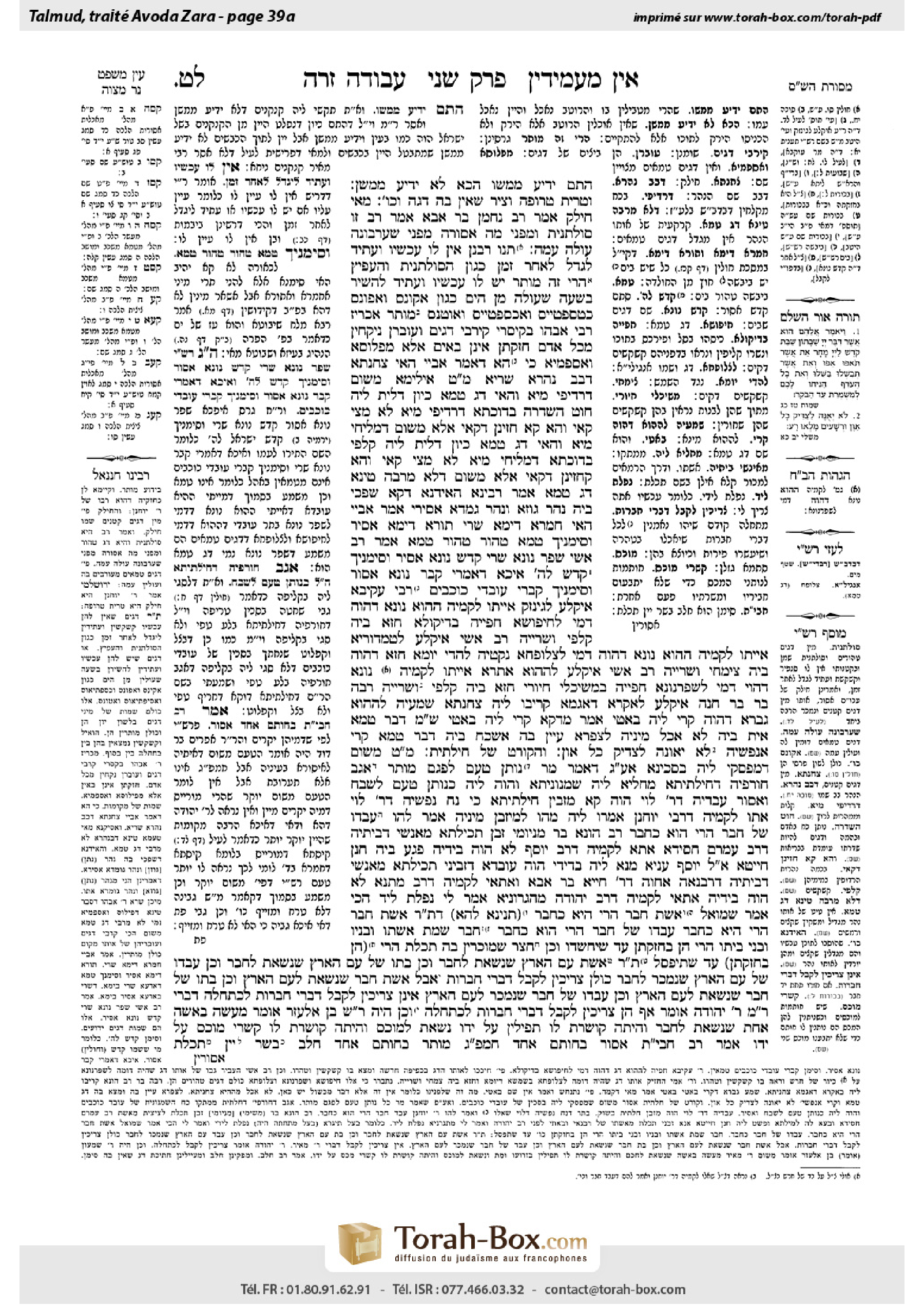
Avodah Zarah 39a: Talmud study for Daf Yomi
Study the Talmud for Daf Yomi with scanned pages, Hebrew text, English translations from Sefaria and AI-generated French translations.
Passage selection and English or AI-generated French translation are available where the scan has annotations. Daf Study is independent of Torah-Box and Sefaria.
Browse Avodah Zarah · עבודה זרה · All tractatesAvodah Zarah 39a text and translations
This page of Avodah Zarah includes the Aramaic text, an English translation and an AI-generated French translation, alongside the scan above.
עבודה זרה ל״ט א · Aramaic and Hebrew text
הָתָם יְדִיעַ מַמָּשׁוֹ, הָכָא לָא יְדִיעַ מַמָּשָׁן.
וְטָרִית טְרוּפָה, וְצִיר שֶׁאֵין בָּהּ דָּגָה וְכוּ׳. מַאי חִילֵּק? אָמַר רַב נַחְמָן בַּר אַבָּא אָמַר רַב: זוֹ סוּלְתָּנִית, וּמִפְּנֵי מָה אֲסוּרָה? מִפְּנֵי שֶׁעֵרְבוֹנָהּ עוֹלֶה עִמָּהּ.
תָּנוּ רַבָּנַן: אֵין לוֹ עַכְשָׁיו וְעָתִיד לְגַדֵּל לְאַחַר זְמַן, כְּגוֹן הַסּוּלְתָּנִית (וְהָעַפְיָץ) [וְהָעַפְיָין] — הֲרֵי זֶה מוּתָּר. יֵשׁ לוֹ עַכְשָׁיו וְעָתִיד לְהַשִּׁיר בְּשָׁעָה שֶׁעוֹלֶה מִן הַיָּם, כְּגוֹן אֲקוּנָס וַאֲפוּנָס, כְּטַסְפַּטְיָיס וְאַכְסְפַּטְיָיס וַאֲטוּנָס — מוּתָּר.
אַכְרֵיז רַבִּי אֲבָהוּ בְּקֵיסָרִי: קִירְבֵי דָגִים וְעוּבָּרָן נִיקָּחִין מִכׇּל אָדָם. חֶזְקָתָן אֵינָן בָּאִים אֶלָּא מִפִּלּוּסָא וְאַסְפַּמְיָא, כִּי הָא דְּאָמַר אַבָּיֵי: הַאי צַחַנְתָּא דְּבָב נַהֲרָא שַׁרְיָא.
מַאי טַעְמָא? אִילֵּימָא מִשּׁוּם דִּרְדִיפִי מַיָּא, וְהַאי דָּג טָמֵא כֵּיוָן דְּלֵית לֵיהּ חוּט הַשִּׁדְרָה, בְּדוּכְתָּא דִּרְדִיפִי מַיָּא לָא מָצֵי קָאֵי, וְהָא קָא חָזֵינַן דְּקָאֵי!
אֶלָּא מִשּׁוּם דִּמְלִיחִי מַיָּא, וְהַאי דָּג טָמֵא — כֵּיוָן דְּלֵית לֵיהּ קִלְפֵי, בְּדוּכְתָּא דִּמְלִיחִי מַיָּא לָא מָצֵי קָאֵי. וְהָא קָחָזֵינַן דְּקָאֵי! אֶלָּא, מִשּׁוּם דְּלָא מְרַבֵּה טִינָא דָּג טָמֵא. אֲמַר רָבִינָא: הָאִידָּנָא דְּקָא שָׁפְכִי בֵּיהּ נְהַר גּוֹזָא וּנְהַר גַּמְדָּא — אֲסִירִי.
אָמַר אַבָּיֵי: הַאי חַמְרָא דְּיַמָּא — שְׁרֵי, תּוֹרָא דְּיַמָּא — אֲסִיר, וְסִימָנָיךְ: טָמֵא טָהוֹר, טָהוֹר טָמֵא.
אָמַר רַב אָשֵׁי: שְׁפַר נוּנָא שְׁרֵי, קְדַשׁ נוּנָא אֲסִיר, וְסִימָנָיךְ: ״קֹדֶשׁ לַה׳״. אִיכָּא דְּאָמְרִי: קְבַר נוּנָא אָסוּר, וְסִימָנָיךְ: קִבְרֵי גוֹיִם.
רַבִּי עֲקִיבָא אִיקְּלַע לְגִינְזַק, אַיְיתוֹ לְקַמֵּיהּ הָהוּא נוּנָא דַּהֲוָה דָּמֵי לְחִיפּוּשָׁא, חַפְּיֵיהּ בְּדִיקּוּלָא, חֲזָא בֵּיהּ קִלְפֵי וְשַׁרְיֵיהּ. רַב אָשֵׁי אִיקְּלַע לְטַמְדוֹרְיָא, אַיְיתוֹ לְקַמֵּיהּ הָהוּא נוּנָא דַּהֲוָה דָּמֵי לִצְלוֹפְחָא, נַקְטֵיהּ לַהֲדֵי יוֹמָא, חֲזָא דַּהֲוָה בֵּיהּ צִימְחֵי וְשַׁרְיֵיהּ.
רַב אָשֵׁי אִיקְּלַע לְהָהוּא אַתְרָא, אַיְיתוֹ לְקַמֵּיהּ נוּנָא דְּהָוֵי דָּמֵי לִשְׁפַרְנוּנָא, חַפְּיֵיהּ בִּמְשִׁיכְלֵי חִיוָּרֵי, חֲזָא בֵּיהּ קִלְפֵי וְשַׁרְיֵיהּ. רַבָּה בַּר בַּר חָנָה אִיקְּלַע לְאַקְרָא דְאַגְמָא, קָרִיבוּ לֵיהּ צַחַנְתָּא, שַׁמְעֵיהּ לְהָהוּא גַּבְרָא דַּהֲוָה קָרֵי לֵיהּ ״בָּאטֵי״.
אֲמַר: מִדְּקָא קָרֵי לֵיהּ ״בָּאטֵי״, שְׁמַע מִינַּהּ דָּבָר טָמֵא אִית בֵּיהּ, לָא אֲכַל מִינֵּיהּ. לְצַפְרָא עַיֵּין בֵּהּ, אַשְׁכַּח בֵּיהּ דָּבָר טָמֵא, קָרֵי אַנַּפְשֵׁיהּ: ״לֹא יְאֻנֶּה לַצַּדִּיק כׇּל אָוֶן״.
וְהַקּוֹרֶט שֶׁל חִילְתִּית. מַאי טַעְמָא? מִשּׁוּם דְּמַפְסְקִי לֵיהּ בְּסַכִּינָא. אַף עַל גַּב דְּאָמַר מָר: נוֹתֵן טַעַם לִפְגָם מוּתָּר, אַגַּב חוּרְפֵּיהּ דְּחִילְתִּיתָא מְחַלְּיָא לֵיהּ שַׁמְנוּנִיתָא, וְהָוֵה לֵיהּ כְּנוֹתֵן טַעַם לְשֶׁבַח, וְאָסוּר.
עַבְדֵּיהּ דְּרַבִּי לֵוִי הֲוָה קָא מְזַבֵּין חִילְתִּיתָא, כִּי נָח נַפְשֵׁיהּ דְּרַבִּי לֵוִי אֲתוֹ לְקַמֵּיהּ דְּרַבִּי יוֹחָנָן, אֲמַרוּ לֵיהּ: מַהוּ לְמִיזְבַּן מִינֵּיהּ? אֲמַר לְהוּ: עַבְדּוֹ שֶׁל חָבֵר הֲרֵי הוּא כְּחָבֵר.
רַב הוּנָא בַּר מִנְיוֹמֵי זְבֵן תְּכֵילְתָּא מֵאֱנָשֵׁי דְּבֵיתֵיהּ דְּרַב עַמְרָם חֲסִידָא, אֲתָא לְקַמֵּיהּ דְּרַב יוֹסֵף, לָא הֲוָה בִּידֵיהּ.
פְּגַע בֵּיהּ חָנָן חַיָּיטָא, אֲמַר לֵיהּ: יוֹסֵף עַנְיָא מְנָא לֵיהּ? בְּדִידִי הֲוָה עוֹבָדָא, דִּזְבֵינִי תְּכֵילְתָּא מֵאֱנָשֵׁי דְּבֵיתֵיהּ דְּרַבְנָאָה אֲחוּהּ דְּרַבִּי חִיָּיא בַּר אַבָּא, וַאֲתַאי לְקַמֵּיהּ דְּרַב מַתְנָא, לָא הֲוָה בִּידֵיהּ. אֲתַאי לְקַמֵּיהּ דְּרַב יְהוּדָה מֵהַגְרוֹנְיָא, אָמַר לִי: נְפַלְתְּ לְיָד, הָכִי אָמַר שְׁמוּאֵל: אֵשֶׁת חָבֵר הֲרֵי הִיא כְּחָבֵר.
תְּנֵינָא לְהָא דְּתָנוּ רַבָּנַן: אֵשֶׁת חָבֵר הֲרֵי הִיא כְּחָבֵר, עַבְדּוֹ שֶׁל חָבֵר הֲרֵי הוּא כְּחָבֵר, חָבֵר שֶׁמֵּת — אִשְׁתּוֹ וּבָנָיו וּבְנֵי בֵיתוֹ הֲרֵי הֵן בְּחֶזְקָתָן עַד שֶׁיֵּחָשְׁדוּ, וְכֵן חָצֵר שֶׁמּוֹכְרִין בָּהּ תְּכֵלֶת הֲרֵי (הֵן בְּחֶזְקָתָן) [הִיא בְּחֶזְקָתָהּ] עַד שֶׁתִּיפָּסֵל.
תָּנוּ רַבָּנַן: אֵשֶׁת עַם הָאָרֶץ שֶׁנִּשֵּׂאת לְחָבֵר, וְכֵן בִּתּוֹ שֶׁל עַם הָאָרֶץ שֶׁנִּשֵּׂאת לְחָבֵר, וְכֵן עַבְדּוֹ שֶׁל עַם הָאָרֶץ שֶׁנִּמְכַּר לְחָבֵר — כּוּלָּן צְרִיכִין לְקַבֵּל דִּבְרֵי חֲבֵרוּת, אֲבָל אֵשֶׁת חָבֵר שֶׁנִּשֵּׂאת לְעַם הָאָרֶץ, וְכֵן בִּתּוֹ שֶׁל חָבֵר שֶׁנִּשֵּׂאת לְעַם הָאָרֶץ, וְכֵן עַבְדּוֹ שֶׁל חָבֵר שֶׁנִּמְכַּר לְעַם הָאָרֶץ — אֵינָן צְרִיכִין לְקַבֵּל דִּבְרֵי חֲבֵרוּת לְכַתְּחִלָּה, דִּבְרֵי רַבִּי מֵאִיר.
רַבִּי יְהוּדָה אוֹמֵר: אַף הֵן צְרִיכִין לְקַבֵּל דִּבְרֵי חֲבֵרוּת לְכַתְּחִלָּה. וְכֵן הָיָה רַבִּי שִׁמְעוֹן בֶּן אֶלְעָזָר אוֹמֵר: מַעֲשֶׂה בְּאִשָּׁה אַחַת שֶׁנִּשֵּׂאת לְחָבֵר, וְהָיְתָה קוֹשֶׁרֶת לוֹ תְּפִילִּין עַל יָדוֹ, נִשֵּׂאת לְמוֹכֵס, וְהָיְתָה קוֹשֶׁרֶת לוֹ קִשְׁרֵי מוֹכֵס עַל יָדוֹ.
אָמַר רַב: חבי״ת אָסוּר בְּחוֹתָם אֶחָד, חמפ״ג מוּתָּר בְּחוֹתָם אֶחָד. חָלָב, בָּשָׂר, יַיִן, תְּכֵלֶת.
Avodah Zarah 39a · English translation
The Gemara explains: There, the substance of the wine is a recognizable component of the fish stew; here, its substance is not a recognizable component of the pickled vegetables.
§ The mishna teaches: And minced tarit fish, and brine that does not have a kilbit fish floating in it, and ḥilak are all prohibited. The Gemara asks: What is ḥilak? Rav Naḥman bar Abba says that Rav says: This is sultanit, a type of small fish that is generally caught before its scales have developed. And for what reason is it prohibited? It is because its size causes it to be intermingled with other fish, and as a result sultanit rises out of the water with non-kosher fish when it is caught.
The Sages taught: If a fish does not currently possess scales but will grow them after a period of time, such as the sultanit and afiyatz fish, it is permitted. Likewise, if it has scales now but will shed them when it is caught and rises from the sea, such as akunas and afuna, ketasfatiyas and akhsaftiyas and otanas fish, it is permitted.
Rabbi Abbahu announced in Caesarea: Fish entrails and their eggs may be purchased from any person, as the presumption with regard to them is that they come only from Pelusium [Pilusa] and Spain [Aspamya], and non-kosher fish are not found in those areas. This is similar to that which Abaye says: These small fish [tzaḥanta] of the Bav River are permitted, as non-kosher fish are not found in that river.
The Gemara asks: What is the reason that Abaye unequivocally permitted eating these fish and was not concerned about the potential presence of non-kosher fish among them? If we say that it is due to the fact that the water flows rapidly, and these non-kosher fish, since they do not have a spinal cord, are not able to exist in a place where the water flows rapidly, as the current carries the non-kosher fish out of the Bav River, and consequently all the remaining fish are kosher, that is not the case, since we see that non-kosher fish exist in rivers with strong currents.
Rather, perhaps Abaye permitted the fish because the water is salty, and these non-kosher fish are not able to exist in a place of salty water since they do not have scales. This, too, is not the case, since we see that non-kosher fish exist in salty water. Rather, Abaye permitted the small fish in the Bav River because the mud in that river is not suitable for non-kosher fish to reproduce. The conditions in the river render it an unproductive habitat for non-kosher fish. Ravina says: Nowadays, as the government built canals between the rivers, and the Goza River and the Gamda River spill into the Bav and carry non-kosher fish there, it is prohibited to eat the small fish without thorough inspection.
The Gemara cites several other statements of amora’im that concern the halakhic status of fish. Abaye says: This creature known as the sea donkey [ḥamara deyamma] is permitted; the creature known as the sea ox [tora deyamma] is prohibited, and your mnemonic to remember this halakha is: Impure is pure, and pure is impure, i.e., the name of an animal which is non-kosher on land is kosher in the sea, and that which is kosher on land is non-kosher in the sea.
Rav Ashi said: The type of fish known as shefar nuna is permitted, and the type of fish known as kadesh nuna is prohibited, and your mnemonic to remember this halakha is: That which is holy [kodesh] is to the Lord, and not for humans. And some say that Rav Ashi said: The type of fish known as kevar nuna is prohibited, and your mnemonic is: The grave [kever] is impure like the graves of gentiles.
The Gemara relates several incidents involving Sages and their rulings with regard to fish. Rabbi Akiva happened to come to Ginzak and they brought before him a certain fish that was similar to a ḥippusha, a non-kosher aquatic creature. When he enclosed it in a basket he saw that it had scales which it shed as it struggled to escape from the basket, and he permitted it on that basis. Rav Ashi happened to come to Tamduria where they brought before him a certain fish that was similar to an eel [tzelofḥa]. He took it out and held it against the light of day and saw that there were thin scales on it, and he permitted it.
Rav Ashi also happened to come to a certain land where they brought before him a fish that was similar to a shefarnuna. He enclosed it in a white vessel and saw that it shed dark scales, which he could see against the white background of the container, and he permitted it. Rabba bar bar Ḥana happened to come to Akra DeAgma and they brought him some tzaḥanta, a dish prepared from small fish. He heard a certain man calling it batei, the name of a non-kosher sea creature.
Rabba bar bar Ḥana said to himself: From the fact that he called it batei, I can conclude from here that there is a non-kosher substance in the tzaḥanta. And he did not eat from it that night. In the morning, he examined the dish and in fact found a non-kosher substance in it. He read the following verse about himself: “No sin shall befall the righteous” (Proverbs 12:21).
§ The mishna teaches: And a sliver of ḥiltit may not be consumed, although one may derive benefit from it. The Gemara asks: What is the reason that it is prohibited? It is because they slice it with a knife on which there is presumably non-kosher residue. And even though the Master said that a prohibited substance that imparts flavor to the detriment of the mixture is permitted, that principle does not apply in this case because as a result of the sharpness of the ḥiltit, the act of slicing it with a knife sweetens, i.e., enhances, the taste of the non-kosher residue. And therefore it is like a prohibited substance that imparts flavor to the enhancement of the mixture, and it is prohibited.
The Gemara relates that the gentile slave of Rabbi Levi would sell ḥiltit, and it was permitted to purchase it from him as he was the slave of a Sage. When Rabbi Levi passed away, they came before Rabbi Yoḥanan and said to him: Now that Rabbi Levi has passed, what is the halakha with regard to whether or not it is permitted to purchase ḥiltit from his gentile slave? Rabbi Yoḥanan said to them: The slave of a ḥaver, one devoted to the meticulous observance of mitzvot, especially halakhot of ritual purity, teruma, and tithes, is as a ḥaver himself, and therefore it is permitted to buy ḥiltit from him.
The Gemara relates another incident that involves the status of a ḥaver and his household. Rav Huna bar Minyumi purchased sky-blue dye [tekhelta] from the people of the household, i.e., the wife, of Rav Amram the pious. One may purchase sky-blue dye for ritual fringes only from a reliable individual, as it is easy to counterfeit it. Rav Huna then came before Rav Yosef to ask if he could rely on her assurance that it was usable for the mitzva. The answer was not available to Rav Yosef.
Later, Ḥanan the tailor happened to meet Rav Huna, and he said to him: From where could poor Rav Yosef have known the answer to this question? Ḥanan continued: There was an incident in which I was involved, as I purchased sky-blue dye from the people of the household, i.e., the wife, of Rabena’a, brother of Rabbi Ḥiyya bar Abba, and I came before Rav Mattana to ask him the same question, and the answer was not available to him either. I then came before Rav Yehuda of Hagronya, who said to me: You have fallen into my hand, i.e., I am the only one who can answer your question. This is what Shmuel says: The wife of a ḥaver is herself considered like a ḥaver, and you may therefore rely on her statement.
The Gemara comments: We learn here that which the Sages taught explicitly in a baraita: The wife of a ḥaver is like a ḥaver; the slave of a ḥaver is like a ḥaver. Furthermore, with regard to a ḥaver that died, his wife and children and members of his household remain in their presumptive status until they are suspected of engaging in inappropriate deeds. And similarly, with regard to a courtyard in which they sell sky-blue dye, it remains in its presumptive status as a place in which kosher sky-blue dye is sold until it is disqualified due to unscrupulous behavior.
The Sages taught: The wife of one who is not careful to keep the particulars of certain halakhot [am ha’aretz], who later marries a ḥaver, and likewise the daughter of an am ha’aretz who marries a ḥaver, and likewise the slave of an am ha’aretz who is sold to a ḥaver, must all accept upon themselves the commitment to observe the matters associated with ḥaver status. But the wife of a ḥaver who later marries an am ha’aretz, and likewise the daughter of a ḥaver who marries an am ha’aretz, and likewise the slave of a ḥaver who was sold to an am ha’aretz, these people need not accept upon themselves the commitment to observe the matters associated with ḥaver status ab initio. This is the statement of Rabbi Meir.
Rabbi Yehuda says: They too must accept upon themselves the commitment to observe the matters associated with ḥaver status ab initio. And similarly, Rabbi Shimon ben Elazar would illustrate this point and say: There was an incident involving a certain woman who married a ḥaver and would tie for him phylacteries on his hand, and she later married a tax collector and would tie for him tax-seals on his hand, which shows that her new husband had a great influence on her level of piety.
§ Rav says: The substances represented by the acronym ḥet, beit, yod, tav are prohibited if they were deposited with a gentile while they were sealed with only one seal. Those represented by the acronym ḥet, mem, peh, gimmel are permitted if they were deposited with a gentile while they were sealed with one seal. The Gemara elaborates: Milk [ḥalav], meat [basar], wine [yayin], and sky-blue dye [tekhelet]
Avodah Zarah 39a · Traduction française (IA)
La Guemara explique : Là, la substance du vin est un composant identifiable de la bouillie de poisson ; ici, sa substance n'est pas un composant identifiable des légumes en conserve.
§ La mitsna enseigne : Et les petits poissons de mer, et la saumure qui ne contient pas un poisson kilbit flottant dedans, et ḥilak sont tous interdits. La Guemara pose la question : Qu'est-ce que ḥilak ? Rav Naḥman bar Abba dit que Rav dit : C'est sultanit, un type de petit poisson qui est généralement pêché avant que ses écailles ne se développent. Et pourquoi est-il interdit ? C'est à cause de sa taille qui le mélange avec d'autres poissons, et comme résultat, le sultanit sort de l'eau avec des poissons non-kosher lorsqu'il est pêché.
Les Sages enseignent : Si un poisson ne possède pas actuellement d'écailles mais en développera après un certain temps, comme le sultanit et le afiyatz, il est permis. De même, si un poisson possède des écailles maintenant mais en enlève lorsqu'il est pêché et sort de la mer, comme les akunas et afuna, ketasfatiyas et akhsaftiyas et otanas, il est permis.
Rabbi Abbahu a déclaré à Caesarea : Les entrailles et les œufs des poissons peuvent être achetés auprès de n'importe qui, car la présomption concernant eux est qu'ils proviennent uniquement de Pelusium [Pilusa] et d'Espagne [Aspamya], et les poissons non-kosher ne sont pas trouvés dans ces régions. Cela ressemble à ce que dit Abaye : Ces petits poissons [tzaḥanta] du fleuve Bav sont permis, car les poissons non-kosher ne sont pas trouvés dans ce fleuve.
La Guemara pose la question : Pourquoi Abaye a-t-il permis sans réserve de manger ces poissons et n'avait-il pas craint la présence potentielle de poissons non-kosher parmi eux ? Si nous disons que c'est à cause du fait que l'eau coule rapidement, et que ces poissons non-kosher, puisqu'ils n'ont pas de colonne vertébrale, ne peuvent pas exister dans un lieu où l'eau coule rapidement, car le courant emporte les poissons non-kosher du fleuve Bav, et par conséquent tous les poissons restants sont kosher, cela n'est pas le cas, car nous voyons que des poissons non-kosher existent dans des rivières à courant fort.
Plutôt, peut-être Abaye a permis les poissons à cause de l'eau salée, et ces poissons non-kosher ne peuvent pas exister dans un lieu d'eau salée puisqu'ils n'ont pas d'écailles. Cela non plus n'est pas le cas, car nous voyons que des poissons non-kosher existent dans l'eau salée. Plutôt, Abaye a permis les petits poissons du fleuve Bav à cause de la boue de ce fleuve qui n'est pas adaptée à la reproduction des poissons non-kosher. Les conditions du fleuve en font un habitat peu productif pour les poissons non-kosher. Ravina dit : Maintenant que le gouvernement a construit des canaux entre les rivières, et que le fleuve Goza et le fleuve Gamda se déversent dans le Bav et apportent des poissons non-kosher là, il est interdit de manger ces petits poissons sans inspection approfondie.
La Guemara cite plusieurs autres déclarations d'amoraïm concernant le statut halakhique des poissons. Abaye dit : Ce créature connue comme le cheval de mer [ḥamara deyamma] est permise ; la créature connue comme l'âne de mer [tora deyamma] est interdite, et votre mnémotechnique pour retenir cette halakha est : Impur est pur, et pur est impur, c'est-à-dire le nom d'un animal qui est non-kosher sur terre est kosher dans la mer, et celui qui est kosher sur terre est non-kosher dans la mer.
Rav Ashi dit : Le type de poisson connu comme shefar nuna est permis, et le type de poisson connu comme kadesh nuna est interdit, et votre mnémotechnique pour retenir cette halakha est : Ce qui est saint [kodesh] est pour l'Éternel, et non pour les humains. Et certains disent que Rav Ashi a dit : Le type de poisson connu comme kevar nuna est interdit, et votre mnémotechnique est : La tombe [kever] est impure comme les tombes des non-juifs.
La Guemara rapporte plusieurs incidents impliquant des Sages et leurs décisions concernant les poissons. Rabbi Akiva est venu à Ginzak et on lui présenta un poisson semblable à un ḥippusha, un créature aquatique non-kosher. Lorsqu'il le mit dans un panier, il vit qu'il avait des écailles qu'il perdait en se débattant pour s'échapper du panier, et il permit ce poisson sur cette base. Rav Ashi est venu à Tamduria où on lui présenta un poisson semblable à un eel [tzelofḥa]. Il le sortit et le tint à la lumière du jour et vit qu'il avait des écailles fines, et il permit ce poisson.
Rav Ashi est également venu dans un certain pays où on lui présenta un poisson semblable à un shefarnuna. Il le mit dans un récipient blanc et vit qu'il perdait des écailles sombres, qu'il pouvait voir contre le fond blanc du contenant, et il permit ce poisson. Rabba bar bar Ḥana est venu à Akra DeAgma et on lui présenta des tzaḥanta, un plat préparé à partir de petits poissons. Il entendit un certain homme l'appeler batei, le nom d'une créature aquatique non-kosher.
Rabba bar bar Ḥana dit à lui-même : À partir du fait qu'il l'appelait batei, je peux conclure ici qu'il y a une substance non-kosher dans le tzaḥanta. Et il ne mangea pas de ce plat cette nuit-là. Le lendemain, il examina le plat et trouva effectivement une substance non-kosher dedans. Il lut la suivante verset à son sujet : « Aucun péché ne frappera le juste » (Proverbes 12:21).
§ La mitsva enseigne : Et une fine lamelle de ḥiltit ne peut pas être consommée, bien qu'on puisse en tirer un bénéfice. La Guemara pose la question : Quelle est la raison de son interdiction ? C'est à cause qu'ils le tranchent avec un couteau sur lequel il y a probablement une résidu non-kosher. Et même si le Maître dit que la substance interdite qui imprime un goût à l'avantage du mélange est permise, ce principe ne s'applique pas dans ce cas car, à cause de la dureté de la ḥiltit, l'acte de la trancher avec un couteau améliore, c'est-à-dire renforce, le goût du résidu non-kosher. Et par conséquent, c'est comme une substance interdite qui imprime un goût à l'avantage du mélange, et elle est interdite.
La Guemara rapporte que l'esclave gentil de R. Lévi vendait du holocauste, et il était permis d'en acheter auprès de lui, car il était l'esclave d'un Sage. Lorsque R. Lévi est décédé, ils se présentèrent devant R. Yochanan et lui dirent : Maintenant que R. Lévi est décédé, quelle est la halakha concernant l'achat du holocauste auprès de son esclave gentil ? R. Yochanan leur répondit : L'esclave d'un ḥaver, c'est-à-dire un homme dévoué à l'observation minutieuse des mitsvot, surtout des halakhot de pureté rituelle, de la terouma et des dîmes, est considéré comme un ḥaver lui-même, et par conséquent il est permis d'en acheter auprès de lui.
La Guemara rapporte un autre incident concernant le statut d'un ḥaver et de sa famille. Rav Huna bar Minyumi acheta du holocauste auprès des membres de la famille, c'est-à-dire la femme, de Rav Amram le pieux. On peut acheter du holocauste pour les franges rituelles uniquement auprès d'une personne fiable, car il est facile de falsifier ce produit. Rav Huna alla ensuite devant Rav Yosef pour demander s'il pouvait se fier à son assurance selon laquelle ce produit était utilisable pour la mitsva. La réponse n'était pas disponible à Rav Yosef.
Plus tard, Hanan le tailleur rencontra par hasard Rav Huna, et lui dit : D'où donc le pauvre Rav Yosef a-t-il pu connaître la réponse à cette question ? Hanan continua : Il y avait un incident dans lequel j'étais impliqué, à savoir que j'avais acheté du holocauste auprès des membres de la famille, c'est-à-dire la femme, de Rabena’a, frère de R. Chiyah bar Abba, et je me suis présenté devant Rav Mattana pour poser la même question, et la réponse n'était pas disponible à lui non plus. Je suis ensuite allé devant Rav Yéhuda de Hagronya, qui me dit : Tu as tombé entre mes mains, c'est-à-dire je suis la seule personne qui puisse répondre à ta question. C'est ce que Shmuel dit : La femme d'un ḥaver est elle-même considérée comme un ḥaver, et par conséquent tu peux donc te fier à son affirmation.
La Guemara commente : Nous apprenons ici ce que les Sages ont explicitement enseigné dans une baraïta : La femme d'un ḥaver est comme un ḥaver ; l'esclave d'un ḥaver est comme un ḥaver. De plus, concernant un ḥaver décédé, sa femme, ses enfants et les membres de sa famille restent dans leur statut présomptif jusqu'à ce qu'ils soient soupçonnés d'engager des comportements inappropriés. De même, concernant un courtil où ils vendent du tekhelet, il reste dans son statut présomptif de lieu où du tekhelet kasher est vendu jusqu'à ce qu'il soit disqualifié en raison de comportements déontologiques inappropriés.
Les Sages enseignèrent : La femme d'un homme qui n'est pas soigneux dans l'observation des détails de certaines halakhot [am ha'aretz], qui épouse ensuite un ḥaver, ainsi que la fille d'un am ha'aretz qui épouse un ḥaver, et ainsi que l'esclave d'un am ha'aretz qui est vendu à un ḥaver, doivent tous accepter de s'engager à observer les choses associées au statut de ḥaver. Mais la femme d'un ḥaver qui épouse un am ha'aretz, ainsi que la fille d'un ḥaver qui épouse un am ha'aretz, et ainsi que l'esclave d'un ḥaver qui est vendu à un am ha'aretz, ces personnes n'ont pas besoin d'accepter de s'engager à observer les choses associées au statut de ḥaver dès le début. C'est la déclaration de R. Méir.
R. Yéhuda dit : Ils doivent aussi accepter de s'engager à observer les choses associées au statut de ḥaver dès le début. De même, R. Shim'on ben Elazar illustrait ce point en disant : Il y avait un incident concernant une certaine femme qui épousa un ḥaver et qui lui attachait des phylactères sur la main, et elle épousa ensuite un percepteur et lui attachait des sceaux fiscaux sur la main, ce qui montre que son mari nouveau avait une grande influence sur son niveau de piété.
§ Rav dit : Les substances représentées par l'acronyme ḥet, beth, yod, tav sont interdites si elles ont été déposées chez un gentil pendant qu'elles étaient scellées avec un seul sceau. Les substances représentées par l'acronyme ḥet, mem, peh, gimel sont permises si elles ont été déposées chez un gentil pendant qu'elles étaient scellées avec un seul sceau. La Guemara développe : Le lait [ḥalav], la viande [basar], le vin [yayin] et le tekhelet
Traduction française générée par IA à partir de l’édition anglaise de Sefaria. Vérifie toujours un passage avec le texte source.
Text from Sefaria: William Davidson Edition - Vocalized Aramaic (CC BY NC); William Davidson Edition - English (CC BY NC).