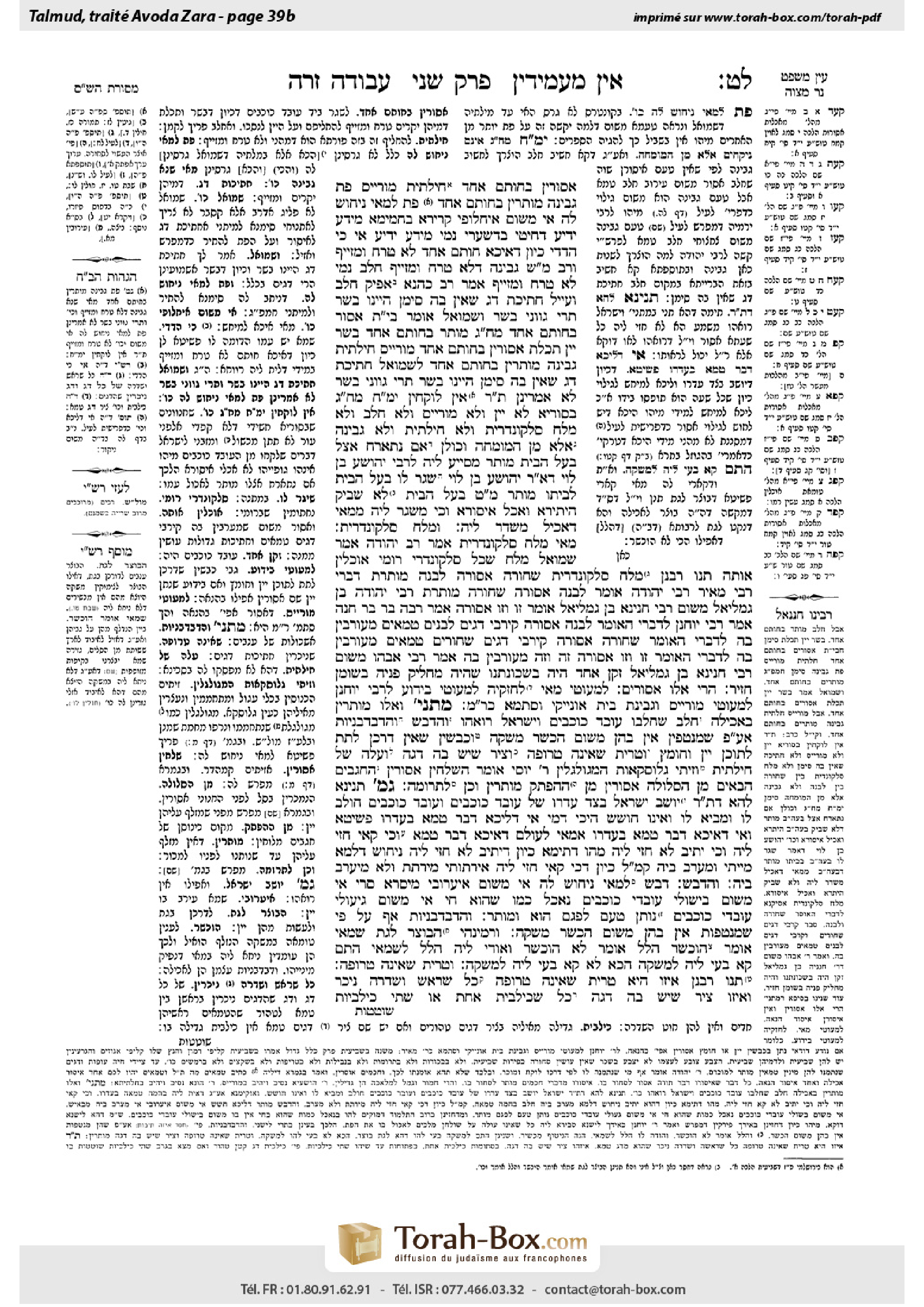
Avodah Zarah 39b: Talmud study for Daf Yomi
Study the Talmud for Daf Yomi with scanned pages, Hebrew text, English translations from Sefaria and AI-generated French translations.
Passage selection and English or AI-generated French translation are available where the scan has annotations. Daf Study is independent of Torah-Box and Sefaria.
Browse Avodah Zarah · עבודה זרה · All tractatesAvodah Zarah 39b text and translations
This page of Avodah Zarah includes the Aramaic text, an English translation and an AI-generated French translation, alongside the scan above.
עבודה זרה ל״ט ב · Aramaic and Hebrew text
אֲסוּרִין בְּחוֹתָם אֶחָד. חִילְתִּית, מוּרְיָיס, פַּת, גְּבִינָה — מוּתָּרִין בְּחוֹתָם אֶחָד.
פַּת, לְמַאי נֵיחוּשׁ לַהּ? אִי מִשּׁוּם אִיחַלּוֹפֵי קָרִירָא בְּחַמִּימָא — מִידָּע יְדִיעַ, דְּחִיטֵּי בְּדִשְׂעָרֵי נָמֵי מִידָּע יְדִיעַ, אִי כִּי הֲדָדֵי — כֵּיוָן דְּאִיכָּא חוֹתָם אֶחָד לָא טָרַח וּמְזַיֵּיף.
וְרַב, מַאי שְׁנָא גְּבִינָה? דְּלָא טָרַח וּמְזַיֵּיף? חָלָב נָמֵי לָא טָרַח וּמְזַיֵּיף! אָמַר רַב כָּהֲנָא: אַפֵּיק חָלָב, וְעַיֵּיל חֲתִיכַת דָּג שֶׁאֵין בָּהּ סִימָן.
הַיְינוּ בָּשָׂר! תְּרֵי גַּוְונֵי בָּשָׂר.
וּשְׁמוּאֵל אוֹמֵר: בי״ת אָסוּר בְּחוֹתָם אֶחָד, מח״ג מוּתָּר בְּחוֹתָם אֶחָד. בָּשָׂר, יַיִן, תְּכֵלֶת אֲסוּרִין בְּחוֹתָם אֶחָד; מוּרְיָיס, חִילְתִּית, גְּבִינָה מוּתָּרִין בְּחוֹתָם אֶחָד. לִשְׁמוּאֵל, חֲתִיכַת דָּג שֶׁאֵין בָּהּ סִימָן הַיְינוּ בָּשָׂר, תְּרֵי גַּוְונֵי בָּשָׂר לָא אָמְרִינַן.
תָּנוּ רַבָּנַן: אֵין לוֹקְחִין ימ״ח מח״ג בְּסוּרְיָא, לֹא יַיִן וְלֹא מוּרְיָיס וְלֹא חָלָב וְלֹא מֶלַח סַלְקוֹנְדְּרִית וְלֹא חִילְתִּית וְלֹא גְּבִינָה, אֶלָּא מִן הַמּוּמְחֶה, וְכוּלָּן אִם נִתְאָרַח אֵצֶל בַּעַל הַבַּיִת — מוּתָּר.
מְסַיַּיע לֵיהּ לְרַבִּי יְהוֹשֻׁעַ בֶּן לֵוִי, דְּאָמַר רַבִּי יְהוֹשֻׁעַ בֶּן לֵוִי: שִׁגֵּר לוֹ בַּעַל הַבַּיִת לְבֵיתוֹ — מוּתָּר. מַאי טַעְמָא? בַּעַל הַבַּיִת לָא שָׁבֵיק הֶיתֵּירָא וְאָכֵל אִיסּוּרָא, וְכִי מְשַׁגַּר לֵיהּ, מִמַּאי דְּאָכֵיל מְשַׁדַּר לֵיהּ.
וּמֶלַח סַלְקוֹנְדְּרִית. מַאי מֶלַח סַלְקוֹנְדְּרִית? אָמַר רַב יְהוּדָה אָמַר שְׁמוּאֵל: מֶלַח שֶׁכׇּל סַלְקוֹנְדְּרֵי רוֹמִי אוֹכְלִין אוֹתָהּ. תָּנוּ רַבָּנַן: מֶלַח סַלְקוֹנְדְּרִית, שְׁחוֹרָה — אֲסוּרָה, לְבָנָה — מוּתֶּרֶת, דִּבְרֵי רַבִּי מֵאִיר. רַבִּי יְהוּדָה אוֹמֵר: לְבָנָה — אֲסוּרָה, שְׁחוֹרָה — מוּתֶּרֶת. רַבִּי יְהוּדָה בֶּן גַּמְלִיאֵל מִשּׁוּם רַבִּי חֲנִינָא בֶּן גַּמְלִיאֵל אוֹמֵר: זוֹ וְזוֹ אֲסוּרָה.
אָמַר רַבָּה בַּר בַּר חָנָה אָמַר רַבִּי יוֹחָנָן: לְדִבְרֵי הָאוֹמֵר לְבָנָה אֲסוּרָה, קִירְבֵי דָּגִים לְבָנִים טְמֵאִים מְעוֹרָבִין בָּהּ. לְדִבְרֵי הָאוֹמֵר שְׁחוֹרָה אֲסוּרָה, קִירְבֵי דָּגִים שְׁחוֹרִים טְמֵאִים מְעוֹרָבִין בָּהּ.
לְדִבְרֵי הָאוֹמֵר זוֹ וְזוֹ אֲסוּרָה, זֶה וָזֶה מְעוֹרָבִין בָּהּ. אָמַר רַבִּי אֲבָהוּ מִשּׁוּם רַבִּי חֲנִינָא בֶּן גַּמְלִיאֵל: זָקֵן אֶחָד הָיָה בִּשְׁכוּנָתֵנוּ, שֶׁהָיָה מַחְלִיק פָּנֶיהָ בְּשׁוּמַּן חֲזִיר.
הֲרֵי אֵלּוּ אֲסוּרִים. לְמַעוֹטֵי מַאי? לְחִזְקִיָּה — לְמַעוֹטֵי בְּיָדוּעַ, לְרַבִּי יוֹחָנָן — לְמַעוֹטֵי מוּרְיָיס וּגְבִינַת בֵּית אוּנְיָיקֵי, וּסְתָמָא כְּרַבִּי מֵאִיר.
מַתְנִי׳ וְאֵלּוּ מוּתָּרִין בַּאֲכִילָה — חָלָב שֶׁחֲלָבוֹ גּוֹי וְיִשְׂרָאֵל רוֹאֵהוּ, וְהַדְּבַשׁ, וְהַדֻּבְדְּבָנִיּוֹת, אַף עַל פִּי שֶׁמְּנַטְּפִין — אֵין בָּהֶן מִשּׁוּם הֶכְשֵׁר מַשְׁקֶה, וּכְבָשִׁין שֶׁאֵין דַּרְכָּן לָתֵת לְתוֹכָן יַיִן וָחוֹמֶץ, וְטָרִית שֶׁאֵינָהּ טְרוּפָה, וְצִיר שֶׁיֵּשׁ בָּהּ דָּגָה, וְעָלֶה שֶׁל חִילְתִּית, וְזֵיתֵי גְלוּסְקָאוֹת הַמְגוּלְגָּלִין.
רַבִּי יוֹסֵי אוֹמֵר: הַשְּׁלָחִין אֲסוּרִין, הַחֲגָבִים הַבָּאִים מִן הַסְּלוּלָה אֲסוּרִין, מִן הַהֶפְתֵּק מוּתָּרִין, וְכֵן לִתְרוּמָה.
גְּמָ׳ תְּנֵינָא לְהָא דְּתָנוּ רַבָּנַן: יוֹשֵׁב יִשְׂרָאֵל בְּצַד עֶדְרוֹ שֶׁל גּוֹי, וְגוֹי חוֹלֵב וּמֵבִיא לוֹ, וְאֵינוֹ חוֹשֵׁשׁ. הֵיכִי דָמֵי? אִי דְּלֵיכָּא דָּבָר טָמֵא בְּעֶדְרוֹ — פְּשִׁיטָא, וְאִי דְּאִיכָּא דָּבָר טָמֵא בְּעֶדְרוֹ — אַמַּאי?
לְעוֹלָם דְּאִיכָּא דָּבָר טָמֵא, וְכִי קָאֵי חָזֵי לֵיהּ, וְכִי יָתֵיב לָא חֲזֵי לֵיהּ; מַהוּ דְּתֵימָא: כֵּיוָן דְּיָתֵיב לָא חָזֵי לֵיהּ, נֵיחוּשׁ דִּלְמָא מַיְיתֵי וּמְעָרֵב בֵּיהּ, קָא מַשְׁמַע לַן: כֵּיוָן דְּכִי קָאֵי חָזֵי לֵיהּ, אִירְתוֹתֵי מִירְתַת וְלָא מְיעָרֵב בֵּיהּ.
וְהַדְּבַשׁ. דְּבַשׁ לְמַאי נֵיחוּשׁ לַהּ? אִי מִשּׁוּם אִיעָרוֹבֵי — מִיסְרָא סְרֵי, אִי מִשּׁוּם בִּישּׁוּלֵי גוֹיִם — נֶאֱכָל כְּמוֹ שֶׁהוּא חַי, אִי מִשּׁוּם גִּיעוּלֵי גוֹיִם — נוֹתֵן טַעַם לִפְגָם הוּא וּמוּתָּר.
וְהַדֻּבְדְּבָנִיּוֹת. אַף עַל פִּי שֶׁמְּנַטְּפוֹת, אֵין בָּהֶן מִשּׁוּם הֶכְשֵׁר מַשְׁקֶה. וּרְמִינְהִי: הַבּוֹצֵר לַגַּת — שַׁמַּאי אוֹמֵר: הוּכְשַׁר, הִלֵּל אוֹמֵר: לֹא הוּכְשַׁר, וְאוֹדִי לֵיהּ הִלֵּל לְשַׁמַּאי!
הָתָם קָא בָעֵי לֵיהּ לְמַשְׁקֶה, הָכָא לָא קָא בָעֵי לֵיהּ לְמַשְׁקֶה.
וְטָרִית שֶׁאֵינָהּ טְרוּפָה: תָּנוּ רַבָּנַן, אֵיזוֹ הִיא טָרִית שֶׁאֵינָהּ טְרוּפָה? כֹּל שֶׁרֹאשׁ וְשִׁדְרָה נִיכָּר. וְאֵיזוֹ צִיר שֶׁיֵּשׁ בָּהּ דָּגָה? כָּל שֶׁכִּילְבִּית אַחַת אוֹ שְׁתֵּי כִּילְבִּיּוֹת
Avodah Zarah 39b · English translation
are all prohibited when they are found with only one seal; ḥiltit, fish stew [morayes], bread [pat], and cheese [gevina] are all permitted when they are found with one seal.
The Gemara explains why only one seal is necessary for bread. With regard to what need we be concerned in the case of bread, that one might have thought it requires two seals? If it is due to the concern for the gentile exchanging the fresh bread of the Jew with his own bread that is less fresh, the difference between cold bread and warm bread is known, and the Jew will realize that there has been an exchange. Likewise, if there is a concern that a gentile might exchange the more valuable wheat bread of the Jew with his own less valuable barley bread, the Jew will also know about it in this case. And if it is due to the concern that a gentile might exchange similar kinds of bread with each other, it can be assumed that since there is one seal the gentile will not trouble himself and forge another seal just to exchange bread of equal value.
The Gemara asks: And according to the opinion of Rav, what is different about cheese that it requires only one seal whereas milk requires two? If the reason is that a gentile will not trouble himself and forge a different seal, as cheese is generally inexpensive and the small profit he might make is not worth such an effort, this reasoning should apply to milk also, as he will not trouble himself and forge a new seal in this case either. Rav Kahana said: Remove the term: Milk, from Rav’s statement, and enter instead: A piece of fish that has no sign of kashrut.
The Gemara raises an objection: Rav could not have been teaching that a piece of fish with no signs of kashrut requires two seals, as fish is the same as meat, which is already included in the list of items that require two seals. The Gemara explains that there are two categories of meat: Animal meat and fish meat. Since one might have thought that they are subject to different halakhot, Rav therefore teaches that both require two seals.
The Gemara cites a different set of lists than that presented by Rav. And Shmuel says: The substances represented by the acronym beit, yod, tav are prohibited when sealed with one seal; those represented by the acronym mem, ḥet, gimmel, are permitted when sealed with one seal. The Gemara explains: Meat [basar], wine [yayin], and sky-blue dye [tekhelet] are prohibited when sealed with a single seal; fish stew [morayes], ḥiltit, and cheese [gevina], are permitted when sealed with a single seal. The Gemara comments: According to Shmuel, a piece of fish that has no sign of kashrut is the same as meat, and we do not say that there is a difference between two categories of meat. Consequently, he does not include in his list a piece of fish that has no sign of kashrut.
The Sages taught: One may not purchase foods represented by the acronym yod, mem, ḥet; mem, ḥet, gimmel in Syria, not even from Jews. The Gemara elaborates: One may not purchase wine [yayin], nor fish stew [morayes], nor milk [ḥalav], nor salkondarit salt [melaḥ salkondarit], nor ḥiltit, nor cheese [gevina], except when purchased from an expert with a reputation for knowing and upholding the halakhot of kashrut. And with regard to all of them, if one is a guest in the home of his host, they are permitted, as a Jew is assumed to keep the halakhot of kashrut in his own home.
The Gemara adds: This supports the statement of Rabbi Yehoshua ben Levi, as Rabbi Yehoshua ben Levi says: If a homeowner sent someone a package of food to his house, the food is permitted. What is the reason? It is because a homeowner does not leave aside permitted foods and eat prohibited foods, and when he sends food to another, he sends it from that which he eats himself, even though one may not be allowed to purchase food from that individual.
§ The mishna teaches that salkondarit salt is prohibited. The Gemara asks: What is salkondarit salt? Rav Yehuda says that Shmuel says: It is the salt that all Roman bakers [salkondarei] eat. The Sages taught: With regard to salkondarit salt, black salt is prohibited, whereas white salt is permitted; this is the statement of Rabbi Meir. Rabbi Yehuda says: White salt is prohibited; black salt is permitted. The Gemara cites a third opinion: Rabbi Yehuda ben Gamliel says in the name of Rabbi Ḥanina ben Gamliel: This and that, i.e., both white and black salkondarit salt, are prohibited.
The Gemara cites an explanation of this dispute. Rabba bar bar Ḥana says that Rabbi Yoḥanan says: According to the statement of the one who says that white salkondarit salt is prohibited, it is suspected that the intestines of white non-kosher fish are mixed in it, and this is the reason for the prohibition. According to the statement of the one who says that black salt is prohibited, it is suspected that the intestines of black non-kosher fish are mixed in it.
According to the statement of the one who said this and that are prohibited, he is concerned that this and that, i.e., the intestines of both white and black fish, are mixed in white and black salt, respectively. The Gemara mentions an additional problem with salkondarit salt: Rabbi Abbahu says in the name of Rabbi Ḥanina ben Gamliel: There was a certain elder in our neighborhood who would smooth its surface with pig fat.
§ The mishna further teaches that the list of items it mentioned are all prohibited. The Gemara asks: Since the mishna began by stating that the items it lists are prohibited for consumption, what does this apparently redundant conclusion serve to exclude? The Gemara answers: According to the opinion of Ḥizkiyya cited on 38b, it serves to exclude cases where it is known that wine of gentiles was added to the foods, as one may not even derive benefit from such foods. According to the opinion of Rabbi Yoḥanan, it serves to exclude fish stew and cheese of Beit Unyaki, as it is prohibited to derive benefit from these, and accordingly, the unattributed statement in this mishna is in accordance with the opinion of Rabbi Meir, cited in the previous mishna (29b).
MISHNA: And these are permitted for consumption: Milk that was milked by a gentile and a Jew watched him doing so; and honey; and grape clusters [davdevaniyyot] which, despite the fact that they are dripping juice, are not subject to the halakhot of susceptibility to ritual impurity caused by contact with that liquid; and pickled vegetables whose usual manner of preparation does not involve adding wine and vinegar to them; and tarit fish that is not minced; and brine that has fish in it; and the leaf of a ḥiltit plant; and rolled olive cakes [geluskaot].
Rabbi Yosei says: Overripe olives are prohibited. Locusts that come from a salesman’s basket are prohibited, whereas those that come from the storeroom [heftek] are permitted; and likewise with regard to the portion of the produce designated for the priest [teruma], as will be explained in the Gemara.
GEMARA: We learn from the mishna that which the Sages taught explicitly in a baraita: A Jew may sit beside a gentile’s flock and wait while the gentile milks his animals and brings the milk to the Jew, and he need not be concerned, even if he cannot see the milking process from his seated position. The Gemara asks: What are the circumstances of this case? If it is known that there is no non-kosher animal in the gentile’s flock, isn’t it obvious that the milk is permitted? Why would the baraita teach an obvious halakha? And if there is a non-kosher animal in his flock, then why is the milk permitted, considering the fact that the Jew could not see the gentile from where he sat?
The Gemara explains: Actually, this is referring to a case where there is a non-kosher animal in the flock, and when the Jew is standing he can see the gentile, but when he is sitting he cannot see the gentile. Lest you say: Since when the Jew is sitting, he cannot see the gentile, we should be concerned that perhaps the gentile will bring non-kosher milk and mix it with the kosher milk, the baraita therefore teaches us that since when the Jew is standing, he can see him, the gentile is fearful of being caught and does not mix anything into the milk.
§ The mishna teaches: And the honey of gentiles is permitted. The Gemara explains: For what need we be concerned with regard to honey? If it is due to the concern that a gentile might mix wine with it, honey spoils when it is mixed with wine, and therefore a gentile would not do so. If it is due to the cooking of gentiles, this too does not apply, because it is eaten as it is, i.e., raw. If it is due to the concern that the honey might have absorbed prohibited taste from vessels of gentiles that require purging, this does not apply either, as it is a prohibited substance that imparts flavor to the detriment of the mixture, and such a case is permitted. Since none of these concerns are relevant, the honey is permitted.
§ The mishna further teaches: And grape clusters which, despite the fact that they are dripping juice, are not subject to the halakhot of susceptibility to ritual impurity caused by contact with that liquid. And the Gemara raises a contradiction from the following baraita: With regard to one who harvests grapes in order to take them to the press and crush them, there is a dispute as to whether or not the liquid that seeps from the grapes renders them susceptible to ritual impurity. Shammai says: It has become susceptible to ritual impurity, and Hillel says: It has not become susceptible. And eventually Hillel conceded to the opinion of Shammai. This shows that the juice that seeps out of grapes does render them susceptible to ritual impurity, which apparently contradicts the ruling of the mishna.
The Gemara explains: There, in the case of the baraita, he wants the juice as a beverage, and one’s intention influences the capability of certain liquids to render substances susceptible to ritual impurity. Therefore, the liquid that seeps from the grapes renders them susceptible to ritual impurity. Here, in the case of the mishna, he does not want the juice as a beverage, and therefore the grapes are not rendered susceptible to impurity.
§ The mishna further teaches: And tarit fish that is not minced and brine that has fish in it are permitted. The Sages taught: What is considered tarit that has not been minced? Any fish whose head and spine are recognizable. And what is considered brine that has fish in it? Any brine that has one kilbit or two kilbiyot
Avodah Zarah 39b · Traduction française (IA)
Tous ces aliments sont interdits lorsqu'ils sont trouvés avec un seul sceau ; ḥiltit, la bouillie de poisson [morayes], le pain [pat], et le fromage [gevina] sont tous permis lorsqu'ils sont trouvés avec un seul sceau.
La Guemara explique pourquoi seul un sceau est nécessaire pour le pain. En quoi devons-nous avoir peur concernant le pain, que l'on puisse penser qu'il nécessite deux sceaux ? Si c'est en raison de la crainte que les Gentils échangent le pain frais des Juifs avec leur propre pain moins frais, la différence entre le pain froid et le pain chaud est connue, et le Juif reconnaîtra qu'il y a eu un échange. De même, si l'on craint que les Gentils échangent le pain en blé plus précieux des Juifs avec leur propre pain en orge moins précieux, le Juif reconnaîtra également cela dans ce cas. Et si c'est en raison de la crainte que les Gentils échangent des types de pains similaires entre eux, on peut supposer que, puisque seul un sceau est présent, le Gentil ne se donnera pas la peine de falsifier un autre sceau juste pour échanger des pains de valeur égale.
La Guemara pose une question : Et selon l'opinion de Rava, qu'est-ce qui diffère dans le fromage qui nécessite seulement un sceau alors que le lait nécessite deux ? Si la raison est que les Gentils ne se donneront pas la peine de falsifier un autre sceau, car le fromage est généralement peu coûteux et le petit profit qu'il pourrait gagner n'en vaut pas la peine, cette raisonnement devrait s'appliquer au lait également, car il ne se donnera pas la peine de falsifier un nouveau sceau dans ce cas non plus. Rav Kahana dit : Retirez le terme : Lait, de l'affirmation de Rava, et remplacez-le par : Un morceau de poisson sans signe de kashrut.
La Guemara soulève une objection : Rava ne pouvait pas enseigner que un morceau de poisson sans signe de kashrut nécessite deux sceaux, car le poisson est du même type que la viande, qui est déjà inclus dans la liste des aliments qui nécessitent deux sceaux. La Guemara explique que les viandes se divisent en deux catégories : viande animale et viande de poisson. Puisque l'on pourrait penser qu'elles sont soumises à des halakhot différentes, Rava enseigne donc que les deux nécessitent deux sceaux.
La Guemara cite un autre ensemble de listes que celui présenté par Rava. Et Shmuel dit : Les substances représentées par l'acronyme beth, yod, tav sont interdites lorsqu'elles sont scellées avec un seul sceau ; celles représentées par l'acronyme mem, ḥet, gimmel sont permises lorsqu'elles sont scellées avec un seul sceau. La Guemara explique : La viande [basar], le vin [yayin], et la teinture bleue [tekhelet] sont interdites lorsqu'elles sont scellées avec un seul sceau ; la bouillie de poisson [morayes], ḥiltit, et le fromage [gevina] sont permises lorsqu'elles sont scellées avec un seul sceau. La Guemara commente : Selon Shmuel, un morceau de poisson sans signe de kashrut est le même que la viande, et nous ne disons pas qu'il y a une différence entre les deux catégories de viande. Par conséquent, il ne les inclut pas dans sa liste.
Les Sages enseignèrent : On ne doit pas acheter les aliments représentés par l'acronyme yod, mem, ḥet ; mem, ḥet, gimmel en Syrie, même auprès des Juifs. La Guemara développe : On ne doit pas acheter le vin [yayin], ni la bouillie de poisson [morayes], ni le lait [ḥalav], ni le sel salkondarit [melaḥ salkondarit], ni ḥiltit, ni le fromage [gevina], sauf lorsqu'on les achète auprès d'un expert connu pour connaître et respecter les halakhot de kashrut. Et concernant tous ces aliments, si l'on est invité chez son hôte, ils sont permis, car on suppose que le Juif tient les halakhot de kashrut dans sa propre maison.
La Guemara ajoute : Cela soutient l'affirmation de Rabbi Yéhoshua ben Levi, car Rabbi Yéhoshua ben Levi dit : Si un propriétaire envoie un colis de nourriture à un autre, la nourriture est permise. Quelle est la raison ? C'est parce qu'un propriétaire ne néglige pas les aliments permis pour manger des aliments interdits, et lorsqu'il envoie de la nourriture à un autre, il l'envoie de ce qu'il mange lui-même, même si l'on ne peut pas acheter de nourriture auprès de cette personne.
§ La mitsna enseigne que le sel salkondarit est interdit. La Guemara pose une question : Quel est le sel salkondarit ? Rav Yéhuda dit que Shmuel dit : C'est le sel que tous les boulangeries romaines [salkondarei] mangent. Les Sages enseignèrent : Concernant le sel salkondarit, le sel noir est interdit, tandis que le sel blanc est permis ; c'est l'affirmation de Rabbi Meir. Rabbi Yéhuda dit : Le sel blanc est interdit ; le sel noir est permis. La Guemara cite un troisième opinion : Rabbi Yéhuda ben Gamliel dit en nom de Rabbi Ḥanina ben Gamliel : Cet et celui, c'est-à-dire les deux sel salkondarit blanc et noir, sont interdits.
La Guemara cite une explication de ce débat. Rabba bar bar Ḥana dit que Rabbi Yoḥanan dit : Selon l'affirmation de celui qui dit que le sel salkondarit blanc est interdit, on soupçonne que les intestins de poissons non-kosher blancs sont mélangés dans ce sel, et c'est la raison de l'interdiction. Selon l'affirmation de celui qui dit que le sel noir est interdit, on soupçonne que les intestins de poissons non-kosher noirs sont mélangés dans ce sel.
Selon l'affirmation de celui qui dit que telle chose et telle autre sont interdites, on s'occupe du fait que telle chose et telle autre, c'est-à-dire les intestins des poissons blancs et noirs, sont mélangés dans le sel blanc et noir, respectivement. La Guemara mentionne un autre problème concernant le sel salkondarit : Rabbi Abbahu dit en nom de Rabbi Ḥanina ben Gamliel : Il y avait un certain vieillard dans notre quartier qui lissait sa surface avec de la graisse de porc.
§ La mitsna enseigne davantage que tous les objets mentionnés sont interdits. La Guemara pose une question : Puisque la mitsna commence par dire que les objets mentionnés sont interdits à la consommation, à quoi sert cette conclusion apparemment redondante ? La Guemara répond : Selon l'opinion de Ḥizkiyya cité sur 38b, cela sert à exclure les cas où il est connu que du vin des Gentils a été ajouté aux aliments, car on ne peut même pas en tirer un bénéfice. Selon l'opinion de Rabbi Yoḥanan, cela sert à exclure la bouillie de poisson et le fromage de Beit Unyaki, car il est interdit de tirer un bénéfice de ces aliments, et par conséquent, l'affirmation non attribuée dans cette mitsna est en accord avec l'opinion de Rabbi Meir, cité dans la mitsna précédente (29b).
MICHNA: Et ces choses sont permises à la consommation : le lait qui a été tiré par un non-Juif et un Juif l’a vu faire ; et le miel ; et les grappes [davdevaniyyot] qui, malgré le fait qu’elles dégouttent du jus, ne sont pas soumises aux halakhot de la souillure rituelle causée par le contact avec ce liquide ; et les légumes marinés dont la préparation habituelle ne consiste pas à y ajouter du vin et de la vinaigre ; et les poissons tarit qui ne sont pas hachés ; et le sel qui contient des poissons ; et la feuille d’un plant ḥiltit ; et les galettes d’olive roulées [geluskaot].
Rabbi Yosei dit : Les olives trop mûres sont interdites. Les locustes qui proviennent d’un panier de vendeur sont interdites, tandis que celles qui proviennent de la réserve [heftek] sont permises ; et de même concernant la part des produits destinés au prêtre [terouma], comme cela sera expliqué dans la Guemara.
GUEMARA : Nous apprenons de la Michna ce que les Sages ont enseigné explicitement dans une baraïta : Un Juif peut s’asseoir à côté du troupeau d’un non-Juif et attendre que le non-Juif tienne ses bêtes et apporte le lait au Juif, et il n’a pas à s’inquiéter, même s’il ne peut pas voir le processus de traite depuis sa position assise. La Guemara pose la question : Quelles sont les circonstances de ce cas ? Si on sait qu’il n’y a pas d’animal non-kosher dans le troupeau du non-Juif, n’est-ce pas évident que le lait est permis ? Pourquoi la baraïta enseigne-t-elle une halakha évidente ? Et si il y a un animal non-kosher dans son troupeau, pourquoi le lait est-il permis, sachant que le Juif ne pouvait pas voir le non-Juif depuis où il était assis ?
La Guemara explique : En réalité, cela fait référence à un cas où il y a un animal non-kosher dans le troupeau, et lorsque le Juif est debout, il peut voir le non-Juif, mais lorsque il est assis, il ne peut pas le voir. De peur que vous disiez : Puisque lorsque le Juif est assis, il ne peut pas voir le non-Juif, nous devrions nous inquiéter que peut-être le non-Juif apportera du lait non-kosher et le mélangera avec le lait kasher, la baraïta enseigne donc que puisque lorsque le Juif est debout, il peut le voir, le non-Juif a peur d’être pris et ne mélange rien dans le lait.
§ La Michna enseigne : Et le miel des non-Juifs est permis. La Guemara explique : Pourquoi avons-nous besoin de nous inquiéter concernant le miel ? Si c’est à cause de la crainte qu’un non-Juif mélange du vin dedans, le miel se dégrade lorsqu’il est mélangé avec du vin, et donc un non-Juif ne le ferait pas. Si c’est à cause de la cuisson des non-Juifs, cela ne s’applique pas non plus, car il est mangé tel quel, c’est-à-dire cru. Si c’est à cause de la crainte que le miel ait absorbé un goût interdit provenant de contenants des non-Juifs qui nécessitent un nettoyage, cela ne s’applique pas non plus, car c’est une substance interdite qui imprime un goût à la détriment de la mixture, et de tels cas sont permis. Puisque aucune de ces craintes ne s’applique, le miel est permis.
§ La Michna enseigne encore : Et les grappes qui, malgré le fait qu’elles dégouttent du jus, ne sont pas soumises aux halakhot de la souillure rituelle causée par le contact avec ce liquide. Et la Guemara soulève une contradiction à partir de la suivante baraïta : Concernant celui qui récolte des raisins afin de les emmener à la presse et de les presser, il y a un débat sur le fait que le liquide qui s’écoule des raisins les rende soumis à la souillure rituelle. Shammai dit : Il est devenu soumis à la souillure rituelle, et Hillel dit : Il n’est pas devenu soumis. Et finalement Hillel a admis l’opinion de Shammai. Cela montre que le liquide qui s’écoule des raisins les rend soumis à la souillure rituelle, ce qui semble contredire la décision de la Michna.
La Guemara explique : Là, dans le cas de la baraïta, il veut le liquide comme boisson, et l’intention influence la capacité de certains liquides à rendre des substances soumises à la souillure rituelle. Par conséquent, le liquide qui s’écoule des raisins les rend soumis à la souillure rituelle. Ici, dans le cas de la Michna, il ne veut pas le liquide comme boisson, et par conséquent les raisins ne sont pas rendus soumis à la souillure.
§ La Michna enseigne encore : Et les poissons tarit qui ne sont pas hachés et le sel qui contient des poissons sont permis. Les Sages ont enseigné : Qu’est-ce qui est considéré comme un poisson tarit qui n’a pas été haché ? Tout poisson dont la tête et la colonne vertébrale sont reconnaissables. Et qu’est-ce qui est considéré comme un sel qui contient des poissons ? Tout sel qui contient une kilbit ou deux kilbiyot.
Traduction française générée par IA à partir de l’édition anglaise de Sefaria. Vérifie toujours un passage avec le texte source.
Text from Sefaria: William Davidson Edition - Vocalized Aramaic (CC BY NC); William Davidson Edition - English (CC BY NC).