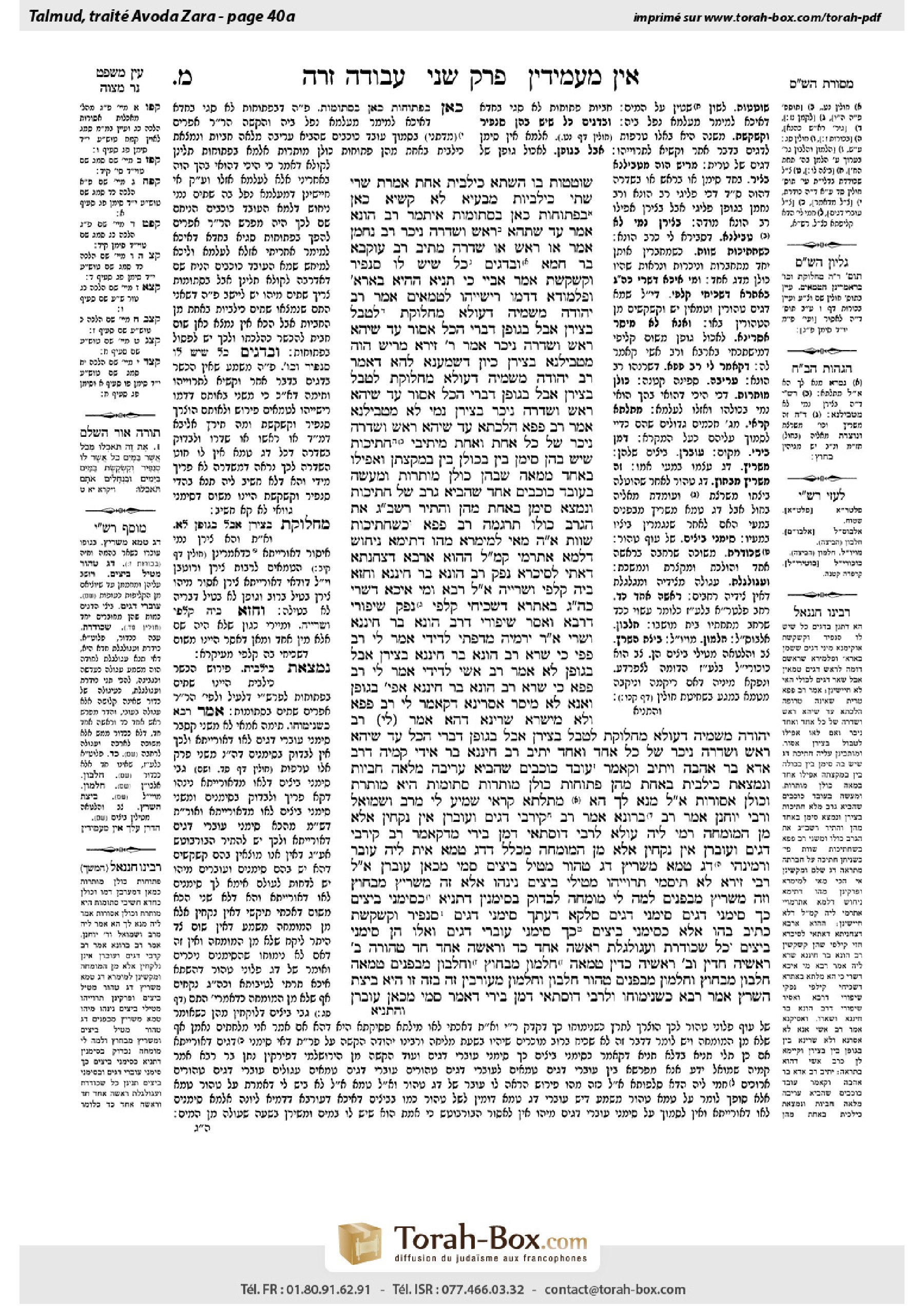
Avodah Zarah 40a: Talmud study for Daf Yomi
Study the Talmud for Daf Yomi with scanned pages, Hebrew text, English translations from Sefaria and AI-generated French translations.
Passage selection and English or AI-generated French translation are available where the scan has annotations. Daf Study is independent of Torah-Box and Sefaria.
Browse Avodah Zarah · עבודה זרה · All tractatesAvodah Zarah 40a text and translations
This page of Avodah Zarah includes the Aramaic text, an English translation and an AI-generated French translation, alongside the scan above.
עבודה זרה מ׳ א · Aramaic and Hebrew text
שׁוֹטְטוֹת בּוֹ. הַשְׁתָּא כִּילְבִּית אַחַת אָמְרַתְּ שְׁרֵי, שְׁתֵּי כִּילְבִּיּוֹת מִבַּעְיָא? לָא קַשְׁיָא: כָּאן בִּפְתוּחוֹת, כָּאן בִּסְתוּמוֹת.
אִיתְּמַר: רַב הוּנָא אָמַר: עַד (שֶׁתְּהֵא) [שֶׁיְּהֵא] רֹאשׁ וְשִׁדְרָה נִיכָּר, רַב נַחְמָן אָמַר: אוֹ רֹאשׁ אוֹ שִׁדְרָה. מֵתִיב רַב עוּקְבָא בַּר חָמָא: וּבַדָּגִים כֹּל שֶׁיֵּשׁ לוֹ סְנַפִּיר וְקַשְׂקֶשֶׂת! אֲמַר אַבָּיֵי: כִּי תַּנְיָא הָהִיא בְּאָרָא וּפַלְמוּדָא, דְּדָמוּ רֵישַׁיְיהוּ לִטְמֵאִים.
אָמַר רַב יְהוּדָה מִשְּׁמֵיהּ דְּעוּלָּא: מַחְלוֹקֶת לְטַבֵּל בְּצִירָן, אֲבָל בְּגוּפָן — דִּבְרֵי הַכֹּל אָסוּר עַד שֶׁיְּהֵא רֹאשׁ וְשִׁדְרָה נִיכָּר. אָמַר רַבִּי זֵירָא: מֵרֵישׁ הֲוָה מְטַבֵּילְנָא בְּצִירָן, כֵּיוָן דִּשְׁמַעְנָא לְהָא דְּאָמַר רַב יְהוּדָה מִשְּׁמֵיהּ דְּעוּלָּא: מַחְלוֹקֶת לְטַבֵּל בְּצִירָן, אֲבָל בְּגוּפָן — דִּבְרֵי הַכֹּל אָסוּר עַד שֶׁיְּהֵא רֹאשׁ וְשִׁדְרָה נִיכָּר, בְּצִירָן נָמֵי לָא מְטַבֵּילְנָא.
אָמַר רַב פָּפָּא, הִלְכְתָא: עַד שֶׁיְּהֵא רֹאשׁ וְשִׁדְרָה נִיכָּר שֶׁל כׇּל אַחַת וְאַחַת. מֵיתִיבִי: חֲתִיכוֹת שֶׁיֵּשׁ בָּהֶן סִימָן, בֵּין בְּכוּלָּן בֵּין בְּמִקְצָתָן, וַאֲפִילּוּ בְּאֶחָד מִמֵּאָה שֶׁבָּהֶן — כּוּלָּן מוּתָּרוֹת, וּמַעֲשֶׂה בְּגוֹי אֶחָד שֶׁהֵבִיא גָּרָב שֶׁל חֲתִיכוֹת, וְנִמְצָא סִימָן בְּאַחַת מֵהֶן, וְהִתִּיר רַבָּן שִׁמְעוֹן בֶּן גַּמְלִיאֵל אֶת הַגָּרָב כּוּלּוֹ!
תַּרְגְּמַהּ רַב פָּפָּא: כְּשֶׁחֲתִיכוֹת שָׁווֹת. אִי הָכִי, מַאי לְמֵימְרָא? מַהוּ דְּתֵימָא נֵיחוּשׁ דִּלְמָא אִתְרְמִי, קָא מַשְׁמַע לַן.
הָהוּא אַרְבָּא דְּצַחַנְתָּא דַּאֲתַי לְסִיכְרָא, נְפַק רַב הוּנָא בַּר חִינָּנָא וַחֲזָא בֵּיהּ קִלְפֵי וְשַׁרְיֵיהּ. אֲמַר לֵיהּ רָבָא: וּמִי אִיכָּא דְּשָׁרֵי כְּהַאי גַּוְונָא בְּאַתְרָא דִּשְׁכִיחִי קִלְפֵי? נָפֵק שִׁיפּוּרֵי דְּרָבָא וְאָסַר, שִׁיפּוּרֵי דְּרַב הוּנָא בַּר חִינָּנָא וְשָׁרֵי.
אָמַר רַב יִרְמְיָה מִדִּפְתִּי: לְדִידִי אָמַר לִי רַב פַּפֵּי, כִּי שְׁרָא רַב הוּנָא בַּר חִינָּנָא — בְּצִירָן, אֲבָל בְּגוּפָן לָא. אָמַר רַב אָשֵׁי: לְדִידִי אָמַר לִי רַב פָּפָּא, כִּי שְׁרָא רַב הוּנָא בַּר חִינָּנָא — אֲפִילּוּ בְּגוּפָן.
וַאֲנָא לָא מֵיסָר אָסַרְנָא, דְּקָאָמַר לִי רַב פָּפָּא, וְלָא מִישְׁרֵא שָׁרֵינָא, דְּהָא אָמַר (לִי) רַב יְהוּדָה מִשְּׁמֵיהּ דְּעוּלָּא: מַחְלוֹקֶת לְטַבֵּל בְּצִירָן, אֲבָל בְּגוּפָן — דִּבְרֵי הַכֹּל עַד שֶׁיְּהֵא רֹאשׁ וְשִׁדְרָה נִיכָּר שֶׁל כׇּל אֶחָד וְאֶחָד.
יָתֵיב רַב חִינָּנָא בַּר אִידִי קַמֵּיהּ דְּרַב אַדָּא בַּר אַהֲבָה, וְיָתֵיב וְקָאָמַר: גּוֹי שֶׁהֵבִיא עֲרֵיבָה מְלֵאָה חָבִיּוֹת, וְנִמְצֵאת כִּילְבִּית בְּאַחַת מֵהֶן — פְּתוּחוֹת, כּוּלָּן מוּתָּרוֹת; סְתוּמוֹת, הִיא מוּתֶּרֶת וְכוּלָּן אֲסוּרוֹת. אֲמַר לֵיהּ: מְנָא לָךְ הָא? מִתְּלָתָא קְרָאֵי שְׁמִיעַ לִי, מֵרַב וּשְׁמוּאֵל וְרַבִּי יוֹחָנָן.
אָמַר רַב בְּרוֹנָא אָמַר רַב: קִירְבֵי דָּגִים וְעוּבָּרָן אֵין נִקָּחִין אֶלָּא מִן הַמּוּמְחֶה. רָמֵי לֵיהּ עוּלָּא לְרַבִּי דּוֹסְתַּאי דְּמִן בֵּירֵי, מִדְּקָאָמַר רַב: קִירְבֵי דָּגִים וְעוּבָּרָן אֵין נִקָּחִין אֶלָּא מִן הַמּוּמְחֶה — מִכְּלָל דְּדָג טָמֵא אִית לֵיהּ עוּבָּר, וּרְמִינְהִי: דָּג טָמֵא מַשְׁרִיץ, דָּג טָהוֹר מֵטִיל בֵּיצִים!
סְמִי מִכָּאן ״עוּבָּרָן״. אֲמַר לֵיהּ רַבִּי זֵירָא: לָא תִּיסְמֵי, תַּרְוַיְיהוּ מְטִילֵי בֵּיצִים נִינְהוּ, אֶלָּא זֶה מַשְׁרִיץ מִבַּחוּץ, וְזֶה מַשְׁרִיץ מִבִּפְנִים.
לְמָה לִי מוּמְחֶה? לִבְדּוֹק בְּסִימָנִין! דְּתַנְיָא: כְּסִימָנֵי בֵיצִים כָּךְ סִימָנֵי דָגִים. סִימָנֵי דָגִים סָלְקָא דַּעְתָּךְ? סִימָנֵי דָגִים ״סְנַפִּיר וְקַשְׁקֶשֶׁת״ כְּתִיב בְּהוּ! אֶלָּא, כְּסִימָנֵי בֵיצִים כָּךְ סִימָנֵי עוּבְּרֵי דָגִים.
וְאֵלּוּ הֵן סִימָנֵי בֵיצִים: כֹּל שֶׁכּוֹדֶרֶת וַעֲגוּלְגֹּלֶת, רֹאשָׁהּ אֶחָד כַּד וְרֹאשָׁהּ אֶחָד חַד — טְהוֹרָה, שְׁנֵי רָאשֶׁיהָ חַדִּין וּשְׁנֵי רָאשֶׁיהָ כַּדִּין — טְמֵאָה, חֶלְמוֹן מִבַּחוּץ וְחֶלְבּוֹן מִבִּפְנִים — טְמֵאָה, חֶלְבּוֹן מִבַּחוּץ וְחֶלְמוֹן מִבִּפְנִים — טָהוֹר, חֶלְבּוֹן וְחֶלְמוֹן מְעוֹרָבִין זֶה בָּזֶה — זוֹ הִיא בֵּיצַת הַשֶּׁרֶץ. אָמַר רָבָא: כְּשֶׁנִּימּוֹחוּ.
וּלְרַבִּי דּוֹסְתַּאי דְּמִן בֵּירֵי, דְּאָמַר: סְמִי מִכָּאן ״עוּבָּרָן״,
Avodah Zarah 40a · English translation
floating in it. The Gemara asks: Now that you have said that brine which has only one kilbit in it is permitted, is it necessary to teach that brine that has two kilbiyot in it is also permitted? The Gemara explains that it is not difficult: Here, two kilbiyot are required to permit the brine, as it is contained in open barrels, but there, only one is required, since it is in sealed barrels.
§ It was stated that Rav Huna says: Tarit is not permitted for consumption until its head and spine are recognizable. Rav Naḥman says: It is permitted if either the head or the spine is recognizable. Rav Ukva bar Ḥama raises an objection from a mishna (Ḥullin 59a): And with regard to fish, any that has fins and scales is permitted. Evidently, the kashrut of fish is determined only by its fins and scales, not its head or its spine. Abaye said: When that mishna is taught, it is in reference to the ara’a and falmuda fish, whose heads are similar to the heads of non-kosher fish.
The Gemara analyzes the dispute between Rav Huna and Rav Naḥman. Rav Yehuda said in the name of Ulla: The dispute applies to dipping foods in their brine, but with regard to eating their actual bodies, everyone agrees that it is prohibited until both the head and the spine are recognizable. The Gemara notes that Rabbi Zeira said: Originally, I would dip foods in their brine, but once I heard that which Rav Yehuda said in the name of Ulla: The dispute is only with regard to dipping foods in their brine, but with regard to eating their actual bodies everyone agrees that it is prohibited until both the head and the spine are recognizable; I too no longer dip foods in their brine.
Rav Pappa said: The halakha is that tarit is prohibited until the head and spine of each and every fish is recognizable. The Gemara raises an objection to Rav Pappa’s statement from a baraita: With regard to pieces of fish that have a sign of kashrut, whether this sign is present in all of them or only in a minority of them, and even if it is present in only one fish out of one hundred of them, they are all permitted. And there was an incident involving a certain gentile who brought a large jug of pieces of fish, and a sign of kashrut was found in one of them, and Rabban Shimon ben Gamliel permitted the entire jug of fish. This apparently contradicts Rav Pappa’s assertion that all the pieces must be recognizable for them to be permitted.
Rav Pappa interpreted that baraita as referring to a case where the pieces correspond to each other, i.e., they fit together so that it is clear that they are all from the same fish. The Gemara raises a difficulty: If that is so, what is the purpose of stating this explicitly? If the pieces correspond it is obvious that they are permitted, as they evidently come from the same kosher fish. The Gemara explains that this was taught lest you say that one should be concerned that perhaps the pieces merely happened to fit together; the baraita therefore teaches us that in such a case the pieces are permitted.
The Gemara relates that there was a certain ship carrying tzaḥanta which came to the city of Sikhra. Rav Huna bar Ḥinnana went out and saw that the fish had scales on them and permitted them, as any fish with scales is kosher. Rava said to him: But is there anyone who permits tzaḥanta in a case like this, when it is from a land where fish with scales are common and it is very possible that the scales are from kosher fish that had been in the boat previously? Shofarot went out from the court of Rava to herald a declaration promulgating his ruling, and he thereby prohibited all the fish on that boat. And shofarot went out from the court of Rav Huna bar Ḥinnana, and he thereby permitted the fish.
The Gemara presents two interpretations of the above ruling. Rav Yirmeya of Difti said: Rav Pappi said to me that when Rav Huna bar Ḥinnana permitted the fish on the ship, he was referring only to their brine, but with regard to their bodies, no, he did not permit them. Rav Ashi said: Rav Pappa said to me that when Rav Huna bar Ḥinnana permitted the fish, he was referring even to their bodies.
Rav Ashi continued: And I do not prohibit the fish, as Rav Pappa said to me that Rav Huna permitted it, but I also do not permit the fish, as Rav Yehuda said to me in the name of Ulla that the dispute between Rava and Rav Huna bar Ḥinnana is referring to dipping foods in their brine, but with regard to eating their actual bodies, everyone agrees that it is prohibited until both the head and spine of each and every fish are recognizable.
Rav Ḥinnana bar Idi sat before Rav Adda bar Ahava, and he sat and said: With regard to a gentile who brought a boat that was full of barrels of fish brine, and a kilbit was found in one of the barrels, the halakha is as follows: If the barrels were open, they are all permitted; if they were closed, then the barrel with the kilbit is permitted, and all the others are prohibited. Rav Adda bar Ahava said to him: From where do you know this? Rav Ḥinnana bar Idi responded: I heard this from three verses, i.e., great Sages upon whom one can rely as though their statements were recorded in verses: From Rav and Shmuel and Rabbi Yoḥanan.
§ The Gemara discusses the halakha with regard to other parts of fish. Rav Beruna says that Rav says: Fish intestines and their roe may be purchased only from an expert. Ulla raises a contradiction to Rabbi Dostai of Biri: From the fact that Rav says: Fish intestines and their roe may be purchased only from an expert, it may be inferred that a non-kosher fish has roe, as otherwise there would be no reason to permit only roe purchased from an expert. And the Gemara raises a contradiction to this claim from the following baraita: A non-kosher fish gives birth whereas a kosher fish lays eggs.
Rabbi Dostai accepted this opinion and said: Delete the phrase: Their roe, from here. Rabbi Zeira said to him: Do not delete it, as both kosher and non-kosher fish are fish that lay, i.e., produce, eggs, but this kosher fish propagates externally by laying eggs in the water which later hatch, and that non-kosher fish propagates internally by keeping the eggs in its own body until they develop. Nevertheless, both produce roe, and there is therefore reason to be concerned that a Jew might purchase non-kosher roe.
The Gemara asks: But even so, why do I need an expert? Let one check the signs of kashrut on the roe himself, as it is taught in a baraita: Like the signs of bird eggs, so are the signs of fish. The Gemara interjects: Does it enter your mind to say that the signs of kashrut for fish are the same as the signs of kashrut for eggs? This is not so, as the signs of kosher fish are the possession of fins and scales, as written in the Torah with regard to them. Rather, the baraita means to say: Like the signs of bird eggs, so are the signs of fish roe.
The baraita continues: And these are the signs of bird eggs: Any egg that narrows at the top and is rounded, so that one of its ends is wide and the other one of its ends is pointed is kosher. If both of its ends are sharp or both of its ends are wide, it is non-kosher. If the yolk is on the outside and the albumen is on the inside, it is non-kosher; if the albumen is on the outside and the yolk is on the inside, it is kosher. If the yolk and albumen are mixed with each other, this is the egg of a creeping animal. Considering that one can easily determine the kashrut of such eggs, why are only those purchased from an expert permitted? Rava says: Rav’s ruling refers specifically to a case where the eggs have melted together and it is impossible to determine whether or not they are kosher based on these signs.
The Gemara asks: But according to the opinion of Rabbi Dostai of Biri, who accepted the idea that non-kosher fish do not lay eggs and says: Delete from here the phrase: Their roe, it is difficult.
Avodah Zarah 40a · Traduction française (IA)
Flottant dans celui-ci. Le Guemara pose la question : Maintenant que vous avez dit que le sel qui contient seulement un kilbit est permis, est-il nécessaire d'enseigner que le sel qui contient deux kilbiyot est également permis ? Le Guemara explique que ce n'est pas difficile : ici, deux kilbiyot sont requis pour permettre le sel, car il est contenu dans des barriques ouvertes, mais là, seul un kilbit est requis, car il est dans des barriques fermées.
§ Il a été dit que Rav Huna dit : Le tarit n'est pas permis à la consommation jusqu'à ce que sa tête et sa colonne vertébrale soient identifiables. Rav Naḥman dit : Il est permis si la tête ou la colonne vertébrale est identifiable. Rav Ukva bar Ḥama émet une objection à partir d'une mitsva (Ḥullin 59a) : Et concernant les poissons, tout ce qui a des nageoires et des écailles est permis. Évidemment, la kashrut des poissons est déterminée uniquement par ses nageoires et ses écailles, pas par sa tête ou sa colonne vertébrale. Abaye a dit : Lorsque cette mitsva est enseignée, elle fait référence aux poissons ara’a et falmuda, dont les têtes sont semblables à celles des poissons non-kosher.
Le Guemara analyse le débat entre Rav Huna et Rav Naḥman. Rav Yehuda a dit en nom de Ulla : Ce débat s'applique à l'immersion des aliments dans leur sel, mais concernant la consommation de leur corps réel, tout le monde s'accorde sur le fait qu'il est interdit jusqu'à ce que la tête et la colonne vertébrale de chaque poisson soient identifiables. Le Guemara note que Rabbi Zeira a dit : D'abord, j'immergeais les aliments dans leur sel, mais une fois que j'ai entendu ce que Rav Yehuda a dit en nom de Ulla : Ce débat s'applique uniquement à l'immersion des aliments dans leur sel, mais concernant la consommation de leur corps réel, tout le monde s'accorde sur le fait qu'il est interdit jusqu'à ce que la tête et la colonne vertébrale de chaque poisson soient identifiables ; je n'immergeais plus les aliments dans leur sel.
Rav Pappa a dit : La halakha est que le tarit est interdit jusqu'à ce que la tête et la colonne vertébrale de chaque poisson soient identifiables. Le Guemara émet une objection contre l'affirmation de Rav Pappa à partir d'une baraïta : Concernant des morceaux de poisson ayant un signe de kashrut, que ce signe soit présent dans tous ou seulement dans une minorité d'entre eux, et même si ce signe est présent dans un seul poisson sur cent, ils sont tous permis. Il y avait un incident concernant un certain non-Juif qui a apporté un grand tonneau de morceaux de poisson, et un signe de kashrut a été trouvé dans l'un d'entre eux, et Rabban Shimon ben Gamliel a permis l'ensemble du tonneau de poisson. Cela semble contredire l'affirmation de Rav Pappa selon laquelle tous les morceaux doivent être identifiables pour être permis.
Rav Pappa a interprété cette baraïta comme faisant référence à un cas où les morceaux correspondent entre eux, c'est-à-dire qu'ils s'adaptent les uns aux autres de sorte qu'il est clair qu'ils proviennent tous du même poisson. Le Guemara émet une difficulté : Si c'est ainsi, à quoi sert-il de préciser cela explicitement ? Si les morceaux correspondent, il est évident qu'ils sont permis, car ils proviennent clairement d'un poisson kasher. Le Guemara explique que cela a été enseigné afin que l'on ne dise pas qu'on doit s'inquiéter du fait que les morceaux aient simplement eu l'air de s'adapter ; la baraïta nous enseigne donc que dans ce cas, les morceaux sont permis.
Le Guemara rapporte qu'il y avait un certain bateau transportant du tzaḥanta qui est arrivé dans la ville de Sikhra. Rav Huna bar Ḥinnana est sorti et a vu que les poissons avaient des écailles et les a permis, car tout poisson ayant des écailles est kasher. Rava a dit à lui : Mais est-ce que quelqu'un permet le tzaḥanta dans un cas comme celui-ci, lorsque c'est d'un lieu où les poissons ayant des écailles sont communs et qu'il est très probable que les éccales proviennent de poissons kashers qui étaient sur le bateau auparavant ? Des shofarot sont sortis du tribunal de Rava pour annoncer une déclaration promulguant sa décision, et il a donc interdit tous les poissons sur ce bateau. Et des shofarot sont sortis du tribunal de Rav Huna bar Ḥinnana, et il a donc permis les poissons.
Le Guemara présente deux interprétations de la décision ci-dessus. Rav Yirmeya de Difti a dit : Rav Pappi a dit à moi que lorsque Rav Huna bar Ḥinnana a permis les poissons sur le bateau, il faisait référence uniquement à leur sel, mais concernant leur corps, non, il ne les a pas permis. Rav Ashi a dit : Rav Pappa a dit à moi que lorsque Rav Huna bar Ḥinnana a permis les poissons, il faisait référence même à leur corps.
Rav Ashi a poursuivi : Et je ne déclare pas interdit les poissons, car Rav Pappa a dit à moi que Rav Huna les a permis, mais je ne permets pas non plus les poissons, car Rav Yehuda a dit à moi en nom de Ulla que le débat entre Rava et Rav Huna bar Ḥinnana s'applique à l'immersion des aliments dans leur sel, mais concernant la consommation de leur corps réel, tout le monde s'accorde sur le fait qu'il est interdit jusqu'à ce que la tête et la colonne vertébrale de chaque poisson soient identifiables.
Rav Ḥinnana bar Idi s'est assis devant Rav Adda bar Ahava, et il a dit : Concernant un non-Juif qui a apporté un bateau plein de barriques de sel de poisson, et un kilbit a été trouvé dans l'une des barriques, la halakha est la suivante : Si les barriques étaient ouvertes, elles sont toutes permises ; si elles étaient fermées, alors la barrique avec le kilbit est permise, et toutes les autres sont interdites. Rav Adda bar Ahava a dit à lui : D'où savez-vous cela ? Rav Ḥinnana bar Idi a répondu : J'ai entendu cela de trois versets, c'est-à-dire des grands Sages sur qui on peut compter comme si leurs paroles étaient inscrites dans des versets : Rav, Shmuel et Rabbi Yoḥanan.
§ Le Guemara discute de la halakha concernant d'autres parties des poissons. Rav Beruna dit que Rav dit : Les intestins et les œufs des poissons peuvent être achetés uniquement auprès d'un expert. Ulla émet une contradiction à l'égard de Rabbi Dostai de Biri : D'après le fait que Rav dit : Les intestins et les œufs des poissons peuvent être achetés uniquement auprès d'un expert, on peut en déduire que le poisson non-kasher a des œufs, autrement il n'y aurait pas de raison de permettre uniquement les œufs achetés auprès d'un expert. Et le Guemara émet une contradiction à cet argument à partir de la baraïta suivante : Un poisson non-kasher donne naissance tandis qu'un poisson kasher pond des œufs.
Rabbi Dostai a adopté cet avis et a dit : Supprimez la phrase : Leur œufs, d'ici. Rabbi Zeira a dit à lui : Ne le supprimez pas, car tant les poissons kasher que les poissons non kasher sont des poissons qui pondent, c'est-à-dire produisent des œufs, mais ce poisson kasher se reproduit en dehors du corps en pondant des œufs dans l'eau qui hatchent ensuite, tandis que le poisson non kasher se reproduit en dedans en maintenant les œufs dans son propre corps jusqu'à ce qu'ils se développent. Cependant, les deux produisent des œufs, et il y a donc une raison de s'inquiéter que un Juif pourrait acheter des œufs non kasher.
Le Guemara demande : Mais même ainsi, pourquoi ai-je besoin d'un expert ? Laissez quelqu'un vérifier lui-même les signes de kashrut sur les œufs, comme il est enseigné dans une baraïta : Comme les signes des œufs d'oiseaux, ainsi sont les signes des œufs de poissons. Le Guemara interrompt : Est-ce que cela entre dans votre esprit de dire que les signes de kashrut pour les poissons sont les mêmes que les signes de kashrut pour les œufs ? Ce n'est pas le cas, car les signes des poissons kasher sont la possession de nageoires et de écailles, comme écrit dans la Torah à leur sujet. Plutôt, la baraïta veut dire : Comme les signes des œufs d'oiseaux, ainsi sont les signes des œufs de poissons.
La baraïta continue : Et ces sont les signes des œufs d'oiseaux : Tout œuf qui se rétrécit en haut et est arrondi, de sorte qu'un de ses bouts est large et l'autre bout est pointu est kasher. Si les deux bouts sont aigus ou les deux bouts sont larges, il est non kasher. Si le jaune est à l'extérieur et la claire est à l'intérieur, il est non kasher ; si la claire est à l'extérieur et le jaune est à l'intérieur, il est kasher. Si le jaune et la claire sont mélangés entre eux, c'est l'œuf d'un animal rampant. Considérant que l'on peut facilement déterminer la kashrut de tels œufs, pourquoi seulement ceux achetés par un expert sont-ils permis ? Rava dit : La décision de Rav s'applique spécifiquement à un cas où les œufs sont fondus ensemble et il est impossible de déterminer s'ils sont kasher ou non en se basant sur ces signes.
Le Guemara pose la question : Mais selon l'opinion de Rabbi Dostai de Biri, qui a adopté l'idée que les poissons non kasher ne pondent pas d'œufs et dit : Supprimez d'ici la phrase : Leur œuf, c'est difficile.
Traduction française générée par IA à partir de l’édition anglaise de Sefaria. Vérifie toujours un passage avec le texte source.
Text from Sefaria: William Davidson Edition - Vocalized Aramaic (CC BY NC); William Davidson Edition - English (CC BY NC).