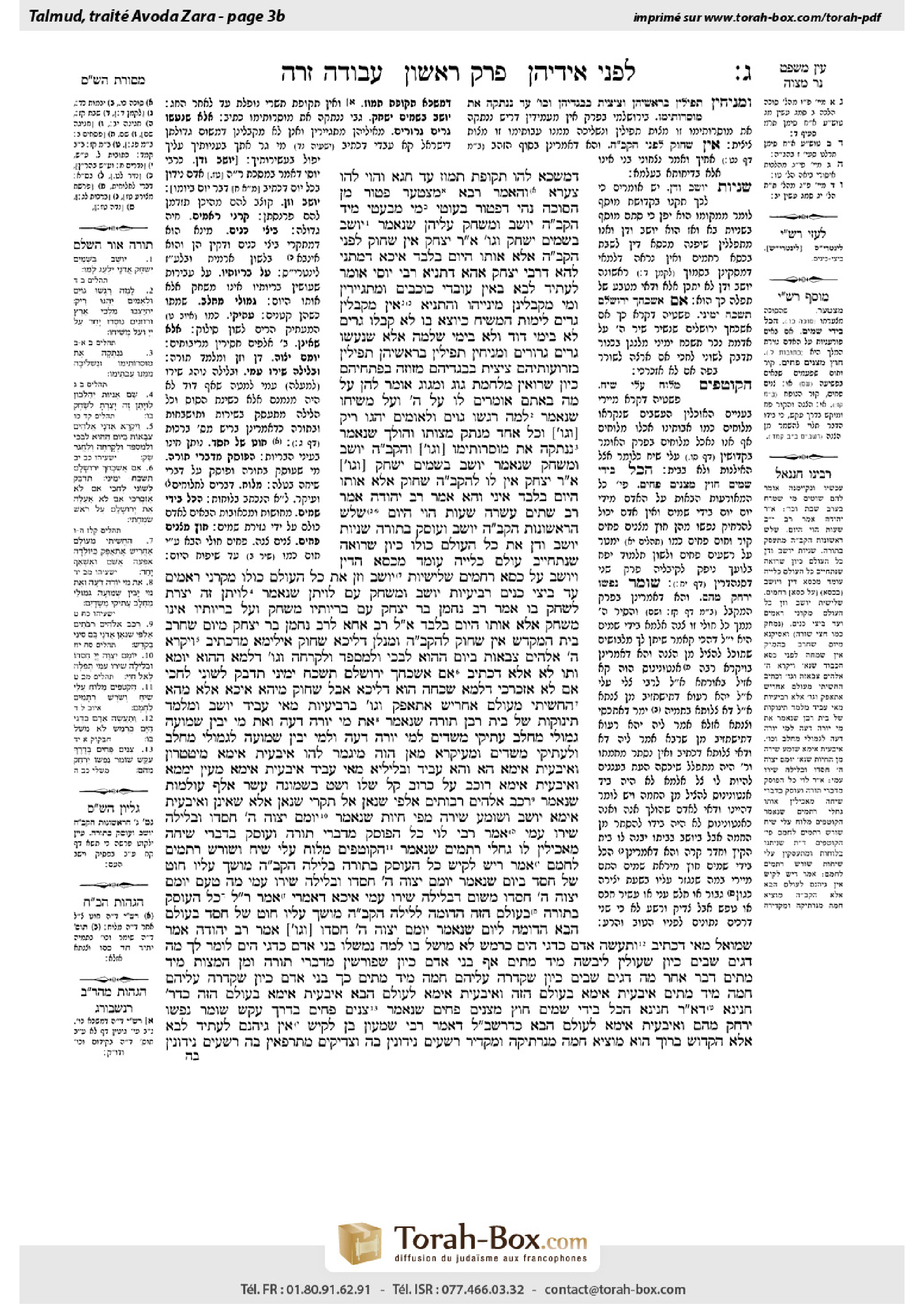
Avodah Zarah 3b: Talmud study for Daf Yomi
Study the Talmud for Daf Yomi with scanned pages, Hebrew text, English translations from Sefaria and AI-generated French translations.
Passage selection and English or AI-generated French translation are available where the scan has annotations. Daf Study is independent of Torah-Box and Sefaria.
Browse Avodah Zarah · עבודה זרה · All tractatesAvodah Zarah 3b text and translations
This page of Avodah Zarah includes the Aramaic text, an English translation and an AI-generated French translation, alongside the scan above.
עבודה זרה ג׳ ב · Aramaic and Hebrew text
דְּמָשְׁכָא לְהוּ תְּקוּפַת תַּמּוּז עַד חַגָּא, וְהָוֵי לְהוּ צַעֲרָא. וְהָאָמַר רָבָא: מִצְטַעֵר פָּטוּר מִן הַסּוּכָּה! נְהִי דְּפָטוּר, בַּעוֹטֵי מִי מְבַעֲטִי?
מִיָּד, הַקָּדוֹשׁ בָּרוּךְ הוּא יוֹשֵׁב וּמְשַׂחֵק עֲלֵיהֶן, שֶׁנֶּאֱמַר: ״יוֹשֵׁב בַּשָּׁמַיִם יִשְׂחָק וְגוֹ׳״. אָמַר רַבִּי יִצְחָק: אֵין שְׂחוֹק לִפְנֵי הַקָּדוֹשׁ בָּרוּךְ הוּא אֶלָּא אוֹתוֹ הַיּוֹם בִּלְבַד.
אִיכָּא דְּמַתְנֵי לְהָא דְּרַבִּי יִצְחָק אַהָא, דְּתַנְיָא: רַבִּי יוֹסֵי אוֹמֵר: לְעָתִיד לָבֹא בָּאִין אוּמּוֹת הָעוֹלָם וּמִתְגַּיְּירִין. וּמִי מְקַבְּלִינַן מִינַּיְיהוּ? וְהָתַנְיָא: אֵין מְקַבְּלִין גֵּרִים לִימוֹת הַמָּשִׁיחַ, כַּיּוֹצֵא בוֹ לֹא קִבְּלוּ גֵּרִים לֹא בִּימֵי דָוִד וְלֹא בִּימֵי שְׁלֹמֹה!
אֶלָּא שֶׁנַּעֲשׂוּ גֵּרִים גְּרוּרִים, וּמַנִּיחִין תְּפִילִּין בְּרָאשֵׁיהֶן, תְּפִילִּין בִּזְרוֹעוֹתֵיהֶם, צִיצִית בְּבִגְדֵיהֶם, מְזוּזָה בְּפִתְחֵיהֶם.
כֵּיוָן שֶׁרוֹאִין מִלְחֶמֶת גּוֹג וּמָגוֹג, אוֹמֵר לָהֶן: עַל מָה בָּאתֶם? אוֹמְרִים לוֹ: עַל ה׳ וְעַל מְשִׁיחוֹ, שֶׁנֶּאֱמַר: ״לָמָּה רָגְשׁוּ גוֹיִם וּלְאֻמִּים יֶהְגּוּ רִיק וְגוֹ׳״,
וְכׇל אֶחָד מְנַתֵּק מִצְוָתוֹ וְהוֹלֵךְ, שֶׁנֶּאֱמַר: ״נְנַתְּקָה אֶת מוֹסְרוֹתֵימוֹ וְגוֹ׳״, וְהַקָּדוֹשׁ בָּרוּךְ הוּא יוֹשֵׁב וּמְשַׂחֵק, שֶׁנֶּאֱמַר: ״יוֹשֵׁב בַּשָּׁמַיִם יִשְׁחָק וְגוֹ׳״. אָמַר רַבִּי יִצְחָק: אֵין לוֹ לְהַקָּדוֹשׁ בָּרוּךְ הוּא שְׂחוֹק אֶלָּא אוֹתוֹ הַיּוֹם בִּלְבַד.
אִינִי? וְהָא אָמַר רַב יְהוּדָה אָמַר רַב: שְׁתֵּים עֶשְׂרֵה שָׁעוֹת הָוֵי הַיּוֹם, שָׁלֹשׁ הָרִאשׁוֹנוֹת — הַקָּדוֹשׁ בָּרוּךְ הוּא יוֹשֵׁב וְעוֹסֵק בַּתּוֹרָה, שְׁנִיּוֹת — יוֹשֵׁב וְדָן אֶת כָּל הָעוֹלָם כּוּלּוֹ, כֵּיוָן שֶׁרוֹאֶה שֶׁנִּתְחַיֵּיב עוֹלָם כְּלָיָיה — עוֹמֵד מִכִּסֵּא הַדִּין וְיוֹשֵׁב עַל כִּסֵּא רַחֲמִים,
שְׁלִישִׁיּוֹת — יוֹשֵׁב וְזָן אֶת כָּל הָעוֹלָם כּוּלּוֹ מִקַּרְנֵי רֵאמִים עַד בֵּיצֵי כִנִּים, רְבִיעִיּוֹת — יוֹשֵׁב וּמְשַׂחֵק עִם לִוְיָתָן, שֶׁנֶּאֱמַר: ״לִוְיָתָן זֶה יָצַרְתָּ לְשַׂחֶק בּוֹ״, אָמַר רַב נַחְמָן בַּר יִצְחָק: עִם בְּרִיּוֹתָיו מְשַׂחֵק, וְעַל בְּרִיּוֹתָיו אֵינוֹ מְשַׂחֵק אֶלָּא אוֹתוֹ הַיּוֹם בִּלְבַד.
אֲמַר לֵיהּ רַב אַחָא לְרַב נַחְמָן בַּר יִצְחָק: מִיּוֹם שֶׁחָרַב בֵּית הַמִּקְדָּשׁ אֵין שְׂחוֹק לְהַקָּדוֹשׁ בָּרוּךְ הוּא. וּמְנָלַן דְּלֵיכָּא שְׂחוֹק? אִילֵּימָא מִדִּכְתִיב: ״וַיִּקְרָא ה׳ אֱלֹהִים צְבָאוֹת בַּיּוֹם הַהוּא לִבְכִי וּלְמִסְפֵּד וּלְקׇרְחָה וְגוֹ׳״, דִּלְמָא הָהוּא יוֹמָא וְתוּ לָא!
אֶלָּא דִּכְתִיב: ״אִם אֶשְׁכָּחֵךְ יְרוּשָׁלִָם תִּשְׁכַּח יְמִינִי תִּדְבַּק לְשׁוֹנִי לְחִכִּי אִם לֹא אֶזְכְּרֵכִי״, דִּלְמָא שִׁכְחָה הוּא דְּלֵיכָּא, אֲבָל שְׂחוֹק מִיהָא אִיכָּא! אֶלָּא מֵהָא: ״הֶחֱשֵׁיתִי מֵעוֹלָם אַחֲרִישׁ אֶתְאַפָּק וְגוֹ׳״.
בִּרְבִיעִיּוֹת מַאי עָבֵיד? יוֹשֵׁב וּמְלַמֵּד תִּינוֹקוֹת שֶׁל בֵּית רַבָּן תּוֹרָה, שֶׁנֶּאֱמַר: ״אֶת מִי יוֹרֶה דֵעָה וְאֶת מִי יָבִין שְׁמוּעָה גְּמוּלֵי מֵחָלָב עַתִּיקֵי מִשָּׁדָיִם״. לְמִי יוֹרֶה דֵּעָה וּלְמִי יָבִין שְׁמוּעָה? לִגְמוּלֵי מֵחָלָב וּלְעַתִּיקֵי מִשָּׁדַיִם.
וּמֵעִיקָּרָא מַאן הֲוָה מַיגְמַר לְהוּ? אִיבָּעֵית אֵימָא: מֶיטַטְרוֹן, וְאִיבָּעֵית אֵימָא: הָא וְהָא עָבֵיד.
וּבְלֵילְיָא מַאי עָבֵיד? אִיבָּעֵית אֵימָא: מֵעֵין יְמָמָא, וְאִיבָּעֵית אֵימָא: רוֹכֵב עַל כְּרוּב קַל שֶׁלּוֹ וְשָׁט בִּשְׁמוֹנָה עָשָׂר אֶלֶף עוֹלָמוֹת, שֶׁנֶּאֱמַר: ״רֶכֶב אֱלֹהִים רִבֹּתַיִם אַלְפֵי שִׁנְאָן״, אַל תִּקְרֵי ״שִׁנְאָן״ אֶלָּא ״שֶׁאֵינָן״, וְאִיבָּעֵית אֵימָא: יוֹשֵׁב וְשׁוֹמֵעַ שִׁירָה מִפִּי חַיּוֹת, שֶׁנֶּאֱמַר: ״יוֹמָם יְצַוֶּה ה׳ חַסְדּוֹ וּבַלַּיְלָה שִׁירֹה עִמִּי״.
אָמַר רַבִּי לֵוִי: כׇּל הַפּוֹסֵק מִדִּבְרֵי תוֹרָה וְעוֹסֵק בְּדִבְרֵי שִׂיחָה מַאֲכִילִין לוֹ גַּחֲלֵי רְתָמִים, שֶׁנֶּאֱמַר: ״הַקֹּטְפִים מַלּוּחַ עֲלֵי שִׂיחַ וְשֹׁרֶשׁ רְתָמִים לַחְמָם״. אָמַר רֵישׁ לָקִישׁ: כׇּל הָעוֹסֵק בַּתּוֹרָה בַּלַּיְלָה הַקָּדוֹשׁ בָּרוּךְ הוּא מוֹשֵׁךְ עָלָיו חוּט שֶׁל חֶסֶד בַּיּוֹם, שֶׁנֶּאֱמַר: ״יוֹמָם יְצַוֶּה ה׳ חַסְדּוֹ וּבַלַּיְלָה שִׁירֹה עִמִּי״. מָה טַעַם ״יוֹמָם יְצַוֶּה ה׳ חַסְדּוֹ״? מִשּׁוּם דְּבַלַּיְלָה שִׁירוֹ עִמִּי.
אִיכָּא דְאָמְרִי, אָמַר רֵישׁ לָקִישׁ: כׇּל הָעוֹסֵק בַּתּוֹרָה בָּעוֹלָם הַזֶּה הַדּוֹמֶה לְלַיְלָה — הַקָּדוֹשׁ בָּרוּךְ הוּא מוֹשֵׁךְ עָלָיו חוּט שֶׁל חֶסֶד בָּעוֹלָם הַבָּא הַדּוֹמֶה לְיוֹם, שֶׁנֶּאֱמַר: ״יוֹמָם יְצַוֶּה ה׳ חַסְדּוֹ וְגוֹ׳״.
אָמַר רַב יְהוּדָה אָמַר שְׁמוּאֵל, מַאי דִּכְתִיב: ״וַתַּעֲשֶׂה אָדָם כִּדְגֵי הַיָּם כְּרֶמֶשׂ לֹא מֹשֵׁל בּוֹ״, לָמָּה נִמְשְׁלוּ בְּנֵי אָדָם כִּדְגֵי הַיָּם? לוֹמַר לָךְ: מָה דָּגִים שֶׁבַּיָּם — כֵּיוָן שֶׁעוֹלִין לַיַּבָּשָׁה מִיָּד מֵתִים, אַף בְּנֵי אָדָם — כֵּיוָן שֶׁפּוֹרְשִׁין מִדִּבְרֵי תוֹרָה וּמִן הַמִּצְוֹת מִיָּד מֵתִים. דָּבָר אַחֵר: מָה דָּגִים שֶׁבַּיָּם — כֵּיוָן שֶׁקָּדְרָה עֲלֵיהֶם חַמָּה מִיָּד מֵתִים, כָּךְ בְּנֵי אָדָם — כֵּיוָן שֶׁקָּדְרָה עֲלֵיהֶם חַמָּה מִיָּד מֵתִים.
אִיבָּעֵית אֵימָא בָּעוֹלָם הַזֶּה, וְאִיבָּעֵית אֵימָא לָעוֹלָם הַבָּא. אִיבָּעֵית אֵימָא בָּעוֹלָם הַזֶּה — כִּדְרַבִּי חֲנִינָא, דְּאָמַר רַבִּי חֲנִינָא: הַכֹּל בִּידֵי שָׁמַיִם חוּץ מִצִּנִּים פַּחִים, שֶׁנֶּאֱמַר: ״צִנִּים פַּחִים בְּדֶרֶךְ עִקֵּשׁ שׁוֹמֵר נַפְשׁוֹ יִרְחַק מֵהֶם״.
וְאִיבָּעֵית אֵימָא לָעוֹלָם הַבָּא — כִּדְרַבִּי שִׁמְעוֹן בֶּן לָקִישׁ, דְּאָמַר רַבִּי שִׁמְעוֹן בֶּן לָקִישׁ: אֵין גֵּיהִנָּם לֶעָתִיד לָבֹא, אֶלָּא הַקָּדוֹשׁ בָּרוּךְ הוּא מוֹצִיא חַמָּה מִנַּרְתִּיקָהּ, וּמַקְדִּיר, רְשָׁעִים נִידּוֹנִין בָּהּ, וְצַדִּיקִים מִתְרַפְּאִין בָּהּ, רְשָׁעִים נִידּוֹנִין
Avodah Zarah 3b · English translation
when the season of Tammuz extends until the festival of Sukkot, and in such years sitting in the sukka causes them suffering. The Gemara asks: But doesn’t Rava say that one who suffers in the sukka is exempt from performing the mitzva of sukka, and under these circumstances even a Jew is permitted to leave the sukka? If so, why are the gentiles criticized for leaving? The Gemara answers: Granted that one is exempt from performing the mitzva and is permitted to leave his sukka, but should one kick it?
The Gemara resumes its narration: Immediately, the Holy One, Blessed be He, sits and makes sport of those gentiles, i.e., He laughs at them, as it is stated: “He that sits in heaven makes sport, the Lord has them in derision” (Psalms 2:4). With regard to this verse, Rabbi Yitzḥak says: There is no making sport for the Holy One, Blessed be He, but on that day alone.
There are those who teach that which Rabbi Yitzḥak subsequently said with regard to this matter, as it is taught in a baraita that Rabbi Yosei says: In the future, the nations of the world will come and convert. The Gemara asks: And do we accept them as converts at that time? But isn’t it taught in another baraita: The court does not accept converts in the days of the Messiah; similarly, they did not accept converts either in the days of David or in the days of Solomon, due to a concern that these people wanted to convert for ulterior motives, because the Jewish people were mighty and respected?
Rather, Rabbi Yosei means that they become converts who have attached themselves to the Jewish people, and they don phylacteries on their heads, phylacteries on their arms, place ritual fringes on their garments, and a mezuza in their doorways.
When these converts see the war of Gog and Magog, every convert of this sort will say to Gog and Magog: For what purpose did you come? They will say to him: We came to fight against the Lord and against His Messiah, as it is stated: “Why are the nations in an uproar? And why do the peoples mutter in vain. The kings of the earth stand up, and the rulers take counsel together, against the Lord, and against His Messiah” (Psalms 2:1–2).
And then every one of these converts will tear loose his sign of performance of a mitzva and leave, as it is stated: “Let us tear their bands asunder, and cast away their cords from us” (Psalms 2:3). And the Holy One, Blessed be He, sits and makes sport, i.e., laughs or rejoices, as it is stated: “He that sits in heaven makes sport, the Lord has them in derision” (Psalms 2:4). Rabbi Yitzḥak says: There is no making sport for the Holy One, Blessed be He, but on that day alone.
The Gemara asks: Is that so? Is there no making sport for the Holy One, Blessed be He? But doesn’t Rav Yehuda say that Rav says: There are twelve hours in the day. During the first three, the Holy One, Blessed be He, sits and engages in Torah study. During the second three hours, He sits and judges the entire world. Once He sees that the world has rendered itself liable to destruction, He arises from the throne of judgment and sits on the throne of mercy, and the world is not destroyed.
During the third set of three hours, the Holy One, Blessed be He, sits and sustains the entire world, from the horns of wild oxen to the eggs of lice. During the fourth three hours, He sits and makes sport with the leviathan, as it is stated: “There is leviathan, whom You have formed to sport with” (Psalms 104:26). Evidently, God makes sport every day, not only on that one day. Rav Naḥman bar Yitzḥak says in explanation: He makes sport with His creations, just as He sports with the leviathan; He does not make sport of His creations but on that day alone.
Rav Aḥa said to Rav Naḥman bar Yitzḥak: From the day the Temple was destroyed, there is no longer any making sport for the Holy One, Blessed be He. And from where do we derive that there is no making sport? If we say that it is from that which is written: “And in that day did the Lord, the God of hosts, call to weeping, and to lamentation, and to baldness and to girding with sackcloth” (Isaiah 22:12), that is inconclusive: Perhaps that day alone was called for weeping and lamentation, and no additional days.
Rather, you might suggest that the source is that it is written: “If I forget you, O Jerusalem, let my right hand forget her cunning. Let my tongue cleave to the roof of my mouth, if I do not remember you” (Psalms 137:5–6). This is also inconclusive, as perhaps there is no forgetting of Jerusalem for God, but in any event there is still making sport. Rather, it is derived from this verse: “I have long time held My peace, I have been still, and refrained Myself; now will I cry like a travailing woman, gasping and panting at once” (Isaiah 42:14).
The Gemara asks: If God no longer makes sport, what does He now do during the fourth three-hour period of the day? The Gemara answers: He sits and teaches Torah to schoolchildren, as it is stated: “Whom shall one teach knowledge? And whom shall one make to understand the message? Them that are weaned from the milk, them that are drawn from the breasts” (Isaiah 28:9). The verse is interpreted in the following manner: To whom does God teach knowledge, and to whom does He make to understand the message? To those who are just weaned from the milk and to those who are drawn from the breasts, i.e., children only recently weaned from nursing.
The Gemara asks: And initially, before the destruction of the Temple, who would teach the schoolchildren? The Gemara answers: If you wish, say that the angel Metatron would teach them, and if you wish, say instead that He would do both this, sport with the leviathan, and that, teach the schoolchildren; whereas after the destruction of the Temple in the fourth period of the day He only teaches the schoolchildren.
The Gemara asks: And during the twelve hours of the night, what does God do? The Gemara answers: If you wish, say that the night is similar to the day, i.e., God performs the same activities as in the day. And if you wish, say instead that He rides on his light cherub and flies in eighteen thousand worlds, as it is stated: “The chariots of God are twenty thousand, even [shinan] thousands” (Psalms 68:18). Do not read it as even [shinan], rather read it as: That which are not [she’einan]. Since the minimum of thousands is two thousand, the phrase: That which are not thousands, indicates that two thousand are not present, i.e., the chariots of God are twenty thousand minus two thousand, which means that God rides in eighteen thousand worlds. And if you wish, say instead that God sits and listens to the songs from the mouths of the angelic creatures, as it is stated: “By day the Lord will command His loving-kindness, and in the night His song shall be with me” (Psalms 42:9).
§ Rabbi Levi says: Anyone who interrupts his study of words of Torah to occupy himself with mundane matters will be fed with the coals of the broom tree, as it is stated: “They pluck salt-wort from wormwood, and the roots of the broom are their food” (Job 30:4). Reish Lakish says: With regard to anyone who occupies himself with Torah at night, the Holy One, Blessed be He, extends a thread of kindness over him by day, as it is stated: “By day, the Lord will command His kindness, and in the night His song shall be with me” (Psalms 42:9). The verse is understood as follows: What is the reason that by day, the Lord will command His kindness to extend over him? It is due to the fact that in the night His song is with me, i.e., he occupies himself at night with Torah, which is referred to as a song.
There are those who say that this is what Reish Lakish says: With regard to anyone who occupies himself with Torah in this world, which is comparable to night, the Holy One, Blessed be He, extends a thread of kindness over him in the World-to-Come, which is comparable to day, as it is stated: “By day, the Lord will command His kindness, and in the night His song shall be with me.”
The Gemara continues discussing the importance of Torah study. Rav Yehuda says that Shmuel says: What is the meaning of that which is written: “And makes people as the fish of the sea, as the creeping things, that have no ruler over them” (Habakkuk 1:14)? Why are people compared to the fish of the sea? This serves to say to you: Just as with regard to the fish of the sea, once they arise onto dry land they die immediately; so too, with regard to people, once they separate themselves from studying words of Torah and performing the mitzvot, they die immediately. Alternatively, just as with regard to the fish of the sea, once the sun is heated over them they die immediately, so too with regard to people, once the sun is heated over them they die immediately.
The Gemara clarifies: If you wish, say that this applies in this world, and if you wish, say instead that it applies to the World-to-Come. If you wish, say that it applies in this world, in accordance with the opinion of Rabbi Ḥanina. As Rabbi Ḥanina says: All occurrences that befall man are in the hands of Heaven except for colds and obstacles [paḥim], from which one is able to protect himself, as it is stated: “Colds and snares are on the path of the crooked; he who guards his soul shall keep far from them” (Proverbs 22:5). This indicates that cold and, conversely, heat, are forms of harm from which one must protect himself, which teaches that being exposed to excessive heat can cause death.
And if you wish, say instead that this is referring to the World-to-Come, in accordance with the statement of Rabbi Shimon ben Lakish. As Rabbi Shimon ben Lakish says: There is no Gehenna in the World-to-Come. Rather, the Holy One, Blessed be He, will remove the sun from its sheath [minnarteikah], where it is situated during these times, and heats [umakdir] that world with it. The wicked will be punished by it and consumed by the heat, but the righteous will be healed by it. The wicked will be punished
Avodah Zarah 3b · Traduction française (IA)
lorsque la saison de Tammuz s'étend jusqu'au festival de Sucot, et dans ces années, rester dans la sukka cause des souffrances. La Guemara pose la question : Mais ne dit pas Rava que celui qui souffre dans la sukka est exempt de l'accomplissement de la mitsva de sukka, et dans ces circonstances même un Juif est autorisé à sortir de la sukka ? Si c'est ainsi, pourquoi les non-Juifs sont-ils blâmés pour avoir quitté ? La Guemara répond : Bien que l'on soit exempt de l'accomplissement de la mitsva et autorisé à sortir de sa sukka, ne devrait-on pas en avoir marre de cela ?
La Guemara reprend son récit : Aussitôt, le Saint, le Très Haut, s'assoit et rit de ces non-Juifs, c'est-à-dire qu'Il se moque d'eux, comme il est dit : « Celui qui s'assoit au ciel rit, l'Éternel les fait de la sorte » (Psaumes 2:4). En ce qui concerne cette versette, Rabbi Yitzhak dit : Il n'y a pas de moquerie faite par le Saint, le Très Haut, mais ce jour-là seulement.
Certains enseignent ce que Rabbi Yitzhak a ensuite dit à propos de cette affaire, comme il est enseigné dans une baraïta que Rabbi Yosei dit : Dans l'avenir, les nations du monde viendront et se convertiront. La Guemara pose la question : Et acceptons-nous ces convertis à cette époque ? Mais n'est-il pas enseigné dans une autre baraïta : Le tribunal ne reçoit pas les convertis pendant les jours du Messie ; de même, il ne les acceptait pas pendant les jours de David ou de Salomon, en raison d'une crainte que ces gens souhaitaient se convertir pour des motifs étrangers, parce que le peuple juif était puissant et respecté ?
Plutôt, Rabbi Yosei veut dire qu'ils deviennent des convertis qui s'attachent au peuple juif, et ils portent des phylactères sur leur tête, des phylactères sur leurs bras, mettent des franges rituelles sur leurs vêtements et une mezuza à leurs portes.
Lorsque ces convertis voient la guerre de Gog et de Magog, chaque converti de ce genre dira à Gog et à Magog : Pourquoi êtes-vous venus ? Ils diront à lui : Nous sommes venus pour combattre l'Éternel et contre Son Messie, comme il est dit : « Pourquoi les nations s'agitent-elles ? Et pourquoi les peuples murmurent-ils en vain. Les rois de la terre se lèvent, et les chefs concertent ensemble contre l'Éternel, et contre Son Messie » (Psaumes 2:1–2).
Et alors chaque un de ces convertis déchirera le signe de l'accomplissement d'une mitsva et quittera, comme il est dit : « Faisons-nous déchirer leurs bandes, et jetons-nous leurs cordes de nous » (Psaumes 2:3). Et le Saint, le Très Haut, s'assoit et fait du sport, c'est-à-dire rit ou se réjouit, comme il est dit : « Celui qui s'assoit au ciel rit, l'Éternel les fait de la sorte » (Psaumes 2:4). Rabbi Yitzhak dit : Il n'y a pas de sport fait par le Saint, le Très Haut, mais ce jour-là seulement.
La Guemara pose la question : Est-ce ainsi ? N'y a-t-il pas de sport fait par le Saint, le Très Haut ? Mais ne dit pas Rav Yehuda que Rav dit : Il y a douze heures dans la journée. Durant les trois premières heures, le Saint, le Très Haut, s'assoit et étudie la Torah. Durant les trois heures suivantes, Il s'assoit et juge le monde entier. Une fois qu'Il voit que le monde s'est rendu coupable de destruction, Il se lève du trône de jugement et s'assoit sur le trône de miséricorde, et le monde n'est pas détruit.
Durant les trois heures suivantes, le Saint, le Très Haut, s'assoit et sustente le monde entier, du cor de bison sauvage à l'œuf de poule. Durant les trois heures suivantes, Il s'assoit et fait du sport avec le léviathan, comme il est dit : « Il y a le léviathan, que Tu as formé pour faire du sport » (Psaumes 104:26). Évidemment, Dieu fait du sport tous les jours, pas seulement ce jour-là. Rav Naḥman bar Yitzḥak dit en explication : Il fait du sport avec Ses créations, tout comme Il fait du sport avec le léviathan ; Il ne fait pas du sport de Ses créations mais ce jour-là seulement.
Rav Aḥa dit à Rav Naḥman bar Yitzḥak : Depuis la destruction du Temple, il n'y a plus de sport fait par le Saint, le Très Haut. Et d'où dérivons-nous que le sport n'existe plus ? Si nous disons que c'est à partir de ce qui est écrit : « Et ce jour-là, l'Éternel, le Seigneur des armées, appela à la douleur, à la lamentation, à la perte de cheveux et à la ceinture de sacs » (Yachin 22:12), cela n'est pas concluant : Peut-être que ce jour-là seul a été appelé à la douleur et à la lamentation, et pas d'autres jours.
Plutôt, vous pourriez suggérer que la source est que cela est écrit : « Si je oublie toi, Jérusalem, que mon bras oublie sa ruse. Que ma langue se fixe au plafond de ma bouche, si je ne t'oublie pas » (Psaumes 137:5–6). Cela est également inconcluant, car peut-être qu'il n'y a pas d'oubli de Jérusalem pour Dieu, mais en tout cas il y a encore du sport. Plutôt, il est dérivé de cette versette : « J'ai longtemps tenu ma paix, j'ai été silencieux, et j'ai gardé ma tranquillité ; maintenant je crierai comme une femme en travail, souffrant et haletant à la fois » (Isaïe 42:14).
La Guemara pose la question : Si Dieu ne fait plus de sport, que fait-il maintenant durant la quatrième période de trois heures de la journée ? La Guemara répond : Il s'assoit et enseigne la Torah aux enfants, comme il est dit : « À qui enseignera-t-on la connaissance ? Et à qui fera-t-on comprendre le message ? À ceux qui sont séparés du lait, à ceux qui sont arrachés aux mamelles » (Isaïe 28:9). La versette est interprétée ainsi : À qui Dieu enseigne-t-il la connaissance, et à qui fait-il comprendre le message ? À ceux qui sont juste séparés du lait et à ceux qui sont arrachés aux mamelles, c'est-à-dire aux enfants récemment séparés de la tétée.
La Guemara pose la question : Et d'abord, avant la destruction du Temple, qui enseignait aux enfants ? La Guemara répond : Si vous le souhaitez, dites que l'ange Méta'aton enseignait à ces enfants, et si vous le souhaitez, dites plutôt qu'Il faisait à la fois ce qu'il y a de plus, faire du sport avec le léviathan, et cela, enseigner aux enfants ; alors que, après la destruction du Temple, durant la quatrième période de la journée, Il ne faisait que l'enseignement aux enfants.
La Guemara pose la question : Et durant les douze heures de la nuit, que fait Dieu ? La Guemara répond : Si tu veux, dis que la nuit est semblable au jour, c'est-à-dire que Dieu effectue les mêmes activités qu'au jour. Et si tu veux, dis plutôt qu'Il monte sur son cherub lumineux et voyage dans dix-huit mille mondes, comme il est dit : « Les chars de Dieu sont vingt mille, même [shinan] des milliers » (Psaumes 68:18). Ne le lis pas comme « même [shinan] », mais comme « ce qui n'est pas [she’einan] ». Puisque le minimum des milliers est deux mille, la phrase « ce qui n'est pas des milliers » indique que deux mille ne sont pas présents, c'est-à-dire que les chars de Dieu sont vingt mille moins deux mille, ce qui signifie que Dieu voyage dans dix-huit mille mondes. Et si tu veux, dis plutôt qu'Il s'assoit et écoute les chants qui sortent des bouches des créatures angéliques, comme il est dit : « Le jour, le Seigneur commandera Sa bonté, et la nuit Son chant sera avec moi » (Psaumes 42:9).
§ Rabbi Levi dit : Celui qui interrompt son étude des paroles de la Torah pour se consacrer à des affaires terrestres sera nourri avec les cendres de l'arbre de la broom, comme il est dit : « Ils arrachent la salicine du genévrier, et les racines de la broom sont leur nourriture » (Job 30:4). Reish Lakish dit : En ce qui concerne celui qui s'occupe de la Torah la nuit, le Saint, le Bienheureux, étend un fil de bonté sur lui le jour, comme il est dit : « Le jour, le Seigneur commandera Sa bonté, et la nuit Son chant sera avec moi » (Psaumes 42:9). La verset est comprise ainsi : Pourquoi le Seigneur commandera-t-il Sa bonté sur lui le jour ? C'est à cause que la nuit Son chant est avec moi, c'est-à-dire qu'il s'occupe de la Torah la nuit, ce qui est appelé un chant.
Il y a ceux qui disent que c'est ce que dit Reish Lakish : En ce qui concerne celui qui s'occupe de la Torah dans ce monde, qui est comparable à la nuit, le Saint, le Bienheureux, étend un fil de bonté sur lui dans le Monde à Venir, qui est comparable au jour, comme il est dit : « Le jour, le Seigneur commandera Sa bonté, et la nuit Son chant sera avec moi. »
La Guemara continue sur l'importance de l'étude de la Torah. Rav Yehuda dit que Shmuel dit : Quelle est la signification de ce qui est écrit : « Et il fait des hommes comme les poissons de la mer, comme les créatures rampantes, qui n'ont pas de maître » (Habacuc 1:14) ? Pourquoi les hommes sont-ils comparés aux poissons de la mer ? Cela sert à te dire : Comme les poissons de la mer, une fois qu'ils montent sur la terre ferme, ils meurent immédiatement ; de même, avec les hommes, une fois qu'ils se séparent de l'étude des paroles de la Torah et de la performance des mitsvot, ils meurent immédiatement. Alternativement, comme les poissons de la mer, une fois que le soleil les brûle, ils meurent immédiatement ; de même avec les hommes, une fois que le soleil les brûle, ils meurent immédiatement.
La Guemara clarifie : Si tu veux, dis que cela s'applique dans ce monde, et si tu veux, dis plutôt qu'il s'applique au Monde à Venir. Si tu veux, dis que cela s'applique dans ce monde, selon l'opinion de Rabbi Ḥanina. Comme Rabbi Ḥanina dit : Toutes les occurrences qui affectent l'homme sont entre les mains de Dieu, sauf les maladies et les obstacles [paḥim], desquels on peut se protéger, comme il est dit : « Les maladies et les pièges sont sur le chemin du déviant ; celui qui garde son âme restera éloigné d'eux » (Proverbes 22:5). Cela indique que le froid et, à l'inverse, la chaleur, sont des formes de malheur desquels on doit se protéger, ce qui enseigne que l'exposition à une chaleur excessive peut causer la mort.
Et si tu veux, dis plutôt que cela fait référence au Monde à Venir, selon la déclaration de Rabbi Shimon ben Lakish. Comme Rabbi Shimon ben Lakish dit : Il n'y a pas de Gehenna dans le Monde à Venir. Plutôt, le Saint, le Bienheureux, retirera le soleil de son fourreau [minnarteikah], où il est situé durant ces temps, et il réchauffera ce monde avec lui. Les méchants seront punis par cela et consumés par la chaleur, mais les justes seront guéris par cela. Les méchants seront punis
Traduction française générée par IA à partir de l’édition anglaise de Sefaria. Vérifie toujours un passage avec le texte source.
Text from Sefaria: William Davidson Edition - Vocalized Aramaic (CC BY NC); William Davidson Edition - English (CC BY NC).