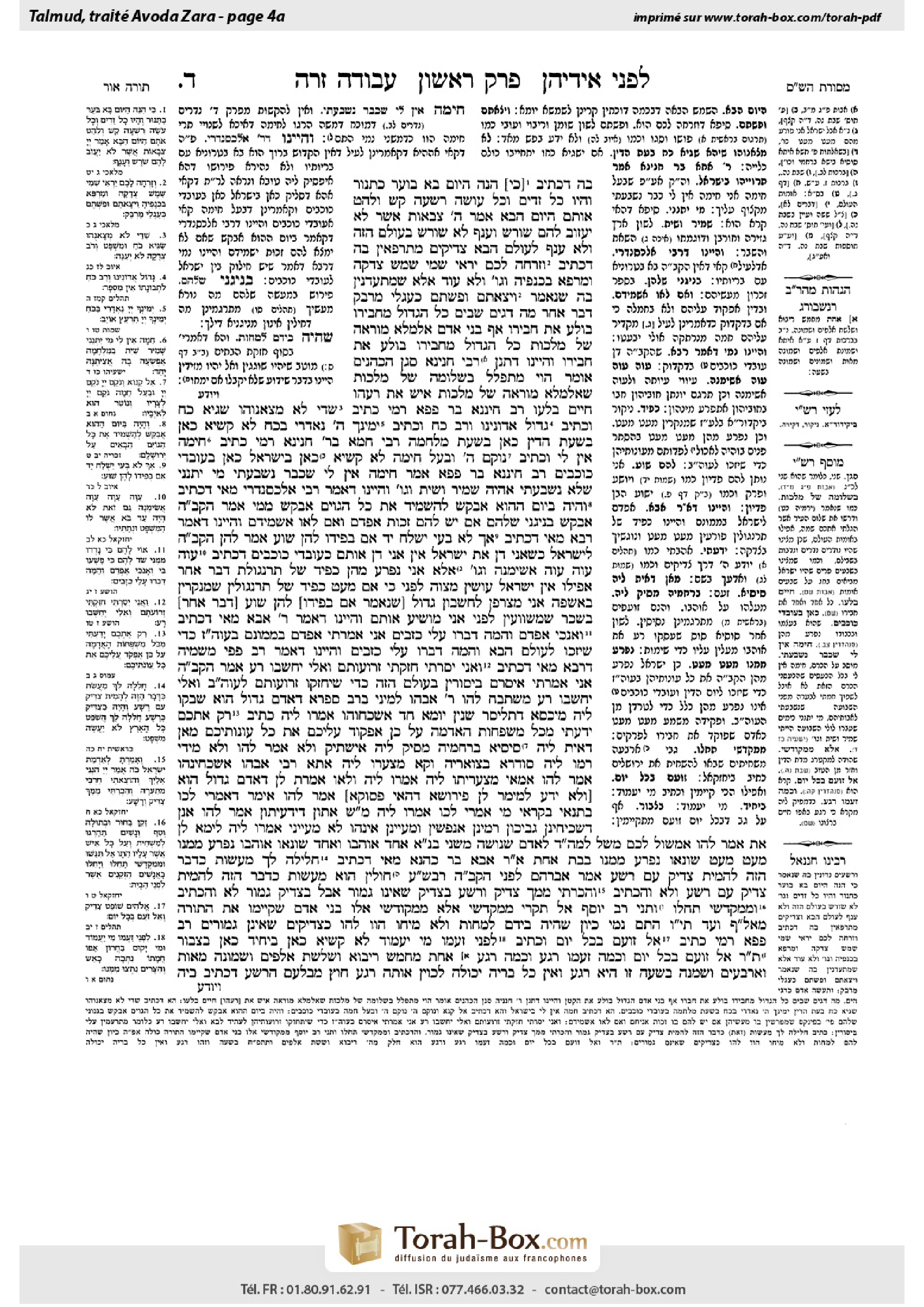
Avodah Zarah 4a: Talmud study for Daf Yomi
Study the Talmud for Daf Yomi with scanned pages, Hebrew text, English translations from Sefaria and AI-generated French translations.
Passage selection and English or AI-generated French translation are available where the scan has annotations. Daf Study is independent of Torah-Box and Sefaria.
Browse Avodah Zarah · עבודה זרה · All tractatesAvodah Zarah 4a text and translations
This page of Avodah Zarah includes the Aramaic text, an English translation and an AI-generated French translation, alongside the scan above.
עבודה זרה ד׳ א · Aramaic and Hebrew text
בָּהּ, דִּכְתִיב: ״[כִּי] הִנֵּה הַיּוֹם בָּא בֹּעֵר כַּתַּנּוּר וְהָיוּ כׇל זֵדִים וְכׇל עֹשֵׂה רִשְׁעָה קַשׁ וְלִהַט אֹתָם הַיּוֹם הַבָא אָמַר ה׳ צְבָאוֹת אֲשֶׁר לֹא יַעֲזֹב לָהֶם שֹׁרֶשׁ וְעָנָף״, לֹא שׁוֹרֶשׁ — בָּעוֹלָם הַזֶּה, וְלֹא עָנָף — לָעוֹלָם הַבָּא.
צַדִּיקִים מִתְרַפְּאִין בָּהּ, דִּכְתִיב: ״וְזָרְחָה לָכֶם יִרְאֵי שְׁמִי שֶׁמֶשׁ צְדָקָה וּמַרְפֵּא בִּכְנָפֶיהָ וְגוֹ׳״, וְלֹא עוֹד אֶלָּא שֶׁמִּתְעַדְּנִין בָּהּ, שֶׁנֶּאֱמַר: ״וִיצָאתֶם וּפִשְׁתֶּם כְּעֶגְלֵי מַרְבֵּק״.
דָּבָר אַחֵר: מָה דָּגִים שֶׁבַּיָּם — כׇּל הַגָּדוֹל מֵחֲבֵירוֹ בּוֹלֵעַ אֶת חֲבֵירוֹ, אַף בְּנֵי אָדָם — אִלְמָלֵא מוֹרָאָה שֶׁל מַלְכוּת, כָּל הַגָּדוֹל מֵחֲבֵירוֹ בּוֹלֵעַ אֶת חֲבֵירוֹ. וְהַיְינוּ דִּתְנַן: רַבִּי חֲנִינָא סְגַן הַכֹּהֲנִים אוֹמֵר: הֱוֵי מִתְפַּלֵּל בִּשְׁלוֹמָהּ שֶׁל מַלְכוּת, שֶׁאִלְמָלֵא מוֹרָאָהּ שֶׁל מַלְכוּת ״אִישׁ אֶת רֵעֵהוּ חַיִּים בָּלָעוּ״.
רַב חִינָּנָא בַּר פָּפָּא רָמֵי, כְּתִיב: ״שַׁדַּי לֹא מְצָאנֻהוּ שַׂגִּיא כֹחַ״, וּכְתִיב: ״גָּדוֹל אֲדוֹנֵינוּ וְרַב כֹּחַ״, וּכְתִיב: ״יְמִינְךָ ה׳ נֶאְדָּרִי בַּכֹּחַ״! לָא קַשְׁיָא, כָּאן בִּשְׁעַת הַדִּין, כָּאן בִּשְׁעַת מִלְחָמָה.
רַבִּי חָמָא בְּרַבִּי חֲנִינָא רָמֵי: כְּתִיב ״חֵמָה אֵין לִי״, וּכְתִיב ״נֹקֵם ה׳ וּבַעַל חֵמָה״! לָא קַשְׁיָא: כָּאן — בְּיִשְׂרָאֵל, כָּאן — בְּאוּמּוֹת הָעוֹלָם. רַב חִינָּנָא בַּר פָּפָּא אָמַר: ״חֵמָה אֵין לִי״ — שֶׁכְּבָר נִשְׁבַּעְתִּי, ״מִי יִתְּנֵנִי״ — שֶׁלֹּא נִשְׁבַּעְתִּי, ״אֶהְיֶה שָׁמִיר וָשַׁיִת וְגוֹ׳״.
וְהַיְינוּ דְּאָמַר רַבִּי אֲלֶכְּסַנְדְּרִי: מַאי דִּכְתִיב ״וְהָיָה בַּיּוֹם הַהוּא אֲבַקֵּשׁ לְהַשְׁמִיד אֶת כׇּל הַגּוֹיִם״, אֲבַקֵּשׁ מִמִּי? אָמַר הַקָּדוֹשׁ בָּרוּךְ הוּא: אֲבַקֵּשׁ בְּנִיגְנֵי שֶׁלָּהֶם, אִם יֵשׁ לָהֶם זְכוּת — אֶפְדֵּם, וְאִם לָאו — אַשְׁמִידֵם.
וְהַיְינוּ דְּאָמַר רָבָא: מַאי דִּכְתִיב: ״אַךְ לֹא בְעִי יִשְׁלַח יָד אִם בְּפִידוֹ לָהֶן שׁוּעַ״? אָמַר לָהֶן הַקָּדוֹשׁ בָּרוּךְ הוּא לְיִשְׂרָאֵל: כְּשֶׁאֲנִי דָּן אֶת יִשְׂרָאֵל, אֵין אֲנִי דָּן אוֹתָם כְּאוּמּוֹת הָעוֹלָם, דִּכְתִיב: ״עַוָּה עַוָּה עַוָּה אֲשִׂימֶנָּה וְגוֹ׳״, אֶלָּא אֲנִי נִפְרָע מֵהֶן כְּפִיד שֶׁל תַּרְנְגוֹלֶת.
דָּבָר אַחֵר: אֲפִילּוּ אֵין יִשְׂרָאֵל עוֹשִׂין מִצְוָה לְפָנַי כִּי אִם מְעַט, כְּפִיד שֶׁל תַּרְנְגוֹלִין שֶׁמְּנַקְּרִין בָּאַשְׁפָּה, אֲנִי מְצָרְפָן לְחֶשְׁבּוֹן גָּדוֹל, [שֶׁנֶּאֱמַר: ״אִם בְּפִידוֹ] לָהֶן שׁוּעַ״, [דָּבָר אַחֵר]: בַּשָּׂכָר שֶׁמְּשַׁוְּועִין לְפָנַי, אֲנִי מוֹשִׁיעַ אוֹתָם.
וְהַיְינוּ דְּאָמַר רַבִּי אַבָּא: מַאי דִּכְתִיב ״וְאָנֹכִי אֶפְדֵּם וְהֵמָּה דִּבְּרוּ עָלַי כְּזָבִים״? אֲנִי אָמַרְתִּי אֶפְדֵּם בְּמָמוֹנָם בָּעוֹלָם הַזֶּה, כְּדֵי שֶׁיִּזְכּוּ לָעוֹלָם הַבָּא, וְהֵמָּה דִּבְּרוּ עָלַי כְּזָבִים.
וְהַיְינוּ דְּאָמַר רַב פַּפִּי מִשְּׁמֵיהּ דְּרָבָא: מַאי דִּכְתִיב ״וַאֲנִי יִסַּרְתִּי חִזַּקְתִּי זְרוֹעֹתָם וְאֵלַי יְחַשְּׁבוּ רָע״? אָמַר הַקָּדוֹשׁ בָּרוּךְ הוּא: אֲנִי אָמַרְתִּי אֲיַסְּרֵם בְּיִסּוּרִין בָּעוֹלָם הַזֶּה כְּדֵי שֶׁיֶּחְזְקוּ זְרוֹעוֹתָם לָעוֹלָם הַבָּא, וְאֵלַי יְחַשְּׁבוּ רָע.
מִשְׁתַּבַּח לְהוּ רַבִּי אֲבָהוּ לְמִינֵי בְּרַב סָפְרָא, דְּאָדָם גָּדוֹל הוּא, שְׁבַקוּ לֵיהּ מִיכְסָא דִּתְלֵיסַר שְׁנִין. יוֹמָא חַד אַשְׁכְּחוּהוּ, אֲמַרוּ לֵיהּ: כְּתִיב ״רַק אֶתְכֶם יָדַעְתִּי מִכֹּל מִשְׁפְּחוֹת הָאֲדָמָה עַל כֵּן אֶפְקֹד עֲלֵיכֶם אֶת כׇּל עֲוֹנֹתֵיכֶם״, מַאן דְּאִית לֵיהּ סִיסְיָא בְּרָחֲמֵיהּ מַסֵּיק לֵיהּ? אִישְׁתִּיק וְלָא אֲמַר לְהוּ וְלָא מִידֵּי, רְמוֹ לֵיהּ סוּדָרָא בְּצַוְּארֵיהּ וְקָא מְצַעֲרוּ לֵיהּ.
אֲתָא רַבִּי אֲבָהוּ אַשְׁכְּחִינְהוּ, אֲמַר לְהוּ: אַמַּאי מְצַעֲרִיתוּ לֵיהּ? אֲמַרוּ לֵיהּ: וְלָאו אָמְרַתְּ לַן דְּאָדָם גָּדוֹל הוּא? וְלָא יָדַע לְמֵימַר לַן פֵּירוּשָׁא דְּהַאי פְּסוּקָא! אֲמַר לְהוּ: אֵימַר דַּאֲמַרִי לְכוּ בְּתַנָּאֵי, בִּקְרָאֵי מִי אֲמַרִי לְכוּ?
אֲמַרוּ לֵיהּ: מַאי שְׁנָא אַתּוּן דְּיָדְעִיתוּן? אֲמַר לְהוּ: אֲנַן דִּשְׁכִיחִינַן גַּבֵּיכוֹן — רָמִינַן אַנַּפְשִׁין וּמְעַיְּינַן, אִינְהוּ לָא מְעַיְּינִי.
אֲמַרוּ לֵיהּ: לֵימָא לַן אַתְּ! אֲמַר לְהוּ: אֶמְשׁוֹל לָכֶם מָשָׁל, לְמָה הַדָּבָר דּוֹמֶה? לְאָדָם שֶׁנּוֹשֶׁה מִשְּׁנֵי בְּנֵי אָדָם, אֶחָד אוֹהֲבוֹ וְאֶחָד שׂוֹנְאוֹ. אוֹהֲבוֹ — נִפְרָע מִמֶּנּוּ מְעַט מְעַט, שׂוֹנְאוֹ — נִפְרָע מִמֶּנּוּ בְּבַת אַחַת.
אָמַר רַבִּי אַבָּא בַּר כָּהֲנָא: מַאי דִּכְתִיב ״חָלִילָה לְּךָ מֵעֲשֹׂת כַּדָּבָר הַזֶּה לְהָמִית צַדִּיק עִם רָשָׁע״? אָמַר אַבְרָהָם לִפְנֵי הַקָּדוֹשׁ בָּרוּךְ הוּא: רִבּוֹנוֹ שֶׁל עוֹלָם, חוּלִּין הוּא מֵעֲשׂוֹת כַּדָּבָר הַזֶּה לְהָמִית צַדִּיק עִם רָשָׁע.
וְלָא? וְהָכְתִיב: ״וְהִכְרַתִּי מִמֵּךְ צַדִּיק וְרָשָׁע״! בְּצַדִּיק שֶׁאֵינוֹ גָּמוּר.
אֲבָל בְּצַדִּיק גָּמוּר לָא? וְהָכְתִיב ״וּמִמִּקְדָּשִׁי תָּחֵלּוּ״, וְתָנֵי רַב יוֹסֵף: אַל תִּקְרֵי ״מִמִּקְדָּשִׁי״ אֶלָּא ״מִמְּקוּדָּשַׁי״, אֵלּוּ בְּנֵי אָדָם שֶׁקִּיְּימוּ אֶת הַתּוֹרָה מֵאָלֶף וְעַד תָּיו. הָתָם נָמֵי, כֵּיוָן שֶׁהָיָה בְּיָדָם לִמְחוֹת וְלֹא מִיחוּ, הָווּ לְהוּ כְּצַדִּיקִים שֶׁאֵינָן גְּמוּרִים.
רַב פָּפָּא רָמֵי, כְּתִיב: ״אֵל זֹעֵם בְּכׇל יוֹם״, וּכְתִיב: ״לִפְנֵי זַעְמוֹ מִי יַעֲמוֹד״! לָא קַשְׁיָא, כָּאן בְּיָחִיד, כָּאן בְּצִבּוּר.
תָּנוּ רַבָּנַן: ״אֵל זֹעֵם בְּכׇל יוֹם״, וְכַמָּה זַעְמוֹ? רֶגַע. וְכַמָּה רֶגַע? אַחַת מֵחֲמֵשׁ רִיבּוֹא וּשְׁלֹשֶׁת אֲלָפִים וּשְׁמוֹנֶה מֵאוֹת וְאַרְבָּעִים וּשְׁמֹנֶה בְּשָׁעָה, זוֹ הִיא רֶגַע, וְאֵין כָּל בְּרִיָּה יְכוֹלָה לְכַוֵּין אוֹתָהּ רֶגַע חוּץ מִבִּלְעָם הָרָשָׁע, דִּכְתִיב בֵּיהּ:
Avodah Zarah 4a · English translation
by it, as it is written: “For, behold, the day comes, it burns as a furnace; and all the proud, and all that work wickedness, shall be stubble; and the day that comes shall set them ablaze, said the Lord of hosts, that it shall leave them neither root nor branch” (Malachi 3:19). This verse is interpreted as follows: Neither a root shall remain for them in this world, nor will a branch grow for them in the World-to-Come. This teaches that the sun itself will burn and consume the wicked in the future.
And the righteous will be healed by it, as it is written in the next verse: “But to you that fear My Name shall the sun of righteousness arise with healing in its wings” (Malachi 3:20). And moreover, not only will they be healed by it, but they will even be rejuvenated by it, as it is stated in the continuation of that verse: “And you shall go forth and leap as calves of the stall.”
Alternatively, just as in the case of fish of the sea, any fish that is bigger than another swallows the other, so too in the case of people, were it not for the fear of the ruling government, anyone who is bigger than another would swallow the other. And this is as we learned in a mishna (Avot 3:2) that Rabbi Ḥanina, the deputy High Priest, says: One should pray for the continued welfare of the government, as were it not for the fear of the government, every man would swallow his neighbor alive.
§ Rav Ḥinnana bar Pappa raises a contradiction between the following verses. It is written: “The Almighty, Whom we have not found out His excellent power” (Job 37:23), which indicates that His power has not been seen. And it is written elsewhere: “Great is our Lord, and mighty in power” (Psalms 147:5), and it is also written: “Your right hand, O Lord, glorious in power” (Exodus 15:6), from which it may be inferred that His power is discernable. The Gemara answers: This is not difficult; here, in the first verse, God’s strength is not seen at a time of judgment, where He acts mercifully, whereas there, in the other verses, they are referring to a time of war, when He wages war against His enemies and His power is seen.
Rabbi Ḥama, son of Rabbi Ḥanina, raises a contradiction between the following verses. It is written: “Fury is not in Me” (Isaiah 27:4), and it is written: “The Lord is a jealous and furious God” (Nahum 1:2). The Gemara answers: This is not difficult; here, where it states that God has no fury, it is speaking with regard to the Jewish people, whereas there, where it says that God has fury, it is speaking with regard to the nations of the world. Rav Ḥinnana bar Pappa says in explanation of the verse: “Fury is not in Me; would that I were as the briers and thorns in flame! I would with one step burn it altogether” (Isaiah 27:4). “Fury is not in Me,” as I have already taken an oath that I will not destroy the Jewish people; “would that I” had not taken this oath, since then I would be active “as the briers and thorns in flame! I would with one step burn it altogether.”
And this is the same as that which Rabbi Alexandri says: What is the meaning of that which is written: “And it shall come to pass in that day, that I will seek to destroy all the nations” (Zechariah 12:9)? “I will seek” from whom? Does God need to seek permission? Rather, the Holy One, Blessed be He, says: I will seek and search in their records [benigeni]; if they have merit, I will redeem them, and if not, I will destroy them.
And this is the same as that which Rava says: What is the meaning of that which is written: “Surely none shall put forth his hand to a ruinous heap, neither because of these things shall help come in one’s calamity [befido]” (Job 30:24)? The Holy One, Blessed be He, says to the Jewish people: When I judge the Jewish people, I do not judge them as I judge the nations of the world. When judging the nations of the world, I punish them for all of their transgressions together, as it is written: “A ruin, a ruin, a ruin, will I make it, this also shall be no more” (Ezekiel 21:32). Rather, I punish the Jewish people like the pecking [kefid] of a hen, which picks up only a tiny amount each time it pecks.
Alternatively, even if the Jewish people perform but a few mitzvot before Me, like the pecking of hens that peck in a dunghill, I will combine them to a large reckoning, as it is stated: “Though they peck [befido],” i.e., perform mitzvot a little at a time, “they will be saved [lahen shua]” (Job 30:24). Alternatively, in reward for the manner in which they cry out [shua] and pray before Me, I will save [moshia] them. In other words, God punishes the Jewish people for each individual infraction, but He does not destroy them entirely in a moment of fury.
And this is the same as that which Rabbi Abba says: What is the meaning of that which is written: “And though I will redeem them, they have spoken lies against Me” (Hosea 7:13)? I said that I would redeem them through taking away their money in this world so that they should merit the World-to-Come, but they have spoken lies against Me, by saying that I am angry and uninterested in them.
And this is the same as that which Rav Pappi says in the name of Rava: What is the meaning of that which is written: “Though I have trained [yissarti] and strengthened their arms, yet they consider evil against Me” (Hosea 7:15)? The Holy One, Blessed be He, says: I said that I would visit them [ayasserem] with afflictions in this world for their benefit, so that their arms would be strengthened in the World-to-Come, but they consider that which I have done as evil.
With regard to the afflictions of the Jewish people, the Gemara relates: Rabbi Abbahu would praise Rav Safra to the heretics by saying that he is a great man. Therefore, they remitted Rav Safra’s obligation to pay taxes for thirteen years, as they relied upon Rabbi Abbahu’s word and wanted to reward a great man. One day they found Rav Safra and said to him: It is written: “You only have I known of all the families of the earth; therefore, I will visit upon you all your iniquities” (Amos 3:2). The meaning of this verse is unclear, as why would God punish specifically the Jewish people because He loves them? One who has wrath [siseya], does he raise it against his beloved? Rav Safra was silent and did not say anything in response to them. They threw a scarf around his neck and tormented him, by pulling and denigrating him.
Rabbi Abbahu came and found them doing this to Rav Safra. Rabbi Abbahu said to them: Why are you tormenting him? They said to him: And didn’t you say to us that he is a great man? But he did not even know how to tell us the explanation of this verse. Rabbi Abbahu said to them: You can say that I said this praise of Rav Safra to you only with regard to the Oral Law and the statements of tanna’im, but did I say to you that he is knowledgeable with regard to the Bible?
They said to Rabbi Abbahu: What is different about you Sages of Eretz Yisrael, that you know the Bible as well? Rabbi Abbahu said to them: We, who are situated among you heretics and are forced to debate the meaning of verses, we impose upon ourselves this obligation and analyze verses in depth. By contrast, those Sages of Babylonia, who are not forced to debate you, do not analyze the Bible in such depth.
The heretics said to Rabbi Abbahu: In that case, you should tell us the meaning of this verse. Rabbi Abbahu said to them: I will relate a parable to you. To what is this matter comparable? It is comparable to a person who lends money to two people, one of whom is his beloved, and the other one is his enemy. In the case of his beloved, he collects the debt from him little by little, whereas in the case of his enemy he collects the debt from him all at once. So too, with regard to the Jewish people, God punishes them for each transgression as it occurs, so that they should not receive one severe punishment on a single occasion.
§ The Gemara continues discussing the manner in which God metes out punishment. Rabbi Abba Bar Kahana says: What is the meaning of that which is written as part of Abraham’s prayer to God, when God informed him that He was going to destroy Sodom: “That be far [ḥalila] from You to do after this manner, to slay the righteous with the wicked” (Genesis 18:25)? This is what Abraham said before the Holy One, Blessed be He: Master of the Universe, it is a sacrilege [ḥullin] for You to do after this manner, to slay the righteous with the wicked.
The Gemara asks: And does God not act in this manner? But isn’t it written: “And I will cut off from You the righteous and the wicked” (Ezekiel 21:8)? The Gemara answers: There the verse is referring to a righteous person who is not completely righteous, and he will therefore be destroyed along with the wicked.
The Gemara raises a difficulty: But is it true that one who is completely righteous cannot be destroyed along with the wicked? But isn’t it written in a prophecy about the destruction of the Temple that God says to the destroyers: “And begin at My Sanctuary [mimmikdashi]” (Ezekiel 9:6); and Rav Yosef teaches: Do not read the word as “mimmikdashi,” but rather read it as mimmekudashai, those sanctified to Me. He explains: These are people who observed the Torah in its entirety, from the first letter of the Hebrew alphabet alef through its final letter tav. These people observed every mitzva in the Torah, and yet they were destroyed along with the wicked. The Gemara answers the difficulty: There too, since they had the power to protest against the wicked and prevent them from sinning and they did not protest, they are considered as righteous people who are not completely righteous.
Rav Pappa raises a contradiction between the following verses. It is written: “A God that has indignation every day” (Psalms 7:12), and yet the world still exists, and it is written: “Who can stand before His indignation?” (Nahum 1:6). The Gemara answers: This is not difficult; here, where the verse states that no one can stand before His indignation, it is referring to an individual, whereas there, when it is written that God is indignant every day, it is referring to the community, which can withstand the indignation of God, due to its cumulative merits.
The Sages taught with regard to the verse: A God that has indignation every day. And how long does His indignation last? It lasts a moment. And how long is a moment? One in 53,848 parts of an hour, a very small amount of time, that is a moment. The Gemara adds: And no entity can precisely determine that moment when God is indignant, except for Balaam the wicked, that it is written concerning him:
Avodah Zarah 4a · Traduction française (IA)
Par lui, car il est écrit : « Voici que le jour arrive, il brûlera comme un four ; et tous les orgueilleux, et tous ceux qui font le mal, seront comme de la paille ; et le jour qui arrive les brûlera, dit l'Éternel des armées, de sorte qu'il ne restera ni racine ni branche » (Malachie 3:19). Cette versette est interprétée ainsi : ni racine ne restera pour eux dans ce monde, ni branche ne poussera pour eux dans le Monde à venir. Cela enseigne que le soleil lui-même brûlera et consumera les méchants dans l'avenir.
Et les justes seront guéris par lui, car il est écrit dans la versette suivante : « Mais à vous qui craignez mon nom, le soleil de justice se lèvera avec guérison dans ses ailes » (Malachie 3:20). Et de plus, ils ne seront pas seulement guéris par lui, mais ils seront même renouvelés par lui, car il est dit dans la continuation de cette versette : « Et vous sortirez et sauterez comme des veaux de l'enclos. »
Autrement dit, tout comme, dans le cas des poissons de la mer, tout poisson plus grand que l'autre engloutit l'autre, de même, dans le cas des gens, sans la crainte du gouvernement régnant, tout homme plus grand que l'autre engloutirait l'autre. Et cela est comme nous l'avons appris dans une mitsva (Avot 3:2) que Rabbi Ḥanina, le sous-prêtre, dit : On devrait prier pour la continuation du bien-être du gouvernement, car sans la crainte du gouvernement, chaque homme engloutirait son voisin vivant.
§ Rav Ḥinnana bar Pappa soulève une contradiction entre les versets suivants. Il est écrit : « L'Éternel, dont nous n'avons pas découvert la puissance excellente » (Job 37:23), ce qui indique que sa puissance n'a pas été vue. Et il est écrit ailleurs : « Grand est notre Seigneur, et puissant en force » (Psaumes 147:5), et il est aussi écrit : « Votre main droite, ô Éternel, glorieuse en puissance » (Exode 15:6), d'où on peut déduire que sa puissance est discernable. La Guemara répond : Ce n'est pas difficile ; ici, dans le premier verset, la puissance de l'Éternel n'est pas vue lors d'un temps de jugement, où Il agit avec miséricorde, tandis que là, dans les autres versets, on parle d'un temps de guerre, où Il mène la guerre contre ses ennemis et sa puissance est visible.
Rabbi Ḥama, fils de Rabbi Ḥanina, soulève une contradiction entre les versets suivants. Il est écrit : « La colère n'est pas en moi » (Isaïe 27:4), et il est écrit : « L'Éternel est un Dieu jaloux et colérique » (Nahum 1:2). La Guemara répond : Ce n'est pas difficile ; ici, où il est dit que Dieu n'a pas de colère, il s'agit du peuple juif, tandis que là, où il dit qu'il a de la colère, il s'agit des nations du monde. Rav Ḥinnana bar Pappa explique la versette : « La colère n'est pas en moi ; serait que j'étais comme les buissons et les épines en feu ! Je brûlerais tout d'un seul pas » (Isaïe 27:4). « La colère n'est pas en moi », car j'ai déjà pris un serment de ne pas détruire le peuple juif ; « serait que j'aurais pas pris ce serment », car alors je serais actif « comme les buissons et les épines en feu ! Je brûlerais tout d'un seul pas. »
Et cela est la même chose que ce que dit Rabbi Alexandri : Quelle est la signification de ce qui est écrit : « Et il arrivera en ce jour, que je chercherai à détruire toutes les nations » (Zacharie 12:9) ? « Je chercherai » de qui ? Dieu a-t-il besoin de demander la permission ? Plutôt, le Saint, le Très Haut, dit : Je chercherai et je rechercherai dans leurs dossiers [benigeni] ; s'ils ont mérite, je les sauverai, et s'ils n'en ont pas, je les détruirai.
Et cela est la même chose que ce que dit Rava : Quelle est la signification de ce qui est écrit : « Assurément, aucun ne tendra sa main vers un tas de ruines, ni à cause de ces choses ne viendra l'aide dans une calamité [befido] » (Job 30:24) ? Le Saint, le Très Haut, dit au peuple juif : Lorsque je juge le peuple juif, je ne le juge pas comme je juge les nations du monde. Lorsque je juge les nations du monde, je les punit pour toutes leurs transgressions ensemble, comme il est écrit : « Ruine, ruine, ruine, je ferai de cela, cela ne sera plus » (Ezéchiel 21:32). Plutôt, je punit le peuple juif comme le picotement [kefid] d'une poule, qui ramasse seulement une petite quantité à chaque fois qu'elle picote.
Autrement dit, même si le peuple juif accomplissait seulement quelques mitsvot devant Moi, comme le picotement des poules qui picotent dans un tas d'ordures, je les combinerai à un grand compte, comme il est dit : « Bien qu'ils picotent [befido], » c'est-à-dire accomplissent des mitsvot un peu à la fois, « ils seront sauvés [lahen shua] » (Job 30:24). Autrement dit, en récompense de la manière dont ils crient [shua] et prient devant Moi, je les sauverai [moshia]. En d'autres termes, Dieu punit le peuple juif pour chaque infraction individuelle, mais Il ne les détruit pas entièrement en un moment de colère.
Et cela est la même chose que ce que dit Rabbi Abba : Quelle est la signification de ce qui est écrit : « Et bien que je les sauverai, ils ont parlé de mensonges contre Moi » (Osée 7:13) ? J'ai dit que je les sauverais en enlevant leur argent dans ce monde afin qu'ils méritent le Monde à venir, mais ils ont parlé de mensonges contre Moi, en disant que Je suis en colère et indifférent envers eux.
Et cela est la même chose que ce que dit Rav Pappi en nom de Rava : Quelle est la signification de ce qui est écrit : « Bien que j'aie formé [yissarti] et fortifié leurs bras, ils considèrent le mal contre Moi » (Osée 7:15) ? Le Saint, le Très Haut, dit : J'ai dit que je visiterais [ayasserem] sur eux des afflictions dans ce monde à leur bénéfice, afin que leurs bras fussent fortifiés dans le Monde à venir, mais ils considèrent ce que j'ai fait comme du mal.
Concerning the afflictions of the Jewish people, the Guemara relates: Rabbi Abbahu would praise Rav Safra to the heretics by saying that he is a great man. Therefore, they remitted Rav Safra’s obligation to pay taxes for thirteen years, as they relied upon Rabbi Abbahu’s word and wanted to reward a great man. One day they found Rav Safra and said to him: It is written: « Vous seul, je vous ai connu parmi toutes les familles de la terre ; donc, je vous punirai de vos iniquités » (Amos 3:2). The meaning of this verse is unclear, as why would God punish specifically the Jewish people because He loves them? One who has wrath [siseya], does he raise it against his beloved? Rav Safra was silent and did not say anything in response to them. They threw a scarf around his neck and tormented him, by pulling and denigrating him.
Rabbi Abbahu came and found them doing this to Rav Safra. Rabbi Abbahu said to them: Why are you tormenting him? They said to him: And didn’t you say to us that he is a great man? But he did not even know how to tell us the explanation of this verse. Rabbi Abbahu said to them: You can say that I said this praise of Rav Safra to you only with regard to the Oral Law and the statements of tanna’im, but did I say to you that he is knowledgeable with regard to the Bible?
They said to Rabbi Abbahu: What is different about you Sages of Eretz Yisrael, that you know the Bible as well? Rabbi Abbahu said to them: We, who are situated among you heretics and are forced to debate the meaning of verses, we impose upon ourselves this obligation and analyze verses in depth. By contrast, those Sages of Babylonia, who are not forced to debate you, do not analyze the Bible in such depth.
Les hérétiques dirent à Rabbi Abbéhu : Dans ce cas, vous devriez nous expliquer le sens de cette verset. Rabbi Abbéhu dit à eux : Je vais vous raconter une parabole. À quoi est-ce comparable ? Cela est comparable à une personne qui prête de l'argent à deux personnes, l'une étant son cher, et l'autre son ennemi. Dans le cas de son cher, il recouvre la dette progressivement, tandis que dans le cas de son ennemi, il recouvre la dette d'un seul coup. De même, concernant le peuple juif, Dieu punit chaque transgression à mesure qu'elle survient, afin qu'ils ne reçoivent pas une punition sévère en une seule fois.
§ La Guemara continue de discuter du mode selon lequel Dieu inflige la punition. Rabbi Abba Bar Kahana dit : Que signifie ce qui est écrit dans la prière d'Abraham devant Dieu, lorsque Dieu lui informe qu'il allait détruire Sodom : « Que ce soit éloigné de Toi de faire ainsi, de tuer les justes avec les méchants » (Genèse 18:25) ? C'est ce que dit Abraham devant le Saint, le Très Haut : Seigneur du monde, il est un sacrilège [ḥullin] pour Toi de faire ainsi, de tuer les justes avec les méchants.
La Guemara demande : Et Dieu ne fait-il pas ainsi ? Mais n’est-il pas écrit : « Et je ferai périr de toi le juste et le méchant » (Ezéchiel 21:8) ? La Guemara répond : Là, la parole fait référence à un juste qui n’est pas tout à fait juste, et il sera donc détruit avec les méchants.
La Guemara soulève une difficulté : Mais est-ce vrai que celui qui est parfaitement juste ne peut pas être détruit avec les méchants ? Mais n’est-il pas écrit dans une prophétie sur la destruction du Temple que Dieu dit aux destructeurs : « Et commence à mon sanctuaire [mimmikdashi] » (Ezéchiel 9:6) ; et Rav Yosef enseigne : Ne lisez pas le mot comme « mimmikdashi », mais plutôt comme mimmekudashai, ceux sanctifiés à Moi. Il explique : Ce sont des personnes qui ont observé la Torah dans son entier, du premier lettre de l’alphabet hébreu alef jusqu’à sa dernière lettre tav. Ces personnes ont observé chaque mitsva de la Torah, et pourtant elles ont été détruites avec les méchants. La Guemara répond à la difficulté : Là aussi, puisqu’ils avaient le pouvoir de protester contre les méchants et de les empêcher de pécher et qu’ils n’ont pas protesté, ils sont considérés comme des justes qui ne sont pas parfaitement justes.
Rav Pappa soulève une contradiction entre les versets suivants. Il est écrit : « Un Dieu qui a de la colère chaque jour » (Psaumes 7:12), et pourtant le monde existe encore, et il est écrit : « Qui peut tenir face à Sa colère ? » (Nahum 1:6). La Guemara répond : Ce n’est pas difficile ; ici, où le verset dit que personne ne peut tenir face à Sa colère, il s’agit d’un individu, tandis que là, où il est écrit que Dieu est indignant chaque jour, il s’agit de la communauté, qui peut supporter la colère de Dieu, grâce à ses mérites cumulés.
Les Sages enseignent concernant le verset : Un Dieu qui a de la colère chaque jour. Et combien dure Sa colère ? Elle dure un instant. Et combien dure un instant ? Une partie sur 53 848 d’une heure, une très petite quantité de temps, c’est un instant. La Guemara ajoute : Et aucun être ne peut déterminer précisément le moment où Dieu est indigne, sauf Balaam le méchant, car il est écrit à son sujet :
Traduction française générée par IA à partir de l’édition anglaise de Sefaria. Vérifie toujours un passage avec le texte source.
Text from Sefaria: William Davidson Edition - Vocalized Aramaic (CC BY NC); William Davidson Edition - English (CC BY NC).