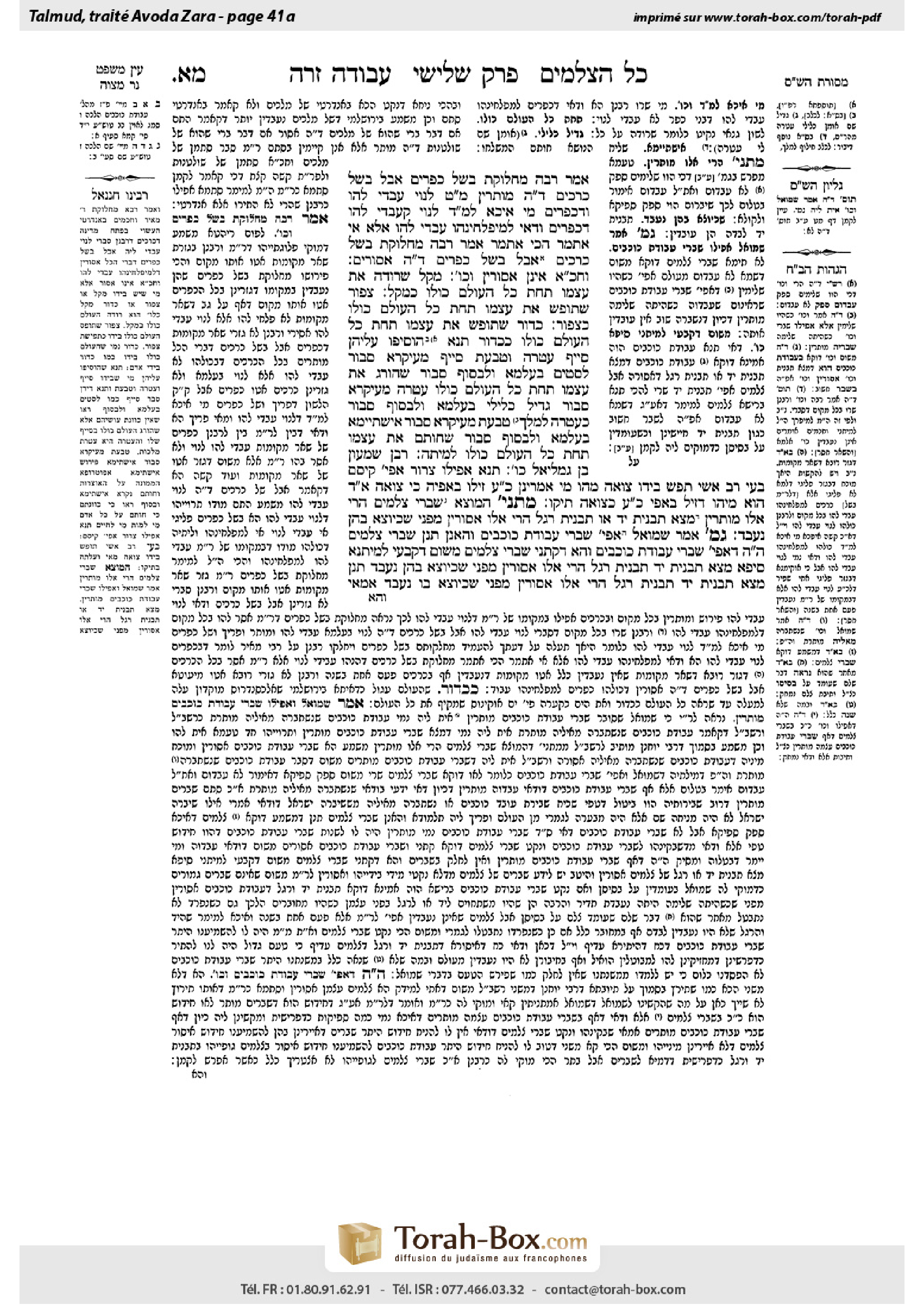
Avodah Zarah 41a: Talmud study for Daf Yomi
Study the Talmud for Daf Yomi with scanned pages, Hebrew text, English translations from Sefaria and AI-generated French translations.
Passage selection and English or AI-generated French translation are available where the scan has annotations. Daf Study is independent of Torah-Box and Sefaria.
Browse Avodah Zarah · עבודה זרה · All tractatesAvodah Zarah 41a text and translations
This page of Avodah Zarah includes the Aramaic text, an English translation and an AI-generated French translation, alongside the scan above.
עבודה זרה מ״א א · Aramaic and Hebrew text
אָמַר רַבָּה: מַחְלוֹקֶת בְּשֶׁל כְּפָרִים, אֲבָל בְּשֶׁל כְּרַכִּים — דִּבְרֵי הַכֹּל מוּתָּרִין, מַאי טַעְמָא? לְנוֹי עָבְדִי לְהוּ.
וְדִכְפָרִים, מִי אִיכָּא לְמַאן דְּאָמַר לְנוֹי קָעָבְדִי לְהוּ? דִּכְפָרִים וַדַּאי לְמִיפְלְחִינְהוּ עָבְדִי לְהוּ!
אֶלָּא אִי אִתְּמַר, הָכִי אִתְּמַר: אָמַר רַבָּה: מַחְלוֹקֶת בְּשֶׁל כְּרַכִּים, אֲבָל בְּשֶׁל כְּפָרִים — דִּבְרֵי הַכֹּל אֲסוּרִים.
וַחֲכָמִים אוֹמְרִים: אֵינָן אֲסוּרִין וְכוּ׳. מַקֵּל — שֶׁרוֹדֶה אֶת עַצְמוֹ תַּחַת כָּל הָעוֹלָם כּוּלּוֹ כְּמַקֵּל, צִפּוֹר — שֶׁתּוֹפֵשׂ אֶת עַצְמוֹ תַּחַת כָּל הָעוֹלָם כּוּלּוֹ כְּצִפּוֹר, כַּדּוּר — שֶׁתּוֹפֵשׂ אֶת עַצְמוֹ תַּחַת כָּל הָעוֹלָם כּוּלּוֹ כְּכַדּוּר.
תָּנָא, הוֹסִיפוּ עֲלֵיהֶן: סַיִיף, עֲטָרָה, וְטַבַּעַת.
סַיִיף — מֵעִיקָּרָא סְבוּר לִסְטִים בְּעָלְמָא, וּלְבַסּוֹף סְבוּר שֶׁהוֹרֵג אֶת עַצְמוֹ תַּחַת כָּל הָעוֹלָם כּוּלּוֹ.
עֲטָרָה — מֵעִיקָּרָא סְבוּר גָּדֵיל כְּלִילֵי בְּעָלְמָא, וּלְבַסּוֹף סְבוּר כַּעֲטָרָה לַכֶּלֶב. טַבַּעַת — מֵעִיקָּרָא סְבוּר אִישְׁתְּיָימָא בְּעָלְמָא, וּלְבַסּוֹף סְבוּר שֶׁחוֹתֵם אֶת עַצְמוֹ תַּחַת כָּל הָעוֹלָם כּוּלּוֹ לְמִיתָה.
רַבָּן שִׁמְעוֹן בֶּן גַּמְלִיאֵל כּוּ׳. תָּנָא: אֲפִילּוּ צְרוֹר, אֲפִילּוּ קֵיסָם.
בָּעֵי רַב אָשֵׁי: תָּפַשׂ בְּיָדוֹ צוֹאָה, מַהוּ? מִי אָמְרִינַן כּוּלֵּי עָלְמָא זִילוּ בְּאַפֵּיהּ כִּי צוֹאָה, אוֹ דִילְמָא הוּא מִיהוּ דְּזִיל בְּאַפֵּי כּוּלֵּי עָלְמָא כְּצוֹאָה? תֵּיקוּ.
מַתְנִי׳ הַמּוֹצֵא שִׁבְרֵי צְלָמִים, הֲרֵי אֵלּוּ מוּתָּרִין. מָצָא תַּבְנִית יָד אוֹ תַּבְנִית רֶגֶל, הֲרֵי אֵלּוּ אֲסוּרִין, מִפְּנֵי שֶׁכַּיּוֹצֵא בָּהֶן נֶעֱבָד.
גְּמָ׳ אָמַר שְׁמוּאֵל: אֲפִילּוּ שִׁבְרֵי עֲבוֹדָה זָרָה. וְהָאֲנַן תְּנַן: שִׁבְרֵי צְלָמִים!
הוּא הַדִּין דַּאֲפִילּוּ שִׁבְרֵי עֲבוֹדָה זָרָה, וְהָא דְּקָתָנֵי שִׁבְרֵי צְלָמִים — מִשּׁוּם דְּקָבָעֵי לְמִיתְנֵא סֵיפָא: מָצָא תַּבְנִית יָד תַּבְנִית רֶגֶל — הֲרֵי אֵלּוּ אֲסוּרִין, מִפְּנֵי שֶׁכַּיּוֹצֵא בָּהֶן נֶעֱבָד.
תְּנַן: מָצָא תַּבְנִית יָד תַּבְנִית רֶגֶל — הֲרֵי אֵלּוּ אֲסוּרִין, מִפְּנֵי שֶׁכַּיּוֹצֵא בּוֹ נֶעֱבָד. אַמַּאי?
Avodah Zarah 41a · English translation
Rabba says: The dispute between Rabbi Meir and the Rabbis is only with regard to statues that are erected in villages. But with regard to those that are erected in cities, all agree that they are permitted, i.e., that it is permitted to derive benefit from them. What is the reason? It is because they were fashioned for ornamental purposes and not for worship.
The Gemara asks: But with regard to those erected in villages, is there anyone who says that they are fashioned for ornamental purposes? Those in villages were certainly fashioned for idol worship. How, then, can the Rabbis maintain that such statues are permitted?
The Gemara answers: Rather, if such a distinction was stated, this is what was stated: Rabba says that the dispute between Rabbi Meir and the Rabbis is only with regard to statues that are erected in cities, where they may have been fashioned simply for ornamental purposes. But with regard to those erected in villages, all agree that they are used for idol worship and are therefore forbidden.
§ The mishna teaches: And the Rabbis say: The only statues that are forbidden are: Any statue that has in its hand a staff, or a bird, or an orb, as these are indications that this statue is designated for idolatry. The Gemara explains that each of these items symbolizes the statue’s supposed divinity, indicating its dominion over the world: A staff symbolizes dominion as the idol rules itself under the entire world, i.e., it rules the entire world, like one rules over an animal with a staff. A bird symbolizes dominion as the idol grasps itself under the entire world, i.e., it grasps the entire world, as one grasps a bird in his hand. An orb symbolizes dominion as the idol grasps itself under the entire world, i.e., it grasps the entire world, as one grasps a ball in his hand.
The Sages taught in the Tosefta (6:1) that they added the following to the list of items that, when added to a statue, indicate that it is worshipped as an idol: A sword in its hand, a crown on its head, and a ring on its finger.
The Gemara explains why these items were initially believed to be insignificant and were later understood as symbolizing idol worship. With regard to a statue holding a sword, the Sages initially thought that this merely indicates that it is a statue of a bandit. But in the end they reasoned that it symbolizes the notion that the idol has the power to kill itself under the whole world, i.e., to kill the entire world.
With regard to a crown, the Sages initially thought that it is merely a woven wreath. But in the end they reasoned that it is like the crown of a king. With regard to a ring, the Sages initially thought that this merely symbolizes the bearer of a signet ring [ishtayema]. But in the end they reasoned that it is symbolic of the idol’s supposed ability to seal its fate under the whole world, i.e., to seal the fate of the entire world, for death.
§ The mishna teaches that Rabban Shimon ben Gamliel says: It is prohibited to derive benefit even from any statue that has any item whatsoever in its hand. The Sages taught in a baraita: It is prohibited to derive benefit from a statue even if it is merely holding a stone, or even a twig.
Rav Ashi raises a dilemma: If the idol is grasping excrement in its hand, what is the halakha? Is this meant to honor the statue, indicating that it is an object of idol worship? Do we say that the statue is forbidden, as this indicates that the entire world is inferior to it like excrement, or perhaps does this indicate that the idol itself is inferior to the entire world like excrement? The Gemara concludes: The question shall stand unresolved.
MISHNA: In the case of one who finds unidentifiable fragments of statues, these are permitted, i.e., one may derive benefit from them. If one found an object in the figure of a hand or in the figure of a foot, these are forbidden, as objects similar to those are worshipped.
GEMARA: Shmuel says: It is permitted to derive benefit even from fragments of objects that have been seen used in idol worship. The Gemara asks: But didn’t we learn in the mishna that fragments of nondescript statues are permitted? This indicates that it is prohibited to derive benefit from fragments of idols that were known to be worshipped.
The Gemara answers: The mishna means that fragments of statues are permitted, and the same is true even of fragments of objects of idol worship. And that which is taught in the mishna: Fragments of statues, is not meant to exclude fragments of idols. Rather, this expression is used because the mishna sought to teach in the last clause: If one found an object in the figure of a hand or in the figure of a foot, these are forbidden, even if they are not known to be objects of idol worship, as objects similar to those are worshipped. If the first clause in the mishna had referred to fragments of idols, it would have been inferred that the latter clause was referring specifically to the figure of a hand or foot that was known to have been worshipped, and that otherwise such figures would not be forbidden.
We learned in the mishna: If one found an object in the figure of a hand or in the figure of a foot, these are forbidden, as objects similar to those are worshipped. The Gemara asks: Why?
Avodah Zarah 41a · Traduction française (IA)
Rabba dit : La dispute entre le Rabbi Meïr et les Rabbins ne concerne que les statues érigées dans les villages. En revanche, concernant celles érigées dans les villes, tous s'accordent sur le fait qu'elles sont permises, c'est-à-dire qu'il est permis d'en tirer un bénéfice. Pourquoi ? C'est parce qu'elles ont été façonnées à des fins décoratives et non pour l'idolâtrie.
La Guemara pose la question : Mais concernant celles érigées dans les villages, y a-t-il quelqu'un qui affirme qu'elles ont été façonnées à des fins décoratives ? Les statues des villages ont certainement été façonnées à des fins d'idolâtrie. Comment alors les Rabbins peuvent-ils affirmer qu'elles sont permises ?
La Guemara répond : En réalité, si une telle distinction avait été émise, cela signifierait que Rabba dit que la dispute entre le Rabbi Meïr et les Rabbins concerne uniquement les statues érigées dans les villes, où elles pourraient avoir été façonnées simplement à des fins décoratives. En revanche, concernant celles érigées dans les villages, tous s'accordent sur le fait qu'elles sont utilisées à des fins d'idolâtrie et sont donc interdites.
§ La mitsva enseigne : Et les Rabbins disent : Les seules statues interdites sont celles qui, dans leur main, portent un bâton, un oiseau ou une balle, car ces objets indiquent que cette statue est destinée à l'idolâtrie. La Guemara explique que chacun de ces objets symbolise la divinité de la statue, indiquant son pouvoir sur le monde : un bâton symbolise le pouvoir, car l'idole règne sur l'ensemble du monde, comme l'on domine un animal avec un bâton. Un oiseau symbolise le pouvoir, car l'idole saisit l'ensemble du monde, comme l'on saisit un oiseau dans sa main. Une balle symbolise le pouvoir, car l'idole saisit l'ensemble du monde, comme l'on saisit une balle dans sa main.
Les Sages ont enseigné dans la Tosefta (6:1) qu'ils ont ajouté à la liste des objets qui, ajoutés à une statue, indiquent qu'elle est vénérée comme un idole : un épée dans sa main, une couronne sur sa tête et un anneau sur son doigt.
La Guemara explique pourquoi ces objets étaient initialement considérés comme insignifiants et ont ensuite été compris comme symbolisant l'idolâtrie. Concernant une statue tenant une épée, les Sages pensaient initialement que cela indiquait simplement qu'il s'agissait d'une statue de brigand. Mais finalement, ils ont raisonné que cela symbolisait l'idée que l'idole a le pouvoir de tuer l'ensemble du monde, c'est-à-dire de tuer l'ensemble du monde.
Concernant une couronne, les Sages pensaient initialement qu'il s'agissait simplement d'un cercle tissé. Mais finalement, ils ont raisonné qu'il s'agissait de la couronne d'un roi. Concernant un anneau, les Sages pensaient initialement qu'il symbolisait le porteur d'un anneau de signet [ishtayema]. Mais finalement, ils ont raisonné qu'il symbolisait la capacité supposée de l'idole à sceller son destin sous l'ensemble du monde, c'est-à-dire à sceller le destin de l'ensemble du monde, pour la mort.
§ La mitsva enseigne que Rabban Shimon ben Gamliel dit : Il est interdit de tirer un bénéfice même d'une statue qui tient quelque objet que ce soit dans sa main. Les Sages ont enseigné dans une baraïta : Il est interdit de tirer un bénéfice d'une statue même si elle tient seulement une pierre ou même une brindille.
Rav Ashi soulève un dilemme : Si l'idole tient des déjections dans sa main, quelle est la halakha ? Est-ce que cela signifie honorer la statue, indiquant qu'il s'agit d'un objet d'idolâtrie ? Disons-nous que la statue est interdite, car cela indique que l'ensemble du monde est inférieur à elle comme des déjections, ou peut-être cela indique que l'idole elle-même est inférieure à l'ensemble du monde comme des déjections ? La Guemara conclut : Cette question restera sans réponse.
MICHNA: Dans le cas d'une personne qui trouve des fragments indéterminés de statues, ceux-ci sont permis, c'est-à-dire qu'on peut en tirer un bénéfice. Si l'on trouve un objet en forme de main ou en forme de pied, ceux-ci sont interdits, car des objets similaires sont vénérés.
GUEMARA: Shmuel dit : Il est permis de tirer un bénéfice même de fragments d'objets utilisés dans l'idolâtrie. La Guemara pose la question : Mais n'avons-nous pas appris dans la mitsva que les fragments de statues indéterminées sont permis ? Cela indique que c'est interdit de tirer un bénéfice de fragments d'idoles connus pour être vénérés.
La Guemara répond : La mitsva signifie que les fragments de statues sont permis, et c'est également le cas des fragments d'objets d'idolâtrie. Et ce qui est enseigné dans la mitsva : Les fragments de statues, n'exclut pas les fragments d'idoles. Cette expression est utilisée car la mitsva cherchait à enseigner dans la dernière clause : Si l'on trouve un objet en forme de main ou en forme de pied, ceux-ci sont interdits, même s'ils ne sont pas connus pour être des objets d'idolâtrie, car des objets similaires sont vénérés. Si la première clause de la mitsva avait fait référence aux fragments d'idoles, on aurait pu en déduire que la seconde clause faisait référence spécifiquement à la forme de main ou de pied connue pour avoir été vénérée, et que dans les autres cas, ces formes ne seraient pas interdites.
Nous avons appris dans la Michna : Si l'on trouve un objet en forme de main ou en forme de pied, ceux-ci sont interdits, car des objets similaires sont vénérés. La Guemara pose la question : Pourquoi ?
Traduction française générée par IA à partir de l’édition anglaise de Sefaria. Vérifie toujours un passage avec le texte source.
Text from Sefaria: William Davidson Edition - Vocalized Aramaic (CC BY NC); William Davidson Edition - English (CC BY NC).