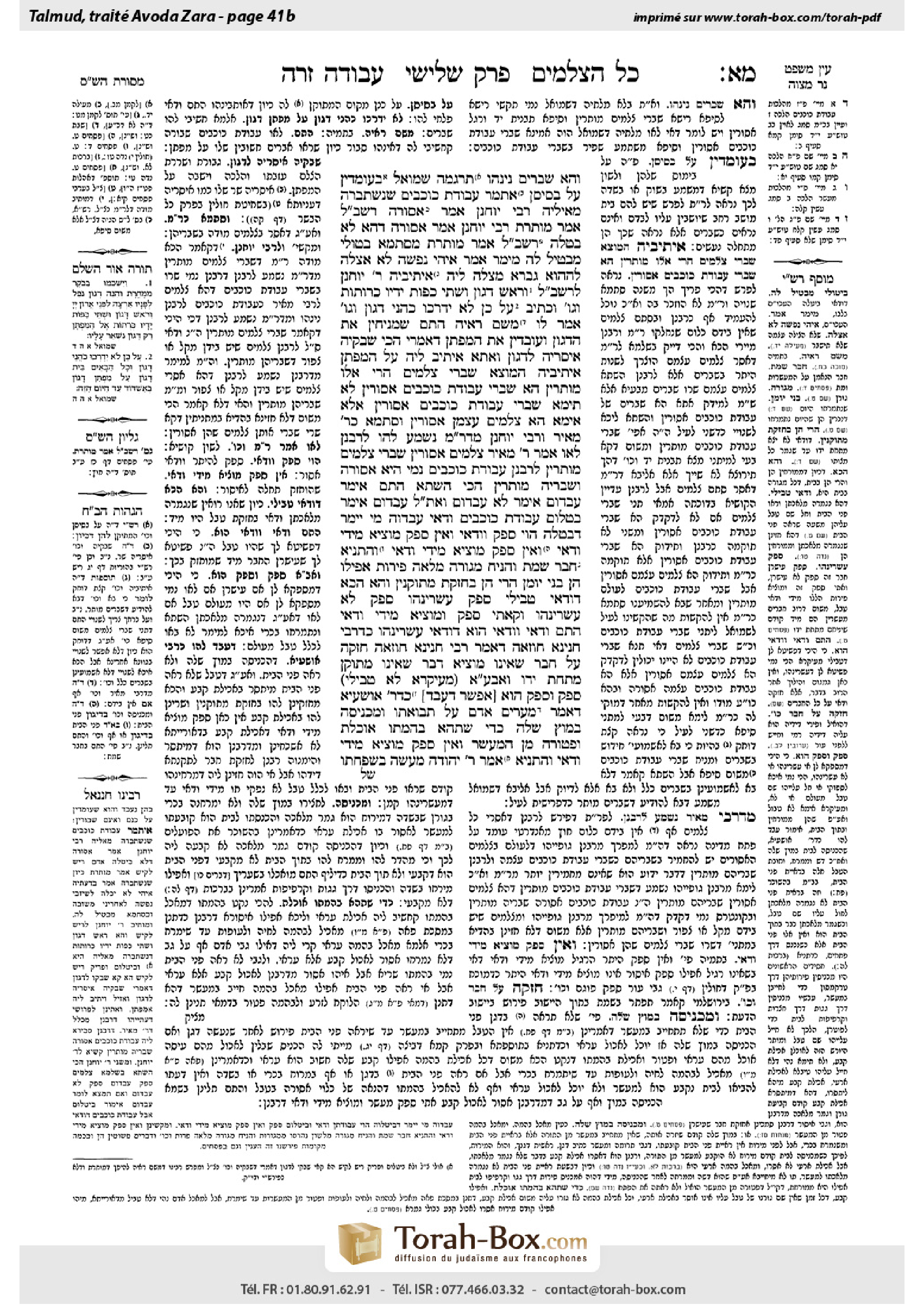
Avodah Zarah 41b: Talmud study for Daf Yomi
Study the Talmud for Daf Yomi with scanned pages, Hebrew text, English translations from Sefaria and AI-generated French translations.
Passage selection and English or AI-generated French translation are available where the scan has annotations. Daf Study is independent of Torah-Box and Sefaria.
Browse Avodah Zarah · עבודה זרה · All tractatesAvodah Zarah 41b text and translations
This page of Avodah Zarah includes the Aramaic text, an English translation and an AI-generated French translation, alongside the scan above.
עבודה זרה מ״א ב · Aramaic and Hebrew text
וְהָא שְׁבָרִים נִינְהוּ! תַּרְגְּמַהּ שְׁמוּאֵל: בְּעוֹמְדִין עַל בְּסִיסָן.
אִתְּמַר: עֲבוֹדָה זָרָה שֶׁנִּשְׁתַּבְּרָה מֵאֵילֶיהָ, רַבִּי יוֹחָנָן אָמַר: אֲסוּרָה, רַבִּי שִׁמְעוֹן בֶּן לָקִישׁ אָמַר: מוּתֶּרֶת.
רַבִּי יוֹחָנָן אָמַר: אֲסוּרָה, דְּהָא לָא בָּטְלָה. רַבִּי שִׁמְעוֹן בֶּן לָקִישׁ אָמַר: מוּתֶּרֶת, מִסְּתָמָא בַּטּוֹלֵי מְבַטֵּיל לַהּ, מֵימָר אָמַר: אִיהִי נַפְשַׁהּ לָא אַצְּלָה, לְהָהוּא גַּבְרָא מַצְּלָה לֵיהּ?
אֵיתִיבֵיהּ רַבִּי יוֹחָנָן לְרַבִּי שִׁמְעוֹן בֶּן לָקִישׁ: ״וְרֹאשׁ דָּגוֹן וּשְׁתֵּי כַּפּוֹת יָדָיו כְּרֻתוֹת וְגוֹ׳״, וּכְתִיב: ״עַל כֵּן לֹא יִדְרְכוּ כֹהֲנֵי דָגוֹן וְגוֹ׳״!
אָמַר לוֹ: מִשָּׁם רְאָיָה? הָתָם שֶׁמַּנִּיחִין אֶת הַדָּגוֹן, וְעוֹבְדִין אֶת הַמִּפְתָּן, דְּאָמְרִי הָכִי: שַׁבְקֵיהּ אִיסָרֵיהּ לְדָגוֹן, וַאֲתָא אִיתֵּיב לֵיהּ עַל הַמִּפְתָּן.
אֵיתִיבֵיהּ: הַמּוֹצֵא שִׁבְרֵי צְלָמִים — הֲרֵי אֵלּוּ מוּתָּרִין. הָא שִׁבְרֵי עֲבוֹדָה זָרָה — אֲסוּרִין!
לָא תֵּימָא שִׁבְרֵי עֲבוֹדָה זָרָה אֲסוּרִין, אֶלָּא אֵימָא: הָא צְלָמִים עַצְמָן אֲסוּרִין, וּסְתָמָא כְּרַבִּי מֵאִיר.
וְרַבִּי יוֹחָנָן, מִדְּרַבִּי מֵאִיר נִשְׁמַע לְהוּ לְרַבָּנַן, לָאו אָמַר רַבִּי מֵאִיר: צְלָמִים אֲסוּרִין, שִׁבְרֵי צְלָמִים מוּתָּרִין, לְרַבָּנַן עֲבוֹדָה זָרָה נָמֵי הִיא אֲסוּרָה וּשְׁבָרֶיהָ מוּתָּרִין!
הָכִי הַשְׁתָּא? הָתָם אֵימַר עֲבָדוּם אֵימַר לֹא עֲבָדוּם, וְאִם תִּמְצֵי לוֹמַר עֲבָדוּם — אֵימַר בִּטְּלוּם. עֲבוֹדָה זָרָה וַדַּאי עֲבָדוּהָ, מִי יֵימַר דְּבַטְּלֻהָ? הָוֵי סָפֵק וּוַדַּאי, וְאֵין סָפֵק מוֹצִיא מִידֵי וַדַּאי!
וְאֵין סָפֵק מוֹצִיא מִידֵי וַדַּאי? וְהָתַנְיָא: חָבֵר שֶׁמֵּת, וְהִנִּיחַ מְגוּרָה מְלֵאָה פֵּירוֹת, אֲפִילּוּ הֵן בְּנֵי יוֹמָן — הֲרֵי הֵן בְּחֶזְקַת מְתוּקָּנִין.
וְהָא הָכָא דְּוַדַּאי טְבִילִי, סָפֵק עַשְּׂרִינְהוּ, סָפֵק לָא עַשְּׂרִינְהוּ, וְקָאָתֵי סָפֵק וּמוֹצִיא מִידֵי וַדַּאי!
הָתָם וַדַּאי וּוַדַּאי הוּא, דְּוַדַּאי עַשְּׂרִינְהוּ, כִּדְרַבִּי חֲנִינָא חוֹזָאָה, דְּאָמַר רַבִּי חֲנִינָא חוֹזָאָה: חֲזָקָה עַל חָבֵר שֶׁאֵינוֹ מוֹצִיא דָּבָר שֶׁאֵינוֹ מְתוּקָּן מִתַּחַת יָדוֹ.
וְאִי בָּעֵית אֵימָא: מֵעִיקָּרָא לָא טְבִילִי, סָפֵק וְסָפֵק הוּא.
אֶפְשָׁר דַּעֲבַד כִּדְרַבִּי אוֹשַׁעְיָא, דְּאָמַר: מַעֲרִים אָדָם עַל תְּבוּאָתוֹ וּמַכְנִיסָהּ בַּמּוֹץ שֶׁלָּהּ, כְּדֵי שֶׁתְּהֵא בְּהֶמְתּוֹ אוֹכֶלֶת וּפְטוּרָה מִן הַמַּעֲשֵׂר.
וְאֵין סָפֵק מוֹצִיא מִידֵי וַדַּאי? וְהָתַנְיָא, אָמַר רַבִּי יְהוּדָה: מַעֲשֶׂה בְּשִׁפְחָתוֹ
Avodah Zarah 41b · English translation
But aren’t they fragments of idols, which are permitted according to Shmuel? The Gemara answers that Shmuel interpreted the mishna as follows: It is referring to a case where these objects that are in the figure of a hand or a foot are standing on their pedestals, which shows that they were designed this way initially and are not merely fragments.
§ It was stated: With regard to objects of idol worship that broke by themselves, Rabbi Yoḥanan says: It is prohibited to derive benefit from them. Rabbi Shimon ben Lakish says: It is permitted.
The Gemara explains the sides of the dispute. Rabbi Yoḥanan says that it is prohibited, as its owner did not revoke its status as an object of idol worship. Rabbi Shimon ben Lakish says that it is permitted, as the owner presumably revoked its status as an object of idol worship, having said to himself: If the idol could not save even itself from harm, can it save that man, i.e., myself?
Rabbi Yoḥanan raised an objection to Rabbi Shimon ben Lakish from the passage in the book of Samuel recounting the downfall of the Philistine god Dagon: “And when they arose early the next morning, behold, Dagon was fallen on his face to the ground before the Ark of the Lord; and the head of Dagon and both the palms of his hands lay cut off upon the threshold; only the trunk of Dagon was left to him” (I Samuel 5:4). And from the next verse it seems that Dagon’s worshippers accorded it honor despite its destruction, as it is written: “Therefore, the priests of Dagon, and anyone who comes into Dagon’s house, do not tread on the threshold of Dagon in Ashdod until this day” (I Samuel 5:5). Evidently, when an idol breaks, its worshippers do not stop worshipping it.
Rabbi Shimon ben Lakish said to him: Is there proof from there? There, the reason people did not tread on the threshold of Dagon is that they had abandoned their worship of the Dagon and would instead worship the threshold upon which Dagon was found, as they stated this reasoning: The spirit of Dagon has left the Dagon idol and instead it came and rested upon the threshold.
Rabbi Yoḥanan raised another objection to Rabbi Shimon ben Lakish from the mishna: In the case of one who finds fragments of statues, these are permitted. This indicates that fragments of known objects of idol worship are forbidden.
Rabbi Shimon ben Lakish replied: Do not say that the indication is that fragments of objects of idol worship are forbidden; rather say that the indication is that full statues themselves are forbidden, and the unattributed mishna is in accordance with the opinion of Rabbi Meir, who, in the previous mishna, prohibits any statue as it is possible that it is worshipped annually.
The Gemara asks: But how does Rabbi Yoḥanan refute the following logic: From the opinion of Rabbi Meir one can learn a detail with regard to the opinion of the Rabbis. Doesn’t Rabbi Meir say that statues are forbidden, while fragments of statues are permitted? From this, one can derive that this is true according to the Rabbis as well with regard to objects of idol worship: The object itself is forbidden, but its fragments are permitted.
The Gemara rejects this comparison: How can these cases be compared? There, in the case of statues, the fragments are permitted because there is room to say that people worshipped them, and there is also room to say that people did not worship them; and even if you say that people worshipped them, there is room to say that their owners subsequently revoked them. This is not comparable to an object of idol worship, which people certainly worshipped, and who is to say that its owner certainly revoked it? It is a conflict between an uncertainty as to whether or not it was revoked, and a certainty that it was worshipped, and the principle is that an uncertainty does not override a certainty.
The Gemara asks: And does an uncertainty not override a certainty? But isn’t it taught in a baraita: In the case of a ḥaver who died and left a storehouse filled with produce, even if the produce was there only that day, it has the presumptive status of produce that was ritually prepared, i.e., properly tithed. This is due to the presumption that the ḥaver tithed the produce himself or instructed others to do so.
The Gemara infers: And here, in this case, the produce was certainly untithed at the outset, and there is uncertainty whether the ḥaver tithed it, and there is uncertainty whether he did not tithe it, and despite this conflict, the uncertainty whether it was tithed comes and overrides the certainty that it was untithed produce.
The Gemara rejects this claim: There, in that case, conflict is between certainty and certainty, as the ḥaver certainly tithed the produce. This presumption is in accordance with the statement of Rabbi Ḥanina Ḥoza’a; as Rabbi Ḥanina Ḥoza’a says: There is a presumption with regard to a ḥaver that he does not release an item from his possession that is not ritually prepared.
And if you wish, say instead that perhaps the produce did not initially have the status of untithed produce, and therefore the conflict is between uncertainty and uncertainty.
This is because it is possible that there was never an obligation to tithe the produce, as the ḥaver may have acted in accordance with the statement of Rabbi Oshaya, who says that a person can employ artifice to circumvent obligations incumbent upon him in dealing with his grain, and bring it into his courtyard in its chaff so that his animal may eat from it. And this grain is exempt from tithes. Although the obligation to tithe produce that has been fully processed applies even to animal fodder, it is permitted to feed one’s animal untithed produce that has not been fully processed. In light of this halakha it is possible that the produce in the storehouse of the ḥaver never needed to be tithed. Consequently, this case is a conflict between two uncertain factors, as it is uncertain whether or not the owner was obligated to tithe the produce in the first place, and even if he was required to do so, it is uncertain whether or not he tithed it.
The Gemara raises another objection: And is it so that an uncertainty does not override a certainty? But isn’t it taught in a baraita that Rabbi Yehuda said: There was an incident involving the maidservant
Avodah Zarah 41b · Traduction française (IA)
Mais ne sont-ce pas des fragments d'idolatres, qui sont permis selon Shmuel ? La Guemara répond que Shmuel interprète la michna ainsi : il s'agit d'un cas où ces objets, qui sont en forme de main ou de pied, sont debout sur leurs socles, ce qui montre qu'ils ont été conçus ainsi initialement et ne sont pas simplement des fragments.
§ On a dit : En ce qui concerne les objets de culte idolâtre qui se sont brisés d'eux-mêmes, Rabbi Yoḥanan dit : il est interdit d'en tirer un bénéfice. Rabbi Shimon ben Lakish dit : il est permis.
La Guemara explique les côtés du débat. Rabbi Yoḥanan dit qu'il est interdit, car l'propriétaire n'a pas révoqué son statut d'objet de culte idolâtre. Rabbi Shimon ben Lakish dit qu'il est permis, car l'propriétaire a probablement révoqué son statut d'objet de culte idolâtre, en se disant : Si l'idole ne pouvait pas se sauver elle-même de la destruction, pouvait-elle sauver cet homme, c'est-à-dire moi ?
Rabbi Yoḥanan a soulevé une objection contre Rabbi Shimon ben Lakish à partir du passage du livre de Samuel racontant la chute de l'idole philistine Dagon : « Et lorsqu'ils se levèrent tôt le lendemain, ils virent que Dagon était tombé face contre terre devant l'Arca du Seigneur ; et la tête de Dagon et les deux mains de ses mains étaient coupées sur le seuil ; seule la tronc de Dagon lui restait » (I Samuel 5:4). Et d'après le verset suivant, il semble que les adorateurs de Dagon lui accordent encore de l'honneur malgré sa destruction, car il est écrit : « Ainsi, les prêtres de Dagon, et toute personne qui entre dans la maison de Dagon, ne foulent pas le seuil de Dagon à Ashdod jusqu'à ce jour » (I Samuel 5:5). Il est évident que lorsqu'une idole se brise, ses adorateurs ne cessent pas de l'adorer.
Rabbi Shimon ben Lakish a dit à lui : y a-t-il une preuve là-dessus ? Là, la raison pour laquelle les gens n'ont pas foulé le seuil de Dagon est qu'ils avaient abandonné leur adoration de Dagon et préféraient plutôt adorer le seuil sur lequel Dagon avait été trouvé, comme ils ont dit cela : l'esprit de Dagon est sorti de l'idole Dagon et est venu plutôt se reposer sur le seuil.
Rabbi Yoḥanan a soulevé une autre objection contre Rabbi Shimon ben Lakish à partir de la michna : Dans le cas d'une personne qui trouve des fragments de statues, ceux-ci sont permis. Cela indique que les fragments d'objets connus de culte idolâtre sont interdits.
Rabbi Shimon ben Lakish a répondu : Ne dis pas que l'indication est que les fragments d'objets de culte idolâtre sont interdits ; plutôt dis que l'indication est que les statues entières sont interdites, et la michna non attribuée est selon l'opinion de Rabbi Meir, qui, dans la michna précédente, interdit toute statue, car il est possible qu'elle soit adorée annuellement.
La Guemara pose la question : Mais comment Rabbi Yoḥanan réfute-t-il cette logique : à partir de l'opinion de Rabbi Meir, on peut apprendre un détail concernant l'opinion des Rabbins. Ne dit pas Rabbi Meir que les statues sont interdites, tandis que les fragments de statues sont permis ? À partir de cela, on peut déduire que cela est vrai selon les Rabbins également concernant les objets de culte idolâtre : l'objet lui-même est interdit, mais ses fragments sont permis.
La Guemara rejette cette comparaison : Comment peuvent ces cas être comparés ? Là, dans le cas des statues, les fragments sont permis car il y a place à dire que les gens les adoraient, et il y a aussi place à dire qu'ils ne les adoraient pas ; et même si vous dites que les gens les adoraient, il y a place à dire que leurs propriétaires les ont révoqués après. Cela n'est pas comparable à un objet de culte idolâtre, qui a certainement été adoré, et qui est-ce qui dit que son propriétaire a certainement révoqué son statut ? Il s'agit d'un conflit entre une incertitude quant à savoir s'il a été révoqué ou non, et une certitude qu'il a été adoré, et le principe est que l'incertitude ne remplace pas la certitude.
La Guemara pose la question : Et l'incertitude ne remplace-t-elle pas la certitude ? Mais n'est-il pas enseigné dans une baraïta : Dans le cas d'un ḥaver qui est mort et a laissé un entrepôt rempli de produits, même si les produits étaient là seulement ce jour, ils ont le statut présomptif de produits tithés, c'est-à-dire tithés correctement. Cela est dû à la présomption que le ḥaver a tithé les produits lui-même ou a chargé d'autres de le faire.
La Guemara déduit : Et ici, dans ce cas, les produits étaient certainement non tithés au départ, et il y a une incertitude quant à savoir si le ḥaver les a tithés, et une incertitude quant à savoir s'il ne les a pas tithés, et malgré ce conflit, l'incertitude quant à leur tithe vient et remplace la certitude qu'ils étaient des produits non tithés.
La Guemara rejette cette affirmation : Là, dans ce cas, le conflit est entre certitude et certitude, car le ḥaver a certainement tithé les produits. Cette présomption est selon la déclaration de Rabbi Ḥanina Ḥoza’a ; car Rabbi Ḥanina Ḥoza’a dit : il y a une présomption concernant un ḥaver qu'il ne libère pas un objet de ses possessions qui n'est pas tithé correctement.
Et si vous le souhaitez, dites plutôt que peut-être les produits n'avaient pas initialement le statut de produits non tithés, et donc le conflit est entre incertitude et incertitude.
C’est parce qu’il est possible que l’obligation de dîmer les produits n’ait jamais existé, car le ḥaver pourrait avoir agi conformément à la déclaration du Rabbi Oshaya, qui dit qu’une personne peut employer des artifices pour éviter les obligations qui pèsent sur elle lorsqu’elle traite son grain, et l’amener dans son courtil avec son épi de blé afin que son bétail puisse en manger. Et ce grain est exempt de dîmes. Bien que l’obligation de dîmer les produits entièrement traités s’applique même aux aliments pour bétail, il est permis de nourrir son bétail avec des produits non dîmés qui n’ont pas été entièrement traités. En lumière de cette halakha, il est possible que les produits dans le grenier du ḥaver n’aient jamais eu besoin d’être dîmés. Par conséquent, ce cas est un conflit entre deux facteurs incertains, car il est incertain que l’propriétaire ait été obligé de dîmer les produits d’abord, et même s’il l’était, il est incertain qu’il les ait dîmés.
La Guemara évoque une autre objection : Et est-ce que l’incertitude ne l'emporte pas sur la certitude ? Mais n’est-il pas enseigné dans une baraïta que Rabbi Yéhuda a dit : Il y avait un cas concernant la servante
Traduction française générée par IA à partir de l’édition anglaise de Sefaria. Vérifie toujours un passage avec le texte source.
Text from Sefaria: William Davidson Edition - Vocalized Aramaic (CC BY NC); William Davidson Edition - English (CC BY NC).