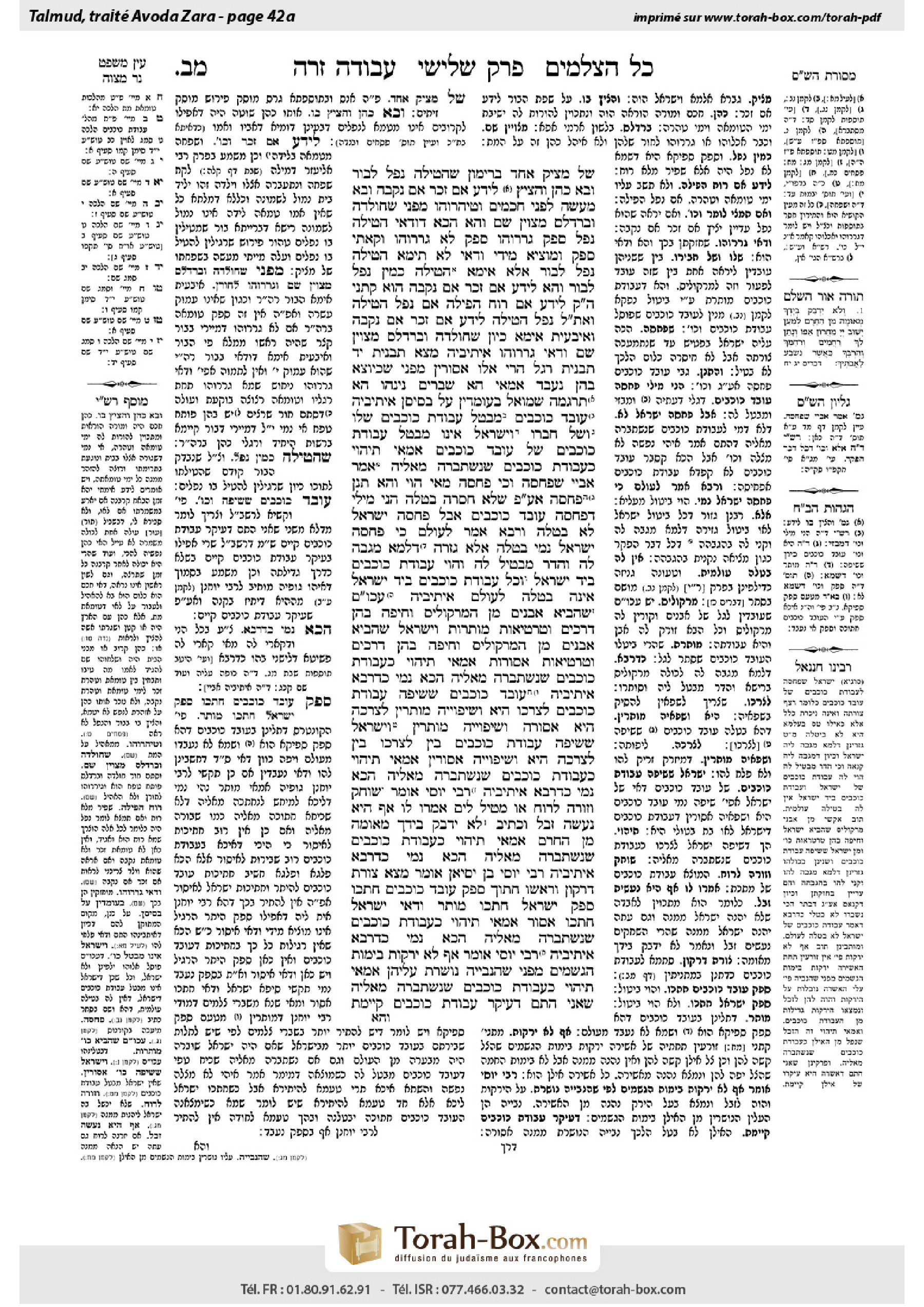
Avodah Zarah 42a: Talmud study for Daf Yomi
Study the Talmud for Daf Yomi with scanned pages, Hebrew text, English translations from Sefaria and AI-generated French translations.
Passage selection and English or AI-generated French translation are available where the scan has annotations. Daf Study is independent of Torah-Box and Sefaria.
Browse Avodah Zarah · עבודה זרה · All tractatesAvodah Zarah 42a text and translations
This page of Avodah Zarah includes the Aramaic text, an English translation and an AI-generated French translation, alongside the scan above.
עבודה זרה מ״ב א · Aramaic and Hebrew text
שֶׁל מֵצִיק אֶחָד בְּרִימּוֹן, שֶׁהֵטִילָה נֵפֶל לְבוֹר, וּבָא כֹּהֵן וְהֵצִיץ לֵידַע אִם זָכָר אִם נְקֵבָה, וּבָא מַעֲשֶׂה לִפְנֵי חֲכָמִים וְטִיהֲרוּהוּ, מִפְּנֵי שֶׁחוּלְדָּה וּבַרְדְּלָס מְצוּיִן שָׁם.
וְהָא הָכָא, דְּוַדַּאי הֵטִילָה נֵפֶל, סָפֵק גֵּרְרוּהוּ, סָפֵק לֹא גֵּרְרוּהוּ, וְקָאָתֵי סָפֵק וּמוֹצִיא מִידֵי וַדַּאי!
לָא תֵּימָא הֵטִילָה נֵפֶל לְבוֹר, אֶלָּא אֵימָא: הֵטִילָה כְּמִין נֵפֶל לְבוֹר.
וְהָא ״לֵידַע אִם זָכָר אִם נְקֵבָה הוּא״ קָתָנֵי!
הָכִי קָאָמַר: לֵידַע אִם רוּחַ הִפִּילָה, אִם נֵפֶל הֵטִילָה, וְאִם תִּמְצֵי לוֹמַר נֵפֶל הֵטִילָה — לֵידַע אִם זָכָר אִם נְקֵבָה.
וְאִיבָּעֵית אֵימָא: כֵּיוָן שֶׁחוּלְדָּה וּבַרְדְּלָס מְצוּיִן שָׁם — וַדַּאי גֵּרְרוּהוּ.
אֵיתִיבֵיהּ: מָצָא תַּבְנִית יָד, תַּבְנִית רֶגֶל — הֲרֵי אֵלּוּ אֲסוּרִין, מִפְּנֵי שֶׁכַּיּוֹצֵא בָּהֶן נֶעֱבָד. אַמַּאי? הָא שְׁבָרִים נִינְהוּ!
הָא תַּרְגְּמַהּ שְׁמוּאֵל: בְּעוֹמְדִין עַל בְּסִיסָן.
אֵיתִיבֵיהּ: גּוֹי מְבַטֵּל עֲבוֹדָה זָרָה שֶׁלּוֹ וְשֶׁל חֲבֵרוֹ, וְיִשְׂרָאֵל אֵינוֹ מְבַטֵּל עֲבוֹדָה זָרָה שֶׁל גּוֹי. אַמַּאי? תֶּיהְוֵי כַּעֲבוֹדָה זָרָה שֶׁנִּשְׁתַּבְּרָה מֵאֵלֶיהָ!
אָמַר אַבָּיֵי: שֶׁפְּחָסָהּ. וְכִי פְּחָסָהּ מַאי הָוֵי? וְהָא תְּנַן: פְּחָסָהּ אַף עַל פִּי שֶׁלֹּא חִסְּרָהּ — בִּטְּלָהּ!
הָנֵי מִילֵּי דְּפַחֲסַהּ גּוֹי, אֲבָל פַּחֲסַהּ יִשְׂרָאֵל לָא בַּטְּלַהּ.
וְרָבָא אָמַר: לְעוֹלָם כִּי פַחֲסַהּ יִשְׂרָאֵל נָמֵי בַּטְּלַהּ, אֶלָּא גְּזֵרָה דִּלְמָא מַגְבַּהּ לַהּ וַהֲדַר מְבַטֵּיל לַהּ, וְהָוֵי עֲבוֹדָה זָרָה בְּיַד יִשְׂרָאֵל, וְכׇל עֲבוֹדָה זָרָה בְּיַד יִשְׂרָאֵל אֵינָהּ בְּטֵלָה לְעוֹלָם.
אֵיתִיבֵיהּ: גּוֹי שֶׁהֵבִיא אֲבָנִים מִן הַמַּרְקוּלִיס, וְחִיפָּה בָּהֶן דְּרָכִים וּטְרַטְיָאוֹת — מוּתָּרוֹת, וְיִשְׂרָאֵל שֶׁהֵבִיא אֲבָנִים מִן הַמַּרְקוּלִיס וְחִיפָּה בָּהֶן דְּרָכִים וּטְרַטְיָאוֹת — אֲסוּרוֹת. אַמַּאי? תֶּיהְוֵי כַּעֲבוֹדָה זָרָה שֶׁנִּשְׁתַּבְּרָה מֵאֵלֶיהָ!
הָכָא נָמֵי, כִּדְרָבָא.
אֵיתִיבֵיהּ: גּוֹי שֶׁשִּׁיפָּה עֲבוֹדָה זָרָה לְצׇרְכּוֹ — הִיא וְשִׁיפּוּיֶיהָ מוּתָּרִין, לְצׇרְכָּהּ — הִיא אֲסוּרָה וְשִׁיפּוּיֶיהָ מוּתָּרִין, וְיִשְׂרָאֵל שֶׁשִּׁיפָּה עֲבוֹדָה זָרָה, בֵּין לְצׇרְכּוֹ בֵּין לְצׇרְכָּהּ — הִיא וְשִׁיפּוּיֶיהָ אֲסוּרִין. אַמַּאי? תֶּיהְוֵי כַּעֲבוֹדָה זָרָה שֶׁנִּשְׁתַּבְּרָה מֵאֵלֶיהָ!
הָכָא נָמֵי, כִּדְרָבָא.
אֵיתִיבֵיהּ: רַבִּי יוֹסֵי אוֹמֵר: שׁוֹחֵק וְזוֹרֶה לָרוּחַ אוֹ מֵטִיל לַיָּם. אָמְרוּ לוֹ: אַף הִיא נַעֲשֵׂית זֶבֶל, וּכְתִיב: ״לֹא יִדְבַּק בְּיָדְךָ מְאוּמָה מִן הַחֵרֶם״. אַמַּאי? תֶּיהְוֵי כַּעֲבוֹדָה זָרָה שֶׁנִּשְׁתַּבְּרָה מֵאֵלֶיהָ!
הָכָא נָמֵי, כִּדְרָבָא.
אֵיתִיבֵיהּ: רַבִּי יוֹסֵי בֶּן יָסְיָאן אוֹמֵר: מָצָא צוּרַת דְּרָקוֹן וְרֹאשׁוֹ חָתוּךְ, סָפֵק גּוֹי חֲתָכוֹ סָפֵק יִשְׂרָאֵל חֲתָכוֹ — מוּתָּר, וַדַּאי יִשְׂרָאֵל חֲתָכוֹ — אָסוּר. אַמַּאי? תֶּיהְוֵי כַּעֲבוֹדָה זָרָה שֶׁנִּשְׁתַּבְּרָה מֵאֵלֶיהָ!
הָכָא נָמֵי, כִּדְרָבָא.
אֵיתִיבֵיהּ: רַבִּי יוֹסֵי אוֹמֵר, אַף לֹא יְרָקוֹת בִּימוֹת הַגְּשָׁמִים, מִפְּנֵי שֶׁהַנְּבִיָּיה נוֹשֶׁרֶת עֲלֵיהֶן. אַמַּאי? תֶּיהְוֵי כַּעֲבוֹדָה זָרָה שֶׁנִּשְׁתַּבְּרָה מֵאֵלֶיהָ!
שָׁאנֵי הָתָם, דְּעִיקַּר עֲבוֹדָה זָרָה קַיֶּימֶת.
Avodah Zarah 42a · English translation
of one violent person [metzik] in the city of Rimon, who cast a non-viable newborn into a pit, and a priest came and looked into the pit to ascertain whether the baby was male or whether it was female, as the length of time of a woman’s ritual impurity after childbirth, even if she gave birth to a non-viable newborn, depends on whether the child was male or female (see Leviticus, chapter 12). And the incident came before the Sages to rule whether or not the priest had contracted ritual impurity while standing over the corpse, and they deemed him ritually pure. The basis for this ruling was due to the fact that as martens and polecats [bardelas] are common there, it is likely that the body was dragged away before the priest arrived at the pit.
The Gemara concludes its objection: And here, in this case, where it is certain that the woman cast the non-viable newborn into the pit, and it is uncertain whether an animal dragged it away and it is uncertain whether no animal dragged it away, the Sages nevertheless ruled that an uncertainty comes and overrides a certainty.
The Gemara rejects this interpretation of the baraita: Do not say that the woman certainly cast a non-viable newborn into a pit; rather, say that she cast an object similar to a non-viable newborn into a pit. Perhaps it was not the body of an infant; it might have merely been congealed blood, which does not impart impurity. Therefore, it is a conflict between uncertainty and uncertainty; it is unclear whether the item that was cast into the pit could have rendered the priest ritually impure, and even if it could have, it might have already been dragged away.
The Gemara asks: But isn’t it taught in the baraita: To ascertain whether it was male or whether it was female, indicating that the only uncertainty was with regard to its sex, as it was certainly a non-viable newborn?
The Gemara answers that this is what the baraita is saying: The priest attempted to examine two aspects of the miscarried entity. He sought to ascertain whether the woman miscarried, bearing an amorphous mass, or whether she cast a non-viable newborn into the pit; and if you say that she cast a non-viable newborn, he sought to ascertain whether it was male or whether it was female.
And if you wish, say that there is a different answer: This case is not a conflict between certainty and uncertainty; rather it is a conflict between certainty and certainty. Since martens and polecats are common there, they certainly dragged the body away. Consequently, the ruling in this case does not contradict the principle that an uncertainty does not override a certainty.
§ The Gemara returns to the dispute with regard to an idol that broke. Rabbi Yoḥanan raised an objection to the opinion of Reish Lakish from the mishna: If one found an object in the figure of a hand or in the figure of a foot, these are forbidden, as objects similar to those are worshipped. Rabbi Yoḥanan asks: Why are they forbidden? Aren’t they fragments, which according to Reish Lakish should be permitted?
The Gemara answers: Didn’t Shmuel interpret the mishna as referring to a case where these objects are standing on their pedestals, which shows that they were designed this way initially?
Rabbi Yoḥanan raised another objection to the opinion of Reish Lakish from a mishna (52b): A gentile can revoke the idolatrous status of his own object of idol worship or that of another gentile, but a Jew cannot revoke the status of a gentile’s object of idol worship. Rabbi Yoḥanan asks: Why can’t a Jew revoke the status of a gentile’s idol according to Reish Lakish? Let it be treated like an object of idol worship that broke on its own, which Reish Lakish deems permitted.
Abaye said: That mishna is referring to a case where the Jew bent the idol out of shape without actually breaking it. The Gemara asks: And if he merely bent the idol out of shape, what of it? But didn’t we learn in a mishna (53a) that if one bent an idol, changing its shape, even if he did not remove any part of it, he thereby revoked its status as an object of idol worship?
The Gemara answers: This statement applies only in a case where a gentile bent the idol, changing its shape; but in a case where a Jew bent it, changing its shape, its status as an object of idol worship is not revoked.
And Rava said a different answer: Actually, the basic halakha is that in a case where a Jew bent it, changing its shape, its status as an object of idol worship is also revoked. But the Sages issued a decree that such an idol retains its idolatrous status, lest a Jew first lift it up and then attempt to revoke its status. In this case the idol’s status is not revoked, as when a Jew lifts an idol he acquires it, and it becomes an object of idol worship in a Jew’s possession, and any object of idol worship in a Jew’s possession can never have its idolatrous status revoked. Therefore, only when an idol breaks on its own does Reish Lakish maintain that its status is revoked.
Rabbi Yoḥanan raised another objection to the opinion of Reish Lakish from a baraita: In the case of a gentile who brought stones from stone heaps that were used in the worship of the deity Mercury [HaMarkulis], and who then paved roads and built theaters [vetarteiot] with them, it is permitted to derive benefit from them, as the gentile revoked their idolatrous status. But in the case of a Jew who brought stones that were used in the worship of Mercury and who then paved roads and built theaters with them, it is prohibited to derive benefit from them. Rabbi Yoḥanan asked: According to Reish Lakish, why does a stone such as this retain its idolatrous status? Let it be treated like an object of idol worship that broke on its own, which Reish Lakish deems permitted.
The Gemara answers: Here too, Rabbi Yoḥanan’s question may be answered in accordance with the opinion of Rava that the Sages issued a decree that an object of idol worship retains its idolatrous status when a Jew attempts to revoke it, lest the Jew lift and acquire the idol, which would make it impossible to subsequently revoke its status.
Rabbi Yoḥanan raised another objection to the opinion of Reish Lakish from a baraita: In the case of a gentile who shaved down an object of idol worship for his own sake, as he needed the shavings, the idol itself and its shavings are then permitted. If he did it for the sake of the idol, to improve its appearance, the idol is forbidden, but its shavings are permitted. But in the case of a Jew who shaved down an object of idol worship, whether he did it for his own sake or for the sake of the idol, the idol itself and its shavings are forbidden. Rabbi Yoḥanan asked: According to Reish Lakish, in a case where a Jew shaved the idol for his own sake, why are the shavings forbidden? Let it be treated like an object of idol worship that broke on its own.
The Gemara answers: Here too, Rabbi Yoḥanan’s question may be answered in accordance with the opinion of Rava that the Sages issued a decree that an object of idol worship retains its idolatrous status when a Jew attempts to cause it to be revoked.
Rabbi Yoḥanan raised another objection to the opinion of Reish Lakish from a mishna (43a): Rabbi Yosei says: When one encounters an idol, he should grind the idol and throw the dust to the wind or cast it into the sea. The Rabbis said to him: What is the good of that? That also gives a Jew benefit from the idol, as it becomes fertilizer for his crops, and deriving any kind of benefit is prohibited, as it is written: “And nothing of the proscribed items shall cleave to your hand” (Deuteronomy 13:18). Rabbi Yoḥanan asked: According to Reish Lakish, why is this prohibited? Let it be treated like an object of idol worship that broke on its own.
The Gemara answers: Here too, Rabbi Yoḥanan’s question may be answered in accordance with the opinion of Rava cited above, that the Sages issued a decree with regard to this matter.
Rabbi Yoḥanan raised another objection to the opinion of Reish Lakish from a baraita: Rabbi Yosei ben Yasian says: If one found an object in the figure of a dragon [derakon] with its head severed, but it is uncertain whether a gentile severed it and it is uncertain whether a Jew severed it, the object is permitted. But if it is certain that a Jew severed it, it is forbidden. Rabbi Yoḥanan asked: According to Reish Lakish, why is it forbidden? Let it be treated like an object of idol worship that broke on its own.
The Gemara answers: Here too, Rabbi Yoḥanan’s question may be answered in accordance with the opinion of Rava that the Sages issued a decree with regard to this matter.
Rabbi Yoḥanan raised another objection to the opinion of Reish Lakish from a baraita: Rabbi Yosei says that one may not even plant vegetables in the rainy season under a tree worshipped as an idol, as foliage may fall on them, serving as fertilizer. Rabbi Yoḥanan asked: According to Reish Lakish, why should a leaf from such a tree retain its idolatrous status? Let it be treated like an object of idol worship that broke on its own.
The Gemara answers: There it is different, as the main object of idol worship, the tree, still exists fully intact.
Avodah Zarah 42a · Traduction française (IA)
d'un homme violent [metzik] dans la ville de Rimon, qui avait jeté un nouveau-né non viable dans un puits, et un prêtre est venu regarder dans le puits pour déterminer si l'enfant était masculin ou féminin, car la durée de la souillure rituelle d'une femme après l'accouchement, même si elle avait accouché d'un nouveau-né non viable, dépendait du sexe de l'enfant (cf. Lévitique, chapitre 12). Et l'incident est venu devant les Sages pour décider si le prêtre avait contracté une souillure rituelle en se tenant sur le corps, et ils l'ont jugé propre. La base de cette décision était le fait que, comme les martres et les furets [bardelas] sont communs là, il est probable que le corps avait été emporté avant l'arrivée du prêtre dans le puits.
La Guemara conclut son objection : Et ici, dans ce cas, où il est certain que la femme avait jeté un nouveau-né non viable dans le puits, et où il est incertain que c'est un animal qui l'ait emporté et incertain que non, les Sages ont tout de même décidé que l'incertitude l'emporte sur la certitude.
La Guemara rejette cette interprétation de la baraïta : Ne dites pas que la femme a certainement jeté un nouveau-né non viable dans un puits ; plutôt, dites qu'elle a jeté un objet semblable à un nouveau-né non viable dans un puits. Peut-être ce n'était pas le corps d'un enfant ; peut-être c'était simplement du sang congelé, qui ne transmet pas la souillure. Ainsi, il s'agit d'une confrontation entre incertitude et incertitude ; il est unclear si l'objet jeté dans le puits pouvait rendre le prêtre souillé rituellement, et même s'il le pouvait, il aurait pu être déjà emporté.
La Guemara pose la question : Mais n'est-ce pas enseigné dans la baraïta : Pour déterminer si c'était un mâle ou une femelle, indiquant que l'incertitude était uniquement concernant son sexe, comme il était certain qu'il s'agissait d'un nouveau-né non viable ?
La Guemara répond que c'est ce que la baraïta dit : Le prêtre a tenté d'examiner deux aspects de l'entité prématurément expulsée. Il cherchait à déterminer si la femme avait eu un accouchement prématuré, avec une masse amorphe, ou si elle avait jeté un nouveau-né non viable dans le puits ; et si vous dites qu'elle avait jeté un nouveau-né non viable, il cherchait à déterminer s'il était masculin ou féminin.
Et si vous le souhaitez, dites qu'il y a une autre réponse : Ce cas n'est pas une confrontation entre certitude et incertitude ; il s'agit plutôt d'une confrontation entre certitude et certitude. Puisque les martres et les furets sont communs là, ils ont certainement emporté le corps. Ainsi, la décision dans ce cas ne contredit pas le principe que l'incertitude ne l'emporte pas sur la certitude.
§ La Guemara reprend la discussion concernant un idole qui s'est brisée. Rabbi Yoḥanan soulève une objection contre l'opinion de Reish Lakish à partir de la mitsna : Si l'on découvre un objet en forme de main ou en forme de pied, ces objets sont interdits, car des objets semblables sont adorés. Rabbi Yoḥanan demande : Pourquoi sont-ils interdits ? Ne sont-ce pas des fragments, qui selon Reish Lakish devraient être permis ?
La Guemara répond : N'a-t-il pas interprété Shmuel la mitsna comme se référant à un cas où ces objets sont debout sur leurs socles, ce qui montre qu'ils étaient conçus ainsi initialement ?
Rabbi Yoḥanan soulève une autre objection contre l'opinion de Reish Lakish à partir d'une mitsna (52b) : Un non-Juif peut révoquer le statut idolâtre de son propre objet d'idolâtrie ou celui d'un autre non-Juif, mais un Juif ne peut pas révoquer le statut d'un objet d'idolâtrie d'un non-Juif. Rabbi Yoḥanan demande : Pourquoi un Juif ne peut-il pas révoquer le statut d'un idole d'un non-Juif selon Reish Lakish ? Faites-le traiter comme un objet d'idolâtrie qui s'est brisé tout seul, que Reish Lakish considère comme permis.
Abaye a dit : Cette mitsva se réfère à un cas où le Juif a déformé l'idole sans la briser effectivement. La Guemara demande : Et si on a simplement déformé l'idole, qu'y a-t-il de particulier ? Mais n'avons-nous pas appris dans une mitsva (53a) que si l'on déformait un idole, changeant sa forme, même sans enlever aucune partie, on révoquait ainsi son statut d'objet d'idolâtrie ?
La Guemara répond : Cette déclaration s'applique uniquement dans un cas où un non-Juif a déformé l'idole, changeant sa forme ; mais dans un cas où un Juif l'a déformée, changeant sa forme, son statut d'objet d'idolâtrie n'est pas révoqué.
Et Rava a dit une autre réponse : En réalité, la halakha fondamentale est que dans un cas où un Juif a déformé l'idole, changeant sa forme, son statut d'objet d'idolâtrie est également révoqué. Mais les Sages ont émis un décret selon lequel un tel idole conserve son statut idolâtre, de peur qu'un Juif ne le soulève d'abord et n'essaie ensuite de révoquer son statut. Dans ce cas, le statut n'est pas révoqué, car quand un Juif soulève un idole, il l'acquiert, et il devient un objet d'idolâtrie en possession d'un Juif, et tout objet d'idolâtrie en possession d'un Juif ne peut jamais avoir son statut idolâtre révoqué. Ainsi, seul dans le cas où un idole se brise tout seul Reish Lakish maintient que son statut est révoqué.
Rabbi Yoḥanan a soulevé une autre objection contre l'opinion de Reish Lakish à partir d'une baraïta : Dans le cas d'un non-Juif qui a ramassé des pierres provenant de tas de pierres utilisés dans l'adoration du dieu Mercure [HaMarkulis], et qui a ensuite pavé des routes et construit des théâtres [vetarteiot] avec elles, il est permis d'en tirer un bénéfice, car le non-Juif a révoqué leur statut idolâtre. Mais dans le cas d'un Juif qui a ramassé des pierres utilisées dans l'adoration de Mercure et qui a ensuite pavé des routes et construit des théâtres avec elles, il est interdit d'en tirer un bénéfice. Rabbi Yoḥanan demande : Selon Reish Lakish, pourquoi un tel objet conserve-t-il son statut idolâtre ? Faites-le traiter comme un objet d'idolâtrie qui s'est brisé tout seul, que Reish Lakish considère comme permis.
La Guemara répond : De même, la question de Rabbi Yoḥanan peut être résolue selon l'opinion de Rava, selon laquelle les Sages ont émis un décret selon lequel un objet d'idolâtrie conserve son statut d'idolâtrie lorsqu'un Juif tente de le révoquer, de peur que le Juif ne le soulève et ne l'acquière, ce qui rendrait impossible de révoquer ultérieurement son statut.
Rabbi Yoḥanan a soulevé un autre objet d'objection contre l'opinion de Reish Lakish, à partir d'une baraïta : Dans le cas d'un non-Juif qui a rasé un objet d'idolâtrie à son propre profit, comme il avait besoin des copeaux, l'idole elle-même et ses copeaux sont alors permis. Si c'était pour l'idole, afin d'améliorer son apparence, l'idole est interdite, mais ses copeaux sont permis. Mais dans le cas d'un Juif qui a rasé un objet d'idolâtrie, qu'il l'ait fait à son propre profit ou à celui de l'idole, l'idole elle-même et ses copeaux sont interdits. Rabbi Yoḥanan a demandé : Selon Reish Lakish, pourquoi les copeaux sont-ils interdits dans le cas où un Juif a rasé l'idole à son propre profit ? Qu'on le traite comme un objet d'idolâtrie qui s'est brisé tout seul.
La Guemara répond : De même, la question de Rabbi Yoḥanan peut être résolue selon l'opinion de Rava, selon laquelle les Sages ont émis un décret selon lequel un objet d'idolâtrie conserve son statut d'idolâtrie lorsqu'un Juif tente de le faire révoquer.
Rabbi Yoḥanan a soulevé un autre objection contre l'opinion de Reish Lakish, à partir d'une mitsna (43a) : Rabbi Yosei dit : Lorsqu'on rencontre un idole, on doit la broyer et jeter les cendres au vent ou les jeter dans la mer. Les Sages lui dirent : Quel est l'avantage de cela ? Cela donne aussi un bénéfice au Juif à partir de l'idole, car cela devient un engrais pour ses récoltes, et tirer tout genre de bénéfice est interdit, comme il est écrit : « Et rien des choses interdites ne s'attachera à ta main » (Deutéronome 13:18). Rabbi Yoḥanan a demandé : Selon Reish Lakish, pourquoi cela est-il interdit ? Qu'on le traite comme un objet d'idolâtrie qui s'est brisé tout seul.
La Guemara répond : De même, la question de Rabbi Yoḥanan peut être résolue selon l'opinion de Rava cité ci-dessus, selon laquelle les Sages ont émis un décret concernant cette affaire.
Rabbi Yoḥanan a soulevé un autre objection contre l'opinion de Reish Lakish, à partir d'une baraïta : Rabbi Yosei ben Yasian dit : Si l'on trouva un objet en forme de dragon [derakon] avec sa tête tranchée, mais on ne sait pas si un non-Juif l'a tranché et on ne sait pas si un Juif l'a tranché, l'objet est permis. Mais si on sait que c'est un Juif qui l'a tranché, il est interdit. Rabbi Yoḥanan a demandé : Selon Reish Lakish, pourquoi est-ce interdit ? Qu'on le traite comme un objet d'idolâtrie qui s'est brisé tout seul.
La Guemara répond : De même, la question de Rabbi Yoḥanan peut être résolue selon l'opinion de Rava, selon laquelle les Sages ont émis un décret concernant cette affaire.
Rabbi Yoḥanan a soulevé un autre objet d'objection contre l'opinion de Reish Lakish, à partir d'une baraïta : Rabbi Yosei dit que l'on ne doit pas même planter des légumes en saison de pluie sous un arbre vénéré comme idole, car des feuilles peuvent tomber dessus, servant d'engrais. Rabbi Yoḥanan a demandé : Selon Reish Lakish, pourquoi une feuille de cet arbre conserve-t-elle son statut d'idolâtrie ? Qu'on la traite comme un objet d'idolâtrie qui s'est brisé tout seul.
La Guemara répond : Il est différent là-bas, car l'objet principal d'idolâtrie, l'arbre, existe encore intact.
Traduction française générée par IA à partir de l’édition anglaise de Sefaria. Vérifie toujours un passage avec le texte source.
Text from Sefaria: William Davidson Edition - Vocalized Aramaic (CC BY NC); William Davidson Edition - English (CC BY NC).