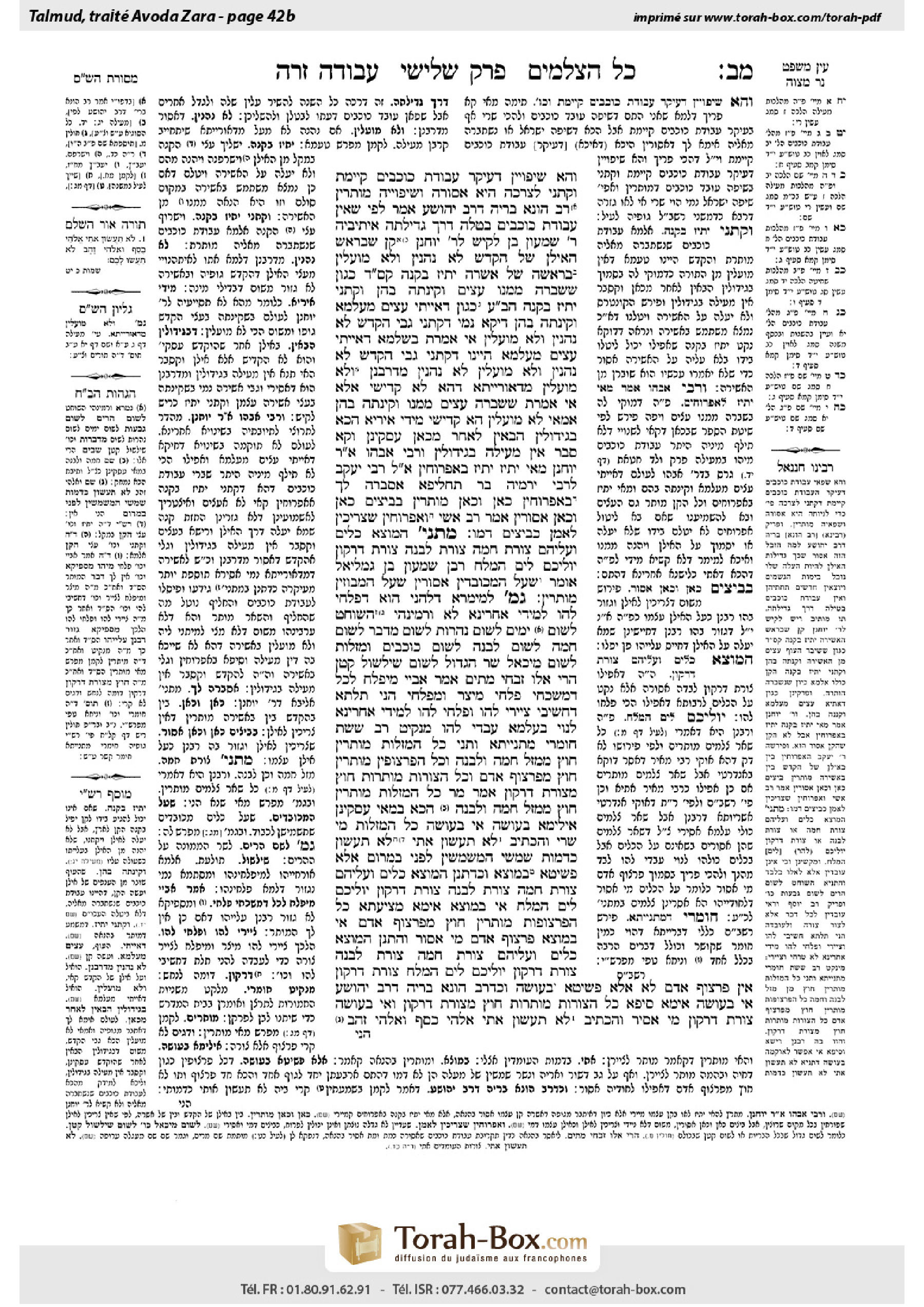
Avodah Zarah 42b: Talmud study for Daf Yomi
Study the Talmud for Daf Yomi with scanned pages, Hebrew text, English translations from Sefaria and AI-generated French translations.
Passage selection and English or AI-generated French translation are available where the scan has annotations. Daf Study is independent of Torah-Box and Sefaria.
Browse Avodah Zarah · עבודה זרה · All tractatesAvodah Zarah 42b text and translations
This page of Avodah Zarah includes the Aramaic text, an English translation and an AI-generated French translation, alongside the scan above.
עבודה זרה מ״ב ב · Aramaic and Hebrew text
וְהָא שִׁיפּוּיָין, דְּעִיקַּר עֲבוֹדָה זָרָה קַיֶּימֶת, וְקָתָנֵי: לְצׇרְכָּהּ — הִיא אֲסוּרָה, וְשִׁיפּוּיֶיהָ מוּתָּרִין!
רַב הוּנָא בְּרֵיהּ דְּרַב יְהוֹשֻׁעַ אָמַר: לְפִי שֶׁאֵין עֲבוֹדָה זָרָה בְּטֵלָה דֶּרֶךְ גְּדִילָתָהּ.
אֵיתִיבֵיהּ רַבִּי שִׁמְעוֹן בֶּן לָקִישׁ לְרַבִּי יוֹחָנָן: קֵן שֶׁבְּרֹאשׁ הָאִילָן שֶׁל הֶקְדֵּשׁ — לֹא נֶהֱנִין וְלֹא מוֹעֲלִין, בְּרֹאשָׁהּ שֶׁל אֲשֵׁרָה — יַתִּיז בְּקָנֶה.
קָא סָלְקָא דַּעְתָּךְ, כְּגוֹן שֶׁשִּׁבְּרָה מִמֶּנּוּ עֵצִים וְקִינְּתָהּ בָּהֶן, וְקָתָנֵי: יַתִּיז בְּקָנֶה.
הָכָא בְּמַאי עָסְקִינַן? כְּגוֹן דְּאַיְיתַי עֵצִים מֵעָלְמָא, וְקִינְּתָהּ בָּהֶן.
דַּיְקָא נָמֵי, דְּקָתָנֵי גַּבֵּי הֶקְדֵּשׁ: לֹא נֶהֱנִין וְלֹא מוֹעֲלִין; אִי אָמְרַתְּ בִּשְׁלָמָא דְּאַיְיתַי עֵצִים מֵעָלְמָא, הַיְינוּ דְּקָתָנֵי גַּבֵּי הֶקְדֵּשׁ: לֹא נֶהֱנִין וְלֹא מוֹעֲלִין — לֹא נֶהֱנִין מִדְּרַבָּנַן, וְלֹא מוֹעֲלִין מִדְּאוֹרָיְיתָא, דְּהָא לָא קַדִּישִׁי.
אֶלָּא אִי אָמְרַתְּ שֶׁשִּׁבְּרָה עֵצִים מִמֶּנּוּ, וְקִינְּתָהּ בָּהֶן, אַמַּאי לֹא מוֹעֲלִין? הָא קַדִּישִׁי!
מִידֵּי אִירְיָא? הָכָא בְּגִידּוּלִין הַבָּאִין לְאַחַר מִכָּאן עָסְקִינַן, וְקָא סָבַר אֵין מְעִילָה בְּגִידּוּלִין.
וְרַבִּי אֲבָהוּ אָמַר רַבִּי יוֹחָנָן: מַאי ״יַתִּיז״? יַתִּיז בָּאֶפְרוֹחִין.
אֲמַר לֵיהּ רַבִּי יַעֲקֹב לְרַבִּי יִרְמְיָה בַּר תַּחְלִיפָא: אַסְבְּרַהּ לָךְ, בְּאֶפְרוֹחִין — כָּאן וְכָאן מוּתָּרִין, בְּבֵיצִים — כָּאן וְכָאן אֲסוּרִין. אָמַר רַב אָשֵׁי: וְאֶפְרוֹחִין שֶׁצְּרִיכִין לְאִמָּן כְּבֵיצִים דָּמוּ.
מַתְנִי׳ הַמּוֹצֵא כֵּלִים וַעֲלֵיהֶם צוּרַת חַמָּה, צוּרַת לְבָנָה, צוּרַת דְּרָקוֹן — יוֹלִיכֵם לְיָם הַמֶּלַח. רַבָּן שִׁמְעוֹן בֶּן גַּמְלִיאֵל אוֹמֵר: שֶׁעַל הַמְכוּבָּדִין — אֲסוּרִין, שֶׁעַל הַמְבוּזִּין — מוּתָּרִין.
גְּמָ׳ לְמֵימְרָא דִּלְהָנֵי הוּא דְּפָלְחִי לְהוּ, לְמִידֵּי אַחֲרִינָא לָא? וּרְמִינְהִי: הַשּׁוֹחֵט לְשׁוּם יַמִּים, לְשׁוּם נְהָרוֹת, לְשׁוּם מִדְבָּר, לְשׁוּם חַמָּה, לְשׁוּם לְבָנָה, לְשׁוּם כּוֹכָבִים וּמַזָּלוֹת, לְשׁוּם מִיכָאֵל שַׂר הַגָּדוֹל, לְשׁוּם שִׁילְשׁוּל קָטָן — הֲרֵי אֵלּוּ זִבְחֵי מֵתִים!
אָמַר אַבָּיֵי: מִיפְלָח לְכֹל דְּמַשְׁכְּחִי פָּלְחִי, מֵיצָר וּמִפְלָחי — הָנֵי תְּלָתָא דַּחֲשִׁיבִי צָיְירִי לְהוּ וּפָלְחִי לְהוּ, לְמִידֵּי אַחֲרִינָא — לְנוֹי בְּעָלְמָא עָבְדִי לְהוּ.
מְנַקֵּיט רַב שֵׁשֶׁת חוּמְרֵי מַתְנְיָיתָא וְתָנֵי: כׇּל הַמַּזָּלוֹת מוּתָּרִין — חוּץ מִמַּזַּל חַמָּה וּלְבָנָה, וְכׇל הַפַּרְצוּפִין מוּתָּרִין — חוּץ מִפַּרְצוּף אָדָם, וְכׇל הַצּוּרוֹת מוּתָּרוֹת — חוּץ מִצּוּרַת דְּרָקוֹן.
אָמַר מָר: כׇּל הַמַּזָּלוֹת מוּתָּרִין, חוּץ מִמַּזַּל חַמָּה וּלְבָנָה. הָכָא בְּמַאי עָסְקִינַן? אִילֵימָא בְּעוֹשֶׂה — אִי בְּעוֹשֶׂה, כׇּל הַמַּזָּלוֹת מִי שְׁרֵי? וְהָכְתִיב: ״לֹא תַעֲשׂוּן אִתִּי״ — לֹא תַּעֲשׂוּן כִּדְמוּת שַׁמָּשַׁי הַמְשַׁמְּשִׁין לְפָנַי בַּמָּרוֹם.
אֶלָּא פְּשִׁיטָא בְּמוֹצֵא, וּכְדִתְנַן: הַמּוֹצֵא כֵּלִים וַעֲלֵיהֶם צוּרַת חַמָּה, צוּרַת לְבָנָה, צוּרַת דְּרָקוֹן — יוֹלִיכֵם לְיָם הַמֶּלַח.
אִי בְּמוֹצֵא, אֵימָא מְצִיעֲתָא: כׇּל הַפַּרְצוּפוֹת מוּתָּרִין חוּץ מִפַּרְצוּף אָדָם; אִי בְּמוֹצֵא, פַּרְצוּף אָדָם מִי אָסוּר? וְהָתְנַן: הַמּוֹצֵא כֵּלִים וַעֲלֵיהֶם צוּרַת חַמָּה, צוּרַת לְבָנָה, צוּרַת דְּרָקוֹן — יוֹלִיכֵם לְיָם הַמֶּלַח. צוּרַת דְּרָקוֹן — אִין, פַּרְצוּף אָדָם — לָא!
אֶלָּא פְּשִׁיטָא בְּעוֹשֶׂה, וְכִדְרַב הוּנָא בְּרֵיהּ דְּרַב יְהוֹשֻׁעַ.
אִי בְּעוֹשֶׂה, אֵימָא סֵיפָא: כׇּל הַצּוּרוֹת מוּתָּרוֹת — חוּץ מִצּוּרַת דְּרָקוֹן; וְאִי בְּעוֹשֶׂה, צוּרַת דְּרָקוֹן מִי אֲסִיר? וְהָכְתִיב: ״לֹא תַעֲשׂוּן אִתִּי אֱלֹהֵי כֶסֶף וֵאלֹהֵי זָהָב״,
Avodah Zarah 42b · English translation
The Gemara asks: But consider the case of shavings, where the main object of idol worship still exists, and nevertheless it is taught in the baraita cited earlier that if a gentile shaved an idol down for its own sake, the idol is forbidden, but its shavings are permitted. Here too, in the case of the fallen leaves of a tree that is worshipped as an idol, it should be permitted to derive benefit from them.
Rav Huna, son of Rav Yehoshua, says: The reason the leaves are not permitted is because the status of an object of idol worship cannot be revoked by its natural manner of growth. Since the falling of leaves is a natural phenomenon, their detachment from the tree does not effect a revocation of their status as objects of idol worship.
Rabbi Shimon ben Lakish raised an objection to the opinion of Rabbi Yoḥanan from a mishna (Me’ila 13b): With regard to a bird’s nest at the top of a tree that belongs to the Temple treasury, one may not derive benefit from it ab initio, but if one derived benefit from it, he is not liable for misuse of property consecrated to the Temple. With regard to a nest that is at the top of a tree used as part of idolatrous rites [ashera], although one may not climb the tree, as that would be benefiting from an object of idol worship, he may knock the nest off with a pole and benefit from it by using it for firewood and the like.
In analyzing this baraita, it enters your mind that this is referring to a case where the bird broke off branches from the worshipped tree and built a nest with them. And yet, the baraita teaches that one may knock the nest off with a pole and it is then permitted to benefit from it. Apparently, the forbidden branches used in the construction of the nest lost their idolatrous status without human involvement, in accordance with the opinion of Reish Lakish that an idol that breaks loses its status.
The Gemara explains: Here we are dealing with a case where the bird brought branches from elsewhere and built a nest with them on top of the worshipped tree. The branches were never part of an object of idol worship.
The Gemara comments: The language of the mishna is also precise if read with this understanding, as it teaches with regard to a nest in a consecrated tree: One may not derive benefit from it ab initio, but if one derived benefit from it, he is not liable for misuse of consecrated property. Granted, if you say that the bird brought branches from elsewhere, this explanation is consistent with that which the mishna teaches with regard to a nest in a consecrated tree, namely, that one may not derive benefit from it, but if one derived benefit from it, he is not liable for misuse of consecrated property. According to this understanding of the mishna, one may not derive benefit from the nest by rabbinic law, but if one derived benefit from it, he is not liable for misusing consecrated property by Torah law, as the branches are not consecrated, but were brought from elsewhere.
But if you say that the bird broke off branches from the tree itself and built a nest with them, why is it taught that one who derives benefit from it is not liable for misusing consecrated property? Aren’t the branches consecrated? Evidently, the mishna is referring to a nest that was built with branches from other trees, in accordance with Rabbi Yoḥanan’s understanding that an object of idol worship that broke on its own is still forbidden.
The Gemara responds to this proof for Rabbi Yoḥanan’s understanding of the mishna: Does this argument prove anything? The mishna can still be interpreted as referring to a case where the branches for the nest came from the tree itself, and here we are dealing with a case of growths that came afterward, i.e., branches that grew after the tree was consecrated, and the tanna of the mishna holds that there is no prohibition against the misuse of consecrated property with regard to such growths.
Another explanation of the mishna in accordance with the opinion of Rabbi Yoḥanan is presented. Rabbi Abbahu says that Rabbi Yoḥanan says: What does it mean that one may knock off the nest? It means that one may knock off the chicks; but one may not derive benefit from the nest itself.
Rabbi Ya’akov said to Rabbi Yirmeya bar Taḥlifa: I will explain the mishna to you: With regard to the chicks, which can fly away and are not confined to the tree, both here and there, i.e., both in the case of a tree consecrated to the Temple treasury and in the case of a tree used for idol worship, deriving benefit from them is permitted. But with regard to the eggs, both here and there, i.e., both in the case of a tree consecrated to the Temple treasury and in the case of a tree used for idol worship, deriving benefit from them is prohibited, as they are not seen as independent of the tree. Rav Ashi added to this and said: And chicks that still need their mother to survive are considered like eggs; deriving benefit from them is prohibited.
MISHNA: In the case of one who finds vessels, and upon them is a figure of the sun, a figure of the moon, or a figure of a dragon, he must take them and cast them into the Dead Sea and not derive any benefit from them, as they are assumed to be objects of idol worship. Rabban Shimon ben Gamliel says: Those figures that are upon respectable vessels are forbidden. Those that are upon disgraceful vessels are permitted.
GEMARA: The Gemara asks with regard to the specific figures listed in the mishna: Is this to say that people worship only these figures, but not any other item? And the Gemara raises a contradiction between this list and that which is taught in another mishna (Ḥullin 39b): With regard to one who slaughters an animal for the sake of, i.e., to worship, seas, for the sake of rivers, for the sake of the wilderness, for the sake of the sun, for the sake of the moon, for the sake of the stars and constellations, for the sake of Michael the great ministering angel, or even for the sake of a small worm, in all of these cases, the animal is forbidden, as these animals have the status of offerings to the dead, i.e., idols.
Abaye said in response to the contradiction: With regard to worship, people might worship any item that they find. With regard to fashioning figures and then worshipping them, only with regard to these three items listed in the mishna, which are important, do people fashion figures of them and worship them. With regard to figures of any other entity, people make them merely for ornamental purposes.
Rav Sheshet would consolidate the principles of the baraitot pertaining to this matter and teach: Figures of all constellations are permitted, except for the following celestial objects: The sun and the moon. And figures of all faces are permitted, except for the human face. And all figures of other items are permitted except for the figure of a dragon.
The Master said: Figures of all constellations are permitted, except for the following celestial objects: The sun and the moon. The Gemara asks: What are we dealing with here? If we say that the reference is to one who forms these figures, i.e., if Rav Sheshet is discussing the issue of which figures it is permitted to form, is forming figures of all the other constellations permitted? But isn’t it written: “You shall not make with Me gods of silver, or gods of gold, you shall not make for you” (Exodus 20:20)? This verse is interpreted to mean: You shall not make figures of My attendants who serve before Me on high, i.e., those celestial bodies, including the constellations, that were created to serve God.
Rather, it is obvious that this halakha is referring to a case where one finds vessels with these figures on them, and this is as we learned in the mishna: In the case of one who finds vessels, and upon them is a figure of the sun, a figure of the moon, or a figure of a dragon, he must take them and cast them into the Dead Sea. This indicates that it is permitted to derive benefit from any other vessels that were found and that had figures on them.
The Gemara asks: If it is a case where one finds vessels with these figures on them, say the middle clause of Rav Sheshet’s statement: Figures of all faces are permitted, except for the human face. Now, if it is a case where one finds vessels with figures on them, is a vessel with the figure of the human face forbidden? But didn’t we learn in the mishna: In the case of one who finds vessels, and upon them is a figure of the sun, a figure of the moon, or a figure of a dragon, he must take them and cast them into the Dead Sea? This indicates that a vessel with the figure of a dragon is forbidden, but a vessel with the figure of a human face is not.
Rather, the Gemara concludes, it is obvious that the statement that the figure of a human face is forbidden is referring to a case where one forms a figure, and this is prohibited, in accordance with the statement of Rav Huna, son of Rav Yehoshua, who states (43b) that the interpretation of the verse: “You shall not make with Me gods of silver, or gods of gold, you shall not make for you” (Exodus 20:20), is: Do not make of Me, i.e., do not form the figure of a person, who was created in the image of God.
The Gemara asks: If it is referring to a case where one forms a figure, say the last clause of Rav Sheshet’s statement: All figures are permitted except for the figure of a dragon. And if it is referring to a case where one forms a figure, is forming the figure of a dragon prohibited? But isn’t it written: “You shall not make with Me gods of silver, or gods of gold”?
Avodah Zarah 42b · Traduction française (IA)
La Guemara pose la question : Mais considérons le cas des copeaux, où l'objet principal de l'idolâtrie existe encore, et pourtant il est enseigné dans la baraïta citée plus haut que si un non-Juif taille un idole à son propre profit, l'idole est interdite, mais ses copeaux sont permis. De même, dans le cas des feuilles tombées d'un arbre qui est vénéré comme un idole, il devrait être permis d'en tirer un bénéfice.
Rav Huna, fils de Rav Yéhoshua, dit : La raison pour laquelle les feuilles ne sont pas permises est que le statut d'un objet d'idolâtrie ne peut être révoqué par sa croissance naturelle. Puisque la chute des feuilles est un phénomène naturel, leur détachement de l'arbre ne constitue pas une révocation de leur statut d'objets d'idolâtrie.
Rabbi Shimon ben Lakish a soulevé un objet contre l'opinion de Rabbi Yoḥanan, en se basant sur une mitsva (Me’ila 13b) : Concernant un nid d'oiseau au sommet d'un arbre appartenant au trésor du Temple, on ne peut pas en tirer un bénéfice dès le début, mais si l'on en a tiré un bénéfice, on n'est pas puni pour l'usage illégitime de biens consacrés au Temple. Concernant un nid au sommet d'un arbre utilisé dans les rites idolâtres [ashera], bien qu'on ne puisse pas monter sur l'arbre, car cela serait tirer un bénéfice d'un objet d'idolâtrie, on peut enlever le nid avec un bâton et en tirer un bénéfice en le utilisant comme bois de chauffage, etc.
En analysant cette baraïta, il vous vient à l'esprit que cela fait référence à un cas où l'oiseau a détaché des branches de l'arbre vénéré et a construit un nid avec elles. Et pourtant, la baraïta enseigne que l'on peut enlever le nid avec un bâton et alors il est permis d'en tirer un bénéfice. Apparemment, les branches interdites utilisées dans la construction du nid ont perdu leur statut idolâtre sans intervention humaine, conformément à l'opinion de Reish Lakish que si un idole se brise, elle perd son statut.
La Guemara explique : Nous sommes ici dans le cas où l'oiseau a apporté des branches d'ailleurs et a construit un nid avec elles au sommet de l'arbre vénéré. Les branches n'étaient jamais parties d'un objet d'idolâtrie.
La Guemara commente : Le langage de la mitsva est aussi précis s'il est lu avec cette compréhension, car il enseigne concernant un nid dans un arbre consacré : On ne peut pas en tirer un bénéfice dès le début, mais si l'on en a tiré un bénéfice, on n'est pas puni pour l'usage illégitime de biens consacrés. En effet, si vous dites que l'oiseau a apporté des branches d'ailleurs, cette explication est cohérente avec ce que la mitsva enseigne concernant un nid dans un arbre consacré, à savoir qu'on ne peut pas en tirer un bénéfice, mais si l'on en a tiré un bénéfice, on n'est pas puni pour l'usage illégitime de biens consacrés. Selon cette compréhension de la mitsva, on ne peut pas en tirer un bénéfice par la loi rabbinique, mais si l'on en a tiré un bénéfice, on n'est pas puni pour l'usage illégitime de biens consacrés par la loi divine, car les branches ne sont pas consacrées, mais ont été apportées d'ailleurs.
Mais si vous dites que l'oiseau a détaché des branches de l'arbre lui-même et a construit un nid avec elles, pourquoi est-il enseigné que celui qui en tire un bénéfice n'est pas puni pour l'usage illégitime de biens consacrés ? Les branches ne sont-elles pas consacrées ? Évidemment, la mitsna fait référence à un nid construit avec des branches d'autres arbres, conformément à l'opinion de Rabbi Yoḥanan que si un objet d'idolâtrie se brise tout seul, il reste interdit.
La Guemara répond à cette preuve en faveur de l'opinion de Rabbi Yoḥanan sur la mitsna : Cette argumentation prouve-t-elle quelque chose ? La mitsna peut toujours être interprétée comme faisant référence à un cas où les branches pour le nid viennent de l'arbre lui-même, et ici nous sommes dans le cas de pousses qui sont venues après, c'est-à-dire des branches qui ont poussé après que l'arbre ait été consacré, et le tanna de la mitsna tient que l'usage illégitime de biens consacrés n'est pas interdit concernant ces pousses.
Une autre explication de la mitsna, conformément à l'opinion de Rabbi Yoḥanan, est présentée. Rabbi Abbahu dit que Rabbi Yoḥanan dit : Que signifie-t-il par le fait de faire tomber le nid ? Cela signifie que l'on peut faire tomber les poussins ; mais on ne peut pas en tirer un bénéfice directement du nid lui-même.
Rabbi Ya’akov a dit à Rabbi Yirmeya bar Taḥlifa : Je vais vous expliquer la michna : Concernant les poussins, qui peuvent voler et ne sont pas confinés à l'arbre, tant ici que là, c'est-à-dire tant dans le cas d'un arbre consacré au trésor du Temple que dans le cas d'un arbre utilisé pour l'idolâtrie, il est permis d'en tirer un bénéfice. Concernant les œufs, tant ici que là, c'est-à-dire tant dans le cas d'un arbre consacré au trésor du Temple que dans le cas d'un arbre utilisé pour l'idolâtrie, il est interdit d'en tirer un bénéfice, car ils ne sont pas vus comme indépendants de l'arbre. Rav Ashi a ajouté à cela et a dit : Et les poussins qui ont encore besoin de leur mère pour survivre sont considérés comme des œufs ; il est interdit d'en tirer un bénéfice.
Michna : Dans le cas d'une personne qui trouve des objets, et sur lesquels il y a une figure du soleil, une figure de la lune ou une figure d'un dragon, il doit les prendre et les jeter dans la Mer Morte et ne pas en tirer de bénéfice, car ils sont considérés comme des objets d'idolâtrie. Rabban Shimon ben Gamliel dit : Ces figures qui sont sur des objets respectables sont interdites. Ceux qui sont sur des objets disgraciés sont permis.
GUEMARA : La Guemara pose une question concernant les figures spécifiques énumérées dans la mitsna : cela signifie-t-il que les gens adorent uniquement ces figures, mais pas d'autres objets ? La Guemara soulève une contradiction entre cette liste et celle enseignée dans une autre mitsna (Ḥullin 39b) : concernant celui qui sacrifie un animal à l'intention de, c'est-à-dire pour adorer, les mers, pour les rivières, pour la steppe, pour le soleil, pour la lune, pour les étoiles et les constellations, pour le grand ange ministre Michel, ou même pour un petit ver, dans tous ces cas, l'animal est interdit, car ces animaux ont le statut de sacrifices pour les morts, c'est-à-dire des idoles.
Abaye répond à cette contradiction : concernant l'adoration, les gens pourraient adorer n'importe quel objet qu'ils trouvent. Concernant la fabrication de figures et leur adoration, seul concernant ces trois objets énumérés dans la mitsna, qui sont importants, les gens fabriquent des figures de ces objets et les adorent. Concernant les figures de tout autre être, les gens les fabriquent uniquement à des fins décoratives.
Rav Sheshet réunissait les principes des baraitot concernant cette question et enseignait : les figures de toutes les constellations sont permises, sauf les objets célestes suivants : le soleil et la lune. Et les figures de tous les visages sont permises, sauf le visage humain. Et toutes les figures d'autres objets sont permises, sauf la figure du dragon.
Le Maître dit : les figures de toutes les constellations sont permises, sauf les objets célestes suivants : le soleil et la lune. La Guemara pose une question : de quoi est-on en train de parler ici ? Si l'on dit que la référence est à celui qui forme ces figures, c'est-à-dire si Rav Sheshet parle de la question de quelles figures il est permis de former, est-il permis de former des figures de toutes les autres constellations ? Mais n'est-il pas écrit : « Vous ne ferez pas pour moi des dieux d'argent, ni des dieux d'or, vous ne ferez pas pour vous » (Exode 20:20) ? Cette verset est interprété pour signifier : vous ne ferez pas de figures de mes serviteurs qui servent devant moi en haut, c'est-à-dire ces corps célestes, y compris les constellations, qui ont été créés pour servir Dieu.
Au contraire, il est évident que cette halakha fait référence à un cas où l'on trouve des objets contenant ces figures, et cela correspond à ce que nous avons appris dans la mitsna : dans le cas où l'on trouve des objets, et sur eux est une figure du soleil, une figure de la lune, ou une figure de dragon, il faut les prendre et les jeter dans la Mer Morte. Cela indique que l'on peut tirer un bénéfice d'autres objets trouvés qui avaient des figures dessus.
La Guemara pose une question : si c'est un cas où l'on trouve des objets avec ces figures dessus, disons la clause intermédiaire de la déclaration de Rav Sheshet : les figures de tous les visages sont permises, sauf le visage humain. Maintenant, si c'est un cas où l'on trouve des objets avec des figures dessus, est-ce que l'objet avec la figure du visage humain est interdit ? Mais n'avons-nous pas appris dans la mitsna : dans le cas où l'on trouve des objets, et sur eux est une figure du soleil, une figure de la lune, ou une figure de dragon, il faut les prendre et les jeter dans la Mer Morte ? Cela indique que l'objet avec la figure de dragon est interdit, mais l'objet avec la figure du visage humain ne l'est pas.
Au contraire, la Guemara conclut que l'affirmation selon laquelle la figure du visage humain est interdite fait référence à un cas où l'on forme une figure, et cela est interdit, conformément à la déclaration de Rav Huna, fils de Rav Yéhoshua, qui affirme (43b) que l'interprétation de la verset : « Vous ne ferez pas pour moi des dieux d'argent, ni des dieux d'or, vous ne ferez pas pour vous » (Exode 20:20), est : ne pas former de moi, c'est-à-dire ne pas former la figure d'une personne, qui a été créée à l'image de Dieu.
La Guemara pose une question : si cela fait référence à un cas où l'on forme une figure, disons la dernière clause de la déclaration de Rav Sheshet : toutes les figures sont permises sauf la figure du dragon. Et si cela fait référence à un cas où l'on forme une figure, est-ce que former la figure du dragon est interdit ? Mais n'est-il pas écrit : « Vous ne ferez pas pour moi des dieux d'argent, ni des dieux d'or » ?
Traduction française générée par IA à partir de l’édition anglaise de Sefaria. Vérifie toujours un passage avec le texte source.
Text from Sefaria: William Davidson Edition - Vocalized Aramaic (CC BY NC); William Davidson Edition - English (CC BY NC).