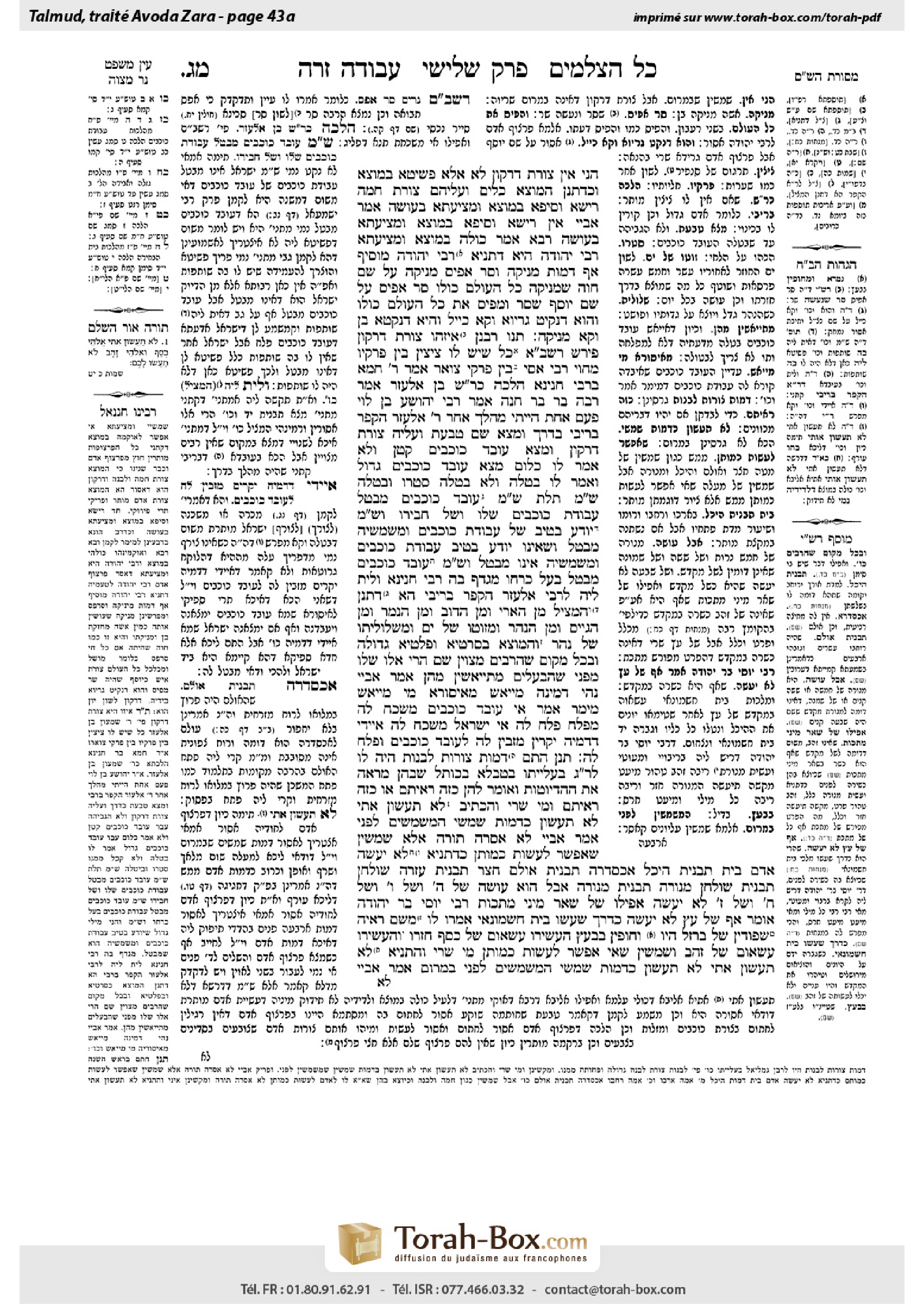
Avodah Zarah 43a: Talmud study for Daf Yomi
Study the Talmud for Daf Yomi with scanned pages, Hebrew text, English translations from Sefaria and AI-generated French translations.
Passage selection and English or AI-generated French translation are available where the scan has annotations. Daf Study is independent of Torah-Box and Sefaria.
Browse Avodah Zarah · עבודה זרה · All tractatesAvodah Zarah 43a text and translations
This page of Avodah Zarah includes the Aramaic text, an English translation and an AI-generated French translation, alongside the scan above.
עבודה זרה מ״ג א · Aramaic and Hebrew text
הָנֵי — אִין, צוּרַת דְּרָקוֹן — לָא!
אֶלָּא פְּשִׁיטָא בְּמוֹצֵא, וּכְדִתְנַן: הַמּוֹצֵא כֵּלִים וַעֲלֵיהֶם צוּרַת חַמָּה.
רֵישָׁא וְסֵיפָא בְּמוֹצֵא, וּמְצִיעֲתָא בְּעוֹשֶׂה?
אָמַר אַבָּיֵי: אִין, רֵישָׁא וְסֵיפָא בְּמוֹצֵא, וּמְצִיעֲתָא בְּעוֹשֶׂה.
רָבָא אָמַר: כּוּלָּהּ בְּמוֹצֵא, וּמְצִיעֲתָא רַבִּי יְהוּדָה הִיא. דְּתַנְיָא: רַבִּי יְהוּדָה מוֹסִיף אַף דְּמוּת מְנִיקָה וְסַר אֲפֵיס. מְנִיקָה — עַל שֵׁם חַוָּה שֶׁמְּנִיקָה כָּל הָעוֹלָם כּוּלּוֹ, סַר אֲפֵיס — עַל שֵׁם יוֹסֵף שֶׁסָּר וּמֵפִיס אֶת כָּל הָעוֹלָם כּוּלּוֹ. וְהוּא דְּנָקֵיט גְּרִיוָא וְקָא כָיֵיל, וְהִיא דְּנָקְטָא בֵּן וְקָא מְנִיקָה.
תָּנוּ רַבָּנַן: אֵיזֶהוּ צוּרַת דְּרָקוֹן? פֵּירֵשׁ רַבִּי שִׁמְעוֹן בֶּן אֶלְעָזָר: כֹּל שֶׁיֵּשׁ לוֹ צִיצִין בֵּין פְּרָקָיו. מַחְוֵי רַבִּי אַסִּי: בֵּין פִּרְקֵי צַוָּאר. אָמַר רַבִּי חָמָא בְּרַבִּי חֲנִינָא: הֲלָכָה כְּרַבִּי שִׁמְעוֹן בֶּן אֶלְעָזָר.
אָמַר רַבָּה בַּר בַּר חָנָה אָמַר רַבִּי יְהוֹשֻׁעַ בֶּן לֵוִי: פַּעַם אַחַת הָיִיתִי מְהַלֵּךְ אַחַר רַבִּי אֶלְעָזָר הַקַּפָּר בְּרִיבִּי בַּדֶּרֶךְ, וּמָצָא שָׁם טַבַּעַת וְעָלֶיהָ צוּרַת דְּרָקוֹן, וּמָצָא גּוֹי קָטָן וְלָא אָמַר לוֹ כְּלוּם, מָצָא גּוֹי גָּדוֹל וְאָמַר לוֹ: בַּטְּלָהּ, וְלֹא בִּטְּלָהּ, סְטָרוֹ וּבִטְּלָהּ.
שְׁמַע מִינַּהּ תְּלָת: שְׁמַע מִינַּהּ גּוֹי מְבַטֵּל עֲבוֹדָה זָרָה שֶׁלּוֹ וְשֶׁל חֲבֵירוֹ, וּשְׁמַע מִינַּהּ יוֹדֵעַ בְּטִיב שֶׁל עֲבוֹדָה זָרָה וּמְשַׁמְּשֶׁיהָ מְבַטֵּל, וְשֶׁאֵינוֹ יוֹדֵעַ בְּטִיב עֲבוֹדָה זָרָה וּמְשַׁמְּשֶׁיהָ אֵינוֹ מְבַטֵּל, וּשְׁמַע מִינַּהּ גּוֹי מְבַטֵּל בְּעַל כׇּרְחוֹ.
מְגַדֵּף בַּהּ רַבִּי חֲנִינָא, וְלֵית לֵיהּ לְרַבִּי אֶלְעָזָר הַקַּפָּר בְּרִיבִּי הָא דִּתְנַן: הַמַּצִּיל מִן הָאֲרִי וּמִן הַדּוֹב וּמִן הַנָּמֵר וּמִן הַגַּיִיס וּמִן הַנָּהָר וּמִזּוֹטוֹ שֶׁל יָם וּמִשְּׁלוּלִיתוֹ שֶׁל נָהָר, וְהַמּוֹצֵא בִּסְרַטְיָא וּפְלַטְיָא גְּדוֹלָה, וּבְכׇל מָקוֹם שֶׁהָרַבִּים מְצוּיִן שָׁם — הֲרֵי אֵלּוּ שֶׁלּוֹ, מִפְּנֵי שֶׁהַבְּעָלִים מִתְיָיאֲשִׁין מֵהֶן?
אָמַר אַבָּיֵי: נְהִי דְּמִינַּהּ מִיָּיאַשׁ, מֵאִיסּוּרָא מִי מִיָּיאַשׁ? מֵימָר אָמַר: אִי גּוֹי מַשְׁכַּח לַהּ — מִפְלָח פָּלַח לַהּ, אִי יִשְׂרָאֵל מַשְׁכַּח לַהּ — אַיְּידֵי דְּדָמֶיהָ יְקָרִין מְזַבֵּין לַהּ לְגוֹי וּפָלַח לַהּ.
תְּנַן הָתָם: דְּמוּת צוּרוֹת לְבָנוֹת הָיָה לוֹ לְרַבָּן גַּמְלִיאֵל בַּעֲלִיָּיתוֹ, בְּטַבְלָא בַּכּוֹתֶל, שֶׁבָּהֶן מַרְאֶה אֶת הַהֶדְיוֹטוֹת, וְאוֹמֵר לָהֶן: כָּזֶה רְאִיתֶם אוֹ כָּזֶה רְאִיתֶם?
וּמִי שְׁרֵי? וְהָכְתִיב: ״לֹא תַעֲשׂוּן אִתִּי״, לֹא תַעֲשׂוּן כִּדְמוּת שַׁמָּשַׁי הַמְשַׁמְּשִׁים לְפָנַי!
אָמַר אַבָּיֵי: לֹא אָסְרָה תּוֹרָה אֶלָּא שַׁמָּשִׁין שֶׁאֶפְשָׁר לַעֲשׂוֹת כְּמוֹתָן,
כִּדְתַנְיָא: לֹא יַעֲשֶׂה אָדָם בַּיִת תַּבְנִית הֵיכָל, אַכְסַדְרָה תַּבְנִית אוּלָם, חָצֵר תַּבְנִית עֲזָרָה, שׁוּלְחָן תַּבְנִית שׁוּלְחַן, מְנוֹרָה תַּבְנִית מְנוֹרָה, אֲבָל הוּא עוֹשֶׂה שֶׁל חָמֵשׁ וְשֶׁל שֵׁשׁ וְשֶׁל שְׁמוֹנֶה, וְשֶׁל שֶׁבַע לֹא יַעֲשֶׂה אֲפִילּוּ שֶׁל שְׁאָר מִינֵי מַתָּכוֹת.
רַבִּי יוֹסֵי בַּר יְהוּדָה אוֹמֵר: אַף שֶׁל עֵץ לֹא יַעֲשֶׂה, כְּדֶרֶךְ שֶׁעָשׂוּ בֵּית חַשְׁמוֹנַאי.
אָמְרוּ לוֹ: מִשָּׁם רְאָיָה? שַׁפּוּדִין שֶׁל בַּרְזֶל הָיוּ, (וְחוֹפִין) [וְחִיפּוּם] בְּבַעַץ, הֶעֱשִׁירוּ — עֲשָׂאוּם שֶׁל כֶּסֶף, חָזְרוּ וְהֶעֱשִׁירוּ — עֲשָׂאוּם שֶׁל זָהָב.
וְשַׁמָּשִׁין שֶׁאִי אֶפְשָׁר לַעֲשׂוֹת כְּמוֹתָן מִי שְׁרֵי? וְהָתַנְיָא: ״לֹא תַעֲשׂוּן אִתִּי״ — לֹא תַעֲשׂוּן כִּדְמוּת שַׁמָּשַׁי הַמְשַׁמְּשִׁים לְפָנַי בַּמָּרוֹם!
אָמַר אַבָּיֵי:
Avodah Zarah 43a · English translation
The Sages interpret this verse as referring to the heavenly constellations, which indicates that it is prohibited to form only these figures, but it is not prohibited to form a figure of a dragon.
Rather, the Gemara concludes, it is obvious that this halakha is referring to a case where one finds a vessel with the figure of a dragon, and this is as we learned in the mishna: In the case of one who finds vessels, and upon them is a figure of the sun, a figure of the moon, or a figure of a dragon, he must take them and cast them into the Dead Sea.
The Gemara asks about the lack of consistency between the clauses of Rav Sheshet’s statement: Can it be that the first clause and the last clause are referring to a case where one finds vessels with the specified figures, and the middle clause is referring to a case where one forms these figures?
Abaye said: Indeed, the first clause and the last clause are referring to cases where one finds vessels with figures, and the middle clause is referring to a case where one forms figures.
Rava said: The entire statement of Rav Sheshet is referring to a case where one finds vessels with these figures, and the middle clause is in accordance with the opinion of Rabbi Yehuda. As it is taught in a baraita that Rabbi Yehuda adds to the list of forbidden figures even a figure of a nursing woman and Sar Apis. The figure of a nursing woman is worshipped as it symbolizes Eve, who nurses the entire world. The figure of Sar Apis is worshipped as it symbolizes Joseph, who ruled over [sar] and appeased [mefis] the entire world by distributing food during the seven years of famine (see Genesis, chapter 41). But the figure of Sar Apis is forbidden only when it is holding a dry measure and measuring with it; and the figure of a nursing woman is forbidden only when she is holding a child and nursing it.
§ The Sages taught: What is a figure of a dragon? Rabbi Shimon ben Elazar explained: It is any figure that has scales between its joints. Rabbi Asi motioned with his hands to depict scales between the joints of the neck. Rabbi Ḥama, son of Rabbi Ḥanina, says: The halakha is in accordance with the opinion of Rabbi Shimon ben Elazar.
Rabba bar bar Ḥana says that Rabbi Yehoshua ben Levi says: Once, I was following Rabbi Elazar HaKappar the Distinguished on the road, and he found a ring there, and there was a figure of a dragon on it. And he then encountered a minor gentile boy, but did not say anything to him. He then encountered an adult gentile, and said to him: Revoke the ring’s idolatrous status. But the gentile did not revoke it. Rabbi Elazar HaKappar then slapped him across his face, whereupon the gentile succumbed and revoked its idolatrous status.
The Gemara comments: Learn from this incident the following three halakhot: Learn from it that a gentile can revoke the idolatrous status of both his object of idol worship and that of another gentile. And learn from the fact that Rabbi Elazar HaKappar waited to find an adult gentile, that only one who is aware of the nature of idol worship and its accessories can revoke the idol’s status, but one who is not aware of the nature of idol worship and its accessories, such as a minor, cannot revoke the idol’s status. And finally, learn from it that a gentile can revoke the status of an idol even against his will.
Rabbi Ḥanina ridiculed this ruling and asked: But why was it necessary to have a gentile actively revoke the idolatrous status of the ring? Doesn’t Rabbi Elazar HaKappar the Distinguished maintain in accordance with that which we learned in a baraita: In the case of one who saves an object from a lion, or from a bear, or from a cheetah, or from a troop of soldiers, or from a river, or from the tide of the sea, or from the flooding of a river, or similarly one who finds an object in a main thoroughfare or in a large plaza, or for that matter, anywhere frequented by the public, in all these cases, the objects belong to him, because the owners despair of recovering them? Therefore, in the case of a lost ring with an idolatrous figure on it, its idolatrous status is automatically revoked, as its owner despairs of recovering it.
Abaye said: Granted, the owner despairs of recovering the object itself, but does he despair of its forbidden [me’issura] idolatrous status? The owner does not assume that the object will never be worshipped again; rather, he says to himself: If a gentile finds it, he will worship it. If a Jew finds it, since it is valuable, he will sell it to a gentile who will then worship it. Therefore, Rabbi Elazar HaKappar had to have the ring’s idolatrous status revoked.
§ We learned in a mishna there (Rosh HaShana 24a): Rabban Gamliel had diagrams of the different figures of moons drawn on a tablet that hung on the wall of his attic, which he would show to the ordinary people [hahedyotot] who came to testify about sighting the new moon but who were unable to adequately describe what they had seen. And he would say to them: Did you see an image like this, or did you see an image like that?
The Gemara asks: And is it permitted to form these figures? But isn’t it written: “You shall not make with Me gods of silver, or gods of gold” (Exodus 20:20), which is interpreted to mean: You shall not make figures of My attendants who serve before Me, i.e., those celestial bodies that were created to serve God, including the sun and the moon.
In answering, Abaye said: The Torah prohibited only the figures of those attendants that one can possibly reproduce something that is truly in their likeness. Since it is impossible to reproduce the sun and the moon, the prohibition does not apply to these entities.
As it is taught in a baraita: A person may not construct a house in the exact image of the Sanctuary, nor a portico in the exact image of the Entrance Hall of the Sanctuary, nor a courtyard corresponding to the Temple courtyard, nor a table corresponding to the Table in the Temple, nor a candelabrum corresponding to the Candelabrum in the Temple. But one may fashion a candelabrum of five or of six or of eight lamps. And one may not fashion a candelabrum of seven lamps even if he constructs it from other kinds of metal rather than gold, as in extenuating circumstances the Candelabrum in the Temple may be fashioned from other metals.
The baraita continues: Rabbi Yosei bar Yehuda says: One may not fashion a candelabrum of wood either, in the manner that the kings of the Hasmonean monarchy fashioned it. When they first purified the Temple they had to fashion the Candelabrum out of wood as no other material was available. Since a wooden candelabrum is fit for the Temple, it is prohibited to fashion one of this kind for oneself.
The Rabbis said to Rabbi Yosei bar Yehuda: Do you seek to cite a proof from there, i.e., from the Hasmonean era, that a candelabrum fashioned of wood is fit for the Temple? During that era the branches of the Candelabrum were fashioned from spits [shappudin] of iron, and they covered them with tin [beva’atz]. Later, when they grew richer and could afford a Candelabrum of higher-quality material, they fashioned the Candelabrum from silver. When they grew even richer, they fashioned the Candelabrum from gold. In any event, Abaye proves from this baraita that the prohibition against forming a figure applies only to items that can be reconstructed in an accurate manner. Since this is not possible in the case of the moon, Rabban Gamliel’s figures were permitted.
The Gemara asks: And is it actually permitted to fashion figures of those attendants of God concerning which it is impossible to reproduce their likeness? But isn’t it taught in a baraita that the verse: “You shall not make with Me gods of silver” (Exodus 20:20), is interpreted to mean: You shall not make figures of My attendants who serve before Me on high? Apparently, this includes the sun and the moon.
Abaye said:
Avodah Zarah 43a · Traduction française (IA)
Les Sages interprètent cette versette comme faisant référence aux constellations célestes, ce qui indique qu'il est interdit de former uniquement ces figures, mais il n'est pas interdit de former une figure de dragon.
En effet, la Guemara conclut que c'est évident que cette halakha fait référence à un cas où l'on trouve un récipient avec la figure d'un dragon, et c'est ce que nous avons appris dans la Michna : Dans le cas où l'on trouve des récipients et qu'ils portent une figure du soleil, une figure de la lune ou une figure de dragon, il faut les prendre et les jeter dans la Mer Morte.
La Guemara pose une question sur l'incohérence entre les clauses de la déclaration de Rav Sheshet : peut-il être que la première clause et la dernière clause fassent référence à un cas où l'on trouve des récipients avec ces figures spécifiées, et que la clause du milieu fasse référence à un cas où l'on forme ces figures ?
Abaye dit : En effet, la première clause et la dernière clause font référence à des cas où l'on trouve des récipients avec des figures, et la clause du milieu fait référence à un cas où l'on fabrique des figures.
Rava dit : L'ensemble de la déclaration de Rav Sheshet fait référence à un cas où l'on trouve des récipients avec ces figures, et la clause du milieu est conforme à l'opinion de Rabbi Yehuda. Comme il est enseigné dans une baraïta que Rabbi Yehuda ajoute à la liste des figures interdites une figure de femme allaitante et Sar Apis. La figure de la femme allaitante est vénérée car elle symbolise Ève, qui nourrit le monde entier. La figure de Sar Apis est vénérée car elle symbolise Joseph, qui régnait sur [sar] et apaisa [mefis] le monde entier en distribuant de la nourriture pendant les sept années de famine (voir Genèse, chapitre 41). La figure de Sar Apis est interdite uniquement lorsqu'elle tient une mesure sèche et la mesure ; et la figure de la femme allaitante est interdite uniquement lorsqu'elle tient un enfant et le nourrit.
§ Les Sages enseignent : Qu'est-ce qu'une figure de dragon ? Rabbi Shimon ben Elazar explique : C'est toute figure qui a des écailles entre ses articulations. Rabbi Asi a fait un geste avec ses mains pour décrire des écailles entre les articulations du cou. Rabbi Ḥama, fils de Rabbi Ḥanina, dit : La halakha suit l'opinion de Rabbi Shimon ben Elazar.
Rabba bar bar Ḥana dit que Rabbi Yehoshua ben Levi dit : Un jour, je suivais Rabbi Elazar HaKappar le Distingué sur la route, et il a trouvé un anneau là, et il y avait une figure de dragon dessus. Et il a ensuite rencontré un petit garçon païen, mais il n'a pas dit quoi que ce soit à lui. Il a ensuite rencontré un adulte païen, et il a dit à lui : Révoque le statut idolâtre de l'anneau. Mais le païen n'a pas révoqué. Rabbi Elazar HaKappar a alors frappé son visage, oùupon le païen s'est effondré et a révoqué le statut idolâtre de l'anneau.
La Guemara commente : Apprends de cet incident les trois halakhot suivantes : Apprends qu'un païen peut révoquer le statut idolâtre à la fois de son objet d'idolâtrie et de celui d'un autre païen. Et apprends du fait que Rabbi Elazar HaKappar a attendu pour trouver un païen adulte, que seul celui qui connaît la nature de l'idolâtrie et de ses accessoires peut révoquer le statut de l'idole, mais celui qui ne connaît pas la nature de l'idolâtrie et de ses accessoires, comme un enfant, ne peut pas révoquer le statut de l'idole. Enfin, apprends qu'un païen peut révoquer le statut d'une idole même contre sa volonté.
Rabbi Ḥanina moqua cette décision et demanda : Mais pourquoi avait-il été nécessaire d'avoir un païen actif pour révoquer le statut idolâtre de l'anneau ? N'est-ce pas que Rabbi Elazar HaKappar le Distingué maintient, selon ce que nous avons appris dans une baraïta : Dans le cas où l'on sauve un objet d'un lion, ou d'un ours, ou d'un léopard, ou d'une troupe de soldats, ou d'un fleuve, ou de la marée de la mer, ou de l'inondation d'un fleuve, ou de manière similaire, celui qui trouve un objet dans une grande artère ou dans une place publique, ou tout simplement n'importe où fréquenté par le public, dans tous ces cas, les objets lui appartiennent, car les propriétaires désespèrent de les récupérer ? Donc, dans le cas d'un anneau perdu avec une figure idolâtre dessus, son statut idolâtre est automatiquement révoqué, car son propriétaire désespère de le récupérer.
Abaye dit : Bien sûr, le propriétaire désespère de récupérer l'objet lui-même, mais est-ce qu'il désespère de son statut idolâtre interdit ? Le propriétaire ne suppose pas que l'objet ne sera jamais à nouveau vénéré ; il dit à lui-même : Si un païen le trouve, il le vénérera. Si un Juif le trouve, puisqu'il est précieux, il le vendra à un païen qui le vénérera alors. Donc, Rabbi Elazar HaKappar avait besoin de faire révoquer le statut idolâtre de l'anneau.
§ Nous avons appris dans une mishna là (Rosh HaShana 24a) : Rabban Gamliel avait des schémas des différentes figures de lunes dessinés sur une tablette qui pendait au mur de son grenier, qu'il montrait aux gens ordinaires [hahedyotot] qui venaient témoigner de la vue de la lune nouvelle mais qui ne pouvaient pas décrire correctement ce qu'ils avaient vu. Et il disait à eux : As-tu vu une image comme celle-ci, ou as-tu vu une image comme celle-là ?
La Guemara pose la question : Et est-il permis de former ces figures ? Mais n'est-il pas écrit : « Tu ne feras pas pour moi des dieux d'argent, ni des dieux d'or » (Exode 20:20), ce qui est interprété pour signifier : Tu ne feras pas des figures de mes serviteurs qui servent devant moi, c'est-à-dire ces corps célestes qui ont été créés pour servir Dieu, y compris le soleil et la lune.
En répondant, Abaye dit : La Torah a interdit uniquement les figures de ces serviteurs dont on peut reproduire véritablement l'aspect. Puisque c'est impossible de reproduire le soleil et la lune, l'interdiction ne s'applique pas à ces entités.
Comme il est enseigné dans une baraïta : une personne ne peut pas construire une maison dans l'image exacte du Sanctuaire, ni un portique dans l'image exacte de la salle d'entrée du Sanctuaire, ni un jardin correspondant au jardin du Temple, ni une table correspondant à la table du Temple, ni un candelabre correspondant au candelabre du Temple. Mais on peut fabriquer un candelabre de cinq ou de six ou de huit lampes. Et on ne peut pas fabriquer un candelabre de sept lampes même si on le construit en métal autre que l'or, comme dans des circonstances atténuantes le candelabre du Temple peut être fait d'autres métaux.
La baraïta continue : Rabbi Yosei bar Yehuda dit : On ne peut pas non plus fabriquer un candelabre en bois, dans le style que les rois de la dynastie hasmonéenne l'ont fait. Lorsqu'ils ont d'abord purifié le Temple, ils avaient besoin de fabriquer le candelabre en bois car aucun autre matériau n'était disponible. Puisque un candelabre en bois est adapté au Temple, il est interdit de le fabriquer pour soi-même.
Les Rabbins dirent à Rabbi Yosei bar Yehuda : Voulez-vous invoquer une preuve à partir de là, c'est-à-dire à partir de l'époque des Hasmoneens, que le candelabre en bois est adapté au Temple ? Durant cette époque, les branches du candelabre étaient faites de tiges d'acier [shappudin], et elles les recouvraient de plomb [beva’atz]. Plus tard, lorsqu'ils se sont enrichis et ont pu se permettre un candelabre en matériau de meilleure qualité, ils ont fait le candelabre en argent. Lorsqu'ils se sont encore enrichis davantage, ils ont fait le candelabre en or. En tout cas, Abaye prouve à partir de cette baraïta que l'interdiction de reproduire une figure s'applique uniquement aux objets pouvant être reproduits avec précision. Puisque cela n'est pas possible dans le cas de la lune, les figures de Rabban Gamliel étaient permises.
La Guemara demande : Et est-il vraiment permis de fabriquer des figures de ces serviteurs de Dieu dont on ne peut pas reproduire l'effigie ? Mais n'est-il pas enseigné dans une baraïta que la parole : « Tu ne feras pas pour moi des dieux en argent » (Exode 20:20), est interprétée pour signifier : Tu ne feras pas des figures de mes serviteurs qui servent devant moi au ciel ? Apparemment, cela inclut le soleil et la lune.
Abaye dit :
Traduction française générée par IA à partir de l’édition anglaise de Sefaria. Vérifie toujours un passage avec le texte source.
Text from Sefaria: William Davidson Edition - Vocalized Aramaic (CC BY NC); William Davidson Edition - English (CC BY NC).