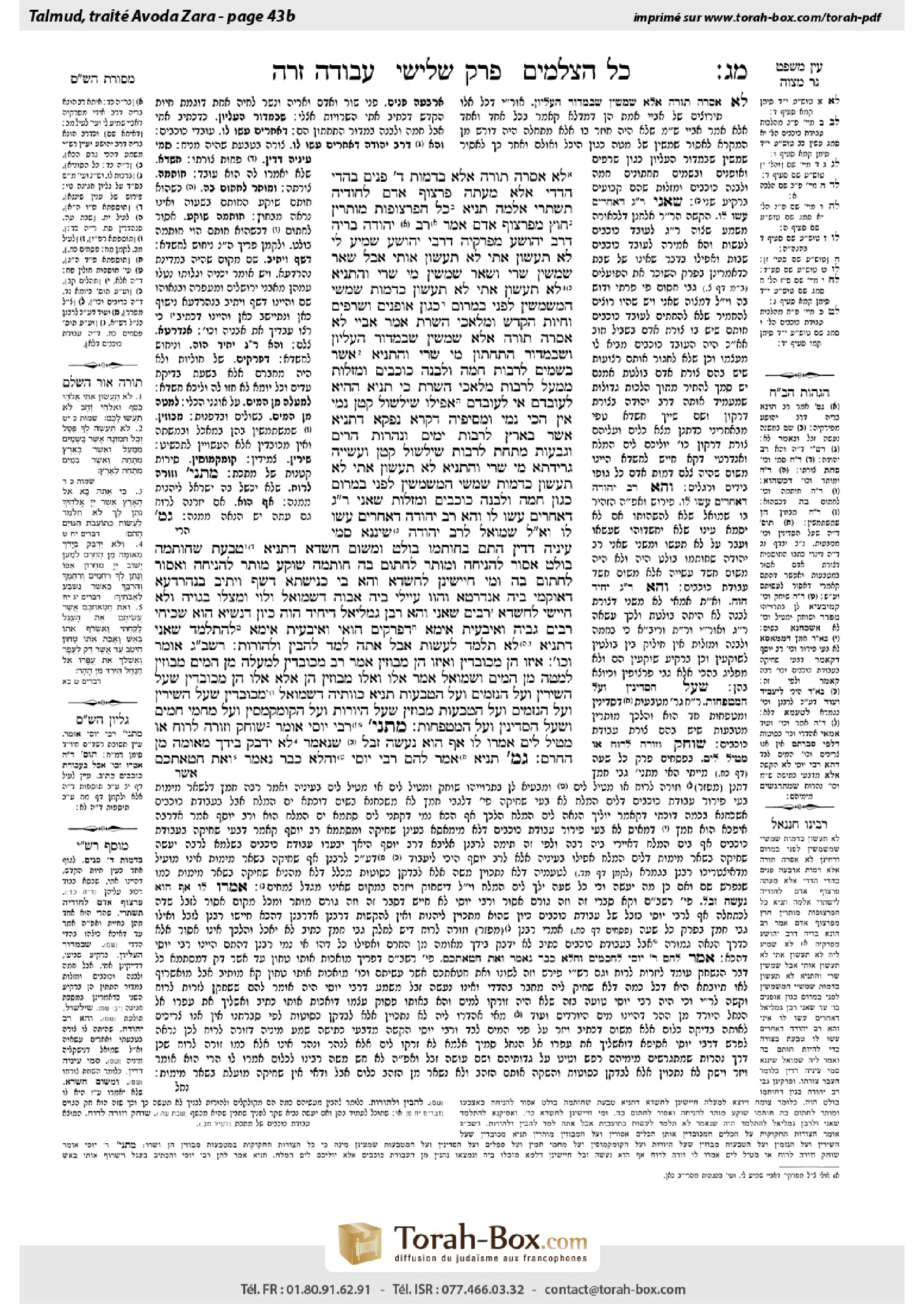
Avodah Zarah 43b: Talmud study for Daf Yomi
Study the Talmud for Daf Yomi with scanned pages, Hebrew text, English translations from Sefaria and AI-generated French translations.
Passage selection and English or AI-generated French translation are available where the scan has annotations. Daf Study is independent of Torah-Box and Sefaria.
Browse Avodah Zarah · עבודה זרה · All tractatesAvodah Zarah 43b text and translations
This page of Avodah Zarah includes the Aramaic text, an English translation and an AI-generated French translation, alongside the scan above.
עבודה זרה מ״ג ב · Aramaic and Hebrew text
לֹא אָסְרָה תּוֹרָה אֶלָּא בִּדְמוּת אַרְבָּעָה פָּנִים בַּהֲדֵי הֲדָדֵי.
אֶלָּא מֵעַתָּה, פַּרְצוּף אָדָם לְחוֹדֵיהּ תִּשְׁתְּרֵי! אַלְּמָה תַּנְיָא: כׇּל הַפַּרְצוּפוֹת מוּתָּרִין, חוּץ מִפַּרְצוּף אָדָם?
אָמַר רַב יְהוּדָה בְּרֵיהּ דְּרַב יְהוֹשֻׁעַ: מִפִּרְקֵיהּ דְּרַבִּי יְהוֹשֻׁעַ שְׁמִיעַ לִי, ״לֹא תַעֲשׂוּן אִתִּי״ — לֹא תַעֲשׂוּן אוֹתִי, אֲבָל שְׁאָר שַׁמָּשִׁין שְׁרֵי.
וּשְׁאָר שַׁמָּשִׁין מִי שְׁרֵי? וְהָתַנְיָא: ״לֹא תַעֲשׂוּן אִתִּי״ — לֹא תַעֲשׂוּן כִּדְמוּת שַׁמָּשַׁי הַמְשַׁמְּשִׁין לְפָנַי בְּמָרוֹם, כְּגוֹן אוֹפַנִּים וּשְׂרָפִים וְחַיּוֹת הַקֹּדֶשׁ וּמַלְאֲכֵי הַשָּׁרֵת!
אָמַר אַבָּיֵי: לֹא אָסְרָה תּוֹרָה אֶלָּא שַׁמָּשִׁין שֶׁבַּמָּדוֹר הָעֶלְיוֹן.
וְשֶׁבְּמָדוֹר הַתַּחְתּוֹן מִי שְׁרֵי? וְהָתַנְיָא: ״אֲשֶׁר בַּשָּׁמַיִם״ — לְרַבּוֹת חַמָּה וּלְבָנָה כּוֹכָבִים וּמַזָּלוֹת, ״מִמַּעַל״ — לְרַבּוֹת מַלְאֲכֵי הַשָּׁרֵת!
כִּי תַּנְיָא הָהִיא, לְעוֹבְדָם.
אִי לְעוֹבְדָם, אֲפִילּוּ שִׁילְשׁוּל קָטָן נָמֵי! אִין הָכִי נָמֵי, וּמִסֵּיפֵיהּ דִּקְרָא נָפְקָא, דְּתַנְיָא: ״אֲשֶׁר בָּאָרֶץ״ — לְרַבּוֹת יַמִּים וּנְהָרוֹת הָרִים וּגְבָעוֹת, ״מִתַּחַת״ — לְרַבּוֹת שִׁילְשׁוּל קָטָן.
וַעֲשִׂיָּיה גְּרֵידְתָּא מִי שְׁרֵי? וְהָתַנְיָא: ״לֹא תַעֲשׂוּן אִתִּי״ — לֹא תַעֲשׂוּן כִּדְמוּת שַׁמָּשַׁי הַמְשַׁמְּשִׁין לְפָנַי בַּמָּרוֹם, כְּגוֹן: חַמָּה וּלְבָנָה, כּוֹכָבִים וּמַזָּלוֹת.
שָׁאנֵי רַבָּן גַּמְלִיאֵל, דַּאֲחֵרִים עָשׂוּ לוֹ.
וְהָא רַב יְהוּדָה, דַּאֲחֵרִים עָשׂוּ לוֹ, וַאֲמַר לֵיהּ שְׁמוּאֵל לְרַב יְהוּדָה: שִׁינָּנָא, סַמִּי עֵינֵיהּ דְּדֵין!
הָתָם בְּחוֹתָמוֹ בּוֹלֵט, וּמִשּׁוּם חֲשָׁדָא, דְּתַנְיָא: טַבַּעַת שֶׁחוֹתָמָהּ בּוֹלֵט — אָסוּר לְהַנִּיחָהּ, וּמוּתָּר לַחְתּוֹם בָּהּ. חוֹתָמָהּ שׁוֹקֵעַ — מוּתָּר לְהַנִּיחָהּ, וְאָסוּר לַחְתּוֹם בָּהּ.
וּמִי חָיְישִׁינַן לַחֲשָׁדָא? וְהָא בֵּי כְנִישְׁתָּא דְּשַׁף וִיתֵיב בִּנְהַרְדְּעָא, (דְּאוֹקְמִי) [דְּאוֹקִימוּ] בֵּיהּ אִנְדְּרָטָא, וַהֲווֹ עָיְילִי בֵּיהּ אֲבוּהּ דִּשְׁמוּאֵל וְלֵוִי וּמְצַלּוּ בְּגַוֵּיהּ, וְלָא חָיְישִׁי לַחֲשָׁדָא! רַבִּים שָׁאנֵי.
וְהָא רַבָּן גַּמְלִיאֵל דְּיָחִיד הֲוָה? כֵּיוָן דְּנָשִׂיא הוּא, שְׁכִיחִי רַבִּים גַּבֵּיהּ. וְאִיבָּעֵית אֵימָא: דִּפְרָקִים הֲוַאי.
וְאִיבָּעֵית אֵימָא, לְהִתְלַמֵּד שָׁאנֵי, דְּתַנְיָא: ״לֹא תִלְמַד לַעֲשׂוֹת״, אֲבָל אַתָּה לָמֵד לְהָבִין וּלְהוֹרוֹת.
רַבָּן שִׁמְעוֹן בֶּן גַּמְלִיאֵל אוֹמֵר וְכוּ׳. אֵיזוֹ הֵן מְכוּבָּדִין, וְאֵיזוֹ הֵן מְבוּזִּין?
אָמַר רַב: מְכוּבָּדִין — לְמַעְלָה מִן הַמַּיִם, מְבוּזִּין — לְמַטָּה מִן הַמַּיִם. וּשְׁמוּאֵל אָמַר: אֵלּוּ וָאֵלּוּ מְבוּזִּין הֵן, אֶלָּא אֵלּוּ הֵן מְכוּבָּדִין — שֶׁעַל הַשֵּׁירִין וְעַל הַנְּזָמִים וְעַל הַטַּבָּעוֹת.
תַּנְיָא כְּוָותֵיהּ דִּשְׁמוּאֵל: מְכוּבָּדִין — שֶׁעַל הַשֵּׁירִין, וְעַל הַנְּזָמִים, וְעַל הַטַּבָּעוֹת; מְבוּזִּין — שֶׁעַל הַיּוֹרוֹת, וְעַל הַקּוּמְקְמֹסִין, וְעַל מְחַמֵּי חַמִּים, וְשֶׁעַל הַסְּדִינִין, וְעַל הַמִּטְפָּחוֹת.
מַתְנִי׳ רַבִּי יוֹסֵי אוֹמֵר: שׁוֹחֵק וְזוֹרֶה לָרוּחַ, אוֹ מֵטִיל לַיָּם. אָמְרוּ לוֹ: אַף הוּא נַעֲשֶׂה זֶבֶל, שֶׁנֶּאֱמַר: ״לֹא יִדְבַּק בְּיָדְךָ מְאוּמָה מִן הַחֵרֶם״.
גְּמָ׳ תַּנְיָא, אָמַר לָהֶם רַבִּי יוֹסֵי, וַהֲלֹא כְּבָר נֶאֱמַר: ״וְאֶת חַטַּאתְכֶם
Avodah Zarah 43b · English translation
This does not include the sun and the moon, as the Torah prohibits the fashioning only of a figure of all four faces of the creatures of the Divine Chariot together (see Ezekiel 1:10). All other figures, which are not in the likeness of the ministering angels, are permitted.
The Gemara raises a difficulty: If that is so, let the fashioning of a figure of a human face alone be permitted. Why then is it taught in a baraita: Figures of all faces are permitted, except for the human face?
Rav Yehuda, son of Rav Yehoshua, said: I heard in a lecture of Rabbi Yehoshua that there is a different reason why one may not fashion a figure of a human face; the verse states: “You shall not make with Me [iti]” (Exodus 20:20). This can be read as: You shall not make Me [oti]. Since the human being was created in the image of God (see Genesis 1:27), it is prohibited to fashion an image of a human being. But fashioning figures of other attendants of God is permitted.
The Gemara asks: And is it permitted to fashion figures of other attendants of God? But isn’t it taught in another baraita that the verse: “You shall not make with Me gods of silver” (Exodus 20:20), is interpreted to mean that you shall not make figures of My attendants who serve before Me on high, for example, ofanim, and seraphim, and the sacred ḥayyot, and the ministering angels?
Abaye said: The Torah prohibits fashioning figures of only those attendants that are in the upper heaven, i.e., the supreme angels in the highest firmament, but it does not prohibit fashioning the celestial bodies, e.g., the sun and the moon, despite the fact that they too are located in heaven.
The Gemara asks: And is it permitted to fashion figures of those bodies that are in the lower heaven? But isn’t it taught in a baraita with regard to the verse: “You shall not make for yourself any graven image, nor any manner of likeness, of anything that is in heaven above, or that is in the earth beneath, or that is in the water under the earth” (Exodus 20:4): The phrase “that is in heaven” serves to include the sun, and the moon, the stars, and the constellations. The term “above” serves to include the ministering angels. Apparently, it is prohibited to fashion a figure even of the celestial bodies that are in the lower heaven.
The Gemara answers: When that baraita is taught, it is in reference to the prohibition against worshipping them. There is no prohibition against forming a figure in their likeness.
The Gemara asks: If that baraita is referring to the prohibition against worshipping them, then why does it mention only celestial bodies? It is prohibited to worship even a tiny worm. The Gemara answers: Yes, it is indeed so; and this prohibition is derived from the latter clause of that verse, as it is taught in a baraita: “That is in the earth” serves to include seas, and rivers, mountains, and hills. The word “beneath” serves to include a tiny worm.
The Gemara asks: And is the mere fashioning of figures of the celestial bodies permitted? But isn’t it taught in another baraita that the verse: “You shall not make with Me gods of silver” (Exodus 20:20), is interpreted to mean that you shall not make figures of My attendants who serve before Me on high, for example: The sun, and the moon, the stars, and the constellations. This is proof that it is prohibited to fashion figures of the sun and the moon. Consequently, the solution proposed by Abaye is rejected, leaving the difficulty of Rabban Gamliel’s diagram unresolved.
The Gemara proposes an alternative resolution: The case of Rabban Gamliel is different, as others, i.e., gentiles, fashioned those figures for him, and it is prohibited for a Jew only to fashion such figures; there is no prohibition against having them in one’s possession.
The Gemara asks: But there is the case of Rav Yehuda, where others fashioned for him a seal with a figure of a person on it, and Shmuel said to Rav Yehuda, who was his student: Sharp-witted one [shinnana], destroy this one’s eyes, i.e., disfigure it, as it is prohibited even to have a figure of a human being in one’s possession.
The Gemara answers: There, in the case of Rav Yehuda, his was a protruding seal, i.e., the figure projected from the ring, and Shmuel prohibited it due to the potential suspicion that he had an object of idol worship in his possession. As it is taught in a baraita: In the case of a ring whose seal protrudes, it is prohibited to place it on one’s finger due to suspicion of idol worship, but it is permitted to seal objects with it. In this case, the act of sealing forms a figure that is sunken below the surface of the object upon which the seal was impressed, which is not prohibited. If its seal is sunken, it is permitted to place it on one’s finger, but it is prohibited to seal objects with it, as that forms a protruding figure.
The Gemara asks: And are we concerned about arousing suspicion due to the use of a human figure? But what about that synagogue that had been destroyed in Eretz Yisrael and was reestablished in Neharde’a, and they erected a statue of the king in it? And nevertheless, Shmuel’s father and Levi would enter and pray in it, and they were not concerned about arousing suspicion. The Gemara answers: A public institution is different; the public is not suspected of having idolatrous intentions. Rather, it is assumed that the statue is there exclusively for ornamental purposes.
The Gemara asks: But wasn’t Rabban Gamliel an individual? According to this reasoning, his figures of the moon should have been forbidden as they would have aroused suspicion. The Gemara answers: Since he was the Nasi, the head of the Sanhedrin, members of the public would often be found with him, and therefore there was no room for suspicion. And if you wish, say there is an alternative answer, namely, that these figures were not whole; rather, they were formed from pieces of figures that had to be assembled. Only complete figures are forbidden.
And if you wish, say there is yet another answer: Fashioning figures in order to teach oneself is different, as it is taught in a baraita with regard to the verse: “You shall not learn to do like the abominations of those nations” (Deuteronomy 18:9): But you may learn in order to understand the matter yourself and teach it to others. In other words, it is permitted to perform certain acts for the sake of Torah study that would otherwise be prohibited.
§ The mishna (42b) teaches that Rabban Shimon ben Gamliel says: Those figures that are upon respectable vessels are forbidden. Those that are upon disgraceful vessels are permitted. The Gemara asks: Which vessels are considered respectable and which are considered disgraceful?
Rav says: These terms do not represent different types of vessels, but rather the location of the figure upon the vessel. A respectable location for an idolatrous figure is on the side of the vessel above the level of the water or food contents; a disgraceful location is below the water level. And Shmuel says: Both these and those locations on eating utensils are disgraceful. Rather, these are respectable locations: Upon bracelets, or upon nose rings, or upon rings.
The Gemara comments: It is taught in a baraita in accordance with the opinion of Shmuel (Tosefta 5:1): Respectable locations for idolatrous figures are upon bracelets, or upon nose rings, or upon rings. Disgraceful locations are upon large pots, or upon small kettles [hakumkemasin], or upon samovars, or upon sheets, or upon towels.
MISHNA: Rabbi Yosei says: When one encounters an idol, he should grind the idol and throw the dust to the wind or cast it into the sea. The Rabbis said to him: What is the good of that? That also gives a Jew benefit from the idol, as it becomes fertilizer for his crops, and deriving any kind of benefit is prohibited, as it is stated: “And nothing of the proscribed items shall cleave to your hand” (Deuteronomy 13:18).
GEMARA: It is taught in a baraita (Tosefta 3:16): Rabbi Yosei said to them: But isn’t it already stated: “And your sin,
Avodah Zarah 43b · Traduction française (IA)
Cela ne comprend pas le soleil et la lune, car la Torah interdit la fabrication uniquement d'une figure comprenant les quatre visages des créatures du Chariot divin (voir Ezéchiel 1:10). Toutes les autres figures, qui ne ressemblent pas aux anges ministraux, sont permises.
La Guemara soulève une difficulté : Si c'est ainsi, pourquoi la fabrication d'une figure d'un visage humain seul serait-elle permise ? Pourquoi alors est-elle enseignée dans une baraïta : Les figures de tous les visages sont permises, sauf celle du visage humain ?
Rav Yéhuda, fils de Rav Yéhoshua, dit : J'ai entendu dans une lecture de Rabbi Yéhoshua que la raison différente pour laquelle on ne peut pas fabriquer une figure d'un visage humain est que la Parashah dit : « Tu ne feras pas pour moi [iti] » (Exode 20:20). On peut le lire comme : « Tu ne feras pas moi [oti] ». Puisque l'homme a été créé à l'image de Dieu (voir Genèse 1:27), il est interdit de fabriquer une image d'un être humain. La fabrication de figures d'autres ministres de Dieu est permise.
La Guemara demande : Et est-il permis de fabriquer des figures d'autres ministres de Dieu ? Mais n'est-il pas enseigné dans une autre baraïta que la parole : « Tu ne feras pas pour toi-même aucun image gravée, ni aucune ressemblance de toute chose qui est au ciel au-dessus, ou qui est sur la terre sous terre, ou qui est dans l'eau sous la terre » (Exode 20:4) est interprétée pour signifier que tu ne feras pas de figures de mes ministres qui servent devant moi au ciel, par exemple, des ofanim, des seraphim, et les chayyot sacrés, et les anges ministraux ?
Abaye dit : La Torah interdit la fabrication uniquement de ceux des ministres qui sont au ciel supérieur, c'est-à-dire les anges supérieurs dans le firmament le plus haut, mais elle ne prohibe pas la fabrication des corps célestes, par exemple, le soleil et la lune, malgré le fait qu'ils sont aussi situés au ciel.
La Guemara demande : Et est-il permis de fabriquer des figures de ces corps qui sont au ciel inférieur ? Mais n'est-il pas enseigné dans une baraïta concernant la parole : « Tu ne feras pas pour toi-même aucun image gravée, ni aucune ressemblance de toute chose qui est au ciel au-dessus, ou qui est sur la terre sous terre, ou qui est dans l'eau sous la terre » (Exode 20:4) : La phrase « qui est au ciel » sert à inclure le soleil, la lune, les étoiles et les constellations. Le terme « au-dessus » sert à inclure les anges ministraux. Apparemment, il est interdit de fabriquer une figure même des corps célestes qui sont au ciel inférieur.
La Guemara répond : Lorsque cette baraïta est enseignée, elle fait référence à l'interdiction de les adorer. Il n'y a pas d'interdiction de former une figure en leur ressemblance.
La Guemara demande : Si cette baraïta fait référence à l'interdiction d'adorer, pourquoi mentionne-t-elle uniquement les corps célestes ? Il est interdit d'adorer même un petit ver. La Guemara répond : Oui, c'est ainsi ; et cette interdiction est tirée de la dernière partie de cette parole, comme il est enseigné dans une baraïta : « qui est sur la terre » sert à inclure les mers, les rivières, les montagnes et les collines. Le mot « sous » sert à inclure un petit ver.
La Guemara demande : Et est-il permis de fabriquer des figures de ces corps célestes ? Mais n'est-il pas enseigné dans une autre baraïta que la parole : « Tu ne feras pas pour moi des dieux d'argent » (Exode 20:20) est interprétée pour signifier que tu ne feras pas de figures de mes ministres qui servent devant moi au ciel, par exemple : le soleil, la lune, les étoiles et les constellations. Cela prouve que la fabrication de figures du soleil et de la lune est interdite. Ainsi, la solution proposée par Abaye est rejetée, laissant la difficulté du diagramme de Rabban Gamliel sans résolution.
La Guemara propose une résolution alternative : Le cas de Rabban Gamliel est différent, car d'autres, c'est-à-dire des non-Juifs, ont fabriqué ces figures pour lui, et il est interdit à un Juif seulement de fabriquer de tels objets ; il n'y a pas d'interdiction d'avoir ces figures en possession.
La Guemara demande : Mais il y a le cas de Rav Yéhuda, où d'autres ont fabriqué pour lui un sceau avec une figure d'un être humain dessus, et Shmuel a dit à Rav Yéhuda, son élève : Homme perspicace [shinnana], détruis les yeux de celui-ci, c'est-à-dire défigure-le, car il est interdit même d'avoir une figure d'un être humain en possession.
La Guemara répond : Là, dans le cas de Rav Yéhuda, c'était un sceau saillant, c'est-à-dire la figure sortait de l'anneau, et Shmuel l'a interdit en raison du soupçon qu'il avait un objet d'idolâtrie en possession. Comme il est enseigné dans une baraïta : Dans le cas d'un anneau dont le sceau est saillant, il est interdit de le porter au doigt en raison du soupçon d'idolâtrie, mais il est permis d'utiliser ce sceau pour sceller des objets. Dans ce cas, l'acte de sceller forme une figure qui est enfoncée sous la surface de l'objet sur lequel le sceau a été imprimé, ce qui n'est pas interdit. Si le sceau est enfoncé, il est permis de le porter au doigt, mais il est interdit de l'utiliser pour sceller des objets, car cela forme une figure saillante.
La Guemara demande : Et sommes-nous préoccupés par le soupçon dû à l'utilisation d'une figure humaine ? Mais que dire de cette synagogue qui avait été détruite en Eretz Yisrael et qui a été reconstruite à Neharde’a, et où ils ont érigé une statue du roi ? Et pourtant, les pères de Shmuel et Levi entraient et priaient dedans, et ils ne s'inquiétaient pas du soupçon. La Guemara répond : Une institution publique est différente ; le public n'est pas soupçonné d'avoir des intentions idolâtres. On suppose que la statue est là uniquement à des fins décoratives.
La Guemara pose la question : Mais n’était-ce pas Rabban Gamliel, un individu seul ? Selon ce raisonnement, ses figures de lune auraient dû être interdites, car elles auraient pu susciter des soupçons. La Guemara répond : Puisque c’était le Nasi, le chef du Sanhédrin, des membres du public étaient souvent présents auprès de lui, et donc il n’y avait pas de place pour des soupçons. Et si vous le souhaitez, dites qu’il existe une autre réponse, à savoir que ces figures n’étaient pas entières ; elles étaient formées de morceaux de figures qui devaient être assemblés. Seules les figures entières sont interdites.
Et si vous le souhaitez, dites qu’il existe une autre réponse : Fabriquer des figures afin d’apprendre est différent, car il est dit dans une baraïta concernant la parole : « Tu ne t’efforceras point de faire comme les abominations des nations » (Deutéronome 18:9) : Mais tu peux apprendre afin de comprendre la chose toi-même et de la transmettre aux autres. En d’autres termes, il est permis d’accomplir certains actes à l’effet de l’étude de la Torah, même si ceux-ci seraient autrement interdits.
§ La Michna (42b) enseigne que Rabban Shimon ben Gamliel dit : Ceux des figures qui sont sur des objets dignes sont interdits. Ceux qui sont sur des objets indignes sont permis. La Guemara pose la question : Quels objets sont considérés dignes et quels sont considérés indignes ?
Rav dit : Ces termes ne désignent pas différents types d’objets, mais plutôt la position de la figure sur l’objet. Une position digne pour une figure idolâtre est sur le côté de l’objet au-dessus du niveau de l’eau ou des aliments ; une position indigne est en dessous du niveau de l’eau. Et Shmuel dit : Ces positions et celles sur les ustensiles de table sont toutes indigènes. En réalité, ces sont des positions dignes : Sur des bracelets, ou sur des anneaux de nez, ou sur des bagues.
La Guemara commente : Il est dit dans une baraïta selon l’opinion de Shmuel (Tosefta 5:1) : Les positions dignes pour les figures idolâtres sont sur des bracelets, ou sur des anneaux de nez, ou sur des bagues. Les positions indigènes sont sur des grandes marmite, ou sur des petites bouilloires [hakumkemasin], ou sur des samovars, ou sur des draps, ou sur des serviettes.
MICHNA : Rabbi Yosei dit : Lorsqu’on rencontre un idole, on doit le moudre et jeter la poussière au vent ou le jeter dans la mer. Les Rabbins lui dirent : Quel est l’intérêt de cela ? Cela donne aussi un bénéfice juif à l’idole, car il devient engrais pour ses récoltes, et tirer tout genre de bénéfice est interdit, car il est dit : « Et rien des choses interdites ne s’attachera à ta main » (Deutéronome 13:18).
GUEMARA : Il est enseigné dans une baraïta (Tosefta 3:16) : Rabbi Yosei dit à eux : Mais n’est-ce pas déjà dit : « Et ton péché »,
Traduction française générée par IA à partir de l’édition anglaise de Sefaria. Vérifie toujours un passage avec le texte source.
Text from Sefaria: William Davidson Edition - Vocalized Aramaic (CC BY NC); William Davidson Edition - English (CC BY NC).