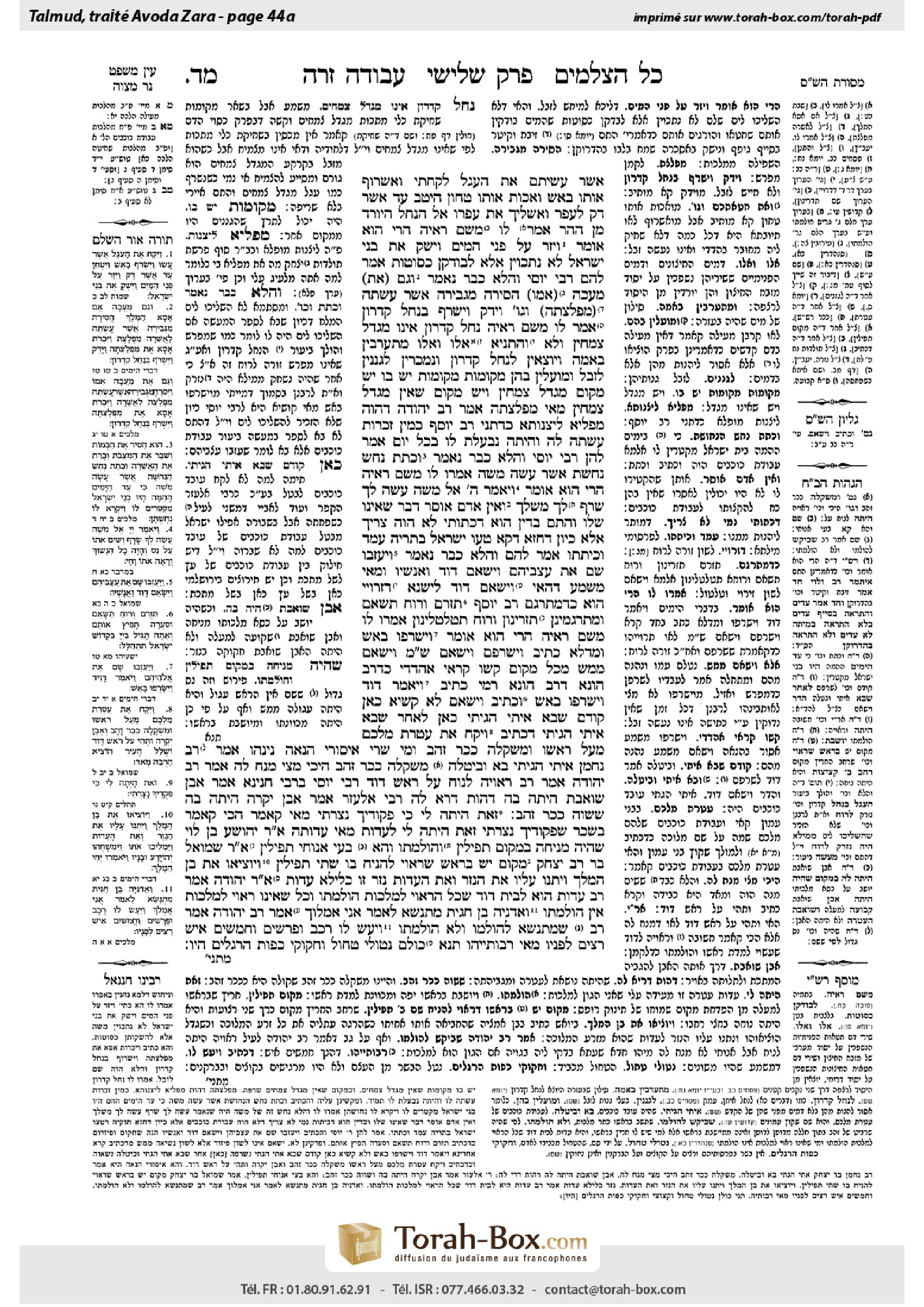
Avodah Zarah 44a: Talmud study for Daf Yomi
Study the Talmud for Daf Yomi with scanned pages, Hebrew text, English translations from Sefaria and AI-generated French translations.
Passage selection and English or AI-generated French translation are available where the scan has annotations. Daf Study is independent of Torah-Box and Sefaria.
Browse Avodah Zarah · עבודה זרה · All tractatesAvodah Zarah 44a text and translations
This page of Avodah Zarah includes the Aramaic text, an English translation and an AI-generated French translation, alongside the scan above.
עבודה זרה מ״ד א · Aramaic and Hebrew text
אֲשֶׁר עֲשִׂיתֶם אֶת הָעֵגֶל לָקַחְתִּי וָאֶשְׂרֹף אֹתוֹ בָּאֵשׁ וָאֶכֹּת אֹתוֹ טָחוֹן הֵיטֵב עַד אֲשֶׁר דַּק לְעָפָר וָאַשְׁלִךְ אֶת עֲפָרוֹ אֶל הַנַּחַל הַיֹּרֵד מִן הָהָר״!
אָמְרוּ לוֹ: מִשָּׁם רְאָיָה? הֲרֵי הוּא אוֹמֵר: ״וַיִּזֶר עַל פְּנֵי הַמַּיִם וַיַּשְׁקְ אֶת בְּנֵי יִשְׂרָאֵל״, לֹא נִתְכַּוֵּין אֶלָּא לְבוֹדְקָן כְּסוֹטוֹת.
אָמַר לָהֶם רַבִּי יוֹסֵי: וַהֲלֹא כְּבָר נֶאֱמַר ״וְגַם אֶת מַעֲכָה אִמּוֹ הֱסִירָהּ מִגְּבִירָה אֲשֶׁר עָשְׂתָה מִפְלַצְתָּהּ וְגוֹ׳ וַיָּדֶק וַיִּשְׂרֹף בְּנַחַל קִדְרוֹן״! אָמַר לוֹ: מִשָּׁם רְאָיָה? נַחַל קִדְרוֹן אֵינוֹ מְגַדֵּל צְמָחִין!
וְלָא? וְהָתַנְיָא: אֵלּוּ וְאֵלּוּ מִתְעָרְבִין בְּאַמָּה, וְיוֹצְאִין לְנַחַל קִדְרוֹן, וְנִמְכָּרִין לְגַנָּנִין לְזֶבֶל, וּמוֹעֲלִין בָּהֶן! מְקוֹמוֹת מְקוֹמוֹת יֵשׁ בּוֹ: יֵשׁ מָקוֹם מְגַדֵּל צְמָחִין, וְיֵשׁ מָקוֹם שֶׁאֵין מְגַדֵּל צְמָחִין.
מַאי ״מִפְלַצְתָּהּ״? אָמַר רַב יְהוּדָה: דַּהֲוָה מַפְלְיָא לֵיצָנוּתָא, כִּדְתָנֵי רַב יוֹסֵף: כְּמִין זַכְרוּת עָשְׂתָה לָהּ, וְהָיְתָה נִבְעֶלֶת לוֹ בְּכׇל יוֹם.
אָמַר לָהֶן רַבִּי יוֹסֵי, וַהֲלֹא כְּבָר נֶאֱמַר: ״וְכִתַּת נְחַשׁ נְחֹשֶׁת אֲשֶׁר עָשָׂה מֹשֶׁה״!
אָמְרוּ לוֹ: מִשָּׁם רְאָיָה? הֲרֵי הוּא אוֹמֵר ״וַיֹּאמֶר ה׳ אֶל מֹשֶׁה עֲשֵׂה לְךָ שָׂרָף״, ״לְךָ״ — מִשֶּׁלְּךָ, וְאֵין אָדָם אוֹסֵר דָּבָר שֶׁאֵינוֹ שֶׁלּוֹ, וְהָתָם בְּדִין הוּא דְּכַתּוֹתֵי לָא הֲוָה צְרִיךְ.
אֶלָּא, כֵּיוָן דַּחֲזָא דְּקָא טָעוּ יִשְׂרָאֵל בָּתְרֵיהּ, עָמַד וְכִיתָּתוֹ.
אָמַר לָהֶם, וַהֲלֹא כְּבָר נֶאֱמַר: ״וַיַּעַזְבוּ שָׁם אֶת עֲצַבֵּיהֶם וַיִּשָּׂאֵם דָּוִד וַאֲנָשָׁיו״, וּמַאי מַשְׁמַע דְּהַאי ״וַיִּשָּׂאֵם דָּוִד״ לִישָּׁנָא דְּזָרוֹיֵי הוּא? כְּדִמְתַרְגֵּם רַב יוֹסֵף: ״תִּזְרֵם וְרוּחַ תִּשָּׂאֵם״, וּמְתַרְגְּמִינַן: תִּזְרֵינוּן וְרוּחַ תְּטַלְטְלִינּוּן.
אָמְרוּ לוֹ: מִשָּׁם רְאָיָה? הֲרֵי הוּא אוֹמֵר ״וַיִּשָּׂרְפוּ בָּאֵשׁ״, וּמִדְּלָא כְּתִיב ״וַיִּשְׂרְפֵם וַיִּשָּׂאֵם״, שְׁמַע מִינַּהּ ״וַיִּשָּׂאֵם״ מַמָּשׁ.
מִכׇּל מָקוֹם, קָשׁוּ קְרָאֵי אַהֲדָדֵי.
כִּדְרַב הוּנָא, דְּרַב הוּנָא רָמֵי: כְּתִיב ״וַיֹּאמֶר דָּוִד וַיִּשָּׂרְפוּ בָּאֵשׁ״, וּכְתִיב ״וַיִּשָּׂאֵם״!
לָא קַשְׁיָא, כָּאן — קוֹדֶם שֶׁבָּא אִיתַּי הַגִּיתִּי, כָּאן — לְאַחַר שֶׁבָּא אִיתַּי הַגִּיתִּי.
דִּכְתִיב: ״וַיִּקַּח אֶת עֲטֶרֶת מַלְכָּם מֵעַל רֹאשׁוֹ וּמִשְׁקָלָהּ כִּכַּר זָהָב״, וּמִי שְׁרֵי? אִיסּוּרֵי הֲנָאָה נִינְהוּ! אָמַר רַב נַחְמָן: אִיתַּי הַגִּיתִּי בָּא וּבִיטְּלָהּ.
מִשְׁקָלָהּ כִּכַּר זָהָב, הֵיכִי מָצֵי מַנַּח לַהּ? אָמַר רַב יְהוּדָה אָמַר רַב: רְאוּיָה לָנוּחַ עַל רֹאשׁ דָּוִד. רַבִּי יוֹסֵי בְּרַבִּי חֲנִינָא אָמַר: אֶבֶן שׁוֹאֶבֶת הָיְתָה בָּהּ, דַּהֲוָת דָּרָא לַהּ. רַבִּי אֶלְעָזָר אָמַר: אֶבֶן יְקָרָה הָיְתָה בָּהּ, שֶׁשָּׁוָה כִּכַּר זָהָב.
״זֹאת הָיְתָה לִּי כִּי פִקּוּדֶיךָ נָצָרְתִּי״ — מַאי קָאָמַר? הָכִי קָאָמַר: בִּשְׂכַר שֶׁפִּקּוּדֶיךָ נָצָרְתִּי, זֹאת הָיְתָה לִי לְעֵדוּת. מַאי עֵדוּתָהּ? אָמַר רַבִּי יְהוֹשֻׁעַ בֶּן לֵוִי: שֶׁהָיָה מַנִּיחָהּ בִּמְקוֹם תְּפִילִּין וְהוֹלַמְתּוֹ. וְהָא בָּעֵי אַנּוֹחֵי תְּפִילִּין! אָמַר רַבִּי שְׁמוּאֵל בַּר רַב יִצְחָק: מָקוֹם יֵשׁ בָּרֹאשׁ שֶׁרָאוּי לְהַנִּיחַ בּוֹ שְׁתֵּי תְפִילִּין.
״וַיּוֹצִיאוּ אֶת בֶּן הַמֶּלֶךְ וַיִּתְּנוּ עָלָיו אֶת הַנֵּזֶר וְאֶת הָעֵדוּת״, ״נֵזֶר״ — זוֹ כְּלִילָא, ״עֵדוּת״ — אָמַר רַב יְהוּדָה אָמַר רַב: עֵדוּת הוּא לְבֵית דָּוִד, שֶׁכׇּל הָרָאוּי לַמַּלְכוּת הוֹלַמְתּוֹ, וְכֹל שֶׁאֵינוֹ רָאוּי לַמַּלְכוּת אֵין הוֹלַמְתּוֹ.
״וַאֲדֹנִיָּה בֶן חַגִּית מִתְנַשֵּׂא לֵאמֹר אֲנִי אֶמְלֹךְ״, אָמַר רַב יְהוּדָה אָמַר רַב: שֶׁמִּתְנַשֵּׂא לְהוֹלְמוֹ וְלֹא הוֹלַמְתּוֹ.
״וַיַּעַשׂ לוֹ רֶכֶב וּפָרָשִׁים וַחֲמִשִּׁים אִישׁ רָצִים לְפָנָיו״, מַאי רְבוּתַיְיהוּ? תָּנָא: כּוּלָּם נְטוּלֵי טְחוֹל וַחֲקוּקֵי כַּפּוֹת הָרַגְלַיִם הָיוּ.
Avodah Zarah 44a · English translation
the calf that you had made, I took and burned it with fire, and beat it in pieces, grinding it very small, until it was as fine as dust; and I cast its dust into the brook that descended out of the mount” (Deuteronomy 9:21)? Moses, who ground up the idolatrous golden calf and dispersed its dust, was apparently unconcerned with the fact that it may fertilize the soil.
The Rabbis said to him: You seek to bring proof from there? Doesn’t it state in the verse: “And he took the calf that they had made, and burned it with fire, and ground it to powder, and strewed it upon the water, and made the children of Israel drink of it” (Exodus 32:20)? Moses ground up the calf intending only to inspect them like sota women, i.e., like a woman suspected by her husband of having been unfaithful. Such a woman is compelled to drink water containing the ground-up ink from a scroll of Torah passages relating to a sota woman, which causes her to die if she was unfaithful, and exonerates her and bestows blessings upon her if she was faithful. Similarly, Moses ground up the calf in order to compel the people to drink, to cause the guilty parties to die.
Rabbi Yosei said to them: But isn’t it already stated concerning Asa: “And he also removed Maacah his mother from being queen, because she had made an abominable image [miflatztah] for an ashera; and Asa cut down her image, and burned it at the Kidron River” (see I Kings 15:13)? It seems that Asa was unconcerned that the ground-up idol may provide fertilization. They said to him: You seek to bring proof from there? The Kidron River does not grow vegetation, so even if the idol would have fertilized the soil, it would have been of no benefit.
The Gemara asks: And does the Kidron River not grow vegetation? But isn’t it taught in a mishna (Yoma 58b): This remainder of blood from the external altar and that remainder of blood from the inner altar are mixed in the Temple courtyard drain beneath the altar, and they flow out with the water used to rinse the area, to the Kidron River, and this water is sold to gardeners for use as fertilizer? The mishna continues: The gardeners pay for this water and thereby desacralize it, and failure to do so would render them liable for misuse of consecrated property. This is explicit proof that the Kidron River does yield produce. The Gemara answers: There are different places in the Kidron River area. There is a place that grows vegetation, and there is a place that does not grow vegetation.
The Gemara tangentially inquires about the meaning of a word in the verse quoted above. What is the meaning of “miflatztah”? Rav Yehuda says: It means an object that intensifies [mafli] licentiousness [leitzanuta]; as Rabbi Yosef teaches: Maacah fashioned upon the idol the likeness of a male organ, and she would engage in sexual activity with it daily.
The baraita continues: Rabbi Yosei attempts to cite another proof that grinding an object of idol worship is sufficient, from Hezekiah’s destruction of Moses’ serpent, which was worshipped by the Jewish people in Hezekiah’s time. Rabbi Yosei said to them: But isn’t it already stated: “And he broke into pieces the brazen serpent that Moses had made; as until those days the children of Israel sacrificed to it” (II Kings 18:4)? This indicates that breaking an object of idol worship into pieces suffices.
The Rabbis said to him: You seek to bring proof from there? Doesn’t it state in the verse: “And the Lord said to Moses: Make you a fiery serpent, and set it upon a pole; and it shall come to pass, that everyone that is bitten, when he sees it, shall live” (Numbers 21:8)? The term “make you” is interpreted to mean that the Lord commanded Moses: Make the serpent from your property. Consequently, the serpent belonged to Moses, and the principle in such a case is that a person does not render forbidden an item that is not his. Therefore, despite worshipping the serpent, the Jewish people could not render it a forbidden object of idol worship, and by right, it was not necessary to demolish it there.
Rather, despite the fact that the serpent did not have the halakhic status of an object of idol worship, since Hezekiah saw that the Jewish people were straying after it, he arose and demolished it. Nevertheless, since this demolishing was not done in order to fulfill the obligation to eradicate objects of idol worship, but merely to prevent its worship, breaking it into pieces was sufficient.
Rabbi Yosei said to the Rabbis, citing another proof for his opinion: But isn’t it already stated: “And they left their images there, and David and his men took them away [vayyissa’em]” (II Samuel 5:21)? And from where may it be inferred that the meaning of this formulation: “Vayyissa’em David,” is winnowing, i.e., scattering in the wind? It is as Rav Yosef translates the verse: “Tizrem veruaḥ tissa’em” (Isaiah 41:16), and we translate it as follows: “You shall fan them, and the wind shall carry them away.” Apparently, this way of disposing of idolatrous objects is sufficient.
The Rabbis said to him: You seek to bring proof from there? Doesn’t it state with regard to the same incident: “And they left their gods there; and David gave an order, and they were burned with fire” (I Chronicles 14:12)? And from the fact that it is not written here: And they burned them vayyissa’em, learn from it that the word vayyissa’em is not referring to scattering in the wind, but rather it should be understood literally, i.e., David and his men took the idols away; and it does not mean that they demolished and scattered them.
The Gemara asks: In any case, the verses contradict each other. The two accounts with regard to David’s disposal of the idols seem inconsistent. One states that his men took them away or scattered them, while the other recounts that they burned them.
The Gemara answers in accordance with the resolution of Rav Huna, as Rav Huna raises a contradiction between the verses, as follows: It is written: “And they left their gods there; and David gave an order, and they were burned with fire” (I Chronicles 14:12), and it is also written: “And David and his men took them away” (II Samuel 5:21).
Rav Huna answers: It is not difficult. In the interim, Ittai the Gittite, who was a gentile, arrived, and David commanded him to revoke the idolatrous status of the idols, as only gentiles are capable of doing this. Here, the verse that states that they burned the idols describes their actions before Ittai the Gittite came, whereas there, the verse that indicates that they simply carried them away is referring to after Ittai the Gittite came and revoked their status as objects of idol worship, obviating the need to burn them.
Another difficulty is resolved by Ittai’s arrival; as it is written with regard to the Ammonite idol: “And he took the crown of Malcam from off his head, and its weight was a talent of gold, and in it were precious stones; and it was set on David’s head” (II Samuel 12:30). But is it permitted for David to wear the crown? Isn’t it an object of idol worship and therefore under the category of items from which deriving benefit is prohibited? Rav Naḥman says: Ittai the Gittite arrived and revoked its status as an object of idol worship.
§ The Gemara discusses David’s crown. The verse states: “And its weight was a talent of gold.” As a talent is a very heavy weight, the Gemara asks: How could David place it on his head? Rav Yehuda says that Rav says: What is meant is not that it was actually placed on his head, but rather that it was fit to rest on David’s head, i.e., it fit the size of his head. Giving a different answer, Rabbi Yosei, son of Rabbi Ḥanina, says: There was a lodestone in it that would hold it up, i.e., from which it was suspended. David sat and placed his head in it, giving the appearance that he was wearing it. Rabbi Elazar says: What is meant is not that it weighed a full talent of gold, but rather that there was a precious stone on it that was worth a talent of gold.
The Gemara asks with regard to the verse: “This I have had, as I have kept Your precepts” (Psalms 119:56): What is it saying? The Gemara answers that this is what the verse is saying: As reward for the fact that I kept your precepts, this crown was a testimony for me that I am fit to be king. What exactly was its testimony? Rabbi Yehoshua ben Levi says: It was that David would place the crown on his head on the spot where one dons phylacteries, and it fit him perfectly. The Gemara asks: But how could he have worn the crown? Wasn’t he required to don phylacteries? Rabbi Shmuel bar Rav Yitzḥak says: There is enough space on the part of the head that is fit for donning phylacteries for one to don two phylacteries.
Similarly, it is stated with regard to Joash: “Then they brought out the king’s son, and put upon him the crown [hanezer] and the testimony, and made him king” (II Chronicles 23:11). “Nezer” is a crown. What was the “testimony”? Rav Yehuda says that Rav says: It is a testimony for the progeny of house of David that anyone who is fit for kingship, the crown fits him properly; and anyone who is unfit for kingship, the crown does not fit him properly.
Similarly, the verse states: “Now Adonijah, son of Haggith, exalted himself, saying: I will be king” (I Kings 1:5). Rav Yehuda says that Rav says: The term “exalted himself” teaches that he sought to have the crown fit him, but it did not fit him.
The verse continues: “And he prepared for himself chariots and riders and fifty people to run before him” (I Kings 1:5). The Gemara asks: What is the novelty of these actions, since other wealthy people do the same, even if they are not the sons of kings with designs on the throne? It is taught in a baraita that what was unique was that the runners all had their spleens removed and had the soles of their feet hollowed, i.e., flesh from their feet was removed, and these two procedures enhanced their speed.
Avodah Zarah 44a · Traduction française (IA)
Le veau que tu avais fait, j’ai pris et je l’ai brûlé avec le feu, et je l’ai écrasé en morceaux, le réduisant en très petits fragments, jusqu’à ce qu’il fût fin comme de la poussière ; et j’ai jeté cette poussière dans le ruisseau qui descendait du mont (Deutéronome 9:21). Moïse, qui avait réduit en poussière le veau idolâtre et dispersé cette poussière, semblait indifférent au fait qu’elle puisse fertiliser le sol.
Les Rabbins dirent à lui : Tu cherches à établir une preuve à partir de là ? N’est-il pas dit dans la parole : « Et il prit le veau qu’ils avaient fait, et le brûla avec le feu, et le réduisit en poudre, et le répandit sur l’eau, et fit boire les enfants d’Israël de ce puits » (Exode 32:20) ? Moïse réduisit le veau en poudre uniquement pour les faire boire comme des sotah, c’est-à-dire comme une femme soupçonnée par son mari d’avoir été infidèle. Une telle femme est contrainte de boire de l’eau contenant la poudre d’encre d’un rouleau de passages de la Torah relatifs à la sotah, ce qui provoque sa mort s’il y a eu infidélité, et l’exonère et lui confère des bénédictions s’il y a eu fidélité. De même, Moïse réduisit le veau en poudre afin de contraindre le peuple à boire, afin de faire mourir les coupables.
Rabbi Yosei dit à eux : Mais n’est-il pas déjà dit concernant Asa : « Et il ôta Maacah sa mère de la royauté, parce qu’elle avait fait une image abominable [miflatztah] pour une ashera ; et Asa coupa son image et la brûla au fleuve Kidron » (voir I Rois 15:13) ? Il semble que Asa fût indifférent au fait que la poussière de l’idole puisse fertiliser le sol. Ils dirent à lui : Tu cherches à établir une preuve à partir de là ? Le fleuve Kidron ne produit pas de végétation, donc même si l’idole aurait fertilisé le sol, cela n’aurait pas été utile.
La Guemara demande : Et le fleuve Kidron ne produit-il pas de végétation ? Mais n’est-il pas enseigné dans une mitsva (Yoma 58b) : Ce reste de sang de l'autel extérieur et ce reste de sang de l'autel intérieur sont mélangés dans le drain du cour de l'Autel, et ils coulent avec l'eau utilisée pour rincer la zone, jusqu'au fleuve Kidron, et cet eau est vendue aux jardiniers pour en être utilisé comme engrais ? La mitsva continue : Les jardiniers paient pour cette eau et ainsi désacralisent cette eau, et l'ignorer rendrait responsable de l'usage d'une propriété consacrée. C'est une preuve explicite que le fleuve Kidron produit des récoltes. La Guemara répond : Il y a différentes zones dans le fleuve Kidron. Il y a une zone qui produit de la végétation, et il y a une zone qui ne produit pas de végétation.
La Guemara interroge de manière tangentielle sur le sens d'un mot dans la parole citée ci-dessus. Quel est le sens de « miflatztah » ? Rav Yehuda dit : Cela signifie un objet qui intensifie [mafli] la luxure [leitzanuta] ; comme Rabbi Yosef enseigne : Maacah avait façonné sur l'idole la ressemblance d'un organe masculin, et elle avait une activité sexuelle avec lui quotidiennement.
La baraïta continue : Rabbi Yosei tente d'établir une autre preuve que le broyage d'un objet d'idolâtrie suffit, à partir de la destruction par Hachia de la serpente de Moïse, qui était adorée par le peuple juif à l'époque de Hachia. Rabbi Yosei dit à eux : Mais n’est-il pas déjà dit : « Et il brisa en morceaux la serpente de bronze que Moïse avait faite ; car jusqu’à ces jours les enfants d’Israël sacrifiaient à elle » (II Rois 18:4) ? Cela indique que briser un objet d'idolâtrie en morceaux suffit.
Les Rabbins dirent à lui : Tu cherches à établir une preuve à partir de là ? N’est-il pas dit dans la parole : « Et l’Eternel dit à Moïse : Fais-toi un serpent de feu, et mets-le sur un poteau ; et il arrivera que celui qui est mordu, lorsqu’il verra cela, vivra » (Nombres 21:8) ? Le terme « fais-toi » est interprété pour signifier que l’Eternel commandait à Moïse : Fais le serpent à partir de tes biens. Ainsi, la serpente appartenait à Moïse, et le principe dans un tel cas est que la personne ne rend pas interdit un objet qui n’est pas le sien. Par conséquent, malgré l’adoration de la serpente, le peuple juif ne pouvait pas la rendre un objet interdit d'idolâtrie, et par droit, il n’était pas nécessaire de la détruire là.
Au contraire, malgré le fait que la serpente n’avait pas le statut halakhique d’un objet d'idolâtrie, puisque Hachia vit que le peuple juif s’éloignait après elle, il s’est levé et l’a détruite. Cependant, puisque cette démolition n’a pas été faite dans le but de remplir l’obligation de détruire les objets d'idolâtrie, mais uniquement pour empêcher son adoration, briser en morceaux suffisait.
Rabbi Yosei dit aux Rabbins, citant une autre preuve pour son opinion : Mais n’est-il pas déjà dit : « Et ils laissèrent leurs images là, et David et ses hommes les emportèrent [vayyissa’em] » (II Samuel 5:21) ? Et d’où peut-on déduire que la formulation : « Vayyissa’em David » signifie le balayage, c’est-à-dire la dispersion dans le vent ? C’est comme Rav Yosef traduit la parole : « Tizrem veruaḥ tissa’em » (Isaïe 41:16), et nous traduisons ainsi : « Tu feras voler, et le vent portera avec lui. » Apparemment, cette manière de débarrasser des objets d'idolâtrie est suffisante.
Les Rabbins dirent à lui : Tu cherches à établir une preuve à partir de là ? N’est-il pas dit concernant le même incident : « Et ils laissèrent leurs dieux là ; et David donna un ordre, et ils furent brûlés avec le feu » (I Chroniques 14:12) ? Et d’après le fait qu’il n’est pas écrit ici : « Et ils brûlèrent les dieux » vayyissa’em, apprends-en que le mot vayyissa’em ne signifie pas la dispersion dans le vent, mais plutôt il faut le comprendre littéralement, c’est-à-dire que David et ses hommes emportèrent les idoles ; et cela ne signifie pas qu’ils les démolirent et les dispersèrent.
La Guemara demande : En tout cas, les versets s’opposent les uns aux autres. Les deux récits concernant la débarras des idoles par David semblent incohérents. L’un dit que ses hommes les emportèrent ou les dispersèrent, tandis que l’autre raconte qu’ils les brûlèrent.
La Guemara répond selon la résolution de Rava Huna, comme Rava Huna soulève une contradiction entre les versets, comme suit : Il est écrit : « Et ils laissèrent leurs dieux là ; et David donna un ordre, et ils furent brûlés par le feu » (I Rois 14:12), et il est aussi écrit : « Et David et ses hommes les emportèrent » (II Samuel 5:21).
Rava Huna répond : Ce n’est pas difficile. Durant cette période, Ittai le Gittite, qui était un non-Juif, arriva, et David lui donna l’ordre de révoquer le statut d’idolâtrie des idoles, car seul les non-Juifs sont capables de le faire. Ici, le verset qui dit qu’ils brûlèrent les idoles décrit leurs actions avant l’arrivée d’Ittai le Gittite, tandis que là, le verset qui indique qu’ils les emportèrent simplement fait référence à après l’arrivée d’Ittai le Gittite et la révocation de leur statut d’objets d’idolâtrie, éliminant ainsi la nécessité de les brûler.
Une autre difficulté est résolue grâce à l’arrivée d’Ittai ; comme il est écrit concernant l’idole ammonite : « Et il prit la couronne de Malcam de dessus sa tête, et son poids était un talent d’or, et dans elle étaient des pierres précieuses ; et elle fut posée sur la tête de David » (II Samuel 12:30). Mais est-il permis à David de porter cette couronne ? N’est-ce pas un objet d’idolâtrie et donc dans la catégorie des objets dont l’usage est interdit ? Rav Naḥman dit : Ittai le Gittite arriva et révoqua son statut d’objet d’idolâtrie.
§ La Guemara discute de la couronne de David. Le verset dit : « Et son poids était un talent d’or. » Comme un talent est un poids très lourd, la Guemara pose la question : Comment David pouvait-il la porter sur sa tête ? Rav Yehuda dit que Rav dit : Ce que cela signifie n’est pas que la couronne fut effectivement portée sur sa tête, mais plutôt qu’elle était adaptée à la taille de sa tête. Donnant une autre réponse, Rabbi Yosei, fils de Rabbi Ḥanina, dit : Il y avait un aimant dans la couronne qui la maintenait en l’air, c’est-à-dire par lequel elle était suspendue. David s’assit et posa sa tête dedans, donnant l’illusion qu’il la portait. Rabbi Elazar dit : Ce que cela signifie n’est pas que la couronne pesait un talent d’or, mais plutôt qu’il y avait une pierre précieuse sur elle qui valait un talent d’or.
La Guemara pose la question concernant le verset : « Cela m’a été donné, car j’ai gardé vos préceptes » (Psaumes 119:56) : Qu’est-ce que cela signifie ? La Guemara répond que cela signifie : En récompense du fait que j’ai gardé vos préceptes, cette couronne était un témoignage pour moi que je suis digne d’être roi. Quel était exactement ce témoignage ? Rabbi Yehoshua ben Levi dit : C’était que David mettait la couronne sur sa tête au même endroit où l’on porte les phylactères, et elle s’y adaptait parfaitement. La Guemara pose la question : Mais comment pouvait-il porter la couronne ? N’était-il pas tenu de porter les phylactères ? Rabbi Shmuel bar Rav Yitzḥak dit : Il y a assez d’espace sur la partie de la tête adaptée à la pose des phylactères pour que l’on puisse porter deux phylactères.
De même, il est dit concernant Joash : « Et ils sortirent le fils du roi, et ils lui mirent la couronne [hanezer] et le témoignage, et ils le firent roi » (II Chroniques 23:11). « Nezer » est une couronne. Quel était le « témoignage » ? Rav Yehuda dit que Rav dit : C’est un témoignage pour la descendance de la maison de David que celui qui est digne de royauté, la couronne s’y adapte parfaitement ; et celui qui n’est pas digne de royauté, la couronne ne s’y adapte pas.
De même, le verset dit : « Maintenant, Adonijah, fils de Haggith, s’exalta, disant : Je serai roi » (I Rois 1:5). Rav Yehuda dit que Rav dit : Le terme « s’exalta » enseigne qu’il cherchait à ce que la couronne s’adapte à lui, mais elle ne s’y adaptait pas.
Le verset continue : « Et il prépara pour lui des chars et des cavaliers et cinquante hommes à courir devant lui » (I Rois 1:5). La Guemara pose la question : Quel est l’originalité de ces actions, puisque d’autres personnes riches font la même chose, même s’ils ne sont pas les fils de rois avec des ambitions de trône ? Il est enseigné dans une baraïta que ce qui était unique était que les coureurs avaient tous leurs rate enlevées et leurs semelles creusées, c’est-à-dire que de la chair de leurs pieds avait été enlevée, et ces deux procédures augmentaient leur vitesse.
Traduction française générée par IA à partir de l’édition anglaise de Sefaria. Vérifie toujours un passage avec le texte source.
Text from Sefaria: William Davidson Edition - Vocalized Aramaic (CC BY NC); William Davidson Edition - English (CC BY NC).