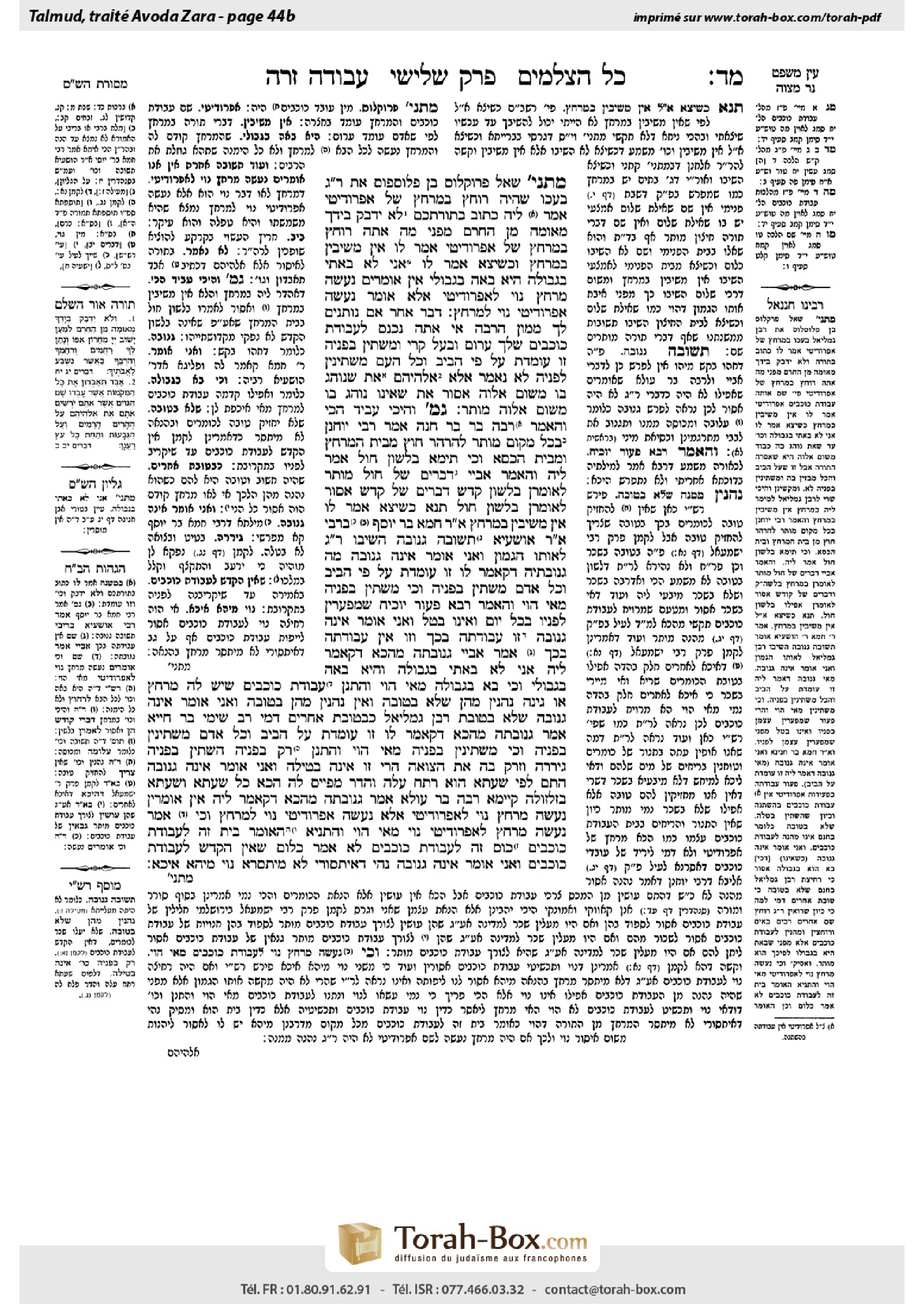
Avodah Zarah 44b: Talmud study for Daf Yomi
Study the Talmud for Daf Yomi with scanned pages, Hebrew text, English translations from Sefaria and AI-generated French translations.
Passage selection and English or AI-generated French translation are available where the scan has annotations. Daf Study is independent of Torah-Box and Sefaria.
Browse Avodah Zarah · עבודה זרה · All tractatesAvodah Zarah 44b text and translations
This page of Avodah Zarah includes the Aramaic text, an English translation and an AI-generated French translation, alongside the scan above.
עבודה זרה מ״ד ב · Aramaic and Hebrew text
מַתְנִי׳ שָׁאַל פְּרוֹקְלוּס בֶּן פְּלוֹסְפוּס אֶת רַבָּן גַּמְלִיאֵל בְּעַכּוֹ, שֶׁהָיָה רוֹחֵץ בַּמֶּרְחָץ שֶׁל אַפְרוֹדִיטֵי. אֲמַר לֵיהּ: כָּתוּב בְּתוֹרַתְכֶם ״לָא יִדְבַּק בְּיָדְךָ מְאוּמָה מִן הַחֵרֶם״, מִפְּנֵי מָה אַתָּה רוֹחֵץ בְּמֶרְחָץ שֶׁל אַפְרוֹדִיטֵי?
אָמַר לוֹ: אֵין מְשִׁיבִין בַּמֶּרְחָץ. וּכְשֶׁיָּצָא אָמַר לוֹ: אֲנִי לֹא בָּאתִי בִּגְבוּלָהּ, הִיא בָּאָה בִּגְבוּלִי. אֵין אוֹמְרִים: נַעֲשָׂה מֶרְחָץ נוֹי לְאַפְרוֹדִיטֵי, אֶלָּא אוֹמֵר: נַעֲשָׂה אַפְרוֹדִיטֵי נוֹי לַמֶּרְחָץ.
דָּבָר אַחֵר: אִם נוֹתְנִים לְךָ מָמוֹן הַרְבֵּה, אִי אַתָּה נִכְנָס לַעֲבוֹדָה זָרָה שֶׁלְּךָ עָרוֹם וּבַעַל קֶרִי וּמַשְׁתִּין בְּפָנֶיהָ, זוֹ עוֹמֶדֶת עַל פִּי הַבִּיב וְכׇל הָעָם מַשְׁתִּינִין לְפָנֶיהָ, לֹא נֶאֱמַר אֶלָּא ״אֱלֹהֵיהֶם״ — אֶת שֶׁנּוֹהֵג בּוֹ מִשּׁוּם אֱלוֹהַּ — אָסוּר, אֶת שֶׁאֵינוֹ נוֹהֵג בּוֹ מִשּׁוּם אֱלוֹהַּ — מוּתָּר.
גְּמָ׳ וְהֵיכִי עָבֵיד הָכִי? וְהָאָמַר רַבָּה בַּר בַּר חָנָה אָמַר רַבִּי יוֹחָנָן: בְּכׇל מָקוֹם מוּתָּר לְהַרְהֵר, חוּץ מִבֵּית הַמֶּרְחָץ וּמִבֵּית הַכִּסֵּא!
וְכִי תֵּימָא: בִּלְשׁוֹן חוֹל אֲמַר לֵיהּ, וְהָאָמַר אַבָּיֵי: דְּבָרִים שֶׁל חוֹל מוּתָּר לְאוֹמְרָן בִּלְשׁוֹן קֹדֶשׁ, דְּבָרִים שֶׁל קֹדֶשׁ אָסוּר לְאוֹמְרָן בִּלְשׁוֹן חוֹל!
תָּנָא: כְּשֶׁיָּצָא, אָמַר לוֹ: אֵין מְשִׁיבִין בַּמֶּרְחָץ.
אָמַר רַב חָמָא בַּר יוֹסֵף בְּרַבִּי, אָמַר רַבִּי אוֹשַׁעְיָא: תְּשׁוּבָה גְּנוּבָה הֱשִׁיבוֹ רַבָּן גַּמְלִיאֵל לְאוֹתוֹ הֶגְמוֹן, וַאֲנִי אוֹמֵר: אֵינָהּ גְּנוּבָה.
מָה גְּנוּבְתַּיהּ? דְּקָאָמַר לוֹ: זוֹ עוֹמֶדֶת עַל פִּי הַבִּיב וְכׇל אָדָם מַשְׁתִּין בְּפָנֶיהָ. וְכִי מַשְׁתִּין בְּפָנֶיהָ מַאי הָוֵי? וְהָאָמַר רָבָא: פְּעוֹר יוֹכִיחַ, שֶׁמְּפַעֲרִין לְפָנָיו בְּכׇל יוֹם וְאֵינוֹ בָּטֵל.
וַאֲנִי אוֹמֵר: אֵינָהּ גְּנוּבָה, זוֹ עֲבוֹדָתָהּ בְּכָךְ, וְזוֹ אֵין עֲבוֹדָתָהּ בְּכָךְ.
אָמַר אַבָּיֵי: גְּנוּבְתַּהּ מֵהָכָא, דְּקָאָמַר לֵיהּ: אֲנִי לֹא בָּאתִי בִּגְבוּלָהּ וְהִיא בָּאָה בִּגְבוּלִי. וְכִי בָּא בִּגְבוּלָהּ מַאי הָוֵי? וְהָתְנַן: עֲבוֹדָה זָרָה שֶׁיֵּשׁ לָהּ מֶרְחָץ אוֹ גִינָּה — נֶהֱנִין מֵהֶן שֶׁלֹּא בְּטוֹבָה, וְאֵין נֶהֱנִין מֵהֶן בְּטוֹבָה.
וַאֲנִי אוֹמֵר: אֵינָהּ גְּנוּבָה, שֶׁלֹּא בְּטוֹבַת רַבָּן גַּמְלִיאֵל כִּבְטוֹבַת אֲחֵרִים דָּמֵי.
רַב שִׁימִי בַּר חִיָּיא אָמַר: גְּנוּבְתַּהּ מֵהָכָא, דְּקָאָמַר לוֹ: זוֹ עוֹמֶדֶת עַל הַבִּיב וְכׇל אָדָם מַשְׁתִּינִין בְּפָנֶיהָ. וְכִי מַשְׁתִּינִין בְּפָנֶיהָ מַאי הָוֵי? וְהָתְנַן: רָק בְּפָנֶיהָ, הִשְׁתִּין בְּפָנֶיהָ, גֵּירְרָה, וְזָרַק בָּהּ אֶת הַצּוֹאָה — הֲרֵי זוֹ אֵינָהּ בְּטֵילָה.
וַאֲנִי אוֹמֵר: אֵינָהּ גְּנוּבָה, הָתָם — לְפִי שַׁעְתָּא הוּא רָתַח עֲלַהּ, וַהֲדַר מְפַיֵּיס לַהּ, הָכָא — כֹּל שַׁעְתָּא וְשַׁעְתָּא בְּזִלְזוּלַהּ קָיְימָא.
רַבָּה בַּר עוּלָּא אָמַר: גְּנוּבְתַּהּ מֵהָכָא, דְּקָאָמַר לֵיהּ, אֵין אוֹמְרִין: נַעֲשָׂה מֶרְחָץ נוֹי לְאַפְרוֹדִיטֵי, אֶלָּא: נַעֲשָׂה אַפְרוֹדִיטֵי נוֹי לַמֶּרְחָץ; וְכִי אָמַר ״נַעֲשָׂה מֶרְחָץ לְאַפְרוֹדִיטֵי נוֹי״ מַאי הָוֵי? וְהָתַנְיָא: הָאוֹמֵר ״בַּיִת זֶה לַעֲבוֹדָה זָרָה״, ״כּוֹס זֶה לַעֲבוֹדָה זָרָה״ — לֹא אָמַר כְּלוּם, שֶׁאֵין הֶקְדֵּשׁ לַעֲבוֹדָה זָרָה.
וַאֲנִי אוֹמֵר: אֵינָהּ גְּנוּבָה, נְהִי דְּאִיתְּסוֹרֵי לָא מִיתַּסְרָא, נוֹי מִיהָא אִיכָּא.
Avodah Zarah 44b · English translation
MISHNA: A wise gentile, Proclus ben Plospus, once asked a question of Rabban Gamliel in the city of Akko when he was bathing in the bathhouse of the Greek god Aphrodite. Proclus said to him: It is written in your Torah: “And nothing of the proscribed items shall cleave to your hand” (Deuteronomy 13:18). For what reason do you bathe before an idol in the bathhouse of Aphrodite?
Rabban Gamliel said to him: One may not answer questions related to Torah in the bathhouse. And when he left the bathhouse, Rabban Gamliel gave him several answers. He said to him: I did not come into its domain; it came into my domain. The bathhouse existed before the statue dedicated to Aphrodite was erected. Furthermore, people do not say: Let us make a bathhouse as an adornment for Aphrodite; rather, they say: Let us make a statue of Aphrodite as an adornment for the bathhouse. Therefore, the main structure is not the Aphrodite statue, but the bathhouse.
Rabban Gamliel continued: Alternatively, there is another answer: Even if people would give you a lot of money, you would not enter before your object of idol worship naked, or as one who experienced a seminal emission who comes to the bathhouse to purify himself, nor would you urinate before it. This statue stands upon the sewage pipe and all the people urinate before it. There is no prohibition in this case, as it is stated in the verse only: “Their gods” (see Deuteronomy 12:2), which indicates that a statue that people treat as a deity is forbidden, but one that people do not treat with the respect that is due to a deity is permitted.
GEMARA: The mishna relates that Rabban Gamliel first told Proclus that he cannot answer a question related to Torah in a bathhouse. The Gemara asks: And how could he have acted in this manner? How could Rabban Gamliel have stated even this halakha in the bathhouse? But doesn’t Rabba bar bar Ḥana say that Rabbi Yoḥanan says: It is permitted to contemplate matters of Torah everywhere except for the bathhouse and the bathroom?
And if you would say that Rabban Gamliel stated this ruling to him in a secular language, and therefore it was permitted for him to do so, this would not be a satisfactory answer; but doesn’t Abaye say that it is permitted to say secular statements in a bathhouse or bathroom in the sacred tongue, Hebrew, but it is prohibited to say sacred, Torah-related, statements even in a secular language in a bathhouse or bathroom?
The Gemara answers that the mishna actually taught as follows: When he left the bathhouse, Rabban Gamliel said to him: One may not answer questions related to Torah in the bathhouse.
§ Rav Ḥama bar Yosef the Distinguished says that Rabbi Oshaya says: Rabban Gamliel gave a deceptive response to that officer, Proclus. And I, Rav Ḥama, say that the response was not deceptive but truthful.
The Gemara explains: What was its deception, according to Rabbi Oshaya? It was that Rabban Gamliel said to him: This statue stands upon the sewage pipe and all people urinate before it. In saying this, Rabban Gamliel meant that the statue has no idolatrous status as is evident from the demeaning conduct performed before it. And this claim is deceptive, as even if one urinates before it, what of it? Does that really negate its idolatrous status? But doesn’t Rava say that the idol of Peor proves the contrary, as its worshippers defecate before it daily, and its idolatrous status still is not revoked?
Rav Ḥama bar Yosef himself disagrees: And I say that it is not a deceptive answer. With regard to that idol, Peor, its standard manner of worship is in that manner; therefore, its status is certainly not revoked by that behavior. But with regard to this statue, Aphrodite, its standard manner of worship is not in that manner. Therefore, the display of demeaning conduct in its presence is indicative of a lack of reverence for it and of its lack of idolatrous status.
Abaye said: The deception in Rabban Gamliel’s response was from here, when he said to him: I did not come into its domain, but rather it came into my domain. He explains: And even if it, the bathhouse, had come into its domain, what of it? Even if the idol had preceded the bathhouse, it would still not render use of the bathhouse prohibited; but didn’t we learn in a mishna (51b): With regard to an object of idol worship that has a bathhouse or a garden in front of it, one may derive benefit from the bathhouse or garden without showing favor by giving thanks or payment to its priests, but one may not derive benefit from it while showing it favor? Rabban Gamliel’s answer was therefore deceptive because the permissibility of using the bathhouse had nothing to do with its antecedence to the statue.
Rav Ḥama bar Yosef himself disagrees: And I say that it is not a deceptive answer, as even though Rabban Gamliel visited the bathhouse without showing favor by expressing thanks or giving payment, the very fact that such an esteemed visitor paid it a visit is the equivalent of others actively showing favor.
Rav Shimi bar Ḥiyya says: The deception in Rabban Gamliel’s response was from here, when he said to him: This statue stands upon the sewage pipe and all people urinate before it. He explains: And if people urinate before it, what of it? That does not indicate a lack of idolatrous status; but didn’t we learn in a mishna (53a): If one spit in front of it, urinated in front of it, dragged it, or threw feces at it, its status as an object of idol worship is not revoked?
Rav Ḥama bar Yosef himself disagrees: And I say that it is not a deceptive answer. There, the case of that mishna is of one who temporarily rages against the idol, and afterward he appeases it. Here, in the case of the Aphrodite statue erected on the sewage pipe, each and every hour the statue remains in a constant state of disparagement. This setup indicates a permanent lack of reverence and an absence of true idolatrous status.
Rabba bar Ulla said: The deception in Rabban Gamliel’s response was from here, when he said to him that people do not say: Let us make a bathhouse as an adornment for Aphrodite; rather, they say: Let us make a statue of Aphrodite as an adornment for the bathhouse. He explains: And even if people say: Let us make a bathhouse as an adornment for Aphrodite, what of it? But isn’t it taught in a baraita: In the case of one who says: This house is hereby dedicated to idol worship, or: This cup is hereby dedicated to idol worship, he has said nothing, i.e., his words take no effect, as there is no halakha of consecration with regard to objects of idol worship. While one can consecrate an item to the Temple through verbal designation, there is no such method for according idolatrous status to an object. Therefore, Rabban Gamliel’s deception lies in his indication that such a formulation would render the bathhouse forbidden as an object of idol worship.
Rav Ḥama bar Yosef himself disagrees: And I say that it is not a deceptive answer. Although the bathhouse would not be rendered forbidden as an object of idol worship due to a verbal designation, it would at least have the status of an adornment of an object of idol worship, which is also forbidden.
Avodah Zarah 44b · Traduction française (IA)
MICHNA: Un savant païen, Proclus ben Plospus, demanda un jour à Rabban Gamliel, à la ville d'Akko, alors qu'il se baignait dans la salle de bain du dieu grec Aphrodite. Proclus dit à lui: Il est écrit dans votre Torah: « Et aucun des objets interdits ne devra adhérer à votre main » (Deutéronome 13:18). Pour quelle raison vous baignez-vous devant un idole dans la salle de bain d'Aphrodite ?
Rabban Gamliel lui répondit: On ne peut pas répondre à des questions relatives à la Torah dans une salle de bain. Et lorsqu'il sortit de la salle de bain, Rabban Gamliel lui donna plusieurs réponses. Il lui dit: Je ne suis pas entré dans son domaine; c'est elle qui est entrée dans mon domaine. La salle de bain existait avant que la statue dédiée à Aphrodite ne soit érigée. De plus, les gens ne disent pas: Faisons une salle de bain comme décoration pour Aphrodite; ils disent plutôt: Faisons une statue d'Aphrodite comme décoration pour la salle de bain. Ainsi, la structure principale n'est pas la statue d'Aphrodite, mais la salle de bain.
Rabban Gamliel continua: Une autre réponse est aussi possible: Même si les gens vous donnaient beaucoup d'argent, vous ne seriez pas entré devant votre idole nu, ou comme celui qui a eu une émission sémencière et vient à la salle de bain pour se purifier, ni ne urineriez devant elle. Cette statue est posée sur le tuyau d'évacuation et tout le monde urine devant elle. Il n'y a pas de prohibition dans ce cas, car il est dit dans la parabole: « Leurs dieux » (voir Deutéronome 12:2), ce qui indique que la statue que les gens traitent comme un dieu est interdite, mais celle que les gens ne traitent pas avec le respect dû à un dieu est permise.
GUEMARA: La Michna rapporte que Rabban Gamliel a d'abord dit à Proclus qu'il ne pouvait pas répondre à une question relative à la Torah dans une salle de bain. La Guemara demande : Et comment pouvait-il avoir agi ainsi ? Comment Rabban Gamliel pouvait-il avoir dit même cette halakha dans la salle de bain ? Mais ne dit pas Rabba bar bar Ḥana que Rabbi Yoḥanan dit : Il est permis de méditer sur des questions de Torah partout sauf dans la salle de bain et la salle de toilette ?
Et si vous dites que Rabban Gamliel a dit cette décision à lui en une langue profane, et donc il était permis de le faire, cela ne serait pas une réponse satisfaisante ; mais ne dit pas Abaye que c'est permis de dire des déclarations profanes dans une salle de bain ou une salle de toilette en langue sacrée, hébreu, mais il est interdit de dire des déclarations sacrées, liées à la Torah, même en une langue profane dans une salle de bain ou une salle de toilette ?
La Guemara répond que la Michna enseigne en réalité ainsi : Lorsqu'il sortit de la salle de bain, Rabban Gamliel lui dit : On ne peut pas répondre à des questions relatives à la Torah dans la salle de bain.
§ Rav Ḥama bar Yosef le Distingué dit que Rabbi Oshaya dit : Rabban Gamliel a donné une réponse trompeuse à cet officier, Proclus. Et moi, Rav Ḥama, dis-je que la réponse n'était pas trompeuse mais véridique.
La Guemara explique : Quelle était la tromperie, selon Rabbi Oshaya ? C'était que Rabban Gamliel lui dit : Cette statue est posée sur le tuyau d'évacuation et tout le monde urine devant elle. En disant cela, Rabban Gamliel voulait dire que la statue n'a pas de statut idolâtre, comme on le voit par le comportement dégradant effectué devant elle. Et cette affirmation est trompeuse, car même si l'on urine devant elle, qu'y a-t-il ? Cela annule-t-il vraiment son statut idolâtre ? Mais ne dit pas Rava que l'idole de Peor prouve le contraire, car ses adorateurs déféquent devant elle quotidiennement, et son statut idolâtre n'est pas révoqué ?
Rav Ḥama bar Yosef lui-même désaccorde : Et je dis que ce n'est pas une réponse trompeuse. En ce qui concerne cette idole, Peor, sa manière standard de culte est ainsi ; donc son statut est certainement pas révoqué par ce comportement. Mais en ce qui concerne cette statue, Aphrodite, sa manière standard de culte n'est pas ainsi. Donc la démonstration de comportement dégradant devant elle indique un manque de respect envers elle et un manque de statut idolâtre.
Abaye dit : La tromperie dans la réponse de Rabban Gamliel provenait de là, lorsqu'il dit à lui : Je n'ai pas entré dans son domaine, mais plutôt elle est entrée dans mon domaine. Il explique : Et même si elle, la salle de bain, avait entré dans son domaine, qu'y a-t-il ? Même si l'idole avait précédé la salle de bain, elle ne rendrait pas l'utilisation de la salle de bain interdite ; mais n'avons-nous pas appris dans une mishna (51b) : En ce qui concerne un objet de culte idolâtre qui a une salle de bain ou un jardin devant lui, on peut en tirer un bénéfice de la salle de bain ou du jardin sans montrer de favoritisme en exprimant des remerciements ou en payant ses prêtres, mais on ne peut pas en tirer un bénéfice en montrant du favoritisme ? La réponse de Rabban Gamliel était donc trompeuse car la permissibilité d'utiliser la salle de bain n'avait rien à voir avec son antériorité par rapport à la statue.
Rav Ḥama bar Yosef lui-même désaccorde : Et je dis que ce n'est pas une réponse trompeuse, car même si Rabban Gamliel a visité la salle de bain sans montrer de favoritisme en exprimant des remerciements ou en payant, le fait que ce visiteur estimé ait visité est équivalent à d'autres qui montrent activement du favoritisme.
Rav Shimi bar Ḥiyya dit : La tromperie dans la réponse de Rabban Gamliel provenait de là, lorsqu'il dit à lui : Cette statue est posée sur le tuyau d'évacuation et tout le monde urine devant elle. Il explique : Et si les gens urinent devant elle, qu'y a-t-il ? Cela ne montre pas un manque de statut idolâtre ; mais n'avons-nous pas appris dans une mishna (53a) : Si l'on crache devant elle, urine devant elle, traîne elle, ou jette des déjections devant elle, son statut d'objet de culte idolâtre n'est pas révoqué ?
Rav Ḥama bar Yosef lui-même désaccorde : Et je dis que ce n'est pas une réponse trompeuse. Là, le cas de cette mishna est celui d'une personne qui temporairement s'indigne contre l'idole, puis s'apaise. Ici, dans le cas de la statue d'Aphrodite érigée sur le tuyau d'évacuation, chaque heure, la statue reste dans un état constant de dénigrement. Ce dispositif indique un manque de respect permanent et l'absence d'un statut idolâtre réel.
Rabba bar Ulla a dit : La tromperie dans la réponse de Rabban Gamliel provenait de là, lorsqu'il lui a dit qu'on ne dit pas : Faisons une maison de bain comme ornement pour Aphrodite ; mais on dit : Faisons une statue d'Aphrodite comme ornement pour la maison de bain. Il explique : Et même si on disait : Faisons une maison de bain comme ornement pour Aphrodite, qu'y a-t-il de mal ? Mais n'est-il pas enseigné dans une baraïta : Dans le cas d'une personne qui dit : Cette maison est désormais consacrée à l'idolâtrie, ou : Ce verre est désormais consacrée à l'idolâtrie, il a dit rien, c'est-à-dire ses paroles n'ont aucun effet, car il n'y a pas de halakha de consécration concernant les objets d'idolâtrie. Bien qu'on puisse consacrer un objet au Temple par désignation verbale, il n'y a pas de telle méthode pour accorder un statut d'idolâtrie à un objet. Ainsi, la tromperie de Rabban Gamliel réside dans son indication que telle formulation rendrait la maison de bain interdite comme objet d'idolâtrie.
Rav Ḥama bar Yosef lui-même est d'avis contraire : Et je dis qu'il ne s'agit pas d'une réponse trompeuse. Bien que la maison de bain ne soit pas rendue interdite comme objet d'idolâtrie en raison d'une désignation verbale, elle aurait au moins le statut d'ornement d'un objet d'idolâtrie, ce qui est également interdit.
Traduction française générée par IA à partir de l’édition anglaise de Sefaria. Vérifie toujours un passage avec le texte source.
Text from Sefaria: William Davidson Edition - Vocalized Aramaic (CC BY NC); William Davidson Edition - English (CC BY NC).