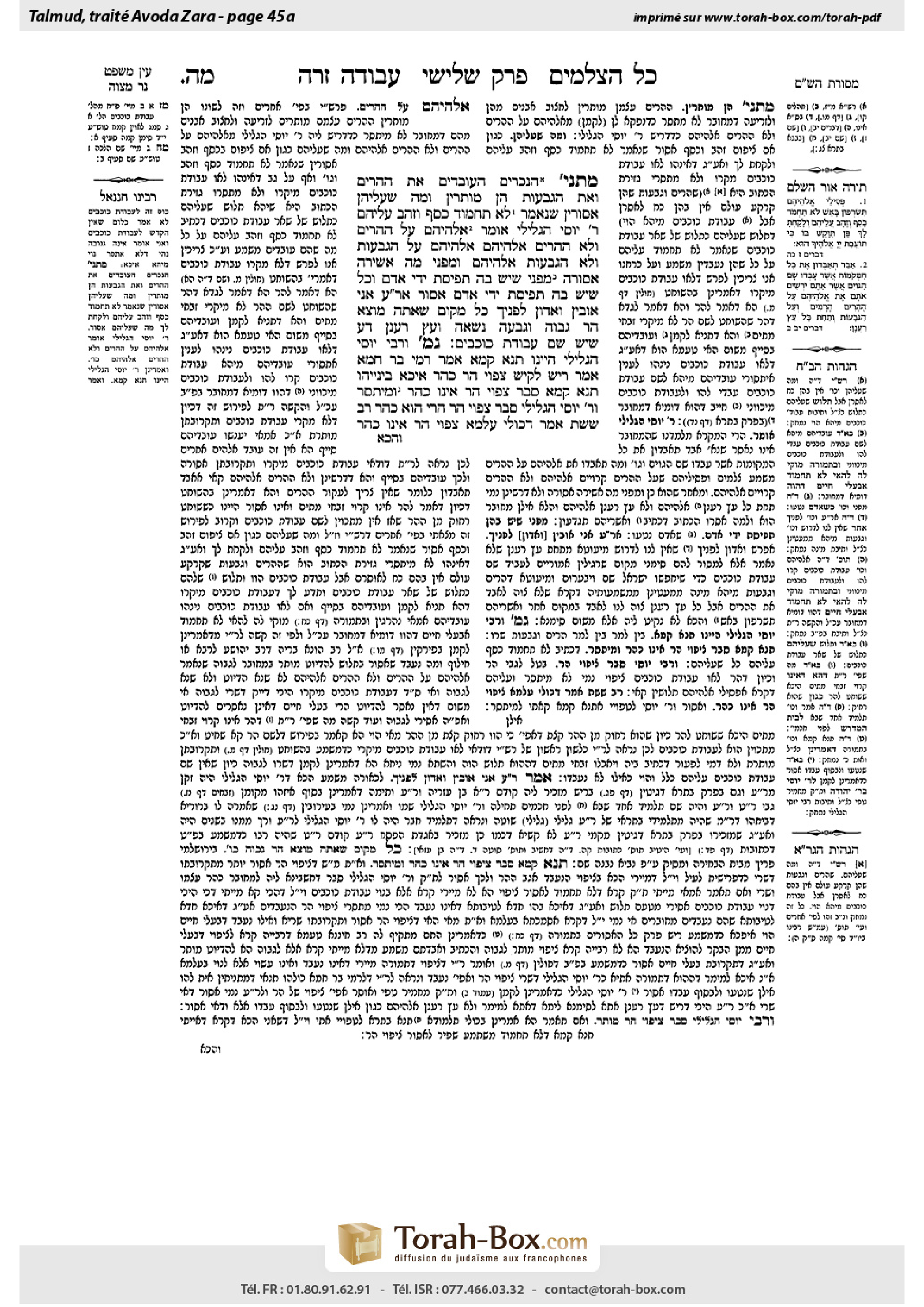
Avodah Zarah 45a: Talmud study for Daf Yomi
Study the Talmud for Daf Yomi with scanned pages, Hebrew text, English translations from Sefaria and AI-generated French translations.
Passage selection and English or AI-generated French translation are available where the scan has annotations. Daf Study is independent of Torah-Box and Sefaria.
Browse Avodah Zarah · עבודה זרה · All tractatesAvodah Zarah 45a text and translations
This page of Avodah Zarah includes the Aramaic text, an English translation and an AI-generated French translation, alongside the scan above.
עבודה זרה מ״ה א · Aramaic and Hebrew text
מַתְנִי׳ הַגּוֹיִם הָעוֹבְדִים אֶת הֶהָרִים וְאֶת הַגְּבָעוֹת — הֵן מוּתָּרִין, וּמָה שֶׁעֲלֵיהֶן אֲסוּרִין, שֶׁנֶּאֱמַר: ״לֹא תַחְמֹד כֶּסֶף וְזָהָב עֲלֵיהֶם״.
רַבִּי יוֹסֵי הַגְּלִילִי אוֹמֵר: ״אֱלֹהֵיהֶם עַל הֶהָרִים״ — וְלֹא הֶהָרִים אֱלֹהֵיהֶם, ״אֱלֹהֵיהֶם עַל הַגְּבָעוֹת״ — וְלֹא הַגְּבָעוֹת אֱלֹהֵיהֶם.
וּמִפְּנֵי מָה אֲשֵׁירָה אֲסוּרָה? מִפְּנֵי שֶׁיֵּשׁ בָּהּ תְּפִיסַת יְדֵי אָדָם, וְכֹל שֶׁיֵּשׁ בָּהּ תְּפִיסַת יְדֵי אָדָם — אָסוּר.
אָמַר רַבִּי עֲקִיבָא: אֲנִי אוֹבִין וְאָדוּן לְפָנֶיךָ, כׇּל מָקוֹם שֶׁאַתָּה מוֹצֵא הַר גָּבוֹהַּ וְגִבְעָה נִשָּׂאָה וְעֵץ רַעֲנָן, דַּע שֶׁיֵּשׁ שָׁם עֲבוֹדָה זָרָה.
גְּמָ׳ וְרַבִּי יוֹסֵי הַגְּלִילִי הַיְינוּ תַּנָּא קַמָּא! אָמַר רָמֵי בַּר חָמָא אָמַר רֵישׁ לָקִישׁ: צִפּוּי הַר כְּהַר אִיכָּא בֵּינַיְיהוּ, תַּנָּא קַמָּא סָבַר: צִפּוּי הַר אֵינוֹ כְּהַר וּמִיתְּסַר, וְרַבִּי יוֹסֵי הַגְּלִילִי סָבַר: צִפּוּי הַר הֲרֵי הוּא כְּהַר.
רַב שֵׁשֶׁת אָמַר: דְּכוּלֵּי עָלְמָא צִפּוּי הַר אֵינוֹ כְּהַר.
Avodah Zarah 45a · English translation
MISHNA: With regard to the halakha in the case of the gentiles who worship the mountains and the hills, the mountains and hills are permitted, but what is upon them is forbidden. It is not prohibited to derive benefit from the mountains and hills themselves, and they can be used for planting, harvesting, and the like. But if gentiles coated them with gold or silver, it is prohibited to derive benefit from the coating, as it is stated: “The graven images of their gods shall you burn with fire; you shall not covet the silver or the gold that is on them, nor take it for yourself, lest you be snared by it; for it is an abomination to the Lord your God” (Deuteronomy 7:25).
Rabbi Yosei HaGelili says with regard to the verse: “You shall destroy all the places where the nations that you are to dispossess served their gods, upon the high mountains, and upon the hills, and under every leafy tree” (Deuteronomy 12:2): The mitzva to destroy objects of idol worship applies to “their gods, upon the high mountains,” but not to the mountains themselves that are their gods. Similarly it applies to “their gods…upon the hills,” but not to the hills themselves that are their gods.
The mishna asks: And for what reason, then, is an ashera forbidden? Doesn’t the verse also state: “And under every leafy tree,” which indicates that the mitzva to destroy objects of idol worship does not apply to the trees themselves? The mishna answers: It is because it is the product of human involvement and did not grow by itself, and the halakha is that anything that is the product of human involvement is forbidden.
Rabbi Akiva says: I will explain and decide the matter before you. The verse does not indicate limitations to the halakhic definition of idols; rather, it is simply giving indicators of prevalent idolatrous practice: Everywhere that you find a high mountain, or an elevated hill, or a leafy tree, know that there is idol worship there.
GEMARA: The Gemara asks: But isn’t the opinion of Rabbi Yosei HaGelili the same as that of the first tanna? Both of them indicate that what is on the mountain is forbidden, while the mountain itself is permitted. Rami bar Ḥama says that Reish Lakish says: The difference between them is the issue of whether the status of the coating of a mountain is like the status of the mountain itself. The first tanna holds that the status of the coating of a mountain is not like the mountain itself, and is therefore forbidden, and Rabbi Yosei HaGelili holds that the status of the coating of a mountain is like the mountain itself.
Rejecting this explanation, Rav Sheshet says: Everyone agrees that the status of the coating of a mountain is not like the mountain itself and is forbidden.
Avodah Zarah 45a · Traduction française (IA)
MICHNA : En ce qui concerne la halakha dans le cas des gentils qui adorent les montagnes et les collines, les montagnes et les collines sont permises, mais ce qui est sur elles est interdit. Il n'est pas interdit d'en tirer un bénéfice des montagnes et des collines elles-mêmes, et on peut les utiliser pour la plantation, la récolte et les choses semblables. Mais si les gentils les recouvrent d'or ou d'argent, il est interdit d'en tirer un bénéfice du recouvrement, car il est dit : « Vous brûlerez en feu les statues de leurs dieux ; vous n'envierez pas l'or ou l'argent qui est sur elles, ni ne les prendrez pour vous, de peur qu'ils ne vous piègent ; car c'est un abomination pour l'Éternel votre Dieu » (Deutéronome 7:25).
Rabbi Yosei HaGelili dit concernant la parole : « Vous détruirez toutes les lieux où les nations que vous allez expulser adoraient leurs dieux, sur les hautes montagnes, et sur les collines, et sous chaque arbre feuillu » (Deutéronome 12:2) : La mitsva de détruire les objets d'idolâtrie s'applique à « leurs dieux, sur les hautes montagnes », mais pas aux montagnes elles-mêmes qui sont leurs dieux. De même, elle s'applique à « leurs dieux… sur les collines », mais pas aux collines elles-mêmes qui sont leurs dieux.
La mishna demande : Et pourquoi, alors, l'asherah est-elle interdite ? N'est-ce pas que la parole dit aussi : « Et sous chaque arbre feuillu », ce qui indique que la mitsva de détruire les objets d'idolâtrie ne s'applique pas aux arbres eux-mêmes ? La mishna répond : C'est parce qu'il s'agit d'un produit de l'ingénierie humaine et non d'une chose qui a poussé tout seul, et la halakha est que tout ce qui est le produit de l'ingénierie humaine est interdit.
Rabbi Akiva dit : Je vais expliquer et décider la question devant vous. La parole ne montre pas de limites à la définition halakhique des idoles ; elle indique simplement des indices de la pratique idolâtrique courante : partout où vous trouvez une haute montagne, ou une colline élevée, ou un arbre feuillu, savez que là il y a de l'idolâtrie.
GUEMARA : La Guemara demande : Mais n'est-ce pas l'opinion de Rabbi Yosei HaGelili qui est la même que celle du premier tanna ? Les deux indiquent que ce qui est sur la montagne est interdit, tandis que la montagne elle-même est permis. Rami bar Ḥama dit que Reish Lakish dit : La différence entre eux est la question de savoir si le statut du recouvrement d'une montagne est comme le statut de la montagne elle-même. Le premier tanna considère que le statut du recouvrement d'une montagne n'est pas comme celui de la montagne elle-même et est donc interdit, et Rabbi Yosei HaGelili considère que le statut du recouvrement d'une montagne est comme celui de la montagne elle-même.
Rejetant cette explication, Rav Sheshet dit : Tout le monde convient que le statut du recouvrement d'une montagne n'est pas comme celui de la montagne elle-même et est interdit.
Traduction française générée par IA à partir de l’édition anglaise de Sefaria. Vérifie toujours un passage avec le texte source.
Text from Sefaria: William Davidson Edition - Vocalized Aramaic (CC BY NC); William Davidson Edition - English (CC BY NC).