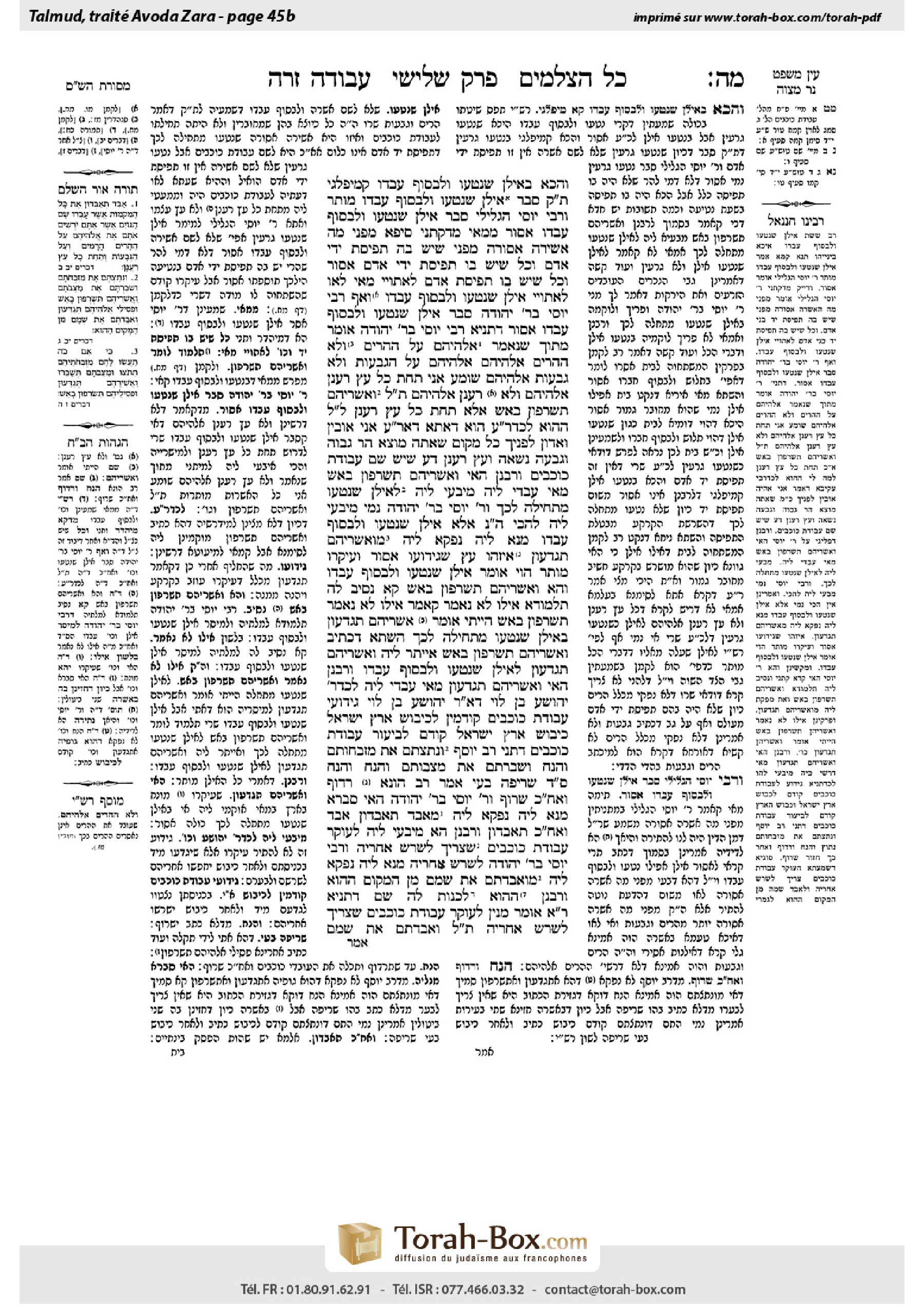
Avodah Zarah 45b: Talmud study for Daf Yomi
Study the Talmud for Daf Yomi with scanned pages, Hebrew text, English translations from Sefaria and AI-generated French translations.
Passage selection and English or AI-generated French translation are available where the scan has annotations. Daf Study is independent of Torah-Box and Sefaria.
Browse Avodah Zarah · עבודה זרה · All tractatesAvodah Zarah 45b text and translations
This page of Avodah Zarah includes the Aramaic text, an English translation and an AI-generated French translation, alongside the scan above.
עבודה זרה מ״ה ב · Aramaic and Hebrew text
וְהָכָא בָּאִילָן שֶׁנְּטָעוֹ וּלְבַסּוֹף עֲבָדוֹ קָמִיפַּלְגִי, תַּנָּא קַמָּא סָבַר: אִילָן שֶׁנְּטָעוֹ וּלְבַסּוֹף עֲבָדוֹ — מוּתָּר, וְרַבִּי יוֹסֵי הַגְּלִילִי סָבַר: אִילָן שֶׁנְּטָעוֹ וּלְבַסּוֹף עֲבָדוֹ — אָסוּר.
מִמַּאי? מִדְּקָתָנֵי סֵיפָא: מִפְּנֵי מָה אֲשֵׁירָה אֲסוּרָה? מִפְּנֵי שֶׁיֵּשׁ בָּהּ תְּפִיסַת יְדֵי אָדָם, וְכֹל שֶׁיֵּשׁ בּוֹ תְּפִיסַת יְדֵי אָדָם אָסוּר. ״וְכֹל שֶׁיֵּשׁ בּוֹ תְּפִיסַת אָדָם״ לְאֵתוֹיֵי מַאי? לָאו לְאֵתוֹיֵי אִילָן שֶׁנְּטָעוֹ וּלְבַסּוֹף עֲבָדוֹ?
וְאַף רַבִּי יוֹסֵי בְּרַבִּי יְהוּדָה סָבַר: אִילָן שֶׁנְּטָעוֹ וּלְבַסּוֹף עֲבָדוֹ — אָסוּר, דְּתַנְיָא: רַבִּי יוֹסֵי בְּרַבִּי יְהוּדָה אוֹמֵר, מִתּוֹךְ שֶׁנֶּאֱמַר: ״אֱלֹהֵיהֶם עַל הֶהָרִים״ — וְלֹא הֶהָרִים אֱלֹהֵיהֶם, ״אֱלֹהֵיהֶם עַל הַגְּבָעוֹת״ — וְלֹא גְּבָעוֹת אֱלֹהֵיהֶם, שׁוֹמֵעַ אֲנִי ״תַּחַת כׇּל עֵץ רַעֲנָן אֱלֹהֵיהֶם״ — וְלֹא רַעֲנָן אֱלֹהֵיהֶם?
תַּלְמוּד לוֹמַר: ״וַאֲשֵׁרֵיהֶם תִּשְׂרְפוּן בָּאֵשׁ״.
אֶלָּא ״תַּחַת כׇּל עֵץ רַעֲנָן״ לְמָה לִי? הָהוּא לְכִדְרַבִּי עֲקִיבָא הוּא דַּאֲתָא, דְּאָמַר רַבִּי עֲקִיבָא: אֲנִי אוֹבִין וְאָדוּן לְפָנֶיךָ, כׇּל מָקוֹם שֶׁאַתָּה מוֹצֵא הַר גָּבוֹהַּ וְגִבְעָה נִשָּׂאָה וְעֵץ רַעֲנָן, דַּע שֶׁיֵּשׁ שָׁם עֲבוֹדָה זָרָה.
וְרַבָּנַן, הַאי ״וַאֲשֵׁרֵיהֶם תִּשְׂרְפוּן בָּאֵשׁ״ מַאי עָבְדִי לֵיהּ? מִיבְּעֵי לֵיהּ לְאִילָן שֶׁנְּטָעוֹ מִתְּחִילָּה לְכָךְ.
וְרַבִּי יוֹסֵי בְּרַבִּי יְהוּדָה נָמֵי מִיבְּעֵי לֵיהּ לְהָכִי? הָכִי נָמֵי. אֶלָּא אִילָן שֶׁנְּטָעוֹ וּלְבַסּוֹף עֲבָדוֹ מְנָא לֵיהּ? נָפְקָא לֵיהּ מִ״וַּאֲשֵׁרֵיהֶם תְּגַדֵּעוּן״, אֵיזֶהוּ עֵץ שֶׁגִּידּוּעוֹ אָסוּר וְעִיקָּרוֹ מוּתָּר? הֱוֵי אוֹמֵר: אִילָן שֶׁנְּטָעוֹ וּלְבַסּוֹף עֲבָדוֹ.
וְהָא ״וַאֲשֵׁרֵיהֶם תִּשְׂרְפוּן בָּאֵשׁ״ קָא נָסֵיב לַהּ תַּלְמוּדָא!
אִילּוּ לֹא נֶאֱמַר קָאָמַר: אִילּוּ לֹא נֶאֱמַר ״תִּשְׂרְפוּן בָּאֵשׁ״, הָיִיתִי אוֹמֵר ״אֲשֵׁרֵיהֶם תְּגַדֵּעוּן״ בְּאִילָן שֶׁנְּטָעוֹ מִתְּחִילָּה לְכָךְ, הַשְׁתָּא דִּכְתִיב ״וַאֲשֵׁרֵיהֶם תִּשְׂרְפוּן בָּאֵשׁ״, אִיַּיתַּר לֵיהּ ״וַאֲשֵׁרֵיהֶם תְּגַדֵּעוּן״ לְאִילָן שֶׁנְּטָעוֹ וּלְבַסּוֹף עֲבָדוֹ.
וְרַבָּנַן, הַאי ״וַאֲשֵׁרֵיהֶם תְּגַדֵּעוּן״ מַאי עָבְדִי לֵיהּ? לְכִדְרַבִּי יְהוֹשֻׁעַ בֶּן לֵוִי, דְּאָמַר רַבִּי יְהוֹשֻׁעַ בֶּן לֵוִי: גִּידּוּעֵי עֲבוֹדָה זָרָה קוֹדְמִין לְכִיבּוּשׁ אֶרֶץ יִשְׂרָאֵל, כִּיבּוּשׁ אֶרֶץ יִשְׂרָאֵל קוֹדֵם לְבִיעוּר עֲבוֹדָה זָרָה.
דְּתָנֵי רַב יוֹסֵף: ״וְנִתַּצְתֶּם אֶת מִזְבְּחֹתָם״ וְהַנַּח, ״וְשִׁבַּרְתֶּם אֶת מַצֵּבֹתָם״ וְהַנַּח.
וְהַנַּח, סָלְקָא דַּעְתָּךְ? שְׂרֵיפָה בָּעֵי! אָמַר רַב הוּנָא: רְדוֹף, וְאַחַר כָּךְ שְׂרוֹף.
וְרַבִּי יוֹסֵי בְּרַבִּי יְהוּדָה, הַאי סְבָרָא מְנָא לֵיהּ? נָפְקָא לֵיהּ מְ״אַבֵּד תְּאַבְּדוּן״ — ״אַבֵּד״, וְאַחַר כָּךְ ״תְּאַבֵּדוּן״.
וְרַבָּנַן? הָא מִיבְּעֵי לֵיהּ לְעוֹקֵר עֲבוֹדָה זָרָה, שֶׁצָּרִיךְ לְשָׁרֵשׁ אַחֲרֶיהָ.
וְרַבִּי יוֹסֵי בְּרַבִּי יְהוּדָה, לְשָׁרֵשׁ אַחֲרֶיהָ מְנָא לֵיהּ? נָפְקָא לֵיהּ מִ״וְּאִבַּדְתֶּם אֶת שְׁמָם מִן הַמָּקוֹם הַהוּא״.
וְרַבָּנַן? הַהוּא לְכַנּוֹת לָהּ שֵׁם, דְּתַנְיָא: רַבִּי אֱלִיעֶזֶר אוֹמֵר: מִנַּיִן לְעוֹקֵר עֲבוֹדָה זָרָה שֶׁצָּרִיךְ לְשָׁרֵשׁ אַחֲרֶיהָ? תַּלְמוּד לוֹמַר: ״וְאִבַּדְתֶּם אֶת שְׁמָם״.
Avodah Zarah 45b · English translation
And here, they disagree with regard to the status of a tree that one planted and only subsequently worshipped. The first tanna holds that a tree that one planted and subsequently worshipped is permitted, and Rabbi Yosei HaGelili holds that a tree that one planted and subsequently worshipped is forbidden.
The Gemara asks: From where does Rav Sheshet infer that Rabbi Yosei HaGelili holds that such a tree is forbidden? It is from the fact that the mishna teaches in the last clause: For what reason is an ashera forbidden? It is because it is the product of human involvement and did not grow by itself, and the halakha is that anything that is the product of human involvement is forbidden. What is added by the generalization: And anything that is the product of human involvement is forbidden? Is it not added to include the case of a tree that one planted and subsequently worshipped?
The Gemara notes: And Rabbi Yosei, son of Rabbi Yehuda, also holds that a tree that one planted and subsequently worshipped is forbidden. As it is taught in a baraita with regard to the verse: “You shall destroy all the places where the nations that you are to dispossess served their gods, upon the high mountains, and upon the hills, and under every leafy tree” (Deuteronomy 12:2): Rabbi Yosei, son of Rabbi Yehuda, says: From that which is stated in the verse: “You shall destroy…their gods, upon the high mountains,” from which the Sages derived: But not the mountains themselves that are their gods, and: “You shall destroy…their gods…upon the hills,” but not the hills themselves if they are their gods, I would derive from the next clause in the verse: “Their gods…under every leafy tree,” that the mitzva to destroy an object of idol worship does not apply to the leafy trees themselves that are their gods.
Therefore, the next verse states: “And you shall break down their altars, and dash in pieces their pillars, and burn their asherim with fire” (Deuteronomy 12:3). Even a tree that was worshipped only after it was planted is forbidden.
Rather, if the trees themselves are forbidden, why do I need the phrase “under every leafy tree”? That phrase comes to teach a halakha in accordance with the opinion of Rabbi Akiva; as Rabbi Akiva says: I will explain and decide the matter before you. Everywhere that you find a high mountain, or an elevated hill, or a leafy tree, know that there is idol worship there. From the fact that Rabbi Yosei, son of Rabbi Yehuda, does not derive from the phrase “under every leafy tree” that a tree that was planted and only subsequently worshipped is still permitted, it is apparent that he holds that such a tree is forbidden. This is consistent with the opinion that Rav Sheshet ascribes to Rabbi Yosei HaGelili.
The Gemara asks: And as for the Rabbis, who maintain that a tree that was planted and subsequently worshipped is permitted, what do they do with this verse: “And burn their asherim with fire”? The Gemara answers: This verse is necessary with regard to the halakha of a tree that was initially planted for that idolatrous practice, which must be destroyed and from which deriving benefit is prohibited.
The Gemara asks: But doesn’t Rabbi Yosei, son of Rabbi Yehuda, also require this phrase to teach this? The Gemara answers. Indeed, he does. Rather, from where does he derive that a tree that one planted and subsequently worshipped is forbidden? He derives it from the following verse: “But so shall you deal with them: You shall break down their altars, and dash in pieces their pillars, and hew down their asherim, and burn their graven images with fire” (Deuteronomy 7:5). Now, which is the tree whose trunk is forbidden but its root is permitted, as the verse instructs one to hew it down? You must say that it is referring to a tree that one planted and subsequently worshipped.
The Gemara asks how that verse can be the source of the ruling of Rabbi Yosei, son of Rabbi Yehuda, for deeming forbidden a tree that was planted and only subsequently worshipped. But doesn’t the baraita state that he adduces the derivation prohibiting worshipped ashera trees from the verse: “And you shall break down their altars, and dash in pieces their pillars, and burn their asherim with fire”?
The Gemara answers: By deriving this halakha from the verse: “And burn their asherim with fire,” Rabbi Yosei, son of Rabbi Yehuda, is speaking utilizing the style of: If it were not stated. The Gemara explains: If the verse: “Burn their asherim with fire,” were not stated, I would have said that the verse: “And hew down their asherim,” is referring to a tree that was initially planted for idol worship. Now that it is written: “And burn their asherim with fire,” the verse: “And hew down their asherim,” is rendered superfluous and is consequently interpreted as referring to a tree that one planted and subsequently worshipped. Therefore, it is ultimately this latter verse that serves as the source for the implied ruling of Rabbi Yosei, son of Rabbi Yehuda, that it is prohibited to derive benefit from such a tree.
The Gemara asks: And as for the Rabbis, what do they do with this verse: “And hew down their asherim”? The Gemara answers: This verse is written in order to teach a halakha in accordance with the statement of Rabbi Yehoshua ben Levi; as Rabbi Yehoshua ben Levi says: The felling of trees dedicated to idol worship precedes the conquering of all of Eretz Yisrael, and conquering Eretz Yisrael precedes the eradication of all the objects of idol worship.
As Rav Yosef teaches a baraita: The verse states: “And you shall break down their altars, and dash in pieces their pillars, and burn their asherim with fire.” Rav Yosef explains: “And you shall break down their altars,” and leave them, as the Torah does not prescribe that they be burned; “and dash in pieces their pillars” and leave them.
The Gemara asks: But does it enter your mind that the Torah is instructing one to leave them alone? Doesn’t an object of idol worship require burning, as it says at the end of the verse: “And burn their asherim with fire”? Rav Huna says: Pursue the enemy and then return to burn them. Meaning, first smash their objects of idol worship, then conquer the land, and then return to burn the smashed items.
The Gemara asks: And from where does Rabbi Yosei, son of Rabbi Yehuda, derive this opinion about the order of priorities in the process of conquering Eretz Yisrael? The Gemara answers: He derives it from the verse: “You shall destroy all the places where the nations that you are to dispossess served their gods, upon the high mountains, and upon the hills, and under every leafy tree.” From the double-verb form of the directive “you shall destroy [abbed te’abedun]” he derives that there are two stages to the destruction of their gods: First destroy them [abbed], i.e., smash them; then go and conquer the land, and only afterward you shall destroy [te’abedun] them completely, i.e., burn or eradicate them.
The Gemara asks: And what do the Rabbis derive from the double verb? The Gemara answers: This double verb is necessary to teach that when one deracinates an object of idol worship, he needs to root out all traces of it.
The Gemara asks: And from where does Rabbi Yosei, son of Rabbi Yehuda, derive the obligation to root out all traces of idol worship? The Gemara answers: He derives it from the verse: “And you shall break down their altars, and dash in pieces their pillars, and burn their asherim with fire; and you shall hew down the graven images of their gods; and you shall destroy their name out of that place” (Deuteronomy 12:3).
The Gemara asks: And what do the Rabbis derive from this verse? The Gemara answers: That verse teaches that it is a mitzva to give a derogatory nickname to an idol. As it is taught in a baraita that Rabbi Eliezer says: From where is it derived that when one deracinates an object of idol worship, he needs to root out all traces of it? The verse states: “And you shall destroy their name out of that place.”
Avodah Zarah 45b · Traduction française (IA)
Et ici, ils s'entendent sur le statut d'un arbre que l'on a planté et qui a ensuite été adoré. Le premier tanna affirme qu'un arbre que l'on a planté et qui a ensuite été adoré est permis, et Rabbi Yosei HaGelili affirme qu'un arbre que l'on a planté et qui a ensuite été adoré est interdit.
La Guemara pose la question : D'où Rav Sheshet déduit-il que Rabbi Yosei HaGelili considère que cet arbre est interdit ? C'est à partir du fait que la Michna enseigne dans la dernière clause : Pourquoi l'asherah est-elle interdite ? C'est parce qu'elle est le produit de l'implication humaine et n'a pas grandi d'elle-même, et la halakha est que tout ce qui est le produit de l'implication humaine est interdit. Qu'est-ce que l'extension : Et tout ce qui est le produit de l'implication humaine est interdit ? N'est-ce pas ajouté pour inclure le cas d'un arbre que l'on a planté et qui a ensuite été adoré ?
La Guemara note : Et Rabbi Yosei, fils de Rabbi Yehuda, considère également que l'arbre que l'on a planté et qui a ensuite été adoré est interdit. Comme il est enseigné dans une baraïta concernant la parole : « Vous détruirez toutes les lieux où les nations que vous allez expulser adoraient leurs dieux, sur les montagnes élevées, et sur les collines, et sous chaque arbre feuillu » (Deutéronome 12:2) : Rabbi Yosei, fils de Rabbi Yehuda, dit : À partir de ce qui est dit dans la parole : « Vous détruirez... leurs dieux, sur les montagnes élevées », des Sages ont déduit : Mais pas les montagnes elles-mêmes qui sont leurs dieux, et : « Vous détruirez... leurs dieux... sur les collines », mais pas les collines elles-mêmes si elles sont leurs dieux, je déduirais à partir de la clause suivante dans la parole : « Leurs dieux... sous chaque arbre feuillu », que la mitsva de détruire un objet d'adoration païenne ne s'applique pas aux arbres feuillus eux-mêmes qui sont leurs dieux.
Par conséquent, la prochaine parole dit : « Et vous détruirez leurs autels, et briserez leurs poteaux, et brûlerez leurs asherim avec le feu » (Deutéronome 12:3). Même un arbre qui a été adoré seulement après avoir été planté est interdit.
Plutôt, si les arbres eux-mêmes sont interdits, pourquoi ai-je besoin de la phrase « sous chaque arbre feuillu » ? Cette phrase vient enseigner une halakha selon l'opinion de Rabbi Akiva ; car Rabbi Akiva dit : Je vais vous expliquer et décider la question. Partout où vous trouvez une montagne élevée, ou une colline élevée, ou un arbre feuillu, savez que là il y a une adoration païenne. Du fait que Rabbi Yosei, fils de Rabbi Yehuda, ne déduit pas à partir de la phrase « sous chaque arbre feuillu » que l'arbre que l'on a planté et qui a ensuite été adoré est encore permis, il est évident qu'il considère que cet arbre est interdit. Cela est cohérent avec l'opinion que Rav Sheshet attribue à Rabbi Yosei HaGelili.
La Guemara pose la question : Et quant aux Rabbins, qui affirment que l'arbre que l'on a planté et qui a ensuite été adoré est permis, que font-ils avec cette parole : « Et brûlez leurs asherim avec le feu » ? La Guemara répond : Cette parole est nécessaire concernant la halakha d'un arbre qui a été initialement planté pour cette pratique idolâtre, qui doit être détruit et dont l'usage est interdit.
La Guemara pose la question : Mais ne dit pas Rabbi Yosei, fils de Rabbi Yehuda, également cela ? La Guemara répond : Oui, il le fait. Plutôt, d'où déduit-il que l'arbre que l'on a planté et qui a ensuite été adoré est interdit ? Il le déduit à partir de la suivante parole : « Mais ainsi agirez-vous avec eux : vous détruirez leurs autels, et briserez leurs poteaux, et abaterez leurs asherim, et brûlerez leurs images gravées avec le feu » (Deutéronome 7:5). Maintenant, quel est l'arbre dont le tronc est interdit mais la racine est permis, comme la parole ordonne d'abattre ? Vous devez dire qu'il s'agit d'un arbre que l'on a planté et qui a ensuite été adoré.
La Guemara pose la question : Comment cette parole peut-elle être la source de la décision de Rabbi Yosei, fils de Rabbi Yehuda, concernant l'interdiction d'un arbre que l'on a planté et qui a ensuite été adoré ? Mais ne dit pas la baraïta que cela vient de la parole : « Et brûlez leurs asherim avec le feu » ?
La Guemara répond : En déduisant cette halakha à partir de la parole : « Et brûlez leurs asherim avec le feu », Rabbi Yosei, fils de Rabbi Yehuda, parle en utilisant le style : Si cela n'avait pas été dit. La Guemara explique : Si la parole : « Brûlez leurs asherim avec le feu », n'avait pas été dite, j'aurais dit que la parole : « Et abattez leurs asherim », fait référence à un arbre qui a été initialement planté pour l'idolâtrie. Maintenant que cela est écrit : « Et brûlez leurs asherim avec le feu », la parole : « Et abattez leurs asherim », est rendue superflue et est donc interprétée comme faisant référence à un arbre que l'on a planté et qui a ensuite été adoré. Par conséquent, c'est cette dernière parole qui sert de source pour la décision implicite de Rabbi Yosei, fils de Rabbi Yehuda, que l'on ne doit pas tirer profit de cet arbre.
La Guemara pose la question : Et quant aux Rabbins, que font-ils avec cette parole : « Et abattez leurs asherim » ? La Guemara répond : Cette parole est écrite afin d'enseigner une halakha selon l'enseignement de Rabbi Yehoshua ben Levi ; car Rabbi Yehoshua ben Levi dit : L'abattage des arbres dédiés à l'idolâtrie précède la conquête de toute l'Éretz Yisrael, et la conquête de l'Éretz Yisrael précède l'éradication de tous les objets d'idolâtrie.
Comme Rav Yosef enseigne une baraïta : La parole dit : « Et vous détruirez leurs autels, et briserez leurs poteaux, et brûlerez leurs asherim avec le feu ». Rav Yosef explique : « Et vous détruirez leurs autels », et laissez-les, car la Torah ne prescrit pas qu'ils soient brûlés ; « et briserez leurs poteaux » et laissez-les.
La Guemara pose la question : Mais est-ce que cela entre dans votre pensée que la Torah ordonne de laisser ces choses en paix ? Nécessairement, un objet de culte païen doit être brûlé, comme il est dit à la fin de la phrase : « Et brûle leurs asherim avec le feu » ? Rav Huna dit : Persuadez-vous de l'ennemi, puis retournez les brûler. Cela signifie, d'abord détruire leurs objets de culte païen, puis conquérir la terre, et ensuite retournez brûler les objets détruits.
La Guemara pose la question : Et d'où Rabbi Yosei, fils de Rabbi Yéhuda, tire-t-il cette opinion sur l'ordre des priorités dans le processus de conquête de la Terre d'Israël ? La Guemara répond : Il tire cela de la parole : « Vous détruirez toutes les places où les nations que vous allez expulser ont servi leurs dieux, sur les montagnes élevées, et sur les collines, et sous chaque arbre feuillu. » À partir de la forme verbale double « vous détruirez [abbed te’abedun] », il tire que la destruction de leurs dieux se fait en deux étapes : d'abord détruirez-les [abbed], c'est-à-dire les briser, puis allez conquérir la terre, et seulement après cela vous détruirez [te’abedun] complètement, c'est-à-dire brûler ou éradiquer.
La Guemara pose la question : Et qu'ont tiré les Rabbins de la forme verbale double ? La Guemara répond : Cette forme verbale double est nécessaire pour enseigner que lorsqu'on déracine un objet de culte païen, il faut éradiquer toutes les traces de celui-ci.
La Guemara pose la question : Et d'où tire Rabbi Yosei, fils de Rabbi Yéhuda, l'obligation d'éradiquer toutes les traces du culte païen ? La Guemara répond : Il tire cela de la parole : « Et tu détruiras leurs autels, et tu briseras leurs poteaux, et tu brûleras leurs asherim avec le feu ; et tu démoliras les statues de leurs dieux ; et tu éradiqueras leur nom de ce lieu » (Deutéronome 12:3).
La Guemara pose la question : Et qu'ont tiré les Rabbins de cette parole ? La Guemara répond : Cette parole enseigne qu'il est une mitsva de donner un surnom dégradant à un idole. Comme il est enseigné dans une baraïta que Rabbi Éliézer dit : D'où tire-t-on que lorsqu'on déracine un objet de culte païen, il faut éradiquer toutes les traces de celui-ci ? La parole dit : « Et tu éradiqueras leur nom de ce lieu. »
Traduction française générée par IA à partir de l’édition anglaise de Sefaria. Vérifie toujours un passage avec le texte source.
Text from Sefaria: William Davidson Edition - Vocalized Aramaic (CC BY NC); William Davidson Edition - English (CC BY NC).