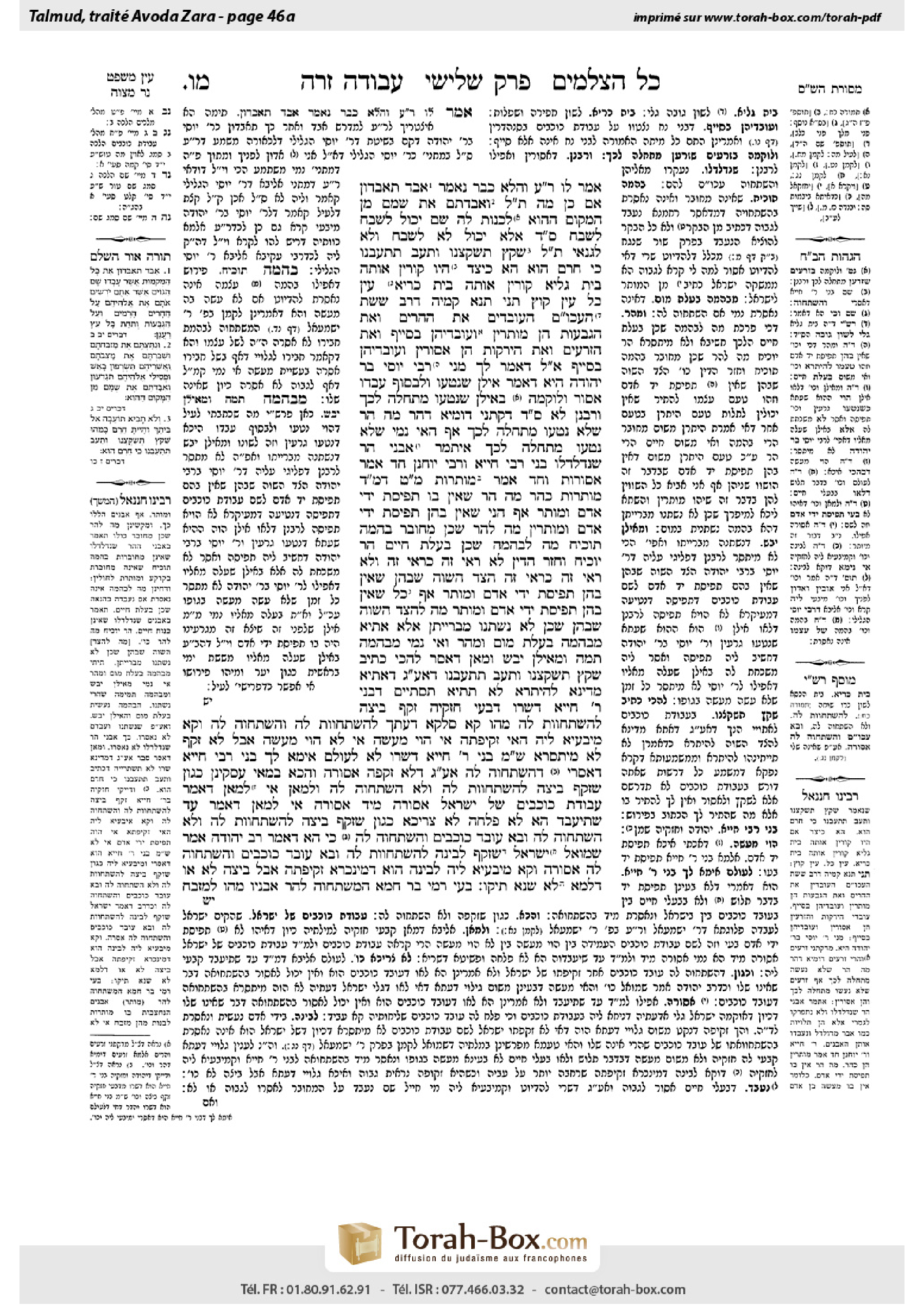
Avodah Zarah 46a: Talmud study for Daf Yomi
Study the Talmud for Daf Yomi with scanned pages, Hebrew text, English translations from Sefaria and AI-generated French translations.
Passage selection and English or AI-generated French translation are available where the scan has annotations. Daf Study is independent of Torah-Box and Sefaria.
Browse Avodah Zarah · עבודה זרה · All tractatesAvodah Zarah 46a text and translations
This page of Avodah Zarah includes the Aramaic text, an English translation and an AI-generated French translation, alongside the scan above.
עבודה זרה מ״ו א · Aramaic and Hebrew text
אָמַר לוֹ רַבִּי עֲקִיבָא, וַהֲלֹא כְּבָר נֶאֱמַר: ״אַבֵּד תְּאַבְּדוּן״, אִם כֵּן מָה תַּלְמוּד לוֹמַר: ״וְאִבַּדְתֶּם אֶת שְׁמָם מִן הַמָּקוֹם הַהוּא״? לְכַנּוֹת לָהּ שֵׁם.
יָכוֹל לְשֶׁבַח? לְשֶׁבַח סָלְקָא דַּעְתָּךְ?! אֶלָּא יָכוֹל לֹא לְשֶׁבַח וְלֹא לִגְנַאי? תַּלְמוּד לוֹמַר: ״שַׁקֵּץ תְּשַׁקְּצֶנּוּ וְתַעֵב תְּתַעֲבֶנּוּ כִּי חֵרֶם הוּא״.
הָא כֵּיצַד? הָיוּ קוֹרִין אוֹתָהּ בֵּית גַּלְיָא — קוֹרִין אוֹתָהּ ״בֵּית כַּרְיָא״, פְּנֵי מֶלֶךְ — ״פְּנֵי כֶּלֶב״, עֵין כֹּל — ״עֵין קוֹץ״.
תָּנֵי תַּנָּא קַמֵּיהּ דְּרַב שֵׁשֶׁת: הַגּוֹיִם הָעוֹבְדִים אֶת הֶהָרִים וְאֶת הַגְּבָעוֹת — הֵן מוּתָּרִין, וְעוֹבְדֵיהֶן בְּסַיִיף, וְאֶת הַזְּרָעִים וְאֶת הַיְּרָקוֹת — הֵן אֲסוּרִין, וְעוֹבְדֵיהֶן בְּסַיִיף.
אֲמַר לֵיהּ: דְּאָמַר לָךְ, מַנִּי? רַבִּי יוֹסֵי בַּר יְהוּדָה הִיא, דְּאָמַר: אִילָן שֶׁנְּטָעוֹ וּלְבַסּוֹף עֲבָדוֹ — אָסוּר.
וְלוֹקְמַהּ בְּאִילָן שֶׁנְּטָעוֹ מִתְּחִלָּה לְכָךְ, וְרַבָּנַן! לָא סָלְקָא דַּעְתָּךְ, דְּקָתָנֵי דּוּמְיָא דְּהַר, מָה הַר שֶׁלֹּא נְטָעוֹ מִתְּחִלָּה לְכָךְ, אַף הַאי נָמֵי שֶׁלֹּא נְטָעוֹ מִתְּחִלָּה לְכָךְ.
אִיתְּמַר: אַבְנֵי הַר שֶׁנִּדַּלְדְּלוּ — בְּנֵי רַבִּי חִיָּיא וְרַבִּי יוֹחָנָן, חַד אָמַר: אֲסוּרוֹת, וְחַד אָמַר: מוּתָּרוֹת. מַאי טַעְמָא דְּמַאן דְּאָמַר מוּתָּרוֹת? כְּהַר — מָה הַר שֶׁאֵין בּוֹ תְּפִיסַת יְדֵי אָדָם וּמוּתָּר, אַף הָנֵי שֶׁאֵין בָּהֶן תְּפִיסַת יְדֵי אָדָם וּמוּתָּרִין.
מָה לְהַר, שֶׁכֵּן מְחוּבָּר! בְּהֵמָה תּוֹכִיחַ.
מָה לִבְהֵמָה, שֶׁכֵּן בַּעֲלַת חַיִּים! הַר יוֹכִיחַ.
וְחָזַר הַדִּין, לֹא רְאִי זֶה כִרְאִי זֶה, וְלֹא רְאִי זֶה כִּרְאִי זֶה, הַצַּד הַשָּׁוֶה שֶׁבָּהֶן שֶׁאֵין בָּהֶן תְּפִיסַת יְדֵי אָדָם וּמוּתָּר, אַף כׇּל שֶׁאֵין בָּהֶן תְּפִיסַת יְדֵי אָדָם וּמוּתָּר.
מָה לְהַצַּד הַשָּׁוֶה שֶׁבָּהֶן, שֶׁכֵּן לֹא נִשְׁתַּנּוּ מִבְּרִיָּיתָן!
אֶלָּא אָתְיָא מִבְּהֵמָה בַּעֲלַת מוּם, וּמֵהַר.
וְאִי נָמֵי, מִבְּהֵמָה תַּמָּה וּמֵאִילָן יָבֵשׁ.
וּמַאן דְּאָסַר, לְהָכִי כְּתִיב ״שַׁקֵּץ תְּשַׁקְּצֶנּוּ וְתַעֵב תְּתַעֲבֶנּוּ״, דְּאַף עַל גַּב דְּאָתְיָא מִדִּינָא לְהֶיתֵּרָא, לָא תֵּתְיַאּ.
תִּסְתַּיֵּים, דִּבְנֵי רַבִּי חִיָּיא דְּשָׁרוּ, דְּבָעֵי חִזְקִיָּה: זָקַף בֵּיצָה לְהִשְׁתַּחֲווֹת לָהּ, מַהוּ?
קָא סָלְקָא דַּעְתָּךְ לְהִשְׁתַּחֲווֹת לָהּ, וְהִשְׁתַּחֲוָה לָהּ, וְקָא מִיבַּעְיָא לֵיהּ הַאי זְקִיפָתָהּ אִי הָוֵי מַעֲשֶׂה אִי לָא הָוֵי מַעֲשֶׂה, אֲבָל לֹא זָקַף — לָא מִיתַּסְרָא, שְׁמַע מִינַּהּ בְּנֵי רַבִּי חִיָּיא דְּשָׁרוּ.
לָא, לְעוֹלָם אֵימָא לָךְ: בְּנֵי רַבִּי חִיָּיא דְּאָסְרִי, דְּהִשְׁתַּחֲוָה לָהּ, אַף עַל גַּב דְּלֹא זְקָפָהּ אֲסוּרָה, וְהָכָא בְּמַאי עָסְקִינַן? כְּגוֹן שֶׁזָּקַף בֵּיצָה לְהִשְׁתַּחֲווֹת לָהּ, וְלֹא הִשְׁתַּחֲוָה לָהּ.
וּלְמַאן? אִי לְמַאן דְּאָמַר: עֲבוֹדָה זָרָה שֶׁל יִשְׂרָאֵל אֲסוּרָה מִיָּד — אֲסוּרָה, אִי לְמַאן דְּאָמַר: עַד שֶׁתֵּיעָבֵד — הָא לָא פַּלְחַהּ!
לָא צְרִיכָא, כְּגוֹן שֶׁזָּקַף בֵּיצָה לְהִשְׁתַּחֲווֹת לָהּ, וְלֹא הִשְׁתַּחֲוָה לָהּ, וּבָא גּוֹי וְהִשְׁתַּחֲוָה לָהּ.
כִּי הָא דְּאָמַר רַב יְהוּדָה אָמַר שְׁמוּאֵל: יִשְׂרָאֵל שֶׁזָּקַף לְבֵינָה לְהִשְׁתַּחֲווֹת לָהּ, וּבָא גּוֹי וְהִשְׁתַּחֲוָה לָהּ — אֲסוּרָה. וְקָא מִיבַּעְיָא לֵיהּ: לְבֵינָה הוּא דְּמִינַּכְרָא זְקִיפָתָהּ, אֲבָל בֵּיצָה — לָא? אוֹ דִּלְמָא לָא שְׁנָא? תֵּיקוּ.
בָּעֵי רָמֵי בַּר חָמָא: הַמִּשְׁתַּחֲוֶה לְהַר, אֲבָנָיו מַהוּ לַמִּזְבֵּחַ?
Avodah Zarah 46a · English translation
Rabbi Akiva said to him: But isn’t it already stated: “You shall destroy” (Deuteronomy 12:2)? This obviously includes rooting out all traces of idols. If so, what is the meaning when the verse states: “And you shall destroy their name out of that place”? This means that it is a mitzva to give it a nickname.
One might have thought that one may give it a positive nickname. The Gemara interjects: Would it enter your mind that one may give a positive nickname to an idol? Rather, the baraita means that one might have thought that the reference is to a nickname that is neither positive nor negative. Therefore, the verse states: “And you shall not bring an abomination into your house, and be accursed like it; you shall detest it, and you shall abhor it; for it is a proscribed item” (Deuteronomy 7:26). This verse clearly indicates that the nickname should be a negative one.
How so? To what type of nickname is this referring? If the idol worshippers would call their house of worship the house of elevation [beit galya], one should call it the house of digging [beit karya]. If they call it the all-seeing eye [ein kol], one should call it the eye of a thorn [ein kotz].
The tanna who recited mishnayot and baraitot in the study hall taught a baraita before Rav Sheshet: With regard to the halakha in the case of the gentiles who worship the mountains and the hills, the mountains and hills are permitted, but their worshippers are punished with decapitation by the sword. But with regard to gentiles who worship plants and vegetables, the plants and vegetables are forbidden and their worshippers are punished with decapitation by the sword.
Rav Sheshet said to him: Who is the tanna who said this to you? It must be Rabbi Yosei, son of Rabbi Yehuda, who says that a tree that one planted and subsequently worshipped is forbidden.
The Gemara asks: But why not interpret the baraita as referring to a tree that one initially planted for idol worship, and then the ruling would be consistent with the opinion of the Rabbis as well? The Gemara answers: This should not enter your mind, as the baraita teaches the case of plants and vegetables as being similar to the case of a mountain. Therefore, one can extrapolate that just as with regard to a mountain, it is a case where one did not initially plant it for this purpose, as mountains are not planted by people, so too, this case of plants and vegetables is a case where one did not initially plant it for this purpose.
§ It was stated: The halakha in a case where a gentile worships boulders that naturally became dislodged from a mountain is subject to dispute between the sons of Rabbi Ḥiyya on the one hand and Rabbi Yoḥanan on the other. One side says: They are forbidden, and one side says: They are permitted. The Gemara asks: What is the reason of the one who says that they are permitted? The Gemara answers: The status of the dislodged stones is still like the status of the mountain itself. Just as in the case of a mountain, it is not the product of human involvement, and therefore it is permitted to derive benefit from it even after it is worshipped, so too, these boulders, which are not the product of human involvement, are permitted.
The Gemara raises an objection: What is notable about a mountain? It is notable in that it is attached to the ground. This may be the reason for the leniency concerning it, and this does not apply to boulders. The Gemara responds: The case of a worshipped animal can prove that this is not relevant, as it is permitted to derive benefit from a worshipped animal even though it is not attached to the ground.
The Gemara defends its objection: What is notable about an animal? It is notable in that it is a living, animate being. This may be the reason for the leniency concerning it, and this does not apply to boulders. The Gemara responds: The case of a mountain can prove that this is not relevant, as it is permitted to derive benefit from a mountain that was worshipped, even though it is not a living being.
And the inference has reverted to its starting point, and the halakha can be inferred from a combination of the two sources: The aspect of this case, that of a mountain, is not like the aspect of that case, that of an animal, and the aspect of that case is not like the aspect of this case; their common element is that they are not products of human involvement, and it is permitted to derive benefit from them. So too, in any case of worshipped objects that are not the product of human involvement, including boulders, they are permitted.
The Gemara objects: What is notable about the common element between the case of a mountain and that of an animal that prevents utilizing it as a paradigm for other cases? These worshipped objects are notable in that they were not altered from their natural form. Perhaps that is why their status remains unchanged. By contrast, a dislodged boulder has been moved from its original position.
Rather, the halakha that a boulder that is dislodged from a mountain is still permitted after it is worshipped is derived from the case of a blemished animal and from the case of a mountain, both of which are permitted after having been worshipped. The notable aspect of a mountain, in that it is an unaltered object and is attached to the ground, is countered by the case of a blemished animal, and the notable aspect of a blemished animal in that it is a living being is countered by the case of a mountain. Therefore, it can be derived from the common element of the two cases that just as these two are not products of human involvement and are not rendered forbidden by worship, so too, a dislodged boulder is not rendered forbidden by worship.
Alternatively, the halakha can be derived from the case of an unblemished animal and from the case of a withered tree, both of which are permitted after having been worshipped. The notable aspect of an unblemished animal, in that it is unaltered and a living being, is countered by the case of a withered tree, and the notable aspect of a withered tree, in that it is attached to the ground, is countered by the case of an unblemished animal.
The Gemara asks: And what is the reasoning of the one who deems worshipped boulders forbidden? The Gemara answers: According to that opinion, it is in order to teach this halakha: It is written: “And you shall not bring an abomination into your house, and be accursed like it; you shall detest it, and you shall abhor it; for it is a proscribed item” (Deuteronomy 7:26). This verse teaches that although one may theoretically derive, by logical inference, to permit the boulders, do not derive that halakha.
The Gemara introduced the case of a boulder that naturally dislodged from a mountain as the subject of a dispute between the sons of Rabbi Ḥiyya and Rabbi Yoḥanan, but it did not specify who subscribes to which opinion. The Gemara suggests: It may be concluded that it is the sons of Rabbi Ḥiyya who deem it permitted, as Ḥizkiyya, Rabbi Ḥiyya’s son, raises a dilemma: If one erected an egg in order to bow to it as an idol, what is the halakha? Is it then prohibited to derive benefit from the egg?
The Gemara explains the proof: It enters your mind that this dilemma is referring to a case where one erected an egg in order to bow to it, and he then bowed to it. And he raises a dilemma as to whether this erecting of the egg is considered a significant act of human involvement that renders the egg forbidden as an object of idol worship, or whether it is not considered a significant act of human involvement. But if he had not erected the egg, there would be no dilemma, as clearly it would not become forbidden. Accordingly, one can conclude from this dilemma that the sons of Rabbi Ḥiyya are the ones who deem the boulder permitted, since it is not a product of human involvement.
The Gemara rejects this proof: No, actually I will say to you that perhaps it is the sons of Rabbi Ḥiyya who deem the dislodged boulder forbidden after it was worshipped, and they similarly hold that in this case of the egg, if he bowed to it, even if did not erect it, the egg is certainly forbidden. And the dilemma is as follows: Here we are dealing with a case where he erected the egg in order to bow to it, but he ultimately did not bow to it. Ḥizkiyya’s dilemma was whether designation of an object as an idol renders it forbidden even without actual worship.
The Gemara asks: But according to whom does he raise the dilemma? If it is according to the one who says that any object of a Jew who dedicated it to idol worship is immediately rendered forbidden, there is no place for the dilemma; the egg is clearly forbidden. If it is according to the one who says that an object of idol worship is not forbidden until it is actually worshipped, there is also no place for the dilemma, as the egg was not worshipped, and is therefore permitted.
The Gemara answers by reformulating the case: No, those are not the cases with regard to which the dilemma is raised. It is necessary to raise it with regard to a case where one erected an egg in order to bow to it, but ultimately he did not bow to it, and then a gentile came along and bowed to it. It is with regard to this case that Ḥizkiyya raises the dilemma.
There is an established principle that one cannot render forbidden an item that is not his. In this case, the egg can be rendered forbidden only by a combination of the Jewish owner’s indicated intention and the gentile’s act of worship. This dilemma assumes that which Rav Yehuda says that Shmuel says: In the case of a Jew who erected a brick in order to bow to it, and a gentile came and bowed to it, it is forbidden. And Ḥizkiyya raises the following dilemma with regard to the case of an egg: Is it specifically a brick that is forbidden, as its being erect is clearly recognizable and is therefore a clear indication of intent on behalf of the Jewish owner, but as for an egg, erecting it is not enough of an indication, and it is therefore permitted? Or perhaps there is no difference, and the egg would similarly be forbidden. The Gemara concludes: The question shall stand unresolved.
§ Rami bar Ḥama raises a dilemma: In the case of one who bows down to a mountain, what is the halakha with regard to the permissibility of using its stones for building the altar in the Temple?
Avodah Zarah 46a · Traduction française (IA)
Rabbi Akiva lui dit : Mais n’est-ce pas déjà dit : « Vous détruirez » (Deutéronome 12:2) ? Cela implique clairement de détruire toutes les traces des idoles. Si c’est ainsi, quelle est la signification lorsque la Parashah dit : « Et vous détruirez leur nom de ce lieu » ? Cela signifie qu’il est un mitsva de lui donner un surnom.
On pourrait penser qu’on peut lui donner un surnom positif. La Guemara interrompt : Est-ce que tu penses qu’on peut donner un surnom positif à une idole ? Plutôt, la baraïta signifie qu’on pourrait penser que la référence est à un surnom ni positif ni négatif. Ainsi, la Parashah dit : « Et tu ne feras pas entrer dans ta maison un abomination, et tu seras maudit comme lui ; tu le détesteras, et tu le dédaigneras ; car c’est un objet interdit » (Deutéronome 7:26). Cette Parashah indique clairement que le surnom doit être négatif.
Comment cela ? À quel genre de surnom cela fait référence ? Si les idolâtres appellent leur lieu de culte la maison d’élévation [beit galya], on devrait l’appeler la maison de creusement [beit karya]. Si ils l’appellent l’œil de tout [ein kol], on devrait l’appeler l’œil d’une épine [ein kotz].
Le tanna qui a récité les mishnayot et les baraitot dans la salle d'étude enseigna une baraïta devant Rav Sheshet : En ce qui concerne la halakha dans le cas des gentils qui adorent les montagnes et les collines, les montagnes et les collines sont permises, mais leurs adorateurs sont punis par la décapitation avec l’épée. En ce qui concerne les gentils qui adorent les plantes et les légumes, les plantes et les légumes sont interdits et leurs adorateurs sont punis par la décapitation avec l’épée.
Rav Sheshet dit à lui : Qui est le tanna qui a dit cela à toi ? Il doit être Rabbi Yosei, fils de Rabbi Yehuda, qui dit qu’un arbre que l’on a planté et que l’on a ensuite adoré est interdit.
La Guemara demande : Pourquoi ne pas interpréter la baraïta comme faisant référence à un arbre que l’on a initialement planté pour l’adoration, et alors la décision serait cohérente avec l’opinion des Rabbins eux-mêmes ? La Guemara répond : Cela ne doit pas entrer dans votre esprit, car la baraïta enseigne le cas des plantes et des légumes comme étant semblable au cas d’une montagne. Ainsi, on peut extrapoler que tout comme dans le cas d’une montagne, il ne s’agit pas d’un objet que l’on a initialement planté à cet effet, car les montagnes ne sont pas plantées par les gens, de même, ce cas des plantes et des légumes est un cas où l’on n’a pas initialement planté à cet effet.
§ Il a été dit : La halakha dans le cas où un gentil adore des rochers qui se sont naturellement détachés d’une montagne est sujette à débat entre les fils de Rabbi Ḥiyya d’un côté et Rabbi Yoḥanan de l’autre. D’un côté, on dit qu’ils sont interdits, et de l’autre, on dit qu’ils sont permis. La Guemara demande : Quel est le raisonnement de celui qui dit qu’ils sont permis ? La Guemara répond : Le statut des rochers détachés est encore comme le statut de la montagne elle-même. Tout comme dans le cas d’une montagne, il n’est pas le produit de l’intervention humaine, et donc il est permis d’en tirer un bénéfice même après qu’il ait été adoré, de même, ces rochers, qui ne sont pas le produit de l’intervention humaine, sont permis.
La Guemara soulève une objection : Qu’est-ce qui est notable dans une montagne ? C’est qu’elle est attachée au sol. Cela pourrait être la raison de la leniencité concernant elle, et cela ne s’applique pas aux rochers. La Guemara répond : Le cas d’un animal adoré peut prouver que cela n’est pas pertinent, car il est permis d’en tirer un bénéfice d’un animal adoré même s’il n’est pas attaché au sol.
La Guemara défend son objection : Qu’est-ce qui est notable dans un animal ? C’est qu’il est un être vivant. Cela pourrait être la raison de la leniencité concernant lui, et cela ne s’applique pas aux rochers. La Guemara répond : Le cas d’une montagne peut prouver que cela n’est pas pertinent, car il est permis d’en tirer un bénéfice d’une montagne adorée, même s’il n’est pas un être vivant.
Et l’inférence est retournée à son point de départ, et la halakha peut être inférée d’une combinaison des deux sources : L’aspect de ce cas, celui d’une montagne, n’est pas comme l’aspect de celui-là, celui d’un animal, et l’aspect de celui-là n’est pas comme l’aspect de ce cas ; leur élément commun est qu’ils ne sont pas des produits de l’intervention humaine, et il est permis d’en tirer un bénéfice. De même, dans tout cas d’objets adorés qui ne sont pas des produits de l’intervention humaine, y compris les rochers, ils sont permis.
La Guemara objecte : Qu’est-ce qui est notable dans l’élément commun entre le cas d’une montagne et celui d’un animal qui empêche d’utiliser celui-ci comme modèle pour d’autres cas ? Ces objets adorés sont notables dans le fait qu’ils n’ont pas été altérés de leur forme naturelle. Peut-être que c’est pourquoi leur statut reste inchangé. En revanche, un rocher détaché a été déplacé de sa position originale.
Plutôt, la halakha selon laquelle un rocher détaché d’une montagne est encore permis après avoir été adoré est dérivée du cas d’un animal blemi et du cas d’une montagne, tous deux étant permis après avoir été adorés. L’aspect notable d’une montagne, dans le fait qu’il s’agit d’un objet non altéré et attaché au sol, est contredit par le cas d’un animal blemi, et l’aspect notable d’un animal blemi, dans le fait qu’il s’agit d’un être vivant, est contredit par le cas d’une montagne. Ainsi, on peut dériver de l’élément commun des deux cas que tout comme ces deux-ci ne sont pas des produits de l’intervention humaine et ne sont pas rendus interdits par l’adoration, de même, un rocher détaché n’est pas rendu interdit par l’adoration.
Une autre possibilité est que la halakha puisse être déduite du cas d'un animal sans tache et du cas d'un arbre dépérit, tous deux étant permis après avoir été adorés. L'aspect notable de l'animal sans tache, qui est intact et un être vivant, est contredit par le cas de l'arbre dépérit, et l'aspect notable de l'arbre dépérit, qui est attaché au sol, est contredit par le cas de l'animal sans tache.
La Guemara pose la question : Et quelle est la raison de celui qui considère les rochers adorés comme interdits ? La Guemara répond : Selon cet avis, c'est afin d'enseigner cette halakha : Il est écrit : « Et tu ne porteras point l'abomination dans ta maison, et tu seras maudit comme elle ; tu la détesteras, et tu la dédaigneras ; car c'est un objet interdit » (Deutéronome 7:26). Cette versette enseigne que bien qu'on puisse théoriquement déduire, par une inférence logique, pour permettre les rochers, ne déduise pas cette halakha.
La Guemara introduit le cas d'un rocher qui s'est détaché naturellement d'une montagne comme sujet d'un débat entre les fils de Rabbi Ḥiyya et Rabbi Yoḥanan, mais elle ne précise pas qui adopte quel avis. La Guemara suggère : On peut conclure que ce sont les fils de Rabbi Ḥiyya qui considèrent cela comme permis, car Ḥizkiyya, le fils de Rabbi Ḥiyya, énonce un dilemme : Si l'on a dressé un œuf afin de se prosterner devant lui comme un idole, quelle est la halakha ? Est-il alors interdit d'en tirer un bénéfice ?
La Guemara explique la preuve : Il entre dans votre esprit que ce dilemme fait référence à un cas où l'on a dressé un œuf afin de se prosterner devant lui, et qu'on s'est ensuite prosterné devant lui. Et il énonce un dilemme sur le fait que ce dressage de l'œuf est-il considéré comme un acte significatif d'intervention humaine qui rend l'œuf interdit comme objet d'adoration idolaire, ou s'il ne l'est pas. Mais si l'on n'avait pas dressé l'œuf, il n'y aurait pas de dilemme, car clairement il ne deviendrait pas interdit. Ainsi, on peut conclure de ce dilemme que les fils de Rabbi Ḥiyya sont ceux qui considèrent la pierre comme permise, car elle n'est pas un produit d'intervention humaine.
La Guemara rejette cette preuve : Non, en réalité je vous dirai que peut-être ce sont les fils de Rabbi Ḥiyya qui considèrent la pierre détachée comme interdite après avoir été adorée, et ils tiennent également que dans ce cas de l'œuf, si l'on s'est prosterné devant lui, même s'il n'a pas été dressé, l'œuf est certainement interdit. Et le dilemme est le suivant : Nous sommes en présence d'un cas où l'on a dressé l'œuf afin de se prosterner devant lui, mais l'on n'a finalement pas se prosterné devant lui. Le dilemme de Ḥizkiyya était de savoir si la désignation d'un objet comme idole le rend interdit même sans adoration réelle.
La Guemara pose la question : Mais selon qui énonce-t-il ce dilemme ? Si c'est selon celui qui dit qu'un objet d'un Juif qui l'a dédié à l'idolâtrie est immédiatement rendu interdit, il n'y a pas de place pour le dilemme ; l'œuf est clairement interdit. Si c'est selon celui qui dit qu'un objet d'idolâtrie n'est pas interdit jusqu'à ce qu'il soit réellement adoré, il n'y a pas non plus de place pour le dilemme, car l'œuf n'a pas été adoré et est donc permis.
La Guemara répond en reformulant le cas : Non, ces cas ne sont pas ceux auxquels le dilemme est évoqué. Il faut évoquer le cas où l'on a dressé un œuf afin de se prosterner devant lui, mais finalement l'on n'a pas se prosterné devant lui, et ensuite un non-Juif est venu se prosterner devant lui. C'est dans ce cas que Ḥizkiyya énonce le dilemme.
Il existe un principe établi selon lequel on ne peut rendre interdit un objet qui n'appartient pas à une personne. Dans ce cas, l'œuf peut être rendu interdit uniquement par la combinaison de l'intention indiquée par le propriétaire juif et de l'acte d'adoration du non-Juif. Ce dilemme suppose ce que Rav Yehuda rapporte que Shmuel a dit : Dans le cas d'un Juif qui a dressé un briquet afin de se prosterner devant lui, et un non-Juif est venu se prosterner devant lui, il est interdit. Et Ḥizkiyya énonce le suivant dilemme concernant le cas de l'œuf : Est-ce spécifiquement le briquet qui est interdit, car son dressage est clairement identifiable et donc une indication claire de l'intention du propriétaire juif, mais concernant l'œuf, le dressage n'est pas suffisant d'indication et il est donc permis ? Ou peut-être qu'il n'y a pas de différence, et l'œuf serait également interdit. La Guemara conclut : La question restera sans réponse.
§ Rami bar Ḥama énonce un dilemme : Dans le cas d'une personne qui se prosterne devant une montagne, quelle est la halakha concernant la permissibilité d'utiliser ses pierres pour construire l'autel dans le Temple ?
Traduction française générée par IA à partir de l’édition anglaise de Sefaria. Vérifie toujours un passage avec le texte source.
Text from Sefaria: William Davidson Edition - Vocalized Aramaic (CC BY NC); William Davidson Edition - English (CC BY NC).