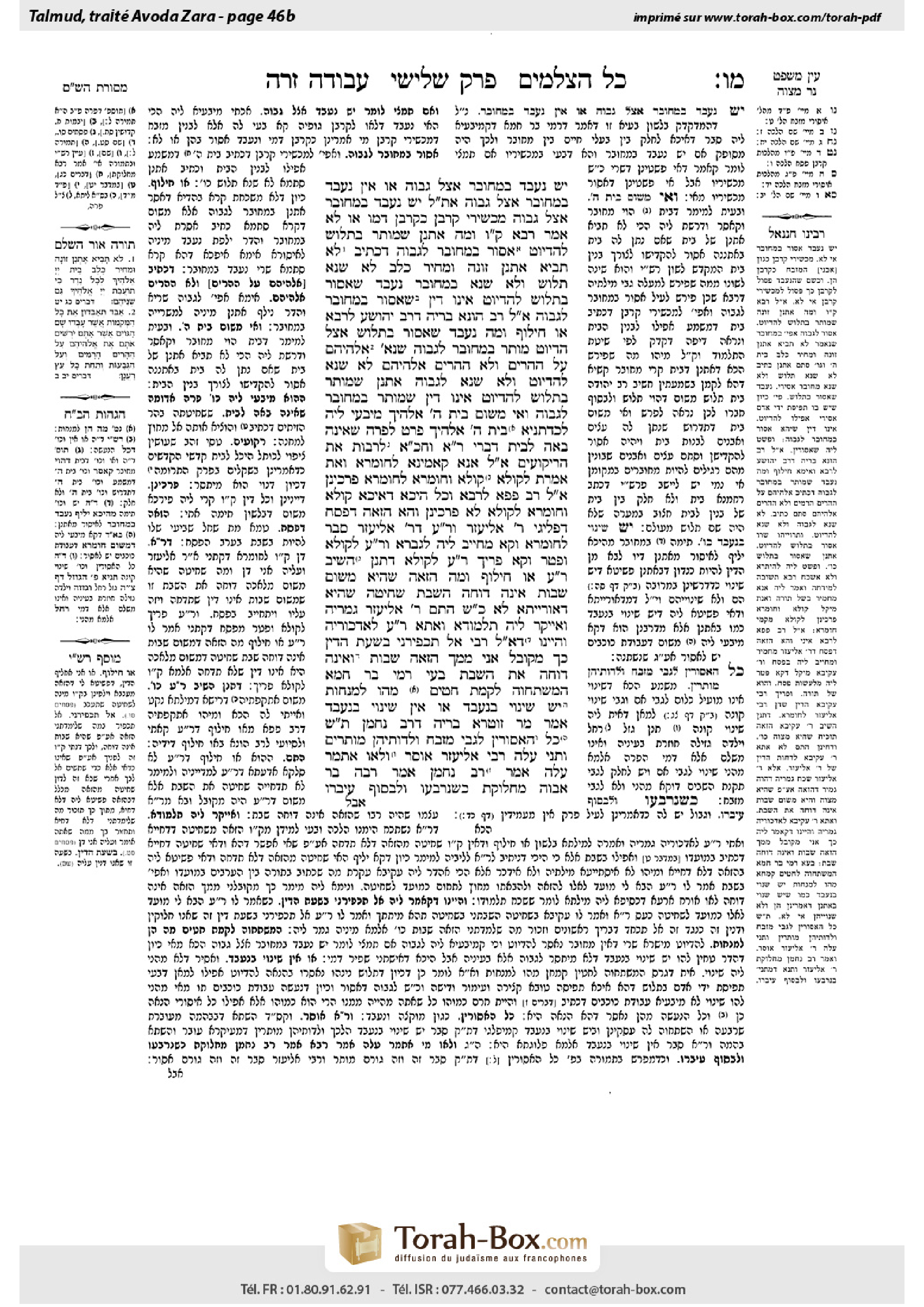
Avodah Zarah 46b: Talmud study for Daf Yomi
Study the Talmud for Daf Yomi with scanned pages, Hebrew text, English translations from Sefaria and AI-generated French translations.
Passage selection and English or AI-generated French translation are available where the scan has annotations. Daf Study is independent of Torah-Box and Sefaria.
Browse Avodah Zarah · עבודה זרה · All tractatesAvodah Zarah 46b text and translations
This page of Avodah Zarah includes the Aramaic text, an English translation and an AI-generated French translation, alongside the scan above.
עבודה זרה מ״ו ב · Aramaic and Hebrew text
יֵשׁ נֶעֱבָד בִּמְחוּבָּר אֵצֶל גָּבוֹהַּ, אוֹ אֵין נֶעֱבָד בִּמְחוּבָּר אֵצֶל גָּבוֹהַּ?
אִם תִּמְצֵי לוֹמַר יֵשׁ נֶעֱבָד בִּמְחוּבָּר אֵצֶל גָּבוֹהַּ, מַכְשִׁירֵי קׇרְבָּן כְּקׇרְבָּן דָּמוּ אוֹ לָא?
אָמַר רָבָא, קַל וָחוֹמֶר: וּמָה אֶתְנַן שֶׁמּוּתָּר בְּתָלוּשׁ לְהֶדְיוֹט, אָסוּר בִּמְחוּבָּר לְגָבוֹהַּ, דִּכְתִיב: ״לֹא תָבִיא אֶתְנַן זוֹנָה וּמְחִיר כֶּלֶב״, לָא שְׁנָא תָּלוּשׁ וְלָא שְׁנָא בִּמְחוּבָּר, נֶעֱבָד שֶׁאָסוּר בְּתָלוּשׁ לְהֶדְיוֹט — אֵינוֹ דִּין שֶׁאָסוּר בִּמְחוּבָּר לְגָבוֹהַּ?
אֲמַר לֵיהּ רַב הוּנָא בְּרֵיהּ דְּרַב יְהוֹשֻׁעַ לְרָבָא: אוֹ חִילּוּף, וּמָה נֶעֱבָד שֶׁאָסוּר בְּתָלוּשׁ אֵצֶל הֶדְיוֹט — מוּתָּר בִּמְחוּבָּר לְגָבוֹהַּ, שֶׁנֶּאֱמַר: ״אֱלֹהֵיהֶם עַל הֶהָרִים״ וְלֹא הֶהָרִים אֱלֹהֵיהֶם, לָא שְׁנָא לְהֶדְיוֹט וְלָא שְׁנָא לְגָבוֹהַּ; אֶתְנַן שֶׁמּוּתָּר בְּתָלוּשׁ לְהֶדְיוֹט — אֵינוֹ דִּין שֶׁמּוּתָּר בִּמְחוּבָּר לְגָבוֹהַּ?
וְאִי מִשּׁוּם ״בֵּית ה׳ אֱלֹהֶיךָ״ מִיבְּעֵי לֵיהּ לְכִדְתַנְיָא: ״בֵּית ה׳ אֱלֹהֶיךָ״ — פְּרָט לְפָרָה שֶׁאֵינָהּ בָּאָה לַבַּיִת, דִּבְרֵי רַבִּי אֱלִיעֶזֶר. וַחֲכָמִים אוֹמְרִים: לְרַבּוֹת אֶת הָרִיקּוּעִים.
אֲמַר לֵיהּ: אֲנָא קָאָמֵינָא לְחוּמְרָא, וְאַתְּ אָמְרַתְּ לְקוּלָּא — קוּלָּא וְחוּמְרָא לְחוּמְרָא פָּרְכִינַן.
אֲמַר לֵיהּ רַב פָּפָּא לְרָבָא: וְכֹל הֵיכָא דְּאִיכָּא קוּלָּא וְחוּמְרָא, לְקוּלָּא לָא פָּרְכִינַן? וְהָא הַזָּאָה דְּפֶסַח, דִּפְלִיגִי רַבִּי אֱלִיעֶזֶר וְרַבִּי עֲקִיבָא, דְּרַבִּי אֱלִיעֶזֶר סָבַר לְחוּמְרָא וְקָא מְחַיֵּיב לֵיהּ לְגַבְרָא, וְרַבִּי עֲקִיבָא לְקוּלָּא וּפָטַר, וְקָא פָרֵיךְ רַבִּי עֲקִיבָא לְקוּלָּא!
דִּתְנַן, הֵשִׁיב רַבִּי עֲקִיבָא: אוֹ חִילּוּף, וּמָה הַזָּאָה שֶׁהִיא מִשּׁוּם שְׁבוּת — אֵינָהּ דּוֹחָה [אֶת] הַשַּׁבָּת, שְׁחִיטָה שֶׁהִיא דְּאוֹרָיְיתָא — לֹא כׇּל שֶׁכֵּן?
הָתָם, רַבִּי אֱלִיעֶזֶר גַּמְרֵיהּ, וְאִיַּיקַּר לֵיהּ תַּלְמוּדָא, וַאֲתָא רַבִּי עֲקִיבָא לְאַדְכּוֹרֵיהּ. וְהַיְינוּ דַּאֲמַר לֵיהּ: רַבִּי, אַל תַּכְפִּירֵנִי בִּשְׁעַת הַדִּין, כָּךְ מְקוּבָּל אֲנִי מִמְּךָ — הַזָּאָה שְׁבוּת, וְאֵינָהּ דּוֹחָה אֶת הַשַּׁבָּת.
בָּעֵי רָמֵי בַּר חָמָא: הַמִּשְׁתַּחֲוֶה לְקָמַת חִטִּים, מַהוּ לִמְנָחוֹת? יֵשׁ שִׁינּוּי בְּנֶעֱבָד, אוֹ אֵין שִׁינּוּי בְּנֶעֱבָד?
אָמַר מָר זוּטְרָא בְּרֵיהּ דְּרַב נַחְמָן: תָּא שְׁמַע, כׇּל הָאֲסוּרִין לְגַבֵּי מִזְבֵּחַ — וַלְדוֹתֵיהֶן מוּתָּרִים, וְתָנֵי עֲלַהּ: רַבִּי אֱלִיעֶזֶר אוֹסֵר.
וְלָאו אִתְּמַר עֲלַהּ, אָמַר רַב נַחְמָן אָמַר רַבָּה בַּר אֲבוּהּ: מַחְלוֹקֶת כְּשֶׁנִּרְבְּעוּ וּלְבַסּוֹף עִיבְּרוּ,
Avodah Zarah 46b · English translation
The Gemara explains the dilemma: An animal that was worshipped is rendered unfit to be sacrificed as an offering in the Temple. The Gemara previously established a principle that objects attached to the ground are not rendered forbidden by idol worship. The question here is this: With regard to an item that is attached to the ground and that was worshipped, is it rendered unfit for the Most High, i.e., for the Temple, just like an animal? Or is the halakha that with regard to an item that is attached to the ground and that was worshipped, it is not rendered unfit for the Most High, just as it is not forbidden with regard to an individual’s deriving benefit from it?
Furthermore, if you say that with regard to an item that is attached to the ground and that was worshipped, it is rendered unfit for the Most High, are the items that merely facilitate the sacrifice of an offering, such as the altar, viewed the same way as an offering itself, or not? Perhaps the principle that items worshipped in idolatrous practice are disqualified for use in the Temple applies only to offerings, and not to the items used to facilitate the bringing of offerings.
Rava says: The dilemma can be resolved with an a fortiori inference. The Torah prohibits the sacrifice of an animal as an offering or a donation to the Temple if it was given in payment to a prostitute or exchanged in the sale of a dog. And if it is so that concerning deriving benefit from an item that served as payment to a prostitute, which is permitted to an ordinary person even in a case where the item is detached from the ground, nevertheless, such an item is forbidden to use for the Most High even in a case where it is attached to the ground, as it is written: “You shall not bring the payment to a prostitute or the price of a dog into the House of the Lord your God for any vow” (Deuteronomy 23:19), where there is no difference whether the payment is unattached to the ground and there is no difference whether it is attached; concerning an object worshipped in idolatrous practice, which is rendered forbidden in a case where it is detached even for the use of an ordinary person, is it not logical that it should be prohibited to use it for the Most High even in the case of an object attached to the ground?
Rav Huna, son of Rav Yehoshua, said to Rava: Or one can reverse the claim. And if an object that was worshipped, which is forbidden in a case where it is detached from the ground even for the use of an ordinary person, is yet permitted for use even for the Most High in a case where it is attached to the ground, as it is stated that the mitzva is to destroy: “Their gods, upon the high mountains” (Deuteronomy 12:2), but not the mountains themselves that are their gods, and therefore with regard to such items, there is no difference between use for an ordinary person and for the Most High; concerning payment to a prostitute, which is permitted for use for an ordinary person in the case of a detached item, is it not logical that it should be permitted to use for the Most High in a case where the payment is an item attached to the ground?
Rav Huna, son of Rav Yehoshua, continues: And if one would say that it should still be prohibited to use it in the Temple due to that which the verse states: “You shall not bring the payment to a prostitute, or the price of a dog, into the House of the Lord your God,” which indicates a blanket prohibition, this verse is already necessary to teach another halakha, namely, that which is taught in a baraita: The phrase “into the House of the Lord your God” excludes its use as a red heifer, which is not brought to the Temple, rather it is sacrificed outside the city on the Mount of Olives; this is the statement of Rabbi Eliezer. And the Rabbis say: It is stated to include the prohibition against hanging in the Temple beaten plates of gold that were used in the payment of a prostitute. Even though they are not used in the Temple service, it is prohibited to hang them up.
Rava said to Rav Huna, son of Rav Yehoshua: I am stating an a fortiori inference that leads to a stringency, and you are stating an opposite a fortiori inference that leads to a leniency. And the principle is that whenever there is the option to employ an a fortiori inference that leads to a leniency or one that leads to a stringency, we infer the stringency.
Rav Pappa said to Rava: And is it so that anywhere that there is an option to employ an a fortiori inference to infer a leniency or a stringency, we do not infer the leniency? But isn’t there the case of sprinkling the purifying water of a red heifer upon one who has contracted ritual impurity through contact with a corpse, in order to thereby obligate him in the sacrificing and eating of the Paschal offering? As Rabbi Eliezer and Rabbi Akiva disagree with regard to whether it is permitted to do this on Shabbat, each of them employing an a fortiori inference to support his opinion. As Rabbi Eliezer holds that a stringency should be inferred and he thereby deems the man obligated to purify himself and bring a Paschal offering, even if he can purify himself only on Shabbat, and Rabbi Akiva infers a leniency and exempts him from the obligation to bring the offering. And clearly, contrary to Rava’s claim, Rabbi Akiva infers a leniency.
This is as we learned in a mishna (see Pesaḥim 65b) that Rabbi Eliezer reasoned: If slaughter, which is generally prohibited on Shabbat by Torah law, is permitted for the sake of sacrificing the Paschal offering, all the more so is it not clear that sprinkling the purifying water of a red heifer, which is prohibited on Shabbat merely due to a rabbinic decree, should override Shabbat? Rabbi Akiva replied: Or one can reverse the claim. And if sprinkling the purifying water on Shabbat, which is prohibited merely due to rabbinic decree, does not override Shabbat, then with regard to slaughter, which is prohibited by Torah law, all the more so is it not clear that it should not override Shabbat? Contrary to Rava’s claim, Rabbi Akiva clearly infers a leniency instead of the stringency inferred by Rabbi Eliezer.
The Gemara answers: There, Rabbi Akiva does not employ a real a fortiori inference. Rabbi Eliezer himself taught him this halakha, which he knew as a tradition, but he had forgotten his own learning and Rabbi Akiva came to remind him of it by drawing an a fortiori inference that would cause Rabbi Eliezer to remember that which he himself had taught. The Gemara offers a support for this interpretation from the continuation of that discussion, which is recorded in a baraita: And this is what Rabbi Akiva said to him: My teacher, do not deny my contention at the time of judgement, i.e., during deliberation of this matter, as this is the tradition I received from you: Sprinkling is prohibited by rabbinic decree and does not override Shabbat.
§ Rami bar Ḥama raises a dilemma: In the case of one who bows to a stalk of wheat, what is the halakha with regard to using it for meal-offerings? Does the wheat lose its forbidden status after it is ground into flour, or not? Does a change in the form of a worshipped object revoke its forbidden status, or does a change in the form of a worshipped object not revoke its forbidden status?
Mar Zutra, son of Rav Naḥman, said: Come and hear a resolution from that which is taught in a mishna (Temura 30b): The principle is that concerning all items that are forbidden with regard to sacrificing them the altar, their offspring, i.e., whatever products are derived from them, are permitted. And it is taught with regard to this mishna: Rabbi Eliezer deems the offspring forbidden.
The Gemara asks: But wasn’t it stated with regard to this dispute that Rav Naḥman says that Rabba bar Avuh says: The dispute is with regard to a case where it became prohibited to use the animals as offerings because a person engaged in bestiality with them and later they became pregnant.
Avodah Zarah 46b · Traduction française (IA)
La Guemara explique la difficulté : un animal qui a été adoré est rendu impropre à être sacrifié comme offrande dans le Temple. La Guemara a précédemment établi un principe selon lequel les objets attachés au sol ne sont pas rendus impurs par l'adoration idolâtre. La question ici est la suivante : concernant un objet attaché au sol et adoré, est-il rendu impropre au Très Haut, c'est-à-dire au Temple, de la même manière qu'un animal, ou bien la halakha est-elle que concernant un objet attaché au sol et adoré, il n'est pas rendu impropre au Très Haut, tout comme il n'est pas interdit à l'individu de tirer un bénéfice de lui ?
De plus, si vous dites que concernant un objet attaché au sol et adoré, il est rendu impropre au Très Haut, les objets qui facilitent la sacrifice d'offrande, tels que l'autel, sont-ils considérés de la même manière qu'une offrande elle-même, ou pas ? Peut-être que le principe selon lequel les objets adorés dans la pratique idolâtre sont disqualifiés pour l'usage dans le Temple s'applique uniquement aux offrandes, et non aux objets utilisés pour faciliter la présentation des offrandes.
Rava dit : cette difficulté peut être résolue par une déduction a fortiori. La Torah interdit le sacrifice d'un animal comme offrande ou comme don au Temple si celui-ci a été donné en paiement à une prostituée ou échangé dans la vente d'un chien. Et si c'est ainsi que concernant le bénéfice tiré d'un objet utilisé comme paiement à une prostituée, qui est permis à un individu ordinaire même dans le cas où l'objet est détaché du sol, néanmoins, cet objet est interdit à l'usage du Très Haut même dans le cas où il est attaché au sol, comme il est écrit : « Vous ne donnerez pas le paiement à une prostituée ou le prix d'un chien dans la Maison du Seigneur votre Dieu pour tout serment » (Deutéronome 23:19), où il n'y a pas de différence si le paiement est détaché du sol et où il n'y a pas de différence si il est attaché ; concernant un objet adoré dans la pratique idolâtre, qui est rendu interdit dans le cas où il est détaché même pour l'usage d'un individu ordinaire, n'est-il pas logique qu'il soit interdit à l'usage du Très Haut même dans le cas d'un objet attaché au sol ?
Rav Huna, fils de Rav Yehoshua, dit à Rava : ou l'on peut inverser l'argument. Et si un objet adoré, qui est interdit dans le cas où il est détaché du sol même pour l'usage d'un individu ordinaire, est cependant permis à l'usage même du Très Haut dans le cas où il est attaché au sol, comme il est dit que la mitsva est de détruire : « Leurs dieux, sur les montagnes élevées » (Deutéronome 12:2), mais pas les montagnes elles-mêmes qui sont leurs dieux, et donc concernant ces objets, il n'y a pas de différence entre l'usage par un individu ordinaire et par le Très Haut ; concernant le paiement à une prostituée, qui est permis à l'usage par un individu ordinaire dans le cas d'un objet détaché, n'est-il pas logique qu'il soit permis à l'usage par le Très Haut dans le cas où le paiement est un objet attaché au sol ?
Rav Huna, fils de Rav Yehoshua, continue : Et si l'on disait que cela devrait encore être interdit d'utiliser cela dans le Temple en raison de ce que le verset dit : « Vous ne donnerez pas le paiement à une prostituée, ou le prix d'un chien, dans la Maison du Seigneur votre Dieu », qui indique une interdiction générale, ce verset est déjà nécessaire pour enseigner une autre halakha, à savoir celle qui est enseignée dans une baraïta : la phrase « dans la Maison du Seigneur votre Dieu » exclut son utilisation comme une vache rouge, qui n'est pas amenée au Temple, mais plutôt sacrifiée en dehors de la ville sur la montagne d'Olives ; c'est la déclaration de Rabbi Eliezer. Et les Rabbins disent : il est dit pour inclure l'interdiction de suspendre des plaques d'or battues qui ont été utilisées comme paiement à une prostituée. Même s'ils ne sont pas utilisés dans le service du Temple, il est interdit de les suspendre.
Rava dit à Rav Huna, fils de Rav Yehoshua : Je fais une déduction a fortiori qui mène à une interprétation stricte, et vous faites une déduction opposée qui mène à une interprétation clémente. Et le principe est que chaque fois qu'il y a l'option d'utiliser une déduction a fortiori qui mène à une interprétation stricte ou à une interprétation clémente, nous déduisons l'interprétation stricte.
Rav Pappa dit à Rava : Et est-ce que partout où il y a l'option d'utiliser une déduction a fortiori pour inférer une clémence ou une stricte interprétation, nous ne déduisons pas la clémence ? Mais n'y a-t-il pas le cas du sprinkling de l'eau de purification de la vache rouge sur celui qui a contracté une impureté rituelle par contact avec un cadavre, afin de l'obliger à sacrifier et à manger l'offrande pascal ? Rabbi Eliezer et Rabbi Akiva s'opposent sur le fait que ce soit permis de le faire le sabbat, chacun utilisant une déduction a fortiori pour soutenir son opinion. Rabbi Eliezer considère que l'interprétation stricte doit être déduite et qu'il considère donc l'homme comme obligé de se purifier et de présenter l'offrande pascal, même s'il peut se purifier seulement le sabbat, et Rabbi Akiva déduit une interprétation clémente et l'exempte de l'obligation de présenter l'offrande. Et clairement, contrairement à l'affirmation de Rava, Rabbi Akiva déduit une interprétation clémente.
C'est ce que nous avons appris dans une mitsva (voir Pessaḥim 65b) que Rabbi Eliezer raisonnait : Si la boucherie, qui est généralement interdite le sabbat par la loi divine, est permise pour le sacrifice de l'offrande pascal, à plus forte raison est-il clair que le sprinkling de l'eau de purification de la vache rouge, qui est interdit le sabbat uniquement par un décret rabbinique, devrait surmonter le sabbat ? Rabbi Akiva répondit : ou l'on peut inverser l'argument. Et si le sprinkling de l'eau de purification le sabbat, qui est interdit uniquement par un décret rabbinique, ne surmonte pas le sabbat, alors concernant la boucherie, qui est interdite par la loi divine, à plus forte raison est-il clair qu'il ne devrait pas surmonter le sabbat ? Contre l'affirmation de Rava, Rabbi Akiva clairement déduit une interprétation clémente au lieu de l'interprétation stricte déduite par Rabbi Eliezer.
Le Guemara répond : Là, Rabbi Akiva ne fait pas un raisonnement a fortiori réel. Rabbi Eliezer lui-même lui a enseigné cette halakha, qu'il connaissait comme une tradition, mais il avait oublié son propre enseignement et Rabbi Akiva est venu le lui rappeler en faisant un raisonnement a fortiori qui aurait fait souvenir à Rabbi Eliezer ce qu'il avait lui-même enseigné. Le Guemara offre un soutien à cette interprétation à partir de la continuation de cette discussion, qui est rapportée dans une baraïta : Et ceci est ce que Rabbi Akiva a dit à lui : Mon maître, ne nie pas mon argument au moment du jugement, c'est-à-dire pendant la discussion sur cette question, car c'est la tradition que j'ai reçue de toi : Le sprinkling est interdit par décret rabbinique et ne l'emporte pas sur le Shabbat.
§ Rami bar Ḥama énonce un dilemme : Dans le cas d'une personne qui s'incline devant un épis de blé, quelle est la halakha concernant l'utilisation de ce blé pour des offrandes de froment ? Le blé perd-il son statut interdit après qu'il ait été moulu en farine, ou non ? Un changement de forme d'un objet adoré annule-t-il son statut interdit, ou un changement de forme d'un objet adoré ne l'annule-t-il pas ?
Mar Zutra, fils de Rav Naḥman, dit : Viens écouter une résolution à partir de ce qui est enseigné dans une mitsna (Temura 30b) : Le principe est que concernant tous les objets interdits en ce qui concerne leur sacrifice sur l'autel, leurs descendants, c'est-à-dire tout ce qui en découle, sont permis. Et il est enseigné à propos de cette mitsna : Rabbi Eliezer considère les descendants comme interdits.
Le Guemara demande : N'était-il pas dit à propos de ce débat que Rav Naḥman dit que Rabba bar Avuh dit : Ce débat concerne un cas où il est devenu interdit d'utiliser les animaux comme offrandes parce qu'une personne a eu des relations sexuelles avec eux et ensuite ils sont devenus enceints.
Traduction française générée par IA à partir de l’édition anglaise de Sefaria. Vérifie toujours un passage avec le texte source.
Text from Sefaria: William Davidson Edition - Vocalized Aramaic (CC BY NC); William Davidson Edition - English (CC BY NC).