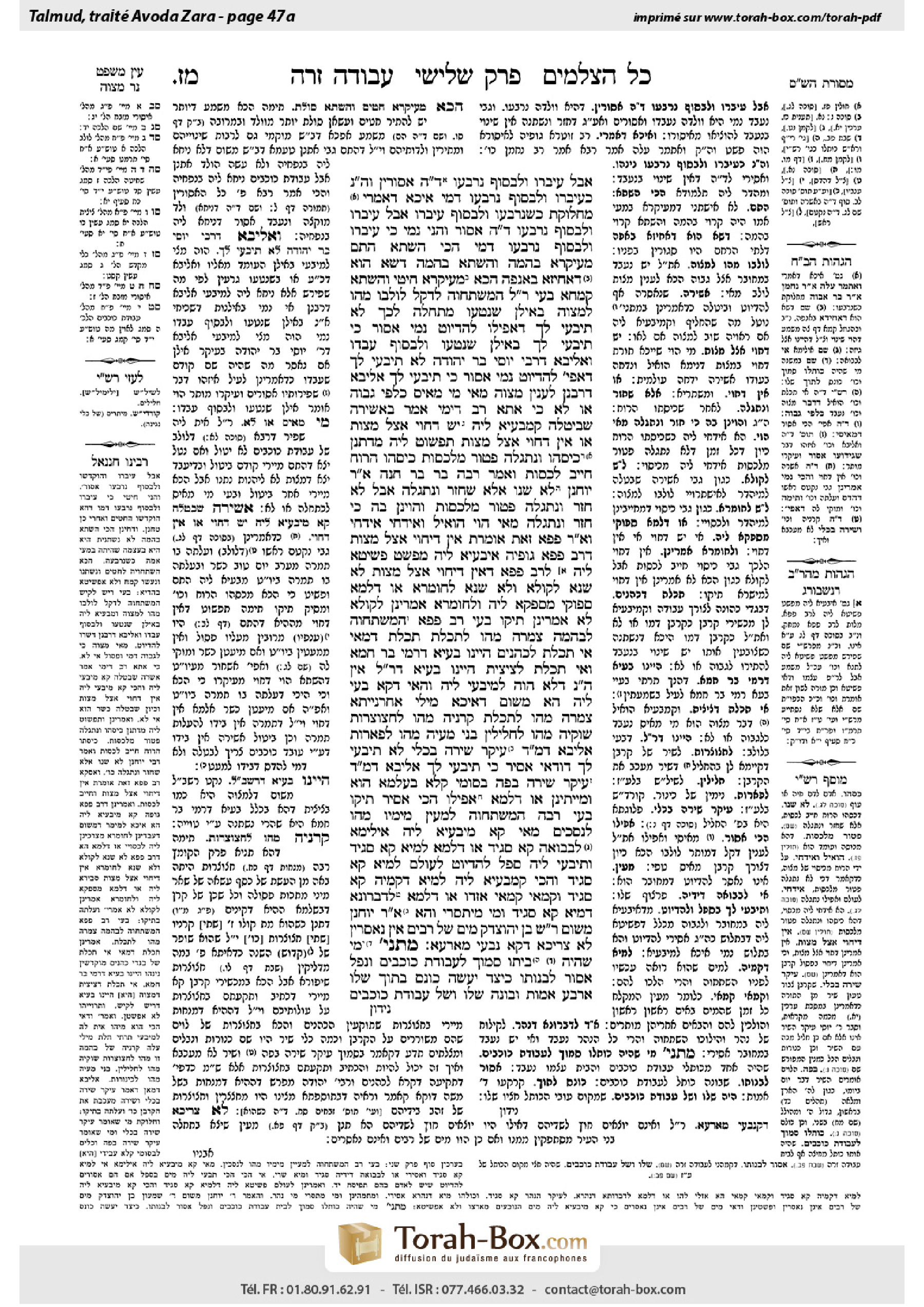
Avodah Zarah 47a: Talmud study for Daf Yomi
Study the Talmud for Daf Yomi with scanned pages, Hebrew text, English translations from Sefaria and AI-generated French translations.
Passage selection and English or AI-generated French translation are available where the scan has annotations. Daf Study is independent of Torah-Box and Sefaria.
Browse Avodah Zarah · עבודה זרה · All tractatesAvodah Zarah 47a text and translations
This page of Avodah Zarah includes the Aramaic text, an English translation and an AI-generated French translation, alongside the scan above.
עבודה זרה מ״ז א · Aramaic and Hebrew text
אֲבָל עִיבְּרוּ וּלְבַסּוֹף נִרְבְּעוּ — דִּבְרֵי הַכֹּל אֲסוּרִין, וְהָכָא נָמֵי כְּעִיבְּרוּ וּלְבַסּוֹף נִרְבְּעוּ דָּמֵי.
אִיכָּא דְּאָמְרִי: מַחְלוֹקֶת כְּשֶׁנִּרְבְּעוּ וּלְבַסּוֹף עִיבְּרוּ, אֲבָל עִיבְּרוּ וּלְבַסּוֹף נִרְבְּעוּ — דִּבְרֵי הַכֹּל אָסוּר, וְהָנֵי נָמֵי כִּי עִיבְּרוּ וּלְבַסּוֹף נִרְבְּעוּ דָּמֵי.
הָכִי הַשְׁתָּא? הָתָם, מֵעִיקָּרָא בְּהֵמָה וְהַשְׁתָּא בְּהֵמָה, דַּשָּׁא הוּא דַּאֲחִידָא בְּאַנְפַּהּ. הָכָא, מֵעִיקָּרָא חִיטֵּי וְהַשְׁתָּא קִמְחָא.
בָּעֵי רֵישׁ לָקִישׁ: הַמִּשְׁתַּחֲוֶה לַדֶּקֶל, לוּלָבוֹ מַהוּ לְמִצְוָה?
בְּאִילָן שֶׁנְּטָעוֹ מִתְּחִלָּה לְכָךְ לָא תִּיבְּעֵי לָךְ, דַּאֲפִילּוּ לְהֶדְיוֹט נָמֵי אָסוּר. כִּי תִּיבְּעֵי לָךְ בְּאִילָן שֶׁנְּטָעוֹ וּלְבַסּוֹף עֲבָדוֹ.
וְאַלִּיבָּא דְּרַבִּי יוֹסֵי בַּר יְהוּדָה לָא תִּיבְּעֵי לָךְ, דַּאֲפִילּוּ לְהֶדְיוֹט נָמֵי אָסוּר. כִּי תִּיבְּעֵי לָךְ אַלִּיבָּא דְּרַבָּנַן, לְעִנְיַן מִצְוָה מַאי? מִי מְאִיס כְּלַפֵּי גָּבוֹהַּ אוֹ לָא?
כִּי אֲתָא רַב דִּימִי אָמַר: בַּאֲשֵׁירָה שֶׁבִּיטְּלָהּ קָמִבַּעְיָא לֵיהּ, יֵשׁ דִּחוּי אֵצֶל מִצְוֹת אוֹ אֵין דִּחוּי אֵצֶל מִצְוֹת?
תִּפְשׁוֹט לֵיהּ מִדִּתְנַן: כִּיסָּהוּ וְנִתְגַּלָּה — פָּטוּר מִלְּכַסּוֹת, כִּיסָּהוּ הָרוּחַ — חַיָּיב לְכַסּוֹת. וְאָמַר רַבָּה בַּר בַּר חָנָה אָמַר רַבִּי יוֹחָנָן: לֹא שָׁנוּ אֶלָּא שֶׁחָזַר וְנִתְגַּלָּה, אֲבָל לֹא חָזַר וְנִתְגַּלָּה — פָּטוּר מִלְּכַסּוֹת.
וְהָוֵינַן בָּהּ: כִּי חָזַר וְנִתְגַּלָּה מַאי הָוֵי? הוֹאִיל וְאִידְּחִי אִידְּחִי!
וְאָמַר רַב פָּפָּא, זֹאת אוֹמֶרֶת: אֵין דִּיחוּי אֵצֶל מִצְוֹת.
דְּרַב פָּפָּא גּוּפֵיהּ אִיבַּעְיָא לֵיהּ, מִפְשָׁט פְּשִׁיטָא לֵיהּ לְרַב פָּפָּא דְּאֵין דִּיחוּי אֵצֶל מִצְוֹת, לָא שְׁנָא לְקוּלָּא וְלָא שְׁנָא לְחוּמְרָא.
אוֹ דִלְמָא סַפּוֹקֵי מְסַפְּקָא לֵיהּ, וּלְחוּמְרָא אָמְרִינַן, לְקוּלָּא לָא אָמְרִינַן? תֵּיקוּ.
בָּעֵי רַב פָּפָּא: הַמִּשְׁתַּחֲוֶה לִבְהֵמָה, צַמְרָהּ מַהוּ לִתְכֵלֶת?
תְּכֵלֶת דְּמַאי? אִי תְּכֵלֶת לְכֹהֲנִים — הַיְינוּ בַּעְיָא דְּרָמֵי בַּר חָמָא, וְאִי תְּכֵלֶת לְצִיצִית — הַיְינוּ בַּעְיָא דְּרֵישׁ לָקִישׁ!
אִין הָכִי נָמֵי דְּלָא הֲוָה לְמִיבְּעֵי לֵיהּ, וְהַאי דְּקָא בָעֵי לֵיהּ הָא מִשּׁוּם דְּאִיכָּא מִילֵּי אַחְרָנְיָיתָא: צַמְרָהּ מַהוּ לִתְכֵלֶת? קַרְנֶיהָ מַהוּ לַחֲצוֹצְרוֹת? שׁוֹקֶיהָ מַהוּ לַחֲלִילִין? בְּנֵי מֵעֶיהָ מַהוּ לְפֹארוֹת?
אַלִּיבָּא דְּמַאן דְּאָמַר: עִיקַּר שִׁירָה בִּכְלִי, לָא תִּיבְּעֵי לָךְ — דְּוַדַּאי אֲסִיר.
כִּי תִּיבְּעֵי לָךְ, אַלִּיבָּא דְּמַאן דְּאָמַר: עִיקַּר שִׁירָה בַּפֶּה, בַּסּוֹמֵי קָלָא בְּעָלְמָא הוּא וּמַיְיתִינַן, אוֹ דִלְמָא אֲפִילּוּ הָכִי אֲסִיר? תֵּיקוּ.
בָּעֵי רַבָּה: הַמִּשְׁתַּחֲוֶה לְמַעְיָן, מֵימָיו מַהוּ לִנְסָכִים? מַאי קָא מִיבַּעְיָא לֵיהּ? אִילֵּימָא לְבָבוּאָה קָא סָגֵיד, אוֹ דִלְמָא לְמַיָּא קָא סָגֵיד? וְתִיבְּעֵי לֵיהּ סֵפֶל לְהֶדְיוֹט!
לְעוֹלָם לְמַיָּא קָא סָגֵיד, וְהָכִי קָמִבַּעְיָא לֵיהּ: לְמַיָּא דְּקַמֵּיהּ קָא סָגֵיד, וְקַמָּאֵי קַמָּאֵי אֲזַדוּ, אוֹ דִּלְמָא לְדַבְרוּנָא דְּמַיָּא קָא סָגֵיד?
וּמִי מִיתַּסְרִי? וְהָא אָמַר רַבִּי יוֹחָנָן מִשּׁוּם רַבִּי שִׁמְעוֹן בֶּן יְהוֹצָדָק: מַיִם שֶׁל רַבִּים אֵין נֶאֱסָרִין! לָא צְרִיכָא, דְּקָא נָבְעִי מֵאַרְעָא.
מַתְנִי׳ מִי שֶׁהָיָה בֵּיתוֹ סָמוּךְ לַעֲבוֹדָה זָרָה, וְנָפַל — אָסוּר לִבְנוֹתוֹ. כֵּיצַד יַעֲשֶׂה? כּוֹנֵס בְּתוֹךְ שֶׁלּוֹ אַרְבַּע אַמּוֹת וּבוֹנֶה.
שֶׁלּוֹ וְשֶׁל עֲבוֹדָה זָרָה —
Avodah Zarah 47a · English translation
But if they became pregnant and later a person engaged in bestiality with them, all agree that the offspring are forbidden because the offspring were involved in the act of bestiality, albeit in their fetal state. And here too, the case of the wheat is similar to the case where they became pregnant and later a person engaged in bestiality with them, because the flour was also worshipped, albeit in the form of a stalk of wheat.
There are those who say that Mar Zutra himself quoted Rav Naḥman’s statement: The dispute is with regard to a case where it became prohibited to use the animals as offerings because a person engaged in bestiality with them and later they became pregnant. But if they became pregnant and later a person engaged in bestiality with them, all agree that the offspring are forbidden. And these stalks of wheat, as well, are similar to the case where they became pregnant and later a person engaged in bestiality with them.
The Gemara asks: How can these cases be compared? There, in the case of offspring that it is prohibited to bring as an offering, it was initially an animal, in its fetal state, and now it is still an animal. A fetus is treated as a full-fledged animal, and the opening of the womb is compared to a closed door that holds it in its place. Here, in the case of the flour, it was initially wheat and now it is flour; it is in a totally new form. Therefore, no proof can be derived from the mishna.
§ Reish Lakish raises a dilemma: In the case of one who bows to a palm tree, what is the halakha with regard to its lulav? Is it permitted to use a lulav cut from it for the mitzva or not?
The Gemara narrows down the dilemma: With regard to a tree that one initially planted for such an idolatrous purpose, do not raise the dilemma. In that case the halakha is clear, as it is prohibited to use it even for an ordinary, non-mitzva, purpose. Rather, raise the dilemma with regard to a tree that one planted and subsequently worshipped.
And do not raise the dilemma according to the opinion of Rabbi Yosei bar Yehuda, who holds that even for an ordinary purpose it is forbidden (see 45b). Rather, when should you raise the dilemma? Raise it according to the opinion of the Rabbis, who hold that such a tree does not become forbidden: What is the halakha with regard to using a lulav from such a worshipped tree for a mitzva? Is it nevertheless forbidden because it is considered repulsive to use such a lulav for the Most High, i.e., for a mitzva, or not?
When Rav Dimi came from Eretz Yisrael to Babylonia, he presented a different understanding of Reish Lakish’s dilemma. He said: Reish Lakish raises the dilemma with regard to an ashera whose status as an object of idol worship was revoked. His dilemma is as follows: Is there disqualification with regard to mitzvot or is there no disqualification with regard to mitzvot? This lulav was once unfit for the mitzva, since it was worshipped while attached to the tree. Is it permanently disqualified, i.e., can it never be rendered fit? Or is the halakha that there is no permanent disqualification with regard to mitzvot, and consequently when the tree’s status as an object of idol worship was revoked, the lulav became fit for the mitzva?
The Gemara suggests: Resolve the dilemma from that which we learned in a mishna (Ḥullin 37a): With regard to one who slaughtered an undomesticated animal or a bird and is obligated to cover the blood, if he covered the blood and it was then uncovered he is exempt from the obligation to cover it a second time. But if the wind blew dust and covered the blood and no person was involved, he is obligated to cover it. And Rabba bar bar Ḥana says that Rabbi Yoḥanan says: The mishna taught that one is obligated to cover the blood after the wind covered it only in a case where the blood was then exposed. But if it was not then exposed, he is exempt from the obligation to cover it.
And we discussed this issue and asked: When the blood was then exposed, what of it? Why is one obligated to cover it a second time? Once it was disqualified, it should remain disqualified. When the wind covered the blood, the person was exempted from covering the blood. If so, even if the blood is subsequently uncovered, he should remain exempt. Why, then, is he obligated to cover the blood in that case?
And Rav Pappa says: That is to say that there is no disqualification with regard to mitzvot. Once the cause of the exemption from the obligation is removed, one is once again obligated to fulfill the mitzva. If so, Reish Lakish’s dilemma is resolved.
The Gemara rejects this suggestion: It is with regard to Rav Pappa’s resolution itself that Reish Lakish raised the dilemma. Is it obvious to Rav Pappa, based on the discussion with regard to the blood, that there is no disqualification with regard to mitzvot; and there is no difference whether that ruling leads to leniency, as in the case of the worshipped tree whose status as an object of idol worship was revoked, thereby permitting its lulav branch to be used for a mitzva, and there is no difference whether that ruling leads to stringency, as in the case of the blood, where one is obligated to cover it anew?
Or perhaps is he uncertain, and therefore, when that ruling leads to stringency, we say that there is no disqualification with regard to mitzvot, and one must perform the mitzva. But when that ruling leads to leniency, we do not say that there is no disqualification with regard to mitzvot. The Gemara concludes: The question shall stand unresolved.
§ Rav Pappa raises a dilemma: In the case of one who bows to an animal, what is the halakha with regard to its wool? May it be used for the sky-blue wool?
The Gemara asks: The sky-blue wool in question is for which mitzva? If it is the sky-blue wool for the ritual garments worn by priests, then Rav Pappa’s dilemma is the same as the dilemma raised by Rami bar Ḥama earlier (46b) with regard to the use in the Temple of worshipped items that have since changed in form. And if the sky-blue wool in question is for the mitzva of ritual fringes, this is the same as the dilemma raised by Reish Lakish with regard to the use of a branch of a worshipped palm tree for performing the mitzva of lulav.
The Gemara answers: Yes, it is indeed so that Rav Pappa did not need to raise this dilemma, as it was previously addressed. And the reason that he raises this dilemma is due to other matters that he needed to clarify, concerning the use of parts of a worshipped animal in the Levites’ ritual song. With regard to its wool, what is the halakha concerning using it for sky-blue wool used in the performance of a mitzva? With regard to its horns, what is the halakha concerning their use for trumpets? With regard to the bones of its thighs, what is the halakha concerning their use for flutes? With regard to its innards, what is the halakha concerning their use for harp strings [leforot]?
According to the opinion of the one who says that the primary element of song in the Temple is the accompaniment by musical instruments, do not raise the dilemma, as it is certain that use of a worshipped animal is prohibited, because the musical instruments are items used to facilitate an offering.
When should you raise the dilemma? Raise it according to the opinion of the one who says that the primary element of song in the Temple is singing with the mouth, and that the musical instruments are used merely to sweeten the sound, i.e., to accompany and enhance the singing. And accordingly, can one bring musical instruments made of a worshipped animal’s parts, as they are not an essential element of the Temple service? Or perhaps is it nevertheless forbidden since it is repulsive to use such instruments in the course of the Temple service? The Gemara concludes: The question shall stand unresolved.
§ Rava raises a dilemma: In the case of one who bows to a spring of water, what is the halakha with regard to using its water for libations? The Gemara asks: What is the dilemma he is raising? If we say that the dilemma concerns whether he is bowing to his own reflection or perhaps he is bowing to the water, why then is this a dilemma only with regard to libations in the Temple? Let him raise the dilemma with regard to the use of a pail of water that a person bowed to, even for ordinary purposes.
The Gemara answers: Actually, it is clear that he is bowing to the water. And this is the dilemma Rava raises: Is he bowing to the water before him, and therefore it follows that the first waters, i.e., those that were present at the time of his bowing, are gone, and the water that is currently flowing is permitted, or perhaps is he bowing to the flow of the water, which would render it prohibited to use all the water that flows in that spring for libations.
The Gemara asks: And is the water actually rendered forbidden by his worship? But doesn’t Rabbi Yoḥanan say in the name of Rabbi Shimon ben Yehotzadak: Water that belongs to the public cannot become forbidden? The Gemara answers: No, the dilemma is not with regard to a public spring. Rather, it is necessary with regard to a spring that flows from the ground in one specific location that is privately owned.
MISHNA: In the case of one whose house was adjacent to a house of idol worship and the dividing wall fell, it is prohibited to rebuild it. What should he do? He should withdraw into his own property four cubits and build the wall there.
In talmudic times, external walls to homes were often built in two parts, with a functional space between them. If the space between the two parts of the wall belonged to him and to the house of idol worship,
Avodah Zarah 47a · Traduction française (IA)
Mais si elles ont été enceintes et qu'un homme a ensuite eu des relations bestiales avec elles, tous s'accordent sur le fait que les enfants sont interdits, car les enfants ont participé à l'acte de bestialité, même dans leur état fœtal. Et ici aussi, le cas du blé est semblable au cas où elles ont été enceintes et qu'un homme a ensuite eu des relations bestiales avec elles, car la farine a aussi été vénérée, même sous la forme d'une tige de blé.
Certains disent que Mar Zutra lui-même a rapporté la déclaration de Rav Naḥman : le débat porte sur un cas où il est devenu interdit d'utiliser les animaux comme offrandes, car un homme a eu des relations bestiales avec eux et ensuite ils sont devenus enceintes. Mais si elles sont devenues enceintes et qu'un homme a ensuite eu des relations bestiales avec elles, tous s'accordent sur le fait que les enfants sont interdits. Et ces tiges de blé, en outre, sont semblables au cas où elles sont devenues enceintes et qu'un homme a ensuite eu des relations bestiales avec elles.
La Guemara pose la question : comment peuvent ces cas être comparés ? Là, dans le cas des enfants qui sont interdits d'être offerts, il s'agissait initialement d'un animal, dans son état fœtal, et maintenant il reste un animal. Un fœtus est traité comme un animal complet, et l'ouverture du ventre est comparée à une porte close qui le maintient en place. Ici, dans le cas de la farine, il s'agissait initialement de blé et maintenant il est devenu farine ; il est dans une forme totalement différente. Par conséquent, aucun argument ne peut être tiré de la mitsva.
§ Reish Lakish soulève un dilemme : dans le cas d'une personne qui s'incline devant un palmier, quelle est la halakha concernant son lulav ? Est-il permis d'utiliser un lulav coupé à partir de lui pour la mitsva ou non ?
La Guemara précise ce dilemme : concernant un arbre que l'on a planté initialement à des fins idolâtres, ne pas soulever ce dilemme. Dans ce cas, la halakha est claire, car il est interdit d'en utiliser même à des fins ordinaires, non-mitsva. Plutôt, soulevez le dilemme concernant un arbre que l'on a planté et ensuite vénéré.
Ne soulevez pas ce dilemme selon l'opinion de Rabbi Yosei bar Yehuda, qui considère qu'il est interdit même à des fins ordinaires (voir 45b). Plutôt, quand devrait-on soulever ce dilemme ? Soulevez-le selon l'opinion des Rabbins, qui considèrent que cet arbre ne devient pas interdit : quelle est la halakha concernant l'utilisation d'un lulav provenant de cet arbre vénéré pour une mitsva ? Est-il tout de même interdit, car on considère qu'il est répugnant d'utiliser un tel lulav pour le Très Haut, c'est-à-dire pour une mitsva, ou non ?
Quand Rav Dimi est venu de la Terre d'Israël vers Babylone, il a présenté une autre interprétation du dilemme de Reish Lakish. Il a dit : Reish Lakish soulève ce dilemme concernant une ashera dont le statut d'objet de vénération idolâtre a été révoqué. Son dilemme est le suivant : y a-t-il une disqualification concernant les mitsvot ou pas ? Ce lulav était initialement inadapté à la mitsva, car il avait été vénéré alors qu'il était attaché à l'arbre. Est-il définitivement inadapté, c'est-à-dire ne peut-il jamais être rendu adapté ? Ou la halakha est-elle que la disqualification n'est pas définitive concernant les mitsvot, et par conséquent, lorsque le statut de l'arbre en tant qu'objet de vénération idolâtre a été révoqué, le lulav est devenu adapté à la mitsva ?
La Guemara suggère : résolvez ce dilemme à partir de ce que nous avons appris dans une mitsna (Ḥullin 37a) : concernant une personne qui a immolé un animal sauvage ou un oiseau et est tenu de couvrir le sang, si elle a couvert le sang et que cela a ensuite été découvert, elle est exemptée de l'obligation de le recouvrir. Mais si le vent a soufflé de la poussière et a couvert le sang et qu'aucune personne n'était impliquée, elle est tenu de le couvrir. Et Rabba bar bar Ḥana dit que Rabbi Yoḥanan dit : la mitsna a enseigné que l'on est tenu de couvrir le sang après que le vent l'ait couvert uniquement dans le cas où le sang a été exposé. Mais si ce n'était pas le cas, elle est exemptée de l'obligation de le couvrir.
Et nous avons discuté de cette question et nous avons demandé : quand le sang a été exposé, qu'en est-il ? Pourquoi est-on tenu de le recouvrir une deuxième fois ? Une fois qu'il était disqualifié, il devrait rester disqualifié. Quand le vent a couvert le sang, la personne était exemptée de couvrir le sang. Si tel est le cas, même si le sang est ensuite découvert, elle devrait rester exemptée. Pourquoi, alors, est-elle tenu de couvrir le sang dans ce cas ?
Et Rav Pappa dit : cela signifie qu'il n'y a pas de disqualification concernant les mitsvot. Une fois que la cause de l'exemption de l'obligation est éliminée, l'obligation de remplir la mitsva est à nouveau applicable. Si tel est le cas, le dilemme de Reish Lakish est résolu.
La Guemara rejette cette suggestion : c'est concernant la résolution de Rav Pappa que Reish Lakish a soulevé le dilemme. Est-ce évident pour Rav Pappa, à partir de la discussion concernant le sang, qu'il n'y a pas de disqualification concernant les mitsvot ; et n'y a-t-il pas de différence si cette décision conduit à une leniency, comme dans le cas de l'arbre vénéré dont le statut d'objet de vénération idolâtre a été révoqué, permettant ainsi d'utiliser sa branche lulav pour une mitsva, et n'y a-t-il pas de différence si cette décision conduit à une stringence, comme dans le cas du sang, où l'on est tenu de le recouvrir à nouveau ?
Ou peut-être est-il incertain, et par conséquent, quand cette décision conduit à une stringence, nous disons qu'il n'y a pas de disqualification concernant les mitsvot, et l'on doit accomplir la mitsva. Mais quand cette décision conduit à une leniency, nous ne disons pas qu'il n'y a pas de disqualification concernant les mitsvot. La Guemara conclut : la question restera sans réponse.
§ Rav Pappa soulève un dilemme : dans le cas d'une personne qui s'incline devant un animal, quelle est la halakha concernant sa laine ? Peut-elle être utilisée pour la laine bleue du ciel ?
La Guemara pose la question : Cette laine bleue ciel est-elle pour quelle mitsva ? Si c'est la laine bleue ciel des vêtements rituels des prêtres, alors la difficulté de Rav Pappa est la même que celle soulevée par Rami bar Ḥama plus tôt (46b) concernant l'utilisation dans le Temple d'objets adorés qui ont depuis changé de forme. Et si la laine bleue ciel en question est pour la mitsva des franges rituelles, c'est la même difficulté que celle soulevée par Reish Lakish concernant l'utilisation d'une branche d'un palmier adoré pour accomplir la mitsva du lulav.
La Guemara répond : Oui, c'est effectivement ainsi que Rav Pappa n'avait pas besoin de soulever cette difficulté, car elle avait été précédemment abordée. Et la raison pour laquelle il soulève cette difficulté est due à d'autres points qu'il avait besoin de clarifier, concernant l'utilisation des parties d'un animal adoré dans la chanson rituelle des Lévites. En ce qui concerne sa laine, quelle est la halakha concernant son utilisation pour la laine bleue ciel utilisée dans l'accomplissement d'une mitsva ? En ce qui concerne ses cornes, quelle est la halakha concernant leur utilisation pour des trompettes ? En ce qui concerne les os de ses cuisses, quelle est la halakha concernant leur utilisation pour des flûtes ? En ce qui concerne ses entrailles, quelle est la halakha concernant leur utilisation pour des cordes de harpe [leforot] ?
Selon l'opinion de celui qui dit que l'élément principal de la chanson dans le Temple est l'accompagnement par des instruments de musique, ne soulève pas la difficulté, car il est certain que l'utilisation d'un animal adoré est interdite, car les instruments de musique sont des objets utilisés pour faciliter une offrande.
Quand devrait-on soulever la difficulté ? Soulevez-la selon l'opinion de celui qui dit que l'élément principal de la chanson dans le Temple est le chant avec la bouche, et que les instruments de musique sont utilisés uniquement pour adoucir le son, c'est-à-dire pour accompagner et améliorer le chant. Et ainsi, peut-on apporter des instruments de musique faits des parties d'un animal adoré, car ils ne sont pas un élément essentiel du service du Temple ? Ou peut-être est-il tout de même interdit, car il est répugnant d'utiliser de tels instruments lors du service du Temple ? La Guemara conclut : La question restera sans réponse.
§ Rava soulève une difficulté : Dans le cas d'une personne qui s'incline devant une source d'eau, quelle est la halakha concernant l'utilisation de cette eau pour les libations ? La Guemara pose la question : Quelle est la difficulté qu'il soulève ? Si nous disons que la difficulté concerne le fait qu'il s'incline devant son propre reflet ou peut-être devant l'eau, pourquoi alors cette difficulté concerne-t-elle uniquement les libations dans le Temple ? Laissez-le soulever cette difficulté concernant l'utilisation d'un récipient d'eau que quelqu'un a adoré, même pour des usages ordinaires.
La Guemara répond : En réalité, il est clair qu'il s'incline devant l'eau. Et c'est cette difficulté que Rava soulève : Est-ce qu'il s'incline devant l'eau devant lui, et donc il en découle que les premières eaux, c'est-à-dire celles présentes au moment de son inclination, sont parties, et l'eau qui coule actuellement est permise, ou peut-être s'incline-t-il devant le courant de l'eau, ce qui rendrait interdit d'utiliser toute l'eau qui coule dans cette source pour les libations.
La Guemara pose la question : Et l'eau est-elle effectivement rendue interdite par son adoration ? Mais ne dit pas Rabbi Yoḥanan en nom de Rabbi Shimon ben Yehotzadak : L'eau qui appartient au public ne peut pas devenir interdite ? La Guemara répond : Non, la difficulté ne concerne pas une source publique. Il est nécessaire qu'elle concerne une source qui coule du sol dans un lieu spécifique privé.
MICHNA : Dans le cas d'une personne dont la maison était adjacente à une maison d'adoration païenne et le mur de séparation s'est effondré, il est interdit de le reconstruire. Que devrait-il faire ? Il devrait se retirer sur sa propre propriété de quatre coudées et reconstruire le mur là.
En temps de Talmud, les murs externes des maisons étaient souvent construits en deux parties, avec un espace fonctionnel entre elles. Si l'espace entre les deux parties du mur appartenait à lui et à la maison d'adoration païenne,
Traduction française générée par IA à partir de l’édition anglaise de Sefaria. Vérifie toujours un passage avec le texte source.
Text from Sefaria: William Davidson Edition - Vocalized Aramaic (CC BY NC); William Davidson Edition - English (CC BY NC).