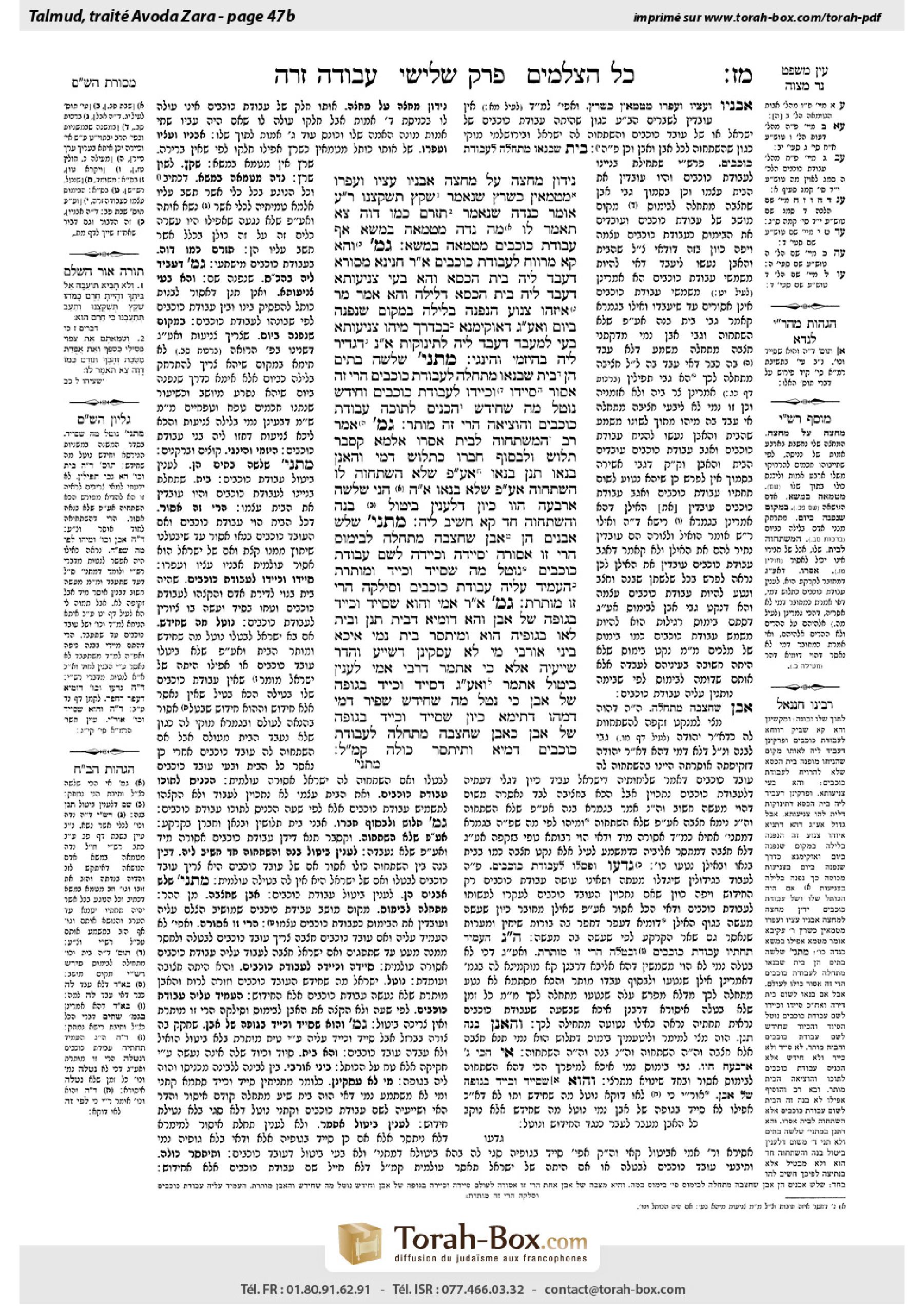
Avodah Zarah 47b: Talmud study for Daf Yomi
Study the Talmud for Daf Yomi with scanned pages, Hebrew text, English translations from Sefaria and AI-generated French translations.
Passage selection and English or AI-generated French translation are available where the scan has annotations. Daf Study is independent of Torah-Box and Sefaria.
Browse Avodah Zarah · עבודה זרה · All tractatesAvodah Zarah 47b text and translations
This page of Avodah Zarah includes the Aramaic text, an English translation and an AI-generated French translation, alongside the scan above.
עבודה זרה מ״ז ב · Aramaic and Hebrew text
נִידּוֹן מֶחֱצָה עַל מֶחֱצָה.
אֲבָנָיו, עֵצָיו וַעֲפָרוֹ — מְטַמְּאִין כְּשֶׁרֶץ, שֶׁנֶּאֱמַר: ״שַׁקֵּץ תְּשַׁקְּצֶנּוּ״.
רַבִּי עֲקִיבָא אוֹמֵר: כְּנִדָּה, שֶׁנֶּאֱמַר: ״תִּזְרֵם כְּמוֹ דָוָה צֵא תֹּאמַר לוֹ״, מָה נִדָּה מְטַמְּאָה בְּמַשָּׂא, אַף עֲבוֹדָה זָרָה מְטַמְּאָה בְּמַשָּׂא.
גְּמָ׳ וְהָא קָא מַרְוַוח לַעֲבוֹדָה זָרָה! אָמַר רַב חֲנִינָא מִסּוּרָא: דְּעָבֵד לֵיהּ בֵּית הַכִּסֵּא.
וְהָא בָּעֵי צְנִיעוּתָא! דְּעָבֵד לֵיהּ בֵּית הַכִּסֵּא דְּלַיְלָה.
וְהָא אָמַר מָר: אֵיזֶהוּ צָנוּעַ? הַנִּפְנֶה בַּלַּיְלָה בְּמָקוֹם שֶׁנִּפְנָה בַּיּוֹם, וְאַף עַל גַּב דְּאוֹקֵימְנָא בִּכְדֶרֶךְ, מִיהוּ צְנִיעוּתָא בָּעֵי לְמֶעְבַּד!
דְּעָבֵד לֵיהּ לְתִינוֹקוֹת.
אִי נָמֵי, דְּגָדַיר לֵיהּ בְּהִיזְמֵי וְהִיגֵי.
מַתְנִי׳ שְׁלֹשָׁה בָּתִּים הֵן — בַּיִת שֶׁבְּנָאוֹ מִתְּחִלָּה לַעֲבוֹדָה זָרָה, הֲרֵי זֶה אָסוּר. סִיְּידוֹ וְכִיְּידוֹ לַעֲבוֹדָה זָרָה וְחִידֵּשׁ — נוֹטֵל מַה שֶּׁחִידֵּשׁ. הִכְנִיס לְתוֹכָהּ עֲבוֹדָה זָרָה וְהוֹצִיאָהּ — הֲרֵי זֶה מוּתָּר.
גְּמָ׳ אָמַר רַב: הַמִּשְׁתַּחֲוֶה לְבַיִת — אֲסָרוֹ. אַלְמָא קָסָבַר תָּלוּשׁ וּלְבַסּוֹף חִבְּרוֹ כְּתָלוּשׁ דָּמֵי, וְהָאֲנַן ״בְּנָאוֹ״ תְּנַן!
בְּנָאוֹ — אַף עַל פִּי שֶׁלֹּא הִשְׁתַּחֲוָה לוֹ, הִשְׁתַּחֲוָה — אַף עַל פִּי שֶׁלֹּא בְּנָאוֹ. אִי הָכִי, הָנֵי שְׁלֹשָׁה — אַרְבָּעָה הָווּ!
כֵּיוָן דִּלְעִנְיַן בִּיטּוּל, בָּנָה וְהִשְׁתַּחֲוָה חַד קָא חָשֵׁיב לֵיהּ.
מַתְנִי׳ שָׁלֹשׁ אֲבָנִים הֵן — אֶבֶן שֶׁחֲצָבָהּ מִתְּחִלָּה לְבִימוֹס — הֲרֵי זוֹ אֲסוּרָה. סִיְּידָהּ וְכִיְּידָהּ לְשֵׁם עֲבוֹדָה זָרָה — נוֹטֵל מַה שֶׁסִּיֵּיד וְכִיֵּיד, וּמוּתֶּרֶת. הֶעֱמִיד עָלֶיהָ עֲבוֹדָה זָרָה וְסִילְּקָהּ — הֲרֵי זוֹ מוּתֶּרֶת.
גְּמָ׳ אָמַר רַבִּי אַמֵּי: וְהוּא שֶׁסִּיֵּיד וְכִיֵּיד בְּגוּפָהּ שֶׁל אֶבֶן.
וְהָא דֻּומְיָא דְּבַיִת תְּנַן, וּבַיִת לָאו בְּגוּפֵיהּ הוּא, וּמִיתְּסַר! בַּיִת נָמֵי אִיכָּא בֵּינֵי אוּרְבֵי.
מִי לָא עָסְקִינַן דְּשִׁייעַ, וַהֲדַר שַׁיְיעֵיהּ?
אֶלָּא כִּי אִתְּמַר דְּרַבִּי אַמֵּי — לְעִנְיַן בִּיטּוּל אִתְּמַר, וְאַף עַל גַּב דְּסִיֵּיד וְכִיֵּיד בְּגוּפָהּ שֶׁל אֶבֶן, כִּי נָטַל מַה שֶּׁחִידֵּשׁ — שַׁפִּיר דָּמֵי.
דְּמַהוּ דְּתֵימָא: כֵּיוָן שֶׁסִּיֵּיד וְכִיֵּיד בְּגוּפָהּ שֶׁל אֶבֶן, כְּאֶבֶן שֶׁחֲצָבָהּ מִתְּחִלָּה לַעֲבוֹדָה זָרָה דָּמְיָא, וְתִיתְּסַר כּוּלַּהּ, קָא מַשְׁמַע לַן.
Avodah Zarah 47b · English translation
the area is treated as half and half with regard to withdrawing into his property before rebuilding the wall; he may build the wall four cubits from the middle of that space.
The stones of the fallen wall, its wood, and its dust, transmit impurity like a creeping animal, i.e., one who touches them becomes impure like one who touches a creeping animal, as it is stated: “And you shall not bring an abomination into your house, and be accursed like it; you shall detest it [shakketz teshakketzennu], and you shall abhor it; for it is a proscribed item” (Deuteronomy 7:26). The term shakketz is used in a different form, shekketz, with regard to creeping animals.
Rabbi Akiva says: Those items transmit impurity like a menstruating woman, as it is stated: “You will put them far away as a menstruating woman; you shall say to it: Go away” (Isaiah 30:22). Just as a menstruating woman transmits impurity by carrying, as one who moves a menstruating woman, even without touching her, becomes impure, so too, objects of idol worship transmit impurity by carrying.
GEMARA: The mishna teaches that one must rebuild his wall at a distance from the house of idol worship. The Gemara asks: But how may one do so? Isn’t he creating more space for the house of idol worship? Rav Ḥanina of Sura said: This is not a problem, as he converts the empty space into a bathroom.
Since the mishna teaches that no wall may be built in that space, the bathroom is apparently not enclosed. The Gemara asks: But doesn’t a bathroom need to be in a place of modesty? The Gemara answers: This is not a problem, as he converts it into a bathroom for nighttime, when no one can see him.
The Gemara asks: But didn’t the master say in a baraita: Who is a modest person? One who defecates at night in the same place that he defecates during the day, i.e., in a place where no one can see him? And although we interpreted the baraita as referring not to location but to conduct, teaching that one must conduct himself at night in the same manner, i.e., with the same degree of modesty, as he does during the day with regard to removing his clothing when defecating (see Berakhot 62a), nevertheless, it can be inferred from here that even at night one is required to observe the dictates of modesty.
The Gemara answers: This is not a problem, as he converts it into a bathroom for children, who are not required to observe the same level of modesty.
The Gemara suggests a different answer to the problem of enlarging the space used for idolatry: Alternatively, one can answer that he fences in the four-cubit space with thorns and shrubs, thereby preventing its use.
MISHNA: With regard to idol worship there are three types of houses, each with its own halakhot. A house that one built initially for the purpose of idol worship is forbidden, i.e., it is prohibited to derive benefit from such a house. If one plastered a house or cemented it for the purpose of idol worship, and he thereby added a layer to the walls of the house, one removes that which he added, and the rest of the house is permitted. If one brought an object of idol worship into a house temporarily and then removed it, the house is then permitted.
GEMARA: Rav says: One who bows to a house has rendered it forbidden. The Gemara infers: Evidently, Rav holds that an item that was detached and that one subsequently attached is considered as if it were still detached. Consequently, a house, which is attached to the ground but was built with materials that were detached from the ground, can become forbidden through worship. The Gemara asks: But didn’t we learn in the mishna that if a house was initially built for the purpose of idol worship, it is forbidden? This indicates that the house becomes forbidden only when it is initially constructed for idolatrous purposes.
The Gemara answers that there are two cases where the house is rendered forbidden: If one built it for purposes of idol worship, even if he did not bow to it, or if he bowed to it, even if he did not build it for purposes of idol worship; it is forbidden in either case. The Gemara asks: If so, why does the mishna list only these three types of houses, when there are really four?
The Gemara answers: Since with regard to the revocation of their idolatrous status there is no difference between a house that one built for idolatrous purposes and a house that one bowed down to, the mishna considers them as one.
MISHNA: With regard to idol worship there are three types of stones, each with its own halakhot. A stone that one initially hewed for use in a platform [bimos] for an idol is forbidden. If one plastered a stone or cemented it for the sake of idol worship, one removes that which he plastered or cemented and the stone is permitted. If one erected an object of idol worship upon a stone and subsequently removed it, the stone is then permitted.
GEMARA: The mishna teaches that one may not derive benefit from a stone plastered or cemented for the sake of idol worship. Rabbi Ami says: And that is the halakha provided that one plastered or cemented within the stone itself, by carving or engraving into it. If the plaster or cement was merely appended to the outside of the stone as an external ornament, the stone is not forbidden.
The Gemara asks: But didn’t we learn in the mishna the halakha with regard to stones immediately following the halakha with regard to a house utilized for idol worship? This indicates that the halakha of a stone is similar to the halakha of a house. And in the case of a house that was rendered forbidden when it was plastered or cemented for idol worship, that plastering was not done within the house itself, but on the exterior of its walls, and even so it is rendered forbidden. Accordingly, even external plastering should render the stone forbidden. The Gemara answers: In the case of a house it can also be explained that the plaster or cement was added to the house itself, as there is space in between the bricks that can be filled in.
The Gemara asks: As the mishna does not specify, are we not dealing even with a house that one plastered with no idolatrous purpose and then plastered again on top of that layer for the sake of idol worship, rendering the house forbidden even without affecting the house itself?
The Gemara answers: Rabbi Ami was not explaining at what point a stone plastered for idolatry becomes forbidden; rather, when Rabbi Ami’s statement was stated, it was stated with regard to revocation of the stone’s idolatrous status, and he taught that even if one plastered or cemented within the stone itself, when one removes that which was added, it is permitted.
The Gemara explains Rabbi Ami’s ruling: Lest you say that since one plastered or cemented within the stone itself, it is equivalent to a stone that one initially hewed for idol worship, and therefore the entire stone is forbidden, Rabbi Ami teaches us that the stone can become permitted by the removal of the additional layer of plaster.
Avodah Zarah 47b · Traduction française (IA)
l'aire est traitée comme moitié et moitié en ce qui concerne l'entrée dans sa propriété avant de reconstruire le mur ; il peut construire le mur à quatre coudées du milieu de cet espace.
Les pierres du mur tombé, son bois et sa poussière transmettent l'impureté comme un animal rampant, c'est-à-dire celui qui les touche devient impur comme celui qui touche un animal rampant, comme il est dit : « Et tu ne porteras point d'abomination dans ta maison, et tu seras maudit comme elle ; tu détesteras cela [shakketz teshakketzennu], et tu détesteras cela ; car c'est un objet interdit » (Deutéronome 7:26). Le terme « shakketz » est utilisé sous une forme différente, « shekketz », en ce qui concerne les animaux rampants.
Rabbi Akiva dit : Ces objets transmettent l'impureté comme une femme en état de ménstruation, comme il est dit : « Tu éloigneras ceux-ci comme une femme en état de ménstruation ; tu diras à cela : Va-t'en » (Isaïe 30:22). Aussi bien qu'une femme en état de ménstruation transmet l'impureté par le transport, comme celui qui transporte une femme en état de ménstruation, même sans la toucher, devient impur, de même les objets d'idolâtrie transmettent l'impureté par le transport.
GUEMARA : La mitsva enseigne qu'on doit reconstruire son mur à une distance de la maison d'idolâtrie. La Guemara pose la question : Mais comment peut-on le faire ? N'est-ce pas créer plus d'espace pour la maison d'idolâtrie ? Rav Ḥanina de Sura dit : Ce n'est pas un problème, car il convertit l'espace vide en une salle de toilette.
Puisque la mitsva enseigne qu'aucun mur ne peut être construit dans cet espace, la salle de toilette n'est visiblement pas entourée. La Guemara pose la question : Mais ne faut-il pas que la salle de toilette soit dans un lieu de pudeur ? La Guemara répond : Ce n'est pas un problème, car il la convertit en une salle de toilette pour la nuit, lorsque personne ne peut le voir.
La Guemara pose la question : Mais n'a-t-il pas dit le maître dans une baraïta : Qui est un homme pudique ? Celui qui défèque la nuit dans le même lieu où il défèque pendant la journée, c'est-à-dire dans un lieu où personne ne peut le voir ? Et bien que nous ayons interprété la baraïta comme se rapportant non à la localisation mais au comportement, enseignant que l'on doit se comporter la nuit de la même manière, c'est-à-dire avec le même degré de pudeur, que pendant la journée en ce qui concerne le retrait de ses vêtements pour déféquer (voir Berakhot 62a), néanmoins, on peut en déduire ici que même la nuit, on est tenu d'observer les prescriptions de pudeur.
La Guemara répond : Ce n'est pas un problème, car il la convertit en une salle de toilette pour les enfants, qui ne sont pas tenus d'observer le même niveau de pudeur.
La Guemara suggère une autre réponse à ce problème de l'élargissement de l'espace utilisé pour l'idolâtrie : Alternativement, on peut répondre qu'il entoure les quatre coudées d'espace avec des épines et des buissons, ce qui empêche son utilisation.
MICHNA : En ce qui concerne l'idolâtrie, il y a trois types de maisons, chacune avec ses propres halakhot. Une maison que l'on a construite initialement à des fins d'idolâtrie est interdite, c'est-à-dire il est interdit d'en tirer un bénéfice. Si l'on a plâtré ou cimenté une maison à des fins d'idolâtrie, et qu'en conséquence l'on a ajouté une couche aux murs de la maison, l'on retire ce qui a été ajouté, et le reste de la maison est permis. Si l'on a introduit un objet d'idolâtrie dans une maison temporairement et ensuite l'a retiré, la maison est alors permise.
GUEMARA : Rav dit : Celui qui s'incline devant une maison l'a rendue interdite. La Guemara infère : Évidemment, Rav considère qu'un objet détaché, que l'on a ensuite attaché, est considéré comme s'il était toujours détaché. Ainsi, une maison, qui est attachée au sol mais qui a été construite avec des matériaux détachés du sol, peut devenir interdite par l'idolâtrie. La Guemara pose la question : Mais n'avons-nous pas appris dans la mitsna que si une maison a été initialement construite à des fins d'idolâtrie, elle est interdite ? Cela indique que la maison devient interdite uniquement lorsqu'elle est initialement construite à des fins d'idolâtrie.
La Guemara répond que les deux cas où la maison est rendue interdite sont : Si l'on a construit la maison à des fins d'idolâtrie, même s'il n'a pas incliné devant elle, ou si l'on a incliné devant elle, même s'il n'a pas construit la maison à des fins d'idolâtrie ; elle est interdite dans les deux cas. La Guemara pose la question : Si c'est ainsi, pourquoi la mitsna liste seulement ces trois types de maisons, alors qu'il y a réellement quatre ?
La Guemara répond : Puisque, en ce qui concerne la révocation de leur statut d'idolâtrie, il n'y a pas de différence entre une maison que l'on a construite à des fins d'idolâtrie et une maison que l'on a incliné devant, la mitsna considère ces deux cas comme un seul.
MICHNA : En ce qui concerne l'idolâtrie, il y a trois types de pierres, chacune avec ses propres halakhot. Une pierre que l'on a initialement taillée à des fins d'utilisation dans une plateforme [bimos] pour un idole est interdite. Si l'on a plâtré ou cimenté une pierre à des fins d'idolâtrie, l'on retire ce qui a été plâtré ou cimenté et la pierre est permise. Si l'on a élevé un objet d'idolâtrie sur une pierre et ensuite l'a retiré, la pierre est alors permise.
GUEMARA : La mitsva enseigne qu'on ne peut pas tirer un bénéfice d'une pierre plâtrée ou cimentée à des fins d'idolâtrie. Rabbi Ami dit : Et c'est la halakha à condition qu'on ait plâtré ou cimenté à l'intérieur de la pierre elle-même, en taillant ou en gravant dedans. Si le plâtre ou le ciment était simplement ajouté à l'extérieur de la pierre comme un ornement externe, la pierre n'est pas interdite.
La Guemara pose la question : Mais n’avons-nous pas appris dans la Michna la halakha concernant les pierres, immédiatement suivant la halakha concernant une maison utilisée pour l’idolâtrie ? Cela indique que la halakha concernant la pierre est semblable à celle concernant la maison. Et dans le cas d’une maison devenue interdite lorsqu’elle a été plâtrée ou cimentée à des fins idolâtres, ce plâtre n’a pas été appliqué à l’intérieur de la maison, mais sur l’extérieur de ses murs, et même ainsi, la maison est devenue interdite. Par conséquent, même le plâtre externe devrait rendre la pierre interdite. La Guemara répond : Dans le cas d’une maison, on peut aussi expliquer que le plâtre ou le ciment a été ajouté à la maison elle-même, car il existe un espace entre les briques qui peut être comblé.
La Guemara pose la question : Comme la Michna ne précise pas, ne sommes-nous pas en présence d’une maison plâtrée sans but idolâtre, puis plâtrée à nouveau sur cette couche pour des raisons idolâtres, rendant la maison interdite même sans affecter la maison elle-même ?
La Guemara répond : Rabbi Ami ne détaillait pas le moment où une pierre plâtrée à des fins idolâtres devient interdite ; plutôt, lorsqu’il a formulé sa déclaration, il s’agissait de la révocation du statut idolâtre de la pierre, et il enseignait que même si l’on plâtre ou cimente à l’intérieur de la pierre elle-même, lorsqu’on retire ce qui a été ajouté, elle est permise.
La Guemara explique la décision de Rabbi Ami : Pour éviter que vous ne disiez que puisque l'on a plâtré ou cimenté à l'intérieur de la pierre elle-même, cela équivaut à une pierre que l'on a taillée initialement à des fins idolâtres, et donc la pierre entière est interdite, Rabbi Ami nous enseigne que la pierre peut devenir permise par la suppression de la couche de plâtre ajoutée.
Traduction française générée par IA à partir de l’édition anglaise de Sefaria. Vérifie toujours un passage avec le texte source.
Text from Sefaria: William Davidson Edition - Vocalized Aramaic (CC BY NC); William Davidson Edition - English (CC BY NC).