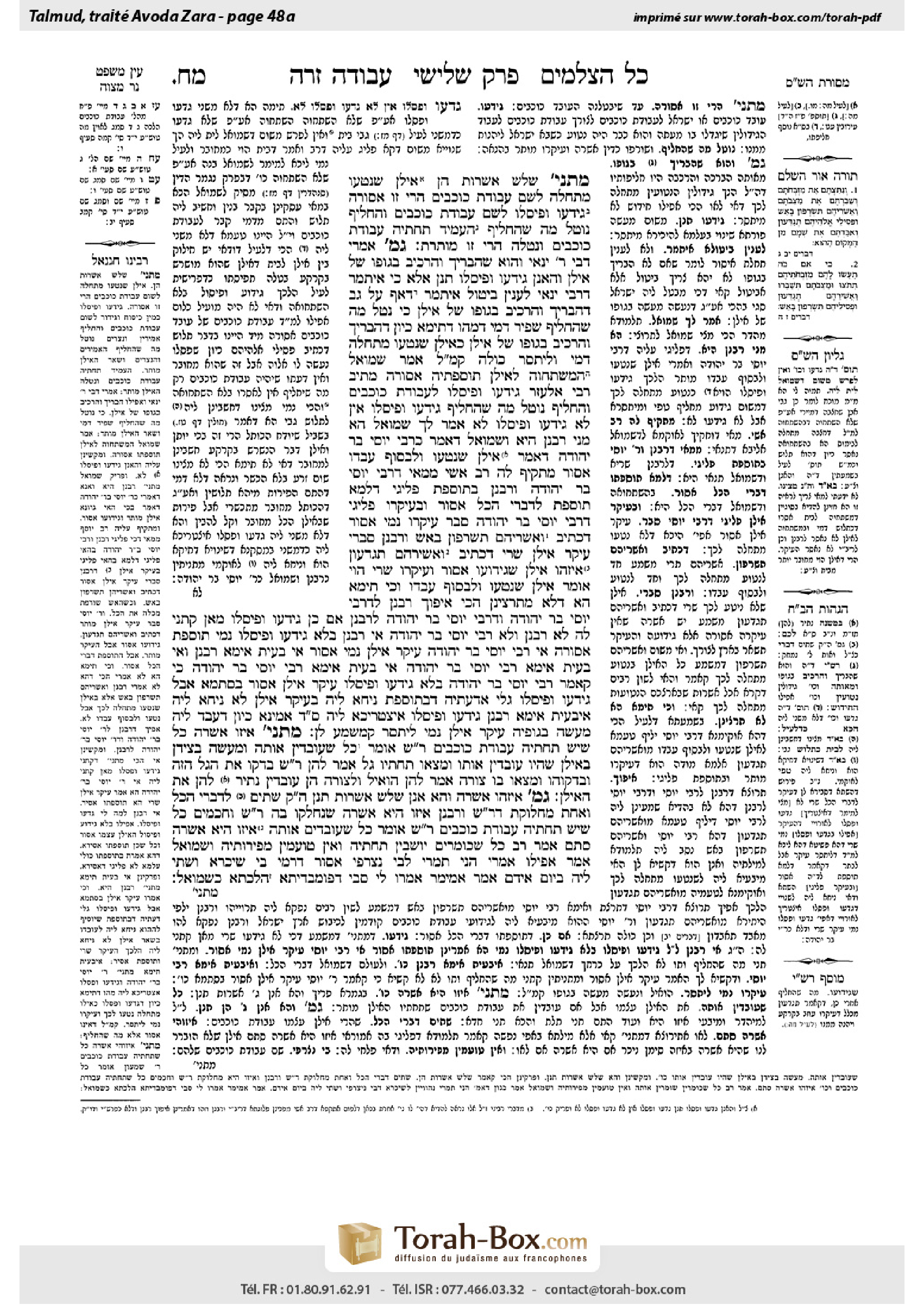
Avodah Zarah 48a: Talmud study for Daf Yomi
Study the Talmud for Daf Yomi with scanned pages, Hebrew text, English translations from Sefaria and AI-generated French translations.
Passage selection and English or AI-generated French translation are available where the scan has annotations. Daf Study is independent of Torah-Box and Sefaria.
Browse Avodah Zarah · עבודה זרה · All tractatesAvodah Zarah 48a text and translations
This page of Avodah Zarah includes the Aramaic text, an English translation and an AI-generated French translation, alongside the scan above.
עבודה זרה מ״ח א · Aramaic and Hebrew text
מַתְנִי׳ שָׁלֹשׁ אֲשֵׁרוֹת הֵן — אִילָן שֶׁנְּטָעוֹ מִתְּחִלָּה לְשֵׁם עֲבוֹדָה זָרָה, הֲרֵי זוֹ אֲסוּרָה. גִּידְּעוֹ וּפִיסְּלוֹ לְשֵׁם עֲבוֹדָה זָרָה וְהֶחְלִיף — נוֹטֵל מַה שֶׁהֶחְלִיף. הֶעֱמִיד תַּחְתֶּיהָ עֲבוֹדָה זָרָה וּנְטָלָהּ — הֲרֵי זוֹ מוּתֶּרֶת.
גְּמָ׳ אָמְרִי דְּבֵי רַבִּי יַנַּאי: וְהוּא שֶׁהִבְרִיךְ וְהִרְכִּיב בְּגוּפוֹ שֶׁל אִילָן.
וְהָאֲנַן ״גִּידְּעוֹ וּפִיסְּלוֹ״ תְּנַן!
אֶלָּא כִּי אִיתְּמַר דְּרַבִּי יַנַּאי, לְעִנְיַן בִּיטּוּל אִיתְּמַר, דְּאַף עַל גַּב דְּהִבְרִיךְ וְהִרְכִּיב בְּגוּפוֹ שֶׁל אִילָן, כִּי נָטַל מַה שֶּׁהֶחְלִיף — שַׁפִּיר דָּמֵי, דְּמַהוּ דְּתֵימָא: כֵּיוָן דְּהִבְרִיךְ וְהִרְכִּיב בְּגוּפוֹ שֶׁל אִילָן כְּאִילָן שֶׁנְּטָעוֹ מִתְּחִלָּה דָּמֵי, וְלִיתְּסַר כּוּלַּהּ, קָא מַשְׁמַע לַן.
אָמַר שְׁמוּאֵל: הַמִּשְׁתַּחֲוֶה לְאִילָן, (תּוֹסֶפְתֵּיהּ) [תּוֹסַפְתּוֹ] אֲסוּרָה. מֵתִיב רַבִּי אֶלְעָזָר: גִּידְּעוֹ וּפִיסְּלוֹ לַעֲבוֹדָה זָרָה וְהֶחְלִיף — נוֹטֵל מַה שֶׁהֶחְלִיף. גִּידְּעוֹ וּפִיסְּלוֹ — אִין, לֹא גִּידְּעוֹ וּפִיסְּלוֹ — לֹא!
אָמַר לְךָ שְׁמוּאֵל: הָא מַנִּי? רַבָּנַן הִיא, וּשְׁמוּאֵל דְּאָמַר כְּרַבִּי יוֹסֵי בַּר יְהוּדָה, דְּאָמַר: אִילָן שֶׁנְּטָעוֹ וּלְבַסּוֹף עֲבָדוֹ — אָסוּר.
מַתְקֵיף לַהּ רַב אָשֵׁי: מִמַּאי דְּרַבִּי יוֹסֵי בַּר יְהוּדָה וְרַבָּנַן בְּתוֹסֶפֶת פְּלִיגִי? דִּלְמָא תּוֹסֶפֶת לְדִבְרֵי הַכֹּל אָסוּר, וּבְעִיקָּרוֹ פְּלִיגִי.
דְּרַבִּי יוֹסֵי בַּר יְהוּדָה סָבַר: עִיקָּרוֹ נָמֵי אָסוּר, דִּכְתִיב: ״וַאֲשֵׁרֵיהֶם תִּשְׂרְפוּן בָּאֵשׁ״, וְרַבָּנַן סָבְרִי: עִיקַּר אִילָן שְׁרֵי, דִּכְתִיב: ״וַאֲשֵׁירֵהֶם תְּגַדֵּעוּן״. אֵיזֶהוּ אִילָן שֶׁגִּידּוּעוֹ אָסוּר וְעִיקָּרוֹ שְׁרֵי? הֱוֵי אוֹמֵר: אִילָן שֶׁנְּטָעוֹ וּלְבַסּוֹף עֲבָדוֹ!
וְכִי תֵּימָא: הָא דְּלָא מְתָרְצִינַן הָכִי — אֵיפוֹךְ רַבָּנַן לִדְרַבִּי יוֹסֵי בַּר יְהוּדָה, וּדְרַבִּי יוֹסֵי בַּר יְהוּדָה לְרַבָּנַן!
אִם כֵּן, גִּידְּעוֹ וּפִיסְּלוֹ, מַאן קָתָנֵי לַהּ? לָא רַבָּנַן וְלָא רַבִּי יוֹסֵי בַּר יְהוּדָה! אִי רַבָּנַן — בְּלֹא גִּידְּעוֹ וּפִיסְּלוֹ נָמֵי תּוֹסֶפֶת אֲסוּרָה, אִי רַבִּי יוֹסֵי בַּר יְהוּדָה — עִיקַּר אִילָן נָמֵי אָסוּר!
אִי בָּעֵית אֵימָא רַבָּנַן, וְאִי בָּעֵית אֵימָא רַבִּי יוֹסֵי בַּר יְהוּדָה. אִי בָּעֵית אֵימָא רַבִּי יוֹסֵי בַּר יְהוּדָה — כִּי קָאָמַר רַבִּי יוֹסֵי בַּר יְהוּדָה בְּלֹא גִּידְּעוֹ וּפִיסְּלוֹ עִיקַּר אִילָן אָסוּר בִּסְתָמָא, אֲבָל גִּידְּעוֹ וּפִיסְּלוֹ — גַּלִּי אַדַּעְתֵּיהּ דִּבְתוֹסֶפֶת נִיחָא לֵיהּ, בְּעִיקַּר אִילָן לָא נִיחָא לֵיהּ.
אִיבָּעֵית אֵימָא: רַבָּנַן, ״גִּידְּעוֹ וּפִיסְּלוֹ״ אִיצְטְרִיכָא לֵיהּ. סָלְקָא דַּעְתָּךְ אָמֵינָא: כֵּיוָן דַּעֲבַד לֵיהּ מַעֲשֶׂה בְּגוּפֵיהּ, עִיקַּר אִילָן נָמֵי לִיתְּסַר, קָמַשְׁמַע לַן.
מַתְנִי׳ אֵיזוֹ אֲשֵׁרָה? כֹּל שֶׁיֵּשׁ תַּחְתֶּיהָ עֲבוֹדָה זָרָה. רַבִּי שִׁמְעוֹן אוֹמֵר: כֹּל שֶׁעוֹבְדִין אוֹתָהּ. וּמַעֲשֶׂה בְּצַיְדָּן בְּאִילָן שֶׁהָיוּ עוֹבְדִין אוֹתוֹ, וּמָצְאוּ תַּחְתָּיו גַּל. אָמַר לָהֶן רַבִּי שִׁמְעוֹן: בִּדְקוּ אֶת הַגַּל הַזֶּה, וּבְדָקוּהוּ וּמָצְאוּ בּוֹ צוּרָה. אָמַר לָהֶן: הוֹאִיל וְלַצּוּרָה הֵן עוֹבְדִין, נַתִּיר לָהֶן אֶת הָאִילָן.
גְּמָ׳ אֵיזֶהוּ אֲשֵׁרָה? וְהָא אֲנַן ״שָׁלֹשׁ אֲשֵׁרוֹת״ תְּנַן! הָכִי קָאָמַר: שְׁתַּיִם לְדִבְרֵי הַכֹּל, וְאַחַת מַחְלוֹקֶת דְּרַבִּי שִׁמְעוֹן וְרַבָּנַן. אֵיזוֹ הִיא אֲשֵׁרָה שֶׁנֶּחְלְקוּ בָּהּ רַבִּי שִׁמְעוֹן וַחֲכָמִים? כֹּל שֶׁיֵּשׁ תַּחְתֶּיהָ עֲבוֹדָה זָרָה, רַבִּי שִׁמְעוֹן אוֹמֵר: כֹּל שֶׁעוֹבְדִים אוֹתָהּ.
אֵיזוֹ הִיא אֲשֵׁרָה סְתָם? אָמַר רַב: כֹּל שֶׁכּוֹמָרִים יוֹשְׁבִין תַּחְתֶּיהָ וְאֵין טוֹעֲמִין מִפֵּירוֹתֶיהָ. וּשְׁמוּאֵל אָמַר: אֲפִילּוּ אָמְרִי ״הָנֵי תַּמְרֵי לְבֵי נִצְרְפֵי״ — אָסוּר, דְּרָמֵי בֵּי שִׁיכְרָא וְשָׁתֵי לֵיהּ בְּיוֹם אֵידָם. אָמַר אַמֵּימָר: אֲמַרוּ לִי סָבֵי דְפוּמְבְּדִיתָא הִלְכְתָא כִּשְׁמוּאֵל.
Avodah Zarah 48a · English translation
MISHNA: There are three types of trees that were used as part of idolatrous rites [ashera]: A tree that one initially planted for the sake of idol worship is forbidden, and one may not derive benefit from any part of the tree. If one lopped off part of the trunk of a tree or trimmed its branches for the sake of idol worship, i.e., to worship that which would regrow there, and the tree’s trunk or limbs regrew, one removes that which has regrown and burns it. The remainder of the tree is then permitted. If one erected an object of idol worship beneath a tree and subsequently removed it, it is permitted to derive benefit from the tree.
GEMARA: The mishna teaches that if one lopped off or trimmed a tree’s branches for the sake of idol worship and it regrew, the tree is permitted upon the removal of the new growth. The Sages of the school of Rabbi Yannai say: And this is the halakha only when one sank the shoot of a vine into the ground or grafted onto the trunk of the tree itself.
The Gemara asks: But didn’t we learn that if he lopped off part of the trunk or trimmed the tree’s branches, the growth is forbidden? In order to render a tree forbidden, according to the Sages of the school of Rabbi Yannai, the act dedicated to idol worship must be sinking or grafting, which are tantamount to replanting the entire tree. The mishna indicates that even cutting off part of a tree renders the new growth forbidden.
The Gemara answers: Rather, when the statement of the Sages of the school of Rabbi Yannai was stated, it was stated with regard to the revocation of the idolatrous status. What they meant to say was that even if one sank the shoot of a vine into the ground or grafted onto the tree itself, effecting a more significant change, nevertheless, when one removes that which has regrown, the tree is permitted. As, lest you say that since one sank the shoot of a vine into the ground or grafted onto the tree itself, it is similar to a tree that one initially planted for idol worship and the entire tree should be forbidden, the Sages of the school of Rabbi Yannai counter this and teach us that even in this case the tree is permitted when that which has regrown is removed.
Shmuel says: In the case of one who bows to a tree, its additional subsequent growth is forbidden. Rabbi Elazar raises an objection from the mishna: If one lopped or trimmed the tree for the sake of idol worship and the tree’s trunk or limbs regrew, one removes that which has regrown and burns it. This indicates that if one lopped or trimmed it the additional growth is forbidden, but if one did not lop or trim it, even if one bowed to the tree, the growth is not forbidden.
The Gemara answers that Shmuel could say to you: In accordance with whose opinion is this mishna? It is in accordance with the opinion of the Rabbis, who maintain that a tree that was planted and only subsequently worshipped is permitted, as it was not initially planted for idol worship. And Shmuel says his statement in accordance with the opinion of Rabbi Yosei bar Yehuda, who says that a tree that one planted and subsequently worshipped is forbidden. Accordingly, bowing to a tree renders its subsequent growth forbidden.
Rav Ashi objects to this answer: From where is it derived that Rabbi Yosei bar Yehuda and the Rabbis disagree with regard to additional growth? Perhaps all agree that additional growth after the tree was worshipped is forbidden, and they disagree only with regard to its trunk.
The Gemara explains what the nature of this dispute would be: As Rabbi Yosei bar Yehuda maintains that its trunk is also forbidden, as it is written: “And you shall break down their altars, and dash in pieces their pillars, and burn their asherim with fire” (Deuteronomy 12:3). Burning with fire destroys the whole tree, which indicates that the entire tree is forbidden, including its trunk. And the Rabbis maintain that the trunk of the tree is permitted, as it is written: “You shall break down their altars, and dash in pieces their pillars, and hew down their asherim, and burn their graven images with fire” (Deuteronomy 7:5). Which is the tree whose hewn part is forbidden, but its trunk is permitted? You must say it is a tree that one planted and subsequently worshipped.
And if you would say that we did not explain their opinions in this manner previously (45b), as the source given there for the opinion of Rabbi Yosei bar Yehuda is the same verse given here as the source for the opinion of the Rabbis, simply reverse the explanation given there to match the one given here. The verse cited there as the source for the opinion of the Rabbis, namely, “and burn their asherim with fire,” should instead be considered the source for the opinion of Rabbi Yosei bar Yehuda, who deems even the trunk of a subsequently worshipped tree forbidden. And the verse cited there as the source for the opinion of Rabbi Yosei bar Yehuda, namely, “and hew down their asherim,” should instead be considered the source for the opinion of the Rabbis that only subsequent growth is forbidden.
The Gemara rejects Rav Ashi’s suggestion: It cannot be that all agree that additional growth is forbidden when a tree is planted and subsequently worshipped, because if so, who teaches the mishna that says that the tree is forbidden when one lopped it or trimmed it? It is neither the Rabbis nor Rabbi Yosei bar Yehuda. If one were to say that the Rabbis teach it, this cannot be, as they maintain that even in a case where one did not lop it or trim it, but simply bowed to it, the additional growth is forbidden. If one were to say that Rabbi Yosei bar Yehuda teaches the mishna, this cannot be, as he maintains that even the trunk of the tree is forbidden after it has been worshipped, and not just the subsequent growth.
The Gemara responds, defending Rav Ashi’s suggestion: If you wish, say that the Rabbis teach the mishna, and if you wish, say that Rabbi Yosei bar Yehuda teaches it. The Gemara explains each possibility: If you wish, say that Rabbi Yosei bar Yehuda teaches it, as when Rabbi Yosei bar Yehuda says that even in a case where one did not lop it or trim it, the trunk of the tree is nevertheless forbidden, it is only in a case where one worshipped the tree without specification, i.e., not any specific part of the tree. But if one lopped it or trimmed it for the sake of idol worship, he has revealed his intention, namely, that he believes that the additional growth is suitable for his idol worship, but that the trunk of the tree is not suitable for his idol worship. Therefore, in such a case only the additional growth is forbidden.
The Gemara explains the other possibility. If you wish, say that the Rabbis teach it. Although they maintain that even without lopping or trimming the tree the additional growth is forbidden if it is worshipped, nevertheless it was necessary for the mishna to mention the case where one lopped it or trimmed it specifically. Otherwise, it might enter your mind to say that since one performed an action on the tree itself, the trunk of the tree should also be forbidden. Therefore, the mishna teaches us that only the additional growth is forbidden and not the trunk.
MISHNA: Which tree is deemed forbidden as an ashera? Any tree that has an object of idol worship beneath it. Rabbi Shimon says: Any tree that people worship. And there was an incident in Tzaidan involving a tree that people would worship, and Jews found beneath it a heap of stones. Rabbi Shimon said to them: Examine this heap of stones. And they examined it and found in it an idolatrous image. Rabbi Shimon said to them: Since it is the image that they worship, we can permit use of the tree to those who wish to derive benefit from it.
GEMARA: The mishna teaches: Which tree is an ashera? The Gemara asks: But didn’t we learn in the previous mishna that there are three types of ashera trees? The Gemara answers: This is what the mishna is saying: Of the three trees mentioned in the previous mishna, there are two where the trees themselves are worshipped, and everyone agrees that they are forbidden. And there is one that is subject to a dispute between Rabbi Shimon and the Rabbis. Which is the ashera with regard to which Rabbi Shimon and the Rabbis disagree? It is any tree that has an object of idol worship beneath it, as Rabbi Shimon says that any tree that people worship is forbidden, but that a tree under which an idol was placed is not forbidden.
The Gemara presents a question: Which tree is assumed to be an ashera, even without specific knowledge that it was worshipped? Rav says: Any tree that gentile priests sit beneath and do not taste of its fruits, as they apparently consider the fruits consecrated to the idol. And Shmuel says: Even if they so much as say: These dates are for the house of Natzrefei, a house of idol worship, the tree is forbidden. This is because the idol worshippers would throw the dates into beer and drink it on their festival day. Ameimar says: The elders of Pumbedita said to me that the halakha is in accordance with the opinion of Shmuel.
Avodah Zarah 48a · Traduction française (IA)
MICHNA : Il existe trois types d'arbres utilisés dans les rites idolâtres [ashera] : un arbre que l'on a planté initialement à des fins d'idolâtrie est interdit, et on ne peut pas en tirer aucun bénéfice. Si l'on a coupé une partie du tronc ou taillé les branches d'un arbre à des fins d'idolâtrie, c'est-à-dire pour adorer ce qui reprendrait croissance là, et que le tronc ou les branches de l'arbre ont reprendu croissance, on enlève ce qui a reprendu croissance et on le brûle. Le reste de l'arbre est alors permis. Si l'on a élevé un objet d'idolâtrie sous un arbre et qu'on l'a ensuite retiré, il est permis de tirer bénéfice de l'arbre.
GUEMARA : La mishna enseigne que si l'on a coupé ou taillé les branches d'un arbre à des fins d'idolâtrie et qu'elles ont reprendu croissance, l'arbre est permis après l'élimination de cette nouvelle croissance. Les Sages de l'école de Rabbi Yannai disent : Et c'est la halakha uniquement lorsque l'on a planté la jeune vigne dans le sol ou l'a greffée sur le tronc de l'arbre lui-même.
La Guemara pose la question : Mais n'avons-nous pas appris que si l'on a coupé une partie du tronc ou taillé les branches d'un arbre, la croissance est interdite ? Afin de rendre un arbre interdit, selon les Sages de l'école de Rabbi Yannai, l'acte dédié à l'idolâtrie doit être la plantation ou la greffe, ce qui équivaut à replanter l'arbre entier. La mishna indique que même la coupe d'une partie de l'arbre rend la nouvelle croissance interdite.
La Guemara répond : Plutôt, lorsque l'affirmation des Sages de l'école de Rabbi Yannai a été émise, elle a été émise concernant la révocation de l'état idolâtre. Ce qu'ils voulaient dire est que même si l'on plante la jeune vigne dans le sol ou l'on la greffe sur l'arbre lui-même, effectuant un changement plus significatif, néanmoins, lorsqu'on enlève ce qui a reprendu croissance, l'arbre est permis. Ainsi, afin que vous ne disiez pas que puisque l'on a planté la jeune vigne dans le sol ou l'a greffée sur l'arbre lui-même, cela est comparable à un arbre que l'on a planté initialement pour l'idolâtrie et que l'ensemble de l'arbre devrait être interdit, les Sages de l'école de Rabbi Yannai contredisent cela et enseignent que même dans ce cas, l'arbre est permis lorsqu'on enlève ce qui a reprendu croissance.
Shmuel dit : Dans le cas d'une personne qui s'incline devant un arbre, sa croissance ultérieure est interdite. Rabbi Elazar oppose un argument tiré de la mishna : Si l'on a coupé ou taillé l'arbre à des fins d'idolâtrie et que le tronc ou les branches de l'arbre ont reprendu croissance, on enlève ce qui a reprendu croissance et on le brûle. Cela indique que si l'on a coupé ou taillé l'arbre, la croissance ultérieure est interdite, mais si l'on n'a pas coupé ou taillé l'arbre, même si l'on s'est incliné devant l'arbre, la croissance n'est pas interdite.
La Guemara répond que Shmuel pourrait dire à vous : Selon l'opinion de qui est cette mishna ? C'est selon l'opinion des Rabbins, qui maintiennent qu'un arbre planté et ensuite adoré est permis, car il n'a pas été planté initialement pour l'idolâtrie. Et Shmuel dit son affirmation selon l'opinion de Rabbi Yosei bar Yehuda, qui dit qu'un arbre que l'on a planté et ensuite adoré est interdit. Ainsi, l'inclination devant un arbre rend sa croissance ultérieure interdite.
Rav Ashi s'oppose à cette réponse : D'où est-il dérivé que Rabbi Yosei bar Yehuda et les Rabbins divergent concernant la croissance supplémentaire ? Peut-être que tous s'accordent sur le fait que la croissance supplémentaire après que l'arbre ait été adoré est interdite, et ils divergent uniquement concernant son tronc.
La Guemara explique la nature de ce débat : Comme Rabbi Yosei bar Yehuda maintient que son tronc est également interdit, car il est écrit : « Et vous démolirez leurs autels, et vous briserez leurs poteaux, et vous brûlerez leurs asherim avec le feu » (Deutéronome 12:3). Le brûlement avec le feu détruit l'arbre entier, ce qui indique que l'ensemble de l'arbre est interdit, y compris son tronc. Et les Rabbins maintiennent que le tronc de l'arbre est permis, car il est écrit : « Vous démolirez leurs autels, et vous briserez leurs poteaux, et vous abaterez leurs asherim, et vous brûlerez leurs images gravées avec le feu » (Deutéronome 7:5). Quel arbre est-ce dont la partie abattue est interdite, mais dont le tronc est permis ? Vous devez dire que c'est un arbre que l'on a planté et ensuite adoré.
Et si vous disiez que nous n'avons pas expliqué leurs opinions ainsi auparavant (45b), car la source donnée là pour l'opinion de Rabbi Yosei bar Yehuda est la même verset que celui donné ici pour l'opinion des Rabbins, simplement inversez l'explication donnée là pour correspondre à celle donnée ici. Le verset cité là comme source pour l'opinion des Rabbins, à savoir « et brûlez leurs asherim avec le feu », devrait plutôt être considéré comme la source pour l'opinion de Rabbi Yosei bar Yehuda, qui considère même le tronc d'un arbre adoré ultérieurement comme interdit. Et le verset cité là comme source pour l'opinion de Rabbi Yosei bar Yehuda, à savoir « et abattez leurs asherim », devrait plutôt être considéré comme la source pour l'opinion des Rabbins qui considèrent que seul la croissance ultérieure est interdite.
La Guemara rejette la suggestion de Rav Ashi : Il ne peut pas être que tous s'accordent sur le fait que la croissance supplémentaire est interdite lorsqu'un arbre est planté et ensuite adoré, car si tel était le cas, qui enseigne la mishna qui dit que l'arbre est interdit lorsqu'on l'a coupé ou taillé ? Ce n'est ni les Rabbins ni Rabbi Yosei bar Yehuda. Si l'on disait que les Rabbins enseignent cela, cela ne peut pas être, car ils maintiennent que même dans le cas où l'on n'a pas coupé ou taillé, mais simplement s'est incliné devant l'arbre, la croissance supplémentaire est interdite. Si l'on disait que Rabbi Yosei bar Yehuda enseigne la mishna, cela ne peut pas être, car il maintient que même le tronc de l'arbre est interdit après qu'il ait été adoré, et non seulement la croissance ultérieure.
La Guemara répond, défendant la suggestion de Rav Ashi : Si vous le souhaitez, dites que les Rabbins enseignent la mitsna, et si vous le souhaitez, dites que Rabbi Yosei bar Yehuda l'enseigne. La Guemara explique chaque possibilité : Si vous le souhaitez, dites que Rabbi Yosei bar Yehuda l'enseigne, car lorsque Rabbi Yosei bar Yehuda dit que même dans le cas où l'on n'a pas taillé ou rabattu l'arbre, le tronc de l'arbre est tout de même interdit, il s'agit seulement du cas où l'on adore l'arbre sans spécifier, c'est-à-dire sans aucune partie spécifique de l'arbre. Mais si l'on a taillé ou rabattu l'arbre à l'intention de l'idolâtrie, il a révélé son intention, à savoir qu'il croit que la croissance supplémentaire est appropriée pour son adoration, mais que le tronc de l'arbre ne l'est pas. Par conséquent, dans ce cas, seul la croissance supplémentaire est interdite.
La Guemara explique l'autre possibilité. Si vous le souhaitez, dites que les Rabbins l'enseignent. Bien qu'ils affirment que même sans tailler ou rabattre l'arbre, la croissance supplémentaire est interdite si elle est adorée, il était nécessaire que la mitsva mentionne spécifiquement le cas où l'on a taillé ou rabattu l'arbre. Sinon, il pourrait entrer en vous l'idée que puisque l'on a effectué une action sur l'arbre lui-même, le tronc de l'arbre devrait également être interdit. Par conséquent, la mitsva nous enseigne que seul la croissance supplémentaire est interdite et non le tronc.
MITSVA : Quel arbre est considéré comme un ashera ? Tout arbre qui a un objet d'idolâtrie sous lui. Rabbi Shimon dit : Tout arbre que les gens adorent. Et il y avait un incident à Tzaidan concernant un arbre que les gens adoraient, et des Juifs trouvèrent sous lui une pile de pierres. Rabbi Shimon dit à ceux-ci : Examinez cette pile de pierres. Et ils l'examinaient et trouvèrent dedans une image idolâtre. Rabbi Shimon dit à ceux-ci : Puisque c'est l'image qu'ils adorent, nous pouvons permettre l'utilisation de l'arbre à ceux qui souhaitent en tirer un bénéfice.
GUEMARA : La mitsva enseigne : Quel arbre est un ashera ? La Guemara demande : Mais n'avons-nous pas appris dans la mitsva précédente qu'il existe trois types d'arbres ashera ? La Guemara répond : C'est ce que la mitsva dit : Parmi les trois arbres mentionnés dans la mitsva précédente, il y a deux où l'arbre lui-même est adoré, et tout le monde convient qu'ils sont interdits. Et il y a un troisième sujet de débat entre Rabbi Shimon et les Rabbins. Quel est l'ashera concernant lequel Rabbi Shimon et les Rabbins débattent ? C'est tout arbre qui a un objet d'idolâtrie sous lui, car Rabbi Shimon dit que tout arbre que les gens adorent est interdit, mais qu'un arbre sous lequel un idole a été placé n'est pas interdit.
La Guemara présente une question : Quel arbre est considéré comme un ashera, même sans connaissance spécifique qu'il a été adoré ? Rav dit : Tout arbre que les prêtres païens s'assoient sous et ne goûtent pas ses fruits, car ils semblent considérer les fruits comme consacrés à l'idole. Et Shmuel dit : Même s'ils disent simplement : Ces dattes sont pour la maison de Natzrefei, une maison d'idolâtrie, l'arbre est interdit. C'est parce que les adorateurs d'idoles jetaient les dattes dans du vin et buvaient ce vin lors de leur fête. Ameimar dit : Les anciens de Pumbedita me dirent que la halakha suit l'opinion de Shmuel.
Traduction française générée par IA à partir de l’édition anglaise de Sefaria. Vérifie toujours un passage avec le texte source.
Text from Sefaria: William Davidson Edition - Vocalized Aramaic (CC BY NC); William Davidson Edition - English (CC BY NC).