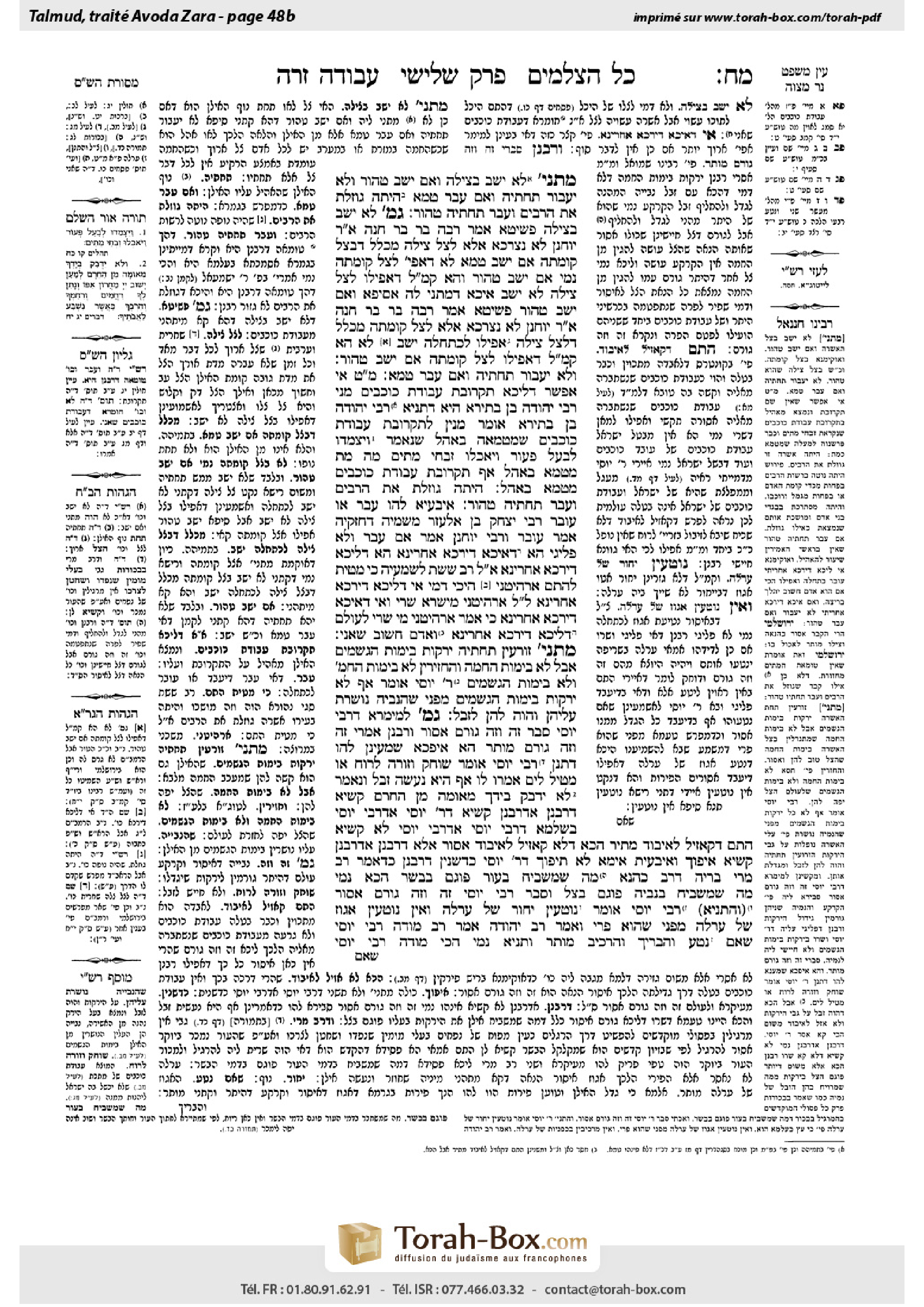
Avodah Zarah 48b: Talmud study for Daf Yomi
Study the Talmud for Daf Yomi with scanned pages, Hebrew text, English translations from Sefaria and AI-generated French translations.
Passage selection and English or AI-generated French translation are available where the scan has annotations. Daf Study is independent of Torah-Box and Sefaria.
Browse Avodah Zarah · עבודה זרה · All tractatesAvodah Zarah 48b text and translations
This page of Avodah Zarah includes the Aramaic text, an English translation and an AI-generated French translation, alongside the scan above.
עבודה זרה מ״ח ב · Aramaic and Hebrew text
מַתְנִי׳ לֹא יֵשֵׁב בְּצִילָּהּ, וְאִם יָשַׁב — טָהוֹר, וְלֹא יַעֲבוֹר תַּחְתֶּיהָ, וְאִם עָבַר — טָמֵא. הָיְתָה גּוֹזֶלֶת אֶת הָרַבִּים וְעָבַר תַּחְתֶּיהָ — טָהוֹר.
גְּמָ׳ לֹא יֵשֵׁב בְּצִילָּהּ. פְּשִׁיטָא! אָמַר רַבָּה בַּר בַּר חָנָה אָמַר רַבִּי יוֹחָנָן: לֹא נִצְרְכָא אֶלָּא לְצֵל צִילָּהּ.
מִכְּלָל דִּבְצֵל קוֹמָתָהּ, אִם יָשַׁב — טָמֵא? לֹא, דַּאֲפִילּוּ לְצֵל קוֹמָתָהּ נָמֵי, אִם יָשַׁב — טָהוֹר, וְהָא קָא מַשְׁמַע לַן, דַּאֲפִילּוּ לְצֵל צִילָּהּ לֹא יֵשֵׁב.
אִיכָּא דְּמַתְנֵי לַהּ אַסֵּיפָא, וְאִם יָשַׁב טָהוֹר. פְּשִׁיטָא? אָמַר רַבָּה בַּר בַּר חָנָה אָמַר רַבִּי יוֹחָנָן: לֹא נִצְרְכָא אֶלָּא לְצֵל קוֹמָתָהּ. מִכְּלָל דִּלְצֵל צִילָּהּ אֲפִילּוּ לְכַתְּחִלָּה יֵשֵׁב? לָא, הָא קָא מַשְׁמַע לַן, דַּאֲפִילּוּ לְצֵל קוֹמָתָהּ אִם יָשַׁב — טָהוֹר.
וְלֹא יַעֲבוֹר תַּחְתֶּיהָ, וְאִם עָבַר — טָמֵא. מַאי טַעְמָא? אִי אֶפְשָׁר דְּלֵיכָּא תִּקְרוֹבֶת עֲבוֹדָה זָרָה.
מַנִּי? רַבִּי יְהוּדָה בֶּן בְּתֵירָא הִיא, דְּתַנְיָא: רַבִּי יְהוּדָה בֶּן בְּתִירָא אוֹמֵר: מִנַּיִן לְתִקְרוֹבֶת עֲבוֹדָה זָרָה שֶׁמְּטַמְּאָה בְּאֹהֶל? שֶׁנֶּאֱמַר: ״וַיִּצָּמְדוּ לְבַעַל פְּעוֹר וַיֹּאכְלוּ זִבְחֵי מֵתִים״ — מָה מֵת מְטַמֵּא בְּאֹהֶל, אַף תִּקְרוֹבֶת עֲבוֹדָה זָרָה מְטַמֵּא בְּאֹהֶל.
הָיְתָה גּוֹזֶלֶת אֶת הָרַבִּים וְעָבַר תַּחְתֶּיהָ — טָהוֹר. אִיבַּעְיָא לְהוּ: עָבַר אוֹ עוֹבֵר? רַבִּי יִצְחָק בֶּן אֶלְעָזָר מִשְּׁמֵיהּ דְּחִזְקִיָּה אָמַר: עוֹבֵר, וְרַבִּי יוֹחָנָן אָמַר: אִם עָבַר.
וְלָא פְּלִיגִי, הָא דְּאִיכָּא דִּירְכָּא אַחֲרִינָא, הָא דְּלֵיכָּא דִּירְכָּא אַחֲרִינָא.
אֲמַר לֵיהּ רַב שֵׁשֶׁת לְשַׁמָּעֵיהּ: כִּי מָטֵית לְהָתָם ״אַרְהֵיטְנִי״. הֵיכִי דָמֵי? אִי דְּלֵיכָּא דִּירְכָּא אַחֲרִינָא, לְמָה לִי ״אַרְהֵיטְנִי״? מִישְׁרָא שְׁרֵי! וְאִי דְּאִיכָּא דִּירְכָּא אַחְרִינָא, כִּי אָמַר ״אַרְהֵיטְנִי״ מִי שְׁרֵי?
לְעוֹלָם, דְּלֵיכָּא דִּירְכָּא אַחֲרִינָא, וְאָדָם חָשׁוּב שָׁאנֵי.
מַתְנִי׳ זוֹרְעִין תַּחְתֶּיהָ יְרָקוֹת בִּימוֹת הַגְּשָׁמִים, אֲבָל לֹא בִּימוֹת הַחַמָּה, וְהַחֲזֵירִין לֹא בִּימוֹת הַחַמָּה וְלֹא בִּימוֹת הַגְּשָׁמִים. רַבִּי יוֹסֵי אוֹמֵר: אַף לֹא יְרָקוֹת בִּימוֹת הַגְּשָׁמִים, מִפְּנֵי שֶׁהַנְּבִיָּה נוֹשֶׁרֶת עֲלֵיהֶן וְהֹוָה לָהֶן לְזֶבֶל.
גְּמָ׳ לְמֵימְרָא דְּרַבִּי יוֹסֵי סָבַר: זֶה וָזֶה גּוֹרֵם — אָסוּר, וְרַבָּנַן אָמְרִי: זֶה וָזֶה גּוֹרֵם — מוּתָּר?
הָא אִיפְּכָא שָׁמְעִינַן לְהוּ, דִּתְנַן: רַבִּי יוֹסֵי אוֹמֵר: שׁוֹחֵק וְזוֹרֶה לָרוּחַ אוֹ מֵטִיל לַיָּם. אָמְרוּ לוֹ: אַף הִיא נַעֲשָׂה זֶבֶל, וְנֶאֱמַר: ״לֹא יִדְבַּק בְּיָדְךָ מְאוּמָה מִן הַחֵרֶם״.
קַשְׁיָא דְּרַבָּנַן אַדְּרַבָּנַן, קַשְׁיָא דְּרַבִּי יוֹסֵי אַדְּרַבִּי יוֹסֵי!
בִּשְׁלָמָא דְּרַבִּי יוֹסֵי אַדְּרַבִּי יוֹסֵי לָא קַשְׁיָא: הָתָם, דְּקָאָזֵיל לְאִיבּוּד — מַתִּיר, הָכָא, דְּלָא קָאָזֵיל לְאִיבּוּד — אָסוּר.
אֶלָּא דְּרַבָּנַן אַדְּרַבָּנַן קַשְׁיָא, אֵיפוֹךְ.
וְאִיבָּעֵית אֵימָא: לָא תֵּיפוֹךְ, דְּרַבִּי יוֹסֵי כִּדְשַׁנִּין, דְּרַבָּנַן כִּדְאָמַר רַב מָרִי בְּרֵיהּ דְּרַב כָּהֲנָא: מָה שֶׁמַּשְׁבִּיחַ בָּעוֹר — פּוֹגֵם בַּבָּשָׂר.
הָכָא נָמֵי, מָה שֶׁמַּשְׁבִּיחַ בַּנְּבִיָּה, פּוֹגֵם בַּצֵּל.
וְסָבַר רַבִּי יוֹסֵי זֶה וָזֶה גּוֹרֵם אָסוּר? וְהָתַנְיָא: רַבִּי יוֹסֵי אוֹמֵר: נוֹטְעִין יִחוּר שֶׁל עׇרְלָה, וְאֵין נוֹטְעִין אֱגוֹז שֶׁל עׇרְלָה, מִפְּנֵי שֶׁהוּא פֶּרִי. וְאָמַר רַב יְהוּדָה אָמַר רַב: מוֹדֶה רַבִּי יוֹסֵי שֶׁאִם נָטַע וְהִבְרִיךְ וְהִרְכִּיב — מוּתָּר.
וְתַנְיָא נָמֵי הָכִי: מוֹדֶה רַבִּי יוֹסֵי
Avodah Zarah 48b · English translation
MISHNA: With regard to an ashera, one may not sit in its shade, but if one sat in its shade he remains ritually pure. And one may not pass beneath it, and if one passed beneath it he is ritually impure. If the tree was robbing the public, i.e., if its branches extended over public property, and one passed beneath it, he remains pure.
GEMARA: The mishna teaches: One may not sit in its shade. The Gemara asks: Isn’t this obvious? He is directly benefiting from an object of idol worship. Rabba bar bar Ḥana said that Rabbi Yoḥanan said: It is necessary only with regard to the shade of its shade. The shade that extends as far as the height of the tree is considered its shade. The less significant shade, that which extends further than the tree’s height, is referred to as the shade of its shade. The mishna is teaching that even this secondary shade is forbidden.
The Gemara comments: By inference, with regard to the shade of its height, its primary shade, if one sat there he is impure. The Gemara rejects this inference: No, this inference is not correct, as even with regard to the shade of its height, if one sat there he remains pure. And this is what the mishna is teaching us: That even with regard to the shade of its shade, one may not sit in it.
There are those who teach this discussion with regard to the latter clause of that part of the mishna, which states: But if one sat in its shade he remains ritually pure. The Gemara asks: Isn’t this obvious? Why should he be rendered impure? Rabba bar bar Ḥana said that Rabbi Yoḥanan said: It is necessary only with regard to the direct shade of its height. Even in this case, he remains pure. The Gemara comments: By inference, with regard to the shade of its shade, one may even sit there ab initio. The Gemara answers: No, this inference is not correct. Rather, this is what the mishna is teaching us: That even with regard to the shade of its height, if one sat there he remains pure.
§ The mishna teaches: And one may not pass beneath an ashera, and if one passed beneath it he is ritually impure. The Gemara asks: What is the reason? The Gemara answers: Because it is impossible that there is no remnant of an idolatrous offering underneath the tree.
The Gemara asks: Whose opinion is this? It is the opinion of Rabbi Yehuda ben Beteira, as it is taught in a baraita that Rabbi Yehuda ben Beteira says: From where is it derived that an idolatrous offering transmits impurity in a tent, i.e., to that which is under the same roof? It is derived from that which is stated: “And they joined themselves unto Ba’al-Peor, and ate the offerings to the dead” (Psalms 106:28). It is derived from here that just as a corpse transmits impurity in a tent, so too, an idolatrous offering transmits impurity in a tent.
§ The mishna teaches: If the tree was robbing the public and one passed beneath it he remains pure. A dilemma was raised before the Sages: Does the mishna mean that if one passed under the tree he remains pure, but that it is prohibited to pass beneath it ab initio? Or does the mishna mean that one may pass beneath it ab initio? Rabbi Yitzḥak ben Elazar says in the name of Ḥizkiyya: One may pass ab initio. And Rabbi Yoḥanan says: The mishna means that if one passed he remains pure, but it is prohibited to pass ab initio.
The Gemara explains: And they do not disagree. This opinion, that one may not pass beneath an ashera, is referring to a case where there is another way to get to his destination. That opinion, that it is permitted to pass beneath it ab initio, is referring to a case where there is no other way.
The Gemara relates: Rav Sheshet, who was blind, was being guided by his attendant toward his city, and there was an ashera shadowing the path. Rav Sheshet said to his attendant: When you arrive at the ashera, have me run past it quickly. The Gemara asks: What were the circumstances? If there was no other way to get to his destination, why did Rav Sheshet request: Have me run past it? In such circumstances, it is permitted to walk normally underneath an ashera. And if there was another way to get to his destination, when Rav Sheshet said: Have me run past it, was it then permitted for him to do so? He still passed under the ashera.
The Gemara answers: Actually, it was a case where there was no other way to get to his destination. And although it was permitted for Rav Sheshet to walk normally underneath the ashera, Rav Sheshet wanted to run past it because an important person is different. An important person should try to pass under the ashera as quickly as possible, lest others misunderstand the circumstances and learn from him that it is permitted for one to walk underneath an ashera even when there is another way for him to reach his destination.
MISHNA: One may plant vegetables underneath an ashera during the rainy season, as the vegetables do not benefit from its shade; on the contrary, the tree’s foliage prevents the vegetables from being properly irrigated by the rain. But one may not plant vegetables under an ashera during the summer, as the shade benefits them. And lettuce may not be planted there at all, neither in the summer nor in the rainy season, because shade is always beneficial to lettuce. Rabbi Yosei says: One may not plant vegetables under an ashera even during the rainy season, because the tree’s foliage [shehaneviyya] falls upon them and serves as fertilizer for them.
GEMARA: The mishna records a dispute between Rabbi Yosei and the Rabbis with regard to planting underneath an ashera in the rainy season when vegetables are fertilized by the tree’s forbidden fallen foliage. As the plant is also fertilized by the permitted nutrients of the ground, the plant’s growth is caused by both prohibited and permitted sources. Therefore, the Gemara asks: Is this to say that Rabbi Yosei holds that when both this and that cause it, i.e., when both permitted and forbidden items contribute to a result, the result is forbidden, and he therefore holds that it is prohibited to plant underneath an ashera in the rainy season; and the Rabbis say that when both this and that cause a result, the result is permitted?
Didn’t we hear that they stated the opposite rulings? As we learned in a mishna (43b): Rabbi Yosei says: When one encounters an idol, he should grind the idol and throw the dust to the wind or cast it into the sea. The Rabbis said to him: What is the good of that? That also gives a Jew benefit from the idol, as it becomes fertilizer for his crops, and deriving any kind of benefit is prohibited, as it is written: “And nothing of the proscribed items shall cleave to your hand” (Deuteronomy 13:18).
The contradiction between the statement of the Rabbis in that mishna and the statement of the Rabbis in the mishna here is difficult, and the contradiction between the statement of Rabbi Yosei in that mishna and the statement of Rabbi Yosei here is difficult.
The Gemara explains: Granted, the contradiction between one statement of Rabbi Yosei and the other statement of Rabbi Yosei is not difficult. It may be resolved as follows: There, in the earlier mishna, since the ground-up idol is dispersed and is going to be completely lost, Rabbi Yosei permits deriving benefit from the fertilizer. By contrast, in the mishna here, where the fallen leaves are not going to be lost so quickly, as they fall together on top of the vegetables and provide direct benefit as fertilizer, deriving benefit from them is prohibited.
But the contradiction between one statement of the Rabbis and the other statement of the Rabbis is difficult. Therefore, the Gemara concludes: Reverse the attribution of the statements, so that the mishna teaches that it is the Rabbis who deem it prohibited to plant under an ashera in the rainy season, while Rabbi Yosei deems it permitted.
And if you wish, say instead: Do not reverse the statements. The contradiction between the statements of Rabbi Yosei can be resolved as we answered before. The contradiction between the statements of the Rabbis can be resolved in accordance with that which Rav Mari, son of Rav Kahana, says about an animal offering that became disqualified for sacrifice. The halakha is that this animal is sold and the proceeds are dedicated to the Temple treasury. One may not skin the hide of the animal whole even though this would make the hide more valuable than if it were cut up into pieces. Rav Mari, son of Rav Kahana, explains that this is because the value that is enhanced with regard to the hide is offset by the damage caused to the flesh. The process of skinning the hide devalues the animal’s flesh; therefore, there is no overall monetary gain for the Temple treasury.
Here too, the value that is enhanced with regard to the planted vegetables by the foliage of the tree is offset by the damage caused by its shade. Therefore, since there is no overall benefit gained from the ashera, the Rabbis deem it permitted to plant underneath it in the winter.
The Gemara asks: And does Rabbi Yosei hold that when both this and that cause it, i.e., when both permitted and forbidden items contribute to a result, the result is forbidden? But isn’t it taught in a mishna (Orla 1:9) that Rabbi Yosei says: One may plant the branch of an orla tree, i.e., a tree during the first three years after its planting, despite the prohibition against eating or deriving benefit from its fruit; but one may not plant an orla nut, because it is a fruit. And Rav Yehuda says that Rav says: Rabbi Yosei concedes that if one planted an orla nut, or sank the shoot of an orla tree into the ground, or grafted an orla tree, deriving benefit from that which grows as a result is permitted. This is apparently because the growth is caused by both a forbidden cause, the orla nut, and a permitted cause, the ground’s nutrients.
The Gemara adds: And that which Rav Yehuda says that Rav says is also taught in a baraita: Rabbi Yosei concedes
Avodah Zarah 48b · Traduction française (IA)
MICHNA : Concernant un ashera, on ne peut pas s'asseoir sous son ombrage, mais si l'on s'est assis sous son ombrage, l'on reste rituellement pur. On ne peut pas passer sous elle, et si l'on a passé sous elle, l'on est rituellement impur. Si l'arbre volait la propriété publique, c'est-à-dire si ses branches s'étendaient sur la propriété publique, et si l'on a passé sous elle, l'on reste pur.
GUEMARA : La mishna enseigne : On ne peut pas s'asseoir sous son ombrage. La Guemara pose la question : N'est-ce pas évident ? Il bénéficie directement d'un objet de culte idolâtre. Rabba bar bar Ḥana a dit que Rabbi Yoḥanan a dit : Cela est nécessaire uniquement concernant l'ombre de sa hauteur. L'ombre qui s'étend jusqu'à la hauteur de l'arbre est considérée comme son ombrage. L'ombre moins importante, celle qui s'étend au-delà de la hauteur de l'arbre, est appelée l'ombre de son ombrage. La mishna enseigne que même cette ombre secondaire est interdite.
La Guemara commente : Par déduction, concernant l'ombre de sa hauteur, son ombrage principal, si l'on s'y était assis, l'on serait impur. La Guemara rejette cette déduction : Non, cette déduction n'est pas correcte, car même concernant l'ombre de sa hauteur, si l'on s'y était assis, l'on restait pur. Et c'est ce que la mishna nous enseigne : Que même concernant l'ombre de son ombrage, on ne peut pas s'y asseoir.
Certains enseignent cette discussion concernant la dernière clause de cette partie de la Michna, qui stipule : Mais si l'on s'est assis sous son ombrage, l'on reste rituellement pur. La Guemara pose la question : N'est-ce pas évident ? Pourquoi devrait-il être rendu impur ? Rabba bar bar Ḥana a dit que Rabbi Yoḥanan a dit : Cela est nécessaire uniquement concernant l'ombre directe de sa hauteur. Même dans ce cas, l'on reste pur. La Guemara commente : Par déduction, concernant l'ombre de son ombrage, on peut même s'y asseoir dès le début. La Guemara répond : Non, cette déduction n'est pas correcte. Plutôt, c'est ce que la Michna nous enseigne : Que même concernant l'ombre de sa hauteur, si l'on s'y était assis, l'on restait pur.
§ La Michna enseigne : Et on ne peut pas passer sous un ashera, et si l'on a passé sous elle, l'on est rituellement impur. La Guemara pose la question : Quelle est la raison ? La Guemara répond : Parce qu'il est impossible qu'il n'y ait pas de reste d'offrande idolâtre sous l'arbre.
La Guemara pose la question : De quel opinion s'agit-il ? C'est l'opinion de Rabbi Yehuda ben Beteira, comme il est enseigné dans une baraïta que Rabbi Yehuda ben Beteira dit : D'où est tiré le fait qu'une offrande idolâtre transmet l'impureté dans une tente, c'est-à-dire à ce qui est sous le même toit ? C'est tiré de ce qui est dit : « Et ils se sont joints à Ba’al-Peor, et ils ont mangé les offrandes aux morts » (Lévitique 106:28). C'est tiré d'ici que tout comme un cadavre transmet l'impureté dans une tente, ainsi une offrande idolâtre transmet l'impureté dans une tente.
§ La mishna enseigne : Si l'arbre volait la propriété publique et que l'on passait sous lui, l'on restait pur. Un dilemme a été soulevé devant les Sages : La mishna signifie-t-elle que si l'on passait sous l'arbre, l'on restait pur, mais qu'il est interdit de passer sous lui dès le début ? Ou la mishna signifie-t-elle que l'on peut passer sous lui dès le début ? Rabbi Yitzḥak ben Elazar dit en nom de Ḥizkiyya : On peut passer dès le début. Et Rabbi Yoḥanan dit : La mishna signifie que si l'on passait, l'on restait pur, mais qu'il est interdit de passer sous lui dès le début.
La Guemara explique : Et ils ne sont pas en désaccord. Cette opinion, selon laquelle l'on ne peut pas passer sous un ashera, fait référence à un cas où il existe un autre chemin pour atteindre sa destination. Cette opinion, selon laquelle l'on peut passer sous l'ashera dès le début, fait référence à un cas où il n'existe pas d'autre chemin.
La Guemara rapporte : Rav Sheshet, qui était aveugle, était conduit par son serviteur vers sa ville, et il y avait un ashera qui ombrageait le chemin. Rav Sheshet a dit à son serviteur : Quand tu arrives à l'ashera, fais-moi courir à travers elle. La Guemara pose la question : Quelles étaient les circonstances ? Si il n'y avait pas d'autre chemin pour atteindre sa destination, pourquoi Rav Sheshet a-t-il demandé : Fais-moi courir à travers elle ? Dans ce cas, il était permis à Rav Sheshet de marcher normalement sous l'ashera. Et si il y avait un autre chemin pour atteindre sa destination, quand Rav Sheshet a dit : Fais-moi courir à travers elle, était-il alors permis de le faire ? Il a encore passé sous l'ashera.
La Guemara répond : En réalité, il s'agissait d'un cas où il n'y avait pas d'autre moyen d'atteindre sa destination. Et bien qu'il fût permis à Rav Sheshet de marcher normalement sous l'ashera, Rav Sheshet voulait courir à travers elle car une personne importante est différente. Une personne importante devrait tenter de passer sous l'ashera aussi rapidement que possible, de peur que les autres ne comprennent les circonstances et ne concluent à partir de lui que c'est permis de marcher sous un ashera même lorsqu'il y a un autre moyen d'atteindre sa destination.
MISHNE : On peut planter des légumes sous un ashera pendant la saison des pluies, car les légumes ne bénéficient pas de son ombrage ; au contraire, les feuillages de l'arbre empêchent les légumes d'être correctement arrosés par la pluie. Mais on ne peut pas planter des légumes sous un ashera pendant l'été, car l'ombre les bénéficiera. Et on ne peut pas planter de la laitue là-bas du tout, ni en été ni en saison des pluies, car l'ombre est toujours bénéfique pour la laitue. Rabbi Yosei dit : On ne peut pas planter des légumes sous un ashera même pendant la saison des pluies, car les feuillages de l'arbre [shehaneviyya] tombent sur eux et servent de fumier pour eux.
GUEMARA : La Michna rapporte un débat entre Rabbi Yosei et les Rabbins concernant la plantation sous un ashera pendant la saison des pluies, lorsque les légumes sont fertilisés par les feuilles tombées et interdites de l'arbre. Comme la plante est également fertilisée par les nutriments permis du sol, la croissance de la plante provient à la fois de sources interdites et permises. Ainsi, la Guemara pose la question : Est-ce que cela signifie que Rabbi Yosei considère que lorsque deux choses contribuent à un résultat, c'est-à-dire lorsque des éléments permis et interdits contribuent à un résultat, ce résultat est interdit, et qu'il considère donc que la plantation sous un ashera pendant la saison des pluies est interdite ; et les Rabbins affirment que lorsque deux choses contribuent à un résultat, ce résultat est permis ?
N'avons-nous pas entendu qu'ils affirmaient des décisions opposées ? Comme nous l'avons appris dans une Michna (43b) : Rabbi Yosei dit : Lorsqu'on rencontre un idole, on doit la pulvériser et jeter la poussière au vent ou la jeter dans la mer. Les Rabbins lui dirent : Quel est l'avantage de cela ? Cela donne également un bénéfice au Juif à partir de l'idole, car cela devient un engrais pour ses cultures, et il est interdit d'obtenir tout genre de bénéfice, comme il est écrit : « Et rien des choses interdites ne doit coller à votre main » (Deutéronome 13:18).
La contradiction entre la déclaration des Rabbins dans la Michna mentionnée et la déclaration des Rabbins dans la Michna ici est difficile, et la contradiction entre la déclaration de Rabbi Yosei dans la Michna mentionnée et la déclaration de Rabbi Yosei ici est difficile.
La Guemara explique : Cela étant, la contradiction entre une déclaration de Rabbi Yosei et l'autre déclaration de Rabbi Yosei n'est pas difficile. Elle peut être résolue ainsi : Là, dans la Michna précédente, puisque l'idole pulvérisée est dispersée et va être complètement perdue, Rabbi Yosei permet d'obtenir un bénéfice à partir de l'engrais. À l'inverse, dans cette Michna-ci, où les feuilles tombées ne vont pas être perdues aussi rapidement, car elles tombent ensemble sur les légumes et offrent un bénéfice direct comme engrais, obtenir un bénéfice d'elles est interdit.
Mais la contradiction entre une déclaration des Rabbins et l'autre déclaration des Rabbins est difficile. Ainsi, la Guemara conclut : Inversez l'attribution des déclarations, de sorte que la Michna enseigne que c'est les Rabbins qui considèrent que la plantation sous un ashera pendant la saison des pluies est interdite, tandis que Rabbi Yosei considère qu'elle est permise.
Et si vous le souhaitez, dites plutôt : Ne réversons pas les déclarations. La contradiction entre les déclarations de Rabbi Yosei peut être résolue comme nous l'avons répondu avant. La contradiction entre les déclarations des Rabbins peut être résolue selon ce que dit Rav Mari, fils de Rav Kahana, concernant un animal offert qui est devenu inadmissible pour le sacrifice. La halakha est que cet animal est vendu et les recettes sont dédiées au trésor du Temple. On ne peut pas dépecer la peau de l'animal entier, même si cela rendrait la peau plus précieuse qu'elle ne le serait si on la coupait en morceaux. Rav Mari, fils de Rav Kahana, explique que c'est parce que la valeur accrue concernant la peau est compensée par le dommage causé à la viande. Le processus de dépecage déprécie la viande de l'animal ; donc, il n'y a pas de gain global pour le trésor du Temple.
Ici aussi, la valeur accrue concernant les légumes plantés par les feuilles de l'arbre est compensée par le dommage causé par son ombre. Ainsi, puisque aucun bénéfice global n'est obtenu à partir de l'ashera, les Rabbins considèrent que la plantation sous elle en hiver est permise.
La Guemara pose la question : Et Rabbi Yosei considère-t-il que lorsque deux choses contribuent à un résultat, c'est-à-dire lorsque des éléments permis et interdits contribuent à un résultat, ce résultat est interdit ? Mais n'est-il pas enseigné dans une Michna (Orla 1:9) que Rabbi Yosei dit : On peut planter la branche d'un arbre orla, c'est-à-dire un arbre durant les trois premières années après son plantation, malgré l'interdiction de manger ou d'obtenir un bénéfice de ses fruits ; mais on ne peut pas planter un fruit orla, car c'est un fruit. Et Rav Yehuda dit que Rav dit : Rabbi Yosei reconnaît que si l'on a planté un fruit orla, ou que l'on a planté la tige d'un arbre orla dans le sol, ou qu'on a greffé un arbre orla, obtenir un bénéfice de ce qui pousse en conséquence est permis. Cela semble être parce que la croissance est causée à la fois par une cause interdite, le fruit orla, et une cause permise, les nutriments du sol.
La Guemara ajoute : Et ce que Rav Yehuda dit que Rav dit est également enseigné dans une baraïta : Rabbi Yosei reconnaît que si l'on a planté un fruit orla, ou que l'on a planté la tige d'un arbre orla dans le sol, ou qu'on a greffé un arbre orla, obtenir un bénéfice de ce qui pousse en conséquence est permis.
Traduction française générée par IA à partir de l’édition anglaise de Sefaria. Vérifie toujours un passage avec le texte source.
Text from Sefaria: William Davidson Edition - Vocalized Aramaic (CC BY NC); William Davidson Edition - English (CC BY NC).