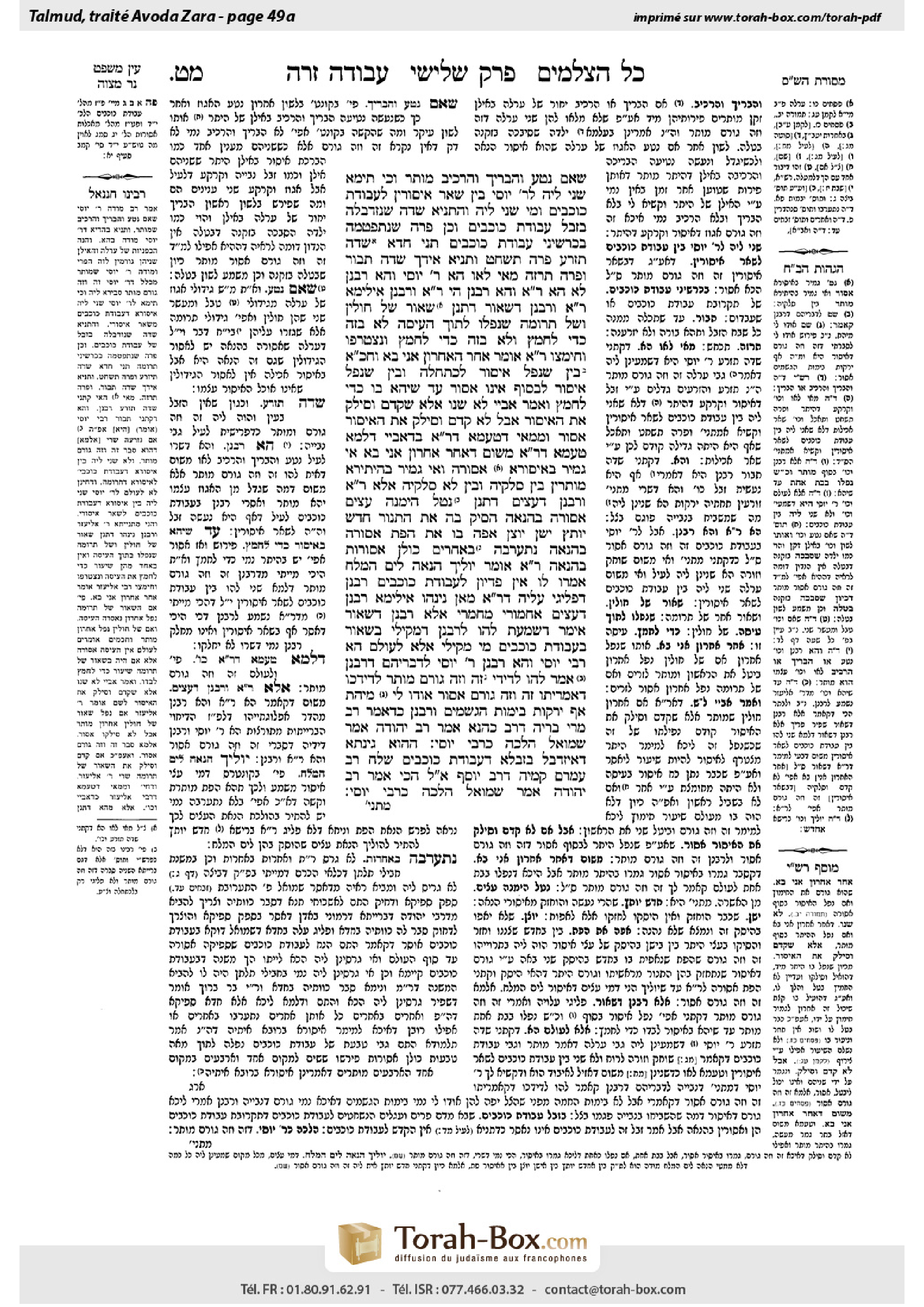
Avodah Zarah 49a: Talmud study for Daf Yomi
Study the Talmud for Daf Yomi with scanned pages, Hebrew text, English translations from Sefaria and AI-generated French translations.
Passage selection and English or AI-generated French translation are available where the scan has annotations. Daf Study is independent of Torah-Box and Sefaria.
Browse Avodah Zarah · עבודה זרה · All tractatesAvodah Zarah 49a text and translations
This page of Avodah Zarah includes the Aramaic text, an English translation and an AI-generated French translation, alongside the scan above.
עבודה זרה מ״ט א · Aramaic and Hebrew text
שֶׁאִם נָטַע וְהִבְרִיךְ וְהִרְכִּיב — מוּתָּר.
וְכִי תֵּימָא, שָׁנֵי לֵיהּ לְרַבִּי יוֹסֵי בֵּין שְׁאָר אִיסּוּרִין לַעֲבוֹדָה זָרָה, וּמִי שָׁנֵי לֵיהּ? וְהָתַנְיָא: שָׂדֶה שֶׁנִּזְדַּבְּלָה בְּזֶבֶל עֲבוֹדָה זָרָה, וְכֵן פָּרָה שֶׁנִּתְפַּטְּמָה בְּכַרְשִׁינֵי עֲבוֹדָה זָרָה, תָּנֵי חֲדָא: שָׂדֶה תִּזָּרַע, פָּרָה תִּשָּׁחֵט, וְתַנְיָא אִידַּךְ: שָׂדֶה תָּבוֹר, וּפָרָה תִּרְזֶה.
מַאי לָאו הָא רַבִּי יוֹסֵי, וְהָא רַבָּנַן? לָא, הָא רַבִּי אֱלִיעֶזֶר, וְהָא רַבָּנַן.
הֵי רַבִּי אֱלִיעֶזֶר וְרַבָּנַן? אִילֵימָא רַבִּי אֱלִיעֶזֶר וְרַבָּנַן דִּשְׂאוֹר.
דִּתְנַן: שְׂאוֹר שֶׁל חוּלִּין וְשֶׁל תְּרוּמָה שֶׁנָּפְלוּ לְתוֹךְ הָעִיסָּה, לֹא בָּזֶה כְּדֵי לְחַמֵּץ וְלֹא בָּזֶה כְּדֵי לְחַמֵּץ, וְנִצְטָרְפוּ וְחִימְּצוּ.
רַבִּי אֱלִיעֶזֶר אוֹמֵר: אַחַר הָאַחֲרוֹן אֲנִי בָּא, וַחֲכָמִים אוֹמְרִים: בֵּין שֶׁנָּפַל אִיסּוּר לְכִתְחִלָּה וּבֵין שֶׁנָּפַל אִיסּוּר לְבַסּוֹף, אֵינוֹ אָסוּר עַד שֶׁיְּהֵא בּוֹ כְּדֵי לְחַמֵּץ.
וְאָמַר אַבָּיֵי: לֹא שָׁנוּ אֶלָּא שֶׁקָּדַם וְסִילֵּק אֶת הָאִיסּוּר, אֲבָל לֹא קָדַם וְסִילֵּק אֶת הָאִיסּוּר — אָסוּר.
וּמִמַּאי דְּטַעְמָא דְּרַבִּי אֱלִיעֶזֶר כִּדְאַבָּיֵי? דִּלְמָא טַעְמָא דְּרַבִּי אֱלִיעֶזֶר מִשּׁוּם דְּ״אַחַר אַחֲרוֹן אֲנִי בָּא״, אִי גְּמִיר בְּאִיסּוּרָא — אֲסוּרָה, וְאִי גְּמִיר בְּהֶיתֵּירָא — מוּתָּרִין, בֵּין סַלְּקֵיהּ וּבֵין לָא סַלְּקֵיהּ!
אֶלָּא, רַבִּי אֱלִיעֶזֶר וְרַבָּנַן דְּעֵצִים.
דִּתְנַן: נָטַל הֵימֶנָּה עֵצִים — אֲסוּרָה בַּהֲנָאָה. הִסִּיק בָּהּ אֶת הַתַּנּוּר, חָדָשׁ — יוּתַּץ, יָשָׁן — יוּצַן. אָפָה בּוֹ אֶת הַפַּת — אֲסוּרָה בַּהֲנָאָה.
נִתְעָרְבָה בַּאֲחֵרִים — כּוּלָּן אֲסוּרוֹת בַּהֲנָאָה. רַבִּי אֱלִיעֶזֶר אוֹמֵר: יוֹלִיךְ הֲנָאָה לְיָם הַמֶּלַח. אָמְרוּ לוֹ: אֵין פִּדְיוֹן לַעֲבוֹדָה זָרָה.
רַבָּנַן דִּפְלִיגִי עֲלֵיהּ דְּרַבִּי אֱלִיעֶזֶר, מַאן נִינְהוּ?
אִילֵּימָא רַבָּנַן דְּעֵצִים, אַחְמוֹרֵי מַחְמְרִי!
אֶלָּא רַבָּנַן דִּשְׂאוֹר, אֵימַר דְּשָׁמְעַתְּ לְהוּ לְרַבָּנַן דִּמְקִילִּי בִּשְׂאוֹר, בַּעֲבוֹדָה זָרָה מִי מְקִילִּי?
אֶלָּא לְעוֹלָם: הָא רַבִּי יוֹסֵי וְהָא רַבָּנַן.
רַבִּי יוֹסֵי לְדִבְרֵיהֶם דְּרַבָּנַן אֲמַר לְהוּ: לְדִידִי, זֶה וָזֶה גּוֹרֵם מוּתָּר,
לְדִידְכוּ דְּאָמְרִיתוּ: זֶה וָזֶה גּוֹרֵם — אָסוּר, אוֹדוֹ לִי מִיהַת אַף יְרָקוֹת בִּימוֹת הַגְּשָׁמִים!
וְרַבָּנַן? כִּדְאָמַר רַב מָרִי בְּרֵיהּ דְּרַב כָּהֲנָא.
אָמַר רַב יְהוּדָה אָמַר שְׁמוּאֵל: הֲלָכָה כְּרַבִּי יוֹסֵי. הָהוּא גִּינְּתָא דְּאִיזְדַּבַּל בְּזִבְלָא דַּעֲבוֹדָה זָרָה, שְׁלַח רַב עַמְרָם קַמֵּיהּ דְּרַב יוֹסֵף. אֲמַר לֵיהּ: הָכִי אָמַר רַב יְהוּדָה אָמַר שְׁמוּאֵל: הֲלָכָה כְּרַבִּי יוֹסֵי.
Avodah Zarah 49a · English translation
that if one planted an orla nut, or sank the shoot of an orla tree into the ground, or grafted an orla tree, that which grows as a result is permitted.
And if you would say that this is not difficult, as Rabbi Yosei distinguishes between items that are forbidden due to other prohibitions and items that are forbidden due to idol worship, does he indeed distinguish in this manner? But isn’t it taught that with regard to a field that was fertilized with dung that came from an animal used in idol worship, and similarly, with regard to a cow that was fattened with vetches used in idol worship, there are opposing opinions: It is taught in one baraita that the field may be sown in the normal manner and the cow may be slaughtered and eaten, and it is taught in another baraita that the field should be left fallow, and the cow should be made lean, until the effects of the dung or vetches have passed.
What, is it not that this baraita that rules leniently is in accordance with the opinion of Rabbi Yosei, who holds that when both permitted and forbidden items contribute to a result, the result is permitted, and that baraita that rules stringently is in accordance with the opinion of the Rabbis? If so, it is clear that Rabbi Yosei does not distinguish between other prohibitions and idol worship, as in this case of idol worship he still permits the result of permitted and forbidden causes. The Gemara answers: No, these baraitot do not reflect the opinions of Rabbi Yosei and the Rabbis. Rather, this baraita is in accordance with the opinion of Rabbi Eliezer, and that baraita is in accordance with the opinion of the Rabbis, who disagree with him.
The Gemara asks: Which dispute between Rabbi Eliezer and the Rabbis is referred to here? If we say that it is the dispute between Rabbi Eliezer and the Rabbis with regard to leaven, that dispute does not necessarily correspond to the controversy between these two baraitot.
As we learned in a mishna (Orla 2:11): In the case of non-sacred leaven and teruma leaven that fell into a non-sacred batch of dough, and this one alone was not potent enough to cause the dough to become leavened, and that one alone was not potent enough to cause the dough to become leavened, and they combined and caused the dough to become leavened, there is a dispute as to whether this dough has the status of teruma, and is therefore forbidden to non-priests, or whether it has the status of non-sacred bread.
Rabbi Eliezer says: I follow the final element that fell into the dough. If the teruma fell in last, the dough is forbidden to non-priests. And the Rabbis say: Whether the forbidden item, i.e., the teruma, fell in first, or whether the forbidden item fell in last, the dough is not forbidden unless there is enough of the forbidden leaven alone to cause the dough to become leavened.
And Abaye says: Rabbi Eliezer taught that when the permitted leaven fell in last, the mixture is permitted only in a case where one first removed the forbidden leaven, before the permitted leaven fell into the dough and made it rise. But if one did not first remove the forbidden leaven, the dough is forbidden even if the permitted leaven fell in last. Apparently, Rabbi Eliezer holds that when both permitted and forbidden leaven cause dough to become leavened, the dough is forbidden.
The Gemara rejects this interpretation: But from where is it apparent that the reason for the opinion of Rabbi Eliezer is in accordance with Abaye’s explanation? Perhaps the reason for the opinion of Rabbi Eliezer is as he says explicitly: I follow the final element. If the dough’s leavening is completed by the forbidden item, it is forbidden; and if it is completed by the permitted item, it is permitted. And this is the halakha whether one removed the forbidden item or whether one did not remove the forbidden item. Accordingly, Rabbi Eliezer does not necessarily hold that when both a forbidden and a permitted item contribute to a result, the result is forbidden.
Rather, the two conflicting baraitot cited with regard to a field fertilized with dung used in idol worship can be attributed in accordance with the opinions of Rabbi Eliezer and the Rabbis with regard to wood from an ashera tree.
As we learned in a mishna (49b): If one took wood from an ashera, it is prohibited to derive benefit from it. In a case where one kindled a fire in an oven with the wood, if it is a new oven and by kindling the fire he hardened the oven and made it stronger for use in the future, then the oven must be shattered. Since forbidden items were used in the process of forming the oven, one may not derive benefit from the use of the forbidden items. But if it is an old oven it may be cooled; it is prohibited to use the oven only while it is still hot. If one baked bread with wood from the ashera as the fuel, it is prohibited to derive benefit from the bread.
If this bread was intermingled with other bread, it is prohibited to derive benefit from all the bread. Rabbi Eliezer says: One must take the benefit and cast it into the Dead Sea. In other words, one is not required to destroy the bread. Instead, one should designate money equal in value to the wood that he used from the ashera, and he should destroy this money to offset the benefit he derived from the forbidden wood. The Rabbis said to him: There is no monetary redemption for objects that are forbidden due to idol worship. Once the bread becomes forbidden, it cannot be redeemed by having the value of the forbidden wood cast into the Dead Sea. In any event, Rabbi Eliezer apparently holds that the result of both forbidden and permitted causes is forbidden, as the bread was baked with both forbidden fuel, i.e., the wood from the ashera, and the permitted oven.
The Gemara asks: If the two conflicting baraitot cited with regard to a field fertilized with dung used in idol worship are attributed in accordance with the opinions of Rabbi Eliezer and the Rabbis, and if this is referring to Rabbi Eliezer’s statement with regard to bread baked in an oven that was heated with fuel from an ashera, then who are the Rabbis who disagree with Rabbi Eliezer, to whom the other baraita is attributed?
If we say that the reference is to the Rabbis who disagree with Rabbi Eliezer with regard to bread baked with wood from an ashera, this cannot be, as they are even more stringent than Rabbi Eliezer with regard to this matter. Not only do they deem bread that was baked with both forbidden and permitted fuel to be forbidden, but they require that it be destroyed and not redeemed. In other words, with regard to the status of the bread there is no dispute; all agree that it is forbidden. Therefore, both opinions are in accordance with the baraita that prohibits the result of both forbidden and permitted causes.
If the reference is rather to the Rabbis who disagree with Rabbi Eliezer with regard to teruma leaven that mixed with non-sacred leaven, as the Rabbis permit the mixture as long as the teruma leaven was not potent enough to cause the dough to rise, the more lenient of the two baraitot cannot be attributed in accordance with this opinion either; as say that you heard that these Rabbis are lenient with regard to the case of leaven; does that mean that they are lenient with regard to cases involving items of idol worship?
As a result of this question, the Gemara retracts its suggestion that Rabbi Yosei’s opinion in the mishna is based on the opinion that a result caused by both permitted and forbidden items is forbidden. Rather, Rabbi Yosei holds that the result is permitted, as is evident from the case of a ground-up and dispersed object of idol worship and from the case of a planted orla nut. Therefore, the baraitot can actually be attributed as follows: This baraita that permits the use of the field is in accordance with the opinion of Rabbi Yosei, and that baraita that prohibits its use is in accordance with the opinion of the Rabbis.
And as for the mishna, which seems to indicate that Rabbi Yosei holds that when a result is caused by both permitted and forbidden items it is forbidden, the Gemara explains that Rabbi Yosei was not expressing his own opinion. Rather, when he said that one may not plant vegetables under an ashera even during the rainy season, he said so in accordance with the statement of the Rabbis that a result caused by both permitted and forbidden items is forbidden. Rabbi Yosei said to them: According to my own opinion, when both this and that cause it, i.e., when both permitted and forbidden items contribute to a result, the result is permitted. It is therefore permitted to plant vegetables under an ashera during all seasons.
But according to your opinion, as you say that when both this and that cause a result it is prohibited, as seen from your ruling that it is prohibited to plant under an ashera during the summer because of the positive effect of the ashera tree’s shade, you should concede to me, in any event, that planting the vegetables even during the rainy season, when there is no shade, is prohibited, because they are fertilized by the fallen foliage.
The Gemara asks: And how would the Rabbis reply to Rabbi Yosei’s point? The Gemara answers: They would reply in accordance with the aforementioned statement that Rav Mari, son of Rav Kahana, says (48b), that when a certain activity causes both a benefit and a greater or equal loss, it is not regarded as a benefit. Here, the positive effect on the plant from the tree’s foliage is offset by the fact that its shade prevents rainwater from reaching the plant. Therefore, since there is no overall benefit gained from the ashera, the Rabbis permit planting underneath it in the winter.
The Gemara concludes: Rav Yehuda says that Shmuel says: The halakha is in accordance with the opinion of Rabbi Yosei. The Gemara recounts an incident supporting this ruling: There was a certain garden that was fertilized with dung that came from an animal used in idol worship. Rav Amram sent a query to Rav Yosef, asking what the halakha is in such a case. Rav Yosef said to him that this is what Rav Yehuda says that Shmuel says: The halakha is in accordance with the opinion of Rabbi Yosei; the produce of the garden is therefore permitted.
Avodah Zarah 49a · Traduction française (IA)
que si l'on a planté un noyau d'orla, ou si l'on a planté un rejeton d'un arbre d'orla dans le sol, ou si l'on a greffé un arbre d'orla, ce qui en résulte est permis.
Et si l'on dit que cela n'est pas difficile, puisque le maître Yosei distingue entre les choses interdites en raison d'autres prohibitions et celles interdites en raison de l'idolâtrie, distingue-t-il ainsi ? Mais n'est-il pas enseigné que concernant un champ fertilisé avec des crottins provenant d'un animal utilisé dans l'idolâtrie, et de même concernant une vache qui a été grassée avec des fèves utilisées dans l'idolâtrie, il y a des opinions opposées : il est enseigné dans une baraïta que le champ peut être semé normalement et la vache peut être sacrifiée et mangée, et il est enseigné dans une autre baraïta que le champ doit rester en friche et la vache doit être maigre jusqu'à ce que les effets des crottins ou des fèves aient disparu.
Qu'est-ce que cela signifie ? Ce n'est pas que cette baraïta qui est leniente est selon l'opinion du maître Yosei, qui considère que lorsque des choses permises et interdites contribuent à un résultat, ce résultat est permis, et que cette baraïta qui est stricte est selon l'opinion des Rabbins ? Si c'est ainsi, il est clair que le maître Yosei ne distingue pas entre d'autres prohibitions et l'idolâtrie, car dans ce cas d'idolâtrie il permet le résultat des causes permises et interdites. La Guemara répond : Non, ces baraitot ne reflètent pas les opinions du maître Yosei et des Rabbins. Plutôt, cette baraïta est selon l'opinion du maître Eliezer, et cette baraïta est selon l'opinion des Rabbins, qui s'y opposent.
La Guemara demande : De quel débat entre le maître Eliezer et les Rabbins s'agit-il ici ? Si l'on dit que c'est le débat entre le maître Eliezer et les Rabbins concernant la levain, ce débat ne correspond pas nécessairement au conflit entre ces deux baraitot.
Comme nous l'avons appris dans une mitsva (Orla 2:11) : Dans le cas d'un levain non sacré et d'un levain de terouma qui sont tombés dans une pâte non sacrée, et que seul l'un n'était pas suffisant pour faire lever la pâte, et que seul l'autre n'était pas suffisant pour faire lever la pâte, et qu'ils se sont combinés pour faire lever la pâte, il y a un débat sur le fait que cette pâte ait le statut de terouma, et donc soit interdite aux non-prêtres, ou qu'elle ait le statut de pain non sacré.
Le maître Eliezer dit : Je suis en accord avec l'élément qui est tombé en dernier dans la pâte. Si le terouma est tombé en dernier, la pâte est interdite aux non-prêtres. Et les Rabbins disent : Qu'importe si l'élément interdit, c'est-à-dire le terouma, est tombé en premier ou en dernier, la pâte n'est pas interdite à moins qu'il y ait suffisamment de levain interdit seul pour faire lever la pâte.
Et Abaye dit : Le maître Eliezer enseigne que lorsque le levain interdit est tombé en dernier, le mélange est permis uniquement dans le cas où l'on a d'abord retiré le levain permis avant que le levain interdit ne tombe dans la pâte et ne fasse lever celle-ci. Mais si l'on n'a pas d'abord retiré le levain permis, la pâte est interdite même si le levain interdit est tombé en dernier. Apparemment, le maître Eliezer considère que lorsque les levains permis et interdits font lever la pâte, la pâte est interdite.
La Guemara rejette cette interprétation : Mais d'où sait-on que la raison de l'opinion du maître Eliezer est selon l'explication d'Abaye ? Peut-être que la raison de l'opinion du maître Eliezer est telle qu'il l'explique explicitement : Je suis en accord avec l'élément final. Si la levain est achevée par l'élément interdit, elle est interdite ; et si elle est achevée par l'élément permis, elle est permise. Et c'est la halakha que l'on ait retiré l'élément interdit ou non. Ainsi, le maître Eliezer ne considère pas nécessairement que lorsque les deux éléments interdit et permis contribuent à un résultat, ce résultat est interdit.
Plutôt, les deux baraitot conflictuelles cités concernant un champ fertilisé avec des crottins utilisés dans l'idolâtrie peuvent être attribués selon les opinions du maître Eliezer et des Rabbins concernant le bois provenant d'un arbre ashera.
Comme nous l'avons appris dans une mitsna (49b) : Si l'on a pris du bois d'un arbre ashera, il est interdit d'en tirer un bénéfice. Dans le cas où l'on a allumé un feu dans une fournaise avec ce bois, si c'est une fournaise neuve et qu'en allumant le feu l'on a durci la fournaise et l'a rendue plus solide pour l'usage futur, alors la fournaise doit être brisée. Puisque des choses interdites ont été utilisées dans le processus de formation de la fournaise, on ne peut pas tirer un bénéfice de l'utilisation des choses interdites. Mais si c'est une fournaise ancienne, elle peut être refroidie ; il est interdit d'utiliser la fournaise tant qu'elle est encore chaude. Si l'on a cuit du pain avec du bois d'arbre ashera comme combustible, il est interdit de tirer un bénéfice du pain.
Si ce pain était mélangé avec d'autres pains, il est interdit de tirer un bénéfice de tous les pains. Le maître Eliezer dit : On doit prendre le bénéfice et le jeter dans la Mer Morte. En d'autres termes, on n'est pas tenu de détruire le pain. Au contraire, on devrait désigner une somme d'argent égale à la valeur du bois utilisé de l'arbre ashera, et on devrait détruire cette somme pour compenser le bénéfice tiré du bois interdit. Les Rabbins dirent à lui : Il n'y a pas de rédemption monétaire pour les objets interdits en raison de l'idolâtrie. Une fois que le pain devient interdit, il ne peut pas être racheté en jetant la valeur du bois interdit dans la Mer Morte. En tout cas, le maître Eliezer semble considérer que le résultat des causes interdites et permises est interdit, car le pain a été cuit avec un combustible interdit, c'est-à-dire le bois de l'arbre ashera, et une fournaise permise.
La Guemara pose la question : Si les deux baraitot contradictoires citées concernant un champ fertilisé avec des déjections utilisées dans le culte idolâtre sont attribuées selon les opinions de Rabbi Eliezer et des Sages, et si cela fait référence à l'affirmation de Rabbi Eliezer concernant le pain cuit dans un four chauffé par du bois provenant d'une ashera, alors qui sont les Sages qui s'opposent à Rabbi Eliezer, auxquels est attribuée l'autre baraïta ?
Si nous disons que la référence est aux Sages qui s'opposent à Rabbi Eliezer concernant le pain cuit avec du bois provenant d'une ashera, cela ne peut pas être, car ils sont encore plus stricts que Rabbi Eliezer à cet égard. Ils ne considèrent pas seulement le pain cuit avec à la fois des combustibles interdits et permis comme interdit, mais ils exigent qu'il soit détruit et non racheté. En d'autres termes, concernant le statut du pain, il n'y a pas de désaccord ; tous s'accordent à dire qu'il est interdit. Ainsi, les deux opinions s'accordent sur la baraïta qui interdit le résultat des causes interdites et permises conjointement.
Si la référence est plutôt aux Sages qui s'opposent à Rabbi Eliezer concernant le levain terouma mélangé avec du levain non sacré, comme les Sages permettent le mélange tant que le levain terouma n'était pas suffisamment puissant pour faire lever la pâte, la baraïta plus clémente ne peut pas non plus être attribuée à cet avis ; car si l'on dit que vous avez entendu que ces Sages sont cléments concernant le cas du levain, cela signifie-t-il qu'ils sont cléments concernant les cas impliquant des objets de culte idolâtre ?
En conséquence de cette question, la Guemara retire sa suggestion selon laquelle l'opinion de Rabbi Yosei dans la Michna est basée sur l'idée que le résultat causé par des choses permises et interdites est interdit. Plutôt, Rabbi Yosei considère que le résultat est permis, comme on le voit dans le cas d'un objet de culte idolâtre broyé et dispersé, et dans le cas d'un noyau d'orla planté. Ainsi, les baraitot peuvent être attribuées comme suit : cette baraïta qui permet l'utilisation du champ est selon l'opinion de Rabbi Yosei, et celle qui interdit son utilisation est selon l'opinion des Sages.
Et concernant la Michna, qui semble indiquer que Rabbi Yosei considère que lorsqu'un résultat est causé par des choses permises et interdites, il est interdit, la Guemara explique que Rabbi Yosei n'exprimait pas son propre avis. Plutôt, lorsqu'il a dit qu'on ne doit pas planter des légumes sous une ashera même pendant la saison des pluies, il l'a dit selon l'affirmation des Sages que le résultat causé par des choses permises et interdites est interdit. Rabbi Yosei a dit aux Sages : Selon mon propre avis, lorsque les deux causes contribuent à un résultat, c'est-à-dire lorsque des choses permises et interdites contribuent à un résultat, le résultat est permis. Il est donc permis de planter des légumes sous une ashera à toutes les saisons.
Mais selon votre avis, comme vous dites que lorsque les deux causes contribuent à un résultat, il est interdit, comme on le voit de votre décision d'interdire de planter sous une ashera en été en raison de l'effet positif de l'ombre de l'arbre ashera, vous devriez reconnaître à mon égard que planter des légumes même pendant la saison des pluies, lorsque l'ombre n'existe pas, est interdit, car ils sont fertilisés par les feuilles tombées.
La Guemara pose la question : Et comment les Sages répondraient-ils au point de Rabbi Yosei ? La Guemara répond : Ils répondraient selon l'affirmation précédente que Rav Mari, fils de Rav Kahana, dit (48b), que lorsqu'une activité cause à la fois un bénéfice et une perte égale ou supérieure, elle n'est pas considérée comme un bénéfice. Ici, l'effet positif sur la plante causé par les feuilles de l'arbre ashera est compensé par le fait que son ombre empêche l'eau de pluie de parvenir à la plante. Ainsi, puisque aucun bénéfice global n'est obtenu de l'ashera, les Sages permettent de planter sous elle en hiver.
La Guemara conclut : Rav Yehuda dit que Shmuel dit : La halakha suit l'opinion de Rabbi Yosei. La Guemara rapporte un incident qui soutient cette décision : Il y avait un jardin fertilisé avec des déjections provenant d'un animal utilisé dans le culte idolâtre. Rav Amram envoya une question à Rav Yosef, demandant quelle est la halakha dans ce cas. Rav Yosef lui dit que c'est ce que Rav Yehuda dit que Shmuel dit : La halakha suit l'opinion de Rabbi Yosei ; la production du jardin est donc permise.
Traduction française générée par IA à partir de l’édition anglaise de Sefaria. Vérifie toujours un passage avec le texte source.
Text from Sefaria: William Davidson Edition - Vocalized Aramaic (CC BY NC); William Davidson Edition - English (CC BY NC).