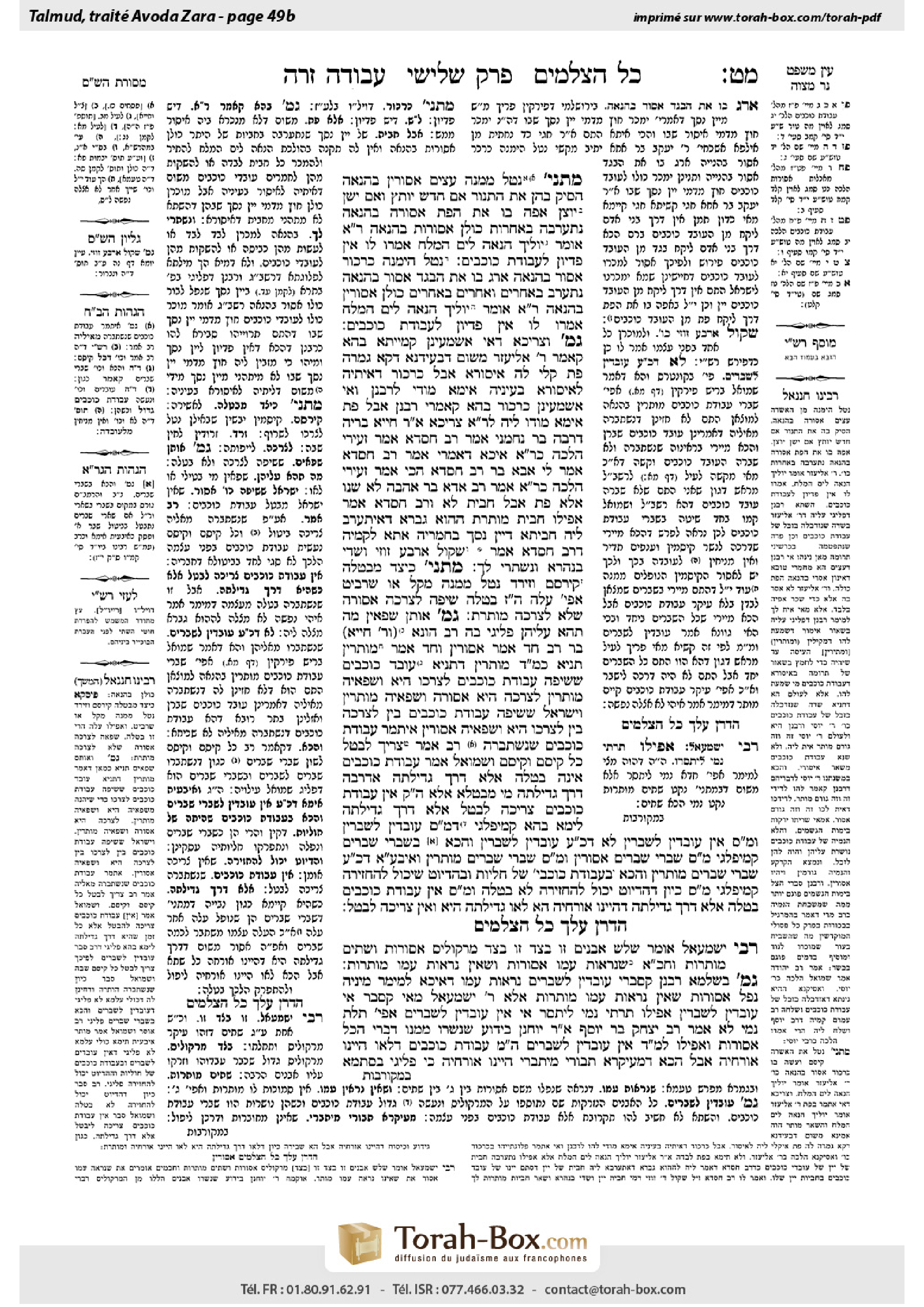
Avodah Zarah 49b: Talmud study for Daf Yomi
Study the Talmud for Daf Yomi with scanned pages, Hebrew text, English translations from Sefaria and AI-generated French translations.
Passage selection and English or AI-generated French translation are available where the scan has annotations. Daf Study is independent of Torah-Box and Sefaria.
Browse Avodah Zarah · עבודה זרה · All tractatesAvodah Zarah 49b text and translations
This page of Avodah Zarah includes the Aramaic text, an English translation and an AI-generated French translation, alongside the scan above.
עבודה זרה מ״ט ב · Aramaic and Hebrew text
מַתְנִי׳ נָטַל מִמֶּנָּה עֵצִים — אֲסוּרִין בַּהֲנָאָה. הִסִּיק בָּהֶן אֶת הַתַּנּוּר, אִם חָדָשׁ — יוּתַּץ, וְאִם יָשָׁן — יוּצַן. אָפָה בּוֹ אֶת הַפַּת — אֲסוּרָה בַּהֲנָאָה.
נִתְעָרְבָה בַּאֲחֵרוֹת — כּוּלָּן אֲסוּרוֹת בַּהֲנָאָה, רַבִּי אֱלִיעֶזֶר אוֹמֵר: יוֹלִיךְ הֲנָאָה לְיָם הַמֶּלַח, אָמְרוּ לוֹ: אֵין פִּדְיוֹן לַעֲבוֹדָה זָרָה.
נָטַל הֵימֶנָּה כַּרְכֵּור — אָסוּר בַּהֲנָאָה. אָרַג בּוֹ אֶת הַבֶּגֶד — אָסוּר בַּהֲנָאָה. נִתְעָרֵב בַּאֲחֵרִים וַאֲחֵרִים בַּאֲחֵרִים — כּוּלָּן אֲסוּרִין בַּהֲנָאָה. רַבִּי אֱלִיעֶזֶר אוֹמֵר: יוֹלִיךְ הֲנָאָה לְיָם הַמֶּלַח. אָמְרוּ לוֹ: אֵין פִּדְיוֹן לַעֲבוֹדָה זָרָה.
גְּמָ׳ וּצְרִיכָא, דְּאִי אַשְׁמְעִינַן קַמַּיְיתָא, בְּהָא קָאָמַר רַבִּי אֱלִיעֶזֶר, מִשּׁוּם דִּבְעִידָּנָא דְּקָא גָמְרָה פַּת קָלֵי לַהּ אִיסּוּרָא, אֲבָל כַּרְכֵּור דְּאִיתֵיהּ לְאִיסּוּרָא בְּעֵינֵיהּ, אֵימָא מוֹדֵי לְרַבָּנַן.
וְאִי אַשְׁמְעִינַן כַּרְכֵּור, בְּהָא קָאָמְרִי רַבָּנַן, אֲבָל פַּת — אֵימָא מוֹדוּ לֵיהּ לְרַבִּי אֱלִיעֶזֶר. צְרִיכָא.
אָמַר רַב חִיָּיא בְּרֵיהּ דְּרַבָּה בַּר נַחְמָנִי אָמַר רַב חִסְדָּא אָמַר זְעֵירִי: הֲלָכָה כְּרַבִּי אֱלִיעֶזֶר. אִיכָּא דְּאָמְרִי, אָמַר רַב חִסְדָּא: אָמַר לִי אַבָּא בַּר רַב חִסְדָּא, הָכִי אָמַר זְעֵירִי: הֲלָכָה כְּרַבִּי אֱלִיעֶזֶר.
אָמַר רַב אַדָּא בַּר אַהֲבָה: לֹא שָׁנוּ אֶלָּא פַּת, אֲבָל חָבִית — לָא, וְרַב חִסְדָּא אָמַר: אֲפִילּוּ חָבִית מוּתֶּרֶת.
הָהוּא גַּבְרָא דְּאִיתְעָרַב לֵיהּ חָבִיתָא דְּיֵין נֶסֶךְ בְּחַמְרֵיהּ, אֲתָא לְקַמֵּיהּ דְּרַב חִסְדָּא, אֲמַר: שְׁקוֹל אַרְבַּע זוּזֵי וּשְׁדִי בְּנַהֲרָא, וְנִשְׁתְּרֵי לָךְ.
מַתְנִי׳ כֵּיצַד מְבַטְּלָהּ? קִירְסֵם וְזֵירֵד, נָטַל מִמֶּנָּה מַקֵּל אוֹ שַׁרְבִיט, אֲפִילּוּ עָלֶה — הֲרֵי זֹה בְּטֵלָה. שִׁיפָּהּ לְצׇרְכָּהּ — אֲסוּרָה, שֶׁלֹּא לְצׇרְכָּהּ — מוּתֶּרֶת.
גְּמָ׳ אוֹתָן שְׁפָאִין — מָה תְּהֵא עֲלֵיהֶן? פְּלִיגִי בַּהּ רַב הוּנָא וְרַבִּי חִיָּיא בַּר רַב: חַד אָמַר אֲסוּרִין, וְחַד אָמַר מוּתָּרִין.
תַּנְיָא כְּמַאן דְּאָמַר מוּתָּרִין, דְּתַנְיָא: גּוֹי שֶׁשִּׁיפָּה עֲבוֹדָה זָרָה לְצׇרְכּוֹ — הִיא וּשְׁפָאֶיהָ מוּתָּרִין, לְצׇרְכָּהּ — הִיא אֲסוּרָה וּשְׁפָאֶיהָ מוּתָּרִין, וְיִשְׂרָאֵל שֶׁשִּׁיפָּה עֲבוֹדָה זָרָה, בֵּין לְצׇרְכָּהּ בֵּין לְצׇרְכּוֹ — הִיא וּשְׁפָאֶיהָ אֲסוּרִין.
אִיתְּמַר: עֲבוֹדָה זָרָה שֶׁנִּשְׁתַּבְּרָה, רַב אָמַר: צָרִיךְ לְבַטֵּל כׇּל קֵיסָם וְקֵיסָם, וּשְׁמוּאֵל אָמַר: עֲבוֹדָה זָרָה אֵינָהּ בְּטֵלָה אֶלָּא דֶּרֶךְ גְּדִילָתָהּ.
אַדְּרַבָּה, דֶּרֶךְ גְּדִילָתָהּ מִי מְבַטְּלָא? אֶלָּא הָכִי קָאָמַר: אֵין עֲבוֹדָה זָרָה צְרִיכָה לְבַטֵּל אֶלָּא דֶּרֶךְ גְּדִילָתָהּ.
לֵימָא בְּהָא קָמִיפַּלְגִי, דְּמָר סָבַר: עוֹבְדִין לִשְׁבָרִין, וּמַר סָבַר: אֵין עוֹבְדִין לִשְׁבָרִין?
לָא, דְּכוּלֵּי עָלְמָא עוֹבְדִין לִשְׁבָרִין, וְהָכָא בְּשִׁבְרֵי שְׁבָרִים קָמִיפַּלְגִי, מָר סָבַר: שִׁבְרֵי שְׁבָרִים אֲסוּרִין, וּמָר סָבַר: שִׁבְרֵי שְׁבָרִים מוּתָּרִין.
וְאִי בָּעֵית אֵימָא: דְּכוּלֵּי עָלְמָא שִׁבְרֵי שְׁבָרִים מוּתָּרִין, וְהָכָא בַּעֲבוֹדָה זָרָה שֶׁל חֻלְיוֹת, וּבְהֶדְיוֹט שֶׁיָּכוֹל לְהַחְזִירָהּ קָמִיפַּלְגִי. מָר סָבַר: כֵּיוָן דְּהֶדְיוֹט יָכוֹל לְהַחְזִירָהּ לָא בָּטְלָה, וּמַר סָבַר: אֵין עֲבוֹדָה זָרָה בְּטֵלָה אֶלָּא דֶּרֶךְ גְּדִילָתָהּ, דְּהַיְינוּ אוֹרְחֵיהּ, הָא לָאו גְּדִילָתָהּ הִיא, וְאֵין צְרִיכָה לְבַטֵּל.
הֲדַרַן עֲלָךְ כׇּל הַצְּלָמִים.
מַתְנִי׳ רַבִּי יִשְׁמָעֵאל אוֹמֵר: שָׁלֹשׁ אֲבָנִים זוֹ בְּצַד זוֹ בְּצַד מַרְקוּלִיס — אֲסוּרוֹת, וּשְׁתַּיִם — מוּתָּרוֹת. וַחֲכָמִים אוֹמְרִים: שֶׁנִּרְאוֹת עִמּוֹ — אֲסוּרוֹת, וְשֶׁאֵין נִרְאוֹת עִמּוֹ — מוּתָּרוֹת.
גְּמָ׳ בִּשְׁלָמָא רַבָּנַן קָסָבְרִי עוֹבְדִין לִשְׁבָרִים, נִרְאוֹת עִמּוֹ דְּאִיכָּא לְמֵימַר מִינֵּיהּ נְפַל — אֲסוּרוֹת, שֶׁאֵין נִרְאוֹת עִמּוֹ — מוּתָּרוֹת.
אֶלָּא רַבִּי יִשְׁמָעֵאל מַאי קָסָבַר? אִי עוֹבְדִין לִשְׁבָרִין, אֲפִילּוּ תַּרְתֵּי נָמֵי לִיתְּסַר! אִי אֵין עוֹבְדִין לִשְׁבָרִים, אֲפִילּוּ תְּלָת נָמֵי לָא!
אָמַר רַב יִצְחָק בַּר יוֹסֵף אָמַר רַבִּי יוֹחָנָן: בְּיָדוּעַ שֶׁנָּשְׁרוּ מִמֶּנּוּ — דִּבְרֵי הַכֹּל אֲסוּרוֹת, וַאֲפִילּוּ לְמַאן דְּאָמַר: אֵין עוֹבְדִין לִשְׁבָרִים — הָנֵי מִילֵּי עֲבוֹדָה זָרָה דְּלָאו הַיְינוּ אוֹרְחֵיהּ, אֲבָל הָכָא דְּמֵעִיקָּרָא תַּבּוֹרֵי מִיתַּבְּרִי — הַיְינוּ אוֹרְחֵיהּ, כִּי פְּלִיגִי בִּסְתָמָא.
Avodah Zarah 49b · English translation
MISHNA: If one took wood from an ashera, it is prohibited to derive benefit from it. In a case where one kindled a fire in an oven with the wood, if it is a new oven and by kindling the fire he hardened the oven and made it stronger for use in the future, then the oven must be shattered. Since forbidden items were used in the process of forming the oven, one may not derive benefit from the use of the forbidden items. But if it is an old oven it may be cooled; it is prohibited to use the oven only while it is still hot. If one baked bread with wood from the ashera as the fuel, it is prohibited to derive benefit from the bread.
If this bread was intermingled with other bread, it is prohibited to derive benefit from all the bread. Rabbi Eliezer says: One must take the benefit and cast it into the Dead Sea. In other words, one is not required to destroy all of the loaves. Instead, one should designate money equal in value to the wood that he used from the ashera, and he should destroy this money to offset the benefit he derived from the forbidden wood. The Rabbis said to him: There is no monetary redemption for objects that are forbidden due to idol worship. Once the bread becomes forbidden, it cannot be redeemed by having the value of the forbidden wood cast into the Dead Sea.
If one took wood from an ashera for use as a weaving shuttle [karkor], it is prohibited to derive benefit from it. If one wove a garment with it, it is prohibited to derive benefit from the garment. If the garment was intermingled with other garments, and those other garments were intermingled with others, it is prohibited to derive benefit from all of them. Rabbi Eliezer says: One must take the benefit and cast it into the Dead Sea. The Rabbis said to him: There is no monetary redemption for objects that are forbidden due to idol worship.
GEMARA: The mishna presents two cases where Rabbi Eliezer and the Rabbis disagree. The Gemara explains: And both are necessary; as if the mishna had taught us only the first case, concerning the forbidden bread, one might have thought that it is only in this case that Rabbi Eliezer says that the bread is permitted after casting the value gained from the forbidden wood into the Dead Sea, because at the time that the bread has finished baking, the forbidden wood has burned up. But in the case of the shuttle, where the original forbidden piece of wood is still extant, perhaps one will say that he concedes to the Rabbis that the forbidden garment may not be redeemed.
And if the mishna had taught us only the case of the shuttle, one might have thought that it is only in this case that the Rabbis say that the forbidden garment may not be redeemed, because the original forbidden piece of wood is still extant. But in the case of the bread, where the forbidden wood was already burned up by the time the bread finished baking, perhaps one will say that they concede to Rabbi Eliezer that the bread may be redeemed. Therefore, both cases are necessary.
Rav Ḥiyya, son of Rabba bar Naḥmani, says that Rav Ḥisda says that Ze’eiri says: The halakha is in accordance with the opinion of Rabbi Eliezer. There are those who say there is a different version of this ruling: Rav Ḥisda says: Abba bar Rav Ḥisda said to me that this is what Ze’eiri says: The halakha is in accordance with the opinion of Rabbi Eliezer.
Rav Adda bar Ahava says: They taught that the halakha is in accordance with the opinion of Rabbi Eliezer only in the case of forbidden bread. But with regard to the case of a barrel of wine used for an idolatrous libation, which was intermingled with permitted barrels of wine, the halakha is not in accordance with the opinion of Rabbi Eliezer. And Rav Ḥisda says: Even in the case of a barrel of libation wine, the wine in the other barrels is permitted once the value of the forbidden barrel has been cast into the Dead Sea.
The Gemara relates: There was a certain man, and it happened that a barrel of wine used for a libation became intermingled with his wine. He came before Rav Ḥisda to ask what he should do. Rav Ḥisda said to him: Take four dinars and cast them into the river, and the rest of the wine will be permitted to you.
MISHNA: How does one revoke the idolatrous status of an ashera? If a gentile trimmed dry wood or pruned green wood from the tree for his own benefit, or if he removed from it a stick, or a rod, or even a leaf, he has thereby revoked its idolatrous status, as he has proven that he no longer worships it. If a gentile shaved down the tree for its own sake, to improve its appearance, it remains prohibited to derive benefit from it. If he shaved it down not for its own sake, it is permitted.
GEMARA: With regard to those shavings that were shaved off for the sake of the ashera, what should be done with them? Rav Huna and Rabbi Ḥiyya bar Rav disagree about it; one says the shavings are forbidden and one says they are permitted.
It is taught in a baraita in accordance with the one who says that the shavings are permitted, as it is taught in a baraita: In the case of a gentile who shaved down an object of idol worship for his own sake, as he wished to use the shavings, the tree and its shavings are permitted. The idolatrous status has been revoked from both the object and its shavings. If he shaved it for its, i.e., for the idol’s, own sake, it remains forbidden, but its shavings are permitted. And in the case of a Jew who shaved down an object of idol worship, whether for its sake or for his own sake, the object and its shavings remain forbidden, as a Jew cannot revoke an object’s idolatrous status.
It was stated: With regard to an object of idol worship that broke, Rav says: It is necessary to revoke the idolatrous status of each and every sliver. And Shmuel says: An object of idol worship can have its status nullified only if part of it breaks off in the course of its natural manner of growth.
The Gemara inquires about Shmuel’s ruling: On the contrary, can an object possibly have its idolatrous status nullified by breaking in the course of its natural manner of growth? The Gemara answers: Rather, this is what Shmuel is saying: If an object of idol worship breaks, its idolatrous status is automatically nullified, as the idol worshipper will see that it broke and will no longer attribute any power to it. It needs to have its idolatrous status actively revoked only in a case where it broke off in the course of its natural manner of growth. For example, if leaves fall from a worshipped tree, the tree and the leaves retain their idolatrous status. In this case, the idol worshipper will not attribute the fallen leaves to a lack of power of the tree.
The Gemara suggests: Let us say that Rav and Shmuel disagree about this: One Sage, Rav, holds that people worship even fragments of idols. Therefore, the fact that an idol broke does not result in the nullification of its idolatrous status. And one Sage, Shmuel, holds that people do not worship fragments of idols.
The Gemara rejects this suggestion: No, everyone agrees that people worship fragments of idols. And here, it is with regard to fragments of fragments that they disagree. One Sage, Rav, holds that fragments of fragments are forbidden; and one Sage, Shmuel, holds that fragments of fragments are permitted.
And if you wish, say instead that everyone agrees that fragments of fragments are permitted, and here they disagree with regard to objects of idol worship that are composed of segments that come apart and that a layman can reassemble. One Sage, Rav, holds that since a layman can reassemble it, its idolatrous status is not nullified. And one Sage, Shmuel, holds that an object of idol worship needs to have its status revoked only when it breaks in the course of its natural manner of growth, as that is its typical manner. This case, where the idol is disassembled, is not related to its natural growth and therefore it requires no further act to revoke its idolatrous status.
MISHNA: Rabbi Yishmael says: Three stones that are adjacent to each other at the side of Mercury [Markulis] are prohibited, as that idol was worshipped by tossing stones toward it, which then became part of the idol. But if there are only two stones, then they are permitted. And the Rabbis say: Those stones that are adjacent to Mercury and appear to have fallen from it are prohibited. But those stones that are not adjacent to it are permitted.
GEMARA: The Gemara asks: Granted, one can explain that the Rabbis hold that idol worshippers worship fragments of idols. Therefore, those stones that are adjacent to Mercury, where it can be said that they fell from its pile of stones, are prohibited; as they are considered fragments of an object of idol worship, namely the stone pile. And those that are not adjacent to Mercury are permitted, as they did not fall from it.
But with regard to the opinion of Rabbi Yishmael, what does he hold? If he holds that idol worshippers worship fragments of idols, even two stones should be prohibited. If he holds that idol worshippers do not worship fragments of idols, even three stones should not be prohibited.
Rav Yitzḥak bar Yosef says that Rabbi Yoḥanan says: In a case where it is known that these stones fell from the pile of stones, everyone agrees that they are prohibited, and this is the halakha even according to the one who says: Idol worshippers do not worship fragments. As that statement applies only to a form of idol worship where that is not the normal manner in which it is worshipped. But here, where the stones thrown onto the pile are broken stones from the outset, this is its normal manner of worship. They disagree only when it is not specifically known where these stones came from.
Avodah Zarah 49b · Traduction française (IA)
MICHNA: Si l'on a pris du bois d'une ashera, il est interdit d'en tirer un bénéfice. Dans le cas où l'on a allumé un feu dans une fournaise avec ce bois, si c'est une fournaise neuve et que, en allumant le feu, on a durci la fournaise et l'a rendue plus solide pour l'usage futur, alors la fournaise doit être brisée. Puisque des objets interdits ont été utilisés dans le processus de fabrication de la fournaise, on ne peut pas tirer un bénéfice de l'utilisation de ces objets interdits. Mais si c'est une fournaise ancienne, on peut la refroidir ; il est interdit d'utiliser la fournaise tant qu'elle est encore chaude. Si l'on a cuit du pain avec du bois provenant de l'ashera comme combustible, il est interdit d'en tirer un bénéfice.
Si ce pain était mélangé avec d'autres pains, il est interdit d'en tirer un bénéfice de tous les pains. Rabbi Eliezer dit : On doit prendre le bénéfice et le jeter dans la Mer Morte. En d'autres termes, on n'est pas tenu de détruire tous les pains. Au contraire, on doit désigner une somme d'argent égale à la valeur du bois utilisé provenant de l'ashera, et on doit détruire cette somme pour compenser le bénéfice tiré du bois interdit. Les Sages lui dirent : Il n'y a pas de rédemption monétaire pour les objets interdits en raison de l'idolâtrie. Une fois que le pain devient interdit, il ne peut pas être racheté en jetant la valeur du bois interdit dans la Mer Morte.
Si l'on a pris du bois d'une ashera pour l'utiliser comme un shuttle de tissage [karkor], il est interdit d'en tirer un bénéfice. Si l'on a tissé une robe avec ce bois, il est interdit d'en tirer un bénéfice. Si la robe était mélangée avec d'autres robes, et que ces autres robes étaient elles-mêmes mélangées avec d'autres, il est interdit d'en tirer un bénéfice de toutes ces robes. Rabbi Eliezer dit : On doit prendre le bénéfice et le jeter dans la Mer Morte. Les Sages lui dirent : Il n'y a pas de rédemption monétaire pour les objets interdits en raison de l'idolâtrie.
GUEMARA : La mitsna présente deux cas où Rabbi Eliezer et les Sages s'opposent. La Guemara explique : Et les deux sont nécessaires ; car si la mitsna nous avait appris seulement le premier cas, concernant le pain interdit, on aurait pu penser que c'est seulement dans ce cas que Rabbi Eliezer dit que le pain est permis après avoir jeté la valeur du bénéfice tiré du bois interdit dans la Mer Morte, car au moment où le pain a fini de cuire, le bois interdit a brûlé. Mais dans le cas du shuttle, où le morceau de bois interdit originel est encore présent, peut-être dira-t-on qu'il concède aux Sages que la robe interdite ne peut pas être rachetée.
Et si la mitsna nous avait appris seulement le cas du shuttle, on aurait pu penser que c'est seulement dans ce cas que les Sages disent que la robe interdite ne peut pas être rachetée, car le morceau de bois interdit originel est encore présent. Mais dans le cas du pain, où le bois interdit avait déjà brûlé au moment où le pain avait fini de cuire, peut-être dira-t-on qu'ils concèdent à Rabbi Eliezer que le pain peut être racheté. Par conséquent, les deux cas sont nécessaires.
Rav Ḥiyya, fils de Rabba bar Naḥmani, dit que Rav Ḥisda dit que Ze’eiri dit : La halakha suit l'opinion de Rabbi Eliezer. Il y a ceux qui disent qu'il existe une version différente de cette décision : Rav Ḥisda dit : Abba bar Rav Ḥisda me dit que c'est ce que Ze’eiri dit : La halakha suit l'opinion de Rabbi Eliezer.
Rav Adda bar Ahava dit : Ils enseignent que la halakha suit l'opinion de Rabbi Eliezer uniquement dans le cas du pain interdit. Mais concernant le cas d'une barrique de vin utilisée pour une libation idolâtre, qui était mélangée avec d'autres barriques de vin permises, la halakha ne suit pas l'opinion de Rabbi Eliezer. Et Rav Ḥisda dit : Même dans le cas d'une barrique de vin de libation, le vin des autres barriques est permis une fois que la valeur de la barrique interdite a été jetée dans la Mer Morte.
La Guemara rapporte : Il y avait un certain homme, et il s'est produit que une barrique de vin utilisée pour une libation est devenue mélangée avec son vin. Il est venu devant Rav Ḥisda pour demander ce qu'il devait faire. Rav Ḥisda lui a dit : Prends quatre dinars et jette-les dans le fleuve, et le reste du vin te sera permis.
MICHNA : Comment révoque-t-on le statut idolâtre d'une ashera ? Si un non-Juif a taillé du bois sec ou a taillé du bois vert de l'arbre à son propre bénéfice, ou s'il a retiré d'elle un bâton, une tige ou même une feuille, il a ainsi révoqué son statut idolâtre, car il a prouvé qu'il ne l'adorait plus. Si un non-Juif a taillé l'arbre à son propre bénéfice, pour l'améliorer en apparence, il reste interdit de tirer un bénéfice de lui. Si il l'a taillé sans le faire à son propre bénéfice, il est permis.
GUEMARA : Concernant ces copeaux qui ont été taillés à l'intention de l'ashera, que faire d'eux ? Rav Huna et Rabbi Ḥiyya bar Rav s'opposent sur ce point ; l'un dit que les copeaux sont interdits et l'autre dit qu'ils sont permis.
Il est enseigné dans une baraïta selon celui qui dit que les copeaux sont permis, comme il est enseigné dans une baraïta : Dans le cas d'un non-Juif qui a taillé un objet d'idolâtrie à son propre bénéfice, comme il voulait utiliser les copeaux, l'arbre et ses copeaux sont permis. Le statut idolâtre a été révoqué à la fois de l'objet et de ses copeaux. Si il l'a taillé à l'intention de l'idole, c'est-à-dire à l'intention de l'idole elle-même, il reste interdit, mais ses copeaux sont permis. Et dans le cas d'un Juif qui a taillé un objet d'idolâtrie, qu'il l'ait fait à son propre bénéfice ou à l'intention de l'idole, l'objet et ses copeaux restent interdits, car un Juif ne peut pas révoquer le statut idolâtre d'un objet.
Il a été dit : Concernant un objet d'idolâtrie qui s'est brisé, Rav dit : Il est nécessaire de révoquer le statut idolâtre de chaque copeau. Et Shmuel dit : Un objet d'idolâtrie peut avoir son statut annulé uniquement si une partie de lui s'est détachée naturellement dans le cours de sa croissance.
La Guemara pose une question sur le jugement de Shmuel : En effet, peut-il arriver qu’un objet ait son statut d’idolâtrie annulé par la casse, dans le cours de sa croissance naturelle ? La Guemara répond : En réalité, c’est ce que Shmuel affirme : si un objet d’idolâtrie se brise, son statut d’idolâtrie est automatiquement annulé, car l’idolâtre constatera qu’il s’est brisé et ne lui attribuera plus de pouvoir. Il faut annuler activement son statut d’idolâtrie uniquement dans le cas où il s’est cassé dans le cours de sa croissance naturelle. Par exemple, si des feuilles tombent d’un arbre vénéré, l’arbre et les feuilles conservent leur statut d’idolâtrie. Dans ce cas, l’idolâtre ne considère pas les feuilles tombées comme un manque de pouvoir de l’arbre.
La Guemara suggère : Disons plutôt que Rav et Shmuel sont en désaccord sur ce point : un Sage, Rav, affirme que les gens adorent même les fragments d’idoles. Ainsi, le fait qu’une idole se brise ne mène pas à l’annulation de son statut d’idolâtrie. Et un autre Sage, Shmuel, affirme que les gens n’adorent pas les fragments d’idoles.
La Guemara rejette cette suggestion : Non, tout le monde convient que les gens adorent les fragments d’idoles. Et ici, ils s’entendent sur les fragments de fragments. Un Sage, Rav, affirme que les fragments de fragments sont interdits ; et un autre Sage, Shmuel, affirme qu’ils sont permis.
Et si vous le souhaitez, dites plutôt que tout le monde convient que les fragments de fragments sont permis, et ici ils s'entendent sur les objets d'idolâtrie composés de segments qui se détachent et que n'importe qui peut réassembler. Un Sage, Rav, affirme que puisque n'importe qui peut les réassembler, leur statut d'idolâtrie n'est pas annulé. Et un autre Sage, Shmuel, affirme qu'un objet d'idolâtrie doit avoir son statut annulé uniquement lorsqu'il se brise dans le cours de sa croissance naturelle, car c'est sa manière normale. Dans ce cas, où l'idole est désassemblée, cela n'est pas lié à sa croissance naturelle et donc ne nécessite pas d'action supplémentaire pour annuler son statut d'idolâtrie.
MICHNA : Rabbi Yishmael dit : Trois pierres adjacentes du côté de Mercure [Markulis] sont interdites, car cette idole était vénérée en lançant des pierres vers elle, ce qui a rendu ces pierres parties de l'idole. Mais si seules deux pierres sont présentes, elles sont permises. Et les Rabbins disent : Ces pierres adjacentes à Mercure et qui semblent avoir tombé d'elles sont interdites. Mais celles qui ne sont pas adjacentes à Mercure sont permises.
GUEMARA : La Guemara pose une question : D'accord, on peut expliquer que les Rabbins pensent que les adorateurs d'idolâtres adorent les fragments d'idolâtres. Ainsi, ces pierres adjacentes à Mercure, où l'on peut dire qu'elles sont tombées de sa pile de pierres, sont interdites, car elles sont considérées comme des fragments d'un objet d'idolâtrie, à savoir la pile de pierres. Et celles qui ne sont pas adjacentes à Mercure sont permises, car elles n'ont pas tombé d'elle.
Mais concernant l’opinion de Rabbi Yishmael, que dit-il ? Si il pense que les adorateurs d’idoles adorent les fragments d’idoles, même deux pierres devraient être interdites. Si il pense que les adorateurs d’idoles n’adorent pas les fragments d’idoles, même trois pierres ne devraient pas être interdites.
Rav Yitzḥak bar Yosef dit que Rabbi Yoḥanan dit : Dans un cas où il est connu que ces pierres sont tombées de la pile de pierres, tout le monde convient qu’elles sont interdites, et c’est la halakha même selon celui qui dit que les adorateurs d’idoles n’adorent pas les fragments. Car cette affirmation s’applique uniquement à une forme d’idolâtrie où cela n’est pas la manière normale de l’adorer. Mais ici, où les pierres lancées sur la pile sont des pierres brisées dès le départ, c’est la manière normale de l’adorer. Ils s’entendent uniquement lorsqu’il n’est pas spécifiquement connu d’où viennent ces pierres.
Traduction française générée par IA à partir de l’édition anglaise de Sefaria. Vérifie toujours un passage avec le texte source.
Text from Sefaria: William Davidson Edition - Vocalized Aramaic (CC BY NC); William Davidson Edition - English (CC BY NC).