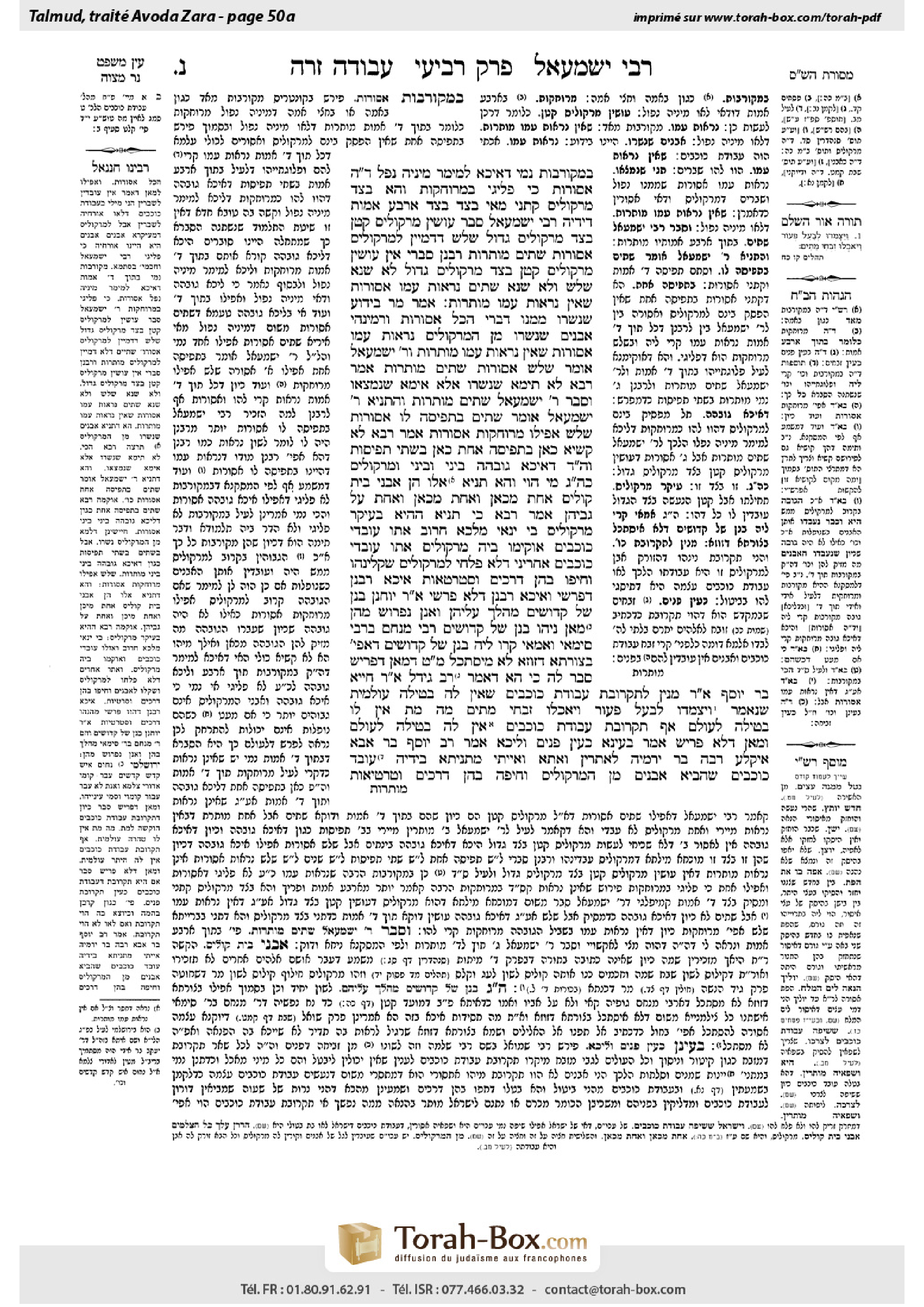
Avodah Zarah 50a: Talmud study for Daf Yomi
Study the Talmud for Daf Yomi with scanned pages, Hebrew text, English translations from Sefaria and AI-generated French translations.
Passage selection and English or AI-generated French translation are available where the scan has annotations. Daf Study is independent of Torah-Box and Sefaria.
Browse Avodah Zarah · עבודה זרה · All tractatesAvodah Zarah 50a text and translations
This page of Avodah Zarah includes the Aramaic text, an English translation and an AI-generated French translation, alongside the scan above.
עבודה זרה נ׳ א · Aramaic and Hebrew text
בִּמְקוֹרָבוֹת נָמֵי, דְּאִיכָּא לְמֵימַר מִינֵּיהּ נְפַל — דִּבְרֵי הַכֹּל אֲסוּרוֹת, כִּי פְּלִיגִי — בִּמְרוּחָקוֹת.
וְהָא ״בְּצַד מַרְקוּלִיס״ קָתָנֵי, מַאי ״בְּצַד״? בְּצַד אַרְבַּע אַמּוֹת דִּידֵיהּ.
רַבִּי יִשְׁמָעֵאל סָבַר: עוֹשִׂין מַרְקוּלִיס קָטָן בְּצַד מַרְקוּלִיס גָּדוֹל, שָׁלֹשׁ דְּדׇמְיָין לְמַרְקוּלִיס — אֲסוּרוֹת, שְׁתַּיִם — מוּתָּרוֹת. רַבָּנַן סָבְרִי: אֵין עוֹשִׂין מַרְקוּלִיס קָטָן בְּצַד מַרְקוּלִיס גָּדוֹל, לָא שְׁנָא שָׁלֹשׁ וְלָא שְׁנָא שְׁתַּיִם, נִרְאוֹת עִמּוֹ — אֲסוּרוֹת, שֶׁאֵין נִרְאוֹת עִמּוֹ — מוּתָּרוֹת.
אָמַר מָר: בְּיָדוּעַ שֶׁנָּשְׁרוּ מִמֶּנּוּ — דִּבְרֵי הַכֹּל אֲסוּרוֹת. וּרְמִינְהִי: אֲבָנִים שֶׁנָּשְׁרוּ מִן הַמַּרְקוּלִיס, נִרְאוֹת עִמּוֹ — אֲסוּרוֹת, שֶׁאֵין נִרְאוֹת עִמּוֹ — מוּתָּרוֹת. וְרַבִּי יִשְׁמָעֵאל אוֹמֵר: שָׁלֹשׁ — אֲסוּרוֹת, שְׁתַּיִם — מוּתָּרוֹת. אָמַר רָבָא: לָא תֵּימָא ״שֶׁנָּשְׁרוּ״, אֶלָּא אֵימָא ״שֶׁנִּמְצְאוּ״.
וְסָבַר רַבִּי יִשְׁמָעֵאל שְׁתַּיִם מוּתָּרוֹת? וְהָתַנְיָא: רַבִּי יִשְׁמָעֵאל אוֹמֵר: שְׁתַּיִם בִּתְפִיסָה לוֹ אֲסוּרוֹת, שָׁלֹשׁ, אֲפִילּוּ מְרוּחָקוֹת — אֲסוּרוֹת!
אָמַר רָבָא: לָא קַשְׁיָא, כָּאן בִּתְפִיסָה אַחַת, כָּאן בִּשְׁתֵּי תְּפִיסוֹת, וְהֵיכִי דָּמֵי? דְּאִיכָּא גּוּבְהָה בֵּינֵי וּבֵינֵי.
וּמַרְקוּלִיס כְּהַאי גַּוְונָא מִי הָוֵי? וְהָא תַּנְיָא: אֵלּוּ הֵן אַבְנֵי בֵּית קוּלִיס — אַחַת מִכָּאן וְאַחַת מִכָּאן וְאַחַת עַל גַּבֵּיהֶן! אָמַר רָבָא: כִּי תַּנְיָא הָהִיא — בְּעִיקַּר מַרְקוּלִיס.
בֵּי יַנַּאי מַלְכָּא חֲרוּב, אֲתוֹ גּוֹיִם אוֹקִימוּ בֵּיהּ מַרְקוּלִיס, אֲתוֹ גּוֹיִם אַחֲרִינֵי דְּלָא פָּלְחִי לְמַרְקוּלִיס שַׁקְלִינְהוּ, וְחִיפּוּ בָּהֶן דְּרָכִים וּסְטָרְטָאוֹת, אִיכָּא רַבָּנַן דְּפָרְשִׁי וְאִיכָּא רַבָּנַן דְּלָא פָּרְשִׁי.
אָמַר רַבִּי יוֹחָנָן: בְּנָן שֶׁל קְדוֹשִׁים מְהַלֵּךְ עֲלֵיהֶן, וַאֲנַן נִפְרוֹשׁ מֵהֶן? מַאן נִיהוּ ״בְּנָן שֶׁל קְדוֹשִׁים״? רַבִּי מְנַחֵם בְּרַבִּי סִימַאי, וְאַמַּאי קָרוּ לֵיהּ ״בְּנָן שֶׁל קְדוֹשִׁים״? דַּאֲפִילּוּ בְּצוּרְתָּא דְּזוּזָא לָא מִיסְתַּכַּל.
מַאי טַעְמָא דְּמַאן דְּפָרֵישׁ? סָבַר לַהּ כִּי הָא דְּאָמַר רַב גִּידֵּל אָמַר רַב חִיָּיא בַּר יוֹסֵף אָמַר רַב: מִנַּיִן לְתִקְרוֹבֶת עֲבוֹדָה זָרָה שֶׁאֵין לָהּ בְּטִילָה עוֹלָמִית? שֶׁנֶּאֱמַר: ״וַיִּצָּמְדוּ לְבַעַל פְּעוֹר וַיֹּאכְלוּ זִבְחֵי מֵתִים״, מָה מֵת אֵין לוֹ בְּטִילָה לְעוֹלָם, אַף תִּקְרוֹבֶת עֲבוֹדָה זָרָה אֵין לָהּ בְּטִילָה לְעוֹלָם.
וּמַאן דְּלָא פָּרֵישׁ, אָמַר: בָּעֵינָא כְּעֵין פְּנִים, וְלֵיכָּא.
אָמַר רַב יוֹסֵף בַּר אַבָּא: אִיקְּלַע רַבָּה בַּר יִרְמְיָה לְאַתְרִין, וַאֲתָא וְאַיְיתִי מַתְנִיתָא בִּידֵיהּ: גּוֹי שֶׁהֵבִיא אֲבָנִים מִן הַמַּרְקוּלִיס וְחִיפָּה בָּהֶן דְּרָכִים וּסְרַטְיָאוֹת —
Avodah Zarah 50a · English translation
Furthermore, everyone agrees that also in the case of stones that are near the stone pile dedicated to Mercury, with regard to which it can be said that they fell from it, they are prohibited. Rabbi Yishmael and the Rabbis disagree only when the stones are distant.
The Gemara challenges: But the mishna teaches that the stones are at the side of Mercury, indicating that they are nearby. The Gemara explains: What is meant by the term: At the side of Mercury? It means at the side of its four cubits.
The Gemara clarifies the dispute: Rabbi Yishmael holds that at times, idol worshippers initially construct a small stone pile dedicated to Mercury at the side of a large stone pile dedicated to Mercury. Therefore, three stones, which resemble a complete pile dedicated to Mercury, are prohibited. Two stones, which do not resemble a stone pile dedicated to Mercury, are permitted. Conversely, the Rabbis hold that idol worshippers do not construct a small stone pile dedicated to Mercury at the side of a large stone pile dedicated to Mercury. Therefore, the halakha is not different in a case where there are three stones, and it is not different in a case where there are two stones. In both cases those stones that can be seen together with the pile dedicated to Mercury are prohibited, as they may have fallen from it, whereas those that cannot be seen together with the stone pile are permitted.
§ The Master said: In a case where it is known that these stones fell from it, everyone agrees that they are prohibited. And the Gemara raises a contradiction to Rabbi Yoḥanan’s statement from his statement presented in a baraita: With regard to stones that fell from a pile dedicated to Mercury, those that can be seen together with it are prohibited; those that cannot be seen together with it are permitted. And Rabbi Yishmael says: Three stones are prohibited, but two stones are permitted. The baraita indicates that Rabbi Yishmael and the Rabbis also disagree where it is known that the stones fell from the stone pile. Rava said: Do not say in the baraita: Stones that fell from a pile. Rather, say: Stones that were found adjacent to the pile. There is no certainty that they fell from the pile.
The Gemara asks: And does Rabbi Yishmael actually hold that two stones that are found adjacent to the pile are permitted? But isn’t it taught in a baraita: Rabbi Yishmael says: Two stones that are found in the area of the pile dedicated to Mercury are prohibited. Three stones are prohibited, even if they are found at a distance.
Rava said: It is not difficult. Here, in the second baraita, it is referring to a case where both the pile and the adjacent stones are in the same area, in which case the stones are forbidden. There, in the first baraita, it is referring to a case where they are in two adjacent areas, in which case they are permitted. And what is considered two adjacent areas? This is referring to a case where there is an elevated area between them, and evidently the stones did not fall from the pile.
The Gemara asks: And are stones that are merely adjacent to each other in this way considered a pile dedicated to Mercury? But isn’t it taught in a baraita: These are the stones of a place of worship dedicated to Mercury: One stone is situated on one side and one is situated on the other side, and one is situated atop of them, but not where the stones are merely adjacent to each other? Rava said: When that baraita is taught, it is with regard to the main pile of stones dedicated to Mercury, but the stones that are added to it are not necessarily arranged in this way.
§ The Gemara relates: The house of King Yannai was destroyed, and gentiles came and placed stones dedicated to Mercury in it. Later, other gentiles who did not worship Mercury came and took those stones and paved paths and streets with them. There were Rabbis who withdrew from these paths, and there were other Rabbis who did not withdraw from these paths.
Rabbi Yoḥanan said: The son of holy ones walks on them. Should we withdraw from them? The Gemara asks: Who is the person referred to as the son of holy ones? The Gemara answers: It is Rabbi Menaḥem, son of Rabbi Simai. And why did they call him the son of holy ones? They did so because Rabbi Menaḥem would not even gaze at the form on a coin, as it was sometimes an idolatrous symbol.
The Gemara asks: What is the reason of the one who withdraws from those paths? He holds in accordance with that which Rav Giddel says that Rav Ḥiyya bar Yosef says that Rav says: From where is it derived that with regard to an offering brought in idolatrous worship, there can never be any nullification of its prohibited status? This is derived from a verse, as it is stated: “They joined themselves to Baal of Peor, and ate the offerings to the dead” (Psalms 106:28). Just as the prohibited status of a corpse has no nullification, and it is forever prohibited to derive benefit from it, so too, the prohibited status of an offering brought in idolatrous worship has no nullification ever.
And the one who does not withdraw from those paths says: In order for idol worship to prohibit an offering I require the offering to be like those offerings sacrificed inside the Temple, and there is no parallel to this offering in the Temple service, as stones are not brought as offerings.
Rav Yosef bar Abba said: Rabba bar Yirmeya happened to come to our locale, and when he came he brought the following baraita with him: In the case of a gentile who brought stones from a pile dedicated to Mercury and paved paths and theaters with them,
Avodah Zarah 50a · Traduction française (IA)
De plus, tout le monde convient que même dans le cas de pierres proches de la pile de pierres dédiée à Mercure, concernant lesquelles on peut dire qu'elles sont tombées d'elle, elles sont interdites. Rabbi Yishmael et les Sages sont en désaccord uniquement lorsque les pierres sont éloignées.
La Guemara questionne : Mais la Michna enseigne que les pierres sont à côté de Mercure, indiquant qu'elles sont proches. La Guemara explique : De quoi parle-t-on lorsqu'on dit : À côté de Mercure ? Cela signifie à côté de ses quatre coudées.
La Guemara clarifie le désaccord : Rabbi Yishmael considère que parfois, les idolâtres construisent d'abord une petite pile de pierres dédiée à Mercure à côté d'une grande pile de pierres dédiée à Mercure. Ainsi, trois pierres, qui ressemblent à une pile complète dédiée à Mercure, sont interdites. Deux pierres, qui ne ressemblent pas à une pile dédiée à Mercure, sont permises. À l'inverse, les Sages pensent que les idolâtres ne construisent pas une petite pile dédiée à Mercure à côté d'une grande pile dédiée à Mercure. Ainsi, la halakha ne diffère pas dans le cas de trois pierres, et ne diffère pas non plus dans le cas de deux pierres. Dans les deux cas, les pierres qui peuvent être vues ensemble avec la pile dédiée à Mercure sont interdites, car elles pourraient avoir tombé d'elle, tandis que celles qui ne peuvent pas être vues ensemble avec la pile de pierres sont permises.
§ Le Maître dit : Dans le cas où il est connu que ces pierres sont tombées d'elle, tout le monde convient qu'elles sont interdites. Et la Guemara soulève une contradiction avec la déclaration de Rabbi Yoḥanan à partir de sa déclaration présentée dans une baraïta : Concernant les pierres tombées d'une pile dédiée à Mercure, celles qui peuvent être vues ensemble avec elle sont interdites ; celles qui ne peuvent pas être vues ensemble avec elle sont permises. Et Rabbi Yishmael dit : Trois pierres sont interdites, mais deux pierres sont permises. La baraïta indique que Rabbi Yishmael et les Sages sont également en désaccord dans le cas où il est connu que les pierres sont tombées de la pile. Rava dit : Ne dites pas dans la baraïta : Des pierres tombées d'une pile. Dites plutôt : Des pierres trouvées à côté de la pile. Il n'y a pas de certitude qu'elles soient tombées de la pile.
La Guemara demande : Et Rabbi Yishmael ne tient-il pas vraiment que deux pierres trouvées à côté de la pile sont permises ? Mais n'est-il pas enseigné dans une baraïta : Rabbi Yishmael dit : Deux pierres trouvées dans la zone de la pile dédiée à Mercure sont interdites. Trois pierres sont interdites, même si elles sont trouvées à distance.
Rava dit : Ce n'est pas difficile. Ici, dans la deuxième baraïta, il s'agit d'un cas où la pile et les pierres adjacentes sont dans la même zone, dans lequel cas les pierres sont interdites. Là, dans la première baraïta, il s'agit d'un cas où elles sont dans deux zones adjacentes, dans lequel cas elles sont permises. Et qu'est-ce qui constitue deux zones adjacentes ? Cela fait référence à un cas où il y a une zone élevée entre elles, et il est évident que les pierres n'ont pas tombé de la pile.
La Guemara demande : Et des pierres simplement adjacentes entre elles sont-elles considérées comme une pile dédiée à Mercure ? Mais n'est-il pas enseigné dans une baraïta : Ces sont les pierres d'un lieu de culte dédié à Mercure : une pierre est située d'un côté et une autre de l'autre côté, et une autre est située au-dessus d'elles, mais pas là où les pierres sont simplement adjacentes entre elles ? Rava dit : Lorsque cette baraïta est enseignée, elle est avec référence à la grande pile de pierres dédiée à Mercure, mais les pierres ajoutées à celle-ci ne sont pas nécessairement disposées ainsi.
§ La Guemara rapporte : La maison du roi Yannai a été détruite, et des Gentils sont venus y placer des pierres dédiées à Mercure. Plus tard, d'autres Gentils qui ne vénéraient pas Mercure sont venus prendre ces pierres et ont pavé des rues et des routes avec elles. Il y avait des Rabbins qui se sont retirés de ces routes, et d'autres Rabbins qui n'ont pas retiré de ces routes.
Rabbi Yoḥanan dit : Le fils des saints marche sur elles. Devons-nous nous retirer d'elles ? La Guemara demande : De qui s'agit-il lorsqu'on parle du fils des saints ? La Guemara répond : C'est Rabbi Menaḥem, fils de Rabbi Simai. Et pourquoi les appelaient-ils le fils des saints ? Parce que Rabbi Menaḥem ne regardait même pas la forme d'une pièce, car parfois c'était un symbole idolâtre.
La Guemara demande : Quel est le fondement de celui qui se retire de ces routes ? Il s'appuie sur ce que Rav Giddel a dit, que Rav Ḥiyya bar Yosef a dit, que Rav a dit : D'où est tiré le fait que concernant une offrande apportée dans un culte idolâtre, il n'y a jamais de nullification de son statut interdit ? Cela est tiré d'un verset, comme il est dit : « Ils se sont joints à Baal de Peor, et ont mangé les offrandes des morts » (Psaumes 106:28). Tout comme le statut interdit d'un cadavre n'a jamais de nullification, et il est interdit de tirer un bénéfice d'avec lui, de même le statut interdit d'une offrande apportée dans un culte idolâtre n'a jamais de nullification.
Et celui qui ne se retire pas de ces routes dit : Pour que le culte idolâtre interdise une offrande, j'exige que l'offrande soit semblable à celles offertes dans le Temple, et il n'y a pas d'offrande similaire dans le service du Temple, car les pierres ne sont pas apportées comme offrandes.
Rav Yosef bar Abba dit : Rabba bar Yirmeya est venu à notre lieu, et lorsqu'il est venu, il a apporté avec lui la suivante baraïta : Dans le cas d'un Gentil qui a apporté des pierres d'une pile dédiée à Mercure et a pavé des routes et des théâtres avec elles,
Traduction française générée par IA à partir de l’édition anglaise de Sefaria. Vérifie toujours un passage avec le texte source.
Text from Sefaria: William Davidson Edition - Vocalized Aramaic (CC BY NC); William Davidson Edition - English (CC BY NC).