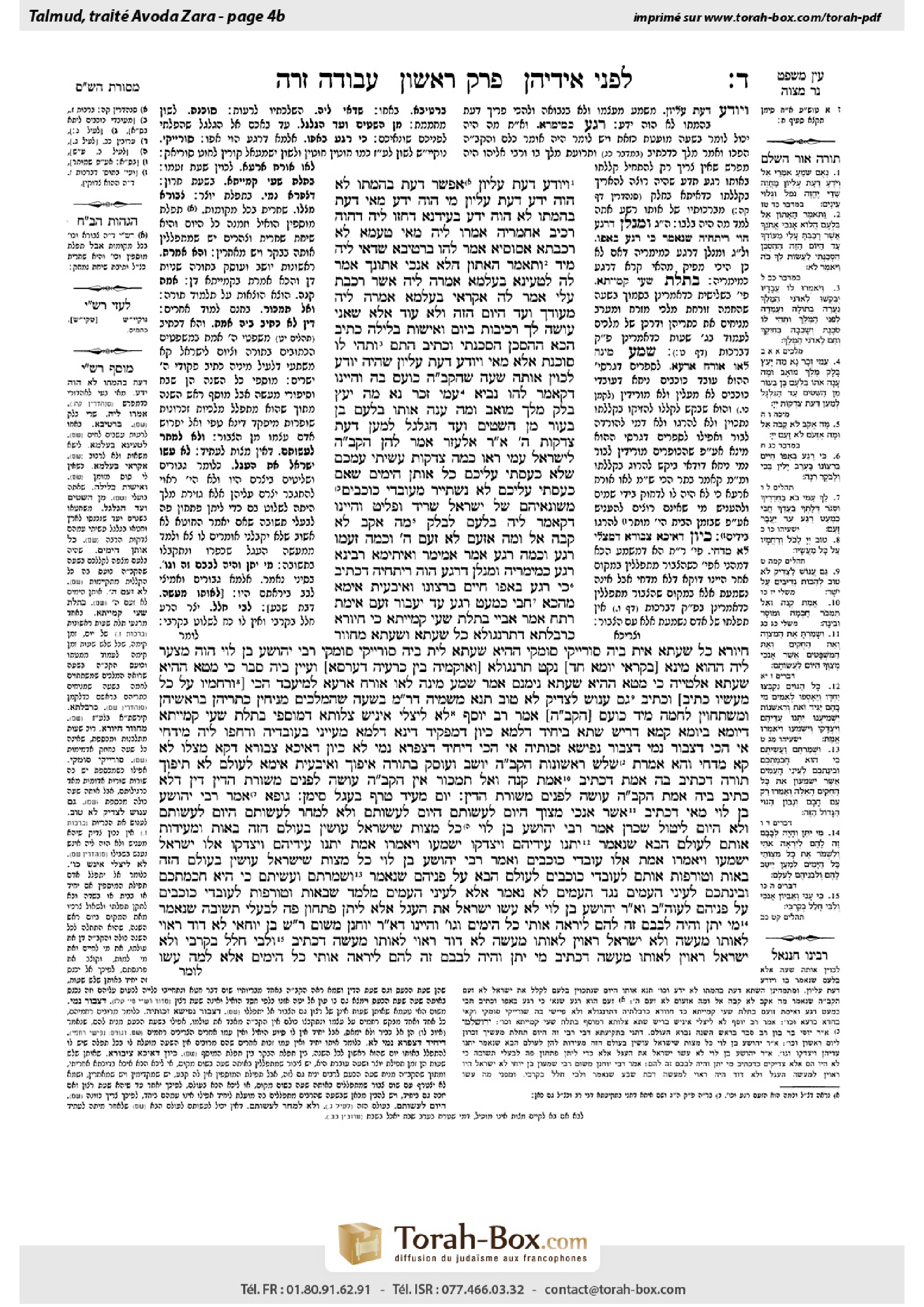
Avodah Zarah 4b: Talmud study for Daf Yomi
Study the Talmud for Daf Yomi with scanned pages, Hebrew text, English translations from Sefaria and AI-generated French translations.
Passage selection and English or AI-generated French translation are available where the scan has annotations. Daf Study is independent of Torah-Box and Sefaria.
Browse Avodah Zarah · עבודה זרה · All tractatesAvodah Zarah 4b text and translations
This page of Avodah Zarah includes the Aramaic text, an English translation and an AI-generated French translation, alongside the scan above.
עבודה זרה ד׳ ב · Aramaic and Hebrew text
״וְיֹדֵעַ דַּעַת עֶלְיוֹן״ — אֶפְשָׁר דַּעַת בְּהֶמְתּוֹ לָא הֲוָה יָדַע, דַּעַת עֶלְיוֹן מִי הֲוָה יָדַע?
מַאי ״דַּעַת בְּהֶמְתּוֹ לָא הֲוָה יָדַע״? בְּעִידָּנָא דַּחֲזוֹ לֵיהּ דַּהֲוָה רְכִיב אַחֲמָרֵיהּ, אֲמַרוּ לֵיהּ: מַאי טַעְמָא לָא רְכַבְתָּא אַסּוּסְיָא? אֲמַר לְהוּ: בִּרְטִיבָא שְׁדַאי לֵיהּ. מִיָּד: ״וַתֹּאמֶר הָאָתוֹן הֲלֹא אָנֹכִי אֲתֹנְךָ״, אֲמַר לַהּ: לִטְעִינָא בְּעָלְמָא.
אֲמַרָה לֵיהּ: ״אֲשֶׁר רָכַבְתָּ עָלַי״! אֲמַר לַהּ: אַקְרַאי בְּעָלְמָא. אֲמַרָה לֵיהּ: ״מֵעוֹדְךָ וְעַד הַיּוֹם הַזֶּה״, וְלֹא עוֹד אֶלָּא שֶׁאֲנִי עוֹשָׂה לָךְ רְכִיבוּת בַּיּוֹם וְאִישׁוּת בַּלַּיְלָה. כְּתִיב הָכָא: ״הַהַסְכֵּן הִסְכַּנְתִּי״, וּכְתִיב הָתָם: ״וַתְּהִי לוֹ סֹכֶנֶת״.
אֶלָּא מַאי ״וְיוֹדֵעַ דַּעַת עֶלְיוֹן״? שֶׁהָיָה יוֹדֵעַ לְכַוֵּין אוֹתָהּ שָׁעָה שֶׁהַקָּדוֹשׁ בָּרוּךְ הוּא כּוֹעֵס בָּהּ, וְהַיְינוּ דְּקָאָמַר לְהוּ נָבִיא: ״עַמִּי זְכׇר נָא מַה יָּעַץ בָּלָק מֶלֶךְ מוֹאָב וּמֶה עָנָה אוֹתוֹ בִּלְעָם בֶּן בְּעוֹר מִן הַשִּׁטִּים וְעַד הַגִּלְגָּל לְמַעַן דַּעַת צִדְקוֹת ה׳״.
אָמַר רַבִּי אֶלְעָזָר, אָמַר לָהֶן הַקָּדוֹשׁ בָּרוּךְ הוּא לְיִשְׂרָאֵל: עַמִּי, רְאוּ כַּמָּה צְדָקוֹת עָשִׂיתִי עִמָּכֶם שֶׁלֹּא כָּעַסְתִּי עֲלֵיכֶם כָּל אוֹתָן הַיָּמִים, שֶׁאִם כָּעַסְתִּי עֲלֵיכֶם לֹא נִשְׁתַּיֵּיר מִשּׂוֹנְאֵיהֶם שֶׁל יִשְׂרָאֵל שָׂרִיד וּפָלִיט, וְהַיְינוּ דְּקָאָמַר לֵיהּ בִּלְעָם לְבָלָק: ״מָה אֶקֹּב לֹא קַבֹּה אֵל וּמָה אֶזְעֹם לֹא זָעַם ה׳״.
וְכַמָּה זַעְמוֹ? רֶגַע. וְכַמָּה רֶגַע? אָמַר אַמֵּימָר, וְאִיתֵּימָא רָבִינָא: רֶגַע כְּמֵימְרֵיהּ. וּמְנָלַן דְּרֶגַע הֲוָה רִיתְחֵיהּ? דִּכְתִיב: ״כִּי רֶגַע בְּאַפּוֹ חַיִּים בִּרְצוֹנוֹ״. וְאִיבָּעֵית אֵימָא מֵהָכָא: ״חֲבִי כִּמְעַט רֶגַע עַד יַעֲבׇר זַעַם״.
אֵימַת רָתַח? אָמַר אַבַּיֵי: בִּתְלָת שָׁעֵי קַמָּיָיתָא, כִּי חִיוָּרָא כַּרְבָּלְתָּא דְתַרְנְגוֹלָא. כֹּל שַׁעְתָּא וְשַׁעְתָּא מִחְוָור חָיוְרָא? כָּל שַׁעְתָּא אִית בֵּיהּ סוּרְיָיקֵי סוּמָּקֵי, הָהִיא שַׁעְתָּא לֵית בֵּיהּ סוּרְיָיקֵי סוּמָּקֵי.
רַבִּי יְהוֹשֻׁעַ בֶּן לֵוִי הֲוָה מְצַעֵר לֵיהּ הָהוּא מִינָא [בִּקְרָאֵי], יוֹמָא חַד נְקַט תַּרְנְגוֹלָא [וְאוֹקְמֵיהּ בֵּין כַּרְעֵיהּ דְּעַרְסָא], וְעַיֵּין בֵּיהּ, סְבַר: כִּי מָטָא הָהִיא שַׁעְתָּא אֶלְטֵיהּ, כִּי מְטָא הָהִיא שַׁעְתָּא נַימְנֵם.
אֲמַר: שְׁמַע מִינַּהּ לָאו אוֹרַח אַרְעָא לְמִיעְבַּד הָכִי, [״וְרַחֲמָיו עַל כׇּל מַעֲשָׂיו״] כְּתִיב, וּכְתִיב: ״גַּם עֲנוֹשׁ לַצַּדִּיק לֹא טוֹב״.
תָּנָא מִשְּׁמֵיהּ דְּרַבִּי מֵאִיר: בְּשָׁעָה שֶׁהַמְּלָכִים מַנִּיחִין כִּתְרֵיהֶן בְּרָאשֵׁיהֶן וּמִשְׁתַּחֲוִין לַחַמָּה, מִיָּד כּוֹעֵס [הַקָּדוֹשׁ בָּרוּךְ הוּא]. אָמַר רַב יוֹסֵף: לָא לִיצַלֵּי אִינִישׁ צְלוֹתָא דְּמוּסָפֵי בִּתְלָת שָׁעֵי קַמָּיָיתָא דְּיוֹמָא בְּיוֹמָא קַמָּא דְּרֵישׁ שַׁתָּא בְּיָחִיד, דִּלְמָא כֵּיוָן דְּמִפְּקִיד דִּינָא, דִּלְמָא מְעַיְּינִי בְּעוֹבָדֵיהּ וְדָחֲפוּ לֵיהּ מִידְּחֵי.
אִי הָכִי, דְּצִבּוּר נָמֵי! דְּצִבּוּר נְפִישָׁא זְכוּתֵיהּ. אִי הָכִי, דְּיָחִיד דְּצַפְרָא נָמֵי לָא! כֵּיוָן דְּאִיכָּא צִבּוּרָא דְּקָא מְצַלּוּ, לָא קָא מִדְּחֵי.
וְהָא אָמְרַתְּ: שָׁלֹשׁ רִאשׁוֹנוֹת הַקָּדוֹשׁ בָּרוּךְ הוּא יוֹשֵׁב וְעוֹסֵק בַּתּוֹרָה! אֵיפוֹךְ.
וְאִיבָּעֵית אֵימָא: לְעוֹלָם לָא תֵּיפוֹךְ, תּוֹרָה דִּכְתִיב בַּהּ ״אֱמֶת״, דִּכְתִיב: ״אֱמֶת קְנֵה וְאַל תִּמְכֹּר״ — אֵין הַקָּדוֹשׁ בָּרוּךְ הוּא עוֹשֶׂה לִפְנִים מִשּׁוּרַת הַדִּין, דִּין דְּלָא כְּתִיב בֵּיהּ ״אֱמֶת״ — הַקָּדוֹשׁ בָּרוּךְ הוּא עוֹשֶׂה לִפְנִים מִשּׁוּרַת הַדִּין.
(יוֹם, מֵעִיד, טָרַף, בָּעֵגֶל — סִימָן.) גּוּפָא, אָמַר רַבִּי יְהוֹשֻׁעַ בֶּן לֵוִי: מַאי דִּכְתִיב ״אֲשֶׁר אָנֹכִי מְצַוְּךָ הַיּוֹם לַעֲשׂוֹתָם״? ״הַיּוֹם לַעֲשׂוֹתָם״ — וְלֹא לְמָחָר לַעֲשׂוֹתָם, ״הַיּוֹם לַעֲשׂוֹתָם״ — וְלֹא הַיּוֹם לִיטּוֹל שְׂכָרָן.
אָמַר רַבִּי יְהוֹשֻׁעַ בֶּן לֵוִי: כׇּל מִצְוֹת שֶׁיִּשְׂרָאֵל עוֹשִׂין בָּעוֹלָם הַזֶּה, בָּאוֹת וּמְעִידוֹת אוֹתָם לָעוֹלָם הַבָּא, שֶׁנֶּאֱמַר: ״יִתְּנוּ עֵדֵיהֶם וְיִצְדָּקוּ יִשְׁמְעוּ וְיֹאמְרוּ אֱמֶת״. ״יִתְּנוּ עֵדֵיהֶם וְיִצְדָּקוּ״ — אֵלּוּ יִשְׂרָאֵל, ״יִשְׁמְעוּ וְיֹאמְרוּ אֱמֶת״ — אֵלּוּ אוּמּוֹת הָעוֹלָם.
וְאָמַר רַבִּי יְהוֹשֻׁעַ בֶּן לֵוִי: כׇּל מִצְוֹת שֶׁיִּשְׂרָאֵל עוֹשִׂין בָּעוֹלָם הַזֶּה, בָּאוֹת וְטוֹרְפוֹת אוֹתָם לְאוּמּוֹת הָעוֹלָם לָעוֹלָם הַבָּא עַל פְּנֵיהֶם, שֶׁנֶּאֱמַר: ״וּשְׁמַרְתֶּם וַעֲשִׂיתֶם כִּי הִוא חׇכְמַתְכֶם וּבִינַתְכֶם לְעֵינֵי הָעַמִּים״, ״נֶגֶד הָעַמִּים״ לֹא נֶאֱמַר, אֶלָּא ״לְעֵינֵי הָעַמִּים״, מְלַמֵּד שֶׁבָּאוֹת וְטוֹרְפוֹת לְאוּמּוֹת הָעוֹלָם עַל פְּנֵיהֶם לָעוֹלָם הַבָּא.
וְאָמַר רַבִּי יְהוֹשֻׁעַ בֶּן לֵוִי: לֹא עָשׂוּ יִשְׂרָאֵל אֶת הָעֵגֶל אֶלָּא לִיתֵּן פִּתְחוֹן פֶּה לְבַעֲלֵי תְּשׁוּבָה, שֶׁנֶּאֱמַר: ״מִי יִתֵּן וְהָיָה לְבָבָם זֶה לָהֶם לְיִרְאָה אֹתִי כׇּל הַיָּמִים וְגוֹ׳״.
וְהַיְינוּ דְּאָמַר רַבִּי יוֹחָנָן מִשּׁוּם רַבִּי שִׁמְעוֹן בֶּן יוֹחַאי: לֹא דָּוִד רָאוּי לְאוֹתוֹ מַעֲשֶׂה, וְלֹא יִשְׂרָאֵל רְאוּיִן לְאוֹתוֹ מַעֲשֶׂה, לֹא דָּוִד רָאוּי לְאוֹתוֹ מַעֲשֶׂה, דִּכְתִיב: ״וְלִבִּי חָלַל בְּקִרְבִּי״,
וְלֹא יִשְׂרָאֵל רְאוּיִן לְאוֹתוֹ מַעֲשֶׂה, דִּכְתִיב: ״מִי יִתֵּן וְהָיָה לְבָבָם זֶה לָהֶם לְיִרְאָה אוֹתִי כָּל הַיָּמִים״, אֶלָּא לָמָה עָשׂוּ?
Avodah Zarah 4b · English translation
“And knows the knowledge of the Most High” (Numbers 24:16). Now, this should not be understood to mean that Balaam knew the thoughts of God, as is it possible that Balaam did not know the mind of his animal, and yet he did know the mind of the Most High?
The Gemara clarifies: What is meant by the claim that Balaam did not know the mind of his animal? When the princes of Moab saw that Balaam was riding on his donkey, they said to him: What is the reason that you do not ride upon a horse, which is more fitting for you? Balaam said to them: I am riding on a donkey because I left my horse in a meadow to graze. Immediately: “And the donkey said to Balaam: Am not I your donkey?” (Numbers 22:30), i.e., the donkey you always use. Balaam said to it: For carrying burdens only, not for riding.
The donkey further said to Balaam: “Upon which you have ridden.” Balaam said to it: Merely at irregular occurrences. The donkey said to him: “All your life long unto this day” (Numbers 22:30). The donkey added: And moreover, I perform for you riding during the day, and marriage, i.e., intercourse, during the night. The Gemara explains: This is derived from the following comparison: It is written here that Balaam’s donkey said: “Was I ever wont [hahasken hiskanti] to do so to you” (Numbers 22:30), and it is written there, with regard to Abishag the Shunammite and King David: “And be a companion [sokhenet] unto him; and let her lie in your bosom” (I Kings 1:2). This teaches that the term hiskanti alludes to sexual intercourse.
The Gemara returns to its previous question: Rather, what is the meaning of: “And knows the knowledge of the Most High” (Numbers 24:16)? It means that he was able to determine precisely the hour at which the Holy One, Blessed be He, is angry. At that moment Balaam would utter his curse and, through God’s anger, it would be fulfilled. And this is what the prophet said to the Jewish people: “O My people, remember now what Balak, king of Moab, devised, and what Balaam, son of Beor, answered him; from Shittim unto Gilgal, that you may know the righteous acts of the Lord” (Micah 6:5).
Rabbi Elazar says, in explanation of that verse: The Holy One, Blessed be He, said to the Jewish people: My nation, see how many acts of kindness I performed for you, that I did not become angry at you during all of those days when Balaam attempted to curse the Jewish people, and he was not able to find a moment of divine anger. As, had I become angry at you, there would not have remained a remnant or a refugee among the enemies of the Jewish people, a euphemism for the Jewish people themselves. Instead, God restrained His anger and Balaam’s curse went unfulfilled. And this is what Balaam said to Balak: Since God is not becoming angry, I can do nothing, as: “How shall I curse whom God has not cursed? And how shall I execrate whom the Lord has not execrated”? (Numbers 23:8).
The Gemara further discusses this matter: And how long does His indignation last? It lasts a moment. And how long is a moment? Ameimar, and some say Ravina, said: It lasts as long as it takes to say the word moment [rega]. The Gemara asks: And from where do we derive that God’s anger lasts for only a moment? As it is written: “His anger is but for a moment; His favor, for a lifetime” (Psalms 30:6). And if you wish, say instead that it is derived from here: “Hide yourself for a brief moment, until the anger passes” (Isaiah 26:20), meaning that God’s anger passes in a mere moment.
The Gemara asks: When is God angry? Abaye said: During the first three hours of the day, when the crest of the rooster whitens in the sun, as though life has left the rooster and it suddenly turns white, that is when God is angry. The Gemara asks: Doesn’t its crest whiten each and every hour? How can this serve as a sign? The Gemara answers: The difference is that every other hour there remain red streaks [surayekei] in the rooster’s crest, whereas at that hour of His anger there are no red streaks in its crest.
The Gemara relates: A certain heretic would distress Rabi Yehoshua ben Levi by incessantly challenging him as to the meaning of verses. One day, Rabbi Yehoshua ben Levi took a rooster and placed it between the legs of the bed upon which he sat, and looked at it. He thought: When that moment of God’s anger arrives, I will curse the heretic and be rid of him. When that moment of God’s anger arrived, Rabbi Yehoshua ben Levi fell asleep and missed the opportunity to curse the heretic.
Upon awakening, Rabbi Yehoshua ben Levi said: I can conclude from the fact that I fell asleep that it is not proper conduct to do this, to curse people, even if they are wicked, as the verse: “And His tender mercies are over all His works” (Psalms 145:9) is written even with regard to sinners. And moreover, it is inappropriate to cause the punishment of another, as it is written: “Punishment, even for the righteous, is not good” (Proverbs 17:26). Even for a righteous person, it is improper to punish another.
In explanation of the cause of God’s anger, it is taught in the name of Rabbi Meir: When the kings wake up and place their crowns on their heads and bow down to the sun, the Holy One, Blessed be He, immediately grows angry. This is why God’s anger occurs during the first three hours of the day. Rav Yosef says: A person should not recite the additional prayers during the first three hours of the day on the first day of Rosh HaShana if he is praying individually, as, since the judgment of the entire world is reckoned then, perhaps the Heavenly court will scrutinize his actions and reject him.
The Gemara raises a difficulty: If that is so, the prayer of the community should not be recited at that time as well. The Gemara explains: The prayer of the community is not rejected even at this time, due to its many merits. The Gemara asks: If that is so, then shouldn’t the morning prayer of one who is praying individually also not be recited at this time? The Gemara answers: Since there is in all places a community that prays the morning prayer at that same time, his prayer is not rejected. By contrast, the additional prayer is recited at different times by different communities, as unlike the morning prayer it does not have a fixed time but can be recited at any point during the day.
The Gemara raises another difficulty: But didn’t you say that during the first three hours of the day The Holy One, Blessed be He, sits and engages in Torah study, and He engages in judgment only during the second set of three hours? The Gemara answers: Reverse the order so that it is stated that He sits in judgment during the first three hours of the day.
And if you wish, say instead: Actually, do not reverse the order. Rather, this is the reason that an individual should not recite the additional prayer during the first three hours of the day when God is engaged in Torah study: In the case of the Torah, with regard to which it is written: Truth, as it is written: “Buy the truth, and sell it not” (Proverbs 23:23), the Holy One, Blessed be He, does not act in a manner that is beyond the letter of the law. But with regard to judgment, with regard to which it is not written: Truth, but it is a process that involves mercy and compromise, the Holy One, Blessed be He, can act in a manner that is beyond the letter of the law.
§ The Gemara presents a mnemonic for the ensuing statements of Rabbi Yehoshua ben Levi: Today, bear witness, shake, the golden calf. The Gemara returns to an earlier discussion (3a), first by citing the matter itself. Rabbi Yehoshua ben Levi says: What is the meaning of that which is written: “Which I command you this day, to do them” (Deuteronomy 7:11)? This verse teaches that today is the time to do them, i.e., to perform the mitzvot, in this world, but tomorrow, in the World-to-Come, is not the time to do them. Furthermore, today is the time to do them, but today is not the time to receive one’s reward, which is given in the World-to-Come.
Rabbi Yehoshua ben Levi says: All of the mitzvot that the Jews perform in this word will come and bear witness for them in the World-to-Come, as it is stated: “Let them bring their witnesses that they may be justified, and let them hear, and say: It is truth” (Isaiah 43:9). He explains: “Let them bring their witnesses that they may be justified”; these are referring to the Jews. “And let them hear, and say: It is truth”; these are referring to the nations of the world.
And Rabbi Yehoshua ben Levi says: All of the mitzvot that the Jewish people perform in this world will come and strike the faces of the nations of the world in the World-to-Come, as it is stated: “Observe therefore and do them; for this is your wisdom and your understanding in the eyes of the nations” (Deuteronomy 4:6). It is not stated: Before the nations; rather, the verse states: “In the eyes of the nations,” which taken literally teaches that they will come and strike the faces of the nations of the world in the World-to-Come.
And Rabbi Yehoshua ben Levi says: The Jewish people fashioned the Golden Calf (see Exodus, chapter 32) only to give a claim to penitents, as it is stated after the revelation at Sinai: “Who would give that they had such a heart as this always, to fear Me, and keep all My commandments, that it might be good for them, and with their children forever” (Deuteronomy 5:26). If the nation was truly at such a lofty spiritual state, how could they worship the Golden Calf? Rather, their sin occurred so that it would be made clear that one can repent for any sin, as even a sin as severe as the Golden Calf was forgiven.
And this is similar to that which Rabbi Yoḥanan says in the name of Rabbi Shimon ben Yoḥai: David was not fit to act as he did in that incident involving Bathsheba, and the Jewish people were not fit to act as they did in that incident of the Golden Calf. David was not fit to act as he did in that incident involving Bathsheba (see II Samuel, chapter 11), as it is written: “And my heart is wounded within me” (Psalms 109:22), i.e., he had vanquished his evil inclination, and therefore it should not have been able to rule over him to that extent.
And likewise the Jewish people were not fit to act as they did in that incident of the Golden Calf, as it is written with regard to the Jewish people of that time: “Who would give that they had such a heart as this always, to fear Me and keep all My commandments, that it might be good for them, and with their children forever” (Deuteronomy 5:25). Rather, why did they perform these sins?
Avodah Zarah 4b · Traduction française (IA)
«Et il connaît la science du Très-Haut» (Nombres 24:16). Maintenant, cela ne doit pas être compris comme signifiant que Balaam connaissait les pensées de Dieu, car il est possible que Balaam ne connaissait pas la pensée de son animal, et pourtant il connaissait la pensée du Très-Haut ?
La Guemara clarifie : De quoi la déclaration selon laquelle Balaam ne connaissait pas la pensée de son animal ? Lorsque les princes de Moab virent que Balaam montait sur son âne, ils lui dirent : Pourquoi ne montez-vous pas sur un cheval, qui est plus adapté à vous ? Balaam répondit à eux : Je monte sur un âne car j'ai laissé mon cheval dans un pré pour paître. Aussitôt : « Et l'âne dit à Balaam : N'étais-je pas toujours ton âne ? » (Nombres 22:30), c'est-à-dire l'âne que vous utilisez toujours. Balaam lui répondit : Pour porter des fardeaux seulement, pas pour monter.
L'âne ajouta à Balaam : « Sur lequel tu as monté. » Balaam lui répondit : Seulement lors d'occasions irrégulières. L'âne dit à lui : « Toute ta vie jusqu'à ce jour » (Nombres 22:30). L'âne ajouta : Et de plus, je t'accompagne à cheval pendant la journée, et l'union pendant la nuit. La Guemara explique : Cela est tiré de la comparaison suivante : Il est écrit ici que l'âne de Balaam dit : « N'ai-je jamais été coutume [hahasken hiskanti] à te faire cela » (Nombres 22:30), et il est écrit là, concernant Abishag la Shunammite et le roi David : « Et sois un compagnon [sokhenet] pour lui ; et qu'elle repose dans ton sein » (I Rois 1:2). Cela enseigne que le terme hiskanti désigne l'acte sexuel.
La Guemara reprend sa question précédente : Et quelle est la signification de : « Et il connaît la science du Très-Haut » (Nombres 24:16) ? Cela signifie qu'il pouvait déterminer précisément l'heure à laquelle le Très-Haut, béni soit-Il, est en colère. À ce moment-là, Balaam prononçait sa malédiction, et, par la colère de Dieu, elle était accomplie. Et c'est ce que le prophète dit au peuple juif : « Ô mon peuple, souvenez-vous maintenant de ce que Balak, roi de Moab, a conçu, et de ce que Balaam, fils de Béor, a répondu ; de Shittim jusqu'à Gilgal, afin que vous sachiez les actions justes du Seigneur » (Micha 6:5).
Rabbi Eléazar dit, en explication de cette verset : Le Très-Haut, béni soit-Il, dit au peuple juif : Mon peuple, voyez combien d'actes de bonté j'ai accomplis pour vous, que je ne suis pas devenu en colère contre vous durant tous ces jours où Balaam tentait de maudire le peuple juif, et qu'il n'a pas réussi à trouver un moment de colère divine. Car, si j'étais devenu en colère contre vous, il ne resterait pas un reste ou un réfugié parmi les ennemis du peuple juif, un euphémisme pour le peuple juif lui-même. Au lieu de cela, Dieu a contenu sa colère et la malédiction de Balaam n'a pas été accomplie. Et c'est ce que Balaam a dit à Balak : Puisque Dieu ne devient pas en colère, je ne peux rien faire, comme : « Comment puis-je maudire celui que Dieu n'a pas maudisé ? Et comment puis-je détester celui que l'Éternel n'a pas détesté ? » (Nombres 23:8).
La Guemara discute davantage ce sujet : Et pendant combien de temps la colère de Dieu dure-t-elle ? Elle dure un moment. Et combien dure un moment ? Ameimar, et certains disent Ravina, dit : Elle dure aussi longtemps que le temps de dire le mot moment [rega]. La Guemara demande : Et d'où tirons-nous que la colère de Dieu dure seulement un moment ? Comme il est écrit : « Sa colère est seulement un moment ; Sa bienveillance, une vie » (Psaumes 30:6). Et si vous le souhaitez, dites plutôt qu'elle est tirée d'ici : « Cache-toi pour un moment, jusqu'à ce que la colère passe » (Jérémie 26:20), c'est-à-dire que la colère de Dieu passe en un instant.
La Guemara demande : Quand Dieu est-il en colère ? Abaye dit : Pendant les trois premières heures de la journée, lorsque la crête du coq se blanchit au soleil, comme si la vie avait quitté le coq et qu'il se blanchissait soudainement, c'est à ce moment-là que Dieu est en colère. La Guemara demande : N'est-ce pas que sa crête se blanchit chaque heure ? Comment cela peut-il servir de signe ? La Guemara répond : La différence est que chaque autre heure, il reste des traces rouges [surayekei] dans la crête du coq, tandis que lors de cette heure de sa colère, il n'y a pas de traces rouges dans sa crête.
La Guemara rapporte : Un certain hérétique dérangeait Rabbi Yéhoshua ben Levi en le défiant constamment sur le sens des versets. Un jour, Rabbi Yéhoshua ben Levi prit un coq et le plaça entre les jambes du lit sur lequel il était assis, et le regarda. Il pensa : Lorsque ce moment de la colère de Dieu arrivera, je maudirai l'hérétique et je serai débarrassé de lui. Lorsque ce moment de la colère de Dieu arriva, Rabbi Yéhoshua ben Levi s'endormit et manqua l'occasion de maudire l'hérétique.
En s'éveillant, Rabbi Yéhoshua ben Levi dit : Je peux conclure du fait que j'ai dormi que ce n'est pas une conduite appropriée de maudire les gens, même s'ils sont méchants, comme le verset : « Et Sa tendresse est sur toutes Ses œuvres » (Psaumes 145:9) est écrit même envers les pécheurs. Et de plus, il n'est pas approprié de causer la punition d'un autre, comme il est écrit : « La punition, même pour le juste, n'est pas bonne » (Proverbes 17:26). Même pour un juste, il n'est pas approprié de punir un autre.
En explication de la cause de la colère de Dieu, il est enseigné en nom de Rabbi Meïr : Lorsque les rois se réveillent et mettent leurs couronnes sur leurs têtes et se prosternent devant le soleil, le Très-Haut, béni soit-Il, s'indigne immédiatement. C'est pourquoi la colère de Dieu a lieu pendant les trois premières heures de la journée. Rav Yosef dit : Une personne ne devrait pas réciter les prières supplémentaires pendant les trois premières heures de la journée le premier jour de Rosh HaShana s'il prie seul, car, puisque le jugement du monde entier est compté alors, peut-être que le tribunal céleste examinera ses actions et le rejette.
La Guemara soulève une difficulté : Si c’est ainsi, la prière de la communauté ne devrait pas être récitée à ce moment-là non plus. La Guemara explique : La prière de la communauté n’est pas rejetée même à ce moment-là, en raison de ses nombreux mérites. La Guemara demande : Si c’est ainsi, pourquoi la prière matinale d’un individu ne devrait-elle pas non plus être récitée à ce moment-là ? La Guemara répond : Puisque dans tous les lieux il existe une communauté qui récite la prière matinale à ce même moment, sa prière n’est pas rejetée. En revanche, la prière supplémentaire est récitée à des moments différents par différentes communautés, car contrairement à la prière matinale, elle n’a pas un moment fixe et peut être récitée à tout moment de la journée.
La Guemara soulève une autre difficulté : Mais n’avez-vous pas dit que durant les trois premières heures de la journée, le Très Haut, béni soit-Il, s’assoit et étudie la Torah, et qu’Il juge seulement durant les trois heures suivantes ? La Guemara répond : Inversez l’ordre afin qu’il soit dit qu’Il juge durant les trois premières heures de la journée.
Et si vous le souhaitez, dites plutôt : En réalité, ne réversons pas l’ordre. Plutôt, c’est la raison pour laquelle un individu ne devrait pas réciter la prière supplémentaire durant les trois premières heures de la journée, lorsque Dieu s’engage dans l’étude de la Torah : En ce qui concerne la Torah, dont il est écrit : « La vérité », comme il est écrit : « Achète la vérité, et ne la vends pas » (Proverbes 23:23), le Très Haut, béni soit-Il, ne fait pas d’acte qui dépasse la lettre de la loi. En ce qui concerne le jugement, dont il n’est pas écrit : « La vérité », mais qui est un processus impliquant la miséricorde et le compromis, le Très Haut, béni soit-Il, peut agir en dehors de la lettre de la loi.
§ La Guemara présente un moyen mnémotechnique pour les déclarations suivantes de Rabbi Yéhoshua ben Lévi : Aujourd’hui, témoignez, secouez, le bœuf d’or. La Guemara revient à une discussion précédente (3a), en commençant par évoquer la question elle-même. Rabbi Yéhoshua ben Lévi dit : Quelle est la signification de ce qui est écrit : « Ce que je commande aujourd’hui, accomplissez-le » (Deutéronome 7:11) ? Cette versette enseigne que c’est aujourd’hui le moment d’accomplir cela, c’est-à-dire d’accomplir les mitsvot, dans ce monde, mais demain, dans le Monde à Venir, ce n’est pas le moment d’accomplir cela. De plus, c’est aujourd’hui le moment d’accomplir cela, mais aujourd’hui n’est pas le moment de recevoir sa récompense, qui est donnée dans le Monde à Venir.
Rabbi Yéhoshua ben Lévi dit : Toutes les mitsvot que les Juifs accomplissent dans ce monde viendront témoigner en leur faveur dans le Monde à Venir, comme il est dit : « Faites-leur appel à leurs témoins afin qu’ils soient justifiés, et qu’ils écoutent et disent : C’est la vérité » (Isaïe 43:9). Il explique : « Faites-leur appel à leurs témoins afin qu’ils soient justifiés » : ces paroles font référence aux Juifs. « Et qu’ils écoutent et disent : C’est la vérité » : ces paroles font référence aux nations du monde.
Et Rabbi Yéhoshua ben Lévi dit : Toutes les mitsvot que le peuple juif accomplît dans ce monde viendront frapper les visages des nations du monde dans le Monde à Venir, comme il est dit : « Observez donc et accomplissez-les ; car c’est votre sagesse et votre intelligence aux yeux des nations » (Deutéronome 4:6). Il n’est pas dit : Avant les nations ; plutôt, la versette dit : « Aux yeux des nations », ce qui, pris littéralement, enseigne qu’ils viendront frapper les visages des nations du monde dans le Monde à Venir.
Et Rabbi Yéhoshua ben Lévi dit : Le peuple juif a façonné le bœuf d’or (voir Exode, chapitre 32) uniquement pour donner un motif aux repentants, comme il est dit après la révélation au Sinaï : « Qui donnerait qu’il eût un tel cœur toujours, pour avoir peur de Moi et pour observer toutes mes commandements, afin qu’il fût bon pour lui, et avec ses enfants pour toujours » (Deutéronome 5:26). Si le peuple était véritablement à un tel niveau spirituel, comment pouvait-il adorer le bœuf d’or ? Plutôt, leur péché est survenu afin qu’il soit clair que l’on peut se repentir de tout péché, comme même un péché aussi grave que le bœuf d’or a été pardonné.
Et cela est semblable à ce que Rabbi Yoḥanan dit au nom de Rabbi Shimon ben Yoḥai : David n’était pas digne d’agir comme il l’a fait dans l’incident de Batsheva, et le peuple juif n’était pas digne d’agir comme il l’a fait dans l’incident du bœuf d’or. David n’était pas digne d’agir comme il l’a fait dans l’incident de Batsheva (voir II Samuel, chapitre 11), comme il est écrit : « Et mon cœur est blessé en moi » (Psaumes 109:22), c’est-à-dire qu’il avait vaincu son penchant mauvais, et donc il ne devrait pas avoir été à ce point dominé par lui.
Et de même, le peuple juif n’était pas digne d’agir comme il l’a fait dans l’incident du bœuf d’or, comme il est écrit à propos du peuple juif à cette époque : « Qui donnerait qu’il eût un tel cœur toujours, pour avoir peur de Moi et pour observer toutes mes commandements, afin qu’il fût bon pour lui, et avec ses enfants pour toujours » (Deutéronome 5:25). Plutôt, pourquoi ont-ils commis ces péchés ?
Traduction française générée par IA à partir de l’édition anglaise de Sefaria. Vérifie toujours un passage avec le texte source.
Text from Sefaria: William Davidson Edition - Vocalized Aramaic (CC BY NC); William Davidson Edition - English (CC BY NC).