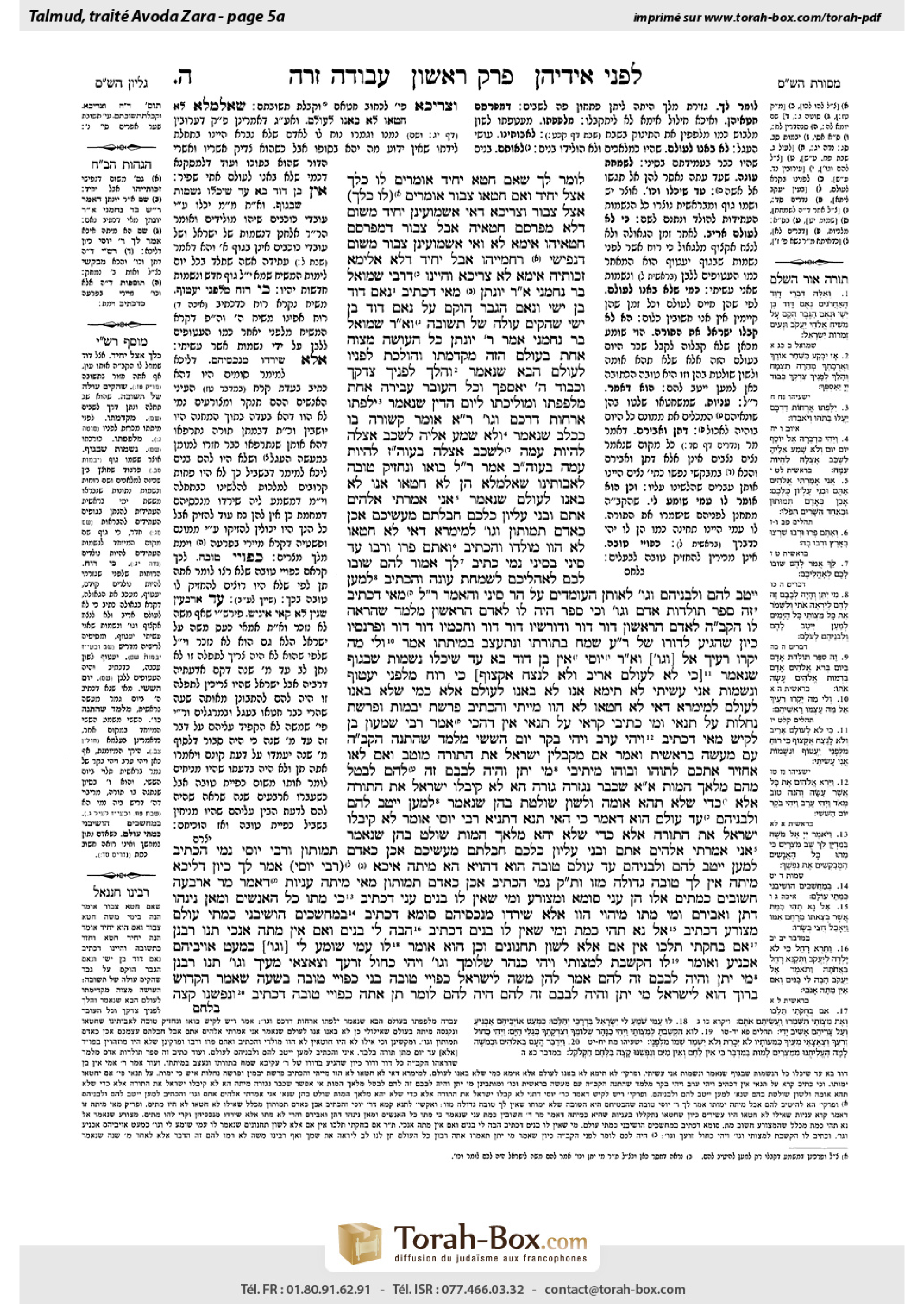
Avodah Zarah 5a: Talmud study for Daf Yomi
Study the Talmud for Daf Yomi with scanned pages, Hebrew text, English translations from Sefaria and AI-generated French translations.
Passage selection and English or AI-generated French translation are available where the scan has annotations. Daf Study is independent of Torah-Box and Sefaria.
Browse Avodah Zarah · עבודה זרה · All tractatesAvodah Zarah 5a text and translations
This page of Avodah Zarah includes the Aramaic text, an English translation and an AI-generated French translation, alongside the scan above.
עבודה זרה ה׳ א · Aramaic and Hebrew text
לוֹמַר לָךְ, שֶׁאִם חָטָא יָחִיד — אוֹמְרִים לוֹ: כְּלָךְ אֵצֶל יָחִיד, וְאִם חָטְאוּ צִבּוּר — אוֹמְרִים לוֹ: כְּלָךְ אֵצֶל צִבּוּר.
וּצְרִיכָא, דְּאִי אַשְׁמוֹעִינַן יָחִיד — מִשּׁוּם דְּלָא מְפַרְסַם חִטְאֵיהּ, אֲבָל צִבּוּר דִּמְפַרְסַם חִטְאַיְהוּ — אֵימָא לָא. וְאִי אַשְׁמוֹעִינַן צִבּוּר — מִשּׁוּם דִּנְפִישִׁי רַחֲמַיְיהוּ, אֲבָל יָחִיד דְּלָא אַלִּימָא זְכוּתֵיהּ — אֵימָא לָא, צְרִיכָא.
וְהַיְינוּ דְּרַבִּי שְׁמוּאֵל בַּר נַחְמָנִי אָמַר רַבִּי יוֹנָתָן, מַאי דִּכְתִיב ״נְאֻם דָּוִד בֶּן יִשַׁי וּנְאֻם הַגֶּבֶר הֻקַם עָל״? נְאֻם דָּוִד בֶּן יִשַׁי שֶׁהֵקִים עוּלָּהּ שֶׁל תְּשׁוּבָה.
וְאָמַר רַבִּי שְׁמוּאֵל בַּר נַחְמָנִי אָמַר רַבִּי יוֹנָתָן: כׇּל הָעוֹשֶׂה מִצְוָה אַחַת בָּעוֹלָם הַזֶּה, מְקַדַּמְתּוֹ וְהוֹלֶכֶת לְפָנָיו לָעוֹלָם הַבָּא, שֶׁנֶּאֱמַר: ״וְהָלַךְ לְפָנֶיךָ צִדְקֶךָ וּכְבוֹד ה׳ יַאַסְפֶךָ״, וְכׇל הָעוֹבֵר עֲבֵירָה אַחַת, מְלַפַּפְתּוֹ וּמוֹלִיכָתוֹ לְיוֹם הַדִּין, שֶׁנֶּאֱמַר: ״יִלָּפְתוּ אׇרְחוֹת דַּרְכָּם וְגוֹ׳״.
רַבִּי אֶלְעָזָר אוֹמֵר: קְשׁוּרָה בּוֹ כְּכֶלֶב, שֶׁנֶּאֱמַר: ״וְלֹא שָׁמַע אֵלֶיהָ לִשְׁכַּב אֶצְלָהּ לִהְיוֹת עִמָּהּ״, ״לִשְׁכַּב אֶצְלָהּ״ — בָּעוֹלָם הַזֶּה, ״לִהְיוֹת עִמָּהּ״ — בָּעוֹלָם הַבָּא.
אָמַר רֵישׁ לָקִישׁ: בּוֹאוּ וְנַחֲזִיק טוֹבָה לַאֲבוֹתֵינוּ, שֶׁאִלְמָלֵא הֵן לֹא חָטְאוּ — אָנוּ לֹא בָּאנוּ לָעוֹלָם, שֶׁנֶּאֱמַר: ״אֲנִי אָמַרְתִּי אֱלֹהִים אַתֶּם וּבְנֵי עֶלְיוֹן כֻּלְּכֶם״, חִבַּלְתֶּם מַעֲשֵׂיכֶם — ״אָכֵן כְּאָדָם תְּמוּתוּן וְגוֹ׳״.
לְמֵימְרָא דְּאִי לָא חָטְאוּ לָא הֲווֹ מוֹלְדוּ? וְהָכְתִיב ״וְאַתֶּם פְּרוּ וּרְבוּ״! עַד סִינַי. בְּסִינַי נָמֵי כְּתִיב ״לֵךְ אֱמֹר לָהֶם שׁוּבוּ לָכֶם לְאׇהֳלֵיכֶם״! לְשִׂמְחַת עוֹנָה.
וְהָכְתִיב: ״לְמַעַן יִיטַב לָהֶם וְלִבְנֵיהֶם וְגוֹ׳״! לְאוֹתָן הָעוֹמְדִים עַל הַר סִינַי.
וְהָאָמַר רֵישׁ לָקִישׁ, מַאי דִּכְתִיב: ״זֶה סֵפֶר תּוֹלְדֹת אָדָם וְגוֹ׳״? וְכִי סֵפֶר הָיָה לוֹ לְאָדָם הָרִאשׁוֹן? מְלַמֵּד שֶׁהֶרְאָה לוֹ הַקָּדוֹשׁ בָּרוּךְ הוּא לְאָדָם הָרִאשׁוֹן דּוֹר דּוֹר וְדוֹרְשָׁיו, דּוֹר דּוֹר וַחֲכָמָיו, דּוֹר דּוֹר וּפַרְנָסָיו. כֵּיוָן שֶׁהִגִּיעַ לְדוֹרוֹ שֶׁל רַבִּי עֲקִיבָא שָׂמַח בְּתוֹרָתוֹ וְנִתְעַצֵּב בְּמִיתָתוֹ, אָמַר: ״וְלִי מַה יָּקְרוּ רֵעֶיךָ אֵל [וְגוֹ׳]״.
וְאָמַר רַבִּי יוֹסֵי: אֵין בֶּן דָּוִד בָּא עַד שֶׁיִּכְלוּ נְשָׁמוֹת שֶׁבַּגּוּף, שֶׁנֶּאֱמַר: ״[כִּי לֹא לְעוֹלָם אָרִיב וְלֹא לָנֶצַח אֶקְּצוֹף] כִּי רוּחַ מִלְּפָנַי יַעֲטוֹף וּנְשָׁמוֹת אֲנִי עָשִׂיתִי״!
לָא תֵּימָא אָנוּ לֹא בָּאנוּ לָעוֹלָם, אֶלָּא כְּמִי שֶׁלֹּא בָּאנוּ לָעוֹלָם. לְמֵימְרָא דְּאִי לָא חָטְאוּ לָא הֲווֹ מָיְיתִי? וְהָכְתִיב פָּרָשַׁת יְבָמוֹת וּפָרָשַׁת נַחֲלוֹת!
עַל תְּנַאי. וּמִי כְּתִיבִי קְרָאֵי עַל תְּנַאי? אִין, דְּהָכִי אָמַר רַבִּי שִׁמְעוֹן בֶּן לָקִישׁ: מַאי דִּכְתִיב ״וַיְהִי עֶרֶב וַיְהִי בֹקֶר יוֹם הַשִּׁשִּׁי״? מְלַמֵּד שֶׁהִתְנָה הַקָּדוֹשׁ בָּרוּךְ הוּא עִם מַעֲשֵׂה בְרֵאשִׁית, וְאָמַר: אִם מְקַבְּלִין יִשְׂרָאֵל אֶת הַתּוֹרָה — מוּטָב, וְאִם לָאו — אַחְזִיר אֶתְכֶם לְתוֹהוּ וָבוֹהוּ.
מֵיתִיבִי: ״מִי יִתֵּן וְהָיָה לְבָבָם זֶה לָהֶם״, לְבַטֵּל מֵהֶם מַלְאַךְ הַמָּוֶת אִי אֶפְשָׁר, שֶׁכְּבָר נִגְזְרָה גְּזֵרָה.
הָא לֹא קִיבְּלוּ יִשְׂרָאֵל אֶת הַתּוֹרָה אֶלָּא כְּדֵי שֶׁלֹּא תְּהֵא אוּמָּה וְלָשׁוֹן שׁוֹלֶטֶת בָּהֶן, שֶׁנֶּאֱמַר: ״לְמַעַן יִיטַב לָהֶם וְלִבְנֵיהֶם עַד עוֹלָם״.
הוּא דְּאָמַר כִּי הַאי תַּנָּא, דְּתַנְיָא: רַבִּי יוֹסֵי אוֹמֵר: לֹא קִיבְּלוּ יִשְׂרָאֵל אֶת הַתּוֹרָה אֶלָּא כְּדֵי שֶׁלֹּא יְהֵא מַלְאַךְ הַמָּוֶת שׁוֹלֵט בָּהֶן, שֶׁנֶּאֱמַר: ״אֲנִי אָמַרְתִּי אֱלֹהִים אַתֶּם וּבְנֵי עֶלְיוֹן כֻּלְּכֶם״, חִבַּלְתֶּם מַעֲשֵׂיכֶם, ״אָכֵן כְּאָדָם תְּמוּתוּן״.
וְרַבִּי יוֹסֵי נָמֵי, הָכְתִיב ״לְמַעַן יִיטַב לָהֶם וְלִבְנֵיהֶם עַד עוֹלָם״, טוֹבָה הוּא דְּהָוְיָא, הָא מִיתָה אִיכָּא! (רַבִּי יוֹסֵי) אָמַר לָךְ: כֵּיוָן דְּלֵיכָּא מִיתָה, אֵין לְךָ טוֹבָה גְּדוֹלָה מִזּוֹ.
וְתַנָּא קַמָּא נָמֵי, הָכְתִיב: ״אָכֵן כְּאָדָם תְּמוּתוּן״, מַאי מִיתָה? עֲנִיּוּת, דְּאָמַר מָר: אַרְבָּעָה חֲשׁוּבִים כְּמֵתִים, אֵלּוּ הֵן: עָנִי, סוּמָא, וּמְצוֹרָע, וּמִי שֶׁאֵין לוֹ בָּנִים.
עָנִי, דִּכְתִיב: ״כִּי מֵתוּ כׇּל הָאֲנָשִׁים״, וּמַאן נִינְהוּ? דָּתָן וַאֲבִירָם. וּמִי מֵתוּ? מִיהְוֵי הֲווֹ! אֶלָּא שֶׁיָּרְדוּ מִנִּכְסֵיהֶם.
סוּמָא, דִּכְתִיב: ״בְּמַחֲשַׁכִּים הוֹשִׁיבַנִי כְּמֵתֵי עוֹלָם״. מְצוֹרָע, דִּכְתִיב: ״אַל נָא תְהִי כַּמֵּת״. וּמִי שֶׁאֵין לוֹ בָּנִים, דִּכְתִיב: ״הָבָה לִּי בָנִים וְאִם אַיִן מֵתָה אָנֹכִי״.
תָּנוּ רַבָּנַן: ״אִם בְּחֻקֹּתַי תֵּלֵכוּ״, אֵין ״אִם״ אֶלָּא לְשׁוֹן תַּחֲנוּנִים, וְכֵן הוּא אוֹמֵר: ״לוּ עַמִּי שׁוֹמֵעַ לִי [וְגוֹ׳] כִּמְעַט אוֹיְבֵיהֶם אַכְנִיעַ״, וְאוֹמֵר: ״לוּ הִקְשַׁבְתָּ לְמִצְוֹתָי וַיְהִי כַנָּהָר שְׁלוֹמֶךָ וְגוֹ׳ וַיְהִי כַחוֹל זַרְעֶךָ וְצֶאֱצָאֵי מֵעֶיךָ וְגוֹ׳״.
תָּנוּ רַבָּנַן: ״מִי יִתֵּן וְהָיָה לְבָבָם זֶה לָהֶם״, אָמַר לָהֶן מֹשֶׁה לְיִשְׂרָאֵל: כְּפוּיֵי טוֹבָה בְּנֵי כְּפוּיֵי טוֹבָה, בְּשָׁעָה שֶׁאָמַר הַקָּדוֹשׁ בָּרוּךְ הוּא לְיִשְׂרָאֵל: ״מִי יִתֵּן וְהָיָה לְבָבָם זֶה לָהֶם״, הָיָה לָהֶם לוֹמַר: תֵּן אַתָּה.
כְּפוּיֵי טוֹבָה, דִּכְתִיב: ״וְנַפְשֵׁנוּ קָצָה
Avodah Zarah 5a · English translation
This serves to say to you that if an individual has sinned, one says to him: Go to that famous individual who sinned, King David, and learn from him that one can repent. And if the community sinned, one says to them: Go to the community that sinned, i.e., the Jewish people at the time of the Golden Calf.
The Gemara notes: And it is necessary to learn about repentance both in the case of an individual and in the case of a community. The reason is that if we had learned this idea only with regard to an individual, one might have thought that he has the option to repent only because his sin is not publicized. But in the case of a community, whose sin is publicized, one might say that the community cannot repent. And likewise, if we had learned this idea only with regard to a community, one might have said that their repentance is accepted because their prayers are more numerous than those of an individual, and they are heard before God. But in the case of an individual, whose merit is not as strong, one might say that he is not able to repent. Therefore, it is necessary to teach both cases.
And this is similar to that which Rabbi Shmuel bar Naḥmani says that Rabbi Yonatan says: What is the meaning of that which is written: “The saying of David, son of Yishai, and the saying of the man raised on high [al]” (II Samuel 23:1)? This is the meaning of the verse: The saying of David, son of Yishai, who raised and lightened the yoke [ullah] of repentance, as he taught the power of repentance through his own example.
And Rabbi Shmuel bar Naḥmani further says that Rabbi Yonatan says: With regard to anyone who performs one mitzva in this world, the mitzva will precede him and walk before him in the World-to-Come, as it is stated: “And your righteousness shall go before you, the glory of the Lord shall be your reward” (Isaiah 58:8). And with regard to anyone who commits one transgression, that transgression will shroud him and lead him on the Day of Judgment, as it is stated: “The paths of their way do wind, they go up into the waste, and are lost” (Job 6:18).
Rabbi Elazar says: The transgression is tied to him like a dog and does not leave him, as it is stated with regard to Joseph and Potiphar’s wife: “And he did not listen to her, to lie by her, or to be with her” (Genesis 39:10). This teaches that Joseph refused “to lie by her” in this world, which would have meant that he would have had “to be with her” in the World-to-Come.
§ The Gemara further discusses the sin of the Golden Calf. Reish Lakish says: Come and let us be grateful to our ancestors who sinned with the Golden Calf, as had they not sinned we would not have come into the world. Reish Lakish explains: As it is stated about the Jewish people after the revelation at Sinai: “I said: You are godlike beings, and all of you sons of the Most High” (Psalms 82:6), which indicates that they had become like angels and would not have propagated offspring. Then, God states: After you ruined your deeds: “Yet you shall die like a man, and fall like one of the princes” (Psalms 82:7).
The Gemara asks: Is this to say that if they had not sinned with the Golden Calf they would not have sired children? But isn’t it written that Noah and his children were instructed: “And you, be fruitful, and multiply” (Genesis 9:7)? The Gemara answers: This instruction was issued only until the revelation at Sinai, but the Jewish people would have become like angels there, had they not sinned. The Gemara asks: Isn’t it also written about the Jewish people who were at the revelation at Sinai: “Go say to them: Return to your tents” (Deuteronomy 5:27), which means that they were instructed to resume marital relations? The Gemara answers: That verse is referring to the enjoyment of conjugal rights, not to procreation.
The Gemara further asks: But isn’t it written: “That it might be good for them, and with their children forever” (Deuteronomy 5:26), which indicates that they would continue to bear children? The Gemara answers: This verse is referring to those children who stood with them at Mount Sinai, not to future generations.
The Gemara raises a further difficulty: But doesn’t Reish Lakish say: What is the meaning of that which is written: “This is the book of the generations of Adam, in the day that God created man” (Genesis 5:1)? Did Adam the first man have a book? Rather, the verse teaches that the Holy One, Blessed be He, showed Adam, the first man, every generation and its expositors, every generation and its Sages, and every generation and its leaders. When Adam arrived at the generation of Rabbi Akiva, he rejoiced in his Torah and was saddened by his death, as Rabbi Akiva was tortured and murdered. Adam said: “How weighty also are Your thoughts to me, O God! How great is the sum of them” (Psalms 139:17). It is evident from here that the Jews were destined to bear future generations from the beginning of time.
And similarly, Rabbi Yosei says: The Messiah, son of David, will not come until all the souls of the body have been finished, i.e., until all souls that are destined to inhabit physical bodies will do so. As it is stated: “For I will not contend for ever, neither will I be always wroth; for the spirit that enwraps itself is from Me, and the souls that I have made” (Isaiah 57:16). According to Rabbi Yosei, in order for the Messiah to come in the end of days, it is necessary for the future generations to be born.
The Gemara answers: Do not say that if our ancestors had not sinned we would not have come into the world, as we still would have been born; rather, it would have been as though we had not come into the world. We would have been of no importance, due to the previous generations that would have still been alive. The Gemara asks: Is this to say that if the Jewish people had not sinned with the Golden Calf then they would not have died? But isn’t the chapter that addresses widows whose husbands die childless (Deuteronomy 25:5–10) written in the Torah, and the chapter that addresses the inheritance a deceased father bequeaths to his sons (Numbers 27:8–11) is also written?
The Gemara answers: These passages were written conditionally, i.e., if the Jewish people were to sin and not become like angels, those halakhot would take effect. The Gemara asks: And are verses written conditionally in this manner? The Gemara answers: Yes, as this is what Rabbi Shimon ben Lakish says: What is the meaning of that which is written: “And there was evening and there was morning, the sixth day” (Genesis 1:31)? This teaches that the Holy One, Blessed be He, established a condition with the acts of Creation, and He said: If the Jewish people accept the Torah at the revelation at Sinai, all is well and the world will continue to exist. But if they do not accept it, I will return you to the primordial state of chaos and disorder.
The Gemara raises an objection from a baraita to the new formulation of Reish Lakish’s statement, according to which the Jewish people would have become immortal had they not sinned with the Golden Calf. The verse states about the Jewish people after the revelation at Sinai: “Who would give that they had such a heart as this always, to fear Me, and keep all My commandments, that it might be good for them, and with their children forever” (Deuteronomy 5:26). The baraita states that although they had reached such an elevated state, it was not possible to nullify the power of the Angel of Death over them, as the decree of death was already issued from the time of creation.
Rather, the baraita explains that the Jewish people accepted the Torah only in order that no nation or tongue would rule over them, as it is stated in the same verse: “That it might be good for them, and with their children forever.” This indicates that had the Jewish people not sinned they would not have achieved immortality, which contradicts Reish Lakish’s statement.
The Gemara answers: Reish Lakish said his statement in accordance with the opinion of that tanna. As it is taught in a baraita that Rabbi Yosei says: The Jewish people accepted the Torah only in order that the Angel of Death would not rule over them, as it is stated: “I said: You are godlike beings, and all of you sons of the Most High” (Psalms 82:6), i.e., they had become immortal like angels. Then, God states: After you ruined your deeds, “yet you shall die like a man, and fall like one of the princes” (Psalms 82:7).
The Gemara asks: And also, according to Rabbi Yosei, isn’t it written: “That it might be good for them, and with their children forever,” from which it may be inferred that although it will be good for them if they remain in this elevated state, there will still be death? The Gemara answers: Rabbi Yosei could have said to you: Since there is no death, there is no greater good than this, i.e., the promise of the verse is immortality.
The Gemara inquires: And according to the first tanna as well, isn’t it written: “Yet you shall die like a man,” which indicates that their mortality was decreed only due to the sin of the Golden Calf? The Gemara answers: What is meant by death? It means poverty. As the Master said: Four are considered as though they were dead: These are a pauper, a blind person, a leper, and one who has no children.
A pauper is considered as though dead, as it is written that God said to Moses: “Go, return to Egypt; for all the men that sought your life are dead” (Exodus 4:19). And who were these men? They were Dathan and Abiram. But did they really die? They were still alive, as they participated in the rebellion of Korah, which took place years later. Rather, the verse does not mean that they had died, but that they had lost their property and become impoverished. This demonstrates that a pauper is considered as though he were dead.
A blind person is considered as though he were dead, as it is written: “He has made me to dwell in dark places, as those that have been long dead” (Lamentations 3:6). A leper is considered as though he were dead, as it is written that Aaron said to Moses when Miriam was struck with leprosy: “Let her not, I pray, be as one dead” (Numbers 12:12). And one who has no children is considered as though he were dead, as it is written that Rachel said to Jacob: “Give me children, or else I am dead” (Genesis 30:1).
The Sages taught with regard to the verse: “If you walk in My statutes” (Leviticus 26:3): In this context, “if” is a term that means nothing other than supplication, i.e., God is hoping that the Jewish people will observe the Torah. And similarly, it is stated: “Oh that My people would hearken to Me, that Israel would walk in My ways, I would soon subdue their enemies” (Psalms 81:14–15). And it states: “Oh that you would hearken to My commandments! Then your peace would be as a river, and your righteousness as the waves of the sea. Your seed also would be as the sand, and the offspring of your body like its grains” (Isaiah 48:18–19).
§ The Gemara returns to a verse cited above. The Sages taught with regard to the verse: “Who would give that they had such a heart as this always, to fear Me, and keep all My commandments, that it might be good for them, and with their children forever” (Deuteronomy 5:26). At a later stage, Moses said to the Jewish people: Ingrates, children of ingrates! When the Holy One, Blessed be He, said to the Jewish people: “Who would give that they had such a heart as this always,” they should have said: You should give us a heart to fear You.
The Gemara explains that Moses calls the Jewish people ingrates, as it is written that the Jewish people spoke disparagingly of the manna: “And our soul loathes
Avodah Zarah 5a · Traduction française (IA)
Cela permet de dire que si une personne a péché, on lui dit : « Allez auprès de cette personne célèbre qui a péché, le roi David, et apprenez de lui que l'on peut se repentir. » Et si la communauté a péché, on leur dit : « Allez auprès de la communauté qui a péché, c'est-à-dire le peuple juif à l'époque du bâton d'or. »
La Guemara note : Il est nécessaire d'apprendre sur le repentir à la fois dans le cas d'une personne et dans le cas d'une communauté. La raison est que si nous avions appris cette idée uniquement dans le cas d'une personne, on aurait pu penser qu'il avait l'option de se repentir uniquement parce que son péché n'était pas publicisé. Mais dans le cas d'une communauté, dont le péché est publicisé, on pourrait dire que la communauté ne peut pas se repentir. De même, si nous avions appris cette idée uniquement dans le cas d'une communauté, on aurait pu dire que leur repentir est accepté parce que leurs prières sont plus nombreuses que celles d'une personne, et qu'elles sont entendues devant Dieu. Mais dans le cas d'une personne, dont la mérite n'est pas aussi fort, on pourrait dire qu'elle n'a pas la capacité de se repentir. Par conséquent, il est nécessaire d'enseigner les deux cas.
Et cela est semblable à ce que dit Rabbi Shmuel bar Naḥmani, qui rapporte Rabbi Yonatan : Quelle est la signification de ce qui est écrit : « La parole de David, fils de Yishai, et la parole de l'homme élevé [al] » (II Samuel 23:1) ? C'est la signification de la parole de David, fils de Yishai, qui a soulevé et allégé le joug du Royaume des Cieux, car il a enseigné la puissance du repentir par son propre exemple.
Et Rabbi Shmuel bar Naḥmani ajoute encore que Rabbi Yonatan dit : Concernant toute personne qui accomplît une mitsva dans ce monde, la mitsva le précède et marche devant lui dans le Monde à Venir, comme il est dit : « Et ta justice marchera devant toi, la gloire du Seigneur sera ton récompense » (Isaïe 58:8). Et concernant toute personne qui commet un péché, ce péché le recouvre et le conduit le Jour du Jugement, comme il est dit : « Les chemins de leur voie tournent, ils montent dans le désert et sont perdus » (Job 6:18).
Rabbi Elazar dit : Le péché est lié à lui comme un chien et ne le quitte pas, comme il est dit concernant Joseph et la femme de Potiphar : « Et il n'écouta pas sa voix, de mentir avec elle, ou d'être avec elle » (Genèse 39:10). Cela enseigne que Joseph a refusé « de mentir avec elle » dans ce monde, ce qui aurait signifié qu'il aurait dû « être avec elle » dans le Monde à Venir.
§ La Guemara discute davantage du péché du bâton d'or. Reish Lakish dit : Viens, et soyons reconnaissants envers nos ancêtres qui ont péché avec le bâton d'or, car s'ils n'avaient pas péché, nous ne serions pas entrés dans le monde. Reish Lakish explique : Comme il est dit à propos du peuple juif après la révélation à Sinaï : « J'ai dit : Vous êtes des êtres divins, et tous vous êtes les fils du Très-Haut » (Psaumes 82:6), ce qui indique qu'ils étaient devenus comme des anges et ne seraient pas devenus des descendants. Puis, Dieu dit : Après que vous avez corrompu vos œuvres : « Cependant, vous mourrez comme un homme, et tomberiez comme l'un des princes » (Psaumes 82:7).
La Guemara pose la question : Est-ce que cela signifie que si ils n'avaient pas péché avec le bâton d'or, ils ne seraient pas entrés dans le monde ? Mais n'est-il pas écrit que Noé et ses enfants furent instruits : « Et vous, soyez féconds et multipliez » (Genèse 9:7) ? La Guemara répond : Cette instruction a été donnée uniquement jusqu'à la révélation à Sinaï, mais le peuple juif serait devenu comme des anges là, s'ils n'avaient pas péché. La Guemara pose la question : N'est-il pas aussi écrit à propos du peuple juif à la révélation à Sinaï : « Dites-leur : Retournez vers vos tentes » (Deutéronome 5:27), ce qui signifie qu'ils ont été instruits de reprendre les relations conjugales ? La Guemara répond : Ce verset fait référence à l'usage des relations conjugales, pas à la procréation.
La Guemara pose encore une difficulté : Mais n'est-il pas écrit : « Afin qu'il soit bon pour eux, et avec leurs enfants pour toujours » (Deutéronome 5:26), ce qui indique qu'ils continueraient à avoir des enfants ? La Guemara répond : Ce verset fait référence à ces enfants qui étaient avec eux à Sinaï, pas aux générations futures.
La Guemara soulève une difficulté supplémentaire : Mais n'est-ce pas ce que Reish Lakish dit : Quelle est la signification de ce qui est écrit : « C'est le livre des générations d'Adam, le jour que Dieu créa l'homme » (Genèse 5:1) ? Adam, le premier homme, avait-il un livre ? Plutôt, le verset enseigne que le Saint, le Bienheureux, a montré à Adam, le premier homme, toutes les générations et leurs exégètes, toutes les générations et leurs Sages, et toutes les générations et leurs chefs. Lorsque Adam est arrivé à la génération de Rabbi Akiva, il s'est réjoui de sa Torah et s'est triste de sa mort, car Rabbi Akiva avait été torturé et tué. Adam a dit : « Combien lourdes sont aussi vos pensées pour moi, ô Dieu ! Combien est grande la somme d'entre elles » (Psaumes 139:17). Il est évident d'ici que les Juifs étaient destinés à avoir des générations futures depuis le début du temps.
Et de même, Rabbi Yosei dit : Le Messie, fils de David, ne viendra pas avant que toutes les âmes du corps ne soient accomplies, c'est-à-dire avant que toutes les âmes destinées à habiter des corps physiques ne le fassent. Comme il est dit : « Car je ne combattrai plus toujours, ni ne serai toujours en colère ; car l'esprit qui s'enveloppe est de Moi, et les âmes que j'ai faites » (Isaïe 57:16). Selon Rabbi Yosei, afin que le Messie vienne à la fin des jours, il est nécessaire que les générations futures soient nées.
La Guemara répond : Ne dis pas que si nos ancêtres n'avaient pas péché nous ne serions pas entrés dans le monde, car nous aurions encore été nés ; plutôt, cela aurait été comme si nous n'étions pas entrés dans le monde. Nous aurions été d'aucune importance, en raison des générations précédentes qui auraient encore été vivantes. La Guemara pose la question : Est-ce que cela signifie que si le peuple juif n'avait pas péché avec le bâton d'or, ils ne seraient pas morts ? Mais n'est-ce pas écrit le chapitre concernant les veuves dont les maris sont décédés sans enfants (Deutéronome 25:5–10) dans la Torah, et le chapitre concernant l'héritage que le père décédé laisse à ses fils (Nombres 27:8–11) est aussi écrit ?
La Guemara répond : Ces passages ont été écrits conditionnellement, c'est-à-dire, si le peuple juif avait péché et ne devenait pas comme des anges, ces halakhot auraient pris effet. La Guemara demande : Et y a-t-il des versets écrits conditionnellement ainsi ? La Guemara répond : Oui, comme c'est ce que dit Rabbi Shimon ben Lakish : Quelle est la signification de ce qui est écrit : « Et il y eut l'après-midi et il y eut le matin, le sixième jour » (Genèse 1:31) ? Cela enseigne que l'Éternel, béni soit Son Nom, a établi une condition avec les actes de la Création, et Il a dit : Si le peuple juif accepte la Torah à la révélation du Sinaï, tout ira bien et le monde continuera à exister. Mais s'ils ne l'acceptent pas, je vous ramènerai à l'état primitif de chaos et de désordre.
La Guemara soulève une objection d'une baraïta contre la nouvelle formulation de la déclaration de Reish Lakish, selon laquelle le peuple juif aurait devenu immortel s'ils n'avaient pas péché avec le bœuf d'or. Le verset mentionne le peuple juif après la révélation du Sinaï : « Qui donnerait qu'ils eussent un tel cœur toujours, pour avoir peur de Moi, et pour observer toutes mes commandements, afin qu'il leur fût bien, et avec leurs enfants pour toujours » (Deutéronome 5:26). La baraïta affirme que bien qu'ils aient atteint un tel état élevé, il était impossible de supprimer le pouvoir de l'Ange de la Mort sur eux, car l'édit de la mort avait déjà été prononcé depuis la Création.
En effet, la baraïta explique que le peuple juif a accepté la Torah uniquement afin que aucun peuple ou langue ne puisse les gouverner, comme il est dit dans le même verset : « Afin qu'il leur fût bien, et avec leurs enfants pour toujours. » Cela indique que si le peuple juif n'avait pas péché, il n'aurait pas atteint l'immortalité, ce qui contredit la déclaration de Reish Lakish.
La Guemara répond : Reish Lakish a dit sa déclaration conformément à l'opinion de ce tanna. Comme il est enseigné dans une baraïta que Rabbi Yosei dit : Le peuple juif a accepté la Torah uniquement afin que l'Ange de la Mort ne gouvernât pas sur eux, comme il est dit : « J'ai dit : Vous êtes des êtres divins, et tous vous êtes les fils du Très-Haut » (Psaumes 82:6), c'est-à-dire qu'ils étaient devenus immortels comme des anges. Puis, Dieu dit : Après que vous avez corrompu vos œuvres, « cependant vous mourrez comme un homme, et vous tomberez comme l'un des princes » (Psaumes 82:7).
La Guemara demande : Et selon Rabbi Yosei, n'est-il pas écrit : « Afin qu'il leur fût bien, et avec leurs enfants pour toujours », d'où on pourrait déduire que bien qu'il leur fasse du bien s'ils restent dans cet état élevé, il y aura encore la mort ? La Guemara répond : Rabbi Yosei aurait pu te dire : Puisque il n'y a pas de mort, il n'y a pas de bien plus grand que cela, c'est-à-dire la promesse du verset est l'immortalité.
La Guemara interroge : Et selon le premier tanna également, n'est-il pas écrit : « Cependant vous mourrez comme un homme », ce qui indique que leur mortalité avait été décrétée uniquement à cause du péché du bœuf d'or ? La Guemara répond : Qu'est-ce que la mort ? Cela signifie la pauvreté. Comme le Maître a dit : Quatre sont considérés comme s'ils étaient morts : Ce sont un pauvre, un aveugle, un lépreux, et celui qui n'a pas d'enfants.
Un pauvre est considéré comme s'il était mort, comme il est écrit que Dieu a dit à Moïse : « Retourne en Égypte ; car tous ceux qui cherchaient ta vie sont morts » (Exode 4:19). Et qui étaient ces hommes ? Ce sont Dathan et Abiram. Mais sont-ils vraiment morts ? Ils étaient encore vivants, car ils avaient participé à la rébellion de Korah, qui s'était produite plus tard. En effet, le verset ne signifie pas qu'ils étaient morts, mais qu'ils avaient perdu leurs biens et étaient devenus pauvres. Cela démontre qu'un pauvre est considéré comme s'il était mort.
Un aveugle est considéré comme s'il était mort, comme il est écrit : « Il m'a fait habiter dans les ténèbres, comme ceux qui sont longtemps morts » (Lamentations 3:6). Un lépreux est considéré comme s'il était mort, comme il est écrit que Aaron a dit à Moïse lorsqu'Miriam avait été touchée de la lèpre : « Que je ne sois pas, je prie, comme un mort » (Nombres 12:12). Et celui qui n'a pas d'enfants est considéré comme s'il était mort, comme il est écrit que Rachel a dit à Jacob : « Donne-moi des enfants, sinon je suis morte » (Genèse 30:1).
Les Sages ont enseigné concernant le verset : « Si vous marchez dans mes statutes » (Lévitique 26:3) : Dans ce contexte, « si » n'est pas autre chose qu'une prière, c'est-à-dire que Dieu espère que le peuple juif observe la Torah. De même, il est dit : « Oh que mon peuple m'écoute ! Que l'Israël marche dans mes voies, je submergerais rapidement leurs ennemis » (Psaumes 81:14–15). Et il est dit : « Oh que vous m'écouciez mes commandements ! Alors votre paix serait comme un fleuve, et votre justice comme les vagues de la mer. Vos enfants aussi seraient comme la poussière, et l'offspring de votre corps comme ses grains » (Isaïe 48:18–19).
§ La Guemara reprend un verset cité plus haut. Les Sages ont enseigné concernant le verset : « Qui donnerait qu'ils eussent un tel cœur toujours, pour avoir peur de Moi, et pour observer toutes mes commandements, afin qu'il leur fût bien, et avec leurs enfants pour toujours » (Deutéronome 5:26). Plus tard, Moïse a dit au peuple juif : Ingrats, enfants d'ingrats ! Quand l'Éternel, béni soit Son Nom, a dit au peuple juif : « Qui donnerait qu'ils eussent un tel cœur toujours », ils auraient dû dire : Vous devriez nous donner un cœur pour avoir peur de Vous.
La Guemara explique que Moïse appelle le peuple juif ingrats, comme il est écrit que le peuple juif a parlé méprisamment du manna : « Et notre âme déteste »
Traduction française générée par IA à partir de l’édition anglaise de Sefaria. Vérifie toujours un passage avec le texte source.
Text from Sefaria: William Davidson Edition - Vocalized Aramaic (CC BY NC); William Davidson Edition - English (CC BY NC).