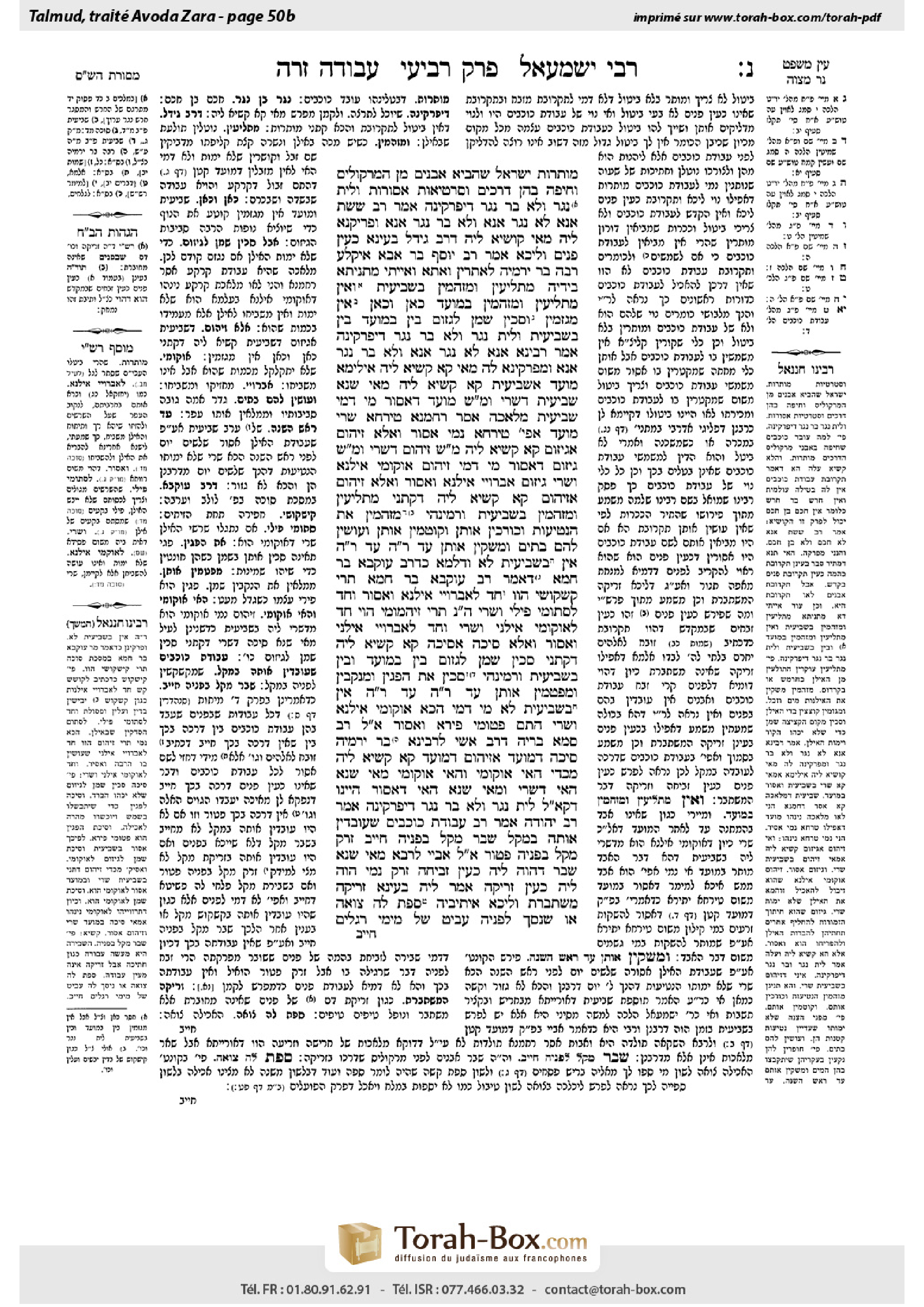
Avodah Zarah 50b: Talmud study for Daf Yomi
Study the Talmud for Daf Yomi with scanned pages, Hebrew text, English translations from Sefaria and AI-generated French translations.
Passage selection and English or AI-generated French translation are available where the scan has annotations. Daf Study is independent of Torah-Box and Sefaria.
Browse Avodah Zarah · עבודה זרה · All tractatesAvodah Zarah 50b text and translations
This page of Avodah Zarah includes the Aramaic text, an English translation and an AI-generated French translation, alongside the scan above.
עבודה זרה נ׳ ב · Aramaic and Hebrew text
מוּתָּרוֹת, יִשְׂרָאֵל שֶׁהֵבִיא אֲבָנִים מִן הַמַּרְקוּלִיס וְחִיפָּה בָּהֶן דְּרָכִים וּסְרַטְיָאוֹת — אֲסוּרוֹת, וְלֵית נַגָּר וְלָא בַּר נַגָּר דְּיִפְרְקִינַּהּ.
אֲמַר רַב שֵׁשֶׁת: אֲנָא לָא נַגָּר אֲנָא וְלָא בַּר נַגָּר אֲנָא, וּפָרֵיקְנָא לֵיהּ: מַאי קוּשְׁיָא לֵיהּ? דְּרַב גִּידֵּל. בָּעֵינָא כְּעֵין פְּנִים, וְלֵיכָּא.
אָמַר רַב יוֹסֵף בַּר אַבָּא: אִיקְּלַע רַבָּה בַּר יִרְמְיָה לְאַתְרִין, וַאֲתָא וְאַיְיתִי מַתְנִיתָא בִּידֵיהּ: מַתְלִיעִין וּמְזַהֲמִין בַּשְּׁבִיעִית, וְאֵין מַתְלִיעִין וּמְזַהֲמִין בַּמּוֹעֵד.
כָּאן וְכָאן אֵין מְגַזְּמִין, וְסָכִין שֶׁמֶן לִגְזוֹם, בֵּין בַּמּוֹעֵד בֵּין בַּשְּׁבִיעִית. וְלֵית נַגָּר וְלָא בַּר נַגָּר דְּיִפְרְקִינַּהּ.
אָמַר רָבִינָא: אֲנָא לָא נַגָּר אֲנָא וְלָא בַּר נַגָּר אֲנָא, וּמְפָרֵקְינָא לַהּ: מַאי קָא קַשְׁיָא לֵיהּ? אִילֵּימָא מוֹעֵד אַשְּׁבִיעִית קָא קַשְׁיָא לֵיהּ — מַאי שְׁנָא שְׁבִיעִית דְּשָׁרֵי, וּמַאי שְׁנָא מוֹעֵד דְּאָסוּר? מִי דָּמֵי?! שְׁבִיעִית — מְלָאכָה אָסַר רַחֲמָנָא, טִירְחָא שְׁרֵי; מוֹעֵד — אֲפִילּוּ טִירְחָא נָמֵי אָסוּר.
וְאֶלָּא זִיהוּם אַגִּיזּוּם קָא קַשְׁיָא לֵיהּ: מַאי שְׁנָא זִיהוּם דְּשָׁרֵי, וּמַאי שְׁנָא גִּיזּוּם דְּאָסוּר? מִי דָּמֵי?! זִיהוּם — אוֹקוֹמֵי אִילָנָא, וּשְׁרֵי; גִּיזּוּם — אַבְרוֹיֵי אִילָנָא, וְאָסוּר.
וְאֶלָּא, זִיהוּם אַזִּיהוּם קָא קַשְׁיָא לֵיהּ, דְּקָתָנֵי: מַתְלִיעִין וּמְזַהֲמִין בַּשְּׁבִיעִית, וּרְמִינְהִי: מְזַהֲמִין אֶת הַנְּטִיעוֹת, וְכוֹרְכִין אוֹתָן, וְקוֹטְמִין אוֹתָן, וְעוֹשִׂין לָהֶם בָּתִּים, וּמַשְׁקִין אוֹתָן עַד רֹאשׁ הַשָּׁנָה — עַד רֹאשׁ הַשָּׁנָה אִין, בִּשְׁבִיעִית לָא!
וְדִלְמָא כִּדְרַב עוּקְבָא בַּר חָמָא, דְּאָמַר רַב עוּקְבָא בַּר חָמָא: תְּרֵי קִשְׁקוּשֵׁי הָווּ, חַד לְאַבְרוֹיֵי אִילָנָא וְאָסוּר, וְחַד לְסַתּוֹמֵי פִּילֵי וּשְׁרֵי. הָכִי נָמֵי תְּרֵי זִיהוּמֵי הָוֵי, חַד לְאוֹקוֹמֵי אִילָנֵי וּשְׁרֵי, וְחַד לְאַבְרוֹיֵי אִילָנֵי וְאָסוּר!
וְאֶלָּא, סִיכָה אַסִּיכָה קָא קַשְׁיָא לֵיהּ, דְּקָתָנֵי: סָכִין שֶׁמֶן לִגְזוֹם בֵּין בַּמּוֹעֵד וּבֵין בַּשְּׁבִיעִית, וּרְמִינְהִי: סָכִין אֶת הַפַּגִּין וּמְנַקְּבִין וּמְפַטְּמִין אוֹתָן עַד רֹאשׁ הַשָּׁנָה — עַד רֹאשׁ הַשָּׁנָה אִין, בִּשְׁבִיעִית לָא!
מִי דָּמֵי?! הָכָא אוֹקוֹמֵי אִילָנָא, וּשְׁרֵי; הָתָם פַּטּוֹמֵי פֵּירָא, וַאֲסִיר!
אֲמַר לֵיהּ רַב סַמָּא בְּרֵיהּ דְּרַב אָשֵׁי לְרָבִינָא בַּר יִרְמְיָה: סִיכָה דְּמוֹעֵד אַזִּיהוּם דְּמוֹעֵד קָא קַשְׁיָא לֵיהּ, מִכְּדִי הַאי אוֹקוֹמֵי וְהַאי אוֹקוֹמֵי, מַאי שְׁנָא הַאי דִּשְׁרֵי וּמַאי שְׁנָא הַאי דַּאֲסִור? הַיְינוּ דְּקָאָמַר לֵיהּ: לֵית נַגָּר וְלָא בַּר נַגָּר דְּיִפְרְקִינַּהּ.
אָמַר רַב יְהוּדָה אָמַר רַב: עֲבוֹדָה זָרָה שֶׁעוֹבְדִין אוֹתָהּ בְּמַקֵּל, שָׁבַר מַקֵּל בְּפָנֶיהָ — חַיָּיב, זָרַק מַקֵּל בְּפָנֶיהָ — פָּטוּר. אֲמַר לֵיהּ אַבָּיֵי לְרָבָא: מַאי שְׁנָא שָׁבַר דַּהֲוָה לֵיהּ כְּעֵין זְבִיחָה, זָרַק נָמֵי הֲוָה לֵיהּ כְּעֵין זְרִיקָה! אֲמַר לֵיהּ: בָּעֵינָא זְרִיקָה מִשְׁתַּבֶּרֶת, וְלֵיכָּא.
אֵיתִיבֵיהּ: סָפַת לָהּ צוֹאָה, אוֹ שֶׁנִּסֵּךְ לְפָנֶיהָ עָבִיט שֶׁל מֵימֵי רַגְלַיִם —
Avodah Zarah 50b · English translation
they are permitted, as the gentile nullified their prohibited status. In the case of a Jew who brought stones from a pile dedicated to Mercury and paved paths and streets with them, they are prohibited. And there is neither a carpenter [naggar] nor a son of a carpenter who can resolve this, i.e., no one can resolve the difficulty inherent in this statement, not a Torah scholar, and not even a scholar who is the son of a scholar.
Rav Sheshet said: As for me, I am not a carpenter, nor am I the son of a carpenter, and yet I will resolve the difficulty. What is the difficulty that Rabba bar Yirmeya finds in the baraita? The baraita is difficult because of the statement of Rav Giddel, that the prohibited status of offerings brought in idol worship can never be revoked. This is not difficult, as in order for idol worship to prohibit an offering I require the offering to be like those offerings sacrificed inside the Temple, and there is not a parallel offering of stones in the Temple.
§ Rav Yosef bar Abba said: Rabba bar Yirmeya happened to come to our locale, and when he came he brought the following baraita with him: One may remove worms from a tree and place manure on a cut in a tree during the Sabbatical Year, but one may not remove worms or place manure on a cut during the intermediate days of the Festival.
The baraita continues: Both here, in the case of the Sabbatical Year, and there, in the case of the intermediate days of the Festival, one may not prune the trees. But one may smear oil on the previously pruned tree on the place where one pruned it in order to prevent the tree from being damaged, both during the intermediate days of the Festival and during the Sabbatical Year. And there is neither a carpenter nor a son of a carpenter who can resolve this.
Ravina said: As for me, I am not a carpenter, nor am I the son of a carpenter, and yet I will resolve the difficulty. What is the difficulty that Rabba bar Yirmeya finds in the baraita? If we say that the difference between the intermediate days of the Festival and the Sabbatical Year poses a difficulty to him, this cannot be so. One cannot explain that Rabba bar Yirmeya is asking what is different about the Sabbatical Year that one is permitted to remove worms and place manure on a cut, and what is different about the intermediate days of the Festival that it is prohibited to do so, as this is not a valid question. Are they comparable? With regard to the Sabbatical Year, the Merciful One prohibited only agricultural labor, whereas other forms of exertion are permitted. With regard to the intermediate days of the Festival, even other forms of exertion are prohibited.
Ravina suggests: Rather, perhaps the difference between placing manure and pruning poses a difficulty to him. What is different about placing manure that it is permitted during the Sabbatical Year, and what is different about pruning that it is prohibited? Ravina rejects this suggestion: This is also not a valid question. Are they comparable? The purpose of placing manure is to preserve the tree, and therefore it is permitted, whereas the purpose of pruning is to enhance the tree, and therefore it is prohibited.
Ravina suggests: Rather, perhaps the contradiction between the aforementioned baraita with regard to placing manure and another mishna with regard to placing manure poses a difficulty to him, as the baraita teaches: One may remove worms from a tree and place manure on a cut in a tree during the Sabbatical Year. And one may raise a contradiction from a mishna (Shevi’it 2:4): One may place manure on the saplings, and one may bind their branches to the trunk so that they grow upright. And one may lop off their tops to promote their growth, and make shelters for them to shield them from the sun, and water them. All these actions are permitted until Rosh HaShana of the Sabbatical Year. One can infer that until Rosh HaShana, yes, one may place manure on the tree; but during the Sabbatical Year itself one may not do so.
Ravina rejects this suggestion: But perhaps one can account for the apparent contradiction in a similar fashion to the explanation of Rav Ukva bar Ḥama, as Rav Ukva bar Ḥama says: There are two types of hoeing [kishkushei]. The purpose of one type is to enhance the tree’s health, and it is therefore prohibited. And the purpose of one type is to close up cracks in the ground, which is permitted, as it is done only to prevent the trees from dying and not to enhance their growth. So too, one may suggest that there are two types of placing manure: One type whose purpose is to preserve the trees, and is therefore permitted, and one type whose purpose is to enhance the trees, and is therefore prohibited.
Ravina suggests: Rather, perhaps the contradiction between the halakha in the baraita with regard to smearing oil and the halakha in another mishna with regard to smearing oil poses a difficulty for him, as the baraita teaches: One may smear oil on the previously pruned tree, on the place where one pruned it, both during the intermediate days of the Festival and during the Sabbatical Year. And one may raise a contradiction from the mishna (Shevi’it 2:5): One may smear oil on the unripe figs in the sixth year of the Sabbatical cycle in order to accelerate their ripening, and similarly one may pierce them and fill the cut with oil to facilitate their ripening until Rosh HaShana. One can infer that until Rosh HaShana, yes, one may smear; but during the Sabbatical Year itself one may not do so.
Ravina rejects this suggestion: That is also not a valid question. Are they comparable? Here, the purpose of smearing oil on the place where the tree was pruned is to preserve the tree, and therefore it is permitted. There, the purpose of smearing oil on the unripe figs is to enhance and enlarge the fruit and is therefore prohibited.
Rav Samma, son of Rav Ashi, said to Ravina: The contradiction between the halakha with regard to smearing oil during the intermediate days of the Festival and the halakha with regard to placing manure during the intermediate days of the Festival poses a difficulty for Rabba bar Yirmeya. Since the purpose of this action is to preserve the tree, and the purpose of that action is to preserve the tree, what is different in this case that it is permitted, and what is different in that case that it is prohibited? This is the reason that Rabba bar Yirmeya said to him: There is neither a carpenter nor a son of a carpenter who can resolve this.
§ Rav Yehuda says that Rav says: In the case of an object of idol worship that is worshipped by means of a stick, e.g., by beating a stick on another object in order to produce noise, if one broke a stick before it, he is liable. If he threw a stick before it, he is exempt. Abaye said to Rava: What is different about the case where one broke a stick? In this case one is liable because it is similar to slaughtering an offering, which is a rite performed in the Temple; so too, in the case where one threw a stick, it is similar to the sprinkling of the blood on the altar. Rava said to Abaye: In order for a sacrificial rite to be similar to the sprinkling of blood, I require a form of throwing that scatters the offering, and that is not the case here.
Abaye raised an objection to Rava’s explanation from a baraita: One who fed [safat] an idol excrement, or who poured a chamber pot of urine before it as a libation,
Avodah Zarah 50b · Traduction française (IA)
ils sont permis, car le non-Juif a annulé leur statut interdit. Dans le cas d'un Juif qui a ramassé des pierres d'un tas dédié à Mercure et qui a pavé des rues et des chemins avec elles, elles sont interdites. Et il n'y a ni un charpentier ni un fils de charpentier qui puisse résoudre cela, c'est-à-dire qu'aucune personne ne peut résoudre la difficulté inhérente à cette déclaration, pas même un savant de la Torah, et encore moins un savant qui est le fils d'un savant.
Rav Sheshet a dit : En ce qui me concerne, je ne suis pas un charpentier, ni le fils d'un charpentier, et pourtant je résoudrai la difficulté. Quelle est la difficulté que Rabba bar Yirmeya trouve dans la baraïta ? La baraïta est difficile en raison de la déclaration de Rav Giddel, selon laquelle le statut interdit des offrandes apportées dans l'idolâtrie ne peut jamais être révoqué. Cela n'est pas difficile, car afin que l'idolâtrie interdise une offrande, je dois exiger que l'offrande soit semblable à celles sacrifiées dans le Temple, et il n'y a pas d'offrande similaire de pierres dans le Temple.
§ Rav Yosef bar Abba a dit : Rabba bar Yirmeya est venu à notre lieu, et lorsqu'il est venu, il a apporté avec lui la baraïta suivante : On peut retirer des vers d'un arbre et appliquer de la matière fécale sur une plaie d'un arbre pendant l'année sainte, mais on ne peut pas retirer des vers ou appliquer de la matière fécale sur une plaie pendant les jours intermédiaires du festival.
La baraïta continue : ici, dans le cas de l'année sainte, et là, dans le cas des jours intermédiaires du festival, on ne peut pas tailler les arbres. Mais on peut appliquer de l'huile sur l'arbre déjà taillé sur la place où l'on a taillé, afin de prévenir que l'arbre ne soit pas endommagé, tant pendant les jours intermédiaires du festival que pendant l'année sainte. Et il n'y a ni un charpentier ni un fils de charpentier qui puisse résoudre cela.
Ravina a dit : En ce qui me concerne, je ne suis pas un charpentier, ni le fils d'un charpentier, et pourtant je résoudrai la difficulté. Quelle est la difficulté que Rabba bar Yirmeya trouve dans la baraïta ? Si nous disons que la différence entre les jours intermédiaires du festival et l'année sainte pose une difficulté pour lui, cela ne peut pas être vrai. On ne peut pas expliquer que Rabba bar Yirmeya demande ce qui est différent de l'année sainte qui permet de retirer des vers et d'appliquer de la matière fécale sur une plaie, et ce qui est différent des jours intermédiaires du festival qui l'interdit, car cela n'est pas une question valable. Sont-ils comparables ? L'Éternel a interdit seulement les travaux agricoles pendant l'année sainte, tandis que d'autres formes d'effort sont permises. Pendant les jours intermédiaires du festival, même d'autres formes d'effort sont interdites.
Ravina suggère : Plutôt, peut-être la différence entre l'application de la matière fécale et la taille pose une difficulté pour lui. Qu'est-ce qui est différent dans l'application de la matière fécale qui permet de le faire pendant l'année sainte, et qu'est-ce qui est différent dans la taille qui l'interdit ? Ravina rejette cette suggestion : cela n'est pas non plus une question valable. Sont-ils comparables ? L'objectif de l'application de la matière fécale est de préserver l'arbre, et donc elle est permise, tandis que l'objectif de la taille est d'améliorer l'arbre, et donc elle est interdite.
Ravina suggère : Plutôt, peut-être la contradiction entre la baraïta mentionnée précédemment concernant l'application de la matière fécale et une autre mishna concernant l'application de la matière fécale pose une difficulté pour lui, car la baraïta enseigne : On peut retirer des vers d'un arbre et appliquer de la matière fécale sur une plaie d'un arbre pendant l'année sainte. Et on peut élever une contradiction à partir d'une mishna (Shevi’it 2:4) : On peut appliquer de la matière fécale sur les jeunes pousses, et on peut attacher leurs branches au tronc afin qu'elles grandissent droit. Et on peut couper leurs extrémités pour favoriser leur croissance, et construire des abris pour les protéger du soleil, et les arroser. Toutes ces actions sont permises jusqu'à Rosh HaShana de l'année sainte. On peut en déduire que jusqu'à Rosh HaShana, oui, on peut appliquer de la matière fécale sur l'arbre ; mais pendant l'année sainte elle-même, on ne peut pas le faire.
Ravina rejette cette suggestion : Mais peut-être peut-on expliquer la contradiction apparemment existante de manière similaire à l'explication de Rav Ukva bar Ḥama, car Rav Ukva bar Ḥama dit : Il y a deux types de labourage [kishkushei]. L'objectif d'un type est d'améliorer la santé de l'arbre, et il est donc interdit. Et l'objectif d'un autre type est de fermer les fissures du sol, ce qui est permis, car il est fait uniquement pour empêcher les arbres de mourir et non pour améliorer leur croissance. De même, on peut suggérer qu'il y a deux types d'application de la matière fécale : un type dont l'objectif est de préserver les arbres et est donc permis, et un type dont l'objectif est d'améliorer les arbres et est donc interdit.
Ravina suggère : Plutôt, peut-être la contradiction entre la halakha dans la baraïta concernant l'application d'huile et la halakha dans une autre mishna concernant l'application d'huile pose une difficulté pour lui, car la baraïta enseigne : On peut appliquer de l'huile sur l'arbre déjà taillé, sur la place où l'on a taillé, tant pendant les jours intermédiaires du festival que pendant l'année sainte. Et on peut élever une contradiction à partir de la mishna (Shevi’it 2:5) : On peut appliquer de l'huile sur les figues non mûres de la sixième année du cycle de l'année sainte afin d'accélérer leur maturité, et de même on peut percer les figues et remplir la plaie avec de l'huile pour favoriser leur maturité jusqu'à Rosh HaShana. On peut en déduire que jusqu'à Rosh HaShana, oui, on peut appliquer ; mais pendant l'année sainte elle-même, on ne peut pas le faire.
Ravina rejette cette suggestion : Cela n'est pas non plus une question valable. Sont-ils comparables ? Ici, l'objectif d'appliquer de l'huile sur la place où l'arbre a été taillé est de préserver l'arbre, et donc il est permis. Là, l'objectif d'appliquer de l'huile sur les figues non mûres est d'améliorer et d'agrandir les fruits et est donc interdit.
Rav Samma, fils de Rav Ashi, dit à Ravina : La contradiction entre la halakha concernant l'application d'huile pendant les jours intermédiaires du festival et la halakha concernant l'application de fumier pendant les jours intermédiaires du festival constitue une difficulté pour Rabba bar Yirmeya. Puisque le but de cette action est de préserver l'arbre, et que le but de cette autre action est également de préserver l'arbre, qu'y a-t-il de différent dans ce cas qui rend cela permis, et qu'y a-t-il de différent dans cet autre cas qui rend cela interdit ? C'est la raison pour laquelle Rabba bar Yirmeya a dit à lui : Il n'y a ni charpentier ni fils de charpentier qui puisse résoudre cela.
§ Rav Yehuda dit que Rav dit : Dans le cas d'un objet d'idolâtrie qui est adoré par l'intermédiaire d'une verge, par exemple, en frappant une verge sur un autre objet afin de produire du bruit, si l'on a cassé une verge avant, il est responsable. Si l'on a lancé une verge avant, il est exempt. Abaye a dit à Rava : Qu'y a-t-il de différent dans le cas où l'on a cassé une verge ? Dans ce cas, on est responsable car cela ressemble à l'immolation d'un sacrifice, qui est une cérémonie accomplie dans le Temple ; de même, dans le cas où l'on a lancé une verge, cela ressemble à l'aspersion du sang sur l'autel. Rava a dit à Abaye : Afin qu'une cérémonie sacrificielle ressemble à l'aspersion du sang, j'exige une forme de lancer qui disperse l'offrande, et cela n'est pas le cas ici.
Abaye a soulevé une objection contre l'explication de Rava à partir d'une baraïta : Celui qui a nourri [safat] un idole des déjections, ou qui a versé une cuvette d'urine devant elle en libation,
Traduction française générée par IA à partir de l’édition anglaise de Sefaria. Vérifie toujours un passage avec le texte source.
Text from Sefaria: William Davidson Edition - Vocalized Aramaic (CC BY NC); William Davidson Edition - English (CC BY NC).