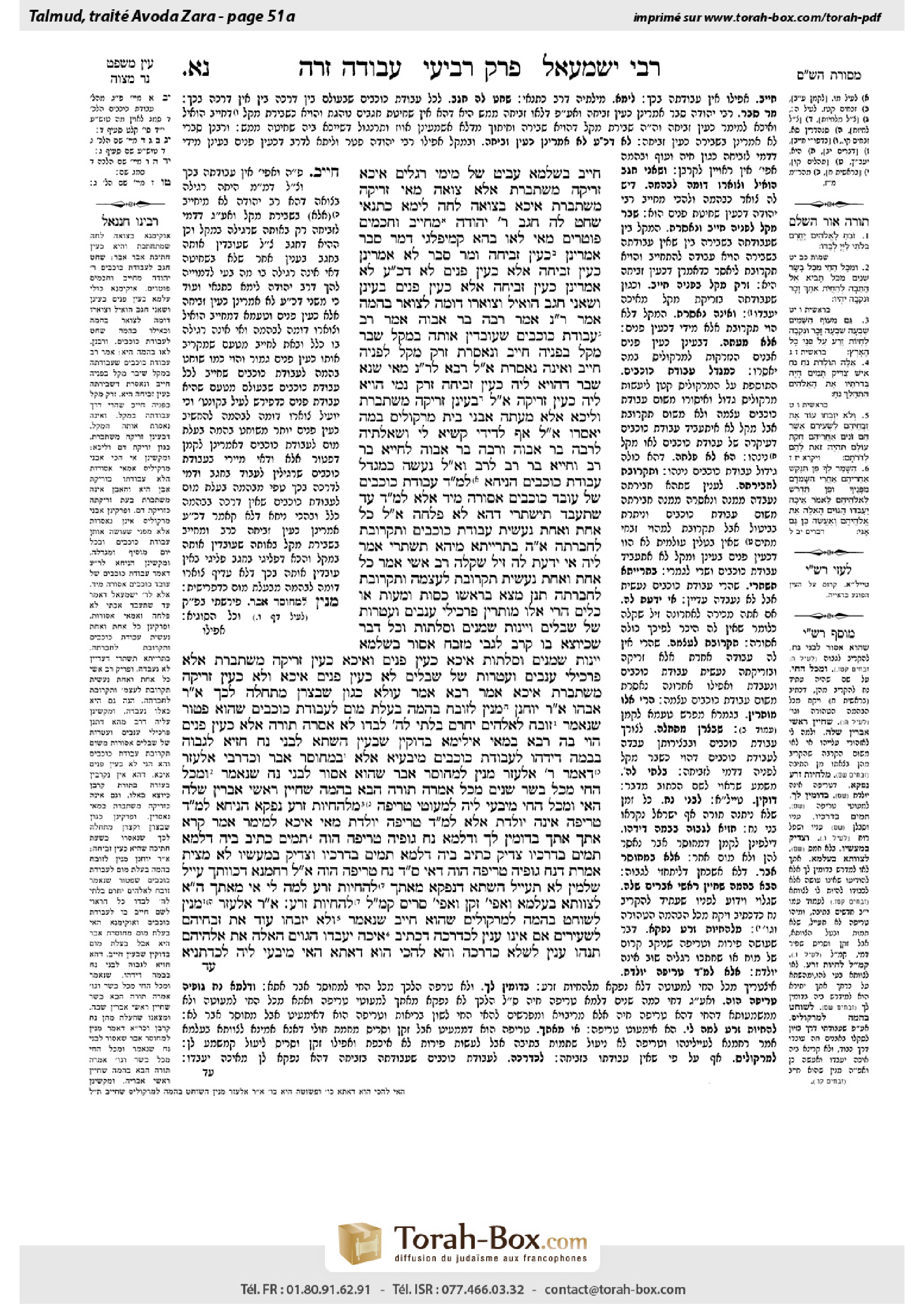
Avodah Zarah 51a: Talmud study for Daf Yomi
Study the Talmud for Daf Yomi with scanned pages, Hebrew text, English translations from Sefaria and AI-generated French translations.
Passage selection and English or AI-generated French translation are available where the scan has annotations. Daf Study is independent of Torah-Box and Sefaria.
Browse Avodah Zarah · עבודה זרה · All tractatesAvodah Zarah 51a text and translations
This page of Avodah Zarah includes the Aramaic text, an English translation and an AI-generated French translation, alongside the scan above.
עבודה זרה נ״א א · Aramaic and Hebrew text
חַיָּיב, בִּשְׁלָמָא עָבִיט שֶׁל מֵימֵי רַגְלַיִם — אִיכָּא זְרִיקָה מִשְׁתַּבֶּרֶת, אֶלָּא צוֹאָה, מַאי זְרִיקָה מִשְׁתַּבֶּרֶת אִיכָּא? בְּצוֹאָה לַחָה.
לֵימָא כְּתַנָּאֵי: שָׁחַט לָהּ חָגָב — רַבִּי יְהוּדָה מְחַיֵּיב, וַחֲכָמִים פּוֹטְרִים.
מַאי לָאו בְּהָא קָמִיפַּלְגִי, דְּמָר סָבַר: אָמְרִינַן כְּעֵין זְבִיחָה, וּמָר סָבַר: לָא אָמְרִינַן כְּעֵין זְבִיחָה, אֶלָּא כְּעֵין פְּנִים?
לָא, דְּכוּלֵּי עָלְמָא לָא אָמְרִינַן כְּעֵין זְבִיחָה, אֶלָּא כְּעֵין פְּנִים בָּעֵינַן, וְשָׁאנֵי חָגָב הוֹאִיל וְצַוָּארוֹ דּוֹמֶה לְצַוַּאר בְּהֵמָה.
אָמַר רַב נַחְמָן אָמַר רַבָּה בַּר אֲבוּהּ אָמַר רַב: עֲבוֹדָה זָרָה שֶׁעוֹבְדִין אוֹתָהּ בְּמַקֵּל, שָׁבַר מַקֵּל בְּפָנֶיהָ — חַיָּיב וְנֶאֱסֶרֶת, זָרַק מַקֵּל לְפָנֶיהָ — חַיָּיב וְאֵינָהּ נֶאֱסֶרֶת.
אֲמַר לֵיהּ רָבָא לְרַב נַחְמָן: מַאי שְׁנָא שָׁבַר דְּהָוְיָא לֵיהּ כְּעֵין זְבִיחָה, זָרַק נָמֵי הָוְיָא לֵיהּ כְּעֵין זְרִיקָה! אֲמַר לֵיהּ: בָּעֵינַן זְרִיקָה מִשְׁתַּבֶּרֶת, וְלֵיכָּא.
אֶלָּא מֵעַתָּה, אַבְנֵי בֵּית מַרְקוּלִיס בַּמֶּה יֵאָסְרוּ? אֲמַר לֵיהּ: אַף לְדִידִי קַשְׁיָא לִי, וּשְׁאֵלְתֵּיהּ לְרַבָּה בַּר אֲבוּהּ, וְרַבָּה בַּר אֲבוּהּ לְחִיָּיא בַּר רַב, וְחִיָּיא בַּר רַב לְרַב, וַאֲמַר לֵיהּ: נַעֲשָׂה כִּמְגַדֵּל עֲבוֹדָה זָרָה.
הָנִיחָא לְמַאן דְּאָמַר: עֲבוֹדָה זָרָה שֶׁל גּוֹי אֲסוּרָה מִיָּד, אֶלָּא לְמַאן דְּאָמַר עַד שֶׁתֵּעָבֵד, תִּישְׁתְּרֵי, דְּהָא לָא פַּלְחַהּ! אֲמַר לֵיהּ: כׇּל אַחַת וְאַחַת נַעֲשֵׂית עֲבוֹדָה זָרָה, וְתִקְרוֹבֶת לַחֲבֶרְתָּהּ.
אִי הָכִי, בָּתְרָיְיתָא מִיהָא תִּשְׁתְּרֵי! אֲמַר לֵיהּ: אִי יָדְעַתְּ לַהּ, זִיל שִׁקְלַהּ. רַב אָשֵׁי אָמַר: כׇּל אַחַת וְאַחַת נַעֲשֵׂית תִּקְרוֹבֶת לְעַצְמָהּ וְתִקְרוֹבֶת לַחֲבֶרְתָּהּ.
תְּנַן: מָצָא בְּרֹאשׁוֹ כְּסוּת וּמָעוֹת אוֹ כֵלִים — הֲרֵי אֵלּוּ מוּתָּרִין, פַּרְכִּילֵי עֲנָבִים וַעֲטָרוֹת שֶׁל שִׁבֳּלִים וְיֵינוֹת שְׁמָנִים וּסְלָתוֹת וְכׇל דָּבָר שֶׁכַּיּוֹצֵא בּוֹ קָרֵב לְגַבֵּי מִזְבֵּחַ — אָסוּר.
בִּשְׁלָמָא יֵינוֹת שְׁמָנִים וּסְלָתוֹת — אִיכָּא כְּעֵין פְּנִים, וְאִיכָּא כְּעֵין זְרִיקָה מִשְׁתַּבֶּרֶת, אֶלָּא פַּרְכִּילֵי עֲנָבִים וַעֲטָרוֹת שֶׁל שִׁבֳּלִים — לָא כְּעֵין פְּנִים אִיכָּא, וְלָא כְּעֵין זְרִיקָה מִשְׁתַּבֶּרֶת אִיכָּא!
אָמַר רָבָא אָמַר עוּלָּא: כְּגוֹן שֶׁבְּצָרָן מִתְּחִלָּה לְכָךְ.
אָמַר רַבִּי אֲבָהוּ אָמַר רַבִּי יוֹחָנָן: מִנַּיִן לַזּוֹבֵחַ בְּהֵמָה בַּעֲלַת מוּם לַעֲבוֹדָה זָרָה שֶׁהוּא פָּטוּר? שֶׁנֶּאֱמַר: ״זֹבֵחַ לָאֱלֹהִים יׇחֳרָם בִּלְתִּי לַה׳ לְבַדּוֹ״, לֹא אָסְרָה תּוֹרָה אֶלָּא כְּעֵין פְּנִים.
הָוֵי בֵּהּ רָבָא, בְּמַאי? אִילֵימָא בְּדוּקִּין שֶׁבָּעַיִן — הַשְׁתָּא לִבְנֵי נֹחַ חַזְיָא לְגָבוֹהַּ בְּבָמָה דִּידְהוּ, לַעֲבוֹדָה זָרָה מִיבַּעְיָא?
אֶלָּא בִּמְחוּסַּר אֵבֶר, וְכִדְרַבִּי אֶלְעָזָר, דְּאָמַר רַבִּי אֶלְעָזָר: מִנַּיִן לִמְחוּסַּר אֵבֶר שֶׁהוּא אָסוּר לִבְנֵי נֹחַ? שֶׁנֶּאֱמַר: ״וּמִכׇּל הָחַי מִכׇּל בָּשָׂר שְׁנַיִם מִכֹּל״, אָמְרָה תּוֹרָה: הָבֵא בְּהֵמָה שֶׁחַיִּין רָאשֵׁי אֵבָרִין שֶׁלָּהּ.
הַאי ״וּמִכׇּל הַחַי״ מִיבְּעֵי לֵיהּ לְמַעוֹטֵי טְרֵיפָה! מִ״לְּהַחֲיוֹת זֶרַע״ נָפְקָא.
הָנִיחָא לְמַאן דְּאָמַר: טְרֵיפָה אֵינָהּ יוֹלֶדֶת, אֶלָּא לְמַאן דְּאָמַר: טְרֵיפָה יוֹלֶדֶת, מַאי אִיכָּא לְמֵימַר?
אָמַר קְרָא: ״אִתָּךְ״, ״אִתָּךְ״ — בְּדוֹמִין לָךְ. וְדִלְמָא נֹחַ גּוּפֵיהּ טְרֵיפָה הֲוָה! ״תָּמִים״ כְּתִיב בֵּיהּ.
דִּלְמָא ״תָּמִים״ בִּדְרָכָיו! ״צַדִּיק״ כְּתִיב בֵּיהּ.
דִּלְמָא ״תָּמִים״ בִּדְרָכָיו, וְ״צַדִּיק״ בְּמַעֲשָׂיו! לָא מָצֵית אָמְרַתְּ דְּנֹחַ גּוּפֵיהּ טְרֵיפָה הֲוָה, דְּאִי סָלְקָא דַּעְתָּךְ נֹחַ טְרֵיפָה הֲוָה, אֲמַר לֵיהּ רַחֲמָנָא: דִּכְוָותָךְ עַיֵּיל, שַׁלְמִין לָא תְּעַיֵּיל?
הַשְׁתָּא דְּנָפְקָא מֵ״אִתָּךְ״, ״לְהַחֲיוֹת זֶרַע״ לְמָה לִי? אִי מֵ״אִתָּךְ״, הֲוָה אָמֵינָא לְצַוְותָּא בְּעָלְמָא, וַאֲפִילּוּ זָקֵן וַאֲפִילּוּ סָרִיס, קָא מַשְׁמַע לַן ״לְהַחֲיוֹת זֶרַע״.
אָמַר רַבִּי אֶלְעָזָר: מִנַּיִן לַשּׁוֹחֵט בְּהֵמָה לְמַרְקוּלִיס שֶׁהוּא חַיָּיב? שֶׁנֶּאֱמַר: ״וְלֹא יִזְבְּחוּ עוֹד אֶת זִבְחֵיהֶם לַשְּׂעִירִם״, אִם אֵינוֹ עִנְיָן לִכְדַרְכָּהּ, דִּכְתִיב: ״אֵיכָה יַעַבְדוּ הַגּוֹיִם הָאֵלֶּה אֶת אֱלֹהֵיהֶם״, תְּנֵהוּ עִנְיָן לְשֶׁלֹּא כְּדַרְכָּהּ.
וְהָא לְהָכִי הוּא דַּאֲתָא? הַאי מִיבְּעֵי לֵיהּ לְכִדְתַנְיָא:
Avodah Zarah 51a · English translation
is liable, even though these substances are repugnant, and even when this is not the typical manner of worshipping that idol. Granted, when one pours a chamber pot of urine before the idol, there is an act of throwing that scatters the offering. But in the case of excrement, what act of throwing that scatters the offering is there? The Gemara answers: This is stated with regard to moist excrement, which breaks apart when thrown.
The Gemara suggests: Let us say that one’s liability for breaking a stick as a form of idol worship is the subject of a dispute between tanna’im: If one slaughtered a locust for an idol, Rabbi Yehuda deems him liable, and the Rabbis deem him exempt from punishment.
What, is it not about this issue that they disagree: One Sage, Rabbi Yehuda, holds that we say that one is liable even in the case of a rite that merely resembles slaughtering an animal, e.g., slaughtering a locust or breaking a stick. And one Sage, i.e., the Rabbis, holds that we do not say that it is sufficient for the rite to merely resemble slaughtering an animal. Rather, the rite must be like the type of slaughtering performed inside the Temple. One is therefore not liable for slaughtering a locust, since locusts are not slaughtered in the Temple.
The Gemara rejects this suggestion: No, everyone holds that we do not say that one is liable even for a rite that merely resembles slaughtering an animal. Rather, we require the rite to be like the type of slaughtering performed inside the Temple. And the case of a locust is different, since its neck is similar to the neck of an animal. Rabbi Yehuda therefore considers slaughtering a locust similar to the type of slaughter performed in the Temple.
§ Rav Naḥman says that Rabba bar Avuh says that Rav says: In the case of an object of idol worship that is worshipped by means of a stick, if one broke a stick before it, he is liable and the stick is rendered prohibited. If he threw a stick before it, he is liable, as its typical manner of worship involves a stick, but the stick is not rendered prohibited.
Rava said to Rav Naḥman: What is different about the case where one broke a stick? In this case the stick is rendered forbidden as it is similar to slaughtering an offering, which is a rite performed in the Temple; so too, in the case where one threw a stick, it is similar to the sprinkling of the blood on the altar. Rav Naḥman said to Rava: In order for a sacrificial rite to be similar to the sprinkling of blood, we require a form of throwing that scatters the offering, and that is not the case here.
Rava asked Rav Naḥman: If that is so, by what means are the stones of a place of worship dedicated to Mercury rendered prohibited, as they do not break apart when they are thrown? Rav Naḥman said to Rava: This question was difficult for me as well, and I asked Rabba bar Avuh about it, and Rabba bar Avuh asked Ḥiyya bar Rav, and Ḥiyya bar Rav asked Rav. And Rav said to Ḥiyya bar Rav: This action is comparable to the act of enlarging the object of idol worship. The stones are not rendered prohibited as an offering brought in idol worship; rather, they are considered part of the pile dedicated to Mercury itself.
Rava said to Rav Naḥman: This works out well according to the one who says that the object of idol worship of a gentile is prohibited immediately. But according to the one who says it is not forbidden until it is worshipped, let it be permitted, as he did not worship it, since he sacrificed no offering to it. Rav Naḥman said to Rava: Each and every one of the stones becomes part of the object of idol worship and is also considered an offering to the other stone that preceded it.
Rava replied: If so, at least the last stone should be permitted, as nothing has yet been sacrificed to it. Rav Naḥman said to Rava: If you know which one it is, you may go and take it, as it is indeed permitted. Rav Ashi says: Even the last stone is forbidden, as each and every one of the stones becomes an offering to itself and also an offering to the other stone that preceded it.
We learned in a mishna (51b): If one found a garment, money, or vessels at the head of Mercury, they are permitted, as they are not an offering but were left there for some other reason. If one found vine branches [parkilei] laden with clusters of grapes, or wreaths made of stalks, or containers of wine, oil, or flour, or any other item the like of which is sacrificed on the altar there, that item is prohibited.
The Gemara asks: Granted, with regard to wine, oil, or flour, there is a sacrificial rite comparable to those rites performed inside the Temple, and there is a rite that is similar to the sprinkling of blood that scatters the offering. But in the case of vine branches laden with clusters of grapes, and wreaths made of stalks, there is neither a sacrificial rite comparable to those rites performed inside the Temple, as these items are not sacrificed on the altar in the Temple, nor is there a rite that is similar to the sprinkling of blood on the altar that scatters the offering.
Rava said that Ulla said: The mishna is referring to a case where he initially picked the grapes for that purpose, in order to sacrifice them in idolatrous worship. The act of picking the fruit is comparable to slaughtering an animal, and it renders them forbidden.
§ Rabbi Abbahu says that Rabbi Yoḥanan says: From where is it derived concerning one who slaughters a blemished animal in idolatrous worship that he is exempt? It is derived from a verse, as it is stated: “He that sacrifices to the gods, save to the Lord only, shall be utterly destroyed” (Exodus 22:19). The verse contrasts sacrificing an offering to the Lord with sacrificing an offering to other gods, indicating that the Torah prohibits only sacrificial rites that are comparable to those rites performed inside the Temple, and blemished animals are disqualified from being sacrificed in the Temple.
Rava discussed this matter: With regard to what type of blemish does this apply? If we say that it applies in the case of a blemish on the cornea of the eye, that is difficult: Now that such an offering is fit for descendants of Noah to offer to the Most High on their personal altar, is it necessary to state that it is considered an offering with regard to the prohibition of idol worship?
Rather, the halakha that one who slaughters a blemished animal in idolatrous worship is exempt is stated with regard to an animal that is lacking a limb, and it is in accordance with the statement of Rabbi Elazar. As Rabbi Elazar says: From where is it derived that with regard to an animal that is lacking a limb, it is prohibited for descendants of Noah to sacrifice it? This is derived from a verse, as it is stated: “And of every living thing of all flesh, two of every sort you shall bring into the ark, to keep them alive with you” (Genesis 6:19). The Torah stated: “Of every living thing,” indicating that Noah should bring into the ark an animal whose extremities are living, as some of the animals would subsequently be used as offerings.
The Gemara asks: Isn’t that phrase: “And of every living thing,” required to exclude an animal with a wound that will cause it to die within twelve months [tereifa], which is disqualified as an offering? The Gemara answers: The disqualification of a tereifa is derived from the verse: “Of the fowl also of the air, seven and seven, male and female, to keep seed alive upon the face of all the earth” (Genesis 7:3), as a tereifa cannot procreate.
The Gemara asks: This works out well according to the one who says that a tereifa cannot bear offspring. But according to the one who says that a tereifa can bear offspring, what can be said? According to this opinion, a tereifa cannot be excluded by the phrase “to keep seed alive,” as it can procreate.
The Gemara answers: The verse states: “You shall bring into the ark, to keep them alive with you” (Genesis 6:19). The term “with you” indicates that the verse is referring to animals that are similar to you, excluding a tereifa. The Gemara challenges: But perhaps Noah himself was a tereifa. In that case, one cannot exclude a tereifa from the comparison of animals to Noah. The Gemara explains: It is written about Noah that he was “a man righteous and without blemish” (Genesis 6:9), indicating that he was physically whole.
The Gemara challenges: Perhaps the term “without blemish” is referring to his conduct, and not to his physical attributes. The Gemara explains: The term “righteous” is written about him, indicating that his conduct was faultless, and therefore the term “without blemish” is necessarily referring to his physical completeness.
The Gemara challenges: Perhaps the term “without blemish” is referring to his conduct, and the term “righteous” is referring to his good deeds. The Gemara explains: You cannot say that Noah himself was a tereifa, as, if it enters your mind to say that Noah was a tereifa, you must say that the Merciful One said to Noah: Bring into the ark animals that are similar to you, i.e., tereifot, but do not bring whole, unblemished animals, and this is clearly not reasonable.
The Gemara asks: Now that the disqualification of a tereifa is derived from the term “with you,” why do I need the phrase “to keep seed alive”? The Gemara answers: If one excluded a tereifa only from the term “with you,” I would say that Noah brought the animals into the ark merely for the purpose of companionship, and therefore even an aged animal who could not bear offspring and even one who was castrated could be brought into the ark. The phrase “to keep seed alive” therefore teaches us that only animals that could reproduce were brought into the ark.
§ Rabbi Elazar says: From where is it derived concerning one who slaughters an animal as an offering to Mercury that he is liable even though it is not typically worshipped in this manner? This is derived from a verse, as it is stated: “And they shall not slaughter their offerings anymore to the se’irim after whom they go astray; this shall be to them an eternal statute, throughout their generations” (Leviticus 17:7). If this verse is not needed for the matter of prohibiting the worship of an idol in its typical manner, it must apply to another matter. The verse cannot be referring to idols that are typically worshipped by slaughtering offerings, as this prohibition is written in the verse: “And lest you inquire after their gods, saying: How do these nations serve their gods? Even so will I do likewise” (Deuteronomy 12:30). One must therefore apply the verse to the matter of prohibiting the worship of an idol in an atypical manner.
The Gemara asks: But with regard to this verse, does it come to teach this prohibition? This verse is required for that which is taught in a baraita, with regard to the prohibition against sacrificing offerings outside the Tabernacle:
Avodah Zarah 51a · Traduction française (IA)
il est responsable, même si ces substances sont répugnantes, et même lorsque cela n'est pas la manière typique de vénérer cet idole. Cependant, lorsque l'on verse un urinoir d'urine devant l'idole, il y a un acte de jet qui disperse l'offrande. Mais dans le cas des déjections, quel acte de jet qui disperse l'offrande y a-t-il ? La Guemara répond : cela est dit concernant des déjections humides, qui se brisent lorsqu'on les jette.
La Guemara suggère : disons que la responsabilité d'un homme pour avoir cassé un bâton en tant que forme de vénération idolâtre est l'objet d'un débat entre les tannaïm : si l'on a sacrifié une locuste pour un idole, Rabbi Yehuda considère qu'il est responsable, et les Sages considèrent qu'il est exempt de punition.
Qu'est-ce qui n'est pas à ce sujet qu'ils débattent : un Sage, Rabbi Yehuda, affirme que l'on considère qu'on est responsable même dans le cas d'un rite qui ressemble simplement à la boucherie d'un animal, par exemple, la boucherie d'une locuste ou la cassure d'un bâton. Et un Sage, c'est-à-dire les Sages, affirme que l'on ne considère pas que ce rite suffit à être comparable à la boucherie d'un animal. Plutôt, le rite doit être comme la boucherie effectuée dans le Temple. On n'est donc pas responsable de la boucherie d'une locuste, car les locustes ne sont pas sacrifiées dans le Temple.
La Guemara rejette cette suggestion : Non, tout le monde affirme que l'on ne considère pas qu'on est responsable même pour un rite qui ressemble simplement à la boucherie d'un animal. Plutôt, on exige que le rite soit comme la boucherie effectuée dans le Temple. Et le cas des locustes est différent, car leur cou est semblable au cou d'un animal. Rabbi Yehuda considère donc la boucherie d'une locustes comme semblable à la boucherie effectuée dans le Temple.
§ Rav Naḥman dit que Rabba bar Avuh dit que Rav dit : dans le cas d'un objet de vénération idolâtre qui est vénéré par un bâton, si l'on a cassé un bâton devant lui, il est responsable et le bâton devient interdit. Si l'on a jeté un bâton devant lui, il est responsable, car la manière typique de vénération implique un bâton, mais le bâton ne devient pas interdit.
Rava a dit à Rav Naḥman : Qu'est-ce qui diffère dans le cas où l'on a cassé un bâton ? Dans ce cas, le bâton devient interdit car il est semblable à la boucherie d'une offrande, qui est un rite effectué dans le Temple ; de même, dans le cas où l'on a jeté un bâton, il est semblable à l'aspersion du sang sur l'autel. Rav Naḥman a dit à Rava : afin qu'un rite sacrificiel soit semblable à l'aspersion du sang, on exige une forme de jet qui disperse l'offrande, et cela n'est pas le cas ici.
Rava demanda à Rav Naḥman : par quel moyen les pierres d'un lieu de vénération dédié à Mercure deviennent-elles interdites, car elles ne se brisent pas lorsqu'on les jette ? Rav Naḥman répondit à Rava : cette question m'a également posé des difficultés, et j'ai demandé à Rabba bar Avuh à ce sujet, et Rabba bar Avuh demanda à Ḥiyya bar Rav, et Ḥiyya bar Rav demanda à Rav. Et Rav dit à Ḥiyya bar Rav : cette action est comparable à l'acte d'agrandir l'objet de vénération idolâtre. Les pierres ne deviennent pas interdites comme une offrande apportée dans la vénération idolâtre ; plutôt, elles sont considérées comme faisant partie de la pile dédiée à Mercure lui-même.
Rava dit à Rav Naḥman : cela fonctionne bien selon celui qui affirme que l'objet de vénération idolâtre d'un gentil est interdit immédiatement. Mais selon celui qui affirme qu'il n'est pas interdit jusqu'à ce qu'il soit vénéré, laisse-le être permis, car il ne l'a pas vénéré, car il n'a pas apporté d'offrande à lui. Rav Naḥman répondit à Rava : chaque pierre devient partie de l'objet de vénération idolâtre et est également considérée comme une offrande à la pierre qui a précédé.
Rava répondit : si c'est ainsi, au moins la dernière pierre devrait être permise, car rien n'a encore été sacrifié à elle. Rav Naḥman répondit à Rava : si tu sais laquelle c'est, tu peux aller la prendre, car elle est effectivement permise. Rav Ashi dit : même la dernière pierre est interdite, car chaque pierre devient une offrande à elle-même et aussi une offrande à la pierre qui a précédé.
Nous avons appris dans une mitsva (51b) : si l'on a trouvé une robe, de l'argent ou des objets à la tête de Mercure, ils sont permis, car ils ne sont pas une offrande mais ont été laissés là pour une autre raison. Si l'on a trouvé des branches de vigne chargées de grappes, ou des couronnes faites de tiges, ou des récipients de vin, d'huile ou de farine, ou tout autre objet semblable à celui qui est sacrifié sur l'autel là-bas, cet objet est interdit.
La Guemara pose la question : Cela est évident concernant le vin, l'huile ou la farine, car il y a un rite sacrificiel comparable à ceux effectués dans le Temple, et il y a un rite semblable à l'aspersion du sang qui disperse l'offrande. Mais dans le cas des branches de vigne chargées de grappes, et des couronnes faites de tiges, il n'y a ni un rite sacrificiel comparable à ceux effectués dans le Temple, car ces objets ne sont pas sacrifiés sur l'autel dans le Temple, ni un rite semblable à l'aspersion du sang sur l'autel qui disperse l'offrande.
Rava a dit que Ulla a dit : la mitsva fait référence à un cas où l'on a d'abord récolté les raisins à cette fin, afin de les sacrifier dans la vénération idolâtre. L'acte de récolter les fruits est comparable à la boucherie d'un animal, et il rend les fruits interdits.
§ Rabbi Abbahu dit que Rabbi Yoḥanan dit : d'où est tiré le fait qu'une personne qui sacrifie un animal blemi dans la vénération idolâtre est exempt ? C'est tiré d'un verset, comme il est dit : « Celui qui sacrifie aux dieux, sauf au Seigneur seul, sera entièrement détruit » (Exode 22:19). Le verset contraste le sacrifice d'une offrande au Seigneur avec le sacrifice d'une offrande aux autres dieux, indiquant que la Torah interdit uniquement les rites sacrificiels comparables à ceux effectués dans le Temple, et les animaux blemis sont disqualifiés pour être sacrifiés dans le Temple.
Rava discute ce sujet : Concernant quel type de défaut cette règle s'applique-t-elle ? Si nous disons qu'elle s'applique au cas d'un défaut sur la cornée de l'œil, cela est difficile : Maintenant que cet animal est propre à être offert par les descendants de Noé à l'Éternel sur leur autel personnel, est-il nécessaire de préciser qu'il est considéré comme un sacrifice en ce qui concerne l'interdiction de l'idolâtrie ?
En réalité, la halakha selon laquelle celui qui sacrifie un animal déficient dans l'idolâtrie est exempt est établie concernant un animal manquant d'un membre, et elle suit la déclaration de Rabbi Eléazar. Rabbi Eléazar dit : D'où est tiré le fait que concernant un animal manquant d'un membre, il est interdit aux descendants de Noé de le sacrifier ? Cela est tiré d'un verset, comme il est dit : « Et de toute créature vivante de toute chair, deux d'une espèce tu apporteras dans l'arca, afin qu'ils te soient préservés avec toi » (Genèse 6:19). La Torah dit : « De toute créature vivante », indiquant que Noé devait apporter dans l'arca un animal dont les extrémités sont vivantes, car certaines des bêtes seraient ultérieurement utilisées comme offrandes.
La Guemara demande : Ce terme « et de toute créature vivante » n'est-il pas nécessaire pour exclure un animal blessé qui mourra dans les douze mois [téréifah], qui est inadmissible comme offrande ? La Guemara répond : La disqualification de la téréifah est tirée du verset : « Et des oiseaux du ciel, sept et sept, mâle et femelle, afin de conserver la semence sur la face de toute la terre » (Genèse 7:3), car la téréifah ne peut pas procréer.
La Guemara demande : Cela s'applique bien selon celui qui dit que la téréifah ne peut pas avoir d'enfants. Mais selon celui qui dit que la téréifah peut avoir d'enfants, que peut-on dire ? Selon cette opinion, la téréifah ne peut pas être exclue par le terme « afin de conserver la semence », car elle peut procréer.
La Guemara répond : Le verset dit : « Tu apporteras dans l'arca, afin qu'ils te soient préservés avec toi » (Genèse 6:19). Le terme « avec toi » indique que le verset fait référence aux animaux semblables à toi, excluant la téréifah. La Guemara conteste : Mais peut-être que Noé lui-même était une téréifah. Dans ce cas, on ne peut pas exclure la téréifah de la comparaison des animaux avec Noé. La Guemara explique : Il est dit à propos de Noé qu'il était « un homme juste et sans tache » (Genèse 6:9), indiquant qu'il était physiquement entier.
La Guemara conteste : Peut-être que le terme « sans tache » fait référence à sa conduite, et non à ses attributs physiques. La Guemara explique : Le terme « juste » est écrit à son sujet, indiquant que sa conduite était irréprochable, et par conséquent le terme « sans tache » fait nécessairement référence à sa complète intégrité physique.
La Guemara conteste : Peut-être que le terme « sans tache » fait référence à sa conduite, et que le terme « juste » fait référence à ses bonnes œuvres. La Guemara explique : On ne peut pas dire que Noé lui-même était une téréifah, car, si cela entre dans votre esprit de dire que Noé était une téréifah, vous devez dire que l'Éternel Miséricordieux a dit à Noé : Apporte dans l'arca des animaux semblables à toi, c'est-à-dire des téréifah, mais ne apporte pas des animaux entiers, sans défaut, et cela n'est clairement pas raisonnable.
La Guemara demande : Maintenant que la disqualification de la téréifah est tirée du terme « avec toi », pourquoi a-t-on besoin du terme « afin de conserver la semence » ? La Guemara répond : Si l'on exclut la téréifah uniquement du terme « avec toi », je dirais que Noé a apporté les animaux dans l'arca uniquement à des fins de compagnie, et par conséquent même un animal âgé qui ne pouvait pas avoir d'offspring et même un castré pouvait être apporté dans l'arca. Le terme « afin de conserver la semence » enseigne donc que seul les animaux capables de procréer ont été apportés dans l'arca.
§ Rabbi Eléazar dit : D'où est-il tiré le fait concernant celui qui sacrifie un animal en offrande à Mercure qu'il est responsable même s'il n'est pas typiquement vénéré ainsi ? Cela est tiré d'un verset, comme il est dit : « Et ils ne sacrifieront plus leurs offrandes aux sé’irim après lesquels ils s'égareront ; cela sera pour eux une loi éternelle, à travers leurs générations » (Lévitique 17:7). Si ce verset n'est pas nécessaire pour l'interdiction de vénérer un idole dans sa manière habituelle, il doit s'appliquer à une autre matière. Ce verset ne peut pas faire référence aux idoles typiquement vénérées par le sacrifice d'offrandes, car cette interdiction est écrite dans le verset : « Et afin de ne pas chercher après leurs dieux, disant : Comment ces nations servent-elles leurs dieux ? Et ainsi ferai-je également » (Deutéronome 12:30). On doit donc appliquer ce verset à l'interdiction de vénérer un idole dans une manière atypique.
La Guemara demande : Mais concernant ce verset, ne vient-il pas enseigner cette interdiction ? Ce verset est nécessaire pour ce qui est enseigné dans une baraïta concernant l'interdiction de sacrifier des offrandes en dehors du Tabernacle :
Traduction française générée par IA à partir de l’édition anglaise de Sefaria. Vérifie toujours un passage avec le texte source.
Text from Sefaria: William Davidson Edition - Vocalized Aramaic (CC BY NC); William Davidson Edition - English (CC BY NC).