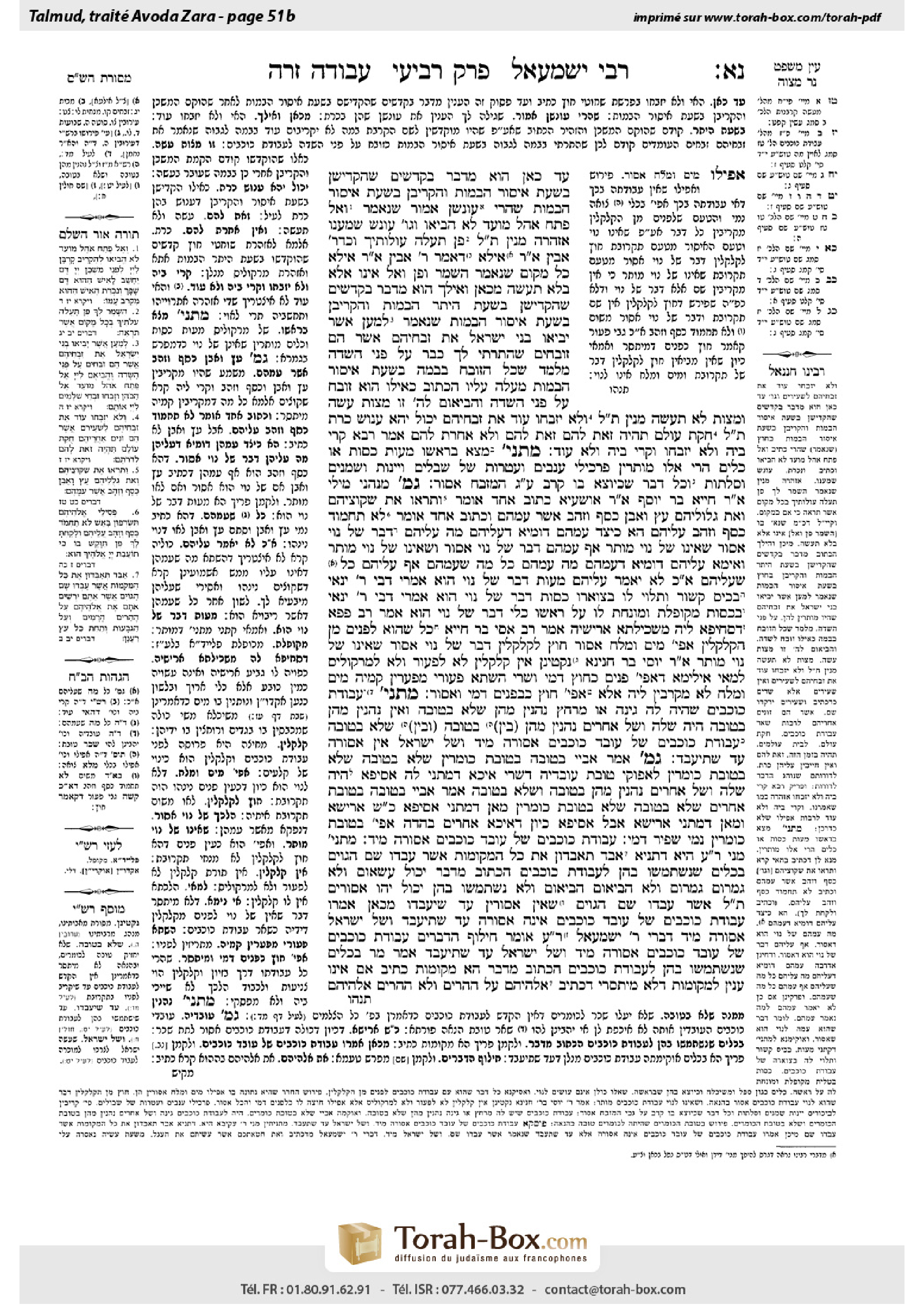
Avodah Zarah 51b: Talmud study for Daf Yomi
Study the Talmud for Daf Yomi with scanned pages, Hebrew text, English translations from Sefaria and AI-generated French translations.
Passage selection and English or AI-generated French translation are available where the scan has annotations. Daf Study is independent of Torah-Box and Sefaria.
Browse Avodah Zarah · עבודה זרה · All tractatesAvodah Zarah 51b text and translations
This page of Avodah Zarah includes the Aramaic text, an English translation and an AI-generated French translation, alongside the scan above.
עבודה זרה נ״א ב · Aramaic and Hebrew text
עַד כָּאן הוּא מְדַבֵּר בְּקָדָשִׁים שֶׁהִקְדִּישָׁן בִּשְׁעַת אִיסּוּר הַבָּמוֹת, וְהִקְרִיבָן בִּשְׁעַת אִיסּוּר הַבָּמוֹת,
שֶׁהֲרֵי עוֹנְשָׁן אָמוּר, שֶׁנֶּאֱמַר: ״וְאֶל פֶּתַח אֹהֶל מוֹעֵד לֹא הֱבִיאוֹ וְגוֹ׳״. עוֹנֶשׁ שָׁמַעְנוּ, אַזְהָרָה מִנַּיִן? תַּלְמוּד לוֹמַר: ״פֶּן תַּעֲלֶה עֹלֹתֶיךָ״.
וְכִדְרַבִּי אָבִין אָמַר רַבִּי אִילָא, דְּאָמַר רַבִּי אָבִין אָמַר רַבִּי אִילָא: כׇּל מָקוֹם שֶׁנֶּאֱמַר ״הִשָּׁמֶר״ וּ״פֶן״ וְ״אַל״ — אֵינוֹ אֶלָּא בְּלֹא תַּעֲשֶׂה.
מִכָּאן וְאֵילָךְ הוּא מְדַבֵּר בְּקָדָשִׁים שֶׁהִקְדִּישָׁן בִּשְׁעַת הֶיתֵּר הַבָּמוֹת, וְהִקְרִיבָן בִּשְׁעַת אִיסּוּר הַבָּמוֹת.
שֶׁנֶּאֱמַר: ״לְמַעַן אֲשֶׁר יָבִיאוּ בְּנֵי יִשְׂרָאֵל אֶת זִבְחֵיהֶם אֲשֶׁר הֵם זֹבְחִים״, שֶׁהִתַּרְתִּי לְךָ כְּבָר, ״עַל פְּנֵי הַשָּׂדֶה״, מְלַמֵּד שֶׁכׇּל הַזּוֹבֵחַ בְּבָמָה בִּשְׁעַת אִיסּוּר הַבָּמוֹת, מַעֲלֶה עָלָיו הַכָּתוּב כְּאִילּוּ הוּא זוֹבֵחַ עַל פְּנֵי הַשָּׂדֶה.
״וֶהֱבִיאָם לַה׳״ — זוֹ מִצְוַת עֲשֵׂה, וּמִצְוַת לֹא תַּעֲשֶׂה מִנַּיִן? תַּלְמוּד לוֹמַר: ״וְלֹא יִזְבְּחוּ עוֹד אֶת זִבְחֵיהֶם״.
יָכוֹל יְהֵא עָנוּשׁ כָּרֵת? תַּלְמוּד לוֹמַר: ״חֻקַּת עוֹלָם תִּהְיֶה זֹּאת לָהֶם״, זֹאת לָהֶם, וְלֹא אַחֶרֶת לָהֶם.
אָמַר רָבָא: קְרִי בֵּיהּ ״וְלֹא יִזְבְּחוּ״, וּקְרִי בֵּיהּ ״וְלֹא עוֹד״.
מַתְנִי׳ מָצָא בְּרֹאשׁוֹ מָעוֹת, כְּסוּת אוֹ כֵלִים — הֲרֵי אֵלּוּ מוּתָּרִין. פַּרְכִּילֵי עֲנָבִים, וַעֲטָרוֹת שֶׁל שִׁבֳּלִים, וְיֵינוֹת וּשְׁמָנִים וּסְלָתוֹת, וְכׇל דָּבָר שֶׁכַּיּוֹצֵא בּוֹ קָרֵב עַל גַּבֵּי הַמִּזְבֵּחַ — אָסוּר.
גְּמָ׳ מְנָהָנֵי מִילֵּי? אָמַר רַב חִיָּיא בַּר יוֹסֵף אָמַר רַבִּי אוֹשַׁעְיָא: כָּתוּב אֶחָד אוֹמֵר ״וַתִּרְאוּ אֶת שִׁקּוּצֵיהֶם וְאֵת גִּלֻּלֵיהֶם עֵץ וָאֶבֶן כֶּסֶף וְזָהָב אֲשֶׁר עִמָּהֶם״, וְכָתוּב אֶחָד אוֹמֵר ״לֹא תַחְמֹד כֶּסֶף וְזָהָב עֲלֵיהֶם״, הָא כֵּיצַד?
״עִמָּהֶם״ דֻּומְיָא דַּ״עֲלֵיהֶם״, מָה ״עֲלֵיהֶם״ — דָּבָר שֶׁל נוֹי אָסוּר, שֶׁאֵינוֹ שֶׁל נוֹי מוּתָּר, אַף ״עִמָּהֶם״ — דָּבָר שֶׁל נוֹי אָסוּר, וְשֶׁאֵינוֹ שֶׁל נוֹי מוּתָּר.
וְאֵימָא: ״עֲלֵיהֶם״ דּוּמְיָא דְּ״עִמָּהֶם״, מָה ״עִמָּהֶם״ — כׇּל מַה שֶּׁעִמָּהֶם, אַף ״עֲלֵיהֶם״ — כֹּל שֶׁעֲלֵיהֶם! אִם כֵּן, לֹא יֵאָמֵר ״עֲלֵיהֶם״.
מָעוֹת, דָּבָר שֶׁל נוֹי הוּא! אָמְרִי דְּבֵי רַבִּי יַנַּאי: בַּכִּיס קָשׁוּר וְתָלוּי לוֹ בְּצַוָּארוֹ.
כְּסוּת, דָּבָר שֶׁל נוֹי הוּא! אָמְרִי דְּבֵי רַבִּי יַנַּאי: בִּכְסוּת מְקוּפֶּלֶת וּמוּנַּחַת לוֹ עַל רֹאשׁוֹ. כְּלִי, דָּבָר שֶׁל נוֹי הוּא! אָמַר רַב פָּפָּא: דִּסְחִיפָא לֵיהּ מַשְׁכִּילְתָּא אַרֵישֵׁיהּ.
אָמַר רַב אַסִּי בַּר חִיָּיא: כׇּל שֶׁהוּא לִפְנִים מִן הַקִּלְקְלִין, אֲפִילּוּ מַיִם וּמֶלַח אָסוּר. חוּץ לְקִלְקְלִין — דָּבָר שֶׁל נוֹי אָסוּר, שֶׁאֵינוֹ שֶׁל נוֹי מוּתָּר. אָמַר רַבִּי יוֹסֵי בַּר חֲנִינָא: נָקְטִינַן, אֵין קִלְקְלִין לֹא לִפְעוֹר וְלֹא לְמַרְקוּלִיס.
לְמַאי? אִילֵימָא דַּאֲפִילּוּ פְּנִים כְּחוּץ דָּמֵי וְשָׁרֵי — הַשְׁתָּא פַּעוֹרֵי מְפַעֲרִין קַמֵּיהּ, מַיִם וּמֶלַח לָא מַקְרְבִין לֵיהּ?! אֶלָּא, אֲפִילּוּ חוּץ כְּבִפְנִים דָּמֵי וְאָסוּר.
מַתְנִי׳ עֲבוֹדָה זָרָה שֶׁהָיָה לָהּ גִּינָּה אוֹ מֶרְחָץ — נֶהֱנִין מֵהֶן שֶׁלֹּא בְּטוֹבָה, וְאֵין נֶהֱנִין מֵהֶן בְּטוֹבָה. הָיָה שֶׁלָּהּ וְשֶׁל אֲחֵרִים — נֶהֱנִין מֵהֶן בֵּין בְּטוֹבָה וּבֵין שֶׁלֹּא בְּטוֹבָה. עֲבוֹדָה זָרָה שֶׁל נׇכְרִי — אֲסוּרָה מִיָּד, וְשֶׁל יִשְׂרָאֵל — אֵין אֲסוּרָה עַד שֶׁתֵּיעָבֵד.
גְּמָ׳ אָמַר אַבָּיֵי: בְּטוֹבָה — בְּטוֹבַת כּוֹמָרִין, שֶׁלֹּא בְּטוֹבָה — שֶׁלֹּא בְּטוֹבַת כּוֹמָרִין, לְאַפּוֹקֵי טוֹבַת עוֹבְדֶיהָ דִּשְׁרֵי.
אִיכָּא דְּמַתְנֵי לַהּ אַסֵּיפָא — הָיָה שֶׁלָּהּ וְשֶׁל אֲחֵרִים, נֶהֱנִין מֵהֶן בְּטוֹבָה וְשֶׁלֹּא בְּטוֹבָה. אָמַר אַבָּיֵי: בְּטוֹבָה — בְּטוֹבַת אֲחֵרִים, שֶׁלֹּא בְּטוֹבָה — שֶׁלֹּא בְּטוֹבַת כּוֹמָרִין.
מַאן דְּמַתְנֵי אַסֵּיפָא — כׇּל שֶׁכֵּן אַרֵישָׁא, וּמַאן דְּמַתְנֵי אַרֵישָׁא — אֲבָל אַסֵּיפָא, כֵּיוָן דְּאִיכָּא אֲחֵרִים בַּהֲדַהּ, אֲפִילּוּ בְּטוֹבַת כּוֹמָרִין נָמֵי שַׁפִּיר דָּמֵי.
עֲבוֹדָה זָרָה שֶׁל נׇכְרִי אֲסוּרָה מִיָּד. מַתְנִיתִין מַנִּי? רַבִּי עֲקִיבָא הִיא, דְּתַנְיָא: ״אַבֵּד תְּאַבְּדוּן אֶת כׇּל הַמְּקֹמוֹת אֲשֶׁר עָבְדוּ שָׁם הַגּוֹיִם״, בְּכֵלִים שֶׁנִּשְׁתַּמְּשׁוּ בָּהֶן לַעֲבוֹדָה זָרָה הַכָּתוּב מְדַבֵּר.
יָכוֹל עֲשָׂאוּם וְלֹא גְּמָרוּם, גְּמָרוּם וְלֹא הֱבִיאוּם, הֱבִיאוּם וְלֹא נִשְׁתַּמְּשׁוּ בָּהֶן, יָכוֹל יְהוּ אֲסוּרִים? תַּלְמוּד לוֹמַר: ״אֲשֶׁר עָבְדוּ שָׁם הַגּוֹיִם״, שֶׁאֵין אֲסוּרִין עַד שֶׁיֵּעָבְדוּ; מִכָּאן אָמְרוּ: עֲבוֹדָה זָרָה שֶׁל נׇכְרִי אֵינָהּ אֲסוּרָה עַד שֶׁתֵּיעָבֵד, וְשֶׁל יִשְׂרָאֵל אֲסוּרָה מִיָּד, דִּבְרֵי רַבִּי יִשְׁמָעֵאל.
רַבִּי עֲקִיבָא אוֹמֵר: חִילּוּף הַדְּבָרִים, עֲבוֹדָה זָרָה שֶׁל נׇכְרִי אֲסוּרָה מִיָּד, וְשֶׁל יִשְׂרָאֵל עַד שֶׁתֵּיעָבֵד.
אָמַר מָר: בְּכֵלִים שֶׁנִּשְׁתַּמְּשׁוּ בָּהֶן לַעֲבוֹדָה זָרָה הַכָּתוּב מְדַבֵּר. הָא ״מְקוֹמוֹת״ כְּתִיב, אִם אֵינוֹ עִנְיָן לִמְקוֹמוֹת דְּלָא מִיתַּסְרִי, דִּכְתִיב: ״אֱלֹהֵיהֶם עַל הֶהָרִים״, וְלֹא הֶהָרִים אֱלֹהֵיהֶם,
Avodah Zarah 51b · English translation
The verse states: “Any man…that slaughters an ox…outside the camp, and to the entrance of the Tent of Meeting he did not bring it, to sacrifice an offering to the Lord” (Leviticus:17:3–4). Until this point, the verse is speaking about sacrificial animals that one consecrated during a period when the prohibition of sacrificing offerings on private altars was in effect, after the Tabernacle was erected, and then he also sacrificed them during a period when the prohibition of sacrificing on private altars was in effect.
This is apparent as the punishment for sacrificing them is stated in this verse, as it is stated: “And to the entrance of the Tent of Meeting he did not bring it, to sacrifice an offering to the Lord, before the Tabernacle of the Lord…that man shall be cut off from among his people” (Leviticus:17:4). We have heard from that verse the punishment, but with regard to the prohibition against sacrificing on a private altar, from where is it derived? The verse states: “Take heed to yourself lest you offer up your burnt-offerings in every place that you see” (Deuteronomy 12:13).
The Gemara comments: And this is in accordance with the principle that Rabbi Avin says that Rabbi Ile’a says, as Rabbi Avin says that Rabbi Ile’a says: Wherever it is stated: “Beware,” “lest,” or “do not,” this is nothing other than a prohibition.
The baraita continues: From that point onward, the verse is speaking about sacrificial animals that one consecrated during a period when there was permission to sacrifice offerings on private altars, before the Tabernacle was erected, and then one sacrificed them outside the Tabernacle during a period when the prohibition of sacrificing on private altars was in effect.
This is apparent, as it is stated: “In order that the children of Israel shall bring their sacrifices, which they slaughter upon the open field, that they shall bring them to the Lord, to the entrance of the Tent of Meeting” (Leviticus 17:5). The phrase: “Their sacrifices, which they slaughter,” is interpreted as referring to offerings that I have previously permitted you to slaughter on private altars. This verse teaches that those offerings may now be sacrificed only inside the Tabernacle. The phrase “upon the open field” teaches that in the case of anyone who slaughters an offering on a private altar during a period when the prohibition of sacrificing on private altars is in effect, even if he sacrifices the offering to God, the verse ascribes him blame as if he is slaughtering it upon the open field in idolatrous worship.
The verse continues: “That they shall bring them to the Lord.” This is a positive mitzva to sacrifice even offerings that were consecrated before the Tabernacle was erected in the wilderness. And from where is it derived that there is a prohibition against sacrificing them outside the Tabernacle? The verse states: “And they shall not slaughter their offerings anymore to the se’irim after whom they go astray; this shall be to them an eternal statute, throughout their generations” (Leviticus 17:7).
One might have thought that sacrificing these offerings outside the Tabernacle would be punishable by karet, as this is the halakha with regard to offerings consecrated after the Tabernacle was consecrated. Therefore, the verse states: “This shall be to them an eternal statute, throughout their generations” (Leviticus 17:7). One can infer from this verse that this, the punishment for transgressing a positive mitzva and a prohibition, applies to them, but no other punishment applies to them. In any event, the baraita interprets the verse: “And they shall not slaughter their offerings anymore to the se’irim,” as prohibiting sacrificing to God on private altars, not as Rabbi Elazar interpreted it, as prohibiting the worship of an idol in an atypical manner.
Rava said: One may derive both halakhot from the verse, as the term “And they shall not” can be interpreted as referring to two distinct prohibitions. Read into the verse: “And they shall not slaughter,” which is interpreted as prohibiting offerings to God on private altars. And also read into the verse: “And they shall not slaughter…anymore to the se’irim,” which is interpreted as prohibiting the worship of an idol in an atypical manner.
MISHNA: If one found money, a garment, or vessels at the head of Mercury, these are permitted. If one found vine branches laden with clusters of grapes, or wreaths made of stalks, or containers of wine, oil, or flour, or any other item the likes of which is sacrificed on the altar there, it is prohibited.
GEMARA: The mishna teaches that money, clothing, or vessels found at the head of the idol are not forbidden. The Gemara asks: From where are these matters derived? Rav Ḥiyya bar Yosef says that Rabbi Oshaya says: One verse states: “And you have seen their detestable things and their idols, wood and stone, silver and gold, which are with them” (Deuteronomy 29:16). And one verse states: “You shall not covet the silver or the gold that is on them, nor take it for yourself” (Deuteronomy 7:25). How can these texts be reconciled? The second verse mentions the prohibition of only silver and gold, whereas the first verse also mentions wood and stone.
The Gemara answers: This teaches that the prohibition with regard to those items that are “with them,” i.e., those found next to the idols, is similar to the prohibition with regard to those items that are “on them.” Just as with regard to those items that are on the idols, a decorative item, e.g., gold or silver, is prohibited, but that which is not a decorative item is permitted, so too, with regard to those items that are with the idols, a decorative item is prohibited, and that which is not a decorative item is permitted.
The Gemara challenges: But one could say to the contrary, that the prohibition with regard to those items that are “on them” is similar to the prohibition with regard to those items that are “with them.” Just as with regard to those items that are with the idols, everything that is found with them is included in the prohibition, as the verse mentions wood and stone, which are not decorative items, so too, with regard to those items that are on the idols, everything that is on them is forbidden. The Gemara explains: If so, the verse should not state the prohibition with regard to items that are on the idols, as it may be inferred a fortiori from the prohibition with regard to items that are found next to them.
The Gemara challenges: The mishna teaches that money that is found at the head of the idol is permitted. This is difficult, as money is a decorative item. The school of Rabbi Yannai say: The ruling of the mishna is not stated with regard to a case where coins were placed on the idol in order to adorn it. Rather, the ruling of the mishna is stated with regard to a case where the money is inside a purse that is tied onto the idol and suspended from its neck for safekeeping, or left there as payment for the priests.
The Gemara challenges: The mishna teaches that a garment found at the head of the idol is permitted. This is difficult, as a garment is a decorative item. The school of Rabbi Yannai say: The ruling of the mishna is not stated with regard to a garment that was placed on the idol in order to adorn it. Rather, the ruling of the mishna is stated with regard to a garment that is folded and placed upon the head of the idol. The Gemara challenges: The mishna teaches that vessels found at the head of the idol are permitted. This is difficult, as a vessel is a decorative item. Rav Pappa said: The mishna is referring to where a pot [mashkilta] is placed upside down upon the head of the idol, in which case it does not serve as decoration.
Rav Asi bar Ḥiyya says: Any item that is found within the inner partitions [hakilkalin] that surround the idol, even water or salt, is prohibited, as it is assumed to be an offering brought in idolatrous worship. With regard to items that are found outside the partitions, a decorative item is prohibited, but that which is not a decorative object is permitted. Rabbi Yosei bar Ḥanina says: We have a tradition that the halakha with regard to the partitions applies neither to Peor nor to Mercury.
The Gemara asks: With regard to what halakha is this stated? If we say that this means that with regard to Peor and Mercury even items that are found inside the partitions are treated like those that are found outside the partitions and they are permitted, this is difficult. Now, Peor is worshipped by defecating before it. Even excrement is offered to Peor. Is it possible that its worshippers do not sacrifice water and salt to it? Although water and salt are not generally offered to an idol, in the case of Peor they certainly can be. Rather, Rabbi Yosei bar Ḥanina means that with regard to Peor and Mercury even items that are found outside the partitions are treated like those that are found inside the partitions, and they are prohibited even if they are not decorative items.
MISHNA: In the case of an object of idol worship that had a garden or a bathhouse, one may derive benefit from them when it is not to the advantage of the idol worship, i.e., when he does not pay for his use, but one may not derive benefit from them when it is to their advantage, i.e., if one is required to pay for his use. If the garden or bathhouse belonged jointly to the place of idol worship and to others, one may derive benefit from them, both when it is to their advantage and when it is not to their advantage. A gentile’s object of idol worship is prohibited immediately, i.e., as soon as it is fashioned for that purpose, but a Jew’s object of idol worship is not prohibited until it is actually worshipped.
GEMARA: Abaye says: The case where use of the garden or bathhouse is to the financial advantage of the idol worship is referring to a case where it is to the financial advantage of the priests [komarin], who receive payment for the use of the garden or bathhouse. The case where it is not to their financial advantage is referring to a case where it is not to the financial advantage of the priests. This is to the exclusion of a situation where using the facility is only to the financial advantage of the idol’s worshippers, in which case one is permitted to derive benefit from them.
The Gemara comments: There are those who teach Abaye’s statement with regard to the latter clause of the mishna: If the garden or bathhouse belonged to the place of idol worship and to others, one may derive benefit from them both when it is to their advantage and when it is not to their advantage. Abaye says: The term: When it is to their advantage, is referring to a case where it is to the financial advantage of the other owners, while the term: When it is not to their advantage, is referring to a case where it is not to the financial advantage of the priests. But if the use of the place is to the financial advantage of the priests, one may not derive benefit from the place.
The Gemara notes: According to the one who teaches Abaye’s statement with regard to the case presented in the latter clause of the mishna, where the garden or bathhouse is only partially owned by the place of idol worship, all the more so does this statement apply to the case presented in the first clause of the mishna, where the garden or bathhouse is owned exclusively by the place of idol worship. But according to the one who teaches Abaye’s statement with regard to the case presented in the first clause, Abaye’s statement applies only to that case. But with regard to the case presented in the latter clause, since there are others who own the place together with the place of idol worship, even if the use of the garden or bathhouse is to the financial advantage of the priests it is permitted.
§ The mishna teaches: A gentile’s object of idol worship is prohibited immediately, i.e., as soon as it is fashioned for that purpose. The Gemara asks: Whose opinion is expressed in the mishna? The Gemara answers: It is the opinion of Rabbi Akiva, as it is taught in a baraita: “You shall destroy all the places, where the nations that you are to dispossess served their gods, upon the high mountains, and upon the hills, and under every leafy tree” (Deuteronomy 12:2). The verse is speaking of vessels that were used by the gentiles for idol worship.
One might have thought that the vessels are prohibited even if the gentiles fashioned them but did not complete them, completed them but did not bring them to the idol, or brought them to the idol but did not use them for idolatrous worship. Might one have thought that in these cases the vessels are prohibited? The verse states: “Where the nations that you are to dispossess served their gods” (Deuteronomy 12:2). This indicates that the vessels are not prohibited until they are used for worship. It is from here that the Sages stated: A gentile’s object of idol worship is not prohibited until it is worshipped, but a Jew’s object of idol worship is prohibited immediately. This is the statement of Rabbi Yishmael.
Rabbi Akiva says: The matters are reversed. A gentile’s object of idol worship is prohibited immediately, but a Jew’s object of idol worship is not forbidden until it is worshipped. The mishna is therefore in accordance with the opinion of Rabbi Akiva.
The Master said above: The verse is speaking of vessels that were used by the gentiles for idol worship. The Gemara asks: Isn’t it written “You shall destroy all the places” (Deuteronomy 12:2), indicating that the verse is not referring to vessels? The Gemara answers: If the halakha stated in this verse is not applicable for the matter of places that were worshipped, it must apply to another matter. The verse cannot apply to the places themselves, as they are not rendered prohibited, as it is written: “You shall destroy…their gods, upon the high mountains” (Deuteronomy 12:2), indicating that one is not required to destroy the mountains that are themselves their gods. Something that is attached to the ground is not rendered forbidden, and therefore even if idol worshippers worshipped the mountain itself it does not need to be destroyed.
Avodah Zarah 51b · Traduction française (IA)
La parabole dit : « Tout homme… qui immole un bœuf… en dehors du camp, et qui n’a pas apporté ce bœuf à l’entrée de la Tente de la Rencontre, pour offrir un sacrifice à l’Éternel » (Lévitique 17,3-4). Jusqu’à ce point, la parabole parle d’animaux sacrifiés qui ont été consacrés durant une période où la prohibition d’offrir des sacrifices sur des autels privés était en vigueur, après l’érection du Tabernacle, et ensuite il les a sacrifiés durant une période où la prohibition d’offrir des sacrifices sur des autels privés était en vigueur.
Cela est évident, car la sanction pour l’immolation de ces animaux est mentionnée dans cette parabole, comme il est dit : « Et qui n’a pas apporté ce bœuf à l’entrée de la Tente de la Rencontre, pour offrir un sacrifice à l’Éternel, avant le Tabernacle de l’Éternel… cet homme sera coupé de son peuple » (Lévitique 17,4). Nous avons entendu de cette parabole la sanction, mais concernant la prohibition d’offrir des sacrifices sur des autels privés, d’où est-elle tirée ? La parabole dit : « Sois vigilant, afin que tu ne sacrifies pas tes holocaustes en tout lieu que tu vois » (Dt 12,13).
La Guemara commente : Et cela correspond à la principale que Rabbi Avin dit que Rabbi Ile’a dit, comme Rabbi Avin dit que Rabbi Ile’a dit : Lorsque l’on lit : « Sois vigilant », « afin que », ou « ne », cela n’est autre chose qu’une prohibition.
La baraïta continue : à partir de ce point, la parole parle d’animaux sacrifiés qui ont été consacrés durant une période où il était permis d’offrir des sacrifices sur des autels privés, avant l’érection du Tabernacle, et ensuite ils les ont sacrifiés en dehors du Tabernacle durant une période où la prohibition d’offrir des sacrifices sur des autels privés était en vigueur.
Cela est évident, car il est dit : « Afin que les enfants d’Israël apportent leurs sacrifices, qu’ils immolent sur le champ ouvert, qu’ils les apportent à l’Éternel, à l’entrée de la Tente de la Rencontre » (Lévitique 17,5). La phrase : « Leurs sacrifices, qu’ils immolent », est interprétée comme faisant référence aux offrandes que j’ai précédemment permis de sacrifier sur des autels privés. Cette parole enseigne que ces offrandes peuvent désormais être sacrifiées uniquement à l’intérieur du Tabernacle. La phrase « sur le champ ouvert » enseigne que dans le cas d’un homme qui immole une offrande sur un autel privé durant une période où la prohibition d’offrir des sacrifices sur des autels privés est en vigueur, même s’il sacrifie l’offrande à Dieu, la parole lui attribue la faute comme s’il immolait sur le champ ouvert dans un culte idolâtre.
La parole continue : « Qu’ils les apportent à l’Éternel. » C’est une mitsva positive d’offrir même des offrandes consacrées avant l’érection du Tabernacle dans le désert. Et d’où est-elle tirée que la prohibition d’offrir ces offrandes en dehors du Tabernacle ? La parole dit : « Et ils ne sacrifieront plus leurs offrandes aux se’irim après lesquels ils s’égarent ; cela sera pour eux une loi éternelle, à travers leurs générations » (Lévitique 17,7).
On aurait pu penser que l’immolation de ces offrandes en dehors du Tabernacle serait punie par le joug du Royaume des Cieux, car c’est la halakha concernant les offrandes consacrées après l’érection du Tabernacle. Par conséquent, la parole divine dit : « Cela sera pour eux une loi éternelle, à travers leurs générations » (Lévitique 17,7). On peut en déduire de cette parole divine que cette sanction, concernant la transgression d’une mitsva positive et d’une prohibition, s’applique à elles, mais aucune autre sanction ne s’applique à elles. En tout cas, la baraïta interprète la parole divine : « Et ils ne sacrifieront plus leurs offrandes aux se’irim », comme une prohibition d’offrir des sacrifices à Dieu sur des autels privés, et non pas comme Rabbi Elazar l’a interprété, comme une prohibition de l’adoration d’un idole de manière atypique.
Rava dit : On peut déduire les deux halakhot de la parole divine, car le terme « Et ils ne sacrifieront pas » peut être interprété comme faisant référence à deux prohibitions distinctes. Lisez dans la parole divine : « Et ils ne sacrifieront pas », qui est interprété comme une prohibition d’offrir des sacrifices à Dieu sur des autels privés. Et lisez également dans la parole divine : « Et ils ne sacrifieront pas… aux se’irim », qui est interprété comme une prohibition de l’adoration d’un idole de manière atypique.
MICHNA : Si l’on trouva de l’argent, une robe, ou des objets au sommet de Mercure, ceux-ci sont permis. Si l’on trouva des branches de vigne chargées de grappes, ou des couronnes faites de tiges, ou des récipients de vin, d’huile ou de farine, ou tout autre objet semblable à celui qui est sacrifié sur l’autel là-bas, il est interdit.
GUEMARA : La Michna enseigne que l’argent, la robe ou les objets trouvés au sommet de l’idole ne sont pas interdits. La Guemara pose la question : D’où sont-ils tirés ? Rav Ḥiyya bar Yosef dit que Rabbi Oshaya dit : Une parole du Tanakh dit : « Et tu as vu leurs choses détestables et leurs idoles, bois et pierre, argent et or, qui sont avec eux » (Dt 29,16). Et une autre parole du Tanakh dit : « Tu ne convoiteras pas l’argent ou l’or qui est sur eux, ni tu ne le prendras pour toi-même » (Dt 7,25). Comment ces textes peuvent-ils être conciliés ? La deuxième parole mentionne la prohibition uniquement de l’argent et de l’or, tandis que la première parole mentionne également le bois et la pierre.
La Guemara répond : Cela enseigne que la prohibition concernant ces objets qui sont « avec eux », c’est-à-dire ceux trouvés à côté des idoles, est semblable à la prohibition concernant ces objets qui sont « sur eux ». Tout comme concernant ces objets qui sont sur les idoles, un objet décoratif, par exemple l’or ou l’argent, est interdit, mais celui qui n’est pas décoratif est permis, de même, concernant ces objets qui sont avec les idoles, un objet décoratif est interdit, et celui qui n’est pas décoratif est permis.
La Guemara pose un défi : On pourrait dire le contraire, à savoir que l'interdiction concernant les objets "sur eux" est semblable à celle concernant les objets "avec eux". Tout ce qui est trouvé avec les idoles est interdit, comme le dit la Sainte Écriture en mentionnant le bois et la pierre, qui ne sont pas des objets décoratifs. De même, tout ce qui est sur les idoles est interdit. La Guemara explique : Si c'est ainsi, la Sainte Écriture ne devrait pas mentionner l'interdiction concernant les objets sur les idoles, car elle pourrait être déduite a fortiori de l'interdiction concernant les objets trouvés à côté d'eux.
La Guemara pose un défi : La Michna enseigne que l'argent trouvé à la tête de l'idole est permis. Cela pose un problème, car l'argent est un objet décoratif. La scolé de Rabbi Yannai dit : La décision de la Michna ne s'applique pas dans le cas où des pièces ont été placées sur l'idole pour la décorer. En réalité, la décision de la Michna s'applique dans le cas où l'argent est dans un sac attaché à l'idole et suspendu à son cou pour être gardé en sécurité, ou laissé là comme paiement pour les prêtres.
La Guemara pose un défi : La Michna enseigne que vêtement trouvé à la tête de l'idole est permis. Cela pose un problème, car un vêtement est un objet décoratif. La scolé de Rabbi Yannai dit : La décision de la Michna ne s'applique pas dans le cas où un vêtement a été placé sur l'idole pour la décorer. En réalité, la décision de la Michna s'applique dans le cas où le vêtement est plié et placé sur la tête de l'idole. La Guemara pose un défi : La Michna enseigne que les ustensiles trouvés à la tête de l'idole sont permis. Cela pose un problème, car un ustensile est un objet décoratif. Rav Pappa dit : La Michna fait référence à un cas où une casserole [mashkilta] est placée à l'envers sur la tête de l'idole, dans ce cas, elle ne sert pas de décoration.
Rav Asi bar Ḥiyya dit : Tout objet trouvé dans les parois internes [hakilkalin] qui entourent l'idole, même de l'eau ou du sel, est interdit, car on le considère comme un sacrifice apporté dans l'adoration idolâtre. Concernant les objets trouvés en dehors des parois, un objet décoratif est interdit, mais celui qui n'est pas décoratif est permis. Rabbi Yosei bar Ḥanina dit : Nous avons une tradition selon laquelle la halakha concernant les parois ne s'applique ni à Peor ni à Mercure.
La Guemara pose une question : À quel halakha cette déclaration s'applique-t-elle ? Si nous disons que cela signifie que concernant Peor et Mercure, même les objets trouvés à l'intérieur des parois sont traités comme ceux trouvés à l'extérieur des parois et sont permis, cela pose un problème. En effet, Peor est adoré en déféquant devant lui. Même les déjections sont offertes à Peor. Est-il possible que ses adorateurs ne sacrifient pas de l'eau et du sel à lui ? Bien que l'eau et le sel ne soient généralement pas offerts à un idole, dans le cas de Peor, ils le sont certainement. En réalité, Rabbi Yosei bar Ḥanina veut dire que concernant Peor et Mercure, même les objets trouvés à l'extérieur des parois sont traités comme ceux trouvés à l'intérieur des parois, et ils sont interdits même s'ils ne sont pas décoratifs.
MICHNA : Dans le cas d'un objet d'adoration idolâtre qui avait un jardin ou une salle de bain, on peut en tirer un bénéfice lorsqu'il n'est pas à l'avantage de l'adoration, c'est-à-dire lorsqu'on ne paie pas pour son utilisation, mais on ne peut en tirer un bénéfice lorsqu'il est à leur avantage, c'est-à-dire si l'on est tenu de payer pour son utilisation. Si le jardin ou la salle de bain appartenait conjointement à la place d'adoration idolâtre et à d'autres, on peut en tirer un bénéfice, qu'il soit à leur avantage ou non. Un objet d'adoration idolâtre d'un non-Juif est interdit immédiatement, c'est-à-dire dès qu'il est façonné à cet effet, mais un objet d'adoration idolâtre d'un Juif n'est pas interdit jusqu'à ce qu'il soit effectivement adoré.
GUEMARA : Abaye dit : Le cas où l'utilisation du jardin ou de la salle de bain est à l'avantage financier de l'adoration idolâtre est celui où il est à l'avantage financier des prêtres [komarin], qui reçoivent un paiement pour l'utilisation du jardin ou de la salle de bain. Le cas où il n'est pas à leur avantage financier est celui où il n'est pas à l'avantage financier des prêtres. Cela exclut le cas où l'utilisation du lieu est uniquement à l'avantage financier des adorateurs de l'idole, dans ce cas, on est autorisé à en tirer un bénéfice.
La Guemara commente : Certains enseignent la déclaration d'Abaye concernant la dernière clause de la Michna : Si le jardin ou la salle de bain appartenait à la place d'adoration idolâtre et à d'autres, on peut en tirer un bénéfice, qu'il soit à leur avantage ou non. Abaye dit : Le terme : Quand c'est à leur avantage, fait référence à un cas où c'est à l'avantage financier des autres propriétaires, tandis que le terme : Quand ce n'est pas à leur avantage, fait référence à un cas où ce n'est pas à l'avantage financier des prêtres. Mais si l'utilisation du lieu est à l'avantage financier des prêtres, on ne peut pas en tirer un bénéfice.
La Guemara note que selon celui qui enseigne la déclaration d'Abaye concernant le cas présenté dans la deuxième clause de la Michna, où le jardin ou la salle de bain est partiellement propriété de la place d'adoration idolâtre, cela s'applique encore davantage au cas présenté dans la première clause de la Michna, où le jardin ou la salle de bain est exclusivement propriété de la place d'adoration idolâtre. Mais selon celui qui enseigne la déclaration d'Abaye concernant le cas présenté dans la première clause, la déclaration d'Abaye s'applique uniquement à ce cas. Cependant, concernant le cas présenté dans la deuxième clause, puisque d'autres possèdent la place en commun avec la place d'adoration idolâtre, même si l'utilisation du jardin ou de la salle de bain est à l'avantage financier des prêtres, elle est permise.
§ La Michna enseigne : L'objet d'idolâtrie d'un non-Juif est interdit dès qu'il est façonné à cet effet. La Guemara demande : Quel est l'opinion exprimée dans la Michna ? La Guemara répond : C'est l'opinion de Rabbi Akiva, comme il est enseigné dans une baraïta : « Vous détruirez toutes les places où les nations que vous allez expulser ont servi leurs dieux, sur les montagnes élevées, et sur les collines, et sous chaque arbre feuillu » (Deutéronome 12:2). La versette parle des vases utilisés par les nations pour l'idolâtrie.
On aurait pu penser que ces vases sont interdits même si les non-Juifs les ont façonnés sans les achever, les ont achevés sans les apporter à l'idole, ou les ont apportés à l'idole sans les utiliser pour l'idolâtrie. Peut-on penser que dans ces cas les vases sont interdits ? La versette dit : « Où les nations que vous allez expulser ont servi leurs dieux » (Deutéronome 12:2). Cela indique que les vases ne sont pas interdits jusqu'à ce qu'ils soient utilisés pour l'idolâtrie. C'est à partir de là que les Sages ont dit : L'objet d'idolâtrie d'un non-Juif n'est pas interdit jusqu'à ce qu'il soit adoré, mais l'objet d'idolâtrie d'un Juif est interdit dès qu'il est façonné. C'est la déclaration de Rabbi Yishmael.
Rabbi Akiva dit : Les choses sont inversées. L'objet d'idolâtrie d'un non-Juif est interdit dès qu'il est façonné, mais l'objet d'idolâtrie d'un Juif n'est pas interdit jusqu'à ce qu'il soit adoré. La Michna est donc conforme à l'opinion de Rabbi Akiva.
Le Maître a dit ci-dessus : La versette parle des objets utilisés par les nations pour l'idolâtrie. La Guemara demande : N'est-il pas écrit « Vous détruirez toutes les places » (Deutéronome 12:2), indiquant que la versette ne parle pas des objets ? La Guemara répond : Si la halakha énoncée dans cette versette ne s'applique pas à la matière des lieux sacrés, elle doit s'appliquer à une autre matière. La versette ne peut pas s'appliquer aux lieux eux-mêmes, car ils ne sont pas rendus interdits, comme il est écrit : « Vous détruirez… leurs dieux, sur les montagnes élevées » (Deutéronome 12:2), indiquant qu'on n'est pas tenu de détruire les montagnes elles-mêmes, qui sont leurs dieux. Ce qui est attaché au sol n'est pas rendu interdit, et par conséquent même si les adorateurs d'idolâtrie adoraient la montagne elle-même, elle n'a pas besoin d'être détruite.
Traduction française générée par IA à partir de l’édition anglaise de Sefaria. Vérifie toujours un passage avec le texte source.
Text from Sefaria: William Davidson Edition - Vocalized Aramaic (CC BY NC); William Davidson Edition - English (CC BY NC).